Clean Energy Council report shows Australia reached15% renewable energy in 2013
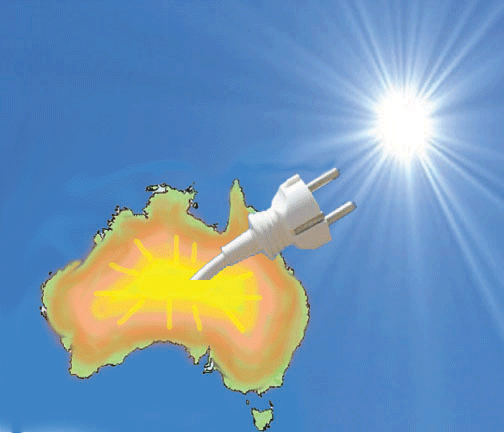 Clean Energy Australia Report 2013 http://www.energymatters.com.au/index.php?main_page=news_article&article_id=4360 24 June 14 A just-released report from the Clean Energy Council reveals renewable energy provided 14.76 per cent of Australia’s electricity last year.
While hydro power made up the lion’s share, Clean Energy Australia Report 2013 states 1.25 million solar power systems were installed by the end of 2013, with more than 200,000 systems installed during last year. There were 4595 solar installers across Australia at the end of 2013.
Again addressing the “solar is for the rich” myth; the report says: “Residents from affluent inner-city suburbs generally installed solar at much lower rates than those in mortgage belt, retirement and regional areas.”
Wind power provided 4 per cent of Australia’s overall electricity demand in 2013, with 1639 wind turbines cranking enough clean power to supply the needs of 1.3 million homes.
Renewables continued to be a significant employer in Australia, with 21,000 jobs across all sectors.
The report states the renewable energy industry has contributed $5 billion of investment to the economy each year for the past three years.
“This report shows that this is an industry poised to unlock tens of billions of dollars in investment, if the national Renewable Energy Target remains in place following the current review process,” said Clean Energy Council Chief Executive Dave Green.
Origin Energy, EnergyAustralia and AGL Energy looking silly, ripping off customers?
Following a model pioneered by political activist group, GetUp!, Greenpeace has developed a mock advertisement (below) imitating the format of the power retailers own advertisements. Itswebsite carries a YouTube clip of the advert and seeks donations to pay to have the advertisement aired on television. The advertisement prominently carries the brands of Origin Energy, Energy Australia and AGL Energy, as solar panel installers posing as employees of these companies remove solar panels from a roof while suggesting the companies are trying to rip off customers by seeking to have the Renewable Energy Target reduced.
One actor states, “by ripping up Australia’s Renewable Energy Target, we can rip you off on your energy bills for years to come”.
A website – www.thegreatenergyripoff.com – has been developed to accompany the advertisement, asking people to “join our petition to the dirty energy giants to support the Renewable Energy Target. We’ll hand deliver it directly to the energy companies so they know consumers expect better.”
Community Energy Congress in Canberra, as Farmers warn against weakening Renewable Energy Target
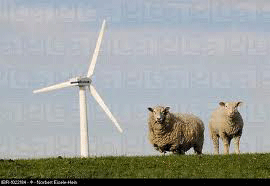 Farmers, activists warn against reducing renewable energy target on Global Wind Energy Day http://www.smh.com.au/environment/climate-change/farmers-activists-warn-against-reducing-renewable-energy-target-on-global-wind-energy-day-20140615-zs8ix.html June 16, 2014 Markus Mannheim Public service editor Over the years, Boorowa grazier Paul Magee watched each of his five children become adults and leave the family farm to find work.
For him and his wife, Lynette, the opportunity to host wind turbines on their 700-hectare property, about 110 kilometres north of Canberra, may have come a little too late.
But the lamb farmer hopes the growing wind-energy industry will help lure young people back to the bush, and says the federal government must maintain its backing for renewable energy. “There is a possibility that one [of my children] could move back here and help to improve the farm and make it more productive – if the renewable energy target is not changed,” Mr Magee told a rally of activists outside Parliament House on Sunday, Global Wind Energy Day.
“There is a further possibility that others … may gain employment in the area. The economic benefits would help stop the drift to larger cities.”
A review of the so-called RET – an aim for 20 per cent of the nation’s electricity to come from renewable sources by 2020 – is due to be completed shortly, amid fears the Abbott government will reduce the target or scrap it entirely.
Last month, Treasurer Joe Hockey launched an unprompted attack on windfarms near Lake George, just outside the ACT, telling conservative radio commentator Alan Jones he found them “utterly offensive” and “a blight on the landscape”. Climate activists have also noted that the RET review’s leader, former Caltex chairman Dick Warburton, and other panel members have close links to the fossil-fuel industry.
Mr Magee said he could not understand the Treasurer’s view. “It could be argued that the very same four-lane freeway he was travelling on is more offensive and a bigger blight on the landscape, and indeed the urban development that has ruined the north shore of Sydney,” he said, referring to Mr Hockey’s electorate.
Small groups of residents near windfarms occasionally oppose the industry, saying turbines are noisy and reduce rural property prices.
However, NSW government polling in 2010 found almost nine in 10 residents in the region near the ACT border supported windfarms, including 61 per cent of people who lived one to two kilometres away from turbines.
Regardless of what happens to the federal RET scheme, ACT Environment Minister Simon Corbell told the rally that Canberra would maintain the nation’s most ambitious renewable energy policy: 90 per cent of the ACT’s electricity would be sourced from renewable energy by 2020.
He also noted that the Royalla solar farm – the largest in Australia – was just a few months’ away from being commissioned.
“The sad thing about that project is that it’s only 20 megawatts. When you look at renewable energy and solar energy around the world, you see that so many nations are investing in schemes and in projects that are in the hundreds of megawatts.
“In a country like Australia, we should be doing the same.”
Sunday’s rally preceded the 2014 Community Energy Congress, which will be held on Monday and Tuesday at the National Library. About 300 delegates are expected to attend from across Australia and overseas.
Australians’ uptake of solar power is having a dramatic effect on electricity markets
 Solar turns tables on Australia’s electricity markets REneweconomy By Giles Parkinson on 16 June 2014 Australia’s electricity markets are forecast to experience more declines in consumption over the next three years, as homes and businesses conserve energy, use smarter appliances and turn increasingly to generating their own electricity.
The 2014 National Electricity Forecasting Report issued on Monday by the Australian Energy Market Operator has highlighted once again how all previous assumptions about electricity demand have been turned on their head in recent years.
As we reported on Friday, AEMO has been forced to revise down its forecast demand for 2013/14 for a second time, and it now expects demand from the National Electricity Market to continue falling for at least another three years.
AEMO notes that in the past five years, instead of surging demand, consumption from the grid has actually fallen by an average of 1.8 per cent a year from 2009–10 to 2013–14.
Ironically, this has been driven, it says, by surging network costs – which have risen in turn because of the $45 billion that was invested on the basis of high demand forecasts five years ago.
These rising costs, in turn, have encouraged consumers to conserve energy, turn to more energy efficient appliances, and look to rooftop solar to deflect their costs. Demand has also been reduced by declining industrial production.
The fall in demand, or at least the fall in demand from the grid (because many houses with solar PV are still consuming, just producing much of their own needs), is being used by incumbent generators and others with vested interests as an excuse to halt, or slow down, the pace of deployment of renewable energy in Australia……
The situation is even more dramatic in South Australia, where we explain here that a textbook decarbonisation of the grid is occurring thanks to its high penetration of rooftop solar, the big uptake of large-scale renewables, and the sidelining of old coal generators.
Of course, as we have seen in the submissions to the RET Review, the incumbent generators hate this. Origin Energy argued that the RET was never designed to force incumbent generators out of the market – it was always presumed that demand would rise and renewables would account for most of new capacity…….. http://reneweconomy.com.au/2014/solar-turns-tables-on-australias-electricity-markets-81352
Solar energy a winner for homes in Caloundra and Iswich, Queensland
 Caloundra and Ipswich tops for solar: Energex Tony Moore BRISBANETIMES.COM.AU SENIOR REPORTER, 13 June 14 The retirees, holiday makers and young families of Caloundra and the working class city of Ipswich have Southeast Queensland’s highest proportion of solar systems according to a breakdown of Energex data.
The breakdown from Energex figures shows some remarkable variations from conventional thinking.
There are fewer solar systems in West End (295), Highgate Hill (210) and South Brisbane (70), than in Inala (982) or Durack (645).
There are more in Carindale (1523) and Rochedale South (1465) than in Premier Campbell Newman’s home suburb of Ashgrove (691).
Queensland Treasurer Tim Nicholls sparked a massive outcry last week when he described some solar energy users as part of the “champagne sippers and the latte set.”
Jeremy Rich, from one of Australia’s longest-running solar energy companies, Energy Matters, said Mr Nicholls’ comments were simply wrong. “It is obvious those statements are emotional statements, without looking at the data,” Mr Rich said. “Because when you look at the data it shows that it is totally the opposite,” he said. “It is the low to middle income areas of Australia that are hurting the most.”
Their company data is similar to the Energex breakdown, showing a major interest in solar energy in Ipswich, Capalaba, Browns Plains and Cleveland in four of the top five spots.
Central Ipswich – home to Swanbank power station – has 50 per cent solar energy penetration, Mr Rich said.
Ipswich homes under the postcode of 4305 – including the suburbs from Raceview through to Brassall – have 5197 solar installations.
Caloundra’s postcode of 4551 – including Caloundra, Caloundra West, Currimundi and Dickey Beach – has 6311 solar installations up to May 2014………
A quick top 10 of Energex’s solar hot spots and their postcodes are:
1: Caloundra 4551: 6311 solar installations
2: Ipswich central east 4305: 5197 solar installations from Raceview to Brassall
3: Advancetown/Gold Coast hinterland 4211: solar 4941 installations
4: Buderim 4556: 4379 solar installations
5: Beenleigh 4207: 4363 solar installations
6: Bray Park 4500: 3931 solar installations
7: Ipswich south-west 4300: Goodna/Camira to Springfield: 3930 solar installations
8: Amberley, Barellan Point and Blacksoil 4306: 3910 solar installations
9: Mt Cotton and Redland Bay 4165: 3810 solar installations
10: Gympie and its surrounds 4570: 3678 solar installations. http://www.brisbanetimes.com.au/queensland/caloundra-and-ipswich-tops-for-solar-energex-20140612-zs66n.html#ixzz34fZsRL6G
Victoria’s community Hepburn Wind farm at risk as government reviews Renewable Energy Target
Renewable Energy Target review sparks fears for wind farm http://www.abc.net.au/news/2014-06-11/renewable-energy-target-review-sparks-fears-for/5514354 11 Jun 2014, Investors in Australia’s first community-owned wind farm near Daylesford say the venture could fail, if changes are made to the Renewable Energy Target. The Federal Government has ordered a review into the pledge of producing 20 per cent of power from renewable sources by 2020. People involved in the Hepburn Wind project met members of the review panel in Daylesford yesterday. Hepburn Wind’s founding chairman, Simon Holmes Court, says scrapping the target would cost locals thousands of dollars. “I can’t sugar-coat it – the project will not be able to continue in its current form,” he said. 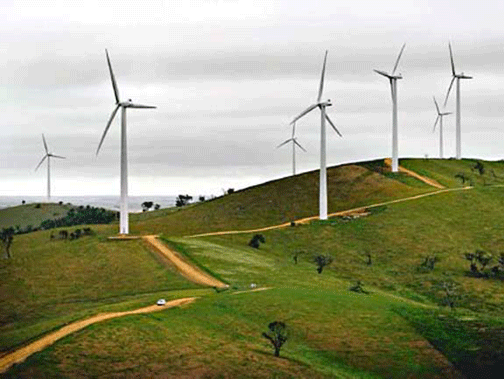 Hepburn has operated turbines since 2011. Director David Perry says the cost would not just be financial. “Perhaps the most painful thing would be to have all that time and passion over the years lost,” he said. The panel toured the wind farm and congratulated Hepburn Wind on its work.
Queensland govt to intervene on the side of wind power opponents?
 Wind farm opponents welcome intervention ABC Rural By Charlie McKillop, 12 June 14, Queensland Deputy Premier Jeff Seeney will determine the fate of a controversial wind farm proposed on the far north’s Atherton Tableland.
Mr Seeney has informed the Mareeba Council he’s decided to ‘call in’ the development application to establish 75 wind turbines at Mt Emerald, about 100 kilometres west of Cairns.
The move has been welcomed by both the mayor of Mareeba, Tom Gilmore, and opponents of the wind farm, who agree the size and complexity of the assessment is beyond the technical and financial resources of the council.
But Steve Lavis, from the Tablelands Wind Turbine Action Group, admits he has reservations about the decision being taken out of the local community…….http://www.abc.net.au/news/2014-06-12/wind-farm-opponents-hopeful-about-intervention/5519106
Queensland Competition Authority finds Renewable Energy Target not causing electricity price rises
CEC: Renewable Energy Target not power price villain: Queensland Competition Authority http://ecogeneration.com.au/news/cec_renewable_energy_target_not_power_price_villain_queensland_competition_/087591/ Tue, 10 June 2014
The Queensland Competition Authority (QCA) confirmed on Friday what the clean energy industry has been saying for years – that the Renewable Energy Target is not a major factor in rising power prices.
Clean Energy Council media release 2 June 2014
Clean Energy Council Policy Director Russell Marsh said the latest price determination from the QCA showed that in 2014-2015 the cost of the Renewable Energy Target to Queensland households will fall, while all other parts of the average electricity bill will rise.
“In particular, power bills are set to jump due to the increasing cost of gas and the costs of the poles and wires in the electricity network,” Mr Marsh said.
“The Renewable Energy Target makes up less than 3 per cent of the average power bill, supports thousands of jobs and is an insurance policy against the future cost of gas power, which some analysts predict may be the defining energy challenge of this decade.” The Renewable Energy Target is designed to ensure at least 20 per cent of Australia’s electricity comes from renewable energy such as wind, hydro, solar and bioenergy like sugar cane waste by 2020 – at the lowest cost. The policy is currently under review, leading to uncertainty which has frozen investment in the sector until it has been completed.
Mr Marsh said the cost to consumers was a major part of the current review process, and four studies this year had shown that power prices would actually increase slightly if the Renewable Energy Target was removed.
“Removing the Renewable Energy Target would mean that we need to source more power from increasingly expensive gas, driving up costs for energy users such as mums and dads and manufacturers. We have already seen the start of this in Queensland with the latest price determination from the QCA.
“The Australian Industry Group, which represents some 60,000 businesses including many manufacturers, has also recognised that there would be no benefit to consumers if the Renewable Energy Target was reduced.”
CSIRO’s breakthrough Solar Steam technology
 Supercritical Solar Steam Could Rival Fossil Fuels http://www.energymatters.com.au/index.php?main_page=news_article&article_id=4338 10 June 14 A breakthrough by CSIRO scientists could see solar energy replace fossil fuels in the most advanced power stations in the world. A research program at the CSIRO Energy Centre in Newcastle focused on using solar power to create supercritical steam – super-hot, pressurised steam – to drive electric turbines in large-scale power plant.
The CSIRO team broke a world record for heating and pressurising steam using only solar thermal power in May. The work has been hailed as a coup for the renewable energy industry. Previously, only coal or gas-fired plants could achieve temperatures high enough generate supercritical steam.
Conventional solar thermal power plants currently generate subcritical steam – but CSIRO believes if these plants could be converted to supercritical steam power, the overall cost of solar electricity would be significantly lowered. “It’s like breaking the sound barrier; this step change proves solar has the potential to compete with the peak performance capabilities of fossil fuel sources,” said CSIRO Energy Director, Dr Alex Wonhas.
“Instead of relying on burning fossil fuels to produce supercritical steam, this breakthrough demonstrates that the power plants of the future could instead be using the free, zero emission energy of the sun to achieve the same result.”
Researchers used CSIRO’s test solar thermal plant in Newcastle to break the world record for solar steam, reaching temperatures of 570 degrees Celsius, at a pressure of 23.5 megapascals (a measure of force per unit area). It is this combination of enormous pressure and heat that makes the breakthrough such an important milestone for solar technology.
The CSIRO says the breakthrough was made possible through a $5.68 million research program supported by the Australian Renewable Energy Agency (ARENA) and collaboration with researchers from solar thermal giant, Abengoa Solar.
ARENA CEO Ivor Frischknecht said that while work remained before supercritical solar steam technology would rival fossil fuels, “This breakthrough brings solar thermal energy a step closer to cost competitiveness with fossil fuel generated power.”
Source
Australia could aim for 50% renewable energy by 2030 – International Report
Australia urged to aim for 50+% renewables by 2030 REneweconomy. By Giles Parkinson on 6 June 2014 Leading international agency says Australia should become one of world leaders in renewables, arguing that the world could double renewable capacity by 2030, save money and slash emissions in the process.
The International Renewable Energy Agency has finalised its ground making REMap 2030 report, confirming its previous estimates that the world could double its renewable energy capacity by 2030,which would not only save money, it would help avoid climate catastrophe.
 The report, released in New York overnight, finds that scaling up renewables to 36 per cent renewable energy by 2030 is not just doable, it is affordable and would lay a crucial pathway to meeting climate goals of capping emissions at below 450 parts per million.
Australia is one of the countries seen in a position of leadership on renewables. As this graph below illustrates, IRENA says that Australia could aim to have more than 50 per cent renewables in its electricity grid by 2030, largely through wind, but also with significant contributions from solar.
Australia is one of the countries seen in a position of leadership on renewables. ( graph ), IRENA says that Australia could aim to have more than 50 per cent renewables in its electricity grid by 2030, largely through wind, but also with significant contributions from solar.
IRENA says the role of variable renewables such as wind and solar is critical, but does not pose any serious technological barriers. Even at a global average of 18 per cent wind and solar, this is less than the share of variable renewables icurrently are integrated into the electricity systems of De mark, Germany, Ireland, Portugal and Spain – and South Australia it should be noted.
“Only a handful of countries – Australia, Denmark, Germany, Morocco, Tonga and the United Kingdom – will reach shares of variable renewables of 30 per cent or higher,” it says………http://reneweconomy.com.au/2014/australia-urged-aim-50-renewables-2030
On global comparisons, Australia fast falling backwards on renewable energy
“With more than 140 countries now adopting renewable energy targets in some form, Australia is part of a mainstream global move towards cleaner sources of power such as solar, wind, bioenergy, hydro, ocean and geothermal energy,” Mr Green said.
“But Australia is at risk of being left behind as other countries continue to strengthen their targets for renewable energy. The process of constantly reviewing Australia’s Renewable Energy Target is destabilising the market and stalling local investment.”
Mr Green said US President Barack Obama announced another acceleration in renewable energy construction this week as part of a comprehensive clean energy package.
“China has introduced an ambitious clean energy program to deal with its air pollution, and in 2013 the installation of new renewable energy capacity in China passed fossil fuel and nuclear power for the first time. Last year alone China installed more wind and solar than any other country in the world,” he said.
“India’s new Prime Minister Narendra Modi has pledged to provide enough solar power to run at least one light bulb in every home. And meanwhile some of the world’s largest economies are those with the most renewable energy installed, including the United States, Germany and Canada.
“Australia has some of the best sun, wind and waves in the world. The Renewable Energy Target needs to be left to get on with the job it was designed to do under former Prime Minister John Howard and expanded in 2009 with the support of the major parties. Business can then get on with driving the creation of much-needed jobs and investment in partnership with local communities.”
Key results from REN21’s 2014 Global Status Report include:
- By early 2014, 144 countries had renewable energy targets, an increase of six from the year before
- An estimated 6.5 million people worked directly or indirectly in the renewable energy sector in 2013
- For the first time, more solar than wind power was installed worldwide in 2013
- China accounted for nearly a third of the global renewable energy capacity added in 2013
- China’s new renewable energy capacity exceeded its new fossil fuel capacity for the first time
- 72 per cent of new energy capacity in the European Union came from renewable energy for the sixth straight year, a stark turnaround from a decade earlier when fossil fuel investment accounted for about 80 per cent of new generation capacity.
REN21 Chair Arthouros Zervos said global perceptions of renewable energy had shifted considerably, with the many technology advances and rapid deployment of renewable energy technologies over the last decade.
Coalition Ministers say that Moree solar energy plant funding is assured
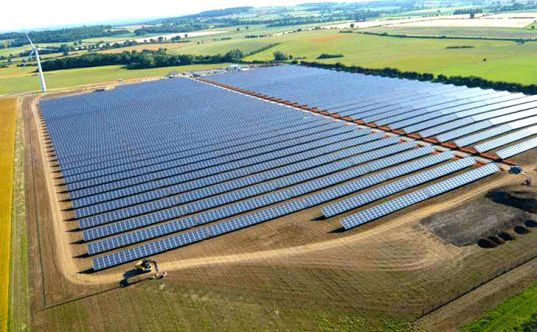 Moree solar on track for Commonwealth funding http://www.abc.net.au/news/2014-06-04/moree-solar-on-track/5500668 By Tim Lamacraft 4 Jun 2014,The Federal Coalition is confident the Moree Solar Farm will secure Commonwealth funding despite plans to axe its finance source.
The Government is looking to axe the Australian Renewable Energy Association, which has expressed interest in providing finance to the Moree Solar Farm, a joint initiative of Pacific Hydro and Fotowatio.
The two companies are nervous that tens-of-millions of dollars in funding is in jeopardy.
But Federal Parkes MP Mark Coulton recently met with Industry Minister Ian Macfarlane on the issue.
He says the Moree Solar Farm is on track to meet Commonwealth funding approvals.
“I’ve been reassured by the Minister and his Department that there’s nothing with this project that’s ringing alarm bells and they’re very happy with it the way it is,” he said.
“Certainly the Moree Solar Farm has no reason at this stage to be fearful that the ARENA funding wont be there.”
It’s not yet clear when the Coalition will approach the Senate in an attempt to repeal the Arena Act, but projects that do not already have agreements in place will not be funded.
Solar thermal energy a step closer with CSIRO breakthrough
CSIRO Newcastle solar breakthrough for supercritical steam ABC News 3 June 14 The CSIRO is describing research at its Newcastle energy centre as a game-changer for the renewable energy industry. The CSIRO is describing research at its Newcastle energy centre as a game-changer for the renewable energy industry.
Researchers have used solar energy to generate hot and pressurised ‘supercritical’ steam at the highest temperatures ever achieved outside of fossil sources.
Supercritical solar steam is water pressurised at enormous force and heated using solar radiation.
Around 90 per cent of Australia’s electricity is generated using fossil fuel, but only a small number of power stations are based on the more advanced supercritical steam.
The world record set at the CSIRO’s Energy Centre in Newcastle this month, was at a pressure of 23.5 megapascals and temperatures up to 570 degrees Celsius.
Project leader, Robbie McNaughton says it is the combination of pressure and temperature demonstrated at scale, that makes it such a breakthrough for solar power…… CSIRO’s Energy Director, Dr Alex Wonhas says the milestone is a game-changer for the industry.
“It’s like breaking the sound barrier,” he said.
“This step change proves solar has the potential to compete with the peak performance capabilities of fossil fuel sources.”
The $9.7 million research program is supported by the Australian Renewable Energy Agency (ARENA).
ARENA CEO Ivor Frischknecht says although more work is needed before the technology is ready for commercialisation, it is an important breakthrough and demonstrates the importance of research and development.
Mr Frischknecht says it brings solar thermal energy a step closer to cost competitiveness with fossil fuel generated power.http://www.abc.net.au/news/2014-06-03/csiro-newcastle-solar-breakthrough-for-supercritical-steam/5495744?§ion=news
VIDEO: a warning from China that Australia could scuttle global carbon emissions trade
 VIDEO: China warns Australia risks scuttlling global emissions trade Lateline Australian Broadcasting Corporation Broadcast: 30/05/2014 Reporter: Stephen McDonell
The head of China’s most advanced carbon emissions exchange says australia could scuttle the creation of a global system of carbon trading by dumping its scheme at a crucial time.
Transcript
EMMA ALBERICI, PRESENTER: The Vice President of China’s most advanced carbon emissions exchange says Australia could scuttle the creation of a global carbon trading system.
As Australia prepares to dump its emissions trading scheme, the world’s largest carbon emitter has set up a pilot plan, designed to form the basis of a China-wide network with the potential to link to those in other countries.
China correspondent Stephen McDonell reports from Shenzhen.
STEPHEN MCDONELL, REPORTER: Shenzhen was at the forefront of China’s opening up in the 1980s. It was given special economic status to spring board the country into a market system.
Today, the city is again being used as a Guinea pig but this time for carbon trading.
The Shenzhen carbon exchange is the first of a series of seven pilot schemes around the country to test how China might run a domestic trading system.
GE XING’AN, VICE PRESIDENT, CHINA EMISSIONS EXCHANGE: Carbon trading is going to have a huge impact on the economy and the companies. We have to first test whether the carbon trading suitable for different, each economic development area…….STEPHEN MCDONELL: Ge Xing’an is Vice President in Shenzhen. His organisation possibly hoping to one day run the entire national system goes by the English name China Emissions Exchange………
STEPHEN MCDONELL: Really, the entire global market might be jeopardised by Australia pulling out?
GE XING’AN: Of course. Of course. Australia is a very important player in the climate change issues and also the carbon market.
STEPHEN MCDONELL: Beijing and Shanghai have also just opened their exchanges but even the most optimistic observers say it could be more than five years until a China-wide trading system is established.
Stephen McDonell, Lateline. http://www.abc.net.au/lateline/content/2014/s4016127.htm
Australia’s role in renewable energy across the globe
 Renewable Energy Across the Globe: Australia Wind and hydroelectric leaders Green Action News, May 21, 2014 by Kathryn Hannis Great steps have been made across the globe toward adopting more environmentally conscious energy sources. How each continent makes use of their varied resources is what sets them apart from each other.
Here’s what’s happening in Australia:
By the end of 2012 Australia was producing almost 30,000 GWh of electricity from renewable energy sources annually. The main renewable sources utilized in Australia are hydroelectric, and wind, with some smaller amounts produced from bioenergy, solar, and geothermal sources.
Currently in Australia there are over 3.2 GW of solar panels installed. Two commercial-scale PV power plants have been opened since 2011 with 1 MW and 10 MW capacities, respectively, and there are plans for many new solar power farms and stations in the future.
There are over 50 wind farms in Australia, with over 1000 turbines between them, which produce 5,000 gigawatt-hours (GWh) of electricity each year, representing 2% of Australia’s total electricity, 23% of electricity from renewable sources, and enough to power over 700,000 homes. The largest wind farm in the southern hemisphere, in terms of area, the Waubra Wind Farm in Victoria, was completed in 2009 and produces 192 MW of electricity. The largest capacity wind farm is Lake Bonney Wind Farm, which produces around 240 MW, despite having 30 fewer turbines. An even larger farm was set to open in 2013 with a capacity of 420 MW.
Hydroelectricity represents almost 60% of renewable energy production on Australia, with several tidal energy projects in the works for the future.
Currently, a geothermal power plant in Queensland produces 80 kW of electricity. Geothermal energy is otherwise underutilized as a source of power. There are recorded potential locations with detectable geothermal activity with further exploration planned, however. It was the goal to have at least three power generation demonstration projects running by 2012.
Energy from biomass in Australia generally takes the form of ‘Bagasse’, or burning sugar cane waste. Together with burning wood, this accounts for 8% of renewable energy production in Australia……. http://greenactionnews.net/blog/renewable-energy-across-the-globe-australia/#
1 This month

of the week – Australians for War Powers Reform (AWPR)
To see nuclear-related stories in greater depth and intensity
 Antinuclear