Evidence mounts on benefits of Renewable Energy target: South Australia’s wind energy success
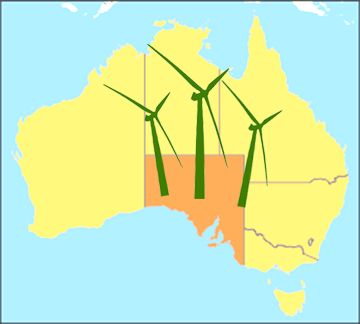 South Australian Wind Power – Economical And Effective http://www.energymatters.com.au/index.php?main_page=news_article&article_id=4299 A new report shows wind power in South Australia has not increased wholesale electricity prices, nor created a need for additional back-up power generation capacity.
Around a quarter of South Australia’s electricity is now sourced from wind power; growing substantially from just 6% in 2005/6.
The eight year study of South Australia’s electricity sector by Windlab Systems shows during the period between 2005 and 2013, wholesale electricity prices have not risen, even if the full cost of the renewable energy certificates (REC) is included. Publicly available data from the Australian Energy Market Operator (AEMO) was utilised for the study.
Reliance on expensive and emission-intensive peaking power plants has reduced as have electricity imports from Victoria states the report. Windlab says electricity related carbon emissions have plummeted 34% even though power consumption has remained stable.
“The findings should provide clear guidance to the Federal Government’s Renewable Energy Target (RET) review panel that wind energy and by association the RET should not be a scapegoat for explaining increases in domestic and business energy costs,” says Roger Price, the CEO of Windlab. “The study further underpins the conclusions of the Clean Energy Council’s commissioned report into the positive cost implications of the RET.”
The Clean Energy Council report indicates abolishing Australia’s Renewable Energy Target (RET) would see Australian households paying billions more for electricity.
A copy of Windlab’s study report can be viewed here (PDF).
The evidence is mounting that the benefits of Australia’s Renewable Energy Target far outweigh the costs. Even so, there are fears the RET review is heading towards a “predetermined and biased outcome” that will result in the loss of thousands of jobs, billions of dollars of investment and also create additional financial burden on Australian households and businesses.
Matthias Corman, Australia’s Finance Minister – Abbott’s mouthpiece for killing renewable energy
 Axing of renewable energy agency would add to broken promises, clean energy industry says, http://www.smh.com.au/federal-politics/political-news/axing-of-renewable-energy-agency-would-add-to-broken-promises-clean-energy-industry-says-20140512-zr9v1.html#ixzz31XjkyEzz May 12, 2014 – The Abbott government is planning to abolish the primary agency supporting clean energy in Australia. The planned axing of the primary agency supporting clean energy in Australia by the Abbott government would break pre-election commitments and send investment in emerging technologies off-shore, an industry group says.
Fairfax Media is among outlets reporting on Monday that the federal government will axe the Australian Renewable Energy Agency (ARENA) in Tuesday’s budget as part of efforts to curb spending.
ARENA, whose budget had been previously cut to $2.5 billion to 2022, would reportedly be left with about $1 billion to complete projects already backed. The agency, established through the combination of other bodies in July 2012, aims to increase the supply and competitiveness of renewable energy such as large-scale solar photovoltaic plants and other emerging technologies.
What’s disappointing here is that the Coalition really went out of its way prior to the election to restate their commitment to ARENA,” said Kane Thornton, deputy chief executive of the Clean Energy Council.
The Abbott government also backed the Renewable Energy Target (RET) before the September election, saying it would support the existing goal of supplying 41,000 gigawatt-hours of clean energy, such as from wind farms and hydropower, by 2020. It has since set up a review of the target led by businessman and climate change sceptic, Dick Warburton, which the renewable energy industry fears will dilute or delay the RET goal.
Axing the agency “would send concerning signals to the renewable energy sector broadly but also to investors around the world who are making investments under ARENA, and are watching closely the outcome of the RET review”, Mr Thornton said.
On ABC’s Radio National on Monday, Finance Minister Mathias Cormann said “too many agencies” were responsible for similar functions and needed to be cut back.
“This is about making government as efficient and effective as possible,” Senator Cormann said.
Support for emerging renewable energy technologies, which include geo-thermal and marine power, should be seen in the context that all other major forms of energy had got their start with backing from governments, Mr Thornton said.
“The very first coal-fired power stations, the first gas and the first nuclear power stations were all supported by the government, and wouldn’t have happened without government help,” he said.
Among the projects getting ARENA support was AGL’s 155 megawatt-capacity solar photovoltaic power plants at Nyngan and near Broken Hill in NSW. ARENA and the NSW government supplied $166.7 million and $64.9 million, respectively, with AGL supplying the remainder of about $208 million, according to the agency.
“That wouldn’t have happened without the support of ARENA,” Mr Thornton said.
“A lot of large-scale solar companies will really question why they are still operating in Australia, and will really focus their efforts on other parts of the world,” he said.
Economically depressed North Tasmania stands to lose wind farm project if Renewable Energy Target is cut.
 Renewable energy fears for wind farm http://www.examiner.com.au/story/2274842/renewable-energy-fears-for-wind-farm/?cs=95 By EMILY BAKER 12 May 14, CUTS to the renewable energy target could affect a wind farm planned for the state’s economically depressed North, the project’s developer says. Low Head Wind Farm founder and director Shane Bartel yesterday said any significant cuts to the target would affect the $60 million wind farm proposed for an area east of Low Head.
Mr Bartel said the project would hire between 30 and 50 contractors in the building phase and employ five to 10 people post- construction.The project was partly driven by the federal target of 20 per cent renewable electricity production by 2020, which is under review.Low Head Wind Farm’s development application has been submitted to the government.”It’s up to the Commonwealth to approve that – we’re still working with them on that,” Mr Bartel said.
“I certainly think (a decision will be made) this month … to date, there have been no serious issues with it.”
The Australian reported on Saturday that Hydro Tasmania – which has power-purchasing agreements for its major Tasmanian wind farms Musselroe and Woolnorth – would suffer financially if there were significant cuts to the renewable energy target.
The state-owned company would not comment on the report leaked to the national newspaper but said ongoing reviews of the target had created uncertainty around wind farm revenues. “Hydro Tasmania did not confirm to The Australian the losses claimed in the story,” a statement from Hydro Tasmania said.
“It is our expectation that a positive outcome from the RET review will in fact make these figures meaningless, and our wind farm investments will be delivering the expected returns.”
Clean Energy Council deputy chief executive Kane Thornton said more than $10 billion of investment in renewable energy would be damaged if the scheme was changed. “Leaving the policy alone would create approximately 18,400 jobs by the end of the decade, additional investment of $15 billion in large-scale renewable energy and lower power bills over the medium term,” he said.
National Health and Medical Research Council finds no evidence of wind turbines negatively affecting health
NHMRC says evidence scant in wind turbine health debate ABC News 10 may 14 An initial report from the National Health and Medical Research Council has found no reliable evidence that wind turbines have a direct physical effect on health…….The review of submissions to the draft report is under-way and the final report is due out within the next few months.http://www.abc.net.au/news/2014-05-09/tch-nhmrc-wind-health-research/5442148
Massive wind farm project approved by Tasmania’s West Coast Council
 $200m wind farm on west coast passes another hurdle http://www.abc.net.au/news/2014-05-09/24200m-wind-farm-on-west-coast-passes-another-hurdle/5441192 9 May 2014 Up to 200 jobs could be created on Tasmania’s west coast after the approval of a massive wind farm project.
The $200 million Granville Harbour project has passed another hurdle after gaining approval from West Coast Council. The proponent Westcoast Wind wants to build 33 turbines which will link to Reece Dam via an 11 kilometre transmission line. The Environment Protection Authority approved the project last month and handed it back to the council to assess.
West Coast Mayor Robyn Gerrity says it was given the green light at a special council meeting last night. “It’s a great boost for us, more job creation to saddle onto the new mining developments that are happening over the next 12 to 18 months,” she said.
The venture is still looking for investors.Last month, the proponents said they were not confident of finding investors while the Federal Government reviews the Renewable Energy Target.
Wind haters control Abbott government policy – poor prospects for future wind energy development
 This may be as good as it gets for Australian wind energy http://reneweconomy.com.au/2014/may-good-gets-australian-wind-energy-72276 By Giles Parkinson on 6 May 2014 New data released on Monday suggested that Australia in the month of April had reached its record level of output for wind energy – 4.6 per cent of total generation from the National Electricity Market.
Accurately measuring the solar energy potential for South West Australia
South-west Australia’s potential solar output measured with accuracy Phys Org 7 May by Rebecca Graham Researchers have developed an algorithm that can be used to simulate the hour-by-hour power output of both photovoltaic and concentrated solar thermal power systems for any location in the south-west corner of Australia. The model is simple enough to run inside a web-browser by the general public and could be tailored to other regions around the world.
Led by Murdoch University’s Dean Laslett, an engineering PhD candidate, the research forms part of a series of studies originated by Sustainable Energy Now aimed at developing an accessible and interactive computer simulation of renewable energy power systems for the South-West Interconnected System (SWIS); WA’s main electricity grid.
As clouds affect how the three main components of solar radiation – direct, diffuse and reflected – reach the earth’s surface, the algorithm was developed through a series of calculations using seasonal rainfall patterns and the three solar radiation components; leading to estimates of daily and hourly cloudiness across the region.
“The seasonal rainfall pattern across WA generally decreases with distance from the coast, with a zone of high rainfall in the south-west corner and the Kimberley,” Mr Laslett says.
“Seasonal cloudiness follows the same pattern. Hence if the longitude and latitude of a location is converted into a distance along the coast-line and a distance inland, estimation of seasonal cloudiness can be simplified.
“An estimate of all three solar radiation components is [also] needed…………”Because the model can be used to estimate all three components of solar irradiance, it’s possible to change the location of one or several photovoltaic or concentrated solar thermal systems and get an idea of how overall energy generation might change.”
“Also because our model can run inside a web-browser, this ability becomes widely accessible to the general public … they can play around and see for themselves what a solar energy power system for the SWIS might look like.” : http://phys.org/news/2014-05-south-west-australia-potential-solar-output.html#jCp
As Australia’s coal industry winds down, wind energy surges ahead
 Wind energy surges to record share as coal ebbs May 5, 2014 Peter Hannam Environment Editor, The Sydney Morning Herald Wind energy’s share of Australia’s main electricity market jumped to a record last month, helping to curb emissions from the power sector even as hydro output shrank, according to energy consultancy Pitt & Sherry.
Wind farms, derided last week by Treasurer Joe Hockey as “utterly offensive” blights on the landscape, increased their share of the market to a record 4.6 per cent, up one percentage point from a year earlier, the company said in its monthly CEDEX report.
With major black-coal fired plants such as Liddell and Bayswater in NSW continuing to operate well short of capacity, greenhouse gas emissions from the National Electricity Market for the month were 5.8 million tonnes lower than a year earlier, or down 3.5 per cent.
Coal’s share of the market remained near its record low of 73.8 per cent.
However, the shift away from coal may soon be reversed as politics and markets combine to alter the economics of energy.
The Abbott government remains steadfast in its plans to remove the carbon tax – now at $24.15 a tonne – which has helped make black coal-fired plants, in particular, relatively expensive.
Senior members, including Prime Minister Tony Abbott, have also signalled their intent to weaken the Renewable Energy Target, a move likely to freeze new investments in wind farms………
Broken promise in the offing?
Mark Butler, the opposition’s climate change spokesman, said the Abbott government was “crab-walking” away from its pre-election promise to leave the Renewable Energy Target unchanged at 41,000 gigawatt-hours by 2020.
The government has set up a review of the target, led by climate change sceptic Dick Warburton, with many in the clean energy industry fearing the panel will recommend a delay and or weakening of the goals.
“This is a just another broken promise driven by ideology in face of the clear evidence that this has been a major policy success,” Mr Butler said.
While falling energy demand has contributed to falling emissions, “the big driver” for the industry has been the rise of renewables, he said.
Two-thirds of the emissions drop has been “because renewable energy increased its market share by 25 per cent in the first 12 months” of the carbon tax’s start, he said. http://www.smh.com.au/environment/climate-change/wind-energy-surges-to-record-share-as-coal-ebbs-20140505-zr4rg.html#ixzz30zIKSJIQ
Some Australians are finding Joe Hockey’s opinion on wind energy offensive and silly
 Joe Hockey’s turbine huff stokes coals of discontent WA Today, 4 May 14
 Simeon Glasson Mr Hockey is right. As a lover of nature I agree with him 100 per cent. Wind farms are an offensive blight on nature’s beauty. As are open-cut coal mines, gold mines, uranium mines, and iron ore mines. The buildings around Sydney Harbour including the Opera House and Harbour Bridge surely spoil the sublime beauty of what must have been a pristine environment before white man arrived. LNG terminals on the (no longer so) Great Barrier Reef? Say no more. I suggest we do away with human civilisation altogether – leave the planet in all its original glory. Hmmm – maybe it’s too late for that.
So unless Mr Hockey wants to live in the Dark Ages let’s keep the wind farms – they look at least as good as some of the alternative sources of energy without the enormous environmental cost.
Andy Royal Joe Hockey is entitled to dislike wind turbines and hold other foolish opinions but he should not try to ram his “ideas” down other people’s throats or, worse, threaten to withdraw government support for green power initiatives designed to help secure a safe and secure future for our children.
Kevin Atkins Joe Hockey, of North Sydney, the epicentre of ugly concrete and steel monstrosities, is offended by a few scattered wind turbines in country Australia which are a “blight on the landscape”. Astonishing.
Doug Steley Joe Hockey says wind farms are “utterly offensive” and “a blight on the landscape”. I did not see him in Morewell when it was covered in toxic choking smoke and ash from the brown-coal-fired power station mine fire recently.
If he thinks a coal-fired power station is more attractive than wind turbines then I would suggest he moves and chooses to live closer to one of them.
Mona Finley Mr Hockey’s opinion of wind farms as ‘‘a blight on the landscape’’ could well go down as one of those ‘‘silly chump’’ statements that will have future generations spluttering with disbelief. Beauty is truly in the eye of the beholder, and every time I have caught sight of wind turbines, whether in Europe, New Zealand, or Australia, they appeared to me like art installations or sculpture – gleaming white, so tall and graceful, vanes turning in a meditative manner – and on top of all that, they’re producing lovely pollution-free energy. What’s not to like?
Anne Cooper I see the wind farms on the road to Canberra and am transfixed by their clean lines and simple efficiency. Conversely, a drive through the blighted Hunter Valley coal region is truly offensive. Get some perspective, Mr Hockey. Wind turbines are just big versions of the iconic Aussie windmills.
Thos Puckett Given his tilt at “utterly offensive” wind farms is the Treasurer the Joe Quixote of the 21st century?…….http://www.watoday.com.au/comment/smh-letters/joe-hockeys-turbine-huff-stokes-coals-of-discontent-20140504-zr4ae.html#ixzz30sXmyRE3
Australia’s Treasurer Joe Hockey on the attack against wind energy
What hope green energy? Hockey says turbines “utterly offensive” http://reneweconomy.com.au/2014/hope-green-energy-hockey-says-turbines-utterly-offensive-72824 By Giles Parkinson on 2 May 2014 The prospects of a re-start of large scale renewable energy projects in Australia dimmed further on Friday when Treasurer Joe Hockey described the sight of wind turbines as “utterly offensive.” Hockey, speaking to ultra-conservative shock-jock Alan Jones on radio 2GB, said wind turbines were a “blight on the landscape” and vowed to axe “the vast number” of environmental agencies
Hockey’s comments were made after Jones asked him about the “nonsense” of climate change, and renewable energy policies, and asked why – when the government had rejected support for SPC Admona and car makers – was it “chasing” Thai and Chinese-made wind turbines.
This is the conversation from there:
Hockey: “If I can be a little indulgent, I drive to Canberra to go to parliament and I must say I find those wind turbines around Lake George to be utterly offensive.”
Jones: “Correct.”
Hockey: “I think they’re just a blight on the landscape.”
Jones: “Correct. The people you are talking to are paying for them. When are you going to knock them off?”
Hockey: (chuckling) “Well, we can’t knock those ones off, they are into locked into a scheme. There is a certain contractual obligation, I’m told, associated with those things. But you will see in the budget we will address the massive duplication that you have talked about, the vast number of agencies involved in the same thing. We have considered that very carefully. When I say we’ve seen the age of entitlement, that applies to business as much as it applies to the rest of us.”
Hockey also told Jones that the government would cut a swathe through environmental agencies, including, he said, the Clean Energy Regulator, which environment minister Greg Hunt says we need to manage and operate the emissions reduction fund in the ludicrous Direct Action scheme.
Hockey probably meant the Clean Energy Finance Corporation. Attention to detail has not been the government’s strong point, and it has been determined to dismantle any authority or scheme with the words “clean” or “climate” or “carbon” in front of it – the carbon price, the Climate Commission, the Climate Change Authority – even the Cleantech awards had to be renamed.
The CEFC, along with the Export Finance Investment Corporation, attracts private funds, and delivers a positive return to the government. But even EFIC has been slated for closure in what the AFR’s Chanticleer columnist described as one of a series of “brain explosions” from the Far Right revealed in the National Audit Commission.
The wind turbines around Lake George that Hockey finds so offensive are part of Infigen Energy’s Capital wind farm (pictured). Neighbouring regions areas are a hot-bed of anti-wind farm activitism, particularly from business leaders such as Maurice Newman, Abbott’s hand-picked head of his business advisory body.
Local state MP Pru Goward, the newly appointed minister of planning for NSW, has described wind turbines as “hideous”, and federal MP Angus Taylor is one of the many fierce opponents of wind farms in the Coalition. Amid all this, the ACT government is trying to commission 200MW of wind capacity as part of its plans to go 90 per cent renewable.
The federal government, on the other hand, appears comfortable with 90 per cent fossil fuels. It has commissioned a review panel to assess the renewable energy target, and has chosen a team led by climate change denier Dick Warburton, who has said that nuclear energy is the only viable alternative to coal, to make a judgement on the scheme that is designed to bring in more wind and solar energy to the energy system.
The constant uncertainty about green energy policy has meant that no new large scale wind farms have been committed in Australia since 2012 – apart from some solar farms supported by other schemes, and the massive investment by Australian households in rooftop solar. The emergence of solar, and soon enough storage, as a cost competitive alternative to energy delivered through expensive networks, is causing Australia’s major utilities to reassess their business models, and the way they deliver electricity. However, they lament that politicians and regulators are looking to the past, rather than the future.
They have argued, as has Tony Abbott, that the renewables scheme is very expensive, even though regulators note that it adds only about 3 per cent to consumer bills.
The Clean Energy Council this week produced a report that suggested that the fall in wholesale prices caused by the influx of renewables would offset the cost of certificates and actually lead to cheaper bills for consumers in the medium to long term.
This assessment was rejected by Hunt this week. And in a further sign of the government’s, and the panel’s hard-line attitude to renewables, Warburton said a complete dismantling of the renewable energy target could not be ruled out, even though this would lead to billions of dollars in losses, and to the removal of the “contractual obligation” that Hockey appeared to lament.
The Australian Renewable Energy Agency is also in danger of having its funding stripped and of being absorbed back into a government department.
As solar energy storage comes in, electricity costs will become a whole new ball game
Storing solar power is the key to cutting energy bills, CSIRO says May 2, 2014 Peter Hannam Environment Editor, The Sydney Morning Herald :”…………From the roofs of 1.3 million Australian homes – with about 50,000 added in the first three months of this year – PV panels are already hurting baseload fossil-fuel generators by flattening the peak demand periods that used to deliver windfall profits.
The real disruption, though, will come if batteries linked to solar PV and other renewable energy sources such as wind become affordable.
“The whole system is built on the fact that you can’t store energy,” Dr Graham said. “If electrical storage could actually become a reality that really turns the whole system on its head.”
“If you’ve got that, (consumers) can potentially disconnect from the grid.”……….
Don’t pull the plug just yet, said Damien Moyse, research director at the Alternative Technology Association.
“You have to pay $15,000 to $20,000 now for batteries” that would enable most families to exit the grid,” Moyse said, so making the move economic “is a fair way off at the moment”.
Entrepreneurs such as Elon Musk, though, plan to bring that day a lot closer. The US billionaire is close to picking a location for a $US5 billion ($5.4 billion) “gigafactory” to mass produce batteries for his Tesla electric cars, aiming to drive down costs by 30 per cent.
“Storage is where PV was five or 10 years ago,” Tom Werner, SunPower’s chief executive said during his first visit to Australia this week. “Consumers will go from being essentially passive to having total control of your energy bill within five to 10 years.”
SunPower, which last month joined Google to lease out PV to about 18,000 US households, will soon start a pilot in Australia to finance PV and storage with plans to broaden the offering “in a small number of years”, Werner said.
However, big incumbent generators, such as Origin Energy and EnergyAustralia, have made it clear they plan to resist further erosion of their business models………
The clean energy industry fears the review panel, led by businessman and climate change sceptic Dick Warburton, will recommend the target be delayed or cut.
For the solar PV industry, though, the worry is the hammer will fall hardest on the small-scale renewable energy scheme that gives an upfront credit for up to 15 years on power their panels will produce.
Ric Brazzale, president of industry group REC Agents Association, said the sale of the small-scale technology certificates brought the cost of a typical 3.5-kilowatt capacity PV panel down about a third from $9500 to $7000.
“People are very concerned about the future of the (solar PV) support,” said John Grimes, chief executive of the Australian Solar Council.
The industry is on course to install 800 megawatts of PV this year, nudging the total towards 4 gigawatts, a rate that would probably halve next year without the aid, Grimes said.
Technology advances, though, will eventually catch up with incumbents. The CSIRO unit has moved on, and among other things, is working on flexible “organic” solar cells.
“They can be less efficient (than silicon-based PV) but they can be more ubiquitous,” Dr Graham said. “It’s the whole roof, not just what you have to attach to it.”…….http://www.theage.com.au/environment/energy-smart/storing-solar-power-is-the-key-to-cutting-energy-bills-csiro-says-20140502-zr2zw.html
Australians waking up to the opportunity to control electricity bills through solar energy
 Solar PV’s potential just starting to dawn, SunPower chief says http://www.smh.com.au/environment/energy-smart/solar-pvs-potential-just-starting-to-dawn-sunpower-chief-says-20140501-zr2my.html May 1, 2014 Peter Hannam Environment Editor, The Sydney Morning Herald Solar photovoltaic systems will continue to spread across Australian rooftops because of rising electricity costs, “great irradiation” and cheaper finance, the head of the second largest PV producer in the US has said.
SunPower Corporation has picked Australia as one of two sites globally for a pilot storage program combining solar PV and batteries that the company hopes will one day make it economic to leave the power grid.
“The tariff structure in Australia will provide a strong foundation to homeowners with the incentive to consider distributed generation and storage,” SunPower chief executive Tom Werner said.
“Consumers will go from being essentially passive to having total control of your energy bill within five to 10 years,” he said.
The Abbott government is conducting another review of the Renewable Energy Target. The goal now calls for electricity supply from clean energy sources to reach 41,000 gigawatt-hours by 2020, although many commentators expect the review to recommend a reduction or delay of the target in part because of slumping demand.
Any dilution would be “a step in the wrong direction,” Mr Werner said. “In most countries, we see them pulling in their targets and increasing them.”
SunPower has installed about 7.5 gigawatts of solar PV – or more than double Australia’s total – and boasts of industry-leading efficiency levels above 20 per cent.
The company has also attracted some big partners, including US billionaire Warren Buffett and French energy group Total. Last month, Google and SunPower invested $US250 million ($269 million) to lease solar PV systems to US residents at a cost typically less than their regular power bill. Mr Werner said the Google tie-up would bring PV to 18,000 households and was “very scalable”. While the company is yet to discuss extending the program to Australia, the potential exists.
“We find all over the world people pay their energy bills. It’s pretty intuitive that it should work well here,” Mr Werner said.
He predicted that financing would play an increasing role in spurring the take-up of PV as governments rolled back incentives, such as feed-in tariffs, and the precipitous drop in panel prices in the past few years levelled off.
In California, SunPower’s home state, the ratio of cash to finance has gone from a 70-30 split to the reverse in just three years.
“I’d be willing to say that it’s likely we’ll see something similar here,” Mr Werner said, adding that SunPower’s partnership with Community First Credit Union offered loans for solar PV at a 7.1 per cent annual rate.
The company also has a stake in a Victorian electricity retailer, owning 42 per cent of Diamond Energy. SunPower would use such a foothold to refocus more on storage and energy management for customers should the Abbott government cut support for the industry, Mr Werner said. http://www.smh.com.au/environment/energy-smart/solar-pvs-potential-just-starting-to-dawn-sunpower-chief-says-20140501-zr2my.html#ixzz30bFchsP8
A new model of small scale solar power production to be piloted in Australia
Australia to pilot new power plan GREGG BORSCHMANN, ABC Environment1 MAY 2014 Householders have the potential to disconnect from the grid under a new system proposed by Sunpower
One of the largest solar companies in the world has chosen Australia as the proving ground for a new model of power production that promises to give householders more control – and cut bills. ‘WHAT DO YOU DO when the sun doesn’t shine?’
It’s been one of the criticisms levelled at the solar panels that are now so common on residential and commercial roofs across Australia.
Australia has the world’s greatest penetration of solar photovoltaic panels (PV). By the end of 2013, more than 3,000 megawatts of small-scale solar was installed across 1.1 million households, with the average system now 3.9 kilowatts in size.
Now Sunpower Corporation – which builds solar panels but also large-scale solar plants – has flagged that it will be using Australia as a global testing ground for a new model for providing electricity.
An announcement on a pilot project in Victoria, focused on the economics of storing domestically produced solar power, is expected in the next two months.
For years, it’s been keenly understood that the next big thing – the Holy Grail if you like for solar – would be the ability to store energy generated from solar panels for later use at a reasonable cost. At the moment, domestic solar PV generators can be supplying power into the grid but only getting paid 8 cents kw/hour during daylight hours, and then be charged as much as 30 cents kw/hour if they use electricity in the early evening peak. Solar storage gets around this problem.
For consumers it could mean being able to manipulate power use – and cut bills by avoiding expensive peak electricity times.
While Sunpower operates in 10 countries across the globe, president Tom Werner has told the ABC that his company has chosen Australia as the country to prove up the economics of power generation from many small-scale sources.
“Australia has a great solar resource,” says Werner. “We see penetration rates in Australia that are higher than other parts of the world, it has frankly expensive power and therefore solar can compete, [and] it has largely de-regulated the electricity markets, so it opens the market up to innovative structures”.
Perhaps the most important of those ‘innovative structures’ is what’s called distributed power generation. “What’s cool is that the consumer will be their own generator and then they’ll use things like storage and energy management to control load. When you combine the control of load – or when you use electricity and how much you use – with generation and being able to use storage … the combination of those two become really, really powerful…
“We see Australia as a market where we can do that early on, learn from that and do that in other parts of the world”.
It seems at first blush impossible to believe. Solar PV installations have slowed since the winding back of generous tariffs for homeowners supplying power to the grid. And then there’s all the uncertainty associated with yet another government review of the 2020 Renewable Energy Target (RET).
But Werner believes Sunpower’s model could be a game changer.
“Think of transitions like wired phones to cell phones to smart phones – it’s going to take a while, but in the next 10 years the way we get electricity will be considerably different.
“To say that the landscape will look a lot different in the next five to ten years is virtually certain, I think the disruptive nature of cost effective renewable has already happened, and it’s very hard to put that genie back in the bottle, so to speak”.
He also believes that distributed solar energy generation can provide cheaper power for consumers.
“We can build distributed generation and have economic energy and that’s what consumers want, they want renewable energy, and they want it to be economic… so the more solar there is, the more economic energy is going to be in Australia. If you combine that with economic storage and energy management and then you add creative financing schemes like we have in the US, you could have an offering where the consumer has way, way more control over their energy bill than they do today”.
Disconnecting
Some retailers are already offering finance packages and loans for home solar systems. Chris O’Brien, General Manager, Sunpower Corporation Australia, says consumers can install solar PV systems with no upfront cost. The loan repayments are covered with the savings on their energy bill, and they can be ahead from year one.
If careful energy use and cheap, sustainable storage is added to this offering, it has major implications for the future of the grid – the network of poles and wires in Australia. http://www.abc.net.au/environment/articles/2014/05/01/3995957.htm
Renewable Energy Target 2013 Administrative Report from Australia’s Clean Energy Regulator
The report provides information about how the Renewable Energy Target is performing against its legislated objectives and details information about who and what is producing renewable energy and benefiting from the scheme.
Some highlights from 2013 report, include:
- 26 renewable energy power stations were accredited in 2013, bringing the total number accredited renewable energy power stations to 394.
- 238,769 small-scale renewable energy system installations were validated by the Clean Energy Regulator in 2013. This saw the total number of small-scale systems installed under the Renewable Energy Target exceed two million.
- 90 liable entities in 2013, who achieved 99.97% small-scale technology certificate compliance and 99.98% large-scale generation certificate compliance.
- more than 20.4 million (20,457,324) small-scale technology certificates and more than 14.6 million (14,649,036) large-scale generation certificates were validly created in 2013.
Australia’s Anti Environment Minister either doesn’t understand renewable energy modelling, or is working for the coal industry
Hunt disputes CEC modeling on renewable energy target http://reneweconomy.com.au/2014/hunt-disputes-cec-modeling-renewable-target-82441 By Giles Parkinson on 1 May 2014 Every day there is a new reason for the renewable energy industry in Australia to become increasingly despondent about its future.
 On Thursday, it was environment minister Greg Hunt, who ostensibly has some influence over renewables policy, taking issue with modelling released by the Clean Energy Council which showed thatconsumer bills would fall, not rise, if the RET was retained, or even increased. Hunt said he had read the report, and agreed with some of it, and disagreed with other bits. On the latter, it appeared to be the idea of a “negative cost” of the RET policy that “did not make sense” to the minister for the environment. Hunt said that if that was the case, then renewable energy projects would not need a subsidy. “Some say that it is a negative cost, but that doesn’t make any sense because you wouldn’t need subsidy if that was the case. It is effectively a cross subsidy from one form of electricity to another, ” he told the Municipal Association of Victoria Environment Conference in Melbourne, in response to a question from Surf Coast Shire Councillor Eve Fisher.
The CEC modelling said that the cost of the RET, in the form of certificates bought by retailers and the cost passed on to consumers, would be around 3-4 per cent of electricity bills – a figure agreed on by Hunt. But the CEC modelling also noted that this impact would be offset by the reductions in the wholesale price, caused by the presence of more renewable energy, which has a minimal short-run cost and forces wholesale electricity prices down. These are conclusions arrived at elsewhere in the world, including by the International Energy Agency, and for what it’s worth is the very argument presented by the fossil fuel industry, as it seeks to have the RET reduced or dismantled entirely. They fear that their profits will be eroded by the expected fall in wholesale prices. They argue that the wholesale cost reductions should not be passed on to consumers. The reason why a RET is warranted – apart from its obvious environmental benefits – is that it requires retailers to write contracts for new wind or solar farms. Without this mechanism, they wouldn’t be built, because of an oversupply of coal and gas fired generators. The incumbents simply want to keep operating these as long as they can. The fact that Hunt doesn’t understand how this works suggests one of two things. The first is that he is possibly confusing the concept of negative cost abatement with his emissions reduction fund, which will allocate money to the cheapest bid in an auction. (Hardly likely that any of those bids would be negative, otherwise it would be the private sector giving a grant to the government.) The Abbott government is already struggling with the concept of negative abatement, given its refusal to allow the Clean Energy Finance Corporation to continue despite its promise that it could do the same by unlocking vast sums of private money. It also suggests that Hunt’s instinct is to side with the fossil fuel industry rather than consumers, which is why the Abbott government insisted on the RET review in the first place, and insisted it be led by the likes of Warburton, rather than the Climate Change Authority, which made the very point that the Clean Energy Council was making this week.
1 This month



Help Aunty Sue Protect Her Land and Sacred Sites From Destructive Rocket Testing.
.

Australians deserve the truth
about
AUKUS – https://aukuspublicinquiry.com/

PETITION – To: Prime Minister Anthony Albanese and the Australian Labor Government

of the week – Australians for War Powers Reform (AWPR)
To see nuclear-related stories in greater depth and intensity

