First operating wave energy array scheme in the world, in Western Australia
 Western Australia wave energy project on the brink of commercialisation Oliver Milman theguardian.com, Wednesday 9 April 2014 A major sustainable energy plan has come closer to fruition with the launch of three giant buoys in Perth Australia could be set for a breakthrough in energy derived from waves, following the launch a major new project in Western Australia.
Carnegie Wave Energy unveiled three large buoys in Perth on Wednesday as part of a new $70 million technology which will feed energy into the Australian grid later this year.
The enormous buoys, called buoyant actuators, will be towed out into the ocean near Garden Island, off the coast of Perth.
The buoys will then be submerged and attached to underwater pumps. The movement of the ocean’s waves will cause the buoys to shoot high-pressure water through pipes which, in turn, will drive turbines and generators onshore, creating electricity.
The high-pressure water will also be fed into an onshore desalination plant, creating fresh water without the need for pumps.
Electricity and water provided by the project will be used by the department of defence for HMAS Stirling, Australia’s largest naval base, which is on Garden Island. The government, which has provided $13.1 million in funding through the Australian Renewable Energy Agency (ARENA), said the project will be the first operating wave energy array scheme in the world……
Ivor Frischknecht, chief executive of ARENA, said Carnegie should be congratulated for helping push forward the viability of wave energy in Australia.“Australia’s wave energy resources along our south and south-west coasts are among the best in the world and, importantly, can be reliably predicted days ahead,” he said.
“There is great long-term potential for wave energy in Australia, with a range of competitive Australian technologies being developed towards commercialisation.” http://www.theguardian.com/environment/2014/apr/09/western-australia-wave-energy-project-on-the-brink-of-commercialisation
Abbott government policies cloud the future for solar energy projects
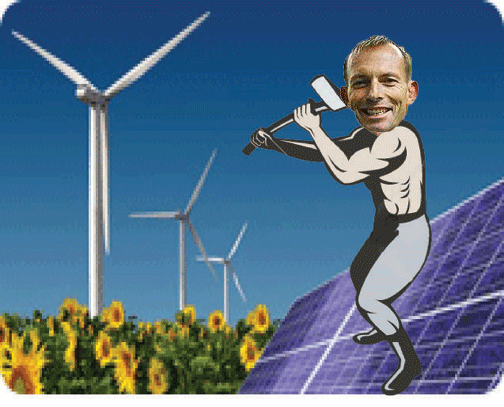 Policy cloud puts up to $110m in solar energy projects on hold SMH, April 8, 2014 Jared Lynch Business reporter Solar projects totaling tens of millions of dollars are at risk after the Abbott government launched a review into its renewable energy targets.
First Solar, the company building the southern hemisphere’s biggest solar plant, said it was reconsidering its future investment plans for Australia, citing increased policy uncertainty.
About $90 million to $110 million worth of projects have been put on hold, First Solar vice president for business development Jack Curtis said. ”We don’t have a great line of sight as to where the next round of projects is coming from, largely as a function of the uncertainty in the policy backdrop,” Mr Curtis said.
The government had planned to source 41,000 gigawatt hours from renewable sources by 2020, or 20 per cent of total supply in that year. But that is being questioned after the government appointed former Reserve Bank board member and global warming sceptic Dick Warburton to head the review.
Mr Curtis said many solar projects only needed short-term incentives. He believed the solar industry had a ”credible path” to become self sustainable, citing its ability to ”dramatically” reduce costs.
For example, in the past five years, the US solar industry had cut costs by 60-70 per cent, Mr Curtis said.
”We are not saying ‘support solar … and we’ll keep saying thanks’. What we are saying that there is a very credible path given the cost reduction demonstrated by the solar industry that it can get to a point where it is a sustainable industry.” First Solar is building two solar plants at Nyngan and Broken Hill in NSW with energy company AGL………
The projects that are on hold are mainly in the mining sector, helping companies with the off-grid operations, Mr Curtis said.
He said those projects had an economic multiplier effect of 1.5x, so for every $1 the government spent, $1.50 was injected into the broader economy. ”[The federal government] obviously has a tight fiscal outlook that they have to manage and we are sympathetic of that.
”But if their other industries that are on the up and up that can generate a 1.5 multiplier for every $1 the government invested, I’d like to hear about them because I think that’s a pretty good positive return on the allocation of government funds.” http://www.smh.com.au/business/carbon-economy/policy-cloud-puts-up-to-110m-in-solar-energy-projects-on-hold-20140408-36a7c.html
Climate denialists and opponents of renewable energy in power in Australia
 Australia’s renewable future in hands of policy fringe dwellers, http://reneweconomy.com.au/2014/australias-renewable-future-in-hands-of-policy-fringe-dwellers-71359 By Giles Parkinson on 7 April 2014 So, it’s come down to this. The defence of Australia’s renewable energy industry has been entrusted to the hands of a man who thinks carbon pollution is caused by nature, not people, and another who is openly hostile to wind farms.
The re-run of the Senate election in Western Australia this weekend provides some interesting fodder for the psephologists: Labor’s continued electoral implosion, the Scott Ludlum-inspired revival of the Greens, and the outstanding success of Clive Palmer’s expensive electioneering.
But for the key policies that will affect Australia’s renewable energy industry – and the decarbonisation of the Australian economy – the equation is essentially unchanged. The numbers in the new Senate, to site from July 1 means that the carbon price – despite whatever hoops that Palmer may try and get the Abbott conservative government to jump through – is effectively dead and buried.
Any changes to the renewable energy target – or even its ditching – will likely go unimpeded through parliament. At best, Labor and the Greens would need support for the RET from Nick Xenophon, not a fan of wind farms, and the DLP’s John Madigan, who has been celebrating what he is sure is the impending demise of the RET.
“The wind industry is panicking in Australia with the likely death of the Renewable Energy Target and this is another example of its peddling influence and money to manipulate the truth,” Senator Madigan told The Australian last week.
At worst, Labor and the Greens would need support from the Palmer United Party to support the renewables target. Good luck with that; Palmer, who now has three of his own Senators and a fourth from the Motoring Party tied up in an unspecified “alliance,” says renewable energy targets should not be compulsory.
“We don’t intend to legislate to make people do something they may not want to do,” Palmer told ABC’s Lateline program last week. This, as economist Ross Garnaut pointed out on the same program, would be about as effective as making taxes voluntary.
What’s not clear is the future of the $10 billion Clean Energy Finance Corporation, or likely budget cuts to the Australian Renewable Energy Agency, both of which would require legislative approval.
The CEFC was actually supported by Xenophon and Madigan in a repeal vote earlier this year because, while they are not supporters of wind energy, they see the upside of bringing in new renewable technologies. Xenophon, in particular is a fan of what he calls “baseload” renewables, meaning geothermal and ocean energy – even those these are years away from commercial deployment. The CEFC has been largely focused on energy efficiency, waste-to-energy, and some emerging solar technologies. ARENA is similarly focused on techologies that do not yet match wind energy on cost.
If Labor can somehow grab the sixth seat in the WA Senate, then Xenophon and Madigan could protect the CEFC, and allow it to continue beyond early July. If not, and the sixth seat falls to the Liberals, then the fate of the CEFC lies in the hands of Palmer.
Quite what he makes of the CEFC is anyone’s guess. The fact that it brings in private money at a ratio of nearly $3 for every $1 in loans may be appealing, so might its ability to develop a profit to the government, and abatement at a “net benefit.”
The abatement equation, however, may just fall on deaf ears. Palmer, it seems, appears to believe that any sort of abatement is a waste of time. Quoting material from what must be one of the more extreme climate denier websites, Palmer told Lateline last week:
“Now we know that 97 per cent of the world’s carbon comes from natural sources. Why don’t we have money to look at how we can reduce the overall carbon signature by reducing it from nature, not just from industry. It’s entirely wrong-focused.”
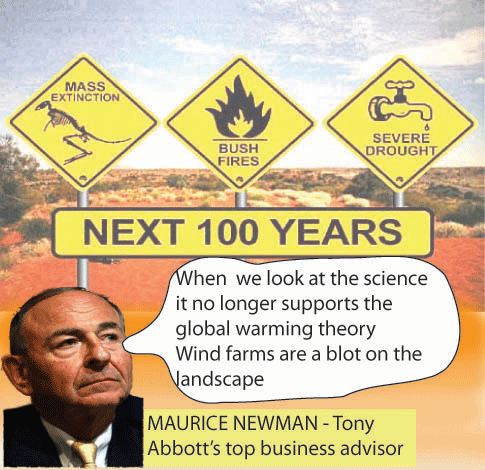 And there’s more. Check out the transcript, it gets feisty in part but it is as though Palmer is channeling the thoughts of Tony Abbott’s main business advisor, Maurice Newman, and those of Dick Warburton, the head of the RET review panel. The climate skeptic brigade is now in full control of climate and renewable energy policy in this country.
Of course, it did not need to have come to this. Climate change and renewable energy policies were supposed to be bipartisan, and for a brief moment in time they were, before the relentless and pig-headed push by the Rudd government to make climate change a wedge issue for the conservatives saw Malcolm Turnbull’s reign at the head of the Coalition ended abruptly, the Liberal Party swerve dramatically to the far right with his replacement by Abbott, and the Greens reject the then CPRS after Rudd refused to even talk to them.
The renewable energy target was also supposed to be bipartisan, and Labor had the opportunity to put this issue to rest if it had the conviction to accept the Climate Change Authority’s recommendation to provide certainty for the industry and push the next review out to 2016.
In the end, Labor backed off. It was the only one of the CCA’s key recommendations that Labor refused to implement. Not only did that decision make the rest of the CCA’s recommendations and endorsement of the RET irrelevant (because of lingering uncertainty about the future of the policy), it left the way open for the Abbott government to conduct its own review, and justify it as a legislative requirement.
And so it appointed a special panel comprising a climate change sceptic, a fossil fuel lobbyist and the former head of one of Australia’s most emissions intensive generation companies to consider the merits of wind and solar.
Now, the renewables industry has to rely, possibly beyond hope, on the support of politicians who think that human-caused climate change is a myth, and that renewables should not be mandated, probably cause health problems, are expensive and unreliable.
It should never have come to this. But it has.
Cost of Australia’s decentralised solar energy is plunging, despite opposition from electricity utilities
 Australia’s Plunging Cost Of Solar Energy (Stats) (Excellent graphs) http://cleantechnica.com/2014/04/07/australias-plunging-cost-solar-energy-graphs/ Giles Parkinson…...“People are told that solar is too expensive,” Greene says. “But we have seen a staggering reduction of the cost of solar in the last couple of years, so I hope that these graphs frame what the actual cost of solar is.”…..
All of this is causing some fierce push-back from the utility industry. Greene and other speakers cited numerous ways that distributors are seeking to slow down the uptake of solar – one is by drawing out the application process (taking 65 business days for each amendment or query), requiring systems to be installed to stop exports back into the grid, or simply refusing the installation.
That, of course, leads to users thinking that they might be better off without the grid. How far is that away?…….
Australian Renewable Energy Agency (ARENA) funding towards Wave Energy
Australian wave energy company receives grant funding, Renewable Energy Magazine, Robin Whitlock, 04 April 2014 Ocean Power Technologies (OPT) has announced that its partner company, Victorian Wave Partners, has received A$5 Million Initial Grant Funding from the Australian Renewable Energy Agency (ARENA) Victorian Wave Partners (VWP) is a project-specific entity that is wholly-owned by OPT (Australasia) Pty. Ltd (OPTA), which is in turn 88 percent owned by OPT. The funding is the first payment under the A$66.5 million grant that was awarded by ARENA to VWP toward the cost of building and deploying its planned wave power station project off the coast of Australia……http://www.renewableenergymagazine.com/article/australian-wave-energy-company-receives-grant-funding-20140406
Inaction on Climate Change will harm Western Australia (- THE AUSTRALIAN Newspaper!)
 WA has a ‘lot to lose‘ http://www.theaustralian.com.au/business/latest/wa-has-a-lot-to-lose/story-e6frg90f-1226873306480 APRIL 03, 2014 West Australia stands to lose a great deal in terms of economic growth and quality of life as a result of inaction on climate change, according to a paper released today by Businesses for A Clean Economy.
The group – an alliance of the Carbon Markets Investors Association, the Clean Energy Council, the Climate Institute, the Investor Group on Climate Change and the WWF – said the state’s long term economic resilience and prosperity depend on national policies that factor in carbon pricing, regulation and catalyse private sector finance and investment.
Complementary measures such as the RET and energy efficiency programs, can provide for a decarbonised, productive and balanced growth pathway for WA’s economy.
“WA and the Clean Economy” highlights for Western Australia the specific impacts, costs of inaction and the economic opportunities in relation to climate change across a range of economic and environmental factors including employment, tourism, agriculture, and lifestyle and quantifies the risk of complacency and inaction.
Risks – key points
- Significant risk to WA coastal infrastructure due to WA’s sea levels rising at twice the global average;
- A 30% yield loss by 2050 due to WA’s drying trend (already causing a 43% reduction of wheat and winter crop production across the southwest wheat belt in 2010- 11 compared to the previous season).
- Threats to WA’s attractiveness as a tourist destination due to the loss of marine biodiversity caused by continued increases in oceanwater pH levels.
“The risks to Western Australia from inaction on climate change are alarming, more so because it is clear that reasonable policies could not only reduce the negative environmental impact but importantly provide WA with considerable opportunity and economic benefit,” said Kirsten Rose, CEO, Sustainable Energy Association of Australia.
“To unlock the opportunities in Western Australia business needs a long term, stable, cost effective policy that can achieve long term emission reduction targets now and facilitate the transition to a competitive low carbon economy”.
Opportunities – Key points
- 4500 new direct WA jobs created by the renewable energy sector by 2030;
- Identified opportunities for WA clean investment in new jobs in manufacturing, retail and agriculture as well as energy;
- Investment in WA’s regional economies due to abundant renewable energy resources (8% of WA’s produced energy being already being renewable)
“Western Australia’s access to the world’s best renewable resources; sun, wind, marine provide the opportunity for WA to lead low carbon growth, attract ongoing investment and create jobs,” said Kirsten Rose.
“WA has significant scope to further diversify the state’s economic development as well as efficiently reduce its emissions and accelerate the transition to a clean economy,” said Ms Rose.
“Business for a Clean Economy are calling for a return to bipartisan support for a market- based price mechanism linked to international markets, to provide greater certainty for business and stimulate investment in new technologies,” said Andrew Petersen, CEO, Sustainable Business Australia.
The B4CE (Businesses for a Clean Economy) Initiative was formed in 2011 by The Carbon Markets Investors Association, the Clean Energy Council, the Climate Institute, the Investor Group on Climate Change and the WWF. Sustainable Business Australia is the B4CE Secretariat. The Initiative has over 400 signatories from a broad range of business and industry sectors. (www.b4ce.com.au)
For profit, environment and efficiency, Australia could have renewable-energy powered high speed rail
Australia Urged to Build High-Speed Rail System Powered By Renewable Energy, EV World 4 April 14, Proposed high-speed rail system would connect 12 major regional towns, and the cities of Brisbane, the Gold Coast, Newcastle, Sydney, Canberra and Melbourne.
A renewable energy powered high speed rail service linking the east-coast Australian cities of Melbourne, Sydney and Brisbane would cut the nation’s regional transport emissions by almost 30 per cent, while providing a profitable and popular service, a new report has found.
The report – a collaborative effort from climate change think tank Beyond Zero Emissions (BZE), the German Aerospace Centre (DLR) and the University of Melbourne’s Energy Research Institute – explores the potential for high speed rail in Australia.
Two years in the making – and due for release next week – the report’s recommends the development of a high speed rail network along the lines of the recent government study; connecting 12 major regional towns, and the cities of Brisbane, the Gold Coast, Newcastle, Sydney, Canberra and Melbourne……….. http://evworld.com/news.cfm?newsid=32762
Solar power making economic sense for remote mining projects in Australia
 First Solar close to deal to power Australian mines, SMH, April 1, 2014 First Solar, the largest US solar-panel maker, is close to announcing agreements to supply its technology to remote mining projects in Australia to help resources companies save on fuel costs.
The company expects to develop as much as 200 megawatts of capacity for the mining industry over the next three years, Jack Curtis, First Solar’s Sydney-based vice president of business development for the Asia-Pacific, said in a phone interview. The Arizona-based company plans to combine solar power with diesel, he said.
“In an environment where profitability isn’t what it used to be, with the mining industry focused on cost control, the electricity that powers the mines is becoming a bigger line item, and the ability to put a dent in that and hedge against fuel price volatility is something that solars offers,” Curtis said. “We expect fairly shortly to announce some pretty exciting projects in that space.”
The U.S. company is increasing efforts to install solar systems at industrial sites and warehouses as utilities demand smaller projects, and is seeking deals in other regions including Saudi Arabia, India and South America. The world’s largest mining companies, including BHP Billiton and Rio Tinto Group, at the same time are reining in spending as a decade-long boom in metal prices wanes.
Mining sites
First Solar will target mining sites in Western Australia, the Northern Territory and South Australia and seek to expand as the solar industry proves that it can provide reliable supply, Curtis said, declining to name any companies.
Operators of Australian mines facing high diesel fuel costs should grow more comfortable using solar technology to generate some of their power, said Nathan Lim, who oversees $127 million in assets and owns First Solar shares as manager of the Australian Ethical International Equities Trust.
“The high cost of energy at a facility in the middle of nowhere has always made it interesting to anyone offering an alternative solution,” Lim said. “The difference between today and five to 10 years ago is the reliability, and that the cost of solar has come down. It’s becoming a no-brainer for people in remote locations.”….. http://www.smh.com.au/business/carbon-economy/first-solar-close-to-deal-to-power-australian-mines-20140401-35uth.html
For solar power in Australia, the Western Australian Senate election is critically important
 Western Australia’s Election Crucial In National Solar Battle http://www.energymatters.com.au/index.php?main_page=news_article&article_id=4241 As the people of Western Australia prepare to return to the polls, the Australian Solar Council says the outcome will play a major role in the battle solar is facing nationally.
“There are increasing indications that the Federal Government is planning to remove or scale back support for rooftop and large scale solar through its review of the Renewable Energy Target (RET),” says Australian Solar Council CEO John Grimes. Mr. Grimes says with Labor and the Greens supporting the position of not changing the RET, if numbers can be secured in the Senate, any changes the Abbot Government seeks to make that would negatively impact the RET can be blocked.
The Australian Solar Council has secured letters of support regarding the Renewable Energy Target from Labor and The Greens. Palmer United Party issending mixed signals. The Council’s Save Solar campaign is currently focusing the majority of its efforts in Western Australia and recently launched its first ever TV and print advertising campaign.
The response from the community is such that it says several political parties have asked the Council stop all of the emails being sent by solar supporters as they are receiving hundreds each day.
“Our clear message – anti-solar policies will only happen at great political cost, because the people are with us,” says Mr. Grimes.
“This campaign says to governments across Australia that solar is the future and the industry will not tolerate ad-hoc policy changes that damage our businesses and most of all restrict access to solar for the 3.5 million people who want solar over the next 5 years.”
Shadow Minister for Environment, Climate Change and Water, Hon. Mark Butler MP will meet solar workers in Perth on Monday to discuss the importance of the Renewable Energy Target for the solar industry; which employs thousands of people in Western Australia.
Renewable Energy Target of great value to farmers
Farms rely on renewable energy target http://www.standard.net.au/story/2177788/farms-rely-on-renewable-energy-target/?cs=383 By SEAN McCOMISH March 27, 2014 WIND farm campaigners will launch a petition in the south-west next week calling on the federal government to preserve the country’s renewable energy target.
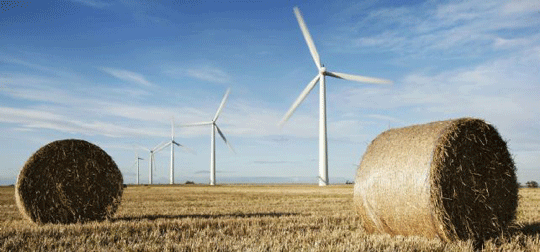
At least four major wind farm projects in Moyne Shire have been shelved until the government completes a review of the renewable energy target (RET) which sets a 20 per cent green energy goal by 2020.
Victorian Wind Alliance (VicWind) a coalition of manufacturers, energy groups and landholders will launch a petition next Tuesday in Yambuk and Portland. VicWind south-west organiser Angela McFeeters told The Standard the RET not only guaranteed income on farms but also supported jobs at Portland tower manufacturer Keppel Prince.
“In places like Yambuk people need to know if they’re going to have a future on the farm with the certainty of the guaranteed income,” Mr McFeeters said.
Campaigners will hand copies of the petition to politicians, including Wannon MP Dan Tehan who has previously expressed support for the green target.
Under the RET, turbines are subsidised thousands of dollars. A number of MPs, including Angus Taylor and Senator John Madigan, want to see the RET scrapped. In January Senator Madigan said the RET “means we are relying more on energy sources that are unreliable”.
According to Moyne Shire documents, construction has been suspended at the Hawkesdale, Ryans Corner, Woolsthorpe and Mortlake south wind farms until the government review is completed by September.
s.mccomih@fairfaxmedia.com.a
Renewable energy and carbon price are financial winners for Tasmania
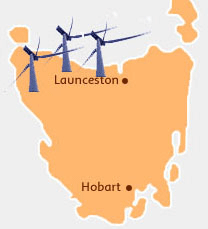 Tasmania wins from pollution price http://christine-milne.greensmps.org.au/campaigns/tasmania-wins-pollution-price 21 March 14, Since the government made big businesses pay for their greenhouse pollution, Tasmanians have come out ahead because the money raised is used to help low-income earners, and invest in clean energy.
Tasmanians who earned $80,000 or less got a permanent tax cut, and the amount you earn before you pay tax was increased from $6,900 to $18,200.
More than 295,000 Tasmanians had permanent rises in their Age Pension, Disability Pension, Carer Allowance, Newstart Allowance, Youth Allowance, Austudy and Abstudy payments, special benefits and Family Tax Benefit A and B.
Tasmanian businesses received $13 million in grants to help their energy efficiency, and $14.9 million went to farmers and landcare groups to protect our soil, wildlife and bush from the effects of climate change.
Part of the funding raised by the price on pollution is also being used to fund investment in more clean renewable energy and energy efficiency, including projects in Tasmania. Tasmania produces more renewable energy than any other Australian state. Selling our renewable energy to other states earns about $70 million for Tasmania every year.
This money is used to pay for our hospitals, schools and other important services. Producing renewable energy fits with Tasmania’s clean, green and creative brand which so many businesses rely on.
Australian Medical Association says wind farms do no cause adverse health effects
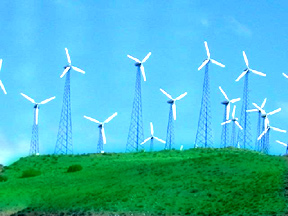 AMA statement on wind power should reassure Australians says CEC http://www.renewableenergymagazine.com/article/ama-statement-on-wind-power-should-reassure-20140319 Robin WhitlockTuesday, 18 March 2014 The Australian Clean Energy Council (CEC) has welcomed a public statement by the Australian Medical Association dismissing claims of adverse health effects from wind turbinesThe CEC said that the AMA statement should provide additional peace of mind for communities living in the vicinity of existing or proposed wind power projects. CEC Policy Director Russell Marsh added that the AMA statement followed similar recommendations by health and acoustic bodies across Australia, to the effect that there is no evidence to link wind farms and adverse health effects.
“Other groups that have made positive statements on wind farm noise and health recently include the New South Wales and Victorian health departments, the South Australian Environmental Protection Agency and the Association of Australian Acoustical Consultants” said Mr Marsh. “The National Health and Medical Research Council, the national peak body for health research, also released a draft position statement several weeks ago that stated there was ‘no reliable or consistent evidence that proximity to wind farms or wind farm noise is directly associated with health effects’.”
Mr Marsh went on to report that no credible Australian health or acoustic organisations are opposing wind farms and that people should therefore feel reassured by that.
There has been a steady misinformation campaign in Australia over several years waged by those opposed to wind farms. This makes it even more important that developers of wind power projects should maintain good relations with the communities living in the vicinity of existing or proposed wind farms.
The CEC has now developed community engagement guidelines for wind farms in addition to a community expectations guide.
For additional information: Clean Energy Council (CEC) Community Engagement Guidelines
Call for electric highway in Western Australia
 Electric car devotees push for electric highway in Western Australia ABC News, By Claire Moodie 18 Mar 2014, Australia’s first ‘electric highway’ will be rolled out in Western Australia if Perth devotees of the cars have their way.The push is on for a network of charging stations in up to 35 towns in Western Australia’s south west, including the tourist getaway of Margaret River.
It would be a game changer for electric vehicle (EV) owners, many of whom currently think twice about leaving the city.”You can’t just drop into a petrol station,” said Patti McBain, whose converted Ford Focus has a range of about 125 kilometres.”You have to plug in somewhere.”…….
Kirsten Rose of the Sustainable Energy Association says Australia is lagging behind due to the lack of public policy on electric cars.”There is little or no support for getting these cars on the road at the moment,” she said. Ms Rose says Australia needs to follow the lead of the US and Europe and introduce financial incentives, such as rebates, if it is to get up to speed with the benefits of EVs.
The rest of the world is well ahead of us in this game. Motor Trade Association chief executive Stephen Moir “In our cities, air quality and air pollution is an increasing issue and EVs have no emissions so there is a very significant public health benefit that needs to be quantified,” she said.
The Motor Trade Association agrees incentives need to be introduced if electric cars are to move from a niche market into the mainstream. Chief executive Stephen Moir says although prices are falling, the average electric vehicle on the Australian market is about twice the price of its petrol equivalent.
The Electric Vehicle Association says while the upfront costs are high, the running costs are minimal. “Once you’ve bought the electric car or motorcycle, you’re looking at less than three cents per kilometre to drive whereas a petrol-powered car might be something like 12,” Mr Jones said.
“The fact that you can generate your own electricity on your roof for free and charge your car and drive around for free, is a winner.”And they need virtually no maintenance.”http://www.abc.net.au/news/2014-03-18/push-for-an-electric-highway-in-wa/5329442
Australia’s transformation from centralised to decentralised energy generation
A ‘new normal’ has not yet been established but all the indications are that the emerging model will lower the cost of new infrastructure, improve competition and greatly improve the degree to which existing infrastructure is used efficiently.
Distributed generation has already succeeded in moving beyond a characterisation as a niche part of the energy industry. However the speed of that transition will depend on the extent to which the market allows for innovation and how quickly the new entrants of today are allowed to become the incumbents of tomorrow.

Centralised to decentralised energy: What does it mean? REneweconomy, By David Green on 16 March 2014 We are in the early stages of a transformation in the way we build, operate and finance our electricity infrastructure in Australia. For decades, Australia’s electricity sector – just like most across the western world – has operated on a model of centralised, state-owned power plants, typically co-located with major sources of fuel. This has meant that not only have a small number of large power plants provided the vast bulk of electricity needs, but that often these plants have been physically clustered together in places like the Latrobe Valley in Victoria and the Hunter Valley in New South Wales. Today, Australia’s energy market is increasingly integrated into one large east coast market and several smaller grids, with the Victorian market fully liberalised. Others, such as Queensland, Western Australia, and Northern Territory are still largely state-owned, and the remaining states are in various degrees of transition.
The core logic behind the physical co-location of generation plants was that the economic efficiency gains from being positioned close to the fuel source (typically coal or large hydro) were greater than the economic inefficiency of transmission losses from transporting power long distances to major population and industrial centres.
New technology and the economic dynamic of the market mean this is now changing. Continue reading
Victoria’s govt joins Abbott’s war on green energy schemes – to axe Energy Efficiency Target
 Victorian Energy Efficiency Target Threatened http://www.energymatters.com.au/index.php?main_page=news_article&article_id=4223 18 March 14 The war on green schemes relating to energy is continuing – the latest victim could be the Victorian Energy Efficiency Target (VEET).
The VEET scheme is designed to make energy efficiency improvements more affordable. It commenced on 1 January 2009 and was legislated to continue in three-year phases until 1 January 2030.
However, it may meet a very premature end. On Sunday, the Herald Sun published a story on a “secret government report” into the scheme that recommended it be abolished and replaced by 2015. Among the reasons reportedly stated is the scheme has been labeled inefficient and a burden to other electricity users.
The Clean Energy Council says claims axing the scheme would provide substantial power bill relief are wrong; as is the conclusion it is ineffective. “The program is getting through to those that need it most and previous studies have shown that it is working well at a low cost,” said Clean Energy Council Chief Executive David Green.
“Two out of every five households in the program have below-average incomes and a third are on some form of welfare.”
Among the products covered under the scheme are selected solar hot water systems and heat pumps. Water heating represents one of the most greenhouse gas and energy intensive activities in a household. This is particularly so in Victoria given much of the state’s electricity generation is through the burning of brown coal – one of the filthiest fossil fuels.
Mr Green said the ‘secret’ modelling released to select media outlets should be fully released for public scrutiny and is confident that scrutiny will reveal VEET is continuing to deliver, both in terms of household savings and the economic activity it creates.
According to the Clean Energy Council, VEET has slashed energy costs for approximately 1.3 million households and businesses; plus has supported thousands of jobs in Victoria’s economy.
1 This month



Help Aunty Sue Protect Her Land and Sacred Sites From Destructive Rocket Testing.
.

Australians deserve the truth
about
AUKUS – https://aukuspublicinquiry.com/

PETITION – To: Prime Minister Anthony Albanese and the Australian Labor Government

of the week – Australians for War Powers Reform (AWPR)
To see nuclear-related stories in greater depth and intensity

