Western Australian town to host large renewable energy grid
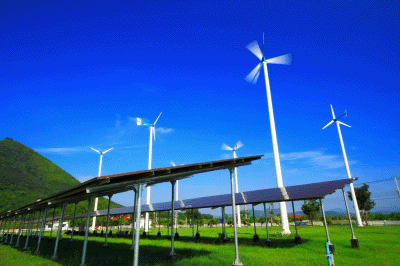 Kalbarri to host what could be Australia’s largest renewable energy grid http://www.watoday.com.au/wa-news/kalbarri-to-host-what-could-be-australias-largest-renewable-energy-grid-20161128-gsz4n5.html A $10 million renewable energy-powered microgrid which has the potential to be the largest in the country will be developed in Western Australia’s Midwest.
The coastal town of Kalbarri is currently supplied by a 140 kilometre long rural feeder line, which experiences outages due to environmental factors.
The microgrid will combine wind and solar power with a large-scale battery and Energy Minister Mike Nahan said the project will be closely looked at to see how the technology could benefit other towns in WA.
“This is a game changer for regional communities who rely on power from a long feeder line, which is subject to environmental factors that can cause outages,” Dr Nahan said.
“The project, which has the potential to be Australia’s biggest renewable microgrid, will consider all generation options and take into account the community’s desire for a renewable solution.””
Western Power will seek expressions of interest from next month with construction expected to begin in 2017.
Solar thermal plant is the best solution for Port Augusta
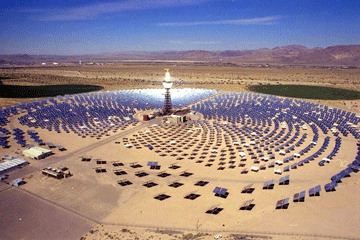 Port Augusta can show the world what just transition for workers looks like https://www.theguardian.com/commentisfree/2016/nov/21/port-augusta-can-show-the-world-what-just-transition-for-workers-looks-like Sharan Burrow
A solar thermal plant in Port Augusta is the best fit for providing both jobs and clean energy. It only needs political will to work Port Augusta, a country town of 14,000 people in South Australia, could have been a perfect example. For 68 years, coal-fired power stations and the local mines generated jobs for 400 workers and provided power for South Australia.
This is the story of a community, its power station workers and their union taking their plan for jobs and solar thermal power to state and federal government, and to global energy giants in France and the United States, demanding a just transition for the people of Port Augusta, demanding a zero carbon future for people everywhere.
The coal-fired power station was on borrowed time. Worried about air quality and environmental health, the community looked for alternative plans for energy, industry and jobs.
Five years of work – during which all options were considered – resulted in a decision that a solar thermal plant was the best fit for both a clean energy base and for skills transfer for existing energy workers.
A feasibility study and three companies interested in constructing this renewable alternative added further cause for optimism.
Even the political support appeared to line up, a promise of funding support before a national election, state government support, and a local mayor backing in his community and workers and their unions with environmental activists singing in tune.
For a moment, Port Augusta held its breath. The plan was in place. A source of energy that would allow workers to transfer from the defunct coal-fired power station. A company willing to build, the community behind it, the workers having hope for a future.
So why are they still waiting?
The missing ingredient is a shared sense of urgency to get the job done, leaving the community and governments out-manoeuvred by corporate greed.
The power station owner, Alinta, deserted its workers and the community in a shocking decision to close years ahead of public commitments. More than 250 workers are potentially stranded.
A dishonest company is nothing new; a company that takes no responsibility for the community from which they have drawn a loyal workforce that made their profits for them is sadly a global tale but where is the rescue team?
A standoff on what comes first, a contract or investment security, seems to be the villain. A standoff between layers of government with a missing procurement contract for purchasing energy from the company willing to invest in the solar thermal plant and a start-up clean tech grant.
Queensland’s solar hub in sunny Western country
 Solar energy: Sunny western Queensland to become a hub for power farms, ABC News, 6 Nov 16 By Lucy Murray Western Queensland is becoming a major hub for solar energy, with the state’s largest solar power farm soon to go online near Barcaldine and construction of another major project about to get underway in Longreach.
Six solar projects partially funded by the Australian Renewable Energy Agency (ARENA) were either recently completed or being built across Queensland.
Construction is expected to begin on another six projects next year.
With construction of the 25 megawatt (MW) Barcaldine solar farm now finished, work is underway to connect the 79,000 panels to the state’s electricity grid with about 580 kilometres of cable.
It will feed the grid with the capacity to power more than 8,000 homes once finished by mid-December, enough to light up Barcaldine 11 times over.
A short distance away, work will soon begin on the 15MW Longreach Solar Farm.
Canadian Solar was successful in the last round of ARENA funding and will begin construction on the project early next year……http://www.abc.net.au/news/2016-11-06/queensland-biggest-solar-farm-set-to-go-online/7975060
New South Wales households lose feedin tariff benefits
Households face steep hike in power charges as solar subsidies end, The Age, 28 Oct 16 Brian Robins Tens of thousands of households are facing a surge in their electricity bills from the start of the new year as the NSW government’s subsidy for rooftop solar panels expires.
This could add more than $1600 to the annual electricity bill as the so-called ‘feed-in tariff’, the price received for surplus electricity sold into the electricity grid, is slashed by as much as 90 per cent in some cases.
Under the original government program, households which installed solar systems received as much as 60¢ a kilowatt hour for surplus electricity sold into the grid. This will fall to 6¢, or possibly less, depending on the deals done with your electricity retailer. The state government’s pricing regulator IPART, the Independent Pricing and Regulatory Tribunal, has recommended electricity companies pay 5.5-7.2¢ per kilowatt hour for electricity bought from households with solar systems…….http://www.theage.com.au/business/households-face-steep-hike-in-power-charges-as-solar-subsidies-end-20161028-gscu4s.html
Port Augusta is attracting solar energy developers
Solar energy developers attracted to Port Augusta after power station’s closure, ABC, The World Today 25 Oct 16 By Khama Reid Solar energy developers are honing their attention on the South Australian city of Port Augusta after the community’s economy took a hit when its largest employer, Alinta Energy, closed its coal-fired power station.
For the past five years, the community has been pushing for a transition from coal to renewable energy, which is now steps closer to becoming reality.
Residents and those in the neighbouring city of Whyalla brag the region gets “300 days of sunshine” a year.
Port Augusta Mayor Sam Johnson said the tagline had become more than just a tourism slogan with solar companies getting serious about development in the region.
“Reach Solar have made an application to the State Government as recent as only a few weeks ago for a very real project here at Port Augusta using solar PV [photovoltaic],” Mr Johnson said.
“We know there’s Solastor and Solar Reserve both looking at large scale solar thermal technology, both in the vicinity of $1 billion projects.”
Mr Johnson said one of the further progressed proposals was for the DP Energy Renewable Energy Park to the south of the city.
“DP Energy actually has planning approval and will be the largest wind and solar PV farm in Australia and actually the first to have not just wind but solar PV technology as well.”
Queensland and SA ‘real hot markets’ for solar
Renew Economy editor Giles Parkinson said the spike in interest was not surprising. “There’s two real hot markets for solar at the moment, that’s Queensland and South Australia and in South Australia around the Port Augusta/Whyalla area and that comes from two things,” Mr Parkinson said.
“One is the excellent sunshine, but also the high wholesale electricity prices.
“They rely so much on gas to set the price of generation, and the price of gas has gone up, so the wholesale price has gone up as well.”
Mr Parkinson said solar was becoming a more affordable investment option.
“I guess the overwhelming driver is the reduction in costs of solar PV, it’s actually falling to a point where it can actually compete with wind energy.”
He said the Australian Renewable Energy Agency (ARENA) previously funded wind farm developments, but in its latest round awarded more than $91 million to solar photovoltaic projects across the country……http://www.abc.net.au/news/2016-10-25/solar-energy-developers-flock-to-port-augusta/7962306
South Australia’s Sundrop Farms – desert solar powered agriculture
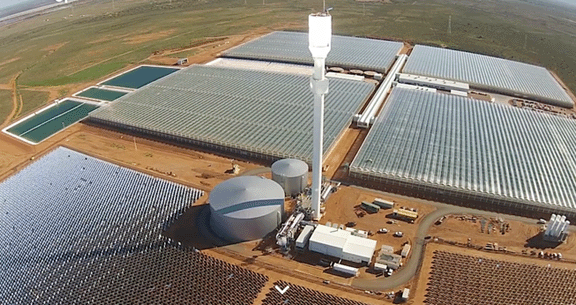
Farms that grow food in arid deserts, without groundwater or fossil fuels, could be the future of agriculture. BRYAN NELSON October 10, 2016, No soil, no pesticides, no fossil fuels, and no groundwater. And yet, a thriving farm in the heart of the arid Australian desert. How is this possible?
An international team of scientists has spent the last six years fine-tuning a system that pipes seawater in from the ocean and desalinates it using a state-of-the-art concentrated solar energy plant. The water is then used to irrigate 180,000 tomato plants grown in coconut husks instead of soil, kept in a network of greenhouses.
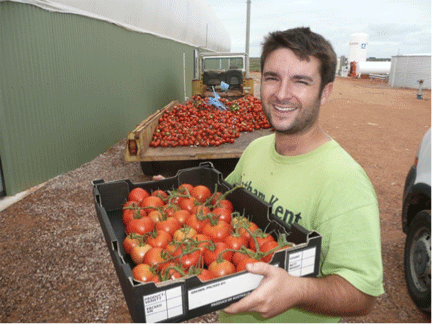 The result is Sundrop Farms, a commercial-scale facility located just off the Spencer Gulf in South Australia that began construction in 2014. Today it’s producing an estimated 17,000 tons of tomatoes per year to be sold in Australian supermarkets.
Given the increasing demand for fresh water around the world — a problem that’s particularly apparent in the sunburned landscape of South Australia — this might just represent future of large-scale farming, especially in coastal desert regions that have previously been non-arable.
The heart of the farm is the 23,000 mirrors that reflect sunlight towards a 115-meter high receiver tower. All of that concentrated sunlight produces an immense amount of power, up to 39 megawatts. That’s more than enough to cover the desalination needs of the farm and supply all the electricity needs of the greenhouses.
The seawater, too, has other purposes besides just irrigation. During scorching hot summers, seawater-soaked cardboard lines the greenhouses to help keep the plants at optimal temperature. Seawater also has the remarkable effect of sterilizing the air, meaning that chemical pesticides are unnecessary.
All in all, the facility cost around 200 million dollars to get up and running. That might sound excessive, but in the long run the facility should save money compared to the costs of conventional greenhouses that require fossil fuels for power. It’s a self-sustaining, cost-efficient design so long as the initial investment can be provided. Facilities similar to the Australian one are already being planned for Portugal and the U.S., as well as another in Australia. Desert areas like those seen in Oman, Qatar and the United Arab Emirates could be next in line.
“These closed production systems are very clever,” said Robert Park of the University of Sydney, Australia, to New Scientist. “I believe that systems using renewable energy sources will become better and better and increase in the future, contributing even more of some of our foods.”
Queensland govt’s push for solar power on all government buildings
Solar should power government schools, TAFE, hospitals: report, Brisbane Times, 13 Oct 16 Tony Moore Solar panels will be installed in Queensland Government buildings including TAFE colleges, schools, hospitals and public houses, to help drive Queensland’s renewable energy from seven per cent today to 50 per cent by 2030, a far-reaching strategic report into Queensland’s renewable energy says……..“The Palaszczuk Government is currently investigating the use of solar PV on state-owned buildings,” Mr Bailey said. Report author and investment banker Colin Mugglestone led a team of researchers who spent seven months analysing how Queensland should reach a position where 50 per cent of its energy is provided by renewable energy by 2030.
The state government now has 9 megawatts of solar panels on government buildings and hopes to generate 2000 megawatts of solar energy from government property by 2030, the report says…….
What could a renewable energy push to 50 per cent by 2030 provide? “It is projected that Queensland could reach 2200 MW of wind, 5200 MW of large-scale solar PV, and 4900 MW rooftop PV by 2030, including 5500 MW of new large scale capacity built after 2020.”
It could provide between around 6400-6700 extra full-time jobs, mainly in the construction of large scale renewable energy plants.
Last month the federal government’s renewable energy body ARENA agreed to fund $51.4 million to seed six new large-scale solar plants in Queensland. That will help potential big solar plants in Dalby, Oakey, Longreach and Kidston west of Townsville and two in Collinsville……..
What do The Greens say?“The Greens welcome this draft report, which confirms that clean energy is good for jobs,” Mr Bartlett said.”But we are dismayed at the years of delay, lack of ambition, and no transition plan for coal power workers.” http://www.brisbanetimes.com.au/queensland/solar-should-power-government-schools-tafe-hospitals-report-20161012-gs112t.html
Solar power needed, to bring energy security and jobs to Port Augusta, South Australia
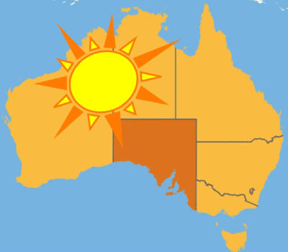 Sam Johnson: Solar power must be provided to regional centres such as Port Augusta to provide electricity security – and jobs
 http://www.adelaidenow.com.au/news/opinion/sam-johnson-solar-power-must-be-provided-to-regional-centres-such-as-port-augusta-to-provide-electricity-security/news-story/4ffcdfeb9fc35ef3f8cbfe0eea1c9bdc October 10, 2016 THE political hoo-ha over renewable energy in South Australia over recent weeks has revealed a serious lack of leadership when South Australian towns like Port Augusta need it most.
Canberra’s renewable energy leadership at risk, as Federal govt demonises renewables.
The solar industry already employs more people than coal-fired generation across the country. In 2014 the solar industry employed more than 13,000 people and even with the uncertainty and watering down of the renewable energy target this is likely to have grown. By comparison, according to the 2011 census 8,000 people worked in fossil fuel electricity generation.
A clean energy transition is already happening, but it is at risk, Guardian, Alexander White, 11 Oct 16 The transition to a low carbon economy is already happening, but is at risk when residents of Australia’s capital go to the polls in local elections.
The transition to a low carbon economy is already happening … in theAustralian Capital Territory, where the local Labor government has legislated for a 100% renewable energy target by the year 2020.
But this major achievement is at risk on Saturday when residents of Canberra go to the polls for territory elections. Continue reading
In Western Australia, retirees trading solar power
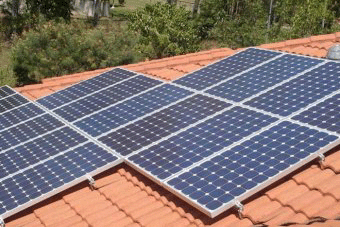 Trading solar power: Retirees test way to beat shrinking feed-in tariffs http://www.abc.net.au/news/2016-10-08/trading-solar-power:-retirees-‘plan-for-the-future’/7914736?section=environment By Kathryn Diss Retirees in the West Australian town of Busselton are trialling a new system which allows them to sell excess energy they have generated from their solar panels direct to their neighbours.
The system bypasses the state’s energy utility Synergy, saving consumers money and increasing returns for solar adopters. Continue reading
Australia’s first sun-tracking solar farm opens at Majura, Canberra
Majura solar farm set to power more than 600 homes after four years of planning, The Age, Clare Sibthorpe, 6 Oct 16, Hundreds of Canberra homes are set to be powered by one of Australia’s first sun-tracking solar farms which opened in Majura on Thursday.The 2.3MW solar farm adjacent to the Mount Majura winery will generate 4,300 MW per hour within a year, which equals about 600 houses.
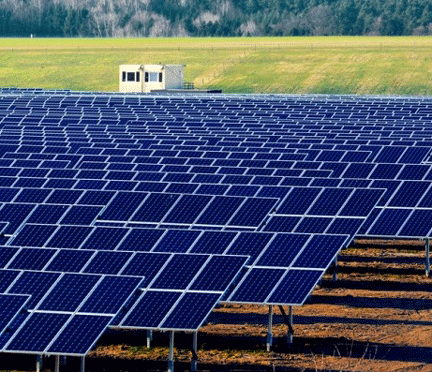
The farm has one of the first self-powered and single axis tracking technology to be used in Australia, which increases output by up to 40 per cent…..
ACT Chief Minister Andrew Barr said the completion of Canberra’s fourth solar farm – with the others in Mugga Lane, Williamsdale and Royalla – helped ensure Canberra’s future renewable power supply was guaranteed…….
He said the ACT government had contracted 640 megawatts of power which exceeded the amount needed to make the territory entirely renewable by 2020.http://www.theage.com.au/business/energy/majura-solar-farm-set-to-power-more-than-600-homes-after-four-years-of-planning-20161006-grw501.html
Look to our sun, urges Hewson
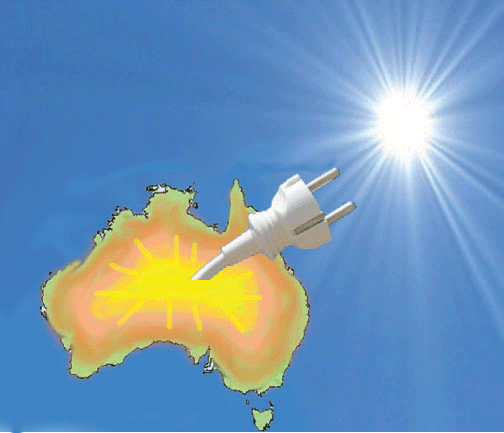 DR John Hewson is leading the charge for more renewable energy – and wants a system redesign.
 Tory Shepherd, Political Editor, The Advertiser, October 6, 2016 AUSTRALIA needs more renewables, not less, former Liberal leader John Hewson says.
Banks ready to back big solar projects: renewable energy jobs on the rise

 Banks looking even closer at backing big solar projects: Clean Energy Council, Brisbane Times, Tony Moore , 8 Sept 16, Australian banks will invest more heavily in solar energy projects within the next 12 months, Clean Energy Council chief executive Kane Thornton said after Thursday’s announcement that 12 new solar farms Australia-wide had been backed by $100 million from the federal government.
The federal government’s Australian Renewable Energy Agency on Thursday announced 12 large-scale solar projects – six in Queensland – had received federal support.
ARENA chief executive Ivor Frischknecht said improved efficiencies had meant solar energy producers were getting much more bang for their funding buck than they were even two years ago. “In 2014, the grant funding needed for large-scale solar projects was $1.60 a watt,” Mr Frischknecht said.”In 2015, this dropped to 43 cents at the EOI stage of ARENA’s $100 million large-scale solar funding round; and to an average of 28 cents in June 2016 when full applications were submitted,” he said.
“The average requirement of the projects we are taking forward today is an incredible 19 cents a watt.”
Mr Thornton said solar projects would soon begin to rely less on federal government for funding to begin operations. “We really at the threshold of saying that once we see another round of these of these projects we are going to see the costs decline to the point when they are built on their own, without the government support,” he said. “I think it is months, if not maybe a year or so, before we can expect them to go ahead without further funding.”
Mr Thornton said banks were now closely examining the viability of investing more heavily in solar and renewable energy projects in Australia.
The first major investment in solar energy by Australian banks came in 2013 when NAB and ANZ invested in a 20 megawatt solar plant in Canberra. More investment in solar plants followed, while banks have questioned some large new coal projects……….
Mr Thornton said scale of new solar farm plants was lowering production costs to the point where it was “cost comparative’ with coal and gas.
Mr Thornton said it was now time to begin training workforces that worked in traditional energy supply companies to work in renewable energy. http://www.brisbanetimes.com.au/queensland/banks-looking-even-closer-at-backing-big-solar-projects-clean-energy-council-20160908-grc5ol.html
Australian Renewable Energy Agency (ARENA) funding 12 large scale solar projects
 12 large scale solar projects to get ARENA funding. And the winners
  are … REneweconomy, By Giles Parkinson on 7 September 2016 All eyes are on the Pullman Hotel in Sydney, where on Thursday, 12 out of the 20 large-scale solar projects shortlisted for the Australian Renewable Energy Agency’s $100 million funding round are expected to be announced as winners of federal government grants.
The announcements are expected to trigger the biggest single investment surge in any renewable energy technology in Australia to date, even outpacing investment in rooftop solar at the height of the premium feed-in tariffs.
Apart from the projects set to go ahead directly from the ARENA tender, the results are also expected to trigger financing commitments for other large-scale solar projects, many of which are keen to cash in on high prices for renewable energy certificates, surging interest in financing from local and international funders, as well as another big slump in the cost of solar modules on international markets.
RenewEconomy understands that 12 of the 20 projects that made the final short list (out of 77 initial inquiries) will get some sort of funding.
The fact that more than half the projects will be helped by ARENA is not unexpected, given the huge reduction in the project costs elicited during the tendering process. It will mean that the ARENA funding round will produce around double the 200MW of large-scale solar capacity that it originally targeted.
It is thought that nine of these 12 projects will be using single axis tracking technology, which a recent study suggests – see our article Solar does work, and a lot better than we thought – provides the best outcome in terms of output and returns on investment.
The tender result is also expected to show that the levellised cost of energy for large-scale solar has fallen to around $100/MWh for the best projects, well below the $135/MWh targeted by ARENA when it started the process.
A lot of this cost reduction is credited to the competitive nature of the bidding process. Last week ARENA chairman Martijn Wilder told ABC Radio the process had knocked down the amount of assistance needed to 10 per cent of project costs from the near 50 per cent needed to get the Nyngan and Broken Hill solar farms built.
It also appears that large energy retailers – under pressure to meet their renewable energy targets,but lately on a capital strike – are prepared to offer around $80-$85/MWh for long-term contracts………..http://reneweconomy.com.au/2016/12-large-scale-solar-projects-to-get-arena-funding-and-the-winners-are-23169
Solar power in Australia working better than expected
Solar Power Does Work, Even Better Than Expected, Clean Technica, September 2nd, 2016 by Giles Parkinson Originally published on RenewEconomy. [excellent graphs]
One of the prices we have to pay for our ideological divide on renewable energy is that we have to read headlines like this, particularly in the Murdoch media: “Solar and wind power simply don’t work, not here, not anywhere”. It was written by the former chairman of a coal mining company, in case you were wondering.
Solar doesn’t work? New analysis of Australia’s first large-scale solar farms shows that solar actually does work, and rather better than expected. And the findings should make it a lot easier for future projects to get the backing of equity investors and bankers, if not the owners of coal fired generators desperately protecting their turf.
The research has been produced by US-based solar module manufacturer First Solar, whose panels have been used for around three quarters of the large-scale solar projects built in Australia to date, by capacity.
Its study shows that at all the solar farms built by First Solar – in western NSW, north Queensland and Western Australia – the output has been higher than forecast. Collectively, the Australian solar plants using First Solar thin-film PV modules are performing above expectations by an average of 3.2 per cent.
The best result has been produced by Broken Hill, the 53MW plant built near the iconic mining town in western NSW, which is so far delivering 4.2 per cent above expectations.
(Spectral advantage, btw, is a measure that First Solar uses to show how much better their panels work in humid conditions than silicon-based rivals).
Now, this might not sound like ground-breaking news – forecast production broken by a few percentage points.
But people in suits are very conservative types, and investment in renewable energy in Australia, both in wind and solar, has been hampered by the fact that bankers won’t finance investments unless they can actually touch, feel and watch the technology, and have proof that it actually works.
This data, Curtis says, is proof that the projects are, indeed, bankable. And that’s more important than it might sound.
Curtis says that even though large-scale solar has been proved in many international locations, local investors still wanted proof that it would work in Australia, even though it does have some of the best solar conditions in the world. Such, perhaps, is the insular nature and/or inherent conservatism of Australia’s banking system.
But Curtis is reassured, not just by the release of the production statistics, but also by the attitude of equity investors and financiers in the local market………
……Dylan McConnell, from the Melbourne Energy Institute, emailed through a production chart from the 102MW Nyngan solar farm, which also used First Solar technology.
McConnell pointed out that, indeed, Nyngan was producing at a capacity factor of 25 to 26 per cent. This, he said, was far higher than official forecasts relied upon for the Australian Power generation Technologies Report, which estimated the average capacity factor of large-scale solar PV at 19-22 per cent.
That, says McConnell, suggests that the forecasts relied upon by the federal government underestimate the output of solar farms by between 15 and 35 per cent.
Little wonder that the government can’t make any sensible decisions about large-scale solar, and why it insists on defunding the agency that has brought about most of the cost reductions in the past year, ARENA. https://cleantechnica.com/2016/09/02/solar-power-work-even-better-expected/
1 This month

of the week – Australians for War Powers Reform (AWPR)
To see nuclear-related stories in greater depth and intensity
 Antinuclear