South Australia to get world’s biggest solar + storage project
 World’s biggest solar + storage projects planned for Australia http://reneweconomy.com.au/2016/worlds-biggest-solar-storage-projects-planned-australia-95528 By Giles Parkinson on 19 July 2016 Australian infrastructure investor Lyon Group says it plans to build the world’s biggest solar plus storage project in South Australia in the next two years, and sees a huge future for combined solar and battery storage plants..
Lyon Group’s David Green – which worked on developing a soon-to-be built 30MW solar plant and 1.4MW/5.3MWh lithium battery storage facility near Cooktown, in far north Queensland, before selling it to German-based company Conergy – plans a series of other projects and claims a pipeline of more than 300MW of solar and up to 60MW of battery storage.
The first new project is planned for South Australia, with a 100MW solar PV plant to be combined with a battery storage array of up to 40MW, Green says the plant could be in operation near Roxby Downs by early 2018, and there are plans for other similar projects around the country.

The first stage of what is known as the Kingfisher project – 20MW of solar PV plus a minimum 2MW battery storage – is expected to be running late next year.
The project is one of the finalists in the Australian Renewable Energy Agency funding round for large scale solar, which is expected to allocate monies to 10 or more projects when decisions are announced next month.
Green says the company – which has previously invested in coal, gas and wind projects, but is now specialising in solar and storage – is looking to be a global industry leader in solar plus storage.
“The genie is out of the bottle. There will be a burst of activity now in large scale solar + battery projects. This is the real battery storage story coming out of Australia – batteries used to convert large scale solar to effectively baseload, or peaking plant.”
The combination of solar and storage means the facilities can compete on two levels – providing clean energy and dispatchable power, either to household or large energy users, and also re-enforcing the edge the grid, in some cases avoiding the costs of grid upgrades. Continue reading
Greening of south-east Queensland – City of Logan leads
 Logan becoming south-east Queensland’s greenest city , Brisbane Times, July 17 2016 The greener side of Logan is starting to show through, with the south-east Queensland city embracing solar energy, recycling initiatives, DIY kits and sustainable living workshops.
Energex statistics from June revealed Logan was ahead of nearby cities when it came to solar power, with more than a quarter of all properties having solar panels on their roofs.
This was compared to 17 per cent in Brisbane and 18 per cent on the Gold Coast.
The city of more 308,000 residents is 70 per cent rural or semi-rural, an appealing factor for those in the area who enjoy their open spaces…….
“A lot of schools are becoming a lot more sustainable, Calvary Christian College at Springwood have their own chickens and sell their eggs, the children involved in gardening, selling produce, checking the eggs,” ………..http://www.brisbanetimes.com.au/queensland/logan-becoming-southeast-queenslands-greenest-city-20160717-gq7mp0.html
Queensland: Catholic schools recognised by Vatican for solar energy success
 Vatican praise for Townsville Catholic diocese solar scheme http://www.abc.net.au/news/2016-07-14/vatican-praise-for-townsville-catholic-diocese-solar-scheme/7630890?section=environment By Ben Millington Catholic schools in north Queensland have caught the eye of the Vatican with a solar project that is cutting carbon emissions and saving millions of dollars.
The Diocese of Townsville, which stretches from the coast to Mt Isa in the state’s north-west, has installed solar panels on roofs of all its eligible schools. The diocese has invested $6 million in one megawatt of solar panels, but diocese director of education Dr Cathy Day said this could deliver a much higher return. “The best figures that I like to think is a saving of $40 million over 25 years,” she said.
“Now when you turn that into teachers that we can pay for, or resources for students, that’s quite a substantial amount of money and I think it’s a great investment.”
In combination with the use of low-energy LED lighting, she said, the diocese had cut carbon emissions by 40 per cent, which is equivalent to taking 40,000 cars off the road. Dr Day said her main motivation had been to set a positive example for students and the broader community. “We’ve all got to start investing in technology and energy efficiency,” she said. “This is the way of the future. Our students are going to be in these industries. Nobody’s going to be working in a coal-fired power station in years to come.”
Emissions will eventually be cut by 80 per cent With further investment, Dr Day said they expect to achieve an 80 per cent reduction in emissions through installing more solar and energy-efficient air conditioning, as well as using batteries to store the power generated.
She returned last week from a visit to Rome, where she presented the project to Vatican officials in meetings led by former deputy prime minister and onetime ambassador to the holy see, Tim Fischer, who has become a spokesman for the project. Mr Fischer said the scheme was well received in Rome and he would like to see it rolled out in schools across the world. “What has happened in Townsville is mildly revolutionary and is extremely positive in terms of energy savings because it works and it can be monitored in real time,” he said.
“That’s what caused positive ripples in Rome. They saw in this sustainable, cut-through, realistic energy savings created without massive capital expenditure.”
The project is already being replicated in other Catholic schools in Cairns and the Northern Territory.
The People’s Solar at Melbourne’s Abbotsford Convent’s major crowd-funded solar energy project
 Australia’s Largest Solar Crowdfunding Campaign a Success, http://probonoaustralia.com.au/news/2016/07/australias-largest-solar-crowdfunding-campaign-success/ Pro Bono, Ellie Cooper, 14 July 16 For-purpose business, The People’s Solar has helped iconic Melbourne Not for Profit, the Abbotsford Convent raise $120,000 for its renewable energy project in the biggest crowdfunding project of its kind in Australia. The People’s Solar, part of Energy for the People, is a platform for delivering community-owned solar power to schools and Not for Profits.
Director and co-founder Tosh Szatow told Pro Bono Australia News this was the biggest solar crowdfunding project of its kind in Australia to date. It was also the largest project his business has been involved in.
“It’s really exciting. We’ve raised something like $250,000 now over two years, so the amount of money we’ve raised for projects has been doubling every six months, and that includes the project with the convent,” Szatow said. “We’ve now completed about 10 projects, it’s the biggest by some margin and it’s really confirmed for us that we can fund really big projects like this.
“And the other exciting thing is the organisations we’re working for would otherwise find it really hard to find the money to pay for solar power, and so it’s really great to know we’re able to help those organisations.”
The Abbotsford Convent, spread over 16.8 acres, has green space and historic buildings, which are said to house Australia’s largest multi-arts precincts. “It’s an iconic building in Melbourne… that’s really well loved by people in Melbourne, and the activities that are hosted at the convent are really important to the community,” Szatow said.
“As well as support for the creative arts and music, painting, sculpture and it’s a really valuable public asset. There’s a large green space which is a real oasis for people in that community. So there were a lot of reasons to get behind it.”
He said the $120,000 solar panel installation, half of which was crowdfunded through Pozible and the other half matched through a donor, would make a huge difference to the convent.
“It will save up to about $15,000 a year, and I believe that’s enough to fully fund the maintenance of their public open space so that’s all the gardening and upkeep on the gardens,” he said.
“So that’s a huge saving to their bottom line. And because it’s a Not for Profit organisation, it runs entirely on donations, saving that $15,000 every year is going to make a huge difference over the course of the panels lifetime.” The mission of Energy for the People is to help foster a “democratic” energy market where all Australians can access renewable energy. Szatow said The People’s Solar was started to focus on social impact and community benefit.
“[We were] talking with a lot of organisations that were struggling to find the money to go solar even though solar power has a pretty good financial payback. We were really looking for a solution to that,” he said.
“And I think more broadly there’s a really strong ethic in what we do with Energy for the People. We’re really keen to give back to the communities that we do work in, and solar is a really nice way of executing that and bringing together our skills and capability in clean energy with our interest and enthusiasm for the community side of things.”
Australians Saving $1 Billion Per Year through Solar Energy
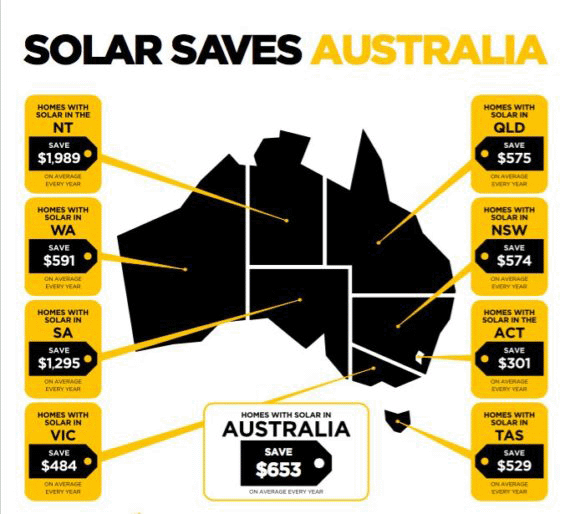
Solar In Australia Saving $1 Billion Per Year http://cleantechnica.com/2016/06/28/solar-australia-saving-1-billion-per-year/ June 28th, 2016 by Joshua S Hill Australia can now boast of over 23.2 million solar PV panels saving citizens $1 billion on their power bills each year.
According to a new report from Solar Citizens, “an  independent community based organisation,” Australia reached 23.2 million solar PV panels installed earlier this year — the equivalent of one per person in the country.
Solar Citizens also calculated the savings currently being made by solar owners on their regular electricity bills, analysing average electricity retail rates across all State and Territories over the past 8 financial years, revealing that solar households have saved $4.4 billion on their power bills since FY 2007–2008, and have been saving around $1 billion every year over the past three years.
“The pace of rooftop solar installation in Australia has been nothing short of phenomenal in recent years,” said Claire O’Rourke, National Director of Solar Citizens. “Solar panels are now a regular and normalised part of Australian life. In fact, Australians spend as much on their solar as they do on tea and coffee.”
In terms of investment, the report shows that 1.5 million Australian households and small businesses have invested more than $8 billion into rooftop solar PV. In fact, the investment figures reported in The State of Solar: Australia’s Solar Rooftop Boom are the highlight of the Solar Citizen’s research. During the 2014–2015 financial year, Australians invested $1.23 billion in rooftop solar — compared to only $118 millioninvested in large-scale solar projects in the calendar year 2014. So far, it is the hard-earned cash of Australian homeowners and small business owners that is driving the renewable energy transformation in Australia.
“Australians are leading the renewables charge and this new set of data plainly reveals that investment in solar PV has been the backbone of the renewables revolution in Australia,” said O’Rourke.
So far in 2016, Australia’s rooftop solar PV installation base has generated over 6.5 TWh, preventing 6.3 million tonnes of greenhouse gas emissions.
And with Australia about to go to the polls this weekend in the country’s federal election, this goes a long way to showing what Australians want from their politicians.
“Australian political leaders need to understand just how much the average Australian themselves have committed of their own money to play a part in the transition of our power system,” added O’Rourke. “With 5 million Australians (or 1 in 5 voters) living under a solar roof, this is potent political constituency.”
A solar energy revolution in mining
The next solar revolution could replace fossil fuels in mining, The Conversation, Geoffrey Brooks Pro-Vice Chancellor (Future Manufacturing), Swinburne University of Technology, June 29, 2016 Recently Sandfire Resources, a gold and copper producer based in Western Australia, announced its new solar power plant will soon start powering its DeGrussa mine. By replacing diesel power, the 10-megawatt power station, with 34,000 panels and lithium storage batteries, is expected to reduce the mine’s carbon emissions by 15%.
This is an exciting development because it realises an important potential that has long been recognised but not exploited. Two of Australia’s greatest resources – solar energy and minerals – are, as luck would have it, both highly concentrated in the same parts of Australia.
In this case, solar energy is being used to power the mine, but there is also great potential for solar energy to be used to convert the minerals to chemicals and metals……..
The next revolution
Currently, Australia’s use of solar energy is largely limited to homes, for hot water and solar-powered electricity. But solar energy has great potential for regional Australia too.
Mines are often isolated. There is typically limited natural gas and electricity supply, and in remote areas energy supply is limited to liquid fossil fuels. This is exactly the potential being exploited by Sandfire Resources at its mine facility 900km north of Perth.
Recent studies by CSIRO have identified the potential to use solar in high-temperature processing of ores such as bauxite, copper and iron ore. This process would use concentrated solar thermal (CST) energy as a heat supply. This heat can also be converted to electricity, known as concentrated solar power (CSP).
This is different to the solar photovoltaic technology used in Sandfire’s solar power plant (and rooftop solar panels), which converts sunlight directly to electricity……..
Concentrated solar energy is still relatively expensive. The Australian Solar Institute estimated in 2012 that the cost of electricity from concentrated solar was approximately double the current cost for conventional energy, reflecting largely the high capital cost of solar systems.
This gap can reasonably be expected to close with increases in the scale of operations (lowering manufacturing costs) and in regulatory pressure on conventional power sources.
It may be a way off, but the small step by Sandfire Resources could be the start of a revolution in the Australian minerals industry. https://theconversation.com/the-next-solar-revolution-could-replace-fossil-fuels-in-mining-61153
Canberra’s community- owned solar farm to be largest in Australia
 ‘Largest community-owned’ solar farm in Australia taking root in Canberra vineyard June 28, 2016 Katie Burgess Canberra Times reporter There are two reasons Canberra’s David Osmond puts his money into solar panels rather than stockpiling it in the bank.
“The returns are better plus it’s going towards a cause I’m very passionate about,” he said.
The latest solar project Mr Osmond will invest in will be the largest community-owned solar farm in Australia – and it will be right here in Canberra.
Mr Osmond is one of the first investors in the SolarShare Community Energy Majura Solar Farm, a $3 million solar plant that, when built, will generate enough electricity to power 250 Canberra homes.
SolarShare project leader Lawrence McIntosh said more than 5000 solar panels will be mounted on three hectares leased from the Mount Majura Vineyard, producing 1.9GWh of electricity each year.
“Wine grapes are best grown on slopes, which leaves the flatter land at the bottom of the valley with not much interest for grape growing but great for a solar project,” he said.
While only 5 per cent of the size of the Royalla Solar Farm south of Canberra, this one will be owned by the community, investors pledging $50 to $10,000 each towards its construction and maintenance.
About 400 people have registered as investors so far and more are being welcomed, Mr McIntosh said.
The flagship farm is predicted to earn more than $360,000 a year in revenue from selling electricity to the energy networks, its profits shared among the project’s investors…….http://www.smh.com.au/environment/energy-smart/largest-communityowned-solar-farm-in-australia-taking-root-in-canberra-vineyard-20160620-gpnu4k.html
Australians have saved $4.4bn in a few years, with solar rooftops
the report estimated solar owners will avoid 6.3m tonnes of carbon dioxide emissions in 2016 – which they found is equivalent to taking a third of all trucks off Australian roads.
Solar Citizens found 80% of federal electorates have more voters with rooftop solar  than would be required to change their sitting members. And of the electorates with the highest numbers of solar owners, seven out of the top 10 were now held by Coalition MPs.
Australians have spent almost $8bn on rooftop solar since 2007, says report https://www.theguardian.com/environment/2016/jun/22/australians-have-spent-almost-8bn-on-rooftop-solar-since-2007-says-report Solar Citizens says since the 2012-13 financial year, rooftop solar owners have saved about $1bn on their household bills each year, Guardian, Michael Slezak, 22 June 16, Australian households and small businesses have invested more than $1bn a year in rooftop solar over the past five years, spending a total of almost $8bn since 2007, new calculations show.
In its latest State of Solar report, Solar Citizens – which campaigns for, and represents the interests of, solar owners – has for the first time estimated Australian’s out-of-pocket investment in rooftop solar, how much money it has saved consumers, and how much carbon it has abated. Continue reading
New South Wales leading the nation with large scale solar farms
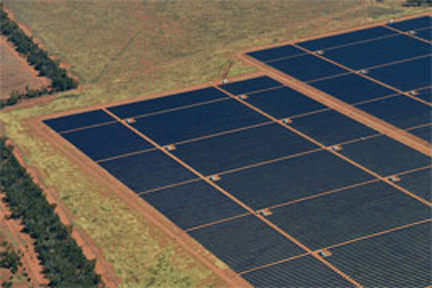 NSW to double existing solar farm capacity with four new plants approved, SMH, Peter Hannam ENVIRONMENT EDITOR, THE SYDNEY MORNING HERALD 23 JUNE 16 The Baird government has granted planning approval for four new large-scale solar plants, potentially more than doubling the existing capacity in the state.
The four plants approved for construction have a combined capacity of 175 megawatts (MW), and would generate another electricity for 56,000 homes if built. “NSW is Australia’s large-scale solar leader, with the country’s three largest solar farms and hundreds of megawatts of solar electricity capacity online and in the pipeline,” planning minister Rob Stokes said. Continue reading
Australian Greens plan for a solar South Australia
 Australian Greens announce plan to fund solar panels for 48,000 SA homes
 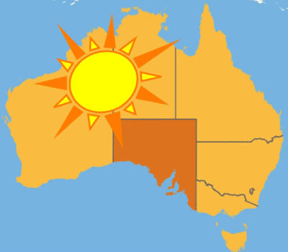 June 16, 2016 http://www.adelaidenow.com.au/news/national/federal-election/australian-greens-announce-plan-to-fund-solar-panels-for-48000-sa-homes/news-story/fd62f39d9131861e539f9a674 Political Editor Tory Shepherd, Advertiser MORE than 48,000 South Australian homes would get solar panels and energy efficient measures under an Australian Greens plan to reduce electricity costs and reduce emissions.
Deputy Leader Larissa Waters and SA Senator Robert Simms has announced in Adelaide today a plan to spend $2000 on each public and community housing home, which they say could save renters as much as $1075 a year.
The plan would cost $60 million a year, and would not be finished until 2030. By that point homes would be retrofitted with energy-saving and water efficient devices, with solar on every roof.
Senator Simms said it would also boost jobs, employing thousands of South Australians.
“This initiative would not only provide South Australians with more jobs in the renewable energy and green housing sector, but it would save the average household $780 per year in electricity bills from installing solar alone,” he said.
Senator Waters said nationally it would help about 800,000 people. More than 2400 deaths a year are associated with cold weather, she said.
“We have an unequal system where our lowest earners are paying the highest price for power, many in ageing houses that are inefficient to run, hot in summer and freezing in winter,” she said.
The Greens will not be able to form Government but they may share the balance of power in the Senate after the July 2 election, which could give them leverage over the major parties.
Ever-growing boom in rooftop solar energy in New South Wales
 Solar usage through the roof in South West https://au.news.yahoo.com/thewest/wa/a/31844405/solar-usage-through-the-roof-in-sw/ Daniel Mercer – The West Australian on June 16, 2016,
In its first snapshot of the South West electricity market since getting responsibility for it last year, the Australian Energy Market Operator will today report that the number of solar panels had trebled in six years.
AEMO said there were 180,000 customers with solar panels across the network from Kalbarri to Kalgoorlie and south to Albany, compared with 165,000 a year ago and just 60,000 in 2011.
Though the latest figure represents more than 18 per cent of State-owned power provider Synergy’s entire customer base, the percentage of households with solar cells is even bigger.
AEMO says 22.5 per cent of South West network households have a system, making WA third for solar panels behind Queensland and South Australia.
The Melbourne-based body also found households and businesses were using bigger systems with the average size of new installations doubling over five years to 4.5kW.
AEMO said the growth rate in solar panel installations in WA was unlikely to slow as prices fell, electricity tariffs rose and subsidies continued. It said the amount of electricity solar panels generated would almost treble between 2016-17 and 2025-26.
One consequence would be flatter demand from the grid as more people generated electricity. With battery storage developing rapidly, the shift from grid power could accelerate with cost implications for customers unable or unwilling to use solar.
Solar change brings economic, social benefits to remote community
 Solar change brings economic, social benefits
In the space of three months, the community’s power bill dropped by more than half, the population grew from three to 40, and local jobs and a school sprang up.
“The sun hits your solar panel, which is on the roof, and creates energy,” Mr Pratt said. “The community will either use that energy during the day, and energy that they’re not using will get stored in the batteries, and they’ll use that energy at night-time when the sun goes down.”
Indigenous Business Australia bought the Allgrid solar system and leased it to the Munungurra Aboriginal Corporation.
Graeme Smith said leasing the system saved the corporation making a large capital withdrawal and allowed the community to change along with developments in technology.
“We can go back and renew our lease upon the latest technology that comes in, so we’re not stuck with the system we’ve got,” Mr Smith said.
Income from the community’s investment portfolios will pay the leasing costs until Munungurra owns the power system outright. With the promise of cheaper power, the community transformed.
Remote community transformed after swapping diesel generator for solar panels http://www.abc.net.au/news/2016-06-14/remote-community-swaps-diesel-for-solar-panels/7508300 By the National Reporting Team’s Kate Wild Graeme Smith was mulling over a long-standing problem at the end of 2015: how to provide affordable power to his tiny, off-grid community.
Despite having freehold title to 170 square kilometres of land east of Tennant Creek and plenty of money in the bank, members of the Munungurra Aboriginal Corporation could not afford to live on their country.
The cost of providing power to such a remote location prevented them building an economy on their land.
“We originally had no power and no water, because we’re not on a grid. We put houses on it, we put generators on it. But still that wasn’t enough,” said Mr Smith, the corporation’s chief executive.
The corporation paid for two diesel generators to run power to two small communities, where two out of eight houses were permanently occupied.
“Whilst it gave people reliable power with two houses pulling off a generator, we’d be going through $600 to $700 a week in diesel,” he said.
“Because we have no employment on community, people weren’t able to pay for the diesel. So they decided to live in town, look after their kids at school, get houses in town, and just go on the dole.”
So on Mr Smith’s initiative, Munungurra Aboriginal Corporation leased a solar power system at a cost of more than $200,000 from Indigenous Business Australia (IBA), and switched off its diesel generator.
IBA is a government-funded organisation that promotes economic independence for Aboriginal and Torres Strait Islander people. Continue reading
Totally Renewable Yackandandah leading Victorian town to 100% renewable energy
 A Yack attack on climate in Yackandandah, TUCKED away in a picturesque nook of Victoria’s North East is a small town doing big things.June 7, 2016
Yackandandah — home to between 700 and 2200 people, depending on where you draw the town border — is one of dozens of communities across the country leading the way on renewable energy.
Its goal is ambitious: to be 100 per cent reliant on renewable energy sources by 2022.
At the helm is Matthew Charles-Jones, an environmental education teacher and former university lecturer who runs an education and accommodation facility at Falls Creek.
He’s a co-chair of Totally Renewable Yackandandah, or TRY as it is more familiarly known, a committee of about half a dozen passionate locals promoting the renewable energy message……
Although Matthew is quick to clarify the 100 per cent target is TRY’s goal and not the official town plan, if the yellow cardboard yaks popping up across the district are any indication, plenty of locals are signing up to the vision.
The Australian PV Institute tracks solar power installations across the country. Its most recent data shows 249 dwellings within the 3749 postcode (taking in Yackandah and Bruarong, a hamlet about 13km south) are producing their own solar energy, about 35 per cent of a combined 700 homes.
This, says Matthew, is up from 24 per cent when TRY entered the scene.
Yackandandah Health, a facility that provides aged care as well as a host of primary health services, was one of the first organisations to take up the mantle.
It has installed 348 solar panels to provide 90kW of power and reduce its annual greenhouse gas emissions by 115 tonnes — in real terms, the equivalent of taking 23 cars permanently off the road.
The system, which produces about a quarter of their electricity consumption, is also expected to save the non-profit, community-owned organisation $1 million over the next 25 years…….
While it is not uncommon for town-folk to be perceived as more progressive than their farming neighbours, around Yackandandah, farmers are also jumping on the bandwagon…….
Firm believers in solar energy’s ability to give a financial return to home and business owners, the TRY committee has established a “perpetual energy fund” to help further ease the cost concern, offering loans for people to install solar systems and then make repayments with the savings off their electricity bill.
It’s an initiative designed to fill the gap left by changes to Australian energy policy that have put solar energy, and renewables in general, on the back burner.
“We need such a massive amount of change in this sector and for me, our traditional institutions aren’t doing enough about it,” Matthew says.
“Around the world countries, communities and business are investing heavily in renewable energy but because there hasn’t been a clear, enduring policy in Australia and in that absence, investment in renewable energy collapsed…….
Yackandandah is not alone.
Matthew estimates there are nearly 80 communities across Victoria leading the way in renewable and community energy.
Closest to home is Newstead, a small town about a 15-minute drive from Castlemaine in central Victoria. Six years ago it announced its goal to be Australia’s first 100 per cent renewable energy town by 2021.
“They’re doing remarkable work,” says Matthew, while noting the town has been helped along by significant financial input from the Victorian Government…….http://www.weeklytimesnow.com.au/country-living/a-yack-attack-on-climate-in-yackandandah/news-story/92775dad3e4dd28f80e052c40668e766
Fantastic news! Port Augusta’s opportunity to become a world class solar energy hub
Revealed: Proposal for $1.2bn solar thermal power plant at Port Augusta June 4, 2016 http://www.adelaidenow.com.au/news/south-australia/revealed-proposal-for-12bn-solar-thermal-power-plant-at-port-augusta/news-story/58e18b826e4ecedfb57a9d11dc5fe7ba Sheradyn Holderhead Tory Shepherd A NEW proposal for a $1.2 billion solar thermal plant at Port Augusta, backed by former federal Liberal leader Dr John Hewson, can be revealed by The Advertiser just weeks after the city was hit with the closure of its power station.
Solastor Australia will next week unveil its plans to build a solar thermal power station with a generation capacity up to 170 megawatts and energy storage capabilities, The Advertiser has discovered.
While details of the project remain secret until an official announcement on Tuesday, a similar proposal from US company SolarReserve would create up to 1000 jobs during construction and about 50 permanent jobs.
Solastor Australia chairman Dr Hewson will reveal the company intends to build a fully integrated, solar thermal power station and energy storage system to provide SA with “24/7 base load and peak load generation”.
“We’ll be announcing it all on Tuesday,” he said last night. “This is world-class. We think this is something we can roll out not only across Australia but internationally. It’s Australian technology, it gives Australia a real edge … in actually being able to turn sunlight into effective baseload energy.”
The Advertiser understands behind-the-scenes work on the proposal has been underway for months. The company has a plant in China and has been working in the Middle East.
And Solastor believes that it can produce affordable energy from the plant. In a statement, Solastor Australia said the proposed power station would cost about $1.2 billion and would have a generation capacity of 110mW in winter and 170mW in summer.
“Once completed, it will generate approximately 1.25 billion kilowatt hours of electricity per annum, which is sufficient to provide power to more than 200,000 Australian homes,” the statement said.
Both Federal and State governments are aware of the plans — and consider it to be a legitimate proposal.
Last month, Federal Environment Minister Greg Hunt promised financial support for the 110mW SolarReserve project, which until now was the only publicly known proposal for a solar thermal plant at Port Augusta.
Port Augusta mayor Sam Johnson said the second proposal was “fantastic news” and, along with four other renewable energy projects, was the “saving grace” for the town and the state’s economy.
“This reinforces comments in the past that Port Augusta will be the renewable capital of Australia,” he said. “This would be South Australia and Australia transitioning to a new world and would be a saving grace for Port Augusta and the SA economy.”
Mr Johnson said this proposal was the fifth renewable energy power station plan, which also included two 100mW solar panel farms, and a combined wind turbine and solar panel farm, the approval of which was expected to be announced next week
These projects will support Arrium and the skilled workforce we have, as well as benefiting small business throughout the region,” Mr Johnson said. “All up these projects would replace the generation from the coal-powered plant.” Repower Port Augusta campaigner Dan Spencer said it was great news that more companies were coming forward with proposals.
“Port Augusta really has the opportunity to become a renewable energy hub,” he said.
“More and more proponents are coming forward and saying they want to invest which is really exciting.
“There’s no reason we couldn’t see both these solar projects get built. The more projects, the more investment, the more clean energy.”
In April a Repower Port Augusta-commissioned ReachTEL poll of 1195 people showed that three-quarters believed the Federal Government should help fund the construction of a solar thermal power plant at Port Augusta.
Labor’s community solar hubs would benefit renters and pensioners
As of February this year, more than 1.5 million Australian homes had rooftop solar panels. But Labor believes gaps exist among households unable to access the technology, such as renters, public housing tenants and apartment dwellers.
The community power hubs would work with communities to develop renewable projects by providing legal and technical expertise and start-up funding.

Projects might include community wind farms, “solar gardens” or shared arrays of solar panels for groups of renters, retrofitting social housing to promote energy efficiency and encouraging solar rooftop installations on social housing and aged-care properties.
The hubs may also provide finance for low-income earners and pensioners, such as by using council rates as financial contributions for projects.
‘Solar revolution’: Labor climate plan warms up to renters, pensioners http://www.theage.com.au/federal-politics/political-news/solar-revolution-labor-climate-plan-warms-up-to-renters-pensioners-20160601-gp8sc8.html June 1, 2016 Nicole Hasham Environment and immigration correspondent Groups of renters could share a “garden” of solar panels and the technology would be encouraged in public housing and aged-care homes in a $98.7 million Labor push to bring the “solar revolution” to those who do not own their homes.
The details came as the Greens announced a plan to double the number of paid firefighters to battle extreme bushfires, saying renewable energy is important but the effects of global warming are already being felt.
Fairfax Media polling this month showed two-thirds of voters believe the federal government is doing “not very much” or “nothing at all” to combat climate change, and Prime Minister Malcolm Turnbull’s adherence to policies of the former Abbott administration has been interpreted as a trigger for a fall in his popular appeal ahead of the July 2 election.
In Brisbane on Wednesday, Opposition Leader Bill Shorten spruiked a Labor plan to create up to 10 “community power hubs” to allow more people to access renewable energy. Labor previously flagged the measure in the release of its broader climate election policies in April. Continue reading
1 This month

of the week – Australians for War Powers Reform (AWPR)
To see nuclear-related stories in greater depth and intensity
 Antinuclear