Climate Council reports on Australia’s top solar states and suburbs
 Australia’s top solar states and suburbs http://onestepoffthegrid.com.au/australias-top-solar-states-and-suburbs/ By Sophie Vorrath on May 25, 2016
Rooftop solar is becoming as “common as insulation” in some parts of Australia, a new report has found, with 14 suburbs now recording penetration above 50 per cent, and many others recording uptake far above their state’s average, sometimes as high as 65 per cent.
The report is the Climate Council’s latest round-up of data on the performance of renewable energy in Australia’s states and territories. . As you can see in the table below, at the state and territory level, South Australia, Queensland, and Western Australia all have a higher share of Australia’s solar PV installations than their share of the population [Table 3 on original]
But in terms of the percentage of households with solar PV, South Australia and Queensland are still leading the country, with PV penetration levels fast approaching one-third of all households. Western Australia comes in at third place, with solar PV panels on one in five households.
In the suburbs of Australia, the data tells a slightly different story, with some postcodes charting a solar PV penetration rate much higher than the average of the state or territory they are located in. Continue reading
Despite our solar resources, Australia way behind Britain in solar energy
Australia 10th in global solar capacity as industry looks ahead to sunnier times http://www.smh.com.au/environment/climate-change/australia-10th-in-global-solar-capacity-as-industry-looks-ahead-to-sunnier-times-20160531-gp83t6.html June 1, 201 Peter Hannam Environment Editor, The Sydney Morning Herald Australia installed almost 1 gigawatt of new solar capacity last year but was easily eclipsed by cloudy nations such as the United Kingdom, which installed about four times as much, according to the REN21 Global Status report on renewable energy.
Investment in new renewable energy and energy efficiency programs rose to a record $US286 billion ($396 billion) even as prices for most technologies, such as solar and wind energy, fell. Growth also came despite falling prices for rival fuel sources, such as coal and oil.
“Renewables are now cost-competitive with fossil fuels in many markets and are established around the world as mainstream sources of energy,” Arthouros Zervos, chairman of REN21, said in the report.
Globally solar PV capacity added 50 gigawatts to reach 227 GW of capacity. New wind power capacity rose even more, adding 63 GW of new capacity to reach 433 GW.
Australia added 900 MW of new solar PV last year – the eighth-most in the world – to reach 5.1 GW of capacity.
That total, though, ranked Australia 10th in the world, trailing nations not known for their sunshine, such as the UK, South Korea and Germany. The UK added 3.7 GW alone last year to reach 9.1 GW of capacity, or almost twice Australia’s tally.
Kane Thornton, chief executive of the Clean Energy Council, said it was “obviously disappointing that the UK had almost twice as much solar power as Australia by the end of 2015, given we have some of the strongest sunshine in the world.” Continue reading
South Australia runs over 50% on renewable energy
 South Australia runs mainly on renewable energy following coal
  plant closure, The Independent, Gabriel Samuels 12 May 16 Majority of energy comes from solar and wind but the transition has been fraught with difficulties South Australia now gets the bulk of its electricity from wind and solar power, following the closure of its last coal-fired power station.
The state, which includes the city of Adelaide, exclusively has gas generators, solar panels and wind turbines serving a population of 1.7 million.
More than 50% of the region’s electricity stems from wind and solar with the remainder coming from energy efficient combined cycle gas plants.
The final coal station still in operation in Port Augusta closed down on May 9 after operating for 31 years. It generated 520 megawatts of power from coal but failed to compete with the falling price of clean renewable energy. Its closure produced a brief faltering in wholesale energy prices across the state.
The RenewablesSA transition initiative was established by the state govenment in late 2009 with a promise of $10 billion invested in low carbon generation by 2025…….
The state plans to become Australia’s wind and solar capital and is working towards complete reliance on natural sources
The state’s leading electricity provider, SA Power Networks, yesterday announced it will undertake Australia’s largest trial of storage batteries in solar homes in a bid to defer a $3 million network upgrade.
Meanwhile, last week Portugal ran entirely on renewable energy for four consecutive days between Saturday and Wednesday, in a bid to become completely reliant on natural resources.
The Independent has contacted RenewablesSA for comment. http://www.independent.co.uk/news/world/australasia/south-australia-runs-entirely-renewable-energy-following-coal-plant-closure-a7037646.html
University of New South Wales team sets new world record for converting sunlight to electricity
 New world record set for converting sunlight to electricity http://www.gizmag.com/solar-cell-electricity-efficiency-world-record-unsw/43384/ Eric Mack May 17, 2016 An Australian team has set a new record for squeezing as much electricity as possible out of direct, unfocused sunlight via a new solar cell configuration. Engineers at the University of New South Wales (UNSW) achieved 34.5 percent sunlight-to-electricity conversion efficiency, a new mark that also comes closer than ever to the theoretical limits of such a system.
UNSW’s Dr. Mark Keevers and Professor Martin Green set the record with a 28 centimeter-square (4.3 sq in), four-junction mini-module embedded in a prism. This new configuration allows the sun’s rays to be split into four bands so that a higher amount of energy can be extracted from each beam.
The same team reached an even higher level of efficiency a few years back using mirrored concentrators that were able to convert 40 percent of incoming sunlight to electricity. However, this new record is the highest level achieved without the use of concentrators.
“What’s remarkable is that this level of efficiency had not been expected for many years,” said Green, citing a German study that set a goal of 35 percent efficiency to be reached by 2050.
The team does not expect that its record-breaking cell configuration will find its way on to home or office rooftops anytime soon, as they are more costly to manufacture. The group is working to reduce the complexity to make them cheaper to produce and sees a future for them on solar towers that make use of concentrating mirrors.
Meanwhile, efficiency gains are also being made in the development of organic solar cells that are cheaper and more flexible. There’s still a long way to go though, as the most recent record for organic photovoltaics set in February was 13.2 percent efficiency. Source: University of New South Wales
Origin Energy to buy whole output from new Queensland solar farm
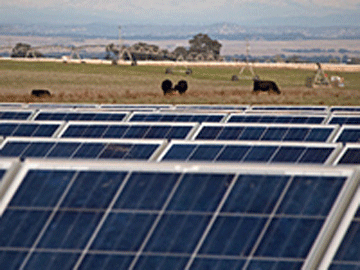 Origin Energy signs up for output from new Queensland solar farm, The Age, May 4, 2016 Angela Macdonald-Smith Energy Reporter A 13-year deal signed by Origin Energy to buy all the electricity produced at a new 100 megawatt solar project in north Queensland has accelerated the recovery of the renewable energy sector after a stalling in new investment over the past two years.
The contract, which will have Origin buy both the output and the renewable energy certificates generated by the Clare Solar Farm, also underscores how large-scale solar is improving in competitiveness, catching up with wind power…….
The Clare project will be built by Spanish company Fotowatio Renewable Ventures at a site 35 kilometres west of Ayr. Production is due to start next year and Origin will buy all of the output until 2030.
The deal follows Origin’s commitment in March to buy the output of FRV’s 56MW Moree solar farm, a project that is already in production in northern NSW. It has also applied for government funding for its own solar project in south-east Queensland.
Origin is one of the biggest liable parties under the RET regulations, which requires it to buy an increasing proportion of renewable energy for its electricity retailing activities. The deal with FRV for the Clare output will take Origin’s portfolio of renewable energy generation and purchase contracts to more than 700MW.
Origin’s head of energy markets Frank Calabria said the cost of solar “is falling rapidly compared with other renewable resources”.
“Now is the ideal time to invest in solar and we have been actively looking for opportunities to diversify and add more renewable energy to our portfolio,” Mr Calabria said.
For FRV, the contract with Origin kicks off a third new investment in Australia, after the Royalla solar project in the ACT and the Moree venture. http://www.theage.com.au/business/energy/origin-energy-signs-up-for-output-from-new-qld-solar-farm-20160503-gollf5.html
First-ever council solar farm for Queensland – on the Sunshine Coast
Sunshine Coast builds Queensland’s first-ever council solar farm Brisbane Times, Tony Moore, 28 Apr 16, Queensland’s first large-scale solar farm run by a local government – saving that council $22 million in electricity costs over 30 years – is now being built on the Sunshine Coast. It will provide green power on the Sunshine Coast by mid-2017 and will slash the council’s costs of buying electricity for everything including streets lights, sports facilities, buildings, galleries, parks and libraries.
The council expects to be able to sell excess electricity from the solar farm, with documentation showing the farm will generate more electricity than the council needs.
Queensland’s Local Government Association says nine local governments are also investigating geothermal energy plans.Redland City Council is also exploring a solar farm.
The Sunshine Coast will build the 15-megawatt solar farm on 50 hectares behind Coolum, making it the first local government in Australia to finance a solar plant itself……. More than 57,800 solar panels will be built on stands three to four metres high above an abandoned canefield owned by the council.
They will generate power by early 2017. The Sunshine Coast Council will fund the $48.5 million to build the solar power plant and awarded the contract to construction firm Downer Utilities.
About 60 jobs will be created during construction and a 10-metre buffer will be planted around the solar farm, which will include a solar research centre…….
“Where we originally planned to save our ratepayers $9 million over the 30-year life of the project, we are now forecasting we will save $22 million,” Cr Jamieson said. Solar energy is popular on the Sunshine Coast, with 30,000 homes installing solar system in the past five years……http://www.brisbanetimes.com.au/queensland/sunshine-coast-builds-queenslands-firstever-council-solar-farm-20160427-gogbw5.html
Export industry potential for Victorian solar energy project, backed by Australian Renewable Energy Agency
 Victorian solar project wins government grant to take its technology to world, The Age, April 24, 2016 –Tom Arup A Victorian technology company striving to produce more efficient and cheaper solar power has won financial backing from the national renewable energy agency to expand its plans.
RayGen Resources, based in Melbourne, will receive a new $2.9 million government grant to help it commercialise what the company says is ground-breaking solar technology that has already received overseas interest.
The technology involves laying out a large array of mirrors that tracks the sun throughout the day and creates a concentrated light beam onto a highly efficient solar photovoltaic receiver sitting on top of a central tower.
In March last year, RayGen opened a 200-kilowatt pilot plant at Newbridge, near Bendigo, to showcase the technology, which the company has dubbed “PV Ultra”. The pilot was built with support from the Australian Renewable Energy Agency, also called ARENA.
The company has now won another ARENA grant, to be announced on Monday, to upgrade the Newbridge project with later versions of the technology and to bolster its solar receiver manufacturing operations at its Blackburn headquarters.
All up it is expected to cost $5.8 million and be completed by December.
RayGen chief executive Alex Wyatt said the expansion would help the company deliver its solar receivers to overseas buyers, including solar-concentrating projects in China.
The RayGen solar PV receivers use a compound called gallium arsenide, commonly used in satellites and space stations, instead of the more typical silicon-based technology. While gallium arsenide is more expensive than silicon, it is also more efficient and when enough sunlight is concentrated it can become cost effective to use, particularly in very sunny areas.
RayGen and ARENA were also partly involved in a 2014 project at the University of NSW, called Power Cube, which set a world record for converting sunlight into power for a solar PV system……
The Turnbull government recently announced it would retain ARENA, dropping Abbott-era plans to axe the agency. But it is seeking to slash the $1.3 billion that ARENA was still due to receive in coming years to help foster new renewable energy development. http://www.theage.com.au/environment/victorian-solar-project-wins-government-grant-to-take-its-technology-to-world-20160422-god18z.html
Solar powered vehicles for Australia – energy utilities now supportive
 Australia Could Be World Leader In Solar-Powered Electric Vehicles Claen Technica, April 12th, 2016 by Giles Parkinson Originally published on RenewEconomy
The shift from petrol cars to electric vehicles appears to be more than a consumer-driven,Tesla-inspired phenomenon. The big utilities are also getting on board.
Origin Energy, one of country’s big three utilities, says Australia could a market leader in solar-powered electric vehicles, given the right incentives and policies that could encourage the uptake of renewable energy and force the closure of the most polluting brown coal power stations. “With an already high penetration of residential solar PV systems in Queensland and South Australia and the emergence of home battery technologies, there is an exciting opportunity for Australia to be a market leader in electric vehicles powered by solar energy,” the company says in a submission to the Climate Change Authority.
Nearly one quarter of Australian homes are equipped with rooftop solar, and Australia is seen as the likely first “mass-market” for battery storage – because of that high solar penetration and because of the country’s high electricity prices, courtesy of its high-cost grid.
Anecdotal evidence suggests that many of the early adopters of electric vehicles are already charging their EVs with their own rooftop solar, and utilities are already switching controlled loads for electric hot water systems back to the day-time from overnight to take advantage of excess solar power. Continue reading
Tasmania’s Bruny Island residents to sell solar power to the grid
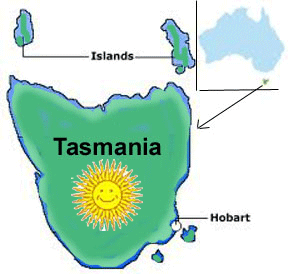 after $2.9m renewable energy grant http://www.themercury.com.au/news/tasmania/residents-on-bruny-island-to-sell-solar-power-after-29m-renewable-energy-grant/news-story/945d59a87250bbfc2d533e8ff9009ace April 14, 2016 RESIDENTS of Bruny Island have the chance to turn their homes into mini-power stations and trade on the national electricity grid to boost the island’s energy security and offset their power costs at the same time.
The Australian Renewable Energy Agency yesterday announced $2.9 million to help a project to help fund solar panels and batteries for up to 40 households on the island.
Harnessing the surplus power they generate is hoped to help take pressure off Bruny Island’s power system during peak times.
The systems will include software that allows homeowners to sell their power back to the grid during times of peak demand — and hence prices — on the National Electricity Market.
“The reason Bruny Island was chosen was because of the constraints they have from their undersea cables,” he said. “A battery with a solar panel can be converted into a remarkable power station. It’s fast and can both produce and consume power in an instant — it’s the type of power station the future needs.”
He said the benefit for households was they could sell their power into the market at a price of about $1 per kilowatt hour — compared to the much lower 5.5c per kilowatt hour feed-in tariffs available at present.
TasNetworks will begin consulting Bruny Island residents about the project over the coming months and seeking expressions of interest via public forums on the island this year.
A solar world first for Perth: solar panels and battery storage on apartment buildings
Apartments set for solar world first https://au.news.yahoo.com/thewest/wa/a/31335712/apartments-set-for-solar-world-first/ Daniel Mercer – The West Australian on April 13, 2016 Dozens of apartments will be able to use, store and trade power under a world-first trial of micro-grid technology to be unveiled in Perth’s south.
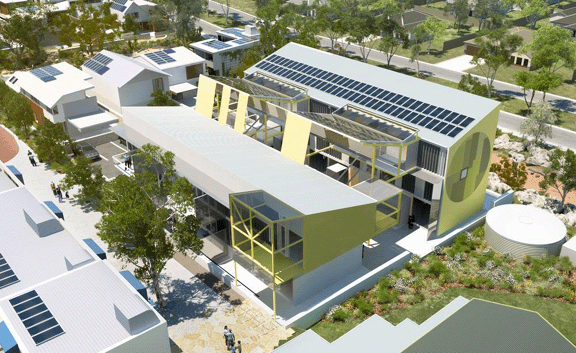
Federal Environment Minister Greg Hunt will today announce the Commonwealth’s green energy fund ARENA has tipped $1 million into a micro-grid project in White Gum Valley.
The $3 million project will have solar panels and batteries installed across four separate apartment developments. It would be up to the strata companies managing the apartment buildings to on-sell the electricity to tenants, rather than State-owned power provider Synergy. The strata companies could sell the electricity cheaper than Synergy or at the same price, currently set at 25.7¢ for every unit of electricity sold. Homes owners and tenants would also be able to trade power to other apartments within the complex during the day and night.
Headed by Curtin University and backed by Western Power, LandCorp, the City of Fremantle and Balance Services Group, the project aims to establish a viable model for the uptake of solar panels on apartment buildings.
Demand for solar panels has exploded across Perth, with more than 170,000 homes installing the systems on their roofs. Apartments, which make up a third of Perth’s housing stock, have been much slower on the uptake.
Curtin University’s Jemma Green said that with battery systems rapidly becoming commercially viable, there was an unprecedented opportunity for apartments to get in on the act.
And she said the implications could be huge, with micro-grids such as White Gum Valley popping up everywhere and transforming the way electricity was generated, transported and sold.
“These kinds of innovations are not only making solar power a viable option for everyone, but potentially reflect the future of power utilities,” Ms Green said.
Queensland pioneers electric car chargers – free for public use
Queensland’s first solar-powered electric car chargers available and free for public use http://www.abc.net.au/news/2016-04-07/qld-first-solar-powered-electric-car-chargers-free-for-public/7307430 By Lexy Hamilton-Smith Queensland’s first solar-powered electric vehicle chargers have been installed on campuses of the University of Queensland at St Lucia and Gatton.

They charge 10 times faster than a home charger and will be free for public use. About 15 minutes of charging can provide a range of up to 70 kilometres.
UQ manager of Energy and Sustainability Andrew Wilson said it was a game changer.”The first inter city charger in Queensland enabling long distance electric vehicle travel outside of the city,” he said.”Hopefully this is the start of an electric vehicle highway throughout the state.”
Energy Minister Mark Bailey said sales of electric cars were currently slow, but said the Government would look into how it could develop the sector. “It is a bit like the chicken before the egg,” he said.
Electric cars start from around $50,000 but one sport version is selling for more than $400,000.
Tritium, which designed and built the Veefil charger in Brisbane, said the initiative would kick-start the electric vehicle revolution in Queensland. “It allows easy inter-city electric vehicle travel between Brisbane and Toowoomba,” chief executive David Finn said.
Mobile solar system – a boon to off-grid users
the combination of the financial and carbon benefits of solar with the flexibility and modularity of conventional diesel or gas power was “music to the ears” of off-grid electricity consumers. Systems can be provided on offtake agreements as short as five years
Mobile solar to take on diesel power http://www.smh.com.au/business/energy/mobile-solar-to-take-on-diesel-power-20160406-go0cbe.html April 8, 2016 Angela Macdonald-Smith Energy Reporter
Laing O’Rourke has successfully piloted a mobile solar-diesel project and is set to roll it out commercially under new subsidiary SunSHIFT, writes Angela Macdonald-Smith. Making solar power a realistic economic option for short-term projects that would otherwise wholly rely on polluting diesel energy is the mission of a new mobile solar system to be commercially rolled out by construction company Laing O’Rourke.
Outback mining sites, remote communities and disaster relief projects are all potential users of the system, which has been developed with the help of funding from the Australian Renewable Energy Agency.
The Australian arm of UK-based Laing O’Rourke has successfully piloted the moveable solar system, which it combined with diesel power back-up, and has set up a new clean energy business, SunSHIFT Pty, to commercialise it.
Plans for the launch of the system on the market are to be officially announced on Friday and Laing O’Rourke said it had already fielded inquiries for “multi-megawatt” systems, including some from emerging overseas economies.
ARENA chief executive Ivor Frischknecht said the plant’s ability to be rapidly set up, relatively cheaply moved and easily scaled up made it suitable for many off-grid applications where power was needed for only a few years. Continue reading
At last Victoria might now get going, farming solar energy
Has Victoria’s moment in the sun finally arrived? http://www.theage.com.au/victoria/has-victorias-moment-in-the-sun-finally-arrived-20160327-gnrs6l.html, The Age, Tom Arup March 27, 2016 Despite a decade of promises and plans from governments, policy uncertainty and project collapses has meant very little has materialised but now a handful of proposed Victorian projects are again on the table.
Phil Galloway stands in an open field between vast stretches of almond trees. The empty land is marginal and the sun above it bright.
One day soon he hopes to roll out 220,000 solar panels across the empty space on the Almas Almonds farm at Bannerton, generating enough electricity to power about 30,000 homes.
“The sun is really just another crop”, Mr Galloway, a former BHP executive, said during a meeting with the local council this week.
“And we’re utilising land that would have otherwise stood empty.”
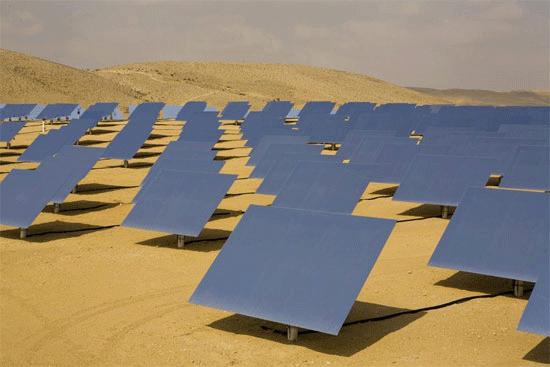
His company, Syncline Energy, is the latest in a long line of proponents that have sought to kick start a large-scale solar industry in Victoria’s sunny north west.
But despite a decade of promises and plans from governments, policy uncertainty and project collapses have meant that very little has materialised. And a celebrated concentrated solar project near Mildura was axed by its proponents in 2014, with the land and equipment later sold.
Now a handful of proposed Victorian projects are again on the table.
The latest bout of activity was sparked by $100 million in competitive grants on offer from the Australian Renewable Energy Agency (ARENA), which is looking to drive innovation in large-scale solar and drive down costs.
It is understood seven Victorian projects were among the 77 that registered initial interest with ARENA. Syncline Energy’s proposal, and another from Solar Choice located near Kerang, were the only two from Victoria to make a recently announced shortlist of 22. Continue reading
Big financial benefits in locating solar and wind power together
 The study’s key findings:
– Co-location potential: The technical capacity of existing wind farms to accommodate co-located solar farms is estimated at over 1 GW. Growth in renewables driven by the Renewable Energy Target is expected to open up technical capacity for an additional 1.5 GW of solar PV to be co-located at new wind farms built by 2020. However, the relative financial competitiveness of these opportunities (combined with relevant policy) may limit the uptake of the full technical potential of co-location.
– Firming effect: Given the intermittent nature of renewable technologies, pairing resources in regions dominated by one particularly technology will likely have a “firming” effect. This reduction in the overall facility’s degree of intermittency results in an improved capacity factor at the connection point and can mitigate associated network constraints in regions dominated by a single generation type.

ARENA: Solar and wind co-location can deliver significant cost savings http://www.pv-magazine.com/news/details/beitrag/arena–solar-and-wind-co-location-can-deliver-significant-cost-savings-_100023809/#axzz43rWPStli 21. MARCH 2016 SOPHIE VORRATH
A total of at least 1GW of large-scale solar could be added to existing Australian wind farms, boosting renewable energy development, generation, and and smoothing its delivery to the grid, according to a new report from the Australian Renewable Energy Agency. Based on data from 10 existing wind farms around Australia, the report – released on Monday and previewed last Thursday at the Wind Wind Industry Forum in Melbourne – found that major savings could be achieved for developers using co-location, particularly in the grid connection infrastructure. Continue reading
Turnbull suggests Port Augusta solar thermal plant for federal clean energy plan
 Port Augusta solar thermal plant likely to be funded by $1 billion federal clean energy fund March 23, 2016 PETER JEAN POLITICAL REPORTER The Advertiser A LARGE solar thermal plant at Port Augusta is likely to be one of the first projects supported by a $1 billion Clean Energy Innovation Fund, to be announced by the Federal Government today.
Prime Minister Malcolm Turnbull and Environment Minister Greg Hunt will today reveal plans for the fund, which will invest up to $100 million per year in emerging technologies.
The announcement comes after the federal and state government were urged to back the development of a solar plan at Port Augusta, where hundreds of jobs will be lost when two coal-fired power stations close in May.
It is likely to cause tension with conservative elements in the Coalition, particularly those who have aligned themselves with former prime minister Tony Abbott.
“We are promoting innovation and new economic opportunities, enhancing our productivity, protecting our environment and reducing emissions to tackle climate change,’’ Mr Turnbull said last night.
“An example of a project could be a large scale solar facility with storage in Port Augusta.
“By offering innovative equity and debt products, the Clean Energy Innovation Fund can accelerate the availability of new technologies to transform the energy market, and deliver better value for taxpayers.”
American company SolarReserve had been seeking support for the development of a large solar thermal plant at Port Augusta.
Similar projects in the United States have created about 1000 construction jobs, 50 ongoing roles and 4000 indirect jobs.
A delegation of federal MPs visited a large solar power station built by SolarReserve in the American state of Nevada last year…….http://www.adelaidenow.com.au/news/south-australia/port-augusta-solar-thermal-plant-likely-to-be-funded-by-1-billion-federal-clean-energy-fund/news-story/7be66ebf70e864e8a1a9cb9a95bd83bc#load-story-comments
1 This month

of the week – Australians for War Powers Reform (AWPR)
To see nuclear-related stories in greater depth and intensity
 Antinuclear