Greens plan for solar shade in Brisbane’s King George Square
Brisbane council election: Greens promise ‘solar shade’ in  , Brisbane Times March 9 2016 Cameron Atfield It’s long been the civic centre of Brisbane, but now King George Square has again found itself at the centre of Brisbane’s council election campaign.
Greens lord mayoral candidate Ben Pennings has unveiled a plan to cover the square in solar shading, which would come equipped with sockets for people to charge their phones in the shade. Below – solar shade , Arizona University
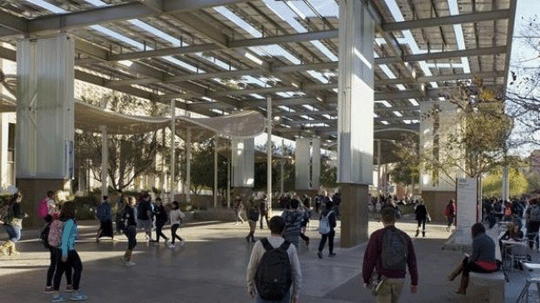
The Greens want to introduce solar shade, similar to this at Arizona State University, to Brisbane’s King George Square
Mr Pennings said the solar panels would generate 100,000 kilowatt hours a year to help charge City Hall, which he said would save Brisbane City Council $20,000 in annual electricity bills.
“The Greens’ plan for King George Square embraces this century rather than looking to the past of roped-off grass,” he said. “A one-off investment of $2.5m will shade King George Square with solar panels.”Residents can relax in the shade and use the power to charge their phones, tablets or laptops.
“New seating will allow people to recharge on their own or connect under the shade in small groups.”………http://www.brisbanetimes.com.au/queensland/brisbane-council-election-greens-promise-solar-shade-in-king-george-square-20160309-gneylr.html
Western Australia’s largest solar installation at Perth shopping complex
WA’s largest solar installation generating one-third of Perth shopping centre’s power http://www.abc.net.au/news/2016-03-03/solar-panel-installation-broadway-shopping-centre-wa-largest/7217984 By Kathryn Diss A shopping complex in Perth’s western suburbs is generating one third of its power from the sun after undertaking Western Australia’s largest solar panel installation on its roof.
The Broadway Fair complex has installed 948 solar panels with the capacity to generate 312 kilowatts of power. Broadway Fair general manager Paul Avon-Smith said the move would save the complex about $20,000 a month in power bills, which could be put towards funding capital works.

“We were looking for soft approach for the cost of doing capital works,” Mr Avon-Smith said. “It gives us an alternative to help cushion rent increases and price rises for our tenant base in a pretty tough market, but allows us to finance crucial capital works. “So that allowed us to do a roof replacement project, plus put the solar in, with there being no upward pressure on our rents for tenants.”
Infinite Energy installed the system at a cost of $600,000.
Managing director Aidan Jenkins said the huge fall in the cost of solar panels in recent years has meant the business model now stacked up for commercial-sized installations. “Solar currently represents the cheapest way to generate electricity, so we will start to see these type of systems become the norm over the next couple of years.”
Government grappling with ‘tsunami’ of solar installations
Large-scale solar installation poses a big challenge for the Government, which currently has too much available power in its network. The rapid uptake of rooftop solar panels has been a big contributor to the problem, displacing traditional sources of power like coal and gas.
Energy Minister Mike Nahan has been an outspoken supporter of solar power and said the state is going to experience a “tsunami” of these types of commercial installations in coming years.
“It just adds more generating capacity to an already oversupplied system, but it is something we have to cope with,” Mr Nahan said. “Over the next decade these are going to crowd out traditional, large-scale generation of coal and gas. “As we go down the track, these technologies on businesses and households illustrates that into the future we are going to have to reduce our production of traditional energy sources and that’s the challenge.”
Victorian town Newstead set for 100% renewable energy within 5 years
PowerCor’s Thomson says it is clear that the majority of the population in Newstead are passionate  about their goal for 100% renewables, and at least five other townships are looking to follow suit.
Newstead could be the host of Victoria’s first solar-powered micro-grid.
The Victorian government is also heavily involved, allocating $200,000 in the hope that the model created for Newstead can be replicable in other communities across Victoria.
 Australian first: Newstead aims to run on 100% renewable energy within five years, http://www.theguardian.com/sustainable-business/2016/mar/01/australian-first-newstead-aims-to-run-on-100-renewable-energy-within-five-years Guardian, Giles Parkinson, 1 Mar 16
Agreement with energy company Powercor will see Victorian town move to solar power, save money and perhaps become a model for other towns. The quiet Victorian town of Newstead – population approaching 500 – has a big ambition: to source all its electricity needs without burning any fossil fuels at all. Within five years, it wants all of its power to come from renewable energy sources.
Newstead is not unique in that goal. At least a dozen towns around Australia, including Yackandandah, Tyalgum, Byron Bay and Lismore, have declared a similar ambition, even if most are allowing themselves more time to reach the target.
What makes Newstead’s situation particularly interesting is it is going ahead with the support, indeed the encouragement, of its local network provider, Powercor.
An agreement struck between the network and Newstead 2021 – the local group driving the township’s ambition – is being hailed as a “game-changer” for the way communities and network operators work together to accelerate the transition to renewable energy.
Glen Thomson, the head of the energy solutions division of Powercor, says renewable generation is now a reality, and solar, wind power and energy storage are increasingly being integrated into electricity networks. Continue reading
Solar thermal power push to keep jobs in Port Augusta
 THE “dominoes” are lined up for Port Augusta to switch from coal-fired to solar thermal power generation and advocates are urging governments to summon the “political will” to secure the project….(subscribers only)
http://www.adelaidenow.com.au/news/south-australia/solar-thermal-power-push-to-keep-jobs-in-port-augusta/news-story/dd0e42df6d28e5e0bb5959966ac676be
Solar energy to the grid: New South Wales’ Moree solar farm in operation
Moree solar farm starts feeding energy into grid http://www.abc.net.au/news/2016-02-29/moree-solar-farm-starts-feeding-the-grid/7207942 ABC New England By Kelly Fuller The largest single-axis tracking solar farm in the country is now feeding energy back into the grid from Moree in New South Wales.

The solar farm is led by Fotowatio Renewable Ventures (FRV) and has been funded with assistance of a $102 million grant from Australian Renewable Energy Agency and $47 million in debt financing from the Clean Energy Finance Corporation.
At full capacity the project is expected to generate 140,000 megawatt hours per annum, or the equivalent energy to supply the needs of 15,000 homes.
The company’s country manager Cameron Gamsworthy said feeding energy back into the grid was a significant step in the project’s development.
“It’s absolutely a major milestone. We’re now generating clean, renewable energy for the country,” he said. “[We are] looking forward to getting the project fully commissioned over the course of the next month.”
The farm’s 222,000 panels are expected to have a life of 30 years, and the company hopes the project will be at full capacity in a month’s time.
Mr Gamsworthy said FRV was considering other projects in the region.
Farm solar is the future
While the Moree project is unique, a University of New England academic said there was a growing demand for solar energy, particularly among rural communities.
“Farmers are getting more and more hungry for mobile technology that can be distributed around the farm,” said Professor David Lamb, from the university’s Smart Farm. “It could be a little water bore pump or some sort of gate alarm system or a trough monitor,” he said. “All of these technologies are going to need solar themselves because we obviously don’t want powerlines running around farms.
“I wouldn’t be surprised if there are literally thousands of little solar panels balancing on the back seat of old tractors that are used to keep the battery alive while it is left out in the weather for the next start.”At the end of the day the solar panel is becoming the set of pliers on a farm — you see them everywhere you look.”
Professor Lamb said the university was putting up ‘smart trees’ around the Smart Farm. “We literally have little sensors in the trees showing the amount of water these guys suck out of the ground, and each and every one of these trees has their own solar panel,” he said.
“[It] is quite ironic when you consider that trees are one of the most efficient harvesters of solar energy that we know.”
Clean Energy Finance Corporation funding exciting solar initiative by Melbourne University
 Melbourne Uni taps CEFC loan to cut power costs, grid dependence, http://reneweconomy.com.au/2016/melbourne-uni-taps-cefc-loan-to-cut-power-costs-grid-dependence-70503 REneweconomy, By Sophie Vorrath on 16 February 2016 The Clean Energy Finance Corporation has announced it will loan up to $9.1 million to the University of Melbourne, to accelerate the installation of solar PV and other renewable and energy efficiency technologies in an effort to cut energy costs and improve sustainability.
The University says the measures – including voltage optimisation, freezer upgrades, and the installation of solar PV, solar thermal and wind micro-turbines – will reduce its grid electricity use by around 8 per cent; not bad considering the university has the energy requirements of a town the size of Warrnambool.
The voltage optimisation equipment – which controls and corrects incoming power voltage to increase building energy efficiency – is expected to produce the biggest energy saving, reducing consumption by more than 4GWh per annum. It also has the added benefit of reducing operating and maintenance costs.
The funding will also see a total of 1.5MW of solar PV installed across 18 roof spaces, which will offset grid energy by generating more than 2.2GWh of electricity a year. The university also plans to install three micro wind turbines on three separate buildings, to demonstrate their potential.
A concentrated solar thermal power system will also be installed, to be used for space and swimming pool heating, with expected energy savings of 0.75GWh. The measures are also expected to cut the university’s emissions by more than 9,000 tonnes a year, thus contributing to its commitment to achieve carbon neutrality by 2030.
For the CEFC, the project falls under the green bank’s investment mandate of financing emerging and innovative renewable energy technologies and energy efficiency for cities and the built environment.
“Australia’s 39 universities make a major contribution to the national economy and to the Australian community,” said the CEFC’s executive director of corporate and project finance, Paul McCartney.
“Yet they face the ongoing challenges of public budget restraint, intensifying global competition and the need to use cutting edge technologies to meet increasing student expectations.
“Clean energy installations like those being undertaken by the University of Melbourne can help universities meet these challenges through an investment that results in reduced environmental impact, higher productivity and stronger financial performance.”
McCartney said the CEFC was looking to work on similar projects with other Australian universities, to help them achieve increased sustainability and cost cuts through energy efficient and renewable technologies.
“The CEFC’s finance can be structured over a longer term than traditionally offered by banks, tailored to match the cost savings delivered through the reduction in grid energy usage,” he said.
Solar energy trading between households a – new concept becoming a reality
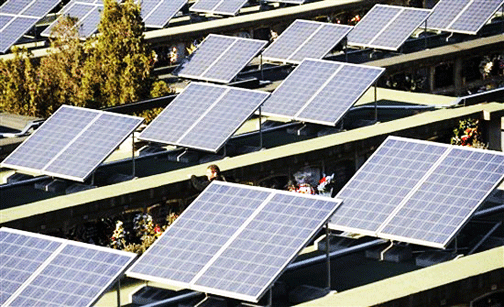 Trading solar-generated power between households to change the way consumers buy electricity, ABC News By consumer affairs reporter Amy Bainbridge, 18 Feb 16 The concept of bypassing major energy retailers to trade rooftop solar-generated electricity between households, small businesses and community groups is inching closer to reality.
Key points:
- Home-based energy generation grows in popularity
- CitiPower and Powercor, owners of poles and wires in Victoria’s power network, installing 18 solar battery power test sites
- Companies say their grid could help facilitate home-generated power in the future
- Community groups and homeowners eager to be part of Tesla solar battery trials
This month’s arrival of the Tesla battery in Australia is slated as a major shift in favour of consumers taking charge of their energy storage.
One Sydney entrepreneur has devised a system that would allow consumers to set up a virtual shop to trade their surplus energy with other households, small businesses and community groups in their grid.Jitendra Tomar, from the Sydney-based start-up Local Volts, said it was about changing the way consumers buy electricity. “Anybody, whether you’re big or small, whether you’re a farmer or residential person, whether you’re a high school or tennis club, can become an energy farmer,” he said……..
The Institute for Sustainable Futures at the University of Technology Sydney is conducting virtual trials of local energy trading at five sites along the eastern seaboard.
The Footscray Community Arts Centre in Melbourne’s Western suburbs is looking to become the first organisation of its kind to be powered by solar.
CEO and director Jade Lillie said the centre was running a crowdfunding campaign to combine with philanthropic donations to buy the panels and a battery. “We’re putting 30 kilowatts of solar panels on this roof, which is the warehouse, and 10 kilowatts of solar panels on Henderson House, which is the heritage-listed building,” she said. “What we’ll be able to do is actually through the Tesla battery is store that energy during the day as well and then use it in the evening so we’re less reliant on mainstream grid-based power sources.”
Ms Lillie says the centre aimed to save $15,000 in power bills each year. The project will also fund LED house lights for its performance space.
The Australian Energy Council, which represents retailers and generators, said it was early days, but there was work underway to study the implications of solar trading within the electricity grid.
With a large component of energy bills made up of network fees and charges, it remains to be seen how much cheaper energy bills will be if consumers are able to trade between each other. http://www.abc.net.au/news/2016-02-17/tesla-trading-solar-generated-power-change-electricity-market/7156934
New South Wales Riverina could become a solar energy hub
 Solar company sees potential for NSW Riverina to become renewable energy hub ABC Riverina, 16 Feb 16, A solar energy company believes the western New South Wales city of Griffith has the potential to market itself as a renewable energy hub. http://www.abc.net.au/news/2016-02-16/solar-company-envisages-nsw-riverina-energy-hub/7170684
Riverina Solar wants to build a $62 million, 30 megawatt solar farm at Yoogali near Griffith. The project has been shortlisted for funding from the Australian Renewable Energy Agency.
Director Steve McCall is hopeful a second solar farm project, also shortlisted for funding, will receive backing. He said it could be the start of a new industry for the region.
“We’ve been talking with Griffith council as well. We believe there’s a great opportunity for Griffith to become a renewable energy hub, or a region where you’ve got large scale solar here,” he said.
“That would hopefully potentially attract universities coming in and doing studies. “We’re also looking at other options, potentially in the future of how solar or how other renewable energies could be attracted to the area.”
Information sessions about the Riverina Solar proposal will be held at the Griffith Regional Theatre on Tuesday and Thursday.
Mr McCall said he would like to have the project’s environmental impact statement completed by the end of the month, and is hopeful the solar farm may be approved by mid-year.
“Griffith has an excellent substation based at Yoogali and it has just recently been upgraded over the last few years, so it has sufficient capacity to be able to connect into that site without a great deal of further upgrade,” he said. Mr McCall said the project would not be affected by the grants process. “We’ve got a number of different, interested offtakers and so once we establish that and finalise that aspect of it, that completes the commercial aspect of the project,” he said.
“While the funding would be terrific, and it’s only a small portion of the project, it doesn’t look like it would jeopardise our project going forward in any sense.”
BENEFITS OF SOLAR FAR OUTWEIGH THE RISKS OF NUCLEAR
 Solar Citizens calls on the South Australian Government to harness the sun to generate low-cost clean energy and kick-start jobs and economic growth rather than becoming a dumping ground for an expensive, toxic nuclear waste.
The findings come as new polling released today shows a majority of voters are more likely to give their vote in the upcoming election to a party supporting ambitious goals and innovation for solar”[1]
The preliminary findings of a Royal Commission into nuclear claim that
-
An expansion of uranium mining is “not the most significant opportunity” to develop South Australia’s economy
-
“It would not be commercially viable to generate electricity from a nuclear power plant in South Australia in the foreseeable future.”
-
Storage and disposal of nuclear fuel waste is “likely” to deliver economic benefits to the State.
“We welcome the Commission’s findings which shows that nuclear mining and power generation is not the solution for South Australia”, said Claire O’Rourke, National Director of Solar Citizens.
“The best way the South Australian Government can support clean energy is supporting households in making the transition to solar energy and reducing people’s power bills. The South Australian Government is leading other states with a target of 50% renewable energy by 2025 and has commissioned research which shows it can get to 100% renewable energy as part of its target of net zero carbon emissions by 2050 ”
“One in four households in South Australia now has rooftop solar and the power they generate from the sun supplies about five per cent of the state’s energy demand.
“These 190,000 South Australian solar homes are only the beginning of the global solar boom, as affordable, reliable home battery storage places lowering the cost of power bills in reach for the majority of households.
“It is important that the State Government makes sure it adopts policies that encourage further investment in renewables, and the jobs this will create.
“The state’s abundant solar resources have already caught the attention of US solar thermal giant SolarReserve, which in November made a bid to build Australia’s first-ever solar thermal plant with storage in Port Augusta. https://drive.google.com/file/d/0B9kNVP3oyB-cQ2NQbnROWVlrUjIxbW1TaUhxTlpKZlNkNHNB/view?usp=sharing

Utility scale solar projects to benefit from ARENA funding as solar costs have fallen
 Cost cuts set solar on track to capture share of RET http://www.smh.com.au/business/energy/cost-cuts-set-solar-on-track-to-capture-share-of-ret-20160209-gmp73f.html February 11, 2016 Angela Macdonald-Smith Energy Reporter Rapid cost reductions have put solar power on a fast-track to capturing at least some of the 2020 Renewable Energy Target market for large-scale projects and are attracting a new breed of player into the local sector.
Last month’s short-listing by the Australian Renewable Energy Association of 22 projects for funding under its $100 million grant round featured a number of names new to Australia, as well as many taking their first foray into solar. Indian conglomerate Adani, better known for its controversial Galilee coal ambitions, also revealed its local solar ambitions this week.
Australia’s wealth of sunshine sets it up to become a leading player in large-scale solar, according to ARENA chief executive Ivor Frischknecht, in a logical follow-on from our enthusiastic adoption of rooftop solar.
Frischknecht points to startling progress on the cost front over the past few years for utility-scale solar projects. Continue reading
Telstra to rollout solar and battery storage technologies
 Telstra takes on energy utilities with home solar and storage plan, Independent Australia Giles Parkinson 11 February 2016 Telstra’s rollout of solar and battery storage looks to be a game-changer in the home energy market. RenewEconomy‘sGiles Parkinson reports.
AUSTRALIA TELECOMMUNICATIONS giant Telstra plans to accelerate the rollout of solar and battery storage technologies, and is looking to offer home energy services to millions of consumers in the first sign it will take on the major energy utilities.
Telstra has established a dedicated project team to be led by Ben Burge, the feisty CEO of Powershop and Meridian Energy Australia,which has made major inroads into the Australian energy oligopoly, and which has been a keen proponent of wireless technology and smart-phone apps.
The arrival of a giant corporation such as Telstra into the home energy market signals massive change in the industry, as new technologies such as solar and battery storage, and the “internet of things” offer new avenues to the consumer market.
Telstra is flagging the possibility of offering home energy services – including solar and battery storage – as part of its bundled services that includes internet and telephone.
Telstra’s head of new business, Cynthia Whelan says in her corporate blog:
We see energy as relevant to our Connected Home strategy, where more and more machines are connected in what is called the Internet of Things.
We are looking at the opportunities to help customers monitor and manage many different aspects of the home, including energy……..
Analysts have predicted for several years now that the traditional energy industry would come under attack from new players such as telcos, and IT giants such as Google.
Mark Coughlin, the head of utilities at PwC, says electricity utilities, are facing their “Kodak moment” as the emergence of rooftop solar, in combination with battery storage and smart software, shift the power from the utility to the customer.
And, he says, telcos such as Telstra are better at consumer service than energy utilities, which will struggle to maintain their right to survive. …….https://independentaustralia.net/environment/environment-display/telstra-takes-on-energy-utilities-with-home-solar-and-storage-plan,8666
Adani going for solar energy project in Australia
Adani pursuing solar energy project February 10, 2016 Indian mining giant Adani is pursuing a solar power project in Australia after years of delays in building a mega coalmine in central Queensland.
The company has confirmed it is chasing investment opportunities in Australia’s solar generation sector, saying it is focusing on potential opportunities in Queensland and South Australia……. http://www.brisbanetimes.com.au/queensland/adani-pursuing-solar-energy-project-20160210-gmqj19.html#ixzz3ztbMquoa
In bushfire season, Solar microgrids and batteries are safer than conventional grid
 Turner says his company has been in productive talks with Victorian energy minister Lily D’Ambrosio over the prospect of subsidising Zen Energy systems capable of running as a localised backup for periods when the grid needs to be switched off
|
Solar microgrids and batteries could prevent another Black Saturday bushfire, Guardian, Max Opray 9 Feb 16, The cause of the Kilmore East fires that contributed to Victoria’s 2009 Black Saturday bushfires was found to be an ageing SP AusNet power line
Smaller sustainable energy systems are a better option than trying to maintain ageing Australian energy infrastructure, say experts On 7 February, Australia solemnly marked the anniversary of an electrical fault.It was on this date in 2009 that Melbourne endured its hottest conditions on record – a sweltering 46.4C. To make matters worse, hot winds blasted through the region at speeds in excess of 100km/h. In Kilmore East, just north of Melbourne, a critical failure in a 43-year-old power line caused bursts of 5000C plasma to arc out and ignite the tinder-dry vegetation in the gully below. Fanned by such extreme winds, the fast-growing inferno would by the end of the day be responsible for the majority of the 173 lives lost in the dozens of fires that engulfed Victoria on Black Saturday, Australia’s worst bushfire disaster. Several of the other blazes that day were started by felled power poles and other electrical issues. This was also the case for many other fires before and since, including Australia’s previous-worst bushfire tragedy, the 1983 Ash Wednesday fires, which claimed 75 lives. Richard Turner, director of South Australian renewable energy powerhouse Zen Energy, has a plan to stop such a thing happening again. Continue reading |
South Australia Riverland farmers get new crop – harvesting the sun
 Solar venture in SA Riverland aims to make abandoned crop land productive again, ABC News, 10 Feb 16 By Isabel Dayman Solar energy might be a saviour for some South Australian Riverland fruit growers who abandoned their crops and land during severe drought late last decade.
Key points:
- Solar test site has 800 panels on the roof of an old storage depot
- Proponent Mark Yates says all profits would stay in the local community
- Many fruit blocks were abandoned at the end of last decade due to severe drought
A test site with 800 solar panels on the roof of an old storage depot at Renmark has been set up by Yates Electrical Services director Mark Yates to show what might be possible.
“We wanted to use this as a test case to see what the viability of the small-scale generation plants could be and whether they could be implemented in a community,” he said.
“We’d like to get 12 months of full data — that way we can draw a really clear picture and be really transparent to show people what the costs are and what the returns are.”
Mr Yates said the owners of vacant fruit blocks might be able to generate a profit from the abandoned land, which he said would be preferable to letting big investors set up large-scale solar operations and take any profits elsewhere.
“With our small-scale solar farms, 100 per cent of the profits that the system generates can be retained by the local community,” he said.
“Traditional methods of generating income are always going to [be there], but I suppose this is just a way we can introduce a completely new market to the area.”…….. The Renmark solar test site is expected to start generating power from the region’s abundant sunshine by the end of this month, and it is planned to be sold into the electricity grid. http://www.abc.net.au/news/2016-02-08/solar-plan-a-ray-of-hope-for-riverland’s-former-fruit-growers/7149150
Queensland disused coal power site could be solar station this year
Solar power station in Collinsville could be under construction this year, ABC News  (includes Audio) 2 Feb 16 QLD Country Hour By David Sparkes Construction of a $100 million solar power station in Collinsville, North Queensland, could begin this year if a deal is struck for selling the electricity.

Ratch Australia plans to build the station on the site of the disused coal power station it purchased in 2011.
Business development executive general manager Anthony Yeates said the company had been short-listed in an tender process with Ergon Energy and, failing that, there were other potential clients for an off-take agreement.
“The bulk of the development activities are all completed, so it’s a fairly advanced project and it’s really just awaiting us to close out some of the important commercial arrangements,” he said………http://www.abc.net.au/news/2016-02-02/ratch-australia-collinsville-solar-project-could-begin-this-year/7132424
1 This month

of the week – Australians for War Powers Reform (AWPR)
To see nuclear-related stories in greater depth and intensity
 Antinuclear