Energy self sufficiency- battery storage and solar getting cheaper
The latest report shows that almost two-thirds of Australians want to be self-sufficient in meeting their energy needs and while battery systems will not give complete independence for most consumers, it does offer a bit more control.
Costs of battery storage systems have been falling at a rapid rate and forecasts are for this trend to continue as more and more households adopt them. It is expected that prices will halve again within the next five years.
Solar panels have also gotten cheaper, with the Climate Council reporting a 75 per cent drop in price over the past five years.
Companies such as Reposit, an ACT-based start-up, are using the grid’s infrastructure to allow people to trade their energy directly on the wholesale market, effectively acting like a mini power station in everybody’s backyard.
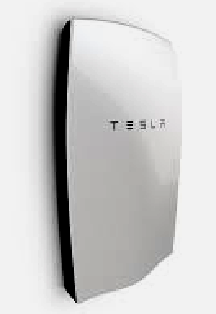 Explained: The Tesla Powerwall and what it means for Australia’s energy market, ABC News, 2 Feb 16, The Powerwall, a lithium-ion battery system designed to store electricity generated from rooftop solar panels, is widely considered to be a game-changer for the electricity industry. 7.30 has asked consumer group Choice to crunch the numbers. Here’s what they found.
What is the Tesla Powerwall?While the concept of a home battery storage system is not new to Australians, the Tesla Powerwall unit has been highly anticipated. Continue reading
Canberra’s Williamsdale Solar Farm approved
Green Light For Canberra’s Williamsdale Solar Farm http://www.energymatters.com.au/renewable-news/williamsdale-solar-farm-em5315/ February 1, 2016 Energy Matters
The proposal was “called in”, meaning the Minister assumed the role of assessment manager for the development application. The Minister is able to call in a project if a development is considered a major policy issue, has a major effect on government objectives and provides a substantial benefit.
“Once completed, the solar farm will power more than 2500 homes, contributing to the Territory’s renewable energy and greenhouse gas reduction targets,” said Minister Mick Gentleman.
“Under the Territory’s greenhouse gas reduction strategy, renewable energy will account for roughly 73 per cent of the emission reductions needed if the ACT is to reach its legislated 2020 target.”
The solar farm will be situated on farmland near the Monaro Highway and Angle Crossing Road in Tuggeranong, at a site just a couple of hundred metres from the ACT’s border with New South Wales. The new solar power station will be around 10 kilometres from the 24MW Royalla Solar Farm.
Minister Gentleman stated he has imposed strict conditions on the development as part of his decision, in order to address concerns raised in four submissions by members of the community. One of those conditions is that non-glare materials be used. Appropriate landscaping works will also be carried out and sufficient bushfire management measures put in place.
Even with the conditions imposed on the Williamsdale project, some still aren’t happy the project is going ahead and feel the consultation process was lacking.
The Williamsdale site wasn’t the first choice for the solar farm. It was originally proposed to be built adjacent to Uriarra Village. However, many Uriarra Village residents were strongly opposed to the project; primarily on the basis of aesthetics and what they stated was a lack of procedural fairness.
The ACT has a legislated target of 90% renewable energy by 2020; a goal it appears it will reach. In August, ACT Labor proposed an even more ambitious renewables target – 100% by 2025.
Queensland moves to solar energy in a planned way
 Queensland searches for a solar fix, THE AUSTRALIAN, JANUARY 18, The acid test for governments, here and everywhere, in the post-Parisian energy environment is turning talk in to meaningful action……Annastacia Palaszczuk’s regime in Brisbane is embarking on a year in which it must put its policies where its mouth was in January 2015, when it scored an upset win in the state elections.
Committed to being the nation’s standard bearer on advancing solar power, the government has sensibly thrown the ball to its new Productivity Commission before it acts…..
The commission’s official role is to come up with a “fair price for solar exports” — that is, the surplus power from householders’ rooftop PV arrays flowing in to the southeastern Queensland grid.
The commission’s draft report is due next month and the final version in May.
Its impact will be felt beyond Queensland’s borders as policymakers elsewhere also have a keen interest in riding the wave of solar enthusiasm that sees the number of Australian homes with PV on their rooftops creeping up towards 1.5 million, a penetration rate of 16 per cent nationally…….
Planned New South Wales solar farm may have Aboriginal stakeholders
 Wind company seeking Aboriginal stakeholders for possible solar farm development http://www.abc.net.au/news/2016-01-13/wind-company-seeking-aboriginal-stakeholders-for-possible-solar/7086478 By Kerrin Thomas The company behind the White Rock Wind Farm, to be located in northern New South Wales, is considering developing a solar farm nearby and is seeking Aboriginal stakeholders to assist in preparing a heritage assessment.
Construction of Stage 1 of the White Rock Wind Farm is expected to start soon, at the site 24kms west of Glen Innes.
70 wind turbines will be constructed initially, expected to produce enough energy to power 75,000 homes a year.
The proponent, Goldwind Australia, has now engaged a company to conduct an assessment of the Aboriginal heritage impacts of a potential solar farm adjacent to the wind farm site.
The company is proposing a 20 to 25 MW facility that would occupy an area of about 50 hectares, with power to be exported through the wind farm’s substation.
NGH Environmental has been engaged to seek information from Aboriginal Stakeholders with cultural knowledge of the Maybole/Spring Mountain area. The purpose of the consultation with Aboriginal people is to assist the proponent in the preparation of the Aboriginal heritage assessment.
Those involved in the process will be required to assist in the determination of the cultural significance of any Aboriginal objects or places within the subject area.
Registrations close later this month.
Queensland could get huge boost for its solar industry
 Queensland solar farms in the race for federal funding http://www.couriermail.com.au/news/queensland/queensland-solar-farms-in-the-race-for-federal-funding/news-story/54e6f7e5880087d774e2661f94898c12 January 15, 2016 JESSICA MARSZALEK The Courier-Mail THE Sunshine State could be set for a huge boost to its solar industry with 10 large-scale solar farms vying for $100 million in Federal Government grants.
The projects earmarked for Queensland, including in Dalby, Proserpine, Oakey, Hughenden, Longreach and Ipswich, are among 22 nationwide invited to make applications to the Australian Renewable Energy Agency (ARENA).
Environment Minister Greg Hunt said that the projects together represented a potential $1.68 billion investment in solar.
“The shortlisted proposals were chosen from a very strong field, demonstrating Australia is ready to invest in utility-scale renewable energy options suited to the 21st century,” Mr Hunt said.
Large-scale solar photovoltaic power is in its infancy in Australia with only three projects commissioned and three more under consideration. It is far fewer than in comparable international markets, with ARENA hoping the technology becomes more competitive in the future as costs come down and government support won’t be necessary.
South Australian launch for Aboriginal owned solar energy storage system
The products are being launched at Tandanya Aboriginal Cultural centre in Adelaide on Wednesday 2 September. Ms Oberon said Adelaide was chosen for the launch because of the council’s Sustainable City Incentive Scheme, which provides up to $5000 towards the cost in installing solar PV storage across the residential, business, education and community sectors. Funding for the program also has financial support from the South Australian government.
“We felt it was important to acknowledge the South Australian government and the City of Adelaide for such a forward-looking and innovative scheme,” Ms Oberon said.
The company is also hoping other state governments and councils will be encouraged to take up the idea of supporting the uptake of renewable energy storage.
The company’s core mission is based on the fundamental Aboriginal approach of stewardship of the earth and its resources. This means needing to shift out of high-emissions fossil-fuel derived energy.
Aboriginal-owned energy company one-upping Tesla By Willow Aliento, The Fifth Estate Friday 8 January 2016 The renewable energy storage game is about to be disrupted, with Australian Aboriginal-owned company AllGrid Energy announcing the launch of WattGrid, a new 10kWh solar energy storage system it says is around 30 per cent cheaper than the Tesla Powerwall.
Customers also don’t have to wait until 2016. Spokeswoman for AllGrid, Deborah Oberon, said the company expected to be making its first deliveries in the next two to three months.

The $11,999 WattGrid unit comprises an aluminium cabinet containing tubular lead acid gel batteries, and a hybrid 5kW solar inverter with battery management system that has load share capability with the grid and uninterrupted power supply capability.
The unit is also accompanied by a software app, WattsHappening, that allows users to view real-time information and interface with the system.
Beta testing has shown the unit can help solar owners maintain an energy supply profile that can be matched to the demand profile, potentially rendering drawing grid power unnecessary.
The Queensland-based company is also releasing another product it has developed, the PortaGrid. This is an independent unit comprising solar panels, storage, UPS, inverter and outlets that is suitable for remote and off-grid locations, as well as emergency situations.
The units can be supplied with an inbuilt weather station that will automatically close up the panels in the event of a severe weather hazard such as a cyclone. Continue reading
Popularity of Western Australia’s rooftop solar makes privatisation of electricity assets unlikley
 WA’s rooftop solar so popular power privatisation not an option, says expert, Guardian, Calla Wahlquist, 6 Jan 16 Prof Philip Jennings, a renewable energy expert, says investors would be unlikely to be interested in unprofitable power networks Western Australia would not be able to privatise its electricity assets “even if they gave it to them for nothing” because the popularity of rooftop solar panels has made state-owned power stations unprofitable, a renewable energy expert has said. Continue reading
Leeton, New South Wales: plan for multimillion dollar solar farm
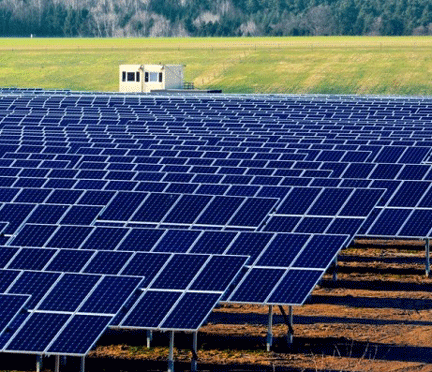 proposed for Wumbulgul http://www.abc.net.au/news/2016-01-07/wumbulgul-solar/7072604 A $90m solar farm is proposed near Leeton in the New South Wales Riverina, to help power a new rail freight hub in the region. Photon Energy has been in discussions with Leeton Shire Council since 2012 about a solar development.
It’s now asked the state government to consider a proposal for a 100 megawatt plant, with the ability to double that output, next to the recently opened Western Riverina Intermodal Freight Terminal at Wumbulgul.
Documentation lodged with the Planning Department states the solar farm would be on a 140 hectare site on the Griffith Road and would take around a year to build.
Photon estimates the farm would have a life of around 30 years, after which infrastructure could be updated or the site rehabilitated.
The application says feedback from initial discussions in August is positive and a community consultation plan will be developed.
The Department is now preparing its requirements for the solar project.
Solar Australia: 1.5 Million+ Solar Power Systems Installed
1.5 Million+ Solar Power Systems Installed In Australia http://www.energymatters.com.au/renewable-news/solar-pv-australia-em5278/ January 5, 2016Energy Matters More than 23.2 million solar panels are now installed in Australia – a module for every man, woman and child in the nation.
According to solar consultancy firm SunWiz, Australia registered its 1,500,000th solar power system on December 22, 2015. More than 4.65 gigawatts of sub-100kW capacity systems are generating clean electricity across the country and saving their owners a bundle on power rates.
SunWiz states Australia boasts the highest number of installations per capita in the world and the equivalent of 18% of Australian households own a PV system.

“Australia ranked 8th in the world for capacity installed in 2014, and is likely to be a top-10 country for installed capacity in 2015,” says SunWiz.
State-wise, while Queensland has the most solar power systems in the country ( 450,000+), South Australia has the highest proportion of households with PV installed (30%).
Solar PV is now contributing more than 2.5% of Australia’s electricity requirements. While that may not sound like a huge amount, it’s very valuable electricity as solar panels typically produce the most power during periods coincide with high demand. This reduces the need for added mains grid infrastructure and the incidence of higher cost generation from peaking power stations; the cost of which can exceed $13,000 per megawatt-hour ($13 a kilowatt hour).
For 2016, SunWiz predicts the residential solar market will slightly contract, the small and mediumcommercial solar sector will grow 10-20% and the large-scale commercial segment will also experience significant growth as companies become increasingly aware of how much can be saved on energy costs by going solar.
SunWiz doesn’t expect much in the way of utility scale projects being brought online in Australia this year.
“… the focus will be upon earlier stages of project development, with utility-scale project deployment starting in earnest in 2017 and growing from there.”
The utility scale sector went into limbo during the drawn-out battle over Australia’s Renewable Energy Target; instigated by now ex-Prime Minister, Tony Abbott. After dragging on for eighteen months, the issue was finally settled in June 2015; ensuring sunnier days ahead for the sector.
Rooftop solar power in Western Australia produces more electricity than the State’s biggest power turbine
 Rooftop solar producing more energy than WA’s biggest turbine, ABC Radio AM 5 Jan 16 By Anthony Stewart Rooftop solar panels in the South-West Interconnected System (SWIS) in Western Australia are now producing as much energy as the state’s largest power turbine, according to research from Curtin University.

SWIS stretches from Kalbarri north of Perth to Ravensthorpe in the state’s south, taking in the Perth metropolitan area. Curtin University sustainability professor Peter Newman said 20 per cent of homes across the grid have rooftop solar panels installed.
“We are in the extraordinary position of saying that Perth [SWIS] now has rooftop solar as the largest supplier of electricity, it’s the biggest power station in WA,” he said.
“It’s nearly 500 megawatts and it’s growing rapidly, by 2020 we could have half of Perth’s [SWIS] households with rooftop solar.”……
Professor Newman said the state’s electricity utilities needed to rapidly adapt to the growth in solar.
“They didn’t predict it, they have all these contracts for coal and gas that go 20 or 30 years and they have even got an old power station out of mothballs, fixed it up, but never turned it on,” he said.
“Despite the boom times we actually reduced our power consumption during this period because people are just not needing it if you’ve got the PV’s [photovoltaic] on the roof.”
Energy utility Synergy has been contacted for comment.
Batteries to drive solar boom….. http://www.abc.net.au/news/2016-01-04/rooftop-solar-panels-bigger-than-biggest-turbine-wa/7066240
New Directive to Clean Energy Finance Corporation (CEFC) supports renewable energy investment
 New clean energy investment mandate a shift from policy proposed by Abbott
Directive to CEFC to focus on innovative and emerging technologies will enhance support for windfarms and small-scale solar projects, Guardian, Shalailah Medhora, 24 Dec 15. The Clean Energy Finance Corporation (CEFC) has been directed to focus on innovative and emerging technologies, reversing a mandate by the former prime minister Tony Abbott that would have specifically blocked funding for windfarms and small-scale solar projects.
The mandate came into effect on Thursday, with a new clause outlining the shift in focus.
“As part of its investment activities in clean energy technologies, the corporation must include a focus on supporting emerging and innovative renewable technologies and energy efficiency, such as large-scale solar, storage associated with large- and small-scale solar, offshore wind technologies, and energy efficiency technologies for cities and the built environment,” the clause said. “ This will in turn increase the uptake of emerging technologies such as large-scale solar and energy efficiency.”
The investment mandate is not exclusive, meaning that established technologies can still be funded, and not retrospective, so projects that have already been funded will not be affected.
“The CEFC will therefore continue to pursue a diverse range of investment activities that are within the scope of the CEFC Act and this new investment mandate,” a statement by the body said.
“Together, the new investment mandate and the accompanying explanatory statement provide guidance on how the CEFC should approach investment in mature and established technologies, such as conventional onshore wind and conventional hydro,” it said. “It is the government’s expectation that, in many circumstances, projects involving mature technologies should be able to secure finance from commercial financing sources.”
The mandate is a shift from what Abbott proposed in July, when he said the body should no longer fund small-scale solar projects such as rooftop panels and wind technology…….
The CEFC chairwoman, Jillian Broadbent, wrote to the environment minister, Greg Hunt, and the finance minister, Mathias Cormann, welcoming the new mandate. She said it was an “appropriate approach that allows the CEFC to support the Australian government policy priorities while still allowing a measure of investment flexibility”. …….http://www.theguardian.com/environment/2015/dec/24/new-clean-energy-investment-mandate-a-shift-from-policy-proposed-by-abbott
Broken Hill has Southern hemisphere’s largest solar energy project
The industry is looking for assurance that Prime Minister Malcolm Turnbull is more climate-friendly than his predecessor, Tony Abbott, who said coal was “good for humanity.”
How Broken Hill became a solar power trailblazer, SMH December 22, 2015 James Paton Broken Hill spawned the world’s largest mining company and generated more than $75 billion in wealth. Now as its minerals ebb, Australia’s longest-lived mining city is looking to tap a more abundant resource.
On the sun-baked edge of the outback city, 700 miles west of Sydney, a solar farm the size of London’s Hyde Park shimmers like an oasis – its panels sending enough electricity to the national grid to power 17,000 homes a year.
Combined with a sister plant, the AGL Energy and First Solar project is the largest of its type in the southern hemisphere. Clean energy advocates are counting on the 140-hectare development to make Broken Hill, which at one time boasted the world’s most successful silver mine, a trailblazer once again. Continue reading
Australia leads the world in home rooftop solar
 Australia’s Small-Scale Rooftop Solar Installations Hit 4.59 GW In 2015 http://cleantechnica.com/2015/12/29/australias-small-scale-rooftop-solar-installations-hit-4-59-gw-in-2015/ by Glenn Meyers Propelling a global boost in renewable energy, Australia’s Clean Energy Regulator has reported small-scale rooftop solar totaled 4.59 GW in 2015. As reported by pv-magazine, data released by the Clean Energy Regulator shows 119,000 new small-scale PV installations have taken place in 2015. While not as sizable as 2014, this number distinguishes Australia with the highest portion of residential buildings with rooftop PV globally.
The Australia small-scale rooftop solar numbers also show the nation has maintained its world lead the world in deployment of rooftop solar. Counting a December 1 calculation, Australia has reached 1.49 million small-scale PV installations. This total is based on data released by this country’s Clean Energy Regulator.
The Clean Energy Regulator was established on 2 April 2012 as an independent statutory authority by the Clean Energy Regulator Act 2011, and operates as part of the Environment portfolio.
Clean Energy Finance Corporation (CEFC) estimates the nation will have another 300 MW of large-scale PV by the end of 2015. “Renewable energy is essential to Australia’s future economic growth and prosperity in a carbon-constrained world and to helping lower Australia’s carbon emissions. The transformation of Australia’s energy sector will require around $100 billion in investment in the renewables sector over the period to 2050.”
The CEFC Act has provided that a minimum of 50% of the CEFC portfolio be invested in renewable energy technologies, related enabling technologies and hybrid technologies that integrate renewable energy technologies by 1 July 2018.
CEFC reports on Australian solar potential
The CEFC has stated, “With the highest average solar radiation per square metre of any country in the world, and substantial cost reductions in solar technology over recent years, there is significant future opportunity for growth in deployment of solar technologies in Australia.”
CEFC has invested in both large and small-scale solar projects using solar photovoltaics. It reports the demand for solar financing continues to be strong, with solar projects valued over $3 billion.
The clean energy report shows a solid foundation for small-scale solar is in place.
Queensland’s Fraser Coast Region could bloom with solar farm, says Councillor
Solar Farm ‘Common Sense’ For Queensland’s Fraser Coast December 30, 2015 Energy Matters “There are many issues on the Fraser Coast Region; none of which are more important than rising energy prices,” says Cr. Loft; who also points to issues with unreliable delivery of electricity.
The councillor states the construction of a solar farm within the region’s boundaries could provide savings for Council of around 15%, freeing up hundreds of thousands of dollars in working capital that could be redirected to other community needs.
In addition to savings, creating jobs and a more robust electricity supply, Cr. Loft says benefits for the region would include “the ability to portray the Fraser Coast Council as an environmentally friendly and green community, compatible with our magnificent natural environment.”
The Fraser Coast sits within the Great Sandy Biosphere, which is part of a world network of Biosphere Reserves.
The proposed feasibility study would include profiling the electricity consumption of Council and major consumers of electricity in the Shire; determining total Shire electricity consumption, potential locations for the facility and the most appropriate technology, e.g. solar panels, CPV or solar thermal + storage.
Cr. Loft believes now is a good time for a major solar power project……..
The Fraser Coast Council incorporates Fraser Island – the world’s largest sand island – and towns including Maryborough, Burrum Heads, Hervey Bay and Brooweena.
Queensland is Australia’s leading state in terms of total solar capacity and it also has the highest number of small scale solar power systems – more than 460,000 installations. http://www.energymatters.com.au/renewable-news/fraser-coast-solar-em5271/
Solar thermal plant at Forbes, New South Wales,has great potential
“This sort of technology will put massive amounts of money into regional Australia if it takes off “.
“It could be very significant here in Australia but also, there are significant overseas opportunities for Vast where Australia could earn export dollars.”
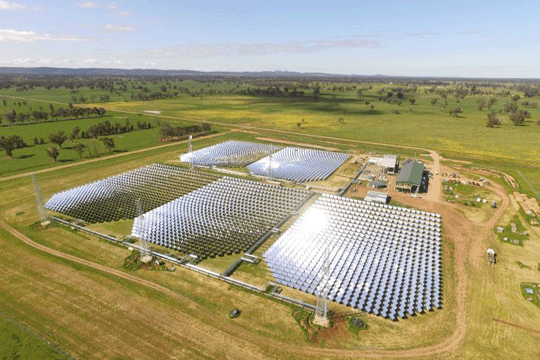
Developer of $20 million Australian-first solar thermal pilot plant predicts sunny future under Turnbull ABC Central West By Melanie Pearce 23 Dec 15 After hours of steady rain, there is not a ray of sunshine in sight and the mud is thick on the ground at the $20 million Jemalong pilot solar thermal plant near Forbes in central west New South Wales.
But in a way, the fact it is overcast helps to explain the importance of this technology, which enables both capture and storage of energy from the sun, according to James Fisher, chief technology officer of Vast Solar.
The engineer, who formerly worked in the fossil fuel industry and said he never thought renewables could compete with coal, now has a much sunnier outlook on the subject.
Technology behind solar thermal power plant
The Australian company has developed what it hopes will be a low-cost, high-efficiency Concentrated Solar Power (CSP) generation technology.
The Jemalong pilot plant will be ready for commissioning in mid-January and is designed to prove the technology works. Continue reading
1 This month

of the week – Australians for War Powers Reform (AWPR)
To see nuclear-related stories in greater depth and intensity
 Antinuclear