South Australia power networks cannot impose tariff on solar homes
Federal Court rejects SA Power Networks’ proposed charge on solar-powered households http://www.abc.net.au/news/2015-12-23/federal-court-rejects-solar-household-charge/7050600 The Federal Court has dismissed an appeal by SA Power Networks to charge a tariff on homes with solar panels.
The electricity distributor wanted it to approve a tariff of about $100 a year.
It argued that solar-powered houses have different energy consumption patterns and are effectively subsidised by houses without panels.
SA Power Networks took the matter to court when the Australian Energy Regulator rejected the proposed charge.
The distributor said that it was “disappointed by the appeal decision” and maintained that its application was about “fair and equitable cost-sharing among customers”.
“This was not about additional revenue,” SA Power networks said in a statement.
Solar farm for Parkes, could double as sheep farm
French company plans 240ha solar farm for Parkes http://www.abc.net.au/news/2015-12-18/240ha-solar-farm-planned-for-parkes/7035218 Landholders adjoining a proposed solar farm near Parkes in central west New South Wales are being assured they will not be adversely affected by the development. The proponent Neoen is planning a 240-hectare plant west of the town that will include about 245,000 solar panels.
Cattle producer John Smeaton plans to lease his land to the company and says planting trees around the site will address any concerns about glare.
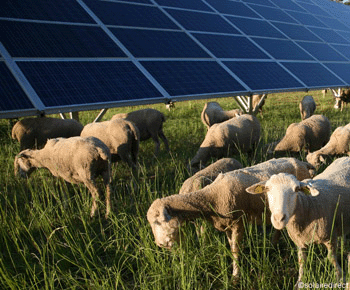 He said he was confident the area would remain productive and become ideal for grazing sheep.”These panels, cattle would wreck them, the only thing they could run there could be sheep,” Mr Smeaton said.
“Some of the other neighbours might be interested in running sheep there.
“From a fire prevention point of view I think it’s necessary for something to take the grass down, because it’s fertile farm land and the grass can grow a metre or more high and it grows hot when it burns.”
The company plans to create 120 jobs during construction if it is successful in getting grant funding and planning approvals next year. Mr Smeaton said it would also have tourism potential.
Australian Renewable Energy Agency (ARENA) funding new solar technology to reduce solar costs
 ARENA supports new, cheaper solar technology to reduce cost of renewable energy in Australia, IBT By Darwin Malicdem on December 07 2015 The Australian Renewable Energy Agency (ARENA) is aiming to reduce the cost of renewable energy in the country by providing a funding boost to an innovative solar cell technology. The new perovskite solar cells could significantly be cheaper than and as efficient as existing solar cells.
ARENA will be providing about $892,000 to CSIRO for the development and application of guidelines for assessing the performance of the perovskite solar photovoltaic (PV) cells. The materials of perovskite can be used in solar cells with a less cost and labour intensive process compared to silicon.
ARENA aims to accelerate the development of perovskite solar PV cells in the country. “If perovskite solar cell technology matures to commercialisation, it has the potential to provide cheaper power from the sun,” said ARENA CEO Ivor Frischknecht.
CSIRO is planning for new methods and guidelines applicable to perovskite solar cells, as international standards to measure solar PV cell performance are only applicable for silicon wafer cells…….http://www.ibtimes.com.au/arena-supports-new-cheaper-solar-technology-reduce-cost-renewable-energy-australia-1490089
Increasing popularity of community solar energy projects in Australia
 Small is beautiful: the community solar projects taking on big energy, Guardian, Annie Kane, 8 Dec 15 A brewery, a bowling club and a library join forces with a new type of energy supplier to save money and become more sustainable
What do Sydney’s Young Henrys brewery, Shoalhaven Heads’ Bowling and Recreation Club, and Bendigo library have in common? They’re all hosts to some of Australia’s first solar power projects funded and run by local people in community energy groups.
Projects like these are becoming increasingly popular in Australia. The Coalition for Community Energy (C4CE) 2015 national community energy strategy states that there were 19 community energy groups operating in early 2015, with a further 59 projects in development. Continue reading
Australian Renewable Energy Agency (ARENA) funds CSIRO’s solar energy initiative
ARENA supports new, cheaper solar technology to reduce cost of renewable energy in Australia http://www.ibtimes.com.au/arena-supports-new-cheaper-solar-technology-reduce-cost-renewable-energy-australia-1490089 By Darwin Malicdem on December 07 2015 The Australian Renewable Energy Agency (ARENA) is aiming to reduce the cost of renewable energy in the country by providing a funding boost to an innovative solar cell technology. The new perovskite solar cells could significantly be cheaper than and as efficient as existing solar cells.
ARENA will be providing about $892,000 to CSIRO for the development and application of guidelines for assessing the performance of the perovskite solar photovoltaic (PV) cells. The materials of perovskite can be used in solar cells with a less cost and labour intensive process compared to silicon.
ARENA aims to accelerate the development of perovskite solar PV cells in the country. “If perovskite solar cell technology matures to commercialisation, it has the potential to provide cheaper power from the sun,” said ARENA CEO Ivor Frischknecht.
CSIRO is planning for new methods and guidelines applicable to perovskite solar cells, as international standards to measure solar PV cell performance are only applicable for silicon wafer cells. The new guidelines would be applied at the ARENA-supported PV Performance Laboratory in Newcastle, Frischknecht said. The lab would help Australian researchers test perovskite samples in the country instead of conducting tests overseas, which will boost research and reduce the risk and costs of the project.
The $2.4-million project for perovskite solar cells is expected for completion in November 2018. ARENA has already received letters of support and offers of cell samples from members of the Australian Centre for Advanced Photovoltaics and international research agencies.
The test results will be validated by internationally accredited laboratories, and CSIRO will work with overseas counterparts for the development of best practice methods suitable for different research laboratory environments, Frischknecht said.
Big solar investment on hold because of Australian govt’s policy uncertainty
 Chinese solar firm says policy instability holding back Australian investment, Guardian, Lenore Taylor in Paris, 5 Dec 15 Hareon Solar executive says firm is considering a billion dollar investment in large scale solar within a year but policy stability, not subsidies, is needed. Chinese firm Hareon Solar is “actively” considering a billion dollar investment in large scale solar projects in Australia, but the stability of government climate policy is its major concern, a senior company executive has told Guardian Australia.
Jie Zhang, Hareon’s vice president of global business development said government subsidies were not necessary for the investment decision, to be taken within a year, but policy stability was required.
“Our only wish for government is a stable policy, don’t flip back and forth, of course we are concerned what has happened in the past in Australia with the renewable energy target,” he said in an interview at the Paris climate summit……
Solar is a 25 year investment. If a government can’t keep its policy stable for five years how can we inves,” he said.
Hareon solar is a major Chinese solar cell manufacturer and global investor in large scale solar projects, founded by Australian citizen Samuel Yang.
It has invested in solar projects delivering 700 megawatts of power inChina as well as big projects in Bulgaria, Romania and the United Kingdom and smaller projects in the US and Japan.
Zhang said investment decisions were driven by government subsidies, but now required strong demand and policy stability…..
The Australian Renewable Energy Agency has announced a large-scale solar competitive round, seeking bids from major solar PV project proponents for grants of up to $30 million from a $100mn program. The Clean Energy Finance Corporation has announced a complementary $250 million large-scale solar financing program.
Renewable energy investment in Australia froze in the early years of the Abbott government when the renewable energy target was under review. In the end in was wound back, but not abolished. http://www.theguardian.com/environment/2015/dec/05/chinese-solar-firm-says-policy-instability-holding-back-australian-investment
Moree solar farm operational by end of 2015
 Energy generation expected at Moree Solar Farm by year’s end, ABC News, 17 Nov 15
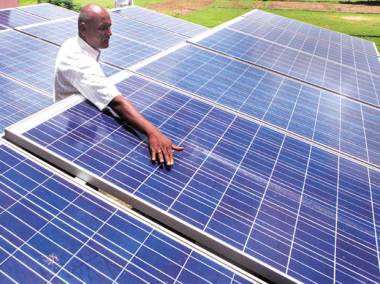
Work is nearly complete on the Moree Solar Farm with an expectation energy will be generated at the site by the end of the year. A spokesman for the company behind the project, Fotowatio Renewable Ventures, said there’s just a few tasks left to do on site.
“The Moree Solar Farm is entering the final stages of construction,” Technical manager Tom Best said.
“We’ve finalised the installation of the PV modules and the tracking system and we’re currently undertaking commissioning of the PV plant with a view to start generating energy by the end of the year.”
The project is led by FRV and has been funded with assistance of a $102 million grant from Australian Renewable Energy Agency and $47 million in debt financing from the Clean Energy Finance Corporation…….
The solar farm is expected to supply 15,000 homes. http://www.abc.net.au/news/2015-11-17/production-expected-at-moree-solar-farm-by-year27s-end/6946716
Canberra researchers seek information from solar home-owners
Solar panels installed on homes across ACT needed by researchers for local power study 666 ABC Canberra By Hannah Walmsley with Philip Clark, 19 Nov 15 Researchers at the Australian National University (ANU) are calling for volunteers across the ACT who have solar panels on their house to take part in a new study. This project will allow us to predict what will be fed into the grid at a particular time. Dr Christfried Webers
ANU researchers are collaborating with Data61’s Machine Learning Research Group — formerly National ICT Australia (NICTA) — to develop methods of forecasting power output from rooftop solar energy systems.
Dr Christfried Webers from the ANU’s College of Engineering and Computer Science said that while total energy output could be measured over long periods, little was known about changing energy output across the day. “What we need is to be able to predict how much energy will be produced over five minutes to 60 minutes,” he said.
“That’s necessary information for the energy market operator — they need information on what’s coming from hour to hour. “It’s also important for the local utility providers because they have a spinning reserve running and if they can anticipate an energy drop, they can ramp that up when they need to.”
Close to 13 per cent of households in the ACT have solar panels generating power. “If that reaches 30 per cent, it will become vital to predict what energy will be produced to ensure the stability of the grid,” Dr Webers said. How the weather can impact
Dr Webers said he hoped the project would allow his team to develop software to forecast the solar output from each suburb using low-cost data-logging devices installed on individual homes…….Canberra residents interested in participating in the project can register their interest with NICTA. http://www.abc.net.au/news/2015-11-17/volunteers-wanted-for-canberra-solar-panel-study/6946904
Total Environment Centre’s legal challenge to South Australia solar tariff proposal
Solar penalty tariff proposal for SA households subject of Federal Court challenge, ABC News By Candice Marcus, 16 Nov 15, An environment group wants the Federal Court to uphold the energy regulator’s decision to reject a penalty tariff on South Australian households with solar power.
The Total Environment Centre has intervened in a court case in which SA Power Networks is challenging the Australian Energy Regulator.
The regulator rejected a pricing proposal for households to face a solar tariff and a social tariff, which SA Power Networks said would have been directed toward helping low-income earners facing hardship in paying their bills.
It was estimated the solar tariff could cost the average solar-powered household about $100 annually.
The Total Environment Centre lodged submissions with the Federal Court urging it uphold the regulator’s rejection of the penalty pricing proposal.
Extra tariffs would be solar ‘disincentive’
Mark Byrne from the environment group said imposing additional tariffs would be a disincentive for people to install and use solar power.
“We’ve got half a million people living under solar roofs in South Australia already though and it’s going to negatively impact on them as well as making it less advantageous for new customers to install solar,” he said.
“Obviously in the long run we want to see more solar because it helps reduce greenhouse emissions as well as household electricity bills.”
He said SA Power Networks had a flawed argument.
“Their argument effectively is that solar customers should be paying more because they use less energy and the network is entitled to a fixed amount of revenue,” he said.
“The unfortunate thing about that is it discriminates against solar customers and will result in them paying about another $100 a year.
“What the network should be doing is introducing a tariff that affects everyone equally and recovers more of their revenue during those peaks, when they’re worried about the impact on prices because they have to build more to meet peak demand.”……..http://www.abc.net.au/news/2015-11-16/court-hears-challenge-on-sa-solar-penalty-tariff-proposal/6944870
Council approval for central Queensland solar farm near Baralaba
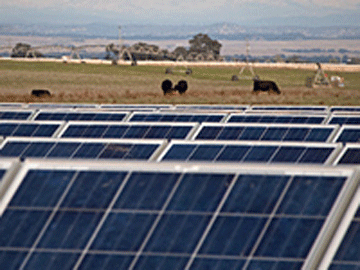 Solar farm proposal near Baralaba in central Queensland gets Banana Shire approval, ABC News, 2 Nov 15 By Jessica Lodge and Jacquie Mackay The Banana Shire Council has given approval to the solar energy company FRV to develop a solar farm near Baralaba in central Queensland. In September, the Central Highlands Regional Council gave the same company approval to develop solar operations at Tieri.
Banana Shire Mayor Ron Carige said the project could create up to 200 jobs during the construction phase.”It’s a great opportunity for not only for the shire but for the community around Baralaba itself,” he said.
“So it’s right near the substation at Baralaba and the total area is 730 hectares but the panels will take up approximately 660 hectares, so it’s quite a large project.”
Councillor Carige said it was a great opportunity for the region moving forward………..http://www.abc.net.au/news/2015-11-02/green-light-for-solar-farm-near-baralaba-in-central-qld/6904428
For solar energy in Australia, the future is looking bright
 Here comes the sun: funding for solar energy will fast-track Australia’s renewable future http://www.lexology.com/library/detail.aspx?g=ca54c642-afdb-4d23-9fd2-f63db9bd992c Corrs Chambers Westgarth A global surge in solar investment is driving new growth in Australia’s solar sector. Costs are falling and storage technology is improving, making solar energy an emerging force in Australia’s clean energy future.
At a global level, energy experts are predicting large-scale solar photovoltaics (PV) to be the least-cost option for power generation almost universally by 2030.[1]
Locally, investment in Australia’s renewable energy industry is forecast to exceed A$40 billion over coming years. This translates to an estimated 30-50 major projects comprising at least 6000MW of new generating capacity to be built by 2020.[2]
Australia’s solar industry is also backed by a number of key funding initiatives. The result is a bankable investment environment that will enable investors and project proponents to harness Australia’s abundant solar resource.
THE RENEWABLE ENERGY TARGET (RET) Continue reading
Sunshine in your beer in Sydney
 Pingala community-owned solar project to hit the roof of Young Henrys brewery, SMH, 2 November Lucy Cormack Environment Reporter
Imagine if there was sunshine in your beer. With a plan to build a solar farm atop the Young Henrys brewery in the heart of Sydney’s inner west, there soon could be.
Community members can become shareholders in the project – a collaboration with community energy organisation Pingala – and therefore, part owners of a future local solar farm. “When the Pingala guys came and spoke to us about it, we hadn’t had an interest in solar. Being able to put enough aside for large-scale solar wasn’t something we could afford,” said brewery part-owner Oscar McMahon.
“This was the perfect thing for us. We will start buying the power from the Pingala solar system on our roof, repaying people’s local investment into that system … we start buying renewable energy from our community.”
Electricity from the system will be used to power brewing processes, avoiding around 127 tonnes greenhouse gas emissions a year…….
The project will be the first for Pingala, part of a plan to start building community-owned solar farms on businesses and organisations across Sydney. The first stages have been realised with approval for a $40,000 innovation grant from the City of Sydney. Pingala volunteer Tom Nockolds said the renewable energy movement can no longer be ignored. “This idea, [it’s] time has really come. We’re opening up a new way for people to invest in renewable energy.” He said the project is directed at everyday “mums and dads who are struggling to find an opportunity to invest in renewables”. “Particularly in Sydney, where a high proportion of people live in apartments, are renters, or don’t have roof [space],” he said.
The Pingala initiative will aim for a 6 per cent to 8 per cent return for investors. After they have been paid back, the panels are gifted to the business to continue using. The first stages have been realised with approval for a $40,000 innovation grant from the City of Sydney.
Pingala volunteer Tom Nockolds said the renewable energy movement can no longer be ignored. “This idea, [it’s] time has really come. We’re opening up a new way for people to invest in renewable energy.”He said the project is directed at everyday “mums and dads who are struggling to find an opportunity to invest in renewables”. “Particularly in Sydney, where a high proportion of people live in apartments, are renters, or don’t have roof [space],” he said.
The Pingala initiative will aim for a 6 per cent to 8 per cent return for investors. After they have been paid back, the panels are gifted to the business to continue using
The Young Henrys project has the nod from Lord Mayor Clover Moore, who said it shows how Sydney “can make the shift to renewable energy even faster”. While Pingala is still obtaining financial and legal advice for the project, Mr Nockolds said in the early new year solar panels will be appearing on the Young Henrys roof…..http://www.smh.com.au/environment/pingala-communityowned-solar-project-to-hit-the-roof-of-young-henrys-brewery-20151029-gkltqu.html#ixzz3qIlYu8Jj
McKinley Shire, Queensland, promotes local business with renewable energy initiative
 McKinlay Shire in north-west Queensland sheds light on solar cost-saving plans for council, traders http://www.abc.net.au/news/2015-10-30/mckinlay-shire-sheds-light-on-solar-panels-plan/6898430 By Zara Margolis A north-west Queensland council has begun the second stage of a plan to help local businesses reduce their power bills. The McKinlay Shire has awarded a contract to a renewable energy company to install solar panels on nine local businesses and some council buildings.
Mayor Belinda Murphy said the company was finalising the solar designs, which should be installed by the end of the year. “The whole aim of council’s approach with this was really triggered by drought initially as well,” she said. “As I’ve said before, there is help for landholders but there has certainly been no direct help and support for businesses in these rural towns. “We identified this about 18 months ago and they were the ones who told us their biggest impacts are freight and power.”
Councillor Murphy said the panels would also be installed at a number of council assets. “Even just from a council perspective we’re going to have a projected power cost saving of around $60,000 per annum,” she said.
“Now we have a power cost annually of around $340,000, so that’s nearly a 20 per cent saving which council can then use to put back into other services, the community, other assets or into reserve.”
Karoonda Council, South Australia, considering floating solar plant
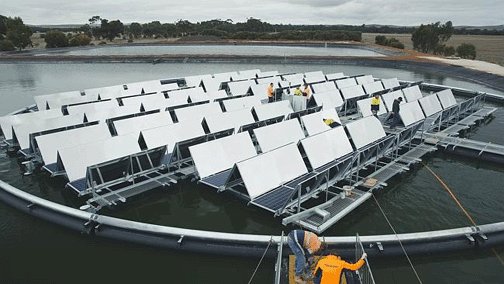 Floating solar power plant mooted for Karoonda to power waste management pump station http://www.abc.net.au/news/2015-10-30/floating-solar-power-plant-mooted-for-karoonda/6899436 The District Council of Karoonda-East Murray says it will look into the possibility of a floating solar power plant at Karoonda in South Australia’s Murray-Mallee region.
Council CEO Peter Smithson said the floating solar plant would provide power for the waste management pump station next to the stormwater dam.
A similar plant is already operating at Jamestown in the state’s mid-north.
Mr Smithson said the council had committed to undertake further due diligence about the green power opportunity.
“We’ve been approached by a company about the possibility of a solar generating power plant at Karoonda which would provide power to our CWMS [Community Wastewater Management System] pumps,” he said.
“We’ve gone and looked at Jamestown.
“There’s quite a long resolution because it really details the fact that there’s no capital outlay by council and it really looks at the fact that we’ve done due diligence and we’ve asked the company to come and address the next council meeting.
Opportunity for Port Augusta to be repowered with solar thermal energy
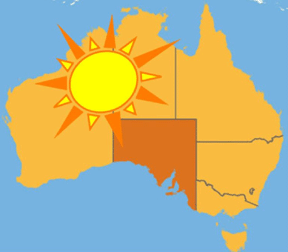 Repower Port Augusta, 30 Oct 15 In incredibly exciting news, after returning from a visit to a massive solar thermal plant in the United States, the federal local member for Port Augusta Rowan Ramsey has revealed to The Transcontinental that US solar thermal giant SolarReserve have made a bid to build solar thermal with storage in Port Augusta!
After a long running community campaign, numerous studies and actions from people like you this revelation is a huge step forward in the community driven push to Repower Port Augusta with solar thermal.
So, what does this mean?
The ACT Government are using a policy called a reverse auction to help them meet their 100% renewable energy target by 2025. This is a policy where they effectively bid for projects to buy renewable power from and early this year they called for bids from projects across the country from solar with stoage.
This is the policy we called on the SA Government to adopt in our submission to the state government that many of you signed onto.
We are still waiting on the result of the bid, but we know the bid for solar thermal from Port Augusta is one of thirty from across the country.
It’s a huge step forward and a testament to the community campaign backed by people across the country that SolarReserve are ready to build solar thermal in Port Augusta.
1 This month

of the week – Australians for War Powers Reform (AWPR)
To see nuclear-related stories in greater depth and intensity
 Antinuclear