Offgrid solar power an economic winner for Western Australian farming family
 WA farming family opts for solar power battery system over costly grid connection, ABC News By Kathryn Diss 3 June 15 When Katherine Naughton’s family moved to a farm in Northam, north-east of Perth, it was going to cost them up to $60,000 to connect their house to the power grid.
But for just two thirds of that cost they have been able to install a solar power storage system, harnessing all of their electrical needs from the sun.”Not having that $400 bill every three months is just fantastic,” Ms Naughton said.
Perth-based company Solar Balance designed the system with Chinese battery manufacturer BYD.The batteries charge from rooftop solar panels during the day and store the energy for use when the sun goes down.
And unlike connecting to the grid, it is an investment that pays for itself. “With the cost of power going up, it’s quite scary how much it keeps going up by every single year, and you don’t know how much it’s going to be in the next five years,” Ms Naughton said. “So if we can go solar then we don’t have to worry about that bill.”
Battery storage an affordable option
With the entry of new players it will put downward pressure on battery costs which is going to be good for everyone over time because it will become more and more affordable. – Rod Hayes
The power revolution may be taking place slowly, just one household at a time, but the industry believes that is set to change………..
Curtin University’s Sustainability Policy Institute’s Jemma Green said the power grid will become less relevant.
“The grid will have a place but it will become more of a back up system as electricity prices go up even further and the price of solar and batteries decline further, the economics of grid defection are going to stack up sooner.
“This is going to have an impact on the utilisation of the grid and therefore the revenue that the government currently derives from using it.
“I think the grid and the business models of the utilities, that is the generators and the poles and wires will need to evolve to deal with this changing energy system which is effectively a centralised and decentralised energy model,” Ms Green said.
Bosche, LG and Samsung have also indicated they plan to enter the market. http://www.abc.net.au/news/2015-06-03/farming-family-opts-for-solar-power-battery-system/6519960
Home energy storage is bringing solar power to the people
What is certain is that the electricity equation will look very different in a few short years, and it looks like, for the first time in many years, that ordinary consumers will hold a bit more of the power
How home energy storage is going to change the way we think about power, Adelaide Now, CAMERON ENGLAND SUNDAY MAIL (SA) MAY 31, 2015 WHEN Elon Musk launched the Tesla Power Wall earlier this month, it was done in true Silicon Valley style.
The charismatic chief executive enters stage right, sans tie, and makes a pronouncement that his new product will change the world — cue rapturous applause from the audience and because this is the United States, whooping.
The thing about Musk’s pronouncement is that it’s most likely true.
It might not necessarily be his company — critics are divided as to whether Tesla will be the market leader it’s portraying itself as — but home and business energy storage is soon to change the way energy utilities, homes and governments think about power……..
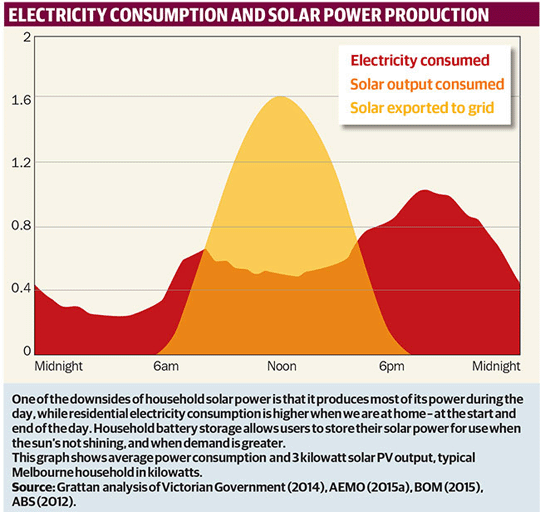
Batteries allow homes and especially businesses to employ “peak shaving” — if power prices spike, flick over to using your own solar power and save money, or if the grid power is cheap, suck it out and sell it back later at a higher price.
Or simply save up the solar power your rooftop panels produce during the day for use in the evening, when your demand might be higher……..
Tesla Power builds on the Tesla Motors technology — relatively standard lithium ion batteries with smart software to help them interact with the grid. The initial interest has been huge. The company recently reported early orders of 50,000 to 60,000 batteries, or as Musk put it, “It’s like crazy off-the-hook”.
Effectively the company is sold out until the middle of next year and its huge new factory will not be big enough to keep up with demand.
At $US3000 for the battery and $US7000 installed with solar panels (US prices) the system makes it economic for houses to become much less dependent on grid power.
UBS estimates that in Australia, the system would pay itself back in six years.
But Tesla is not the only game in town — although it almost certainly has the best PR machine. Continue reading
Australian Renewable Energy Agency sets out conditions for large scale solar
 Establishing the social licence to operate large scale solar facilities in Australia: insights from social research for industry http://apo.org.au/research/establishing-social-licence-operate-large-scale-solar-facilities-australia-insights-social
Introduction
The main objective of the research was to identify the preconditions necessary for utility-scale solar installations to have a social licence to operate in Australia. Specifically, the research set out to understand general attitudes towards solar energy and the acceptability of large scale solar energy facilities with a view to creating this report.
The research consisted of three key components:
• Quantitative phase: a survey of a representative sample of 1,197 Australians.
• Qualitative phase: a series of 15 group discussions held in capital cities, regional centres and communities near large scale solar facilities. Research to investigate perceptions of the desirability of utility-scale solar facilities.
• Review phase: a review of the factors that influence social licence to operate solar facilities, conducted via in-depth interviews and covered in the group discussions with stakeholders in communities living near large scale solar facilities.
The quantitative survey included testing the impact of exposure to two sets of stimuli (consisting of images and information about large scale solar facilities) through asking survey participants about their attitudes towards large scale solar facilities relating to land use; efficiency; reliability; visual impacts; economic impacts; environmental impacts; health impacts and the cost of electricity before and after seeing the stimulus materials.
Western Australian gas company planning to sell solar panels and batteries
 Alinta’s solar plan to cut bills, The West Australian Daniel Mercer June 1, 2015 Gas giant Alinta is hatching a plan to sell solar panels and batteries to households, allowing them to slash power bills by reducing reliance on the electricity grid.
Alinta is also weighing the idea of offering micro gas generators, which could pave the way for households to disconnect from the grid altogether.
The plan looms as a direct challenge to taxpayer-owned electricity provider Synergy, which has been losing millions of dollars as customers switch to solar en masse.
There are about 170,000 households in the South West grid alone which have photovoltaic cells on their roofs, and this figure is expected to soar by the end of the decade.
Under Alinta’s plan, tipped to start this year, it would lease solar panels to residential customers, who would then provide any power they did not use back to Alinta to sell into the market.
The Sydney-based company would also offer batteries to store surplus solar power and small gas-fired generators that could be used as a backup in the event it was cloudy for days.
Efficient and affordable battery storage has long been regarded as the holy grail of renewable energy and US firm Tesla announced last month it was on the verge of being able to produce it………https://au.news.yahoo.com/thewest/a/28289418/alintas-solar-plan-to-cut-bills/
Solar testing laboratory: CSIRO helps investor confidence in large-scale solar
 CSIRO establishes solar testing laboratory http://www.dailytelegraph.com.au/business/breaking-news/csiro-establishes-solar-testing-laboratory/story-fnn9c0gv-1227375518543 JOHN CONROY MAY 30, 2015
CSIRO is set to increase confidence in large-scale solar by more accurately predicting how different solar photovoltaic (PV) systems will perform on Australian shores.
Over the course of a 32-month project supported by $1.3 million Australian Renewable Energy Agency (ARENA) funding, CSIRO successfully established unique indoor and outdoor testing capabilities that are now accessible to PV researchers and industry.
ARENA CEO Ivor Frischknecht said these new facilities would allow different solar panels and cells to be scrutinised, assessing how they respond to Australian conditions and predicting their output over time.
“Accurately predicting the energy output of a solar PV power plant is critical throughout its lifecycle, from forecasting future revenue and determining commercial viability to day-to-day operation on the electricity grid,” Mr Frischknecht said.
 “Effective forecasting is particularly important for investor confidence and risk mitigation as the cost of new plants is mostly up-front.
BHP funded Grattan Institute unfairly critical of solar energy

Solar Industry Hits Back At Report Critical Of Roof-Top Solar, New Matilda, By Thom Mitchell, 27 May 15 A report by a respected think-tank is being slammed by key players in the solar energy industry. Thom MItchell reports.
A report published by the Grattan Institute on Monday has been dismissed by the solar industry, which argues its critique of generous state and federal government subsidy schemes misrepresents their true value and ignores important flow-on benefits. Continue reading
Small scale solar power from Australian company transforms slum life in India
Australian solar company Pollinate Energy brings light to slums of India ABC Foreign Correspondent By South Asia correspondent Stephanie March 26 May 15 With indoor air pollution from kerosene lamps and stoves the second largest cause of death in India, one company, founded by Australians, has come up with a solution to the problem.
Every night in the sprawling shanty towns of the country of 1.2 billion people, the air fills with dense, black smoke.
“We used to get oil from the market and pour it into the lamp and light it; the house used to get full of soot and dirt,” said Abdul, a slum-dweller in Bangalore who lives in a hut made of wooden board and tarpaulin.
That was until Abdul bought a portable solar light from a company called Pollinate Energy, founded by five young Australians.
“After we got this solar lamp a lot of things improved,” Abdul said. “Now we don’t worry that there will be a fire.” Continue reading
Australians overwhelmingly prefer solar energy – survey results
Survey Says Australians Prefer Solar Power Sputnik News 25 May 15 Australians strongly support the use of renewable energy, according to Ipsos research company’s survey. Some 87 percent of respondents were strongly in favor of solar panels on homes and 78 percent supported large-scale solar energy facilities.MOSCOW (Sputnik) — Solar power is considered the most efficient source of energy by an overwhelming majority of Australians, Ipsos research company stated Monday.
Earlier in May, following months of negotiations, Australia’s current government and the primary opposition party reached an agreement to scale back its Renewable Energy Target (RET) by almost 20 percent by 2020, due to declining power demand.
A recent Ipsos report based on a poll of nearly 1200 people funded by Australian Renewable Energy Agency (ARENA) revealed that Australians responding to the poll strongly support the use of renewable energy. Some 87 percent of respondents were strongly in favor of solar panels on homes and 78 percent supported large-scale solar energy facilities.
An overall 72 percent of respondents from across Australia said they supported wind farms and hydro energy, while tidal and geothermal energy was favored by 52 and 45 percent respectively……..
Since coming to power in 2013, Prime Minister Tony Abbott has repealed a tax on carbon emissions and eliminated the post of science minister……… http://sputniknews.com/environment/20150525/1022530489.html#ixzz3bHKV5Rpu
The solar revolution that is coming to Australia’s homes
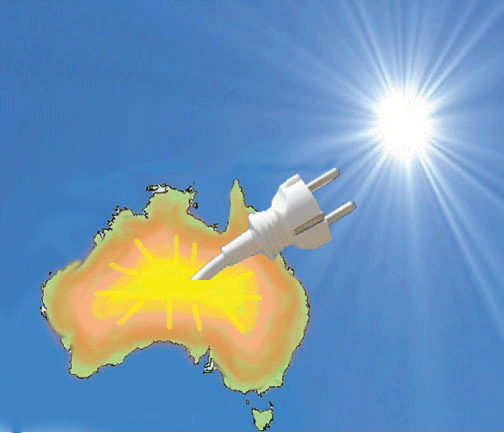 Could solar power be about to transform the electricity industry and drive prices down? http://www.abc.net.au/7.30/content/2015/s4240286.htm Australian Broadcasting Corporation Broadcast: 21/05/2015 Reporter: Matt Peacock A revolution driven by solar panels and cheaper batteries is transforming Australia’s electricity industry and promising to drive power prices down.
Transcript
LEIGH SALES, PRESENTER: Imagine life without that dreaded quarterly power bill. That could be around the corner for people with solar panels. Until now, solar energy couldn’t be stored efficiently and people who had it relied on the electricity grid for backup. Now, new battery technology means that could change. Matt Peacock reports. Continue reading
Australian breakthrough solar technology built in Cyprus in five weeks
Australian scientists have designed and installed solar energy technology in Cyprus to help the island nation shift away from fossil fuels and also to tackle its chronic water shortages.
A team from the CSIRO, Australia’s national science agency, took five weeks to construct a ‘solar thermal field’ containing 50 heliostats – large mirrors that reflect the power of the sun. The solar thermal field lies in Pentakomo, on the southern coast of Cyprus and places the country at the frontier of solar energy research in Europe.
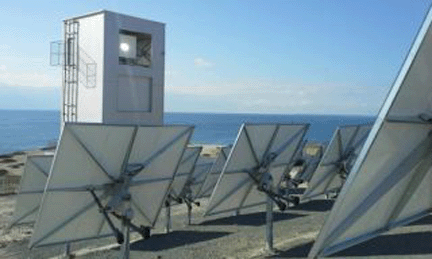
The CSIRO won an international tender to provide its technology to Cyprus for a trial that could lead to broad solar take-up in the country and elsewhere. It is understood that several other countries in Europe and the Middle East are interested in adopting CSIRO solar technology.
Cyprus hopes to take on the technology so it can reform its oil-dependent economy and meet a European Union target of 13 per cent of energy coming from renewable sources by 2020. The Mediterranean country is also plagued by water shortages and may use solar energy to power desalination plants.
The CSIRO technology uses mirrors to track the sun and reflect it towards a single receiving point on top of a tower. This heat then warms a fluid, in this case molten salt.
The molten salt, heated to 250°C, is stored in a hot tank and the steam produced powers a turbine for electricity. Crucially, this storage method allows for energy to be produced long after the sun has disappeared.
“The question about solar is always about storage at night-time,” said Wes Stein, solar research leader at CSIRO.
“This liquid is cheaper and more efficient than batteries, such as those made by Elon Musk. We can generate steam for electricity on a cloudy day. Continue reading
Australia leads the world in percentage of homes with solar power
 Australian households chase sun to lead world on solar adoption http://www.canberratimes.com.au/act-news/australian-households-chase-sun-to-lead-world-on-solar-adoption-20150516-gh2uh9.html May 16, 2015 Mark Sawa Northside Chronicle reporter Australian households are world leaders in solar power installation, according to new figures from Australia’s peak industry body representing the fossil fuel and renewable energy sector.
The Energy Supply Association of Australia, representing the fossil fuel and renewable energy sector, has sourced data from around the world revealing household solar photovoltaic (PV) penetration in Australia is way out in front of any other nation.
The report shows almost 15 per cent of Australian households have adopted the technology to power their homes.
This is more than triple that of Germans, who are second on the world stage and typically thought of as the most prolific solar adopters. Continue reading
Solar trams for Melbourne
Renewable energy group bids to turn Melbourne’s trams solar May 18, 2015 Tom Arup Environment editor, The Age

Melbourne’s entire tram network could be powered by solar if the state government gave a bold renewable energy proposal the green light.
While the pitch may conjure up images of trams with rooftop panels on them like the family home, the power would instead be generated at two new solar farms the project proponents plan to build near Swan Hill and Mildura.
The company behind the bid, the Australian Solar Group, have held quiet talks over four years with different arms of the government to try get the project off the ground, but has so far not got final backing.
The two solar farms would generate 80 gigawatt-hours of electricity a year, about the same amount used by Melbourne’s tram network, which is the world’s largest.
Under the proposal the government would back the project by signing Public Transport Victoria (PTV) up to a power purchase agreement with the solar farms, creating a reliable revenue source alongside the renewable energy target.
The proponents say the project has been designed to ensure the cost of tram tickets would not rise, nor would it add to PTV’s power bill. It would cut 100,000 tonnes of greenhouse gas emissions a year from running trams and give the city an obvious global selling point (see the mock-up tram design above), according to the pitch…….http://www.theage.com.au/victoria/renewable-energy-group-bids-to-turn-melbournes-trams-solar-20150518-gh3ime.html
Australia has the most affordable solar systems in the developed world.

But while this was happening a revolution was unfolding in the affordability of solar power systems. Rather fortunately for Australia, we are one of the best positioned nations to take advantage of this revolution. Continue reading
Australian electricity utility Origin launches solar energy leasing programme
Origin launches solar services program for homes, small business, REneweconomy, By Sophie Vorrath on 12 May 2015 Major Australian utility, Origin Energy, is set to launch a solar leasing program in three separate states, focusing on small-scale residential and commercial solar systems.
The move by Origin follows the launch, a week earlier, of the battery storage product from rival gentailer, AGL Energy – which was announced ahead of schedule, and to coincide with Tesla’s sensational energy storage reveal.
AGL’s first “proposition” – customers are being asked able to “register their interest” – will be a limited number of 6kWh batteries the size of a large suitcase, made to suit a family home with around 3-4.5kW of rooftop PV. And while this makes AGL Australia’s first energy retailer to stake a claim in the energy storage market, Origin says it will be the first to enter the roof-rental space, and says it hopes to expand its program into other cities.
The solar power purchase agreement market represents huge and largely untapped potential in Australia. Companies like SolarGen and SunEdison are already taking advantage – the soon to be launched 350kW PV system at Tyrrell’s Wines Hunter Valley vineyard, which we report on here, offers one of the nation’s first commercial examples.
Utilities, however, have been slower to get with the program………
Canberra battery storage trial likely to kill the myth of “no baseload renewables power”
Canberra-based renewable energy consulting company IT Power will analyse the performance of six major lithium-ion battery brands, comparing them to “old school” and advanced lead-acid batteries for use in large and small electricity grids.
A testing centre will be established at the Canberra Institute of Technology for the trials to be partially funded by $450,000 from the Australian Renewable Energy Agency.
T Power’s managing Director Simon Troman said storage was the next step needed to help integrate renewable energy, especially solar, into electricity grids.
 “It kills the argument put out there by the anti-renewable mob that they’re intermittent and you can’t rely on them… and it turns intermittent renewables like solar and wind into a direct competitor for base-load power.
Rather than research new options for storage, Mr Troman said the trail will purchase batteries for
testing that are already commercially available making the impact more immediate and maintaining the independence of the data.
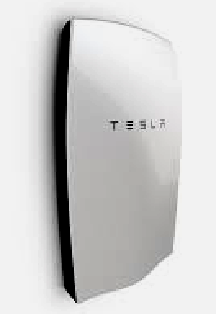
Electric car maker Tesla’s first foray into lithium-ion batteries for homes the Powerwall, announced last week featuring technology developed by Canberra start-up Reposit Power, could be part of the trials when it goes on the market. Continue reading
1 This month

of the week – Australians for War Powers Reform (AWPR)
To see nuclear-related stories in greater depth and intensity
 Antinuclear