Coalition Ministers say that Moree solar energy plant funding is assured
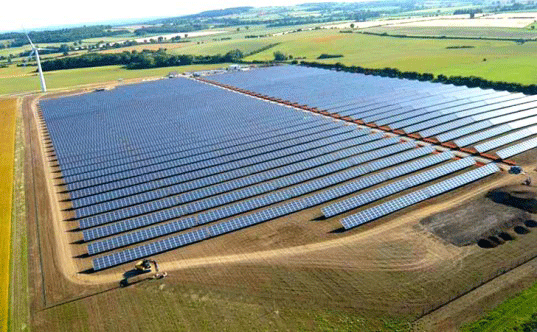 Moree solar on track for Commonwealth funding http://www.abc.net.au/news/2014-06-04/moree-solar-on-track/5500668 By Tim Lamacraft 4 Jun 2014,The Federal Coalition is confident the Moree Solar Farm will secure Commonwealth funding despite plans to axe its finance source.
The Government is looking to axe the Australian Renewable Energy Association, which has expressed interest in providing finance to the Moree Solar Farm, a joint initiative of Pacific Hydro and Fotowatio.
The two companies are nervous that tens-of-millions of dollars in funding is in jeopardy.
But Federal Parkes MP Mark Coulton recently met with Industry Minister Ian Macfarlane on the issue.
He says the Moree Solar Farm is on track to meet Commonwealth funding approvals.
“I’ve been reassured by the Minister and his Department that there’s nothing with this project that’s ringing alarm bells and they’re very happy with it the way it is,” he said.
“Certainly the Moree Solar Farm has no reason at this stage to be fearful that the ARENA funding wont be there.”
It’s not yet clear when the Coalition will approach the Senate in an attempt to repeal the Arena Act, but projects that do not already have agreements in place will not be funded.
Solar thermal energy a step closer with CSIRO breakthrough
CSIRO Newcastle solar breakthrough for supercritical steam ABC News 3 June 14 The CSIRO is describing research at its Newcastle energy centre as a game-changer for the renewable energy industry. The CSIRO is describing research at its Newcastle energy centre as a game-changer for the renewable energy industry.
Researchers have used solar energy to generate hot and pressurised ‘supercritical’ steam at the highest temperatures ever achieved outside of fossil sources.
Supercritical solar steam is water pressurised at enormous force and heated using solar radiation.
Around 90 per cent of Australia’s electricity is generated using fossil fuel, but only a small number of power stations are based on the more advanced supercritical steam.
The world record set at the CSIRO’s Energy Centre in Newcastle this month, was at a pressure of 23.5 megapascals and temperatures up to 570 degrees Celsius.
Project leader, Robbie McNaughton says it is the combination of pressure and temperature demonstrated at scale, that makes it such a breakthrough for solar power…… CSIRO’s Energy Director, Dr Alex Wonhas says the milestone is a game-changer for the industry.
“It’s like breaking the sound barrier,” he said.
“This step change proves solar has the potential to compete with the peak performance capabilities of fossil fuel sources.”
The $9.7 million research program is supported by the Australian Renewable Energy Agency (ARENA).
ARENA CEO Ivor Frischknecht says although more work is needed before the technology is ready for commercialisation, it is an important breakthrough and demonstrates the importance of research and development.
Mr Frischknecht says it brings solar thermal energy a step closer to cost competitiveness with fossil fuel generated power.http://www.abc.net.au/news/2014-06-03/csiro-newcastle-solar-breakthrough-for-supercritical-steam/5495744?§ion=news
Solar power proving a good investment for Western Australians
 Solar Helps Delay New Power Station In Western Australia http://www.energymatters.com.au/index.php?main_page=news_article&article_id=4319 26 May 14, WA’s solar households and businesses are collectively generating as much power as a major traditional power station. According to The West Australian’s Daniel Mercer, given forecasts from Synergy of a continuing increase in solar uptake, the State Government now says a new power station would not need to be constructed in the state until 2029.
Synergy predicts there could be as much as 1500MW of solar capacity feeding into Western Australia’s electricity grid by 2020.
The rate that Western Australians have embraced solar is quite stunning. The numbers of solar power systems connected to the grid has grown from just three in June 2007 to 135,419 (Synergy customers) as of March 2014.
According to solar provider Energy Matters, a 5kW solar panel system installed in Perth can return a financial benefit of between $1,577 and $2,196 annually. In some cases, a system of this size can basically blow away an average household’s power bills.
Energy Matters’ Australian Solar Index estimates the internal rate of return of a system installed in Perth to be 17.8%; making it one of the best investments around.
However, as is the case in the rest of Australia, clouds are gathering on the horizon for WA’s solar industry and potential new solar households. The Renewable Energy Target review is currently under way and concerns have been expressed regarding possible outcomes; including a gutting of subsidies.
Current support for acquiring systems can translate to thousands of dollars off the cost of going solar. The uncertainty surrounding the review means the best time to go solar in Western Australia could be right now.
Going solar in WA doesn’t necessarily mean a significant up-front financial outlay. Energy Matters offers a zero-deposit “Save As You Go” arrangement to eligible customers where monthly repayments can be less than what would otherwise be spent on mains-grid supplied electricity.
Rio Tinto finds that solar is the best way to power Queensland off-grid mine
 Rio Tinto to deploy 6.7MW solar PV + storage at off-grid mine
REneweconomy By Giles Parkinson on 22 May 2014 A ground-breaking, $23.4 million project to cut out daytime diesel consumption at Rio Tinto bauxite mine at Weipa could unlock billions of dollars of similar investments in the mining industry – which is weighed down by soaring energy costs.
Mining giant Rio Tinto is to host a $23.4 million solar PV plus storage facility at its Weipa bauxite mine, that is the first of its type and scale in the world and could unleash billions of dollars of similar investment. Rio Tinto Alcan – with the help of the Australian Renewable Energy Agency – is to install a 1.7MW solar PV array at its Weipa bauxite mine later this year, and then add a further 5MW of solar PV and battery storage.
The Weipa mine is located on the Cape York Peninsula at the very northern tip of eastern Australia, and relies on expensive diesel that has to be shipped in.
The first phase of the solar project – to be built with First Solar thin-film modules and constructed by Australian solar firm Ingenero – is expected to reduce daytime diesel demand from the mine’s 26MW diesel generator by up to 20 per cent.
However, the addition of more solar and storage to balance out intermittency could reduce daytime diesel consumption altogether at certain times.
The Weipa project was the first of around 70 submissions – worth several billion dollars of investment – from mining operators in Australia for funding for such ground breaking projects under ARENA’s $400 million remote energy program.
The ending of the commodities boom has made miners more focused on energy costs. Continue reading
Weipa solar project brings cheap energy to remote Queensland community
 AUDIO: Cheaper electricity from Weipa solar project final act of axed renewable energy agencyhttp://www.abc.net.au/news/2014-05-22/cheaper-electricity-from-weipa-solar-project-final/5469770?section=qld Many remote communities around Australia are totally reliant on costly diesel fuel to provide the electricity that most take for granted. But the far north Queensland mining town of Weipa is adding solar energy to the mix in what’s being called an Australian first. It could be the final act for an agency that’s facing the axe after last week’s savage federal budget.
Australia’s energy utilities fight to stop rooftop solar
 Solar Industry Battle — Australian Energy Utilities Pushing For End To Rooftop Solar Subsidies, Clean Technica 21 May 14 Australia’s major energy utilities are now united in pushing for an end to rooftop solar subsidies – pitching the incumbent utilities into a major battle with the solar industry and consumer groups over the treatment of household solar.
AGL Energy became the last of the major utilities to throw its hat into the anti-solar ring, declaring on Friday in its submission to the renewable energy target review that rooftop solar subsidies were no longer needed.
AGL Energy also said the large scale renewable energy target would be impossible to meet – earning an extraordinary rebuke from PowerShop, the Australian offshoot of New Zealand energy giant Meridian Energy, its joint venture partner in Australia’s largest renewable energy project, the 420MW Macarthur wind farm – of joining other utilities on the “dark side”.
The issue around support for solar, however, is now the major flash point for the industry. Given the stoppage in large scale developments because of uncertainty around the LRET, rooftop solar is currently accounting for the bulk of renewable energy investment in the country. It supports an industry that provides more than 11,000 jobs, and nearly $3 billion in investment in 2013, as well as supporting ongoing world-leading research.
Those jobs and investment are now under threat. Continue reading
Solar power – floating panels a benefit for water short South Australia
Floating solar power plant would reduce evaporation, proponent says ABC News By Matthew Doran 12 May 2014 A solar power plant which is planned for South Australia would float on a wastewater treatment basin.
Geits ANZ is proposing the venture and director Felicia Whiting thinks it would prove at least 50 per cent more efficient than a land-based solar power system.”It’s very much like a traditional solar array with the exception that it’s designed to float on the water,” she said. (Below, Solar floating panels in France)
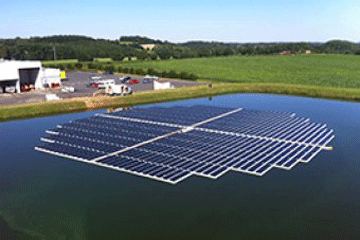
“The mass of water has a cooling effect on the panels and we also include a cooling system utilising the water body itself to be able to keep the water panels … at a constant temperature. “When that happens, you get a longer life of the photovoltaic panels and you get a greater efficiency.” In actual design, Ms Whiting says the floating solar plant would not differ greatly from a traditional one.”The system is designed from a HDP (high-density polyethylene) pipe, which is the buoyancy, and it has a structural steel pontoon sitting abreast that and then the PV (photovoltaic) panels slot into the structural system,” she said. “It’s like a racking system with buoyancy.”
She says having the wastewater largely covered by a floating plant brings other benefits. “We’re at about 90 per cent water evaporation prevention for the surface area that we cover,” she said. “In a dry climate like South Australia that’s about 2.5 metres of water evaporation depth annually that you’re saving.
“It’s a world-first for putting a system of this nature on a treated wastewater plant basin.”
Other evaporation savers in the planning
Geits has floating plants operating in France, Italy and Korea………
Geits has applied to the Essential Services Commission for an electricity generation licence.
Ms Whiting hopes construction on the ponds of the Northern Areas Council waste treatment plant can start in the second half of this year.
“Because it’s a prefabricated system we’re looking at a commissioning date of around September, October,” she said. http://www.abc.net.au/news/2014-05-12/floating-solar-power-plant-would-reduce-evaporation/5445912
Lady Elliot Island to add wind and solar to its existing hybrid energy
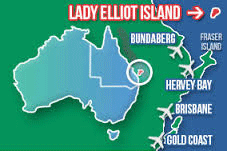 More renewable energy in the wind for Lady Elliot Island http://www.abc.net.au/news/2014-05-12/more-renewable-energy-in-the-wind-for-lady-elliot/5445804 By Frances Adcock Operators on Lady Elliot Island, north-east of Bundaberg, will consider installing wind generators to further improve the island’s energy efficiency.
One-hundred new solar panels will be installed at the island’s hybrid solar power station, which has provided more than half of the island’s power since 2008.
The island’s resort manager, Peter Gash, wants the island to become even more reliant on renewable energy.
“By Christmas we’d hope to do it by, we’d like to install a 10 kilowatt wind generator which will continue to feed power into the battery and into the grid, night and day, and if we can get the success we are hoping for with our 10 to 12 kilowatt wind generator and our 73 kilowatt of solar we will be hopeful we will be somewhere up around 90 per cent renewable,” he said.
He says after the installation of the new panels, more than 70 per cent of the island will be reliant on renewable energy. “We have a barge coming out on Wednesday and there is 125 panels on that and they are 260 watts per panel and they will go up on two separate roofs, and that’s a 16 and 17 kilowatt system,” he said.
“So another 33 kilowatts, so another 125 panels, so that puts us up at 73 kilowatts of power which is a substantial amount of power.”
Accurately measuring the solar energy potential for South West Australia
South-west Australia’s potential solar output measured with accuracy Phys Org 7 May by Rebecca Graham Researchers have developed an algorithm that can be used to simulate the hour-by-hour power output of both photovoltaic and concentrated solar thermal power systems for any location in the south-west corner of Australia. The model is simple enough to run inside a web-browser by the general public and could be tailored to other regions around the world.
Led by Murdoch University’s Dean Laslett, an engineering PhD candidate, the research forms part of a series of studies originated by Sustainable Energy Now aimed at developing an accessible and interactive computer simulation of renewable energy power systems for the South-West Interconnected System (SWIS); WA’s main electricity grid.
As clouds affect how the three main components of solar radiation – direct, diffuse and reflected – reach the earth’s surface, the algorithm was developed through a series of calculations using seasonal rainfall patterns and the three solar radiation components; leading to estimates of daily and hourly cloudiness across the region.
“The seasonal rainfall pattern across WA generally decreases with distance from the coast, with a zone of high rainfall in the south-west corner and the Kimberley,” Mr Laslett says.
“Seasonal cloudiness follows the same pattern. Hence if the longitude and latitude of a location is converted into a distance along the coast-line and a distance inland, estimation of seasonal cloudiness can be simplified.
“An estimate of all three solar radiation components is [also] needed…………”Because the model can be used to estimate all three components of solar irradiance, it’s possible to change the location of one or several photovoltaic or concentrated solar thermal systems and get an idea of how overall energy generation might change.”
“Also because our model can run inside a web-browser, this ability becomes widely accessible to the general public … they can play around and see for themselves what a solar energy power system for the SWIS might look like.” : http://phys.org/news/2014-05-south-west-australia-potential-solar-output.html#jCp
As solar energy storage comes in, electricity costs will become a whole new ball game
Storing solar power is the key to cutting energy bills, CSIRO says May 2, 2014 Peter Hannam Environment Editor, The Sydney Morning Herald :”…………From the roofs of 1.3 million Australian homes – with about 50,000 added in the first three months of this year – PV panels are already hurting baseload fossil-fuel generators by flattening the peak demand periods that used to deliver windfall profits.
The real disruption, though, will come if batteries linked to solar PV and other renewable energy sources such as wind become affordable.
“The whole system is built on the fact that you can’t store energy,” Dr Graham said. “If electrical storage could actually become a reality that really turns the whole system on its head.”
“If you’ve got that, (consumers) can potentially disconnect from the grid.”……….
Don’t pull the plug just yet, said Damien Moyse, research director at the Alternative Technology Association.
“You have to pay $15,000 to $20,000 now for batteries” that would enable most families to exit the grid,” Moyse said, so making the move economic “is a fair way off at the moment”.
Entrepreneurs such as Elon Musk, though, plan to bring that day a lot closer. The US billionaire is close to picking a location for a $US5 billion ($5.4 billion) “gigafactory” to mass produce batteries for his Tesla electric cars, aiming to drive down costs by 30 per cent.
“Storage is where PV was five or 10 years ago,” Tom Werner, SunPower’s chief executive said during his first visit to Australia this week. “Consumers will go from being essentially passive to having total control of your energy bill within five to 10 years.”
SunPower, which last month joined Google to lease out PV to about 18,000 US households, will soon start a pilot in Australia to finance PV and storage with plans to broaden the offering “in a small number of years”, Werner said.
However, big incumbent generators, such as Origin Energy and EnergyAustralia, have made it clear they plan to resist further erosion of their business models………
The clean energy industry fears the review panel, led by businessman and climate change sceptic Dick Warburton, will recommend the target be delayed or cut.
For the solar PV industry, though, the worry is the hammer will fall hardest on the small-scale renewable energy scheme that gives an upfront credit for up to 15 years on power their panels will produce.
Ric Brazzale, president of industry group REC Agents Association, said the sale of the small-scale technology certificates brought the cost of a typical 3.5-kilowatt capacity PV panel down about a third from $9500 to $7000.
“People are very concerned about the future of the (solar PV) support,” said John Grimes, chief executive of the Australian Solar Council.
The industry is on course to install 800 megawatts of PV this year, nudging the total towards 4 gigawatts, a rate that would probably halve next year without the aid, Grimes said.
Technology advances, though, will eventually catch up with incumbents. The CSIRO unit has moved on, and among other things, is working on flexible “organic” solar cells.
“They can be less efficient (than silicon-based PV) but they can be more ubiquitous,” Dr Graham said. “It’s the whole roof, not just what you have to attach to it.”…….http://www.theage.com.au/environment/energy-smart/storing-solar-power-is-the-key-to-cutting-energy-bills-csiro-says-20140502-zr2zw.html
Australians waking up to the opportunity to control electricity bills through solar energy
 Solar PV’s potential just starting to dawn, SunPower chief says http://www.smh.com.au/environment/energy-smart/solar-pvs-potential-just-starting-to-dawn-sunpower-chief-says-20140501-zr2my.html May 1, 2014 Peter Hannam Environment Editor, The Sydney Morning Herald Solar photovoltaic systems will continue to spread across Australian rooftops because of rising electricity costs, “great irradiation” and cheaper finance, the head of the second largest PV producer in the US has said.
SunPower Corporation has picked Australia as one of two sites globally for a pilot storage program combining solar PV and batteries that the company hopes will one day make it economic to leave the power grid.
“The tariff structure in Australia will provide a strong foundation to homeowners with the incentive to consider distributed generation and storage,” SunPower chief executive Tom Werner said.
“Consumers will go from being essentially passive to having total control of your energy bill within five to 10 years,” he said.
The Abbott government is conducting another review of the Renewable Energy Target. The goal now calls for electricity supply from clean energy sources to reach 41,000 gigawatt-hours by 2020, although many commentators expect the review to recommend a reduction or delay of the target in part because of slumping demand.
Any dilution would be “a step in the wrong direction,” Mr Werner said. “In most countries, we see them pulling in their targets and increasing them.”
SunPower has installed about 7.5 gigawatts of solar PV – or more than double Australia’s total – and boasts of industry-leading efficiency levels above 20 per cent.
The company has also attracted some big partners, including US billionaire Warren Buffett and French energy group Total. Last month, Google and SunPower invested $US250 million ($269 million) to lease solar PV systems to US residents at a cost typically less than their regular power bill. Mr Werner said the Google tie-up would bring PV to 18,000 households and was “very scalable”. While the company is yet to discuss extending the program to Australia, the potential exists.
“We find all over the world people pay their energy bills. It’s pretty intuitive that it should work well here,” Mr Werner said.
He predicted that financing would play an increasing role in spurring the take-up of PV as governments rolled back incentives, such as feed-in tariffs, and the precipitous drop in panel prices in the past few years levelled off.
In California, SunPower’s home state, the ratio of cash to finance has gone from a 70-30 split to the reverse in just three years.
“I’d be willing to say that it’s likely we’ll see something similar here,” Mr Werner said, adding that SunPower’s partnership with Community First Credit Union offered loans for solar PV at a 7.1 per cent annual rate.
The company also has a stake in a Victorian electricity retailer, owning 42 per cent of Diamond Energy. SunPower would use such a foothold to refocus more on storage and energy management for customers should the Abbott government cut support for the industry, Mr Werner said. http://www.smh.com.au/environment/energy-smart/solar-pvs-potential-just-starting-to-dawn-sunpower-chief-says-20140501-zr2my.html#ixzz30bFchsP8
A new model of small scale solar power production to be piloted in Australia
Australia to pilot new power plan GREGG BORSCHMANN, ABC Environment1 MAY 2014 Householders have the potential to disconnect from the grid under a new system proposed by Sunpower
One of the largest solar companies in the world has chosen Australia as the proving ground for a new model of power production that promises to give householders more control – and cut bills. ‘WHAT DO YOU DO when the sun doesn’t shine?’
It’s been one of the criticisms levelled at the solar panels that are now so common on residential and commercial roofs across Australia.
Australia has the world’s greatest penetration of solar photovoltaic panels (PV). By the end of 2013, more than 3,000 megawatts of small-scale solar was installed across 1.1 million households, with the average system now 3.9 kilowatts in size.
Now Sunpower Corporation – which builds solar panels but also large-scale solar plants – has flagged that it will be using Australia as a global testing ground for a new model for providing electricity.
An announcement on a pilot project in Victoria, focused on the economics of storing domestically produced solar power, is expected in the next two months.
For years, it’s been keenly understood that the next big thing – the Holy Grail if you like for solar – would be the ability to store energy generated from solar panels for later use at a reasonable cost. At the moment, domestic solar PV generators can be supplying power into the grid but only getting paid 8 cents kw/hour during daylight hours, and then be charged as much as 30 cents kw/hour if they use electricity in the early evening peak. Solar storage gets around this problem.
For consumers it could mean being able to manipulate power use – and cut bills by avoiding expensive peak electricity times.
While Sunpower operates in 10 countries across the globe, president Tom Werner has told the ABC that his company has chosen Australia as the country to prove up the economics of power generation from many small-scale sources.
“Australia has a great solar resource,” says Werner. “We see penetration rates in Australia that are higher than other parts of the world, it has frankly expensive power and therefore solar can compete, [and] it has largely de-regulated the electricity markets, so it opens the market up to innovative structures”.
Perhaps the most important of those ‘innovative structures’ is what’s called distributed power generation. “What’s cool is that the consumer will be their own generator and then they’ll use things like storage and energy management to control load. When you combine the control of load – or when you use electricity and how much you use – with generation and being able to use storage … the combination of those two become really, really powerful…
“We see Australia as a market where we can do that early on, learn from that and do that in other parts of the world”.
It seems at first blush impossible to believe. Solar PV installations have slowed since the winding back of generous tariffs for homeowners supplying power to the grid. And then there’s all the uncertainty associated with yet another government review of the 2020 Renewable Energy Target (RET).
But Werner believes Sunpower’s model could be a game changer.
“Think of transitions like wired phones to cell phones to smart phones – it’s going to take a while, but in the next 10 years the way we get electricity will be considerably different.
“To say that the landscape will look a lot different in the next five to ten years is virtually certain, I think the disruptive nature of cost effective renewable has already happened, and it’s very hard to put that genie back in the bottle, so to speak”.
He also believes that distributed solar energy generation can provide cheaper power for consumers.
“We can build distributed generation and have economic energy and that’s what consumers want, they want renewable energy, and they want it to be economic… so the more solar there is, the more economic energy is going to be in Australia. If you combine that with economic storage and energy management and then you add creative financing schemes like we have in the US, you could have an offering where the consumer has way, way more control over their energy bill than they do today”.
Disconnecting
Some retailers are already offering finance packages and loans for home solar systems. Chris O’Brien, General Manager, Sunpower Corporation Australia, says consumers can install solar PV systems with no upfront cost. The loan repayments are covered with the savings on their energy bill, and they can be ahead from year one.
If careful energy use and cheap, sustainable storage is added to this offering, it has major implications for the future of the grid – the network of poles and wires in Australia. http://www.abc.net.au/environment/articles/2014/05/01/3995957.htm
South Australian scheme to install solar panels at no cost
Tindo Solar will install solar panels free for 5000 businesses and households http://www.adelaidenow.com.au/business/tindo-solar-will-install-solar-panels-free-for-5000-businesses-and-households/story-fni6uma6-1226893885057 RICHARD EVANS THE ADVERTISER APRIL 23, 2014 A NEW solar scheme could get thousands of SA households equipped with free panels and paying cheaper bills for life.
Mawson Lakes solar panel manufacturer Tindo Solar will install solar panels free for an estimated 5000 businesses and households around the state in the next year.
However, if the scheme proves popular the company says there will be no cap on the number of people able to sign up.
Customers will pay for electricity for an agreed time frame of up to 15 years before owning the panels outright.Tindo business and people manager Richard Inwood said the scheme would be a “game changer” and revolutionise the electricity market in Australia.
“Instead of us selling the system, we’re selling the electricity that that system is generating – that electricity is going to pay off that system,” he said.“We have now become a retailer of 100 per cent green energy that is cheaper than what can be purchased from the grid.”

“SA Power Networks made more than $300 million profit last financial year – that shows how much fat is in there.”
Tindo Solar secured a $30 million loan, under the Federal Government-funded Clean Energy Finance Corporation, last week to install the systems with more money available if demand exceeds expectations, Mr Inwood said.
He said the scheme would provide customers with daytime electricity prices that were 20 to 30 per cent cheaper than most other providers. “Energy has increased around 70 per cent in the last seven years,” he said. “If you look at the average electricity cost per kilowatt it’s 35 to 42 cents per kilowatt – we will provide you with a price of around 25c a kilowatt.”
“Price rises will be no more than one per cent per annum and we want to take the worry around energy price increases away from the public generally and give them certainty. It’s the long term certainty over your energy bills that is exciting.”
Mr Inwood said the company guaranteed its flagship panels had a 240V AC output, with testing at Tindo of other imported panels installed in South Australia revealing the actual output often does not always match the higher voltage promise and brings associated safety compromises.
He said an anticipated upsurge in business for the Mawson Lakes business could mean more jobs for the company.
“Recruiting and on-boarding of factory staff could take as little as four weeks,” he said.
“We currently have 24 staff and would see this at least treble if we are to get the $30 million spent in two years which is what is required.”
Mr Inwood said the State Government also supported the scheme with a tender for 200 public housing homes in the pipeline.
FACTS:
Upfront cost – $0.
Repayment time frame – up to 15 years – longer in some cases. Customer will own the system at the end of the agreement.
Price per kilowatt – 20-30 per cent cheaper than traditional energy providers.
Annual price rises – up to 1 per cent a year.
Expected uptake – 5000 businesses and households in the next year.
READ MORE: Tindo Solar welcomes ACCC probe into solar advertising
Small scale solar energy triumphing globally, and especially in Australia
Small Scale Solar A Stand-Out Performer http://www.energymatters.com.au/index.php?main_page=news_article&article_id=4267 Global investment in renewable energy jumped in the first quarter – and in Australia, it’s still citizens leading the revolution through rooftop solar power.
According to Bloomberg New Energy Finance (BNEF), investment in clean energy around the world reached USD $47.7bn during the first 3 months of this year.
The stand-out sector was small scale solar power (less than 1MW systems); which skyrocketed by as much as 42%. Overall investment in solar (large and small) was up 23% at $27.5bn.
RenewEconomy, drawing on data from BNEF and Pew Charitable Trusts, states Australian households accounted for nearly two thirds of total investment in renewables in the nation in 2013 ($2.8 billion), and practically all of it so far this year.
RenewEconomy states more than 4,000 applications to install small systems are being a lodged a month in the south-east Queensland region managed by Energex. In South Australia and Western Australia, small scale system uptake is more than 2,500 a month, and in Victoria just below that level.
That uptake is so strong isn’t surprising. In addition to the lure of households being able to slash or even wipe out their power bills; there is an added sense of urgency given fears with regard to the future of Australia’s Renewable Energy Target (RET). The RET provides support for the purchase of small-scale solar power systems; which can amount to thousands of dollars.
Another factor helping to drive uptake is the availability of innovative financing arrangements – such as zero dollar deposit payment plans. National provider Energy Matters’ Save As You Go initiative is structured in a way that in addition to the zero deposit; repayments are structured so many households will repay less per week than what they would spend on equivalent mains electricity supply.
According to Energy Matters, solar is still one the highest returning investmentsin Australia – outperforming shares, property, gold, global fixed interest or even fine art.
Small scale solar thermal energy initiative unveiled today in New South Wales
 Solar plant to be unveiled at Wallsend swimming pool http://www.abc.net.au/news/2014-04-15/solar-plant-to-be-unveiled-at-wallsend-swimming-pool/5390322 A revolutionary solar thermal project invented by researchers at the University of Newcastle will be unveiled today at Wallsend swimming pool. The demonstration plant will collect heat from the sun in curved mirrored troughs, producing electricity and heat for on-site use, using the new heat engine technology.
The GRANEX project has been funded by the Australian Renewable Energy Agency (ARENA). Researcher Professor Behdad Moghtaderi says the technology will have significant benefits for remote mining and industrial sites in rural communities.
“It can be used in remote communities, aboriginal communities, because all we need is a set of solar arrays,” he said. “You really don’t need diesel fuel, or anything like that.
“The problem is not really the infrastructure as such. “It’s more of a cost and logistical problems associated with transporting diesel fuel.”
The Wallsend swimming centre could save hundreds of dollars on its its annual power bills because of the project.
Professor Moghtaderi says the technology means electricity can be produced with zero carbon emissions from a range of different sources.”Any type of low-grade heat source and also renewable energy sources, in the example that you have for a swimming pool today, essentially we are using solar energy as heat input,” he said. “But, with the same token, you can use geothermal energy, biomass energy or waste heat going out of the stack of power plants and things like that.” ARENA CEO Ivor Frischknecht today joined Parliamentary Secretary for Industry and Paterson MP Bob Baldwin at the official launch.
“The $1.7 million project integrates solar thermal and GRANEX heat engine technology and is supported by $812,000 funding from ARENA,” he said.”The 200 kilowatt solar field, located at the Wallsend swimming complex, will generate 30 kilowatts of electrical output and 150 kilowatts of heat for the swimming pool.
Mr Frischknecht says the demonstration project is the first of its kind and will produce thousands of hours of valuable operating data.”It demonstrates the potential of small-scale solar thermal systems in providing cost effective energy options, particularly for off-grid areas,” he said.
“ARENA recognises the importance of supporting renewable energy projects that are innovative, economically geared and increasingly market-driven – such as those that could deliver low cost power to remote mining communities.
“It is vital that Australia continues to deliver world-leading and cost-effective renewable technology solutions that keep up with economic growth.”
1 This month

of the week – Australians for War Powers Reform (AWPR)
To see nuclear-related stories in greater depth and intensity
 Antinuclear