Solar energy brings profits to Cairns
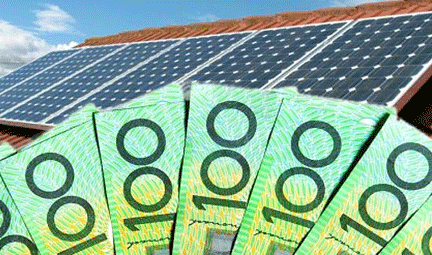 Sun powers hot returns as Cairns takes a shine to solar power for profitable asset CAIRNS is reaping the benefits of tropical sunshine, with annual returns on investment in local solar power more than twice those of most other assets.http://www.cairnspost.com.au/lifestyle/sun-powers-hot-returns-as-cairns-takes-a-shine-to-solar-power-for-profitable-asset/story-fnjpuwet-1226808318516 24 Jan 14
The city has been revealed as one of the top performers in Australia for giving the best return on solar investment when compared with shares, property, gold, global fixed interest and fine art.
National solar provider Energy Matters recently used consumer feedback to rank each town for solar viability.
Cairns came in fifth on the national list, with a 20.1 per cent investment return per year for almost a quarter (23 per cent) of solar-eligible homes that had invested in the power source as of last March.
Townsville ranked the country’s top solar town with a 21.8 per cent annual return on investment, closely followed by Gladstone (21 per cent), and Brisbane and Mackay (both 20.2 per cent).
The figures took into account each city’s sunshine hours, the cost of a solar system for that region, local electricity rates and the region’s level of government support.
According to the report, returns from solar lie well ahead of the average returns for Australian shares (9.8 per cent), residential investment property (9.5 per cent), global fixed interest (8.5 per cent), fine art investment (8 per cent) and gold (4.1 per cent).
“Australians are constantly looking for the best place to invest their money, yet they’re overlooking one of the best, and it’s right above their head,” said Energy Matters co-founder Nick Brass.
He pointed to the initial outlay costs and consumer confusion around available government support for preventing more people seeking out solar.
Wade Allen, managing director ofNaked Energy, said Cairns’ solar consumers were still on the rise, despite a dip in numbers after July 1 last year when the solar grid feed-in tariff dropped from 44 to 8.
“It’s no longer a ‘plug and play’ situation,” he said. “We’re sizing solar systems perfectly for what people can use … and that’s how we’re able to help them achieve a good return.”
Will Abbott carry his war on renewables to attack rooftop solar power
 Abbott urged to cut rooftop solar in national renewables revamp http://reneweconomy.com.au/2014/abbott-may-cut-rooftop-solar-national-renewables-revamp-83883 By Giles Parkinson on 23 January 2014 The Australian rooftop solar PV industry may have to prepare for a future with no federal government incentives. There is growing speculation that the small scale renewable certificate may be cut in a revamp of the national renewable energy target.
RenewEconomy understands that there is a renewed push by utilities and generators – particularly but not exclusively the state-owned ones – to close the small scale renewable energy scheme (SRES) and cease issuing renewable energy certificates for rooftop solar. Others suggest cutting the price cap on the certificates.
The renewable energy target is already under threat from utilities and generators, state governments, and sympathizers within the Abbott ministry to either remove, or severely dilute, the 20 per cent target. Continue reading
Community microgrids the renewable energy opportunity for rural Australia
“The stand-alone approach would give electricity network companies the opportunity to sell assets that they can no longer afford to maintain, and creates the potential to unwind cross-subsidies from urban to regional consumers,”
Unplugging Australia From The Mains Grid http://www.energymatters.com.au/index.php?main_page=news_article&article_id=4136 Regional towns and new housing estates in Australia have the potential to dump mains grid electricity supply quite soon according to a new report.
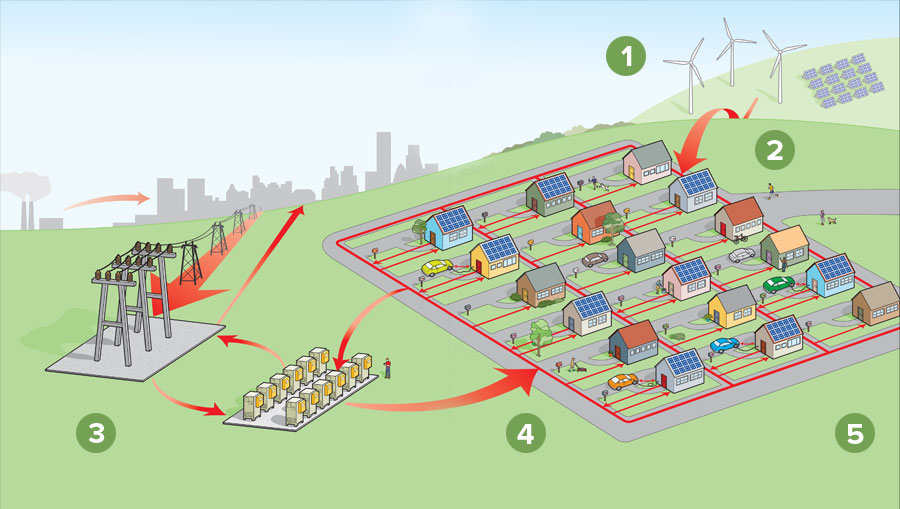
The document, prepared by Energy for the People and the ATA might initially send shivers down the spine of Big Energy; one that is already quivering from the impact of the home solar revolution in Australia.
This doesn’t necessarily mean households would be reliant on whatever panels they could fit on the roof. It could also involve “micro-grids” where communities buy back their local energy grid and invest in local energy generation and storage says Tosh Szatow, director of Energy for the People. Continue reading
Solar energy microgrid viable for rural towns in Victoria
Australia’s micro-grid opportunity, Business Spectator, Tristan Edis, 21 Jan 14 A new report released today suggests that the improving economics of solar and battery technology mean that by 2020 it would be cost-effective for greenfield housing
What’s highly surprising is that the authors of the report suggest that it could be economically viable for some Victorian regional towns to move to self-contained solar micro-grids today.

The study was prepared by the Alternative Technology Association and the organisation Energy for the People, which is focused on developing community clean-energy power projects. It looked at three alternative Victorian locations for assessing the viability of stand-alone power solutions: the regional town of Bendigo; Werribee – a fringe suburb of Melbourne experiencing rapid greenfield housing estate growth; and inner urban Melbourne. Continue reading
Solar panels – literally our best investment
Home Solar: Australia’s Best-Performing Investment http://www.energymatters.com.au/index.php?main_page=news_article&article_id=4131 20 January 2013 – National solar provider Energy Matters has released consumer insights that rank each town for solar viability and also reveal the true investment potential of solar power in comparison to shares, property, gold, global fixed interest or even fine art.
The figures will startle many; with it outperforming all other investment options using current ASX figures and other key organisations that rate investment opportunities.
The consumer insights also revealed Townsville in Queensland was Australia’s top address for solar, giving its residents a healthy return of investment of 21.8% per year. Other mainland capital cities included Brisbane (annual return of investment of 20.2%), Adelaide (19.1%), Sydney (18.9%), Perth 17.8%) and Melbourne (13.2%). Continue reading
Award to Australian university team for cost-cutting solar technology
 Bright sparks scoop top award for cutting cost of solar power, The Age, 20 Jan 14 Peter Hannam ENVIRONMENT EDITOR, THE SYDNEY MORNING HERALD AUSTRALIA’S WORLD-LEADING EFFORTS TO DRIVE DOWN THE COST OF SOLAR ENERGY HAVE BEEN RECOGNISED WITH AN AUSTRALIA-BASED RESEARCHER TAKING OUT THE ENGINEERING EQUIVALENT OF THE OSCARS.
Professor Stuart Wenham and his team at the University of NSW won this year’s A. F. Harvey Engineering Research Prize from the Institution of Engineering and Technology, and plan to plough the $560,000 award – one of the world’s richest – back into their work. “The prizemoney is going to be very valuable for us,” Professor Wenham said. “We’re going to use that to expand one of the research areas that actually contributed to winning us the prize.”
As Fairfax Media reported in May, Professor Wenham’s team discovered methods to control hydrogen atoms to correct deficiencies in silicon, the most costly material in solar photovoltaic (PV) cells.
As a result of the new hydrogenation process, lower-quality low-cost silicon can achieve the same performance as typical commercial cells using the expensive high-purity silicon, which now convert about 17-20 per cent of the sun’s energy into electricity.”
Solar power combats effects of heat wave in Australia
Australian Heatwave Solar Power Statistics http://www.energymatters.com.au/index.php?main_page=news_article&article_id=4129 17 Jan 14, The contribution solar energy has made in combating the effects of the current heatwave is significant.
With electricity generation plants and mains supply networks feeling the strain of 40C-plus heat and demand caused by air-conditioning; solar has helped alleviate the pressure.
The Australian Solar Council has found that at their peak on Wednesday,solar panel systems were contributing the following as a percentage of state electricity use:
– 27.54% in South Australia
– 11.77% in Western Australia
– 8.14% in Queensland
– 5.38% in Victoria
– 5.23% in New South Wales
The value of this power was not only in the quantity, but also in its timing; with peak production between 2:30pm-5:00pm – a timeframe when demand is high. This helped to rein in wholesale pricing which has reached staggering levels at times and possibly reduced the number of blackouts and load shedding that may have otherwise occurred.
Load shedding and blackouts are not only inconvenient and can cause significant economic losses; the often sudden nature of these events can also be dangerous.
“As a community we should be congratulating those people who have made a significant personal investment in installing solar PV, which is now paying dividends for the entire community,” said John Grimes, Chief Executive of the Australian Solar Council.
“Because solar PV produces electricity where it is used and does not need vast network infrastructure, the power that is produced is all being used to best effect, which adds up to a big saving for solar.”
“In a country like Australia where 1 in 100 year heat waves are becoming more frequent, solar is the perfect solution” said Mr. Grimes. “We expect more and more Australians to invest in solar PV systems to take control of their own energy future.”
While some states are yet to feel any relief from the heat, it’s reassuring to know that thousands of solar power systems are quietly working away delivering clean energy and helping to keep the lights and cool on indoors for many.
A step forward for solar thermal plant in Port Augusta
 Australian Youth Climate Coalition 16 Jan 14 We’re excited to share a great win with Repower Port Augusta

Today the Australian Renewable Energy Agency and the South Australian Government announced that they have committed to funding for Alinta Energy to run a feasibility study into building solar thermal in Port Augusta.
This is a huge step forward in building our first solar thermal plant!
You can read more here:http://www.businessspectator.com.au/news/2014/1/15/energy-markets/arena-funds-port-augusta-solar-thermal-study
The Australian Greens BREAKING NEWS: South Australia is one step closer to having a solar thermal plant!
On a day when we are sweltering under record-breaking heat, and climate change looms large, it has just been announced Alinta Energy has received ARENA funding for a feasibility study into solar thermal in Pt Augusta.
A huge effort from the team at Repower Port Augusta who have worked tirelessly on this project, and great news for the Port Augusta community. Bring on a healthy clean energy future!
Australia has 2 million small scale renewable energy systems
 Australia reaches nearly two million small scale solar systems http://reneweconomy.com.au/2014/australia-reaches-nearly-two-million-small-scale-solar-systems-66389 By Giles Parkinson on 9 January 2014 Clean Energy Regulator says Australia now has 2 million small scale renewable energy systems – enough to power Perth, Hobart, Darwin and Canberra.
Australia has now installed more than 2 million small scale renewable energy systems – reaching the target just eight months after the country achieved its first one million rooftop solar systems.
The announcement came from the Clean Energy Regulator, which manages Australia’s renewable energy target. The total is made up of 1.83 million small scale solar systems (both rooftop PV and solar hot water, and 173,000 air source heat pumps – see graph below).
The CER said the data underlines the fact that investment in small-scale renewable energy continues to flourish in Australia. Nearly all subsidies have been removed for small scale installations, although rooftop solar and other systems still benefit from renewable energy certificates. Continue reading
Western Australia’s phenomenal uptake of solar energy
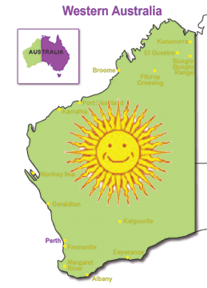 Western Australia Solar Uptake – From 1 To 130,000 http://www.energymatters.com.au/index.php?main_page=news_article&article_id=4096 26 Dec 13 The growth of residential solar power in Western Australia in the area serviced by Synergy has been nothing short of phenomenal. Continue reading
For the moment – limits to traditional battery storage of renewable energy
Falling battery prices coupled with a desire for self-sufficiency and the need for resilience against extreme weather events may mean that families purchasing a house Down Under may soon ask: “does it come with batteries?”
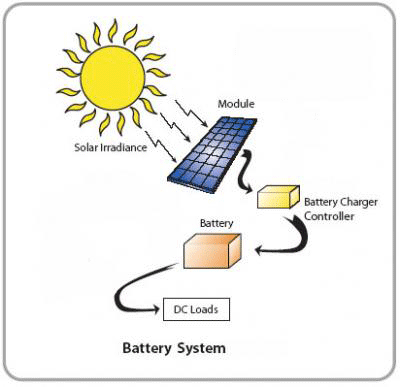 Storing renewable energy starts at home, DW Jonathan Gifford 16 Dec 13 “……At this stage the problem is that batteries are either expensive or inefficient. Even homes with a relatively large solar installation find that they cannot rely on it exclusively – even under the Australian sun. “The main problem for me is the storage of electricity hasn’t improved a great deal in the 41 years I’ve been here,” said Peter Holland, a Western Australian who has been living on a ‘bush’ property outside of the state’s capital, Perth.
“I’ve always had a bank of 12 two-volt batteries, but there’s a huge amount of loss,” Holland said. “The batteries are relatively inefficient and they’re extremely expensive.” Because of this, Holland’s off-grid system still requires a backup generator to cope when the sun isn’t shining or when large household appliances are switched on.
The solar industry has long understood the necessity of electricity storage. Shaun Qu, founder and CEO of Canadian Solar, says that the development of storage technologies will allow for more renewable energy to be installed. Continue reading
Australian government aiming to slow development of small scale solar power?
Renewable Energy Target Review Red Alert , Renewable Energy News, 12 Dec 13 The Abbott government will soon release its terms of reference for another Renewable Energy Target review says the Australian Solar Council. Given the general vibe; it doesn’t bode well for remaining small scale solar subsidies.
As solar feed-in-tariff incentives are dialled down, the Renewable Energy Target is now the major form of support to the solar industry in Australia and for those buying solar panel systems.
“The future of the small-scale scheme for solar PV is in considerable doubt,” states Australian Solar Council CEO John Grimes…….
The solar power industry currently employs more than 18,000 people in 4,500 small and medium businesses across Australia – many in rural and regional areas.
With Renewable Energy Target related support still providing subsidies of up to a couple of thousand dollars on solar panel systems and that support continuing after the review not something to bank on; the best time to go solar may be right now……..http://www.energymatters.com.au/index.php?main_page=news_article&article_id=4074
Victorian Aged Care Facility to get grid-connected solar power
Yingli Green Energy Hold. Co. Ltd. (ADR) : EnviroGroup Installs Australia’s Largest Grid-Connected Enphase Microinverter Project in Conjunction with Yingli Solar, 4 Traders Group, 12/11/2013 |Glenlyn Aged Care Facility to power 50 percent of its energy needs with solar power
Enphase Energy, Inc. (NASDAQ:ENPH), today announced that EnviroGroup, a specialist provider of renewable energy products and systems for commercial applications, government clients and residential home owners, has successfully installed Australia’s largest grid-connected solar power system with Enphase microinverters, in conjunction with Yingli Green Energy, known as “Yingli Solar”, at the Glenlyn Aged Care Facility in Glenroy, Victoria.
This 100kW installation is expected to generate over 392kWh of solar energy daily – which is approximately 50 percent of Glenlyn’s electricity requirements – to power the center’s operational and cooling facilities, particularly in periods of peak daytime demand……….http://www.4-traders.com/YINGLI-GREEN-ENERGY-HOLD-52545/news/Yingli-Green-Energy-Hold-Co-Ltd-ADR–EnviroGroup-Installs-Australias-Largest-Grid-Connected-E-17603508/
Solar power is reshaping Australia’s electricity market
People power: Rooftop solar PV reaches 3GW in Australia REneweconomy,By Giles Parkinson on 4 December 2013 Australia has passed through another significant solar milestone, reaching 3GW of solar PV this month, as Queensland nudged the 1GW mark and states such as South Australia reached household penetration rates of 25 per cent.
“Solar power is reshaping Australia’s electricity market,” says Warwick Johnston, the head of solar research group SunWiz, who compiled the data. “This is a milestone as note-worthy as the one millionth solar power system that was installed in April.”
The growth in solar PV in Australia is quite remarkable, given that Australia’s capacity was barely more than 180MW in 2009. Much of this growth came as a result of generous feed in tariffs, but the growth continues as a new generation of households look to solar to hedge against the rising cost of grid-based electricity, to make a statement about green energy, or to do both.Australia is almost unique in the world in having its solar installations almost exclusively in rooftop solar PV. That, according to Johnston, now totals 3GW on its own, mostly residential but also on a growing number of commercial rooftops, such as wineries.
Australia has only one solar PV array above 1.2MW, the 10MW Greenough River solar farm in Western Australia, although three projects have begun or are about to begin construction in the ACT, and the 102MW Nyngan project will also begin construction in January. Others are in the wings. To put this into comparison, the Japanese market is expected to install 9GW of solar in 2013 alone, much of it at commercial or larger scale…….http://reneweconomy.com.au/2013/people-power-rooftop-solar-pv-reaches-3gw-in-australia-99543
Large scale solar energy company to begin operations in Australia
SolarReserve Sets Up Shop In Australia, Renewable Energy News, 6 Dec 13 SolarReserve has announced the company’s international expansion into Australia through the opening of an office in Perth. The company says its Australian operations will focus on large-scale concentrating solar power (CSP) and photovoltaic (PV) projects, particularly in the off-grid mining sector.
“In Australia, the best solar resources are commonly found in remote areas where mines operate, presenting the off-grid mining sector with a substantial opportunity to offset the high price of electricity generation in these remote locations with a solar energy alternative,” says SolarReserve’s CEO Kevin Smith.
There are more than 1,000 operating mines in Western Australia – and many of those are powered by high-priced and polluting diesel fuel.
“In the face of impending policy decisions by the Australian government related to renewable energy and carbon emissions, solar energy for the mining sector is a win-win: good for business and good for the environment.”
The company was one of the participants in a meeting earlier this year in the gold mining city of Kalgoorlie in Western Australia to plan the Goldfields’ renewable energy future……http://www.energymatters.com.au/index.php?main_page=news_article&article_id=4062
1 This month

of the week – Australians for War Powers Reform (AWPR)
To see nuclear-related stories in greater depth and intensity
 Antinuclear