Solar Citizens bring about Government U-turn in Western Australia – national repercussions?

 Barnett Backs Down From Solar Backflip http://www.energymatters.com.au/index.php?main_page=news_article&article_id=3885 13 Aug 13, Solar supporters rejoiced after the Western Australian State Government yesterday reversed its decision to slash the feed in tariff rate for tens of thousands of solar households.
“Quite simply, we got this decision wrong and we have to fix it,” Premier Colin Barnett said in a short statement.
“We understand that this measure would have had an unfair impact on one section of the community and it has to be reversed.”
Within hours of the original decision to slash the incentive, solar households and supporters mobilized. Mainstream and social media was buzzing with condemnation. A Solar Citizens petition was launched that very quickly attracted over 9,000 signatures protesting the reduction.
Even within the State Government’s ranks, there was dissent. Overall, the backlash was such that it had the potential to impact results in the Federal Election. Continue reading
Western Australia: Liberals rebel against govt reneging on solar energy deal
Liberal rebellion on solar heats up, The West, Gareth Parker and Daniel Mercer, The West Australian August 12, 2013, 2 Colin Barnett is facing a backbench revolt over the State Government’s decision to halve its rooftop solar panel subsidy, with a pair of Liberal MPs accusing the Government of lacking integrity.
The growing rebellion came as a letter from Synergy sent in 2011 emerged as a key piece of evidence in any potential legal fight over
the changes. The letter – sent soon after the Government cut the tariff in a previous revision to the scheme – says that customers entitled to the
40 cent payment would get it “for the full term of your 10-year contract”.
Government MPs have been flooded with complaints from irate voters about the decision to cut to the so-called solar feed-in tariff from
40 cents to 20 cents, with the issue spilling over to the Federal election campaign as a vote turn-er against Liberal candidates.
Maverick Hillarys MLA Rob Johnson threatened to cross the floor for the first time in his 20-year career to vote against the measure,
while Southern River MLA Peter Abetz said the Government had acted unethically.
Mr Johnson said the Government was acting with a “lack of integrity” by reneging on a deal with 75,000 solar panel owners in a bid to save
$51.2 million over the next four years. Continue reading
Solar energy in Australia heading for big commercial applications?
 Solar PV projects can be rolled out within months, not years. The experience from the Australian residential solar sector illustrates that solar PV can scaled-up very quickly. While grid connection is a more involved process for commercial rooftop solar than residential, each system involves tens of kilowatts instead of just two or three. So it seems reasonable to expect that if the market conditions are conducive, there would be no physical constraints to commercial solar rolling out a few hundred megawatts in 2014, and a gigawatt in 2015.
There would still be a need for new wind farm development under such scenario, but it would buy time for wind farm projects to scale-up, and ensure enough supply to meet the Renewable Energy Target.
Market could blindside Origin and Energy Australia Climate Spectator Tristan Edis 9 Aug, “……So far Origin Energy and Energy Australia have been holding out on signing onto long-term power purchase agreements for wind farms, because they’re hoping the Coalition will water down the level of the Renewable Energy Target. AGL has also put a halt to further development concerned that it might come true.
This can create a self-fulfilling phenomenon, because waiting to develop projects makes the target more difficult to achieve. This then encourages government to intervene to water down the target.
However there’s some interesting wrinkles that could mean solar becomes a bigger player in the large-scale renewable energy target, producing substantial numbers of large-scale renewable energy certificates known as LGCs.
1) Non-traditional buyers for renewable energy certificates may emerge and the price will rise……..
2) Commercial rooftop solar developers will begin producing LGCs……..
3) Finance products are emerging to support commercial solar………… Continue reading
New solar energy company opens in Sydney
 China’s quiet achiever makes mark on energy’s new frontier SMH, August 10, 2013 Peter Hannam Carbon economy editor “…….Yingli Green Energy, has knocked Suntech off its rank as the world’s biggest producer of solar photovoltaic panels and its breakneck growth – along with an array of other Chinese firms – has driven PV prices down by about three-quarters in four years.
“He’s China’s Richard Branson,” said Daman Cole, commercial director of Yingli Solar, speaking of his boss at the opening of the company’s Australian office this week in Sydney……..
The opening of the Sydney office is also part of Yingli’s search for new markets. The company aims to grab 10 per cent of the Australian market within a couple of years, with a focus on commercial customers. Orders secured include a 1.25-megawatt deal to supply the panels for 30 buildings for the City of Sydney worth $3.4 million, while it has also signed a distribution pact with L&H Group, a major electrical wholesaler in Australia and New Zealand.
Solar-powered smartphone batteries and broader “energy solutions” with customers are expected to feature in the future…… http://www.smh.com.au/business/chinas-quiet-achiever-makes-mark-on-energys-new-frontier-20130809-2rn5n.html
Australia’s solar energy revolution in outer suburbs
Solar revolution led by outer suburbs, SBS World News, 5 AUG 2013, Households across the country are putting solar panels on their roofs at a rate that has exceeded all expectations, By Tim Flannery
 Households across the country are putting solar panels on their roofs at a rate that has exceeded all expectations. This year we hit 1 million rooftops with photovoltaic (PV) solar panels, up from just 8,000 in 2007. This means that a staggering 2.6 million Australians, 11% of the population, are now using the sun to power their homes.
The solar energy revolution is being led in suburbs and towns like Dubbo and Campbelltown in NSW, Bundaberg in Queensland, Hoppers Crossing in Melbourne, and Mandurah in Western Australia. This increase is being driven by ordinary Australians. It is the modest outer metropolitan suburbs across the country, with high concentrations of mortgages, which show the greatest uptake.
The cost of installing a PV panel today is less than a quarter of what it was in 2002. The decision to install solar panels is no longer just about global responsibility – it makes financial sense. As global momentum for solar continues to grow, the technology is advancing and manufacturing is being up-scaled in countries like China. Together these factors are rapidly driving down costs, making solar increasingly competitive even without subsidies. Businesses are watching the drop in technology costs keenly as payback periods become increasingly cost competitive.
Smart investors are realising that this trend is here to stay and that the future of energy is renewable. …. http://www.sbs.com.au/news/article/1796353/Comment-Solar-revolution-led-by-outer-suburbs
Australian solar households generate over $2 million in electricity, daily
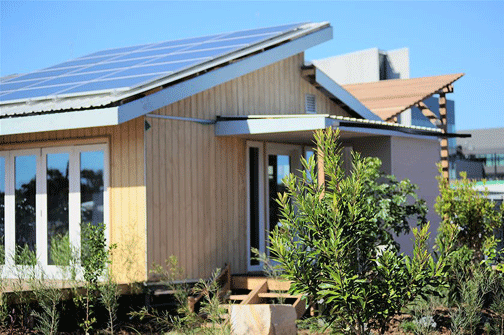 Climate Commission Lauds Solar Power http://www.energymatters.com.au/index.php?main_page=news_article&article_id=3874 6 Aug 13, Solar power in Australia is a ‘revolution that nobody saw coming’ says the Climate Commission in its latest report, The Critical Decade – Australia’s Future: Solar Energy.
‘Nobody’ is probably over-generalising. There are many Australians who understood its potential; however, ‘nobody’ could probably be more accurately applied to Big Energy and the fossil fuel industry. It’s certainly taken those sectors by surprise; having morphed from a mildly amusing novelty to an irritation, to a serious disruption to the energy status quo.
The Climate Commission report states it was only 4 years ago the Australian Bureau of Agricultural and Resource Economics estimated it would take at least a decade for Australia’s solar capacity to reach a stage where it would be able generate 3,500,000 megawatt hours annually. We reached that point this year; thanks to the early adopters who kicked off the revolution, government support and a massive reduction in the price of solar equipment.
With over 1 million solar panel systems installed; around 11% of our population now live in a solar household. In April this year, we estimated Australian solar households to be generating $2 million plus in electricity daily. The Climate Commission report states around a third of all solar PV systems in Australia were installed in 2012 and during last year, approximately 3.4 million tonnes of emissions were avoided. 70% of all new electricity generation capacity installed in Australia in 2012 was solar PV.
Rather than revealing anything new, the Climate Commission’s report gives an overall summary of where we’ve been, where we are and where we might head as a solar nation; providing an overview of the technology and issues, plus a range of interesting statistics gathered from various sources.
For example, while our 2012 figures are stunning and despite having vastly superior solar resources, Australia installed less than a third of the solar capacity that Germany did last year. On sunny days, solar PV now accounts for up to 35% of electricity consumed in Germany.
For new arrivals to the solar party or others wanting a handy guide to refer to for fairly current facts and figures, The Critical Decade – Australia’s Future: Solar Energy (PDF) is recommended reading.
South Australia’s renewable energy success, despite planned cutbacks in solar feed-in tariff
SA’s love affair with renewables isn’t just solar-focused; the state also has the largest wind power capacity in the nation. According to the Australian Energy Market Operator, approximately 29% of South Australia’s electricity came from renewable energy sources in 2012.
South Australia Solar Feed In Tariff Countdown http://www.energymatters.com.au/index.php?main_page=news_article&article_id=3872 5 Aug 13, South Australia’s feed in tariff will be slashed for new applications soon. To avoid the inevitable applications rush; households intending going solar may want to make a move now.
South Australia’s current solar feed in tariff for surplus exported electricity is comprised of two parts- a retailer contribution of 9.8c and a 16 cent component paid by SA Power Networks. Continue reading
Australians saving money by going solar
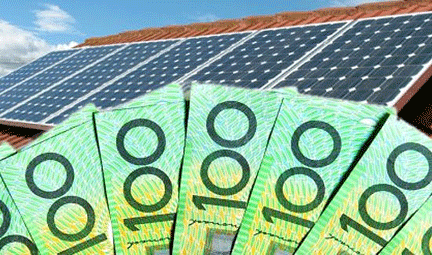 Going Solar Now Cheaper Than A Daily Cup Of Coffee http://www.energymatters.com.au/index.php?main_page=news_article&article_id=3865 31 July 13 Australian solar solutions provider Energy Matters is currently offering fully installed 3kW solar panel systems from under $3 a day; with no up-front payment required.
With Energy Matters’ Save As You Go Solar initiative and depending on installation location; repayments are as little as $20.55 week for a 3kW system that can return a financial benefit of up to $1,215 year – meaning the amount saved on electricity bills can be more than the repayments.
After the payment period, electricity produced by the system is essentially free. Continue reading
Large scale solar power project for Western New South Wales
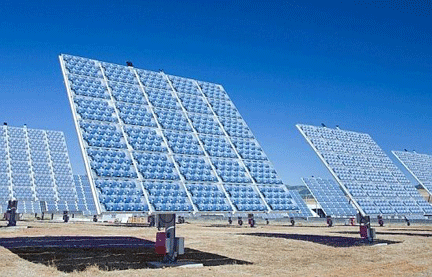 Largest solar power station in the southern hemisphere News International, 31 July 2013 11:16 Gary Gray Canberra , Federal Minister for Climate Change, Mark Butler today announced construction will start in January on the largest solar power station in the southern hemisphere after the Australian Renewable Energy Agency (ARENA) reached financial close with AGL Energy Limited (AGL).
Mr Butler said the project will be built across two sites in Western NSW and will cover a combined area four times the size of the Sydney CBD.
“Australia has the highest average solar radiation per square metre of any continent in the world and we should take advantage of that natural asset,” Mr Butler said.
“This project is 15 times larger than any other solar power station in Australia and represents a big step forward towards making solar a bigger part of Australia’s energy mix.
“The Rudd Government is committed to transitioning Australia to a clean energy future and this combined 155 megawatt solar project helps make renewable energy cost competitive for more Australians.”
Minister for Resources and Energy Gary Gray said this was a major milestone for AGL and the Government and would help boost investor confidence in large utility-scale solar.
“Reaching financial close and progressing to construction is a major achievement paving the way for future investment and meaning that, in a short time, an additional 50,000 homes across New South Wales will be powered by clean energy each year,” Mr Gray said. Continue reading
Australia could replace coal energy by solar energy by 2040 – Energy expert
Solar energy growth could drive out coal by 2040, expert says SMH, July 24, 2013 Peter Hannam Carbon economy editor Australia could phase out almost all its fossil-fuel sourced electricity by 2040 if it doubled the current rate of take-up of solar energy and wind energy maintained its current growth pace, said Professor Ken Baldwin, director of ANU’s Energy Change Institute….. to shift the energy sector away from carbon-intensive coal and gas sources to avoid dangerous climate change, renewable energy could provide all but a couple of per cent of Australia’s electricity in under three decades, he said, citing data from ANU’s Centre for Sustainable Energy Systems. Continue reading
Western Australian Goldfields ready to lead on solar thermal energy
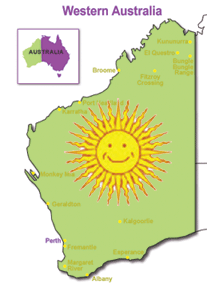 Solar Thermal Touted For Western Australia’s Goldfields http://www.energymatters.com.au/index.php?main_page=news_article&article_id=3858 25 July 13, Greens Senator Scott Ludlam was in the gold mining city of Kalgoorlie in Western Australia on Tuesday; convening a meeting to plan the Goldfields’ renewable energy future.
Senator Ludlam says the Australian Greens’Connecting Clean Energy plan (PDF) was a perfect fit for the Goldfields. The plan focuses on the identification and creation of new Renewable Energy Zones to help remove investment and infrastructure barriers.
“The community and business sector in the Goldfields are showing they are ready to take the leadership on solar energy,” said Senator Ludlam. Continue reading
Flat pack modular solar buildings – another Australian first
Australian Flat Pack Solar Buildings http://www.energymatters.com.au/index.php?main_page=news_article&article_id=3852 24 July 13 An Australian company is producing flat pack modular accommodation that incorporates solar power.
Blue Planet Buildings, based in Revesby, New South Wales, manufactures a modular system that in flat-pack configuration sits in its own metal bottom frame with adjustable feet and does not require a concrete slab or brick piers.
Engineered to exceed Category D Cyclone standards, the building’s frame is made from extruded aluminium. Metal wall and roof modules are 80mm thick, the floor 110mm thick and feature injected EPS insulation. All windows in the structure are double glazed to maximize energy efficiency and suppress noise.
Optional fittings include plumbing and provision for a deep cycle battery bank.
2 people can assemble the buildings in as little as an hour; with a crane or forklift required to position the roof section. Assembly is so simple, tradespeople are not needed.
Up to 6 flat packed units can fit in a single shipping container. The demountable buildings are being used across Australia in mining, construction, emergency services, education, transport and infrastructure sectors. Once a project is complete, the units can be disassembled and relocated.
Blue Planet Buildings was the recipient of The Australian Business Award for Best Eco Product in its industry classification for 2013.
New South Wales students taking their zero emissions house to China’s Solar Decathlon
Win or lose, beyond Datong, the long-term plan is to convert the Illawarra Flame into a commercially viable concept that will work at scale, so Australia’s fibros can be cleaned up, revitalised and power on for another lifetime.
 Chic shack SUE WHITE ABC Environment 16 JUL 2013 A humble Australian home is an unlikely contender in the ‘energy olympics’ being held in China in a few weeks.
When 33 students from the Wollongong region started packing for their upcoming travels to Datong, China, luggage limits were put to the test. Fifty packets of Tim Tams. Hundreds of koala key rings. At least one cricket set. And oh yes, an entire house.
The “Illawarra Flame” renovated fibro at an open day earlier in the year.Clearly, this was no normal end of semester break. But for the students and their supporters (totalling 51 students, staff and contractors from the University of Wollongong and TAFE Illawarra Institute), not much is normal about their entry into this year’s Solar Decathlon China.
Even getting in was no small feat. Team UOW, as it’s known, is the first Australian team ever accepted into the prestigious international event. This two-week marathon is the largest sustainable building research and innovation competition in the world. There are 23 teams from around 30 countries entering their eco-friendly houses, and all are hoping to come home as the winner of 2013’s ‘Energy Olympics’.
For Team UOW, it’s been a two-year journey to demonstrate it’s possible to transform a typical uninspiring Aussie fibro house into the Illawarra Flame; a stylish, net zero-emission home powered by the planet and, of course, plenty of student power — of both the brain and brawn varieties. Continue reading
Mildura’s concentrated solar power plant officially launched
Australia’s largest concentrated solar power plant officially launched REneweconmy, By Sophie Vorrath on 17 July 2013 Australia’s largest concentrated photovoltaic (CPV) solar power plant was officially opened today, with the Victorian energy minister joining executives from the plant’s developer, Solar Systems, to cut the ribbon on the 1.5MW demonstration facility in Mildura.
The demonstration of the “dense array” solar technology of parent company Silex Systems is a fore-runner for what is expected to be a 100MW power plant, with construction slated to begin in 2014. Another 1MW demonstration plant is being built in Saudi Arabia, with hopes of further development as that country pushes into the start of a $100 billion solar spending program
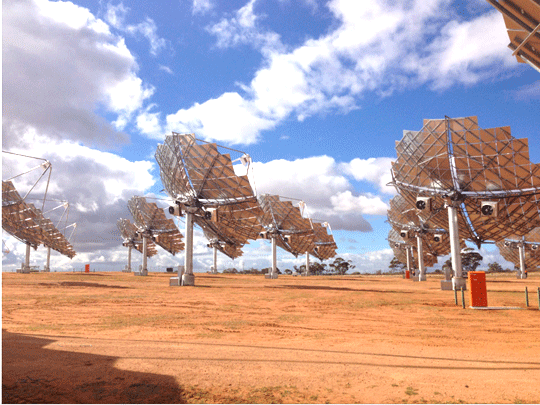
The array – whose 40 CPV dishes have been feeding power into the national grid for almost a month, after their successful commissioning began in April – collects sunlight in more than 100 curved mirrors and focuses it onto ultra-high efficiency “mulit-junction” PV cells; technology originally developed by Boeing to power satellites. Silex CEO Michael Goldsworthy says the cells currently boast efficiency rates of around 43 per cent – about double that of today’s best silicon-based cells and up to four times the efficiency of thin film solar cells – but he hopes this can be lifted to more than 50 per cent, or even 60 per cent, with further research.
The technology also uses ‘active cooling’ technology to maximise power output while minimising water consumption and prolonging the technology’s lifespan…….. Continue reading
Sunshine Council – an Australian first – to have council solar farm
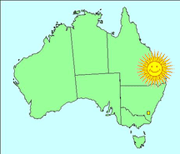 Sunshine Coast Council To Go Solar http://www.energymatters.com.au/index.php?main_page=news_article&article_id=3837 14 July 13, Queensland’s Sunshine Coast Council is planning to build a solar farm that would supply half of its electricity needs. Mayor Mark Jamieson says it would be the first council in Australia to have a utility scale solar farm constructed.
“The $24-30m solar farm proposed to be built at Valdora near Coolum would meet half of council’s electricity needs for at least the next 30 years,” he said. “Over the next three decades council is expected to pay in excess of $110m for electricity, and the solar farm would have the potential to reduce that by many millions of dollars.”
Council believes it will save around $10 million over the expected life of the project.
The solar farm project would inject $10 million into the local economy over the next 10 years and create 40 jobs during construction.
One of the reasons Sunshine Coast Council believes now is the right time to invest is energy contract re-negotiation with current retailers is due in 2014. It also recognises solar panel prices are currently very low; something that could change given fluctuations in the Australian dollar and other factors.
The solar farm would help develop the Sunshine Coast’s cleantech industry hub and skills developed during construction could be deployed to similar projects within Queensland and elsewhere in Australia; helping to further diversify the local economy.
“This project has the potential to transform the Sunshine Coast. It would become the embodiment of everything we stand for; a region which is economically, environmentally and socially sustainable,” said Councillor Mark Jamieson. “It would save money, reduce our carbon footprint and take us another step closer to becoming the most sustainable region in Australia”
Council will call for Expressions of Interest to design and build the solar farm in the next few weeks and hopes construction will commence in 2014.
1 This month

of the week – Australians for War Powers Reform (AWPR)
To see nuclear-related stories in greater depth and intensity
 Antinuclear