Australia’s first utility scale solar energy plant – but we lag behind USA
Australia lags US by four years in solar roll-out, First Solar says. SMH, October 16, 2012 First Solar, the biggest maker of thin-film panels, said Australia is four years behind the US in building large solar farms and expects its
project with General Electric to help spur the industry’s expansion.
First Solar is supplying panels to the 10-megawatt Greenough River project in Western Australia, the nation’s first large-scale solar plant. The GE- and Verve Energy-owned solar project, which started this month, may increase capacity to as much as 40 megawatts, the companies said Oct. 10.
“This is less about the size and more about the fact that we now have a utility-scale solar project in Australia,” Jack Curtis, First Solar’s Sydney-based vice president of business development, said . “The local industry can now look to this project and see they can be developed, that they can be executed. It will provide local operational data that can be used to bring the rest of the industry along.” ….. http://www.smh.com.au/environment/climate-change/australia-lags-us-by-four-years-in-solar-rollout-first-solar-says-20121016-27pih.html#ixzz29ZyKNn6y
Solar energy farm up and running in Western Australia
Hip hip array! First solar farm opens in WA SMH, October 10, 2012 Australia switched on its first utility-scale solar farm today, a small step on the way to achieving ambitious renewable energy use targets that traditional coal and gas power producers are now fighting to soften.
The Greenough River Solar project, just outside the small town of Walkaway in Western Australia is a joint-venture between WA state-owned Verve Energy and US conglomerate General Electric. It is expected to generate 10 megawatts, enough to power 3000 homes. Continue reading
Solar plant construction in Victoria moves on
 Solar plant work heats up with latest funding http://www.abc.net.au/news/2012-10-05/waste-dump-to-top-agenda-at-anti-nuclear-forum/4297944 Oct 5, 2012 Victoria’s Energy Minister has launched the second funding round for a new 1.5 megawatt solar power plant near Mildura.
Work started on the $400 million Solar Systems power station at Carwarp, south of Mildura, earlier this year.
The latest round of $10 million in funding from the State Government will allow the plant’s construction to begin in earnest.
Minister Michael O’Brien says he expects the project to showcase solar energy.
“This new 1.5 megawatt power plant will really demonstrate its scale – that large scale solar can work, the technology works and establishing these plants is actually proving on the ground that they work,” he said.
“[It] is really a massive step forward towards creating a new solar industry for that part of Victoria.”
The Member for Mildura, Peter Crisp, has welcomed the announcement and says it is a milestone in the plant’s development.
“Part of that development that makes it so critical at this stage is that they are now getting ready to start construction in Mildura,” he said.
“Those who have been out will see that it’s fenced, there’s a road area, there’s loading bays – there’s a whole lot of work being done but now you’ll start to see the parabolic dishes being assembled on site, as it now starts to move into that larger scale project.”
$Multi million sale of Australia’s biggest solar power plant in Alice Springs
 Australia’s biggest solar power station sold http://www.abc.net.au/rural/news/content/201210/s3604021.htm By Allyson Horn, 04/10/2012 Australia’s largest solar power plant has been sold in what’s believed to be a multi-million dollar deal.
The Uterne power plant in Alice Springs began operating last year. It was developed in partnership between internationally-based SunPower Corporation and the Northern Territory’s electricity provider, Power and Water Corporation, at a cost of $6.6 million.
It’s been sold to Australian-based alternative energy company Epuron for an unknown price. The terms of the deal are not yet known. Under a new arrangement, Power and Water will continue to buy electricity generated by the plant at an agreed rate for the next 20 years.
SunPower will continue to provide operational and maintenance services in conjunction with Ogden Power, which is based in Alice Springs. The venture was financed by the Commonwealth Bank, making it Australia’s first major bank to support a solar project of this size.
Epuron executive director Andrew Durran said the acquisition made the company one of the largest solar project owners and asset managers in Australia.
The solar station produces about 1 per cent of Alice Springs’ electricity a year and can meet 2 per cent of peak demand on a sunny day. Epuron, which was founded in 2003, has also been involved in the development of a large number of power-generating wind farms, particularly in NSW.
Australia’s top solar suburbs are low to medium income areas, not rich
Australia’s Top 6 Solar Suburbs http://www.energymatters.com.au/index.php?main_page=news_article&article_id=3403 by Energy Matters, 2 Oct 12 The mortgage belt suburbs and the bush are where solar power truly shines. REC Agents Association (RAA) has expanded on an earlier submission prepared for the Climate Change Authority in relation to Australia’s Renewable Energy Target review that conclusively busted the myth ofsolar being the realm of rich city dwellers.
In its geographical analysis of solar energy systems under the Renewable Energy Target, RAA states suburbs with the highest penetration were typically in the outer metropolitan mortgage belt.
The RAA lists the 6 top solar suburbs as being:
Coodanup, Western Australia – 30% (9,463 systems)
Abbotsford, Queensland – 26% of houses (9,029 systems)
Booral Queensland – 34% of houses (8,823 systems)
Cocoroc Queensland – 29% of houses (8,426 systems)
Hoppers Crossing, Victoria – 34% of houses (8,138 systems)
Bentley, New South Wales – 39% of (7,763 systems)
The organisation notes some houses may have solar panels and solar hot water systems installed, meaning the penetration rate could be slightly lower
The average annual gross income of solar households across Australia is estimated to be $60,216 a year.
The full report includes a table of the top 20 solar PV and solar hot water suburbs by state. In a related research note, RAA says the Small-scale Renewable Energy Scheme (SRES) has resulted in 1.5 million solar systems being installed by Australian families up until June 30 this year. Of this number, 753,844 were solar panels systems and 743,842 were solar hot water systems.
It says the cost impact of the SRES will drop to less than 1% of residential electricity prices when the Solar Credits multiplier is totally phased out in 10 months from now
The REC Agents Association (RAA) was established in late 2011 and acts on behalf of agents registered with the Clean Energy Regulator (CER).
Solar Trivia: Only 118 households had installed solar panel systems 2001.
Solar energy going backwards in Queensland, with its anti-renewable energy government
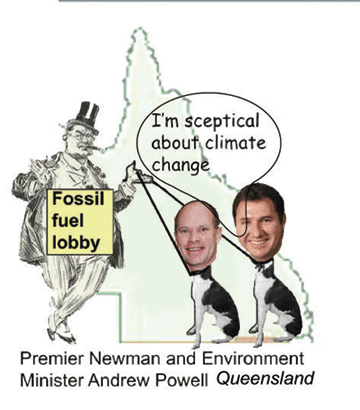 Queensland a leader in solar? Not on Campbell Newman’s watch By Charis Palmer 27 September 2012 The Conversation Around the clock solar power could be a reality for Australians in the foreseeable future, but experts say a hostile state government stands in the way of Queensland becoming the solar power leader suggested by the Climate Commission.
The latest instalment from the Climate Commission on the impacts and opportunities of climate change is “wilfully blind to reality”, with no mention of the massive coal and coal seam gas industries in Queensland, said Chris McGrath, senior lecturer in environmental regulation at the University of Queensland. The report says Queensland’s solar resources are among the best in the world, and the state should take more advantage of the opportunity.
But in the absence of positive deployment policies from the state government, it will take some time to see large solar power stations serving retail customers, said Mark Diesendorf, deputy director of the Institute of Environmental Studies at University of New South Wales. The Climate Commission’s report cites the Kogan Creek Solar Boost Project, which will provide a solar thermal addition to the neighbouring coal-fired power station, expected to be the largest solar integration project in the world.
But in July, Queensland Premier Campbell Newman withdrew $75 million in funding from the proposed stand-alone 250 megawatt Solar Dawn project near Chinchilla.
Dr Diesendorf said concentrated solar thermal could be vital to solar power generation in the longer term. “It’s not very expensive to store the heat on concentrated solar thermal and therefore have 24 hour solar power.”
But with several coal-fired power stations running at less than capacity in Queensland, organisations investing in new solar infrastructure will find it difficult to compete, Dr McGrath said. He added that the government’s focus remained on coal and coal seam gas, with renewables seen as a small component only.
“They’re talking about Queensland as a leader for solar, but Queensland’s going backwards in terms of participating in any funding for addressing climate change, and unwinding programs.” Dr McGrath said the picture painted by the Climate Commission in its report is the same one that’s been painted for ten years with no action taken.
He said a blunter approach was needed from the Commission and agreed that while it may not be an advocacy group, it was up to scientists to point out the consequences of policy choices. “It’s not advocating if you say the 5 per cent by 2020 goal will lead to three degrees warming and we won’t have a Great Barrier Reef at this point. That’s just joining the dots for people to see.”
Solar power in Australia being taken up by the less well off
 ‘Solar Is For The Rich’ Myth Well And Truly Busted http://www.energymatters.com.au/index.php?main_page=news_article&article_id=3392 by Energy Matters, 24 Sept 12 The anti-solar brigade is running out of ammunition after yet another popular myth – that rich city dwellers represent the majority of solar installs – has again been shown to be completely and utterly false.
In a submission prepared by the Rec Agents Association (RAA) to the Climate Change Authority in relation to Australia’s Renewable Energy Target review, an analysis of postcode locations of solar electric and solar hot water system installations found most systems (53%) were installed in regional and rural communities with only 43% installed in the major capital cities.
Solar power uptake amounted to 13% in the major capital cities of Australia and 21% outside of the major capital cities.
Furthermore, the suburbs with the highest income levels did not correspond to those with highest penetration – in fact, the opposite was more likely.
“A broad range of communities have accessed solar under the RET scheme and the above figures explode the myth that the RET is supporting metropolitan middle class welfare and is evidence of the RET’s equitable effectiveness,” states the submission.
Echoing sentiments expressed by others, RAA also believes the RET review should be extended from 2 to a minimum of 4 years as the current 2 year review increases investment uncertainty for the renewable energy industry.
RAA’s response to the Climate Change Authority’s Statutory Renewable Energy Target Review can be viewed here (PDF).
The REC Agents Association (RAA) was established in late 2011 and represents agents registered with the Clean Energy Regulator (CER) that createsRenewable Energy Certificates (RECs) and other environmental certificates.
Queensland leads in war against solar energy
War against solar: pricing regulator favours gross tariffs, REneweconomy, By Giles Parkinson on 14 September 2012 The Queensland pricing regulator says it favours the introduction of a gross feed in tariff in the state, in a move that the solar industry say would be devastating for the rooftop solar PV market…..
They argue it effectively reduces competition in the industry, and potentially removes one of the key solutions to the overloading of grids. Numerous independent studies have underlined the important role that solar PV could help in meeting peak demand, but this is rarely acknowledged by the utilities, who are more concerned about protecting revenues by growing their assets. The move comes just months after the Queensland Government slashed its net feed in tariff. Queensland had been the fastest growing state for solar PV, accounting for 40 per cent of national installations by some count.
The introduction of gross tariffs would also likely kill off the emerging commercial-scale solar PV market in Australia. Commercial scale solar is considered one of the most effective options for reducing peak demand because the output from the rooftop or ground mounted panels corresponds with usage by commercial users.
However, Australian solar companies have also expressed fears that the suspension of grants under the Federal government’s $800 million Clean Technology Investment Program for manufacturing groups could threaten many projects, just as the industry was getting started.
The head of one NSW company, who requested anonymity, said he had 15 proposals on the drawing board, ranging in size from 30kW systems to up to 1MW for customers including manufacturers, processors, retailers, and vineyards.
He said if the funding was withdrawn, only a couple of smaller projects were likely to go ahead. That’s because larger commercial customers had the buying power to negotiate lower electricity prices – of around 16c-18c/kWh (instead of 30ckW/h or more) from the utilities which were effectively cross subsidized by other users. RenewEconomy highlighted the other issues surrounding commercial solar in this piece earlier this week, Why new solar tariffs coud drive a man to diesel”….
The situation in Australis is not unique. In the US, for instance, the solar industry is facing similar issues, as highlighted in this piece on Greentech Media this week – where they flagged a potential installation of 75GW of solar PV in the country by the end of the decade – 15 times its current capacity – and massive resistance from utilities.
In Australia, the utilities have become concerned because of recent forecasts that suggest up to 18GW of solar PV could be installed in the country over the next few decades. Some private forecasts suggest that could happen within a decade.
As David Crane, the head of leading US energy generator NRG, said earlier this year, solar PV represents the biggest threat to the conventional energy industry in half a century. In the Greentech Media piece, the solar companies said utilities in the US were so powerful they acted as “a fourth arm of government” and won’t give up easily. Professor Ross Garnaut has commented on the extent of regulatory capture in the Australian industry, hence the ability to “gold plate” networks and extract huge compensation packages for the carbon price. http://reneweconomy.com.au/2012/war-against-solar-pricing-regulator-favours-gross-tariffs-23984
Australian Capital Territory leads with big solar, AND decentralised solar energy
 Canberra Goes Solar In A Big Way http://www.energymatters.com.au/index.php?main_pag news_article&article_id=3371 by Energy Matters, 6 Sept 12, Spanish company FRV has been awarded a project to develop a 20MW solar panel based electricity generation facility in the Australian Capital Territory.
The FRV Royalla Solar Farm will be constructed 23 kilometres south of Canberra’s CBD and will consist of approximately 83,000 solar panels – the largest facility of its kind to date in Australia. Royalla Solar Farm will generate enough electricity to supply the power needs of around 4,500 homes and avoid over half a million tonnes of greenhouse gas emissions during its serviceable life.
Country Manager of FRV Australia said the project represents an important step in the company’s long term commitment in Australia. The Australian Solar Council welcomed the announcement by the A.C.T. Government.
“This is a landmark day for Big Solar in Australia”, said John Grimes, Chief Executive of the Australian Solar Council.
“Australia’s clean energy future has arrived in Canberra…Solar is increasingly taking on coal-fired power on price.”
“Big solar plants will increasingly meet Australia’s peak power energy needs, and today’s announcement by the A.C.T. Government is a window into Australia’s solar future.”
Mr. Grimes also congratulated the ACT Government for “delivering Big Solar at low cost and at breakneck speed.”
ACT Environment Minister Simon Corbell said the project would make Canberra the solar capital of Australia – and at a low cost. “The Government’s reverse auction process is about getting the cheapest price for the best amount of renewable energy generation, and today we’ve delivered on that,” he said.
Construction is due to begin in 2013 and is expected to be finished in 2014, subject to relevant approvals. FRV states it has fully developed more than 360 MW of renewables capacity globally and has participated in the development of over 2,750 MW at different stages.
Bidding for the ACT project occurred under a reverse auction model. According to RenewEconomy’s Giles Parkinson, reverse auctions are already being deployed successfully in some of the world’s biggest energy markets, including India.
In addition to support for Big Solar, the ACT also encourages home solar power through a feed in tariff incentive. Surplus electricity generated by home systems is purchased by ActewAGL Retail at the customer’s electricity tariff rate.
According to national solar solutions provider Energy Matters, a 3kW solar panel system installed in Canberra can generate a financial benefit of nearly $800 a year.
University of New South Wales (UNSW)’s solar cell innovation
UNSW, Suntech Power and Hanwha Solar Partner to Improve Solar Cell Efficiency AZOcleantech, September 6, 2012 By Gary Thomas Researchers at the School of Photovoltaics and Renewable Energy Engineering (SPREE) at the University of New South Wales (UNSW) in Australia have developed an advanced processing technology for enhancing the efficiency of silicon solar cells. SPREE has entered into a research partnership with Suntech Power and Hanwha Solar, twomajor silicon solar cell manufacturers.
Thin film The electric insulator in a solar cell is located between the aluminium back-plate and the silicon wafer. The newly developed technology involves “self-patterning” tiny metal contact regions into the electric insulator of a solar cell…..
http://www.azocleantech.com/news.aspx?newsID=17281
The University of NSW a global leader in solar technology research and development.
UNSW, Suntech and Hanwha Solar Collaborate http://www.energymatters.com.au/index.php?main_page=news_article&article_id=3370 by Energy Matters 6 Sept 12, Technology being developed at the University of New South Wales to improve the efficiency of silicon solar cells has grabbed the attention of two of the world’s largest solar panel manufacturers.
The School of Photovoltaics and Renewable Energy Engineering (SPREE) has inked a collaborative research agreement with Suntech Power and Hanwha Solar to further develop experimental technology to automate and speed up patterning of solar cell electric insulators.
“Currently closely-spaced small-area metal contact regions in an insulating layer can only be formed by deliberately patterning the holes with a laser scanning over the surface, which is quite slow,” says Dr Alison Lennon, a senior lecturer from SPREE.
Dr Lennon says other methods such as aerosol and ink-jet printing are at this point too slow and have been unable to demonstrate the required patterning reliability.
Dr. Lennon and her PhD students are investigating the use of aluminium anodisation, a process where a chemical coating is formed on a metal surface to protect against corrosion, which she says can turn an aluminium layer on a silicon solar cell into a dielectric layer with many tiny holes; exactly what is needed.
The team has already constructed prototypes of cells using the process and is now working on improving cell efficiencies and refining the technique to make it commercially viable – and this is where Suntech and Hanwha Solar solar come in.
Dr Lennon says the collaboration is an example of two companies realising they can achieve more as partners than as competitors, which could result in faster commercialisation.
The University of NSW is a global leader in solar technology research and development.
It was announced recently UNSW would be a partner conducting research in connection with two large solar farms projects to be constructed over the next three years in western New South Wales.
UNSW also has a long association with Suntech. Among other achievements, earlier this year collaborative research between the two led to a world record 20.3% efficiency for a production silicon solar cell through further refinements to Suntech’s Pluto cell technology.
Suntech founder Dr. Zhengrong Shi is a graduate of UNSW.
Country Victoria taking to solar power, ahead of Melbourne
Solar Power – Regional Victoria Gets It http://www.energymatters.com.au/index.php?main_page=news_article&article_id=3361, by Energy Matters, 30 Aug 12, Statistics recently released by the Australian Bureau of Statistics (ABS) show uptake of solar power technology outside of Melbourne to be higher than in the state’s capital city.
In Melbourne, 4% of households had solar hot waterand 5% had solar panel systems in October 2011. However, in the rest of the Victoria, 9% of households had solar hot water installed and 8% had solar panels. Uptake has probably increased substantially since October last year, but these results help quash one of the many myths of solar power – that only well-to-do big city folks can afford it. Continue reading
Australia tops the world in household solar panels
Australians lead in fitting solar panels on homes, SMH, August 18, 2012 Ben Cubby AUSTRALIANS put more household solar panel systems on their roofs than anyone else in the world last year, new data from the Clean Energy Regulator and the International Energy Agency show. The statistic astonished many in the solar industry, given Australia’s small population compared with renewable energy market leaders such as European Union countries, China, Japan and the United States.
About 392,500 new household solar systems were switched on last year. Australia still generates far less solar electricity than those countries, but the nation’s preference for small, individual panels mounted on detached, owner-occupied suburban homes means a greater number of systems were actually installed. Continue reading
Victor Harbor, South Australia, – the nation’s champion solar city
South Australia’s Victor Harbor A Solar Stronghold http://www.energymatters.com.au/index.php?main_page=news_article&article_id=3341 15 AUGUST, 2012 | by Energy Matters
Home owners in Victor Harbor, a seaside resort township situated 80 kilometres from Adelaide, South Australia, have been installing solar panels at a cracking pace. A Clean Energy Council (CEC) report late last year put Victor Harbor installations at 38% of all houses in the area – and the love affair with solar continues.
According to Victor Harbor Renewable Energy Programs, six meters per day were being installed in June 2012; resulting in a least 40% of the town’s houses now featuring solar power systems.
Given the recent 18% rise in electricity prices in South Australia, savings on power bills for Victor Harbor consumers are now estimated at over $1 million per annum – a very impressive outcome given the population of the area. “This changes our local economy for the better. The money stays here and the opportunity of harvesting what the CSIRO Smart Grid report terms ‘distributed energy,’ becomes an economic opportunity not just for Victor Harbor, but all regional communities,” states the VHREP web site.
The City of Victor Harbor set up a solar buyer’s group in 2009 that resulted in approximately 3,000 ratepayers across four councils installing solar panels. Asolar buyers group uses the power of bulk purchasing to reduce the cost of installing systems.
Across the Fleurieu Peninsula, the associated carbon emissions reduction of these systems is estimated at 3,000 tonnes per annum.
According to solar solutions provider Energy Matters, a good quality 5kW solar power system installed in Adelaide can realise electricity bill savings of over $1,800 a year – and similar savings can be achieved throughout the state.
Under South Australia’s feed in tariff program, new participants now receive 25.8c per kilowatt hour minimum for surplus electricity generated by their systems that is exported to the mains power grid.
As we reported earlier this week, South Australia has the highest penetration of rooftop solar panels among Australia’s National Electricity Market (NEM) regions, with around 20% of SA homes having installed systems by the end of February 2012.
Success of wind and solar energy in South Australia
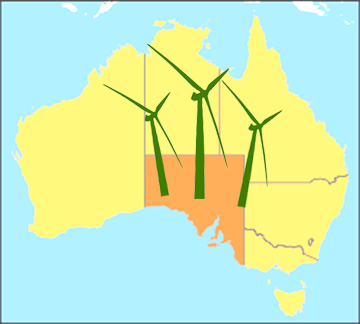 SA shows wind and solar make energy cleaner and cheaper, REneweconomy, By Giles Parkinson 13 August 2012As Europe has looked towards its biggest and most successful economy Germany to lead the way into green energy, Australians are getting a glimpse into its own grid of the future in the state of South Australia – arguably the advanced economy with the highest wind energy penetration, and now with the highest penetration of rooftop solar PV, in the world.
The latest South Australian Electricity Report (SAER), released by the Australian Energy Market Operator last week, gives some fascinating insights into how wind and now solar PV are changing the nature of the local grid – and providing the state with cleaner, greener and cheaper energy.
For a start, in 2011/12, wind overtook coal as the second biggest producer of energy in the state.
But while solar PV is not included , here’s another interesting set of statistics. South Australia has had the biggest reduction in energy demand compared to forecasts of just a year ago – down 10 per cent from last year’s predictions. Industry demand has fallen, but it still represents growth of 5.4 per cent. The biggest change has been in residential demand, which has fallen 7 per cent. It just so happens that South Australia has the highest penetration of rooftop PV of all the NEM states, meaning – as AEMO states – that ‘”less electricity is being supplied from the grid.”
Indeed, by the end of 2012, two out of five houses in the state had installed rooftop solar PV – more than double the national rate ….. Another interesting snippet from AEMO’s report is that rooftop solar – contrary to some opinion – is helping to meet peak demand….. http://reneweconomy.com.au/2012/sa-shows-wind-and-solar-make-energy-cleaner-and-cheaper-39021
1 This month

of the week – Australians for War Powers Reform (AWPR)
To see nuclear-related stories in greater depth and intensity
 Antinuclear