Australian breakthrough in solar energy storage
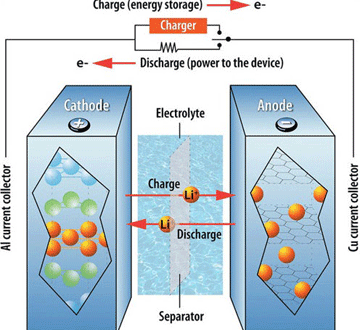
The picture at left is of a typical Lithium ion battery, not the sodium ion one. But I do my best! – CM
Australian scientists make renewable energy storage breakthrough, Home Heating Guide By Katie Anderson August 10, 2012 Although renewable energy technologies have come on leaps and bounds in the last couple of decades, a solution to economical energy storage remains a big stumbling block in the quest to generate more energy with sustainable technologies and to make renewable energies more affordable. However a team of scientists in Australia are one step closer to finding a viable solution in terms of storing solar and wind energy for use in non-generation times – at night and during windless days. And it comes in the form of a water-based sodium-ion battery , developed by researchers from the School of Chemical and Mathematical Sciences at Murdoch University in Perth, Western Australia. Continue reading
Solar photovoltaic energy is here to stay, and to grow, in Australia
 The inevitability of Solar PV in Australia, The Energy Collective, Nigel Morris, August 8, 2012 Is 40 gigawatts by 2030 conceivable in Australia?We argue for the inevitable surprise PV has in store for us. Over the last few months, I have had the pleasure of presenting to hundreds of solar industry delegates at the EcoGeneration Master Classes held around Australia.
Inevitably, the most interesting part for me was the conversations with so many who are at the ‘coal face’; working day in, day out to sell the virtues of solar photovoltaic (PV) against rising coal-fired energy prices.
I met installers who told me that they could feel the attitude of the mass market changing, describing how the economic proposition was so compelling that conversion rates were rising, despite the declining levels of government support.
I met wholesalers who were astounded at the rate of demand from dealers, at the pull-through from the market, and that it is flowing well beyond 30 June – when the Small-scale Technology Certificate (STC) multiplier will be reduced. They are talking about short-term supply shortages, would you believe.
…….One of the most popular slides in my presentation was one that showed a snapshot of where the local market could be by 2030. This slide stems from analysis I helped produce for the Australian Energy Market Operator (AEMO) who – as a result – effectively lifted the expectations for solar PV from less than 2 gigawatts (GW) in 2030 to a potential of 18 GW. And that’s only the rooftop installations; the ‘behind-the-meter’ demand. But since the last Master Class, several fascinating events have occurred that got me thinking about how this revised projection fits into the wider context of predicting solar uptake. Continue reading
Solar panel popularity cuts demand
Adelaide Now, Julian Swallow August 09, 2012 REDUCED electricity consumption and growing use of renewable energy will cause a five-year delay in the need for extra generation investment in SA, a new report says. Continue reading
Australians taking up decentralised solar power – with a vengeance!
 The federal government’s principal forecasting body last week said its landmark assessment of 40 different technologies indicated that by 2030, solar PV would be the cheapest of all available
  technologies
Off grid and on household and commercial rooftops, solar PV is already offering a cheaper alternative.
nearly four million Australians are living in a home with solar hot water or a PV system – and that means they don’t listen to the bulls*** that it is not working, not ready or unreliable.”
Bolt from the blue: How Australia got gold in rooftop solar REneweconomy By Giles Parkinson 6 August 2012 Australia has long been regarded as one of the pioneers of the global solar photovoltaic industry, courtesy of its excellent research at institutions such as UNSW and elsewhere. Now, thanks to its excellent solar resource, rising electricity costs and the falling cost of solar PV, it is now emerging as the leading market for rooftop solar as well.
It wasn’t that long ago that visitors from Europe expressed their astonishment about the lack of solar panels on Australia’s rooftops. But, as one industry leader noted the other day, the growth of PV in Australia has jumped 6,900 per cent between the Beijing Olympics and the London Olympics – enough to earn it a gold medal in deployment.
As consulting group SunWiz noted last month, Australia installed more small-scale rooftop PV (systems less than 10kW) on households in 2011 than Germany, with 795MW vs 759MW. It now has an estimated 1.7 gigawatts of solar PV installed on rooftops, and is expected to get to 2,000MW by the end of the year. The Australian Energy Markets Operator recently said there could be 12,000MW to 18,000MW of rooftop solar PV in the country by 2030. Sunwiz and Solar Business Services say 18,000MW is conceivable by 2022. Continue reading
Port Augusta, South Australia, encouraged by government interest in solar thermal energy
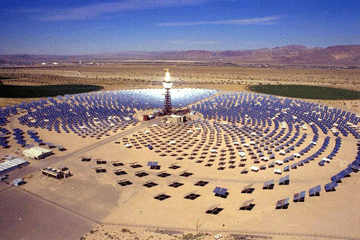 Minister on solar thermal fact-finding tour http://www.abc.net.au/news/2012-08-02/minister-on-solar-thermal-fact-finding-tour/4171960 August 02, 2012 South Australia’s Mineral Resources and Energy Minister, Tom Koutsantonis, will travel to Nevada to research the viability of solar thermal energy. The Minister met solar thermal lobbyists and local government representatives in Port Augusta yesterday. He was given documentation showing the community’s support for the local power stations to be converted to the renewable source.
Mr Koutsantonis says the trip to the United States is to explore and clarify details of solar thermal energy. “We understand gas power generation, we understand coal power generation, we understand wind – in terms of renewable energy we’re
basically the epicentre of Australia,” he said. “If South Australia was a country in its own right we would be number
two in the world for renewable energy.”
Mr Koutsantonis says he is willing to lobby the Federal Government and Alinta Energy to invest in solar thermal.
Port Augusta Mayor Joy Baluch says she is pleased the State Government is supporting a conversion to solar thermal energy for local power stations and is learning more about how the technology works.
“Our conversation has been extremely encouraging to the fact that the Minister is going to Nevada personally to check out the existing and operating solar thermal plant,” she said.
Outback Aboriginal company joins forces with solar power company
 Aboriginal people to install solar systems in remote WA communities http://www.abc.net.au/rural news/content/201207/s3556353.htm ABC rural news By Babs McHugh , 30/07/2012 An Indigenous mining company has joined forces with a solar power company to build renewable energy systems in remote Western Australia.
Carey Power plans to train and employ local Aboriginal people to install and maintain the power systems, which will also be rolled out to mine sites.
Minnie King is a Torres Strait Islander who’ll run the company, which has already signed a memorandum of understanding (MOU) with an Aboriginal Corporation in the Northern Territory to look at power solutions there.
She says Carey Power will be initially focused on solar energy projects, using panels bought in China.
“We’re interested in looking at perhaps doing hybrids, where there are existing diesel generation systems in communities, looking at installing solar there, perhaps solar farms,” she said. “But in saying that, there are other technologies that we would be interested in exploring down the track.”
Lower income suburbs in Victoria taking to solar energy in a big way
Tarneit and neighbouring suburbs Hoppers Crossing and Truganina have more solar power installed than any other postcode in the state – 2564 systems, with a capacity of 5.1 megawatts.
Werribee, just a little further down the Princes Freeway, is second on the list of Victorian solar postcodes. The top five are rounded out by other lower-income, outer-suburban areas: Cranbourne, Caroline Springs and Grovedale in Geelong.
”I don’t think the government or public have appreciated just how profound or rapid the change will be in the solar market over the next couple of years.”
Out on the fringe, solar comes of age, The Age, July 28, 2012,  Adam Morton UNTIL recently, Tarneit, about 25 kilometres west of the Melbourne CBD, was mostly grazing paddocks, a place without a post
office. Now there is barely a cow left. Between the 2006 and 2011 censuses, the population of the outer suburb boomed, tripling to more than 20,000 as the city sprawled and first home buyers snapped up new affordable housing.
The residents of Tarneit are much like those in other developing areas on the city’s fringe. As you might expect, they earn less than the average Victorian. Perhaps less predictably, they are also much more likely to have solar panels on their roofs.
While the myth of solar panels as a purely upper-middle-class luxury persists, new data released by the Clean Energy Regulator suggests it is misplaced. Continue reading
Solar energy with molten salt storage a good option for remote mining areas in Australia
Australia risks missing out on green energy investment Crikey, by Giles Parkinson of RenewEconomy 25 July 12“……..Acciona is also one of the leading companies in concentrated solar thermal — building plants boasting parabolic trough and solar tower technologies, and recently adding molten salt storage so that such plants can become “dispatchable” like gas-fired power station
He said even solar thermal CSP is also already operating at about $150/MWh in countries with good sun, such as South Africa and Australia, and Acciona argues that this should draw the attention of big miners such as BHP Billiton and Rio Tinto, which are paying $300/MWh or more for diesel at remote mine sites.
“There’s got to be a shift in mindset from having a diesel generation plant they know well and which is relatively cheap to build, to shifting towards a highly technical generation source and perhaps outsourcing the management and ownership of that asset through a third party that knows how to operate that,” Thompson said.
Mateo says PV is heading towards $100/MWh and it was interesting to note that in some countries, financing had been offered by banks without subsidies from the government, and even without power purchase agreements. In Chile, for instance, the cost of energy is $100/MWh, which allows wind and solar PV, in some instances, to compete. Mateo said there could be opportunities to combine CSP installations with solar PV….. http://www.crikey.com.au/2012/07/24/australia-risks-missing-out-on-green-energy-investment/
Battery storage of energy poised to increase renewable energy systems, especially in remote areas
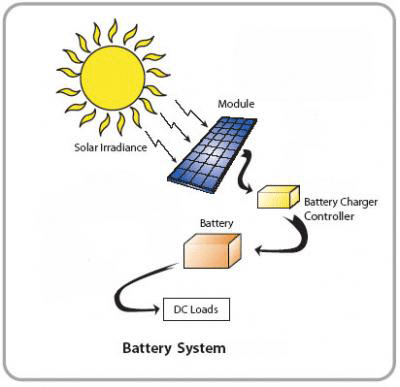 the way the world generates electricity and delivers it to customers is undergoing fundamental change, be it towards smart grids or green grids, and scalable energy storage solutions, such as batteries, will be a key part of the industry in the future.
Redflow is one of only a handful of manufacturers of “flow” batteries, which Winter says are better able to manage long-term storage than lithium ion or other battery standards…..
Energy storage group Redflow works to recharge batteries BY: GILES PARKINSON The Australian July 20, 2012 WHEN Brisbane-based battery storage developer Redflow listed on the Australian Stock Exchange in November 2010, it quickly became a market darling: the prospect of a cost-effective battery in a market increasingly hungry for storage capacity to manage demand peaks and the influx of renewables seemed irresistible.
Redflow shares quickly jumped to a peak of $1.70 for a market capitalisation of well more than $100 million before enthusiasm began to wane. Earlier this year, the bottom fell out when the company admitted its business plan was overly optimistic and any manufacturing deals would have to be put on hold……Chris Winter, who co-invented the company’s key product, a zinc-bromine “flow” battery in a Brisbane back yard in 2001, took the reins again. Continue reading
Australia top in solar radiation, may soon be top in solar energy market.
Yingli Green Energy, a Chinese solar panel manufacturer, believes that the potential for solar energy in Australia is so high that it may become the leader of the photovoltaic mass market by the end of the year.
Yingli notes the number of solar energy projects that are taking root in the country. Some researchers and solar energy market analysts have suggested that Australia may be the first to reach grid-parity with its solar energy initiatives. If this is accomplished within the next five years, the country could be home to the most active solar energy markets in the world.
Australia poised to take the lead in solar energy market http://www.hydrogenfuelnews.com/australia-poised-to-take-the-lead-in-solar-energy-market/854766/ BY ANGIE BERGENSON – JULY 16, 2012 ingli Green Energy notes the solar energy potential of the country
Over the past decade, Australia has shown modest support for alternative energy. In recent years, this support has been growing at a rapid pace, with the country now showing major interest in solar energy. Because of Australia’s exposure to solar radiation, it is one of the most attractive locations in terms of a solar energy market. Continue reading
Big solar panel company opening in Sydney, sees great future for solar power in Australia
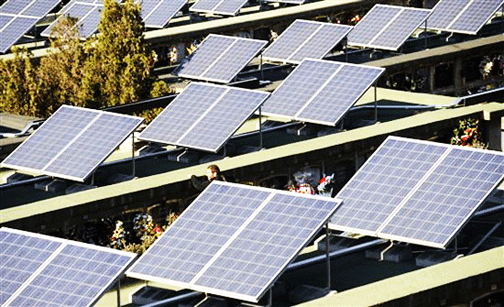 GREEN DEALS: Australia’s new solar player, Climate Spectator, 11 Jul 2012 Daniel Palmer Yingli Green Energy The world’s third largest solar manufacturer is setting up shop in Australia. China-based and NYSE-listed Yingli Green Energy has said it will open an office in Sydney to serve as its regional headquarters. With the unique claim to fame of being the first renewable energy company to sponsor the FIFA World Cup, the company sees Australia as a great place to further boost its global market share.
“Australia is one of the most promising markets in the solar industry,” Liansheng Miao, Chairman and CEO of Yingli, said. “We are happy to enhance our local presence by establishing this subsidiary, which will enable us to provide more convenient products and services to Australian customers.” The new branch will also be looking at selling panels in New Zealand and the Pacific Islands…… http://www.climatespectator.com.au/commentary/green-deals-australia-s-new-solar-player
Solar power with energy storage will benefit Australian households, AND utility companies
The partnership can actually benefit utilities too, though.
The residential systems (5 kW/20 kWh) will be available to the general residential marketplace in fall 2012, the company states. It will also be offering commercial and utility-scale energy storage systems.
Energy storage and solar join forces in Australia, REneweconomy, By Zachary Shahan 11 July 2012 Solar energy is getting cheaper and cheaper. It’s an excellent choice for homeowners around the world. It can cut electricity bills
dramatically and deliver up some pretty sweet long-term savings. But things get really exciting when you let it play with a cheap, home energy storage system. OK, I’m not sure if there’s a truly “cheap” system out there yet, but prices are falling for those as well, and a decent energy storage system with a solar power system is a match that utility companies probably don’t want to see.
Recent news is that energy storage company Greensmith Energy Management Systems has teamed up with South-Australian solar developer ZEN Energy Systems in the land down under.
“In the agreement, Greensmith will provide software licenses for its
Battery Operating System to ZEN, who will market and deliver a line of
energy storage products in Australia.”
This could be big news. Continue reading
Australia’s Solar PV threatening profits of big energy companies
How big utilities propose to kill solar PV, REneweconomy By Giles Parkinson 9 July 2012 A couple of nasty figures have been produced in recent weeks that will give energy companies – retailers, generators and distributors – cause to reflect on how they will manage to satisfy their shareholders’ insatiable appetite for increased profits in coming years.
The figures were inter-related. The first lot were the updated demand forecasts issues by the Australian Energy Market Operators. Demand for 2012/13 is now likely to be nearly 10 per cent below where it was predicted just a year ago, and demand out to 2020 might be 30 per cent below the most optimistic predictions. For an industry that has relied on an unremitting correlation of electricity demand to GDP growth, this has been a shock to the system.
Part of this reduction has been partly blamed on reduced manufacturing, and partly on reduced demand from households and business in response to surging electricity costs, and on the massive investment in infrastructure to cope with peak demand. But the most enduring, and growing factor, at least on the demand side, is the penetration of solar PV. And AEMO forecasts give little consolation to the established industry – the amount of solar PV in the Australian market is tipped to grow 10-fold over the next two decades, and its impact on revenue and profits for the incumbent generators, retailers and network operators will increase accordingly.
Private forecasts suggest that the growth of solar PV could be much greater than that recognised by AEMO. Yingli, the world’s largest solar PV manufacturer in 2012, has said that Australia could, in fact, become the first “mass market” for solar PV in the world – thanks to a combination of declining costs, rising grid prices, lots of sun and innovative financing models…….
Here are some tactics that are being suggested to deal with what AGL Energy managing director Michael Fraser described on the Radio National Breakfast program 10 days ago as the “infiltration” of solar PV and distributed energy. “It’s been a good thing,” Fraser said. “But we will have to watch that.”…. http://reneweconomy.com.au/2012/how-big-utilities-propose-to-kill-solar-pv-81496
Jumbo sized solar pergola at Perth zoo
Perth Zoo unveils ‘jumbo’ solar plant http://www.watoday.com.au/wa-news/perth-zoo-unveils-jumbo-solar-plant-20120705-21je4.html WA Today July 5, 2012 Perth Zoo has completed its jumbo-sized solar panel installation – stretching partly across its elephant enclosure – making it the city’s largest single source of sun power.
A new 102-metre “solar pergola” was unveiled today, completing the $2.7 million clean-energy project that began last year with the installation of 303 solar panels on eight zoo structures. They include the elephant barn, reptile display, retail shop,
maintenance and administrative buildings.
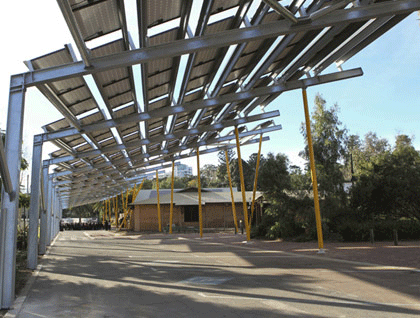
A total of 755 solar panels are now used by the zoo, with the potential to generate about a third of its energy needs – 370,000kW hours a year – saving the popular tourist attraction about $100,000 a year. The installation was jointly funded by the state and federal governments as part of the nation’s $94 million Solar Cities program.
While the steel-framed solar pergola is the centrepiece of the Perth Zoo project, it also doubles as a bus shelter, running along the northern perimeter road and propping up 452 solar panels with a power rating of 145kW.
The entire system is rated at 237kW, making it the largest single solar generator in Perth – the world’s sunniest capital city, with an average eight hours sunshine a day over the entire year. Perth Zoo hosts about 610,000 visitors a year.
 Solar Dawn confirms its plan to rise Ecogeneration, , 5 July 2012 The Solar Dawn consortium has advised the Federal Government that its Solar Flagships Program-winning project is well-advanced and remains Australia’s best prospect for a large-scale solar thermal facility, despite the consortium failing to meet the recent financial close milestone and the Queensland Government’s decision to withdrawn from its project support agreement.
Solar Dawn Project Director Anthony Wiseman said that while the project delay represented a set-back, the consortium – made up of AREVA Solar and Wind Prospect, after CS Energy pulled out – will pursue discussions with the Australian Renewable Energy Agency (ARENA) and the Queensland Government to move Solar Dawn forward based on the project’s advanced status and the strong economic and environmental benefits it offers to the state and the country…..
1 This month

of the week – Australians for War Powers Reform (AWPR)
To see nuclear-related stories in greater depth and intensity
 Antinuclear