Queensland’s solar tariff helps create $3.5 billion in new investment
 Queensland’s tariff, which pays 45c per kWh, had helped thousands to access clean power…“[Queensland will avoid] going down the path of other states in collapsing their schemes and causing such dislocation amongst a somewhat new and still vulnerable part of the economy.”….Current policies to promote renewable energy in Queensland would create $3.5 billion in new investment and 3500 new jobs.
Solar cuts are ‘foolish’: Roberston – Narooma News, GRAHAM READFEARN, 06 Sep, 2011 Queensland Energy Minister Stephen Robertson has accused other state governments of being “foolish and shortsighted” for cutting payments to promote solar energy.Mr Robertson told the Ecogen renewable energy conference in Brisbane yesterday that recent decisions in Victoria and New South Wales to cut back payments for homeowners with solar power would damage the industry. Continue reading
Victoria’s Professor Maria Forsyth’s research team – developing solar storage
 Can we store solar energy for when the sun doesn’t shine?, The Age, 30 Aug 11, A question for Professor Maria Forsyth”….one of Australia’s top researchers with an Australian Research Council Laureate Fellowship, Professor Forsyth and her research team are developing battery technologies and materials so industries can capture green energy and store it, too….
“..we’re looking at it more from a point of view of stationary applications — so any small industry that can generate its own power on-site, and has storage capacity and capability, doesn’t have to rely on the grid….
How soon could these materials be available?
I have a desire to see the first generation of these devices available within three years. In five to 10 years, we should be getting towards the high-quality end of these devices. But it does require industry involvement — worldwide, and especially in Australia.
Silex, a supposedly solar company deeply involved in the nuclear industry
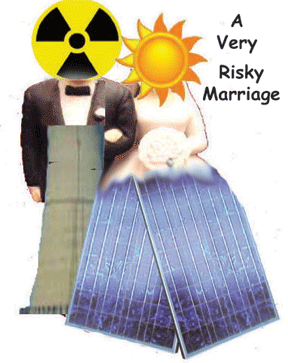 progress hinges on a world-leading uranium processing method called laser enrichment.
The technology has been acquired by a heavy-hitting US consortium of nuclear companies, Global Laser Enrichment, which has completed a testing program.
(repeating this item, lest we forget Australia’s involvement – C.M.)
Heavy weather for nation’s solitary solar-panel maker, The Australian, TIM BOREHAM , July 18, 2011 AS the head of Australia’s only solar-panel maker, Silex Systems’ Michael Goldsworthy sticks to script and welcomes the pending carbon tax and accompanying billion-dollar renewable subsidy programs that will benefit companies such as Silex….. Continue reading
Nuclear energy a dead cat, as solar will take over
Is nuclear an option? It is difficult to see how the nuclear power industry will cope with falling solar prices and increased perceptions of risk following the Fukushima accident. Solar and wind power will soon put the nuclear power construction industry out of business.
Solar energy is vast, ubiquitous and indefinitely sustainable. There will never be a major solar accident, there’s minimal waste disposal issues, and we will never go to war over solar energy.

 Solar will force coal and nuclear out of the energy business The Conversation, by Andrew Blakers, 18 August 2011, A solar energy revolution is brewing that will put the coal and nuclear industries out of business. Solar is already reaching price parity with coal in many parts of Australia. In contrast to coal and nuclear, solar is fully sustainable and safe. Solar is now an established industry that is growing very rapidly. Continue reading
Australia’s soldiers going solar
 Super slim solar cell a success, The Age, Ben Cubby August 12, 2011 ‘A typical solar cell is about 0.2 millimetres thick, which is 200 micrometres thinner than a human hair or a sheet of paper, will soon be used by Australian soldiers on patrol in Afghanistan as a portable power source. The solar cells, invented by researchers at the Australian National University, can be used to cover helmets, tents or clothing and recharge electronic gear such as night vision goggles.
They also have extensive potential in civilian applications, including recharging phones and computers, because a square metre of lightweight solar panel can generate 140 watts of power and yet be rolled up into a ball afterwards. ‘A typical solar cell is about 0.2 millimetres thick, which is 200 micrometres – that’s too thick to bend, it would shatter,” the project’s chief investigator, Andrew Blakers, said. ”But these cells are about 45 microns thick, so they are flexible and also about the same efficiency as commercial solar cells. By comparison, really fine quality merino wool is about 18 microns thick.” In practice, many square metres of panel could be unfurled from a box about the same size as a wine cask http://www.theage.com.au/national/super-slim-solar-cell-a-success-20110811-1iot3.html
Sydney-siders go solar
 Solar use in Sydney soars, SYDNEY, Aug. 8 (UPI) –– Beset by rising consumer energy prices, consumers in Sydney, Australia’s most populous city, are looking to solar energy. In 2010 the city introduced a solar bonus scheme, which was very popular in Sydney’s more prosperous suburbs, with more than 14 percent of homes installing rooftop solar panels, compared with a New South Wales statewide average of about 3 percent…..
the number of private dwellings with solar panels had increased from 2,000 18 months ago to 46,000 after the former New South Wales Labor government introduced a solar bonus rebate scheme.
That plan allowed for a 60-cents-per-kilowatt-hour feed-in tariff for consumers utilizing solar panels, The Sydney Morning Herald reported….
Bowing to increasing public interest in the issue, Ausgrid has begun publishing details of solar panel installations and other data on its Web site to allow councils, consumers and other interested parties to evaluate patterns of electricity usage…http://www.upi.com/Business_News/Energy-Resources/2011/08/08/Solar-use-in-Sydney-soars/UPI-88871312819223/?spt=hs&or=er
Victorian solar cell initiative
AUSTRALIA TO MANUFACTURE SOLAR CELLS WITH NEW PRINTING MACHINE, FEN, By Annie Dang on 1 August 2011 Producing solar cells with zero-emissions electricity will provide new manufacturing opportunities for local industries.
Australian solar researchers and industry have partnered to develop innovative ways of generating zero-emissions electricity using a printing machine to produce solar cells.
The $7.2 million project will see the development of a possible alternative solar cell technology compared with more conventional photovoltaic systems. It is expected that the products will provide Australia industries the opportunity to commercialise and produce the cells competitively. The Federal Government will contribute a $1.7 million grant through the Australian Solar Institute with the Victorian Government providing funding of equal amount.
Launched in Melbourne yesterday, Minister for Resources and Energy, Martin Ferguson AM MP said the project was aimed at developing efficient solar cells using organic materials and conventional printing methods.
The project will see researchers at the University of Melbourne, the CSIRO Future Manufacturing Flagship, and Monash University collaborate with industry partners BlueScope Steel, Innovia Films and Robert Bosch to take commercialese their printing machine innovation…. http://www.myfen.com.au/news/australia-to-manufacture-solar-cells-with-new-prin
Too much success for household solar power in Western Australia
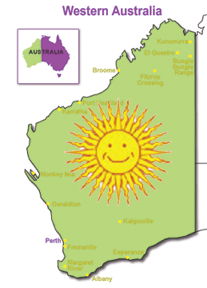 WA solar rebate scheme too popular to continue, SMH, Courtney Trenwith, August 1, 2011, The WA government has axed one of the most successful household environmental programs – the solar panel rebate scheme – precisely because it was too popular.
No new applications will be accepted from today. More than 65,000 household solar panels have been installed since the scheme started in 2009…WA solar rebate scheme too popular to continue
Future for decentralised solar power in Australia
”grid parity” – when unsubsidised solar energy becomes cost-competitive with power from the electricity grid – is getting devilishly close as the cost of photovoltaics (PV) falls…..
”If you can spend $500 and get $700 to $800 back, there won’t be a person in Australia that would ignore that,” Newman says. ”The PV [photovoltaic] retailers will be all over them, and the smart energy retailers will of course step into the game.” It might not be the cheapest form of abatement available to the economy but it’s money in the bank for the punter.
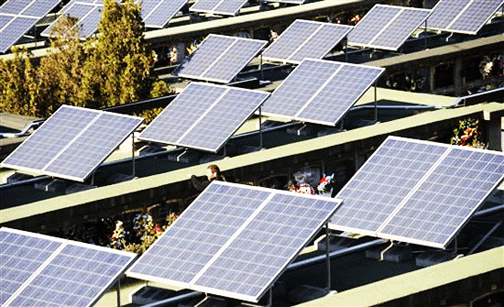
Future lies in power to (and from) the people, Sydney Morning Herald,Paddy Manning, July 30, 2011 It’s hard to tell whether the glass is half full or half empty for Australia’s solar industry right now…….. Continue reading
Queensland University leads in research for solar distributed energy
“In future, it will need to accommodate many, many more, smaller input sources in diverse locations, from renewable resources such as solar, geothermal and wind,” Professor Meredith says.
He says mid-size, commercial-scale renewable power generating systems like UQ’s will become increasingly common in urban and remote areas.
UQ powers up $7m solar array QBR, July 15, 2011, Brisbane has today stepped up its renewable energy research capabilities with the official launch of the University of Queensland’s $7.75 million solar array – the largest power system of its kind in Australia. Continue reading
New solar technology based on Australian design
The Pluto design is based on the PERL (passivated emitter with rear locally diffused) technology developed at Australia’s University of New South Wales, where efficiencies of 25 percent have been achieved in the laboratory. Unique texturing technology with lower reflectivity ensures more sunlight can be absorbed throughout the day even without direct solar radiation.
Suntech Unveils Pluto and Mono/Multi Hybrid Modules, Two new products show the innovation coming from China’s solar firms. GreenTechSolar, Eric Wesoff, 12 July 11, Suntech (NYSE: STP), the world’s largest solar module manufacturer just launched two new products. Continue reading
Selling solar energy from Australian home rooftops
 AUSTRALIA SAYS HOUSEHOLDS CAN SELL SOLAR ENERGY FOR US$40, Utility Products, 6 July 2011 Australian households can sell their solar energy for about A$38 (US$40.48) for every megawatt hour of electricity generated.
The Office of the Renewable Energy Regulator says the average market price for a Renewable Energy Certificate, which is equivalent to one megawatt hour of electricity generation, is $38.39 in 2011.
The office released its annual report on Tuesday which showed more than 160,000 homes and businesses installed solar energy last year.
That was an increase of more than 100,000 on the previous year.
“Growth in the installation of solar panels was encouraged by various state and federal initiatives including Solar Credits,” the report said.
Solar credits make solar panel installation cheaper for home owners.
The ORER accredited 24 more renewable energy power stations in 2010, bringing to 316 the total number of accredited renewable energy power stations in Australia.
Those stations can generate power to the equivalent of more than 1.9 million homes.
Solar power for Queensland’s Sunshine Coast
Australia’s Sunshine Coast gives green light to 10MW PV plant Recharge, 30 June 11 Energy Parks Australia (EPA) has been given the go-ahead to build one of the country’s largest solar plants – a 10MW facility on the Sunshine Coast in Queensland. The A$40m ($43m) project – the first of what the company hopes will be a pipeline of six – was approved by the Sunshine Coast Regional CouncilThe 50 hectare site on former sugar-cane land at Valdora, about 125km north of Brisbane, may include a biofuel plant alongside the PV installation.
EPA is looking for domestic and international investors to back the project.
The solar facility would be one of the biggest in Australia, apart from the utility-scale projects announced earlier this month under the government’s Solar
Flagships programme…. http://www.rechargenews.com/energy/solar/article264517.ece
Swap your BHP shares: rooftop solar is a better investment
 Rooftop Solar Power A Better Investment Than Shares, Renewable Energy News by Energy Matters 20 June 11 An independent think tank believes Australian retirees investing in solar power will find it a more profitable investment than BHP Billiton shares and safer than bank shares.
Writing for the Australian Financial Review, David Hetherington, Executive Director of independent progressive think tank Per Capita, says new “solar plus storage” technology for homes and small businesses offers a way for retirees and others to future proof against rapidly escalating electricity costs. Continue reading
Australian govt awards solar funding to nuclear company AREVA
BP Solar, Areva win $770m funding from Solar Flagship Climate Spectator 18 June 11 The Federal Government on Saturday announced that a consortium led by BP Solar and a proposal put forward by French nuclear giant Areva had won the 1st round of funding under the $1.5 billion Solar Flagships Program. Continue reading
1 This month

of the week – Australians for War Powers Reform (AWPR)
To see nuclear-related stories in greater depth and intensity
 Antinuclear