Wind and solar energy make economic and scientific sense
 Audio: Renewable energy finally makes economic sense, ABC Radio National 3 March 2014 Critics says renewable energy cannot supply a reliable base-load of electricity, a claim rejected by author Mark Diesendorf. In this opinion piece, he
  argues that wind, solar and other technologies are not only better for the environment, they make economic and scientific sense as well.You may have recently heard the following common claim repeated by aproponent of nuclear power: renewable energy cannot supply ‘base-load’ electric power. This misleading claim is based on the false assumption that the only way to supply base-load electricity demand is via coal and nuclear power stations.
A boost for wind energy as ACT plans big renewables projects
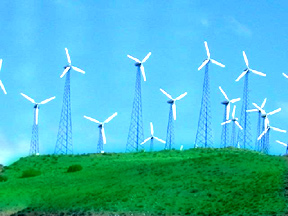 Clean energy boost stirs stalled wind farms, Canberra Times, March 1, 2014 Kirsten Lawson Chief Assembly reporter . The ACT government’s planned roll-out of large-scale clean energy projects is set to give new life to stalled wind farms near Canberra.
Infigen Energy, the company that runs the Capital 1 wind farm near Bungendore, already has approval for another 41 wind turbines at the site, generating about 100 megawatts of energy. General manager of development David Griffin confirmed his company hoped to take part in an auction expected later this year to win the right to supply the ACT with renewable energy for a guaranteed price over 20 years.
A second big project, near Collector, was approved last year for 55 wind turbines, generating 187 megawatts, and run by Ratch-Australia (80 per cent Thai owned, 20 per cent Transfield). Ratch could not be reached on Friday.
Environment Minister Simon Corbell announced a vast increase in the ACT’s commitment to renewable energy last week, more than doubling the cap on feed-in projects to 550 megawatts, with the bulk of the funded projects in wind farms around Canberra.
Solar would make up most of the rest, but it is undecided whether solar projects outside the ACT will qualify…….http://www.canberratimes.com.au/act-news/clean-energy-boost-stirs-stalled-wind-farms-20140228-33rrx.html
Auxstralia’s peak medical research body gives wind farms a clean bill of health
Link between wind farms and health problems rejected by research review SMH, February 24, 2014 Tom Arup Environment editor, The Age There is no reliable or consistent evidence that wind farms directly cause human health problems, a major draft review by Australia’s leading medical research body has found.
The hotly anticipated study by the National Health and Medical Research Council, has also called for further research into the issue after it identified only a handful of studies into the issue it deemed credible enough to be considered under the review.
Anti-wind farm campaigners claim turbines can cause a wide range of ailments including, headaches, insomnia, and dizziness, sometimes dubbing the symptoms as “wind farm syndrome.”
These have been widely rejected by the industry and many public health researchers.
How vested interests exploit rural communities about “wind turbine syndrome”
a community that is well-informed, consulted and empowered is much more likely to welcome the development of clean technology, and reject the offerings of anti-wind groups selling a narrative of fear and danger..
The theory of wind turbine syndrome was not sourced from empirical scientific investigation – it was borne of a heady mix of human nature and vested interests,
 stew of sentiment and pseudoscience bubbles below the surface, and the link need only be completed by motivated and well-funded lobby groups with no desire to adhere to the bounds of scientific inquiry
Consultation is the key to curing wind turbine syndrome KETAN JOSHI ABC Environment3 FEB 2014 Joshi 7 MAY 2013 Wind turbine syndrome is a symptom of a community that feels it has lost control. It has very little to do with wind farms and ‘infrasound’. PRIME MINISTER TONY ABBOTT’S intention to open a fresh investigation into the vexed issue of ‘wind turbine syndrome’ hasn’t impressed many.
Mick Vagg, SeniorLecturer at Deakin University wrote that ‘there is no scientific justification for any further investigation of ‘wind turbine syndrome'”.
Meanwhile the anti-wind Waubra Foundationsupports the plan……. Continue reading
Community ownership of wind farms in Australia
Consultation is the key to curing wind turbine syndrome, KETAN JOSHI ABC Environment 3 Feb 14 “…….In Australia, community ownership is gaining traction. My employer, InfigenEnergy, is looking to enable community ownership of one of the wind turbines at the Flyer’s Creek development in NSW, through theCentral NSW Renewable Energy Cooperative (CENREC).
The Hepburn Wind Farm, a two-turbine community-owned wind farm in Victoria, has generated 27,809 megawatt-hours since commencement — enough to power an average Australian home for 4,209 years, and the proposed Fremantle Co-operative wind farm project in WA recently hit a $10,000 crowd-funding target to produce myth-busting videos on wind energy. The Coonooer Bridge Wind Farm development utilises a community benefit model that is the first of its kind, and has been welcomed by locals.
These initiatives are, simply, the circuit-breakers needed to lessen the influence of lobby groups working against the integration of renewable technology into our energy system, and empower communities. Abbott’s research will likely be ineffective in lessening the spread of wind energy health fears in communities.
The deployment of clean technology across Australia as a means of reducing our reliance on fossil fuels will be stewarded by tight-knit Australian communities. The companies that develop, operate and maintain large-scale generation assets fuelled by renewable resources can only benefit from community ownership and engagement.
It seems the only ones who will lose out from this shift will be those who professionally stoke anger and feed fear. The demand for their resource will run swiftly dry.http://www.abc.net.au/environment/articles/2014/02/03/3935067.htm
New South Wales’ biggest wind farm on the way
Foundations poured for NSW biggest renewable energy projecthttp://www.abc.net.au/news/2014-01-24/wind-project/5216572 Fri 24 Jan 2014 Foundations have begun to be laid at the Monaro site in the New South Wales south east of what will become the State’s biggest wind farm project. Continue reading
Renewable Energy Target enabled Musselroe Wind Farm
the jobs and investment in Tasmania would not have been possible without the Renewable Energy Target, which is supporting the development of new clean energy projects right across Australia.
This year sees yet another review of the RET, with initial signals from Prime Minister Abbott being less than encouraging – a situation that is negatively affecting investment in new major renewable energy projects in Australia.
 Tasmania’s Musselroe Wind Farm Opens, Renewable Energy News, 20 Jan 14 Tasmania’s largest wind farm was officially opened on Wednesday by Premier Lara Giddings. The 168-megawatt Musselroe Wind Farm consists of 56 Vestas wind turbines and is joint venture operated by Shenhua Clean Energy and Hydro Tasmania.
According to Hydro Tasmania, the wind farm is generating enough energy to supply the needs of up to 50,000 homes; equivalent to the residential power needs of Burnie and Devonport combined…..Clean Energy Council Chief Executive David Green –
“The $394 million Musselroe Wind Farm has employed Tasmanians in construction jobs since 2011, and the steel towers for the project were manufactured locally in Launceston,” he said. Continue reading
Australian Renewable Energy Agency, (ARENA) funding offshore wind energy
 Ocean Power Technologies forms new offshore wind power funding agreement With Australian Government http://www.renewableenergyfocus.com/view/36498/ocean-power-technologies-forms-new-offshore-wind-power-funding-agreement-with-australian-government/ 16 January 2014
A$66.5 million grant will be used towards the cost of building and deploying a 62.5MW peak-rated wave power station off the coast of Portland, Victoria. The agreement with the Australian Renewable Energy Agency, or “ARENA”, is a Deed of Variation to the original Funding Deed, through which a A$66.5 million grant was previously awarded by the Commonwealth.
Among the important changes included in the new agreement are:
The incorporation of milestones for each of the three stages of the project
Acceleration of reimbursement of eligible expenses for stages one and two
An increase in the number of milestones to better support project cash flow requirements The agreement also recognizes the role of Lockheed Martin as the lead for systems integration of the PowerBuoys and overall program management.
Gullen Range Wind Farm now sending energy into the National Electricity Market.
Gullen Range wind farm starts producing renewable energy Crookwell Gazette Dec. 19, 2013, GOLDWIND Australia has celebrated a significant milestone with the first renewable energy generation from Gullen Range Wind Farm. Continue reading
Victorians now being won over to wind energy?
Two weeks after the forum in Seymour, VCAT finally approved Cherry Tree. It is now only the second wind farm to win planning permission in Victoria since August 2011.
Against the wind The Age, December 19, 2013 Michael Green Planning restrictions and health fears have left Victorians reluctant to embrace wind power. But this may be changing. Gwenda Allgood is a no-nonsense local councillor, five times a mayor, from Ararat. In mid-November she travelled east to Seymour to speak about wind farms at a forum on energy held in the bowls club hall.
“We did not have one objection,” she told the audience, explaining the benefits of the Challicum Hills wind farm, built in 2003. “I can only speak as I find: there is no noise [from the turbines]. I don’t know why, but there isn’t. And they’re our best ratepayer – they pay well, they really do.” Continue reading
The power of suggestion in attitudes to wind power and health
 The results showed that the experience of symptoms and mood during exposure to audible windfarm sound and infrasound was influenced by the type of expectations provided before exposure periods.
The onus falls on the media to report on health fears about wind farms cautiously, particularly given strong evidence that it is the discussion itself that may be creating and perpetuating health complaints.
Wind turbines don’t make you feel sick or healthy, but spin can http://theconversation.com/wind-turbines-dont-make-you-feel-sick-or-healthy-but-spin-can-20845 Fiona Crichton PhD candidate in psychological medicine at University of Auckland 29 Nov 13
Despite at least 19 reviews of the scientific evidence universally concluding that exposure to wind farm sound doesn’t trigger adverse health effects, people continue to report feeling unwell because they live near wind turbines.
We’ve known for some time that exposure to negative messages about wind farms makes people more likely to report feeling sick after exposure to turbines. And new research, published by my colleagues and I this week in the journal Health Psychology, shows positive messages about wind farms may have the opposite effect – improve perceptions of health.
Infrasound
Speculation in the media and on the internet often attributes the symptoms to sub-audible sound produced by operating wind farms (infrasound). But the reality is that infrasound (sound below 16 hertz) is consistently present in the environment and is caused by wind, ocean waves and traffic. Importantly, research demonstrates there is nothing unusual about the levels of infrasound produced by wind farms. Continue reading
A win for local communities as Tribunal finds wind farms are not harmful to health
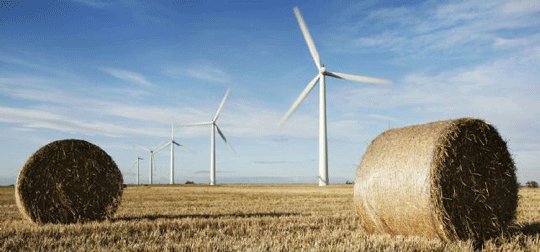 Wind farm ruling a win for communities: Clean energy group http://www.abc.net.au/news/2013-11-27/wind-farm-health-findings-a-win-for-communities/5120036 ABC Rural By Babs McHugh The Clean Energy Council says the latest rejection of claims of negative health effects of wind farms is adding more certainty to the future of the industry for investors.
The Victoria Civil and Administrative Tribunal (VCAT) has approved a 16-turbine wind farm at Trawool, north of Melbourne, after finding there’s no evidence they have adverse effects on health and well being. Director of policy with the Clean Energy Council, Russell Marsh, says he wasn’t surprised by the findings. “Pretty much every wind farm that’s been proposed in recent years has been opposed on grounds of adverse health effects.
“What we’ve seen in the last 24 hours is that there’s yet more evidence to show that those claims are unfounded. “New South Wales and Victorian state health bodies, and federal departments also, have found there’s no scientific evidence to back up claims of ill- health effects, physical and psychological.
“And this is backed up by a noise study for the Waterloo wind farm released yesterday by the South Australian Environmental Protection Agency. “That found the noise from the wind farm fell below the thresholds set under the planning conditions.
“Also, the rumbling noise that some residents complained about (in diaries they were asked to keep) was present at times when the wind farm was switched off.” Mr Marsh says it’s not only wind farm operators who these findings benefit. “It is a significant win for the industry, but also for communities who live near wind farms. “Yet again, this is showing that when these adverse health (claims) are tested, they don’t stack up.
“So communities shouldn’t be concerned about a wind farm being located near them.”
South Australian Environment Protection Authority (EPA) finds Wind Farm Not Harming Residents
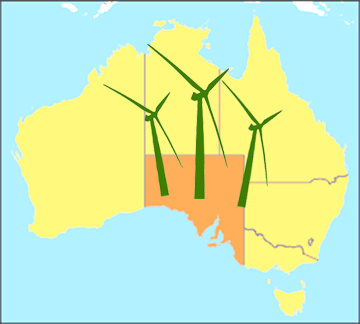 EPA study finds no evidence wind farm noise impacting residents ABC News, 27 Nov 2013, A study into the Waterloo Wind Farm, south-east of Clare, has found there is no evidence linking noise from the farm to any adverse effects on local residents.
The study was undertaken by the Environment Protection Authority (EPA) during April and June.
It has found noise produced does not breach authority guidelines and that low frequency infrasound levels are below internationally-accepted thresholds for perception.
The authority also says in some situations there was no association between events described by residents in noise diaries with audio records and data.
The authority’s Peter Dolan says he cannot say why local residents are complaining about health effects…….http://www.abc.net.au/news/2013-11-27/epa-study-finds-no-evidence-wind-farm-noise/5119556
Victorian Wind Farm gets the All Clear to Go Ahead
 Cherry Tree wind farm gets go ahead in Victoria ABC Rural By Babs McHugh 27 Nov 2013, The Victoria Civil and Administrative Tribunal (VCAT) has approved a wind farm after finding there’s no evidence wind farms have adverse effects on health and wellbeing. Infigen Energy’s proposal for a 16-turbine wind farm near Seymour, north of Melbourne, was rejected by the Mitchell Shire Council, which said there were widespread health concerns.
The council said it had received more than 100 objections to the project in the Trawool Valley, which also raised concerns about disruption to the landscape.
Infigen appealed the decision to the VCAT, and the Cherry Tree Wind Farm is now the first to be given the go-ahead under the Victorian Government’s new planning laws for wind farms which were introduced in 2011.
The Tribunal used information from the New South Wales and the Victorian health departments that shows there’s no scientific evidence to link wind turbines with adverse health effects or support claims that inaudible sound can have psychological effects……. http://www.abc.net.au/news/2013-11-27/wind-farm-go-ahead-victoria/5119518
Wind energy in Australia – a good investment
 Investing in Australian wind energy http://ecogeneration.com.au/news/investing_in_australian_wind_energy/084291/, 15 November 2013 In this exclusive excerpt from the December 2013 edition of EcoGeneration, newly appointed Managing Director of OneWind Australia Michael Toke discusses the company’s investment strategy for Australian wind energy.
In May 2013, Denham Capital announced a planned investment of $US75 million ($A78.8 million) equity in a 1 gigawatt portfolio of Australian wind energy projects currently under development.As part of the deal, Denham partnered with Enersis Australia, National Power and Kato Capital to create a new entity called OneWind Australia.
OneWind Australia will initially focus on the late-stage development and financing of several Australian projects, including:
- Glen Innes, a 100 megawatt (MW) project in New South Wales
- Lincoln Gap, a 250 MW project in South Australia
- Cattle Hill, a 240 MW project in Tasmania
.
Denham said that its investment is aimed at accelerating development of these projects, with a goal of achieving financial close on several phases in the first half of 2014.
Why does OneWind Australia see Australia as a good market for investment in wind farms? Continue reading
1 This month

of the week – Australians for War Powers Reform (AWPR)
To see nuclear-related stories in greater depth and intensity
 Antinuclear