Anti Wind group exposed – poses as a “charitable foundation” – Senator Di Natale
Pollie Watch: Senator for Victoria holds anti-wind farm lobby to account Yes 2 renewables November 14, 2013 by Leigh Ewbank Senator for Victoria Richard DiNatale (Australian Greens) has used his first speech since the 2013 election to hold the anti-wind farm lobby to account for spreading health fears, being subsidised by Australian taxpayers, and having links to fossil fuel investors.
Rather than distracting policy makers with spurious claims of a wind farm noise disease and wasting taxpayers money, Senator DiNatale suggests the anti-wind farm groups could campaign on the health impacts of poor air quality.
“We are seeing more people dying from poor air quality than we’re seeing die from the road toll. The mining and combustion and transport of coal is one of the reasons why that’s happening. But no, this group campaigns against a clean renewable form of energy, despite the fact that if we able to make the transition to cleaner renewable energy we mitigate against some of the most important health impacts…”
DiNatale takes aim at the Waubra Foundation and their status as a ‘health promotion charity,’
“The issue here is not that the Waubra Foundation should continue to spread the misinformation that it does. The issue here is that the Australian taxpayer should be subsidising that activity. [Australian taxpayers] are subsidising the work of the Waubra Foundation–that is, every person in this country makes a donation to the anti-wind activities of the Waubra Foundation.”
In his speech, DiNatale shines a light on the background of the founder and current chairman of the Waubra Foundation, Peter Mitchell. According to DiNatale, Mr Mitchell is a “current and former director of a number of coal, gas, and uranium related companies” as well as a background campaigning against wind farms:
“[Mitchell] is a director of Lowel Resources, who are basically the ultimate holding company of a resources fund, which are companies engaged entirely in mining and energy investment including oil, gas and uranium. He’s also the former director of the Australian Petroleum Institute Limited and Molopo Limited, a company entirely invested in oil and gas ……http://yes2renewables.org/2013/11/14/pollie-watch-senator-for-victoria-holds-anti-wind-farm-lobby-to-account/
Waubra residents dissociate themselves from anti wind farm group
 Waubra Wednesday #9 – Community demands its name back from anti-wind farm group On 1 November 2013, the Waubra community ramped up its campaign to reclaim its name from an anti-wind farm campaign group known as the Waubra Foundation. Yes 2 Renewables November 6, 2013 by Leigh Ewbank Fed up with the town’s name being tarnished by claims of a ‘Waubra disease‘, community leaders have sent a petition with 316 signatures to the anti-wind farm organisation asking them to stop using town’s name. Yes 2 Renewables applaud the community’s effort on the issue.
“Waubra is associated with wind towers. We don’t mind that,” Waubra wind farmer Doug Hobson told The Courier. “With the turbines people actually take more notice of our town as they pass through.
“But when you Google ‘Waubra’ the first thing that comes up is something negative about our town. People would think that everyone in Waubra doesn’t like wind farms, and that is not the case,” Hobson added.
The petition was sent to the Waubra Foundation just days after they announced more anti-wind farm campaigners to positions in the organisation, such as retired Liberal MP Alby Schultz who is slated to lobby the Abbott government. Yes 2 Renewables commented on the appointments at Climate Spectator.
It’s clear the Waubra Foundation has no credible claim to use the town’s name. Yet will the Foundation heed the wishes of community members or will it ignore them? Time will tell. For now, Yes 2 Renewables will keep an eye on the situation…….
Petition Text……
Cover Letter sent with the petition….
Bullying tactics by the anti wind farm lobby
Bullying from wind farm opponents a pattern of behaviour http://yes2renewables.org/2013/11/07/bullying-from-wind-farm-opponents-a-pattern-of-behaviour/ November 7, 2013 by Leigh Ewbank Last week, The Canberra Times reported that anti-wind farm campaigner Tony Hodgson has threatened legal action against neighbours who host turbines. The following is a letter to the editor published by the paper:
Anti-wind farm campaigner Tony Hodgson’s threats to sue neighbours who host turbines (‘Threat of legal action against wind farm hosts,’ October 29, p6) are not new.
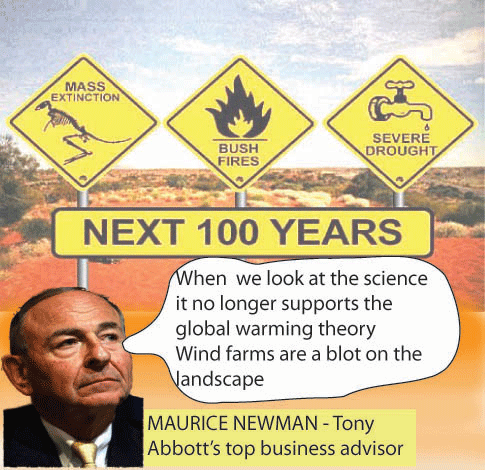 Earlier this year it was reported that Maurice Newman, business advisor to Prime Minister Tony Abbott and board member of Tiger Airlines, issued a similar threat to Crookwell sheep farmer Charlie Prell. In both cases, the legals threats were made in relation to alleged health impacts of wind farms.
There are now 19 reviews by credible health bodies that show wind energy is clean and safe. It’s time for anti-wind farm groups to accept this and stop bullying potential turbine hosts–people who are seeking a drought-proof income stream for their farm and act on climate change.
It’s OK for people to have disagreements about the aesthetics of wind farms in the bush. Most Australians can accept that. What’s unacceptable is bullying behaviour in the form of legal threats. It’s divisive and prevents communities from assessing the merits of wind farms.
Anti wind farm group’s ‘sprawling and inarticulate’ tactics to try to delay King Island wind project

 Judge labels King Island wind farm legal challenge ‘sprawling and inarticulate’ http://www.abc.net.au/news/2013-11-01/king-island-wind-farm-legal-challenge-too-27sprawling27/5063722 1 Nov 2013 A legal challenge against Hydro Tasmania’s King Island wind farm proposal has been described as “sprawling” and liable to create additional costs.
The No TasWind Farm group has appeared in the Federal Court in a bid to stop Hydro proceeding with its $2 billion project. Lawyers representing the group say Hydro did not have broad community support for the wind farm and it should not proceed.
Justice Duncan Kerr described the application as massively sprawling, inarticulate and likely to result in significant costs to Hydro Tasmania, without concluding anything. He has ordered the two parties to meet and narrow down the claim before returning to court later this month. Hydro wants to build 200-turbines on the island, creating the largest wind farm in the Southern Hemisphere.
It said the project would not proceed to the feasibility study without the backing of most of the residents. The survey in June found just under 59 per cent support, which Hydro described as sufficient. The close vote prompted the opponents to launch a legal challenge to stop the project. In a statement,
Hydro says a decision on the project’s future will only be made after a feasibility study. Several studies are underway looking at whether the TasWind project is commercially and technically feasible. Hydro says the court challenge will not affect the timing of this phase.
Legal bullying threats now adopted by wind farm opponents

 “We’re going to the bullying tactics, are we? I don’t know what it’s all about, but I assume that’s what it is, old school bullying tactics.”…..
Mr Poile said there were a lot of people and groups he did not recognise as locals, including anti-wind farm activist Sarah Laurie from the Waubra Foundation, based in South Australia.
Threat of legal action against wind farm hosts, Canberra Times, Hamish Boland-Rudder October 29, 2013 An anti-wind farm resident of Collector says he will sue his neighbours should they become turbine hosts as part of a proposed wind farm in the small community north of Canberra. Continue reading
Community owned energy – the success story of Hepburn Wind farm, Victoria
”We’ve developed a model for community wind and a model for community solar energy,” she explains. ”There are about 70 different groups [in] Australia interested in developing … projects.”
Hepburn co-op sailing with the wind September 29, 2013 Michael Green There’s lots of energy behind locally owned wind power. http://theage.domain.com.au/real-estate-news/hepburn-coop-sailing-with-the-wind-20130928-2ula1.html Late last summer, Melbourne artist Ghostpatrol spent a week manoeuvring a crane in a paddock in Leonards Hill. With a small team, he painted a huge image of a girl dressed in green on one of the two wind turbines that comprise the Hepburn Wind farm, near Daylesford.
The artists camped under the turbine. They had to rise early to paint before the wind picked up, and for good reason: the girl’s name – and the turbine’s, too – is Gale. .The community-owned wind farm has now been operating for more than two years. It has produced more than 22 million kilowatt-hours of renewable energy, which more than matches the amount used by households in Daylesford and Hepburn.
Taryn Lane, Hepburn Wind’s community officer, conducts regular tours for school groups and university students. ”We’re the closest wind farm to Melbourne,” she says. ”We believe we’ve got a big role to play in helping to demystify wind power.”
Giving Gale a personality has helped with that, and so, too, will a new sign on the road at the front of the wind farm, which will click over with every kilowatt-hour the turbines produce. ”It will address the myth that wind energy is unreliable. Although it’s intermittent, it is really predictable,” she says. As well as electricity, the turbines generate money for the community. So far, more than three-dozen projects – from solar streetlights to public seating – have received a total of $72,000. Continue reading
Western Australia’s Mumbida Wind Farm officially opened
The WA Water Corporation will purchase 100 percent of the wind farm’s output for its Southern Seawater Desalination Plant near Binningup. That plant is also powered by the 10 megawatt Greenough River Solar Farm – Australia’s first utility-scale solar farm.
“In a typical year electricity production from the wind farm will be equivalent to the electricity consumption of 35,000 homes and will displace 200,000 tonnes of greenhouse gas emissions,” says Verve Energy.
The Mumbida Wind Farm has been designed to be expanded to 85MW in the future.
All Systems Go For Mumbida Wind Farm http://www.energymatters.com.au/index.php?main_page=news_article&article_id=3964 1 Oct 13 The 55MW Mumbida Wind Farm in Western Australia has been officially opened. A joint venture of Verve Energy and Infrastructure Capital Group (ICG), the facility is located on farmland situated approximately 40km southeast of Geraldton in the mid-west of Western Australia. Continue reading
Quality evidence for Victoria- that wind farms do not damage health
 Our own Victorian Department of Health published its findings on the matter in Wind farms, sound and health in April 2013. It rules out the potential for wind farms to have damaging effects…..Wind farm infrasound is at levels well below the hearing threshold, and evidence does not support claims that inaudible sounds can have direct physiological effects. Put simply: what we can’t hear can’t harm us.
Wind farms: What we can’t hear, can’t harm http://reneweconomy.com.au/2013/wind-farms-what-we-cant-hear-cant-harm-34870 By Sarah Durrant on 27 September 2013 In a new analysis, the Australian Energy Market Operator estimates Victoria will have 4,090 MW of new wind energy capacity installed by 2020. Those who support more renewables in the energy mix will welcome the forecast, yet it may be optimistic.
Today (Friday September 27), the Victorian Civil Administration Tribunal (VCAT) will resume the decision making process on the Cherry Tree Range wind farm proposed for central Victoria. Despite meeting the world’s strictest wind farm planning laws and laying outside the multitude of no-go zones imposed by the Baillieu government, the project could be thwarted. By what? The self interest and pseudo-science trumpeted by anti-wind farm groups.
The fate of the Cherry Tree Range wind farm is a test case for wind energy in Victoria. If it’s approved then there’s hope Victoria will achieve the high-penetration of wind energy AEMO predict by the end of the decade.
VCAT adjourned with an interim determination in April, finding the permit application was in accordance with all the planning considerations that the Mitchell Shire had contested. However the Tribunal decided it would await the outcome of an EPA SA study into alleged noise complaints at Waterloo wind farm, and also a newreview by the National Health and Medical Research Council.
VCAT left us to ponder the question: whether there is a causal link between sound pressure emissions from wind turbines and adverse health effects of a physiological nature.
BEAM Mitchell Environment Group – a local community group of which I’m a member – has taken a look at some of the most recent Australia/NZ sourced evidence to demonstrate that our support for the Cherry Tree project is backed up by quality evidence. Continue reading
South Australia’s renewable energy success, as its electricity prices fall
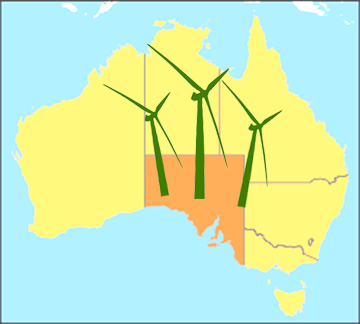

The Australian Energy Market Operator has predicted that the amount of rooftop solar could triple by 2020. Depending on how much wind energy is built between now and 2020 – and that will depend on whether the new government retains the current renewable energy target – the state’s renewable energy capacity is expected to soar well above 50 per cent by then.
South Australia’s perfect energy mix: Cleaner, greener, cheaper REneweconomy, By Giles Parkinson on 18 September 2013 Not only has South Australia achieved the highest level of wind energy and rooftop solar in the country, and has cut its emissions by a third in the last few years, its consumers have also had a windfall in generation costs: they are paying generators much less for their electricity than they did before the boom in wind farm and household solar began in 2009.
A study by energy analyst firm Pitt & Sherry finds that in 2012/13, the average South Australian paid generators $88 a year less for the electricity he or she consumed than they did in 2009-10.
And that is even after the introduction of a carbon price. If the impact of the carbon price is taken out, the average price paid per capita to generators in South Australia has fallen by $188 over the last four years – during which time the wind industry has grown from virtually nothing to more than 1,200MW, and rooftop solar has done the same (it is now 400MW). Continue reading
Pacific Hydro will go it alone, believing in its Portland Wind Project.
 Clean energy providers bypassing the big power retailers CRIKEY, TRISTAN EDIS | SEP 17, 2013 Pacific Hydro’s wind farm will be financed without a big power retailer involved. Is this the future or just a last hurrah for the Clean Energy Finance Corporation? Pacific Hydro announced last week it will construct the 47 megawatts final stage of the Portland Wind Project. The size of the wind farm is nothing exceptional, but the way it is commercially structured is: this wind farm is one of very few constructed without a major energy retailer involved either as the owner, or as a 10-year-plus purchaser of the output.
Generally wind farms are developed with energy retailers involved. That’s because they substantially reduce the risk of the project by providing a fixed price for output, bypassing wholesale electricity and renewable energy certificate markets which can be extremely volatile………
Pacific Hydro has decided to take a punt that market fundamentals will eventually prevail. It’s worth noting they’ve done this with $70 million in finance from the Clean Energy Finance Corporation. The CEFC’s mandate includes adopting the presumption that politicians don’t fiddle with the law of the land.
Will other financiers be quite so brave now the CEFC has been ordered to shut down? http://www.crikey.com.au/2013/09/17/clean-energy-providers-bypassing-the-big-power-retailers/?wpmp_switcher=mobile
Wind farmers find the industry profitable and benign – no “wind farm syndrome”
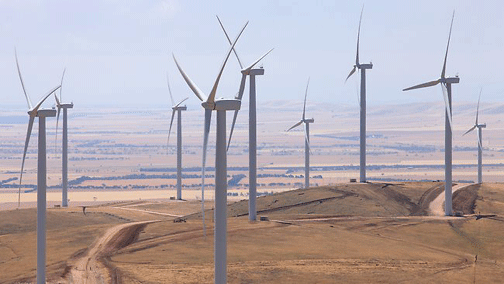 Wind turbine syndrome: farm hosts tell very different story The Conversation, Simon Chapman Professor of Public Health at University of Sydney 18 Sept 13 People who host wind turbines on their properties and derive rental income from wind energy companies have important stories to tell about living alongside turbines, but they’ve largely been absent from the debate on wind farms and health. Australian filmmaker and researcher Neil Barrett is finally giving this critical group a voice in his new short film, The way the wind blows, released today.
Turbine hosts at Waubra earn A$8,000 a year for each turbine on their land. In the bush, the expression that wind farms can “drought-proof a farm” is common: a land owner with ten turbines can wake up each morning comfortable in the thought that a tough year with poor rain or bad frosts can be ridden out, thanks to income from wind generation.
All of Barrett’s interviewees say they can hear the turbines but none say they are bothered by them or suffer from any health problems they attribute to the turbines. Continue reading
Ambitious community wind farm project for Fremantle?
Fremantle Community Wind Farm , Pozible, By Claire Vanderplank, Raoul Abrutat, Louis Kent, Rowan Gallagher, Michael Fuller and Jamie Ally The Fremantle Community Wind Farm is an ambitious project to build 8 to 12 community-owned wind turbines along the breakwaters at Fremantle Port. With 8 turbines sized to fit within the port landscape, the project would produce enough electricity for 3300 average Australian homes.
We are so passionate about this project. It will produce clean energy and distribute profits locally. With Fremantle’s connection to the wind and water and its identity as a progressive city, the project has great potential to produce cultural and social capital. It also has educational and awareness-raising potential due to the prominent location. Check out our website and Facebook page for all the details.
The project is at a critical point in time; ready to go ahead however facing one key barrier, land access. The community’s voice is required to make it happen. There are too many myths and misperceptions blowing around regarding wind farms that are holding this, and other projects, back. We are on a mission to set things straight.
Exposing the garbage propaganda from the anti wind farm lobby
More than two-thirds of Australian wind farms including more than half of those with large turbines have never received a single complaint. Two whole states – Western Australia and Tasmania – have seen no complaints.
Wind turbine syndrome: farm hosts tell very different story The Conversation, Simon Chapman Professor of Public Health at University of Sydney 18 Sept 13 “………Laurie and the Waubra Foundation have done all they can to spread concern about the harms they allege are caused by living near wind farms. One former Waubra resident has been particularly prominent, speaking emotionally at anti-wind farm meetings about how wind farms have ruined his health and caused his family to move to Ballarat, at great personal expense.
In a statement that would be of immense interest to Apple, Samsung and Nokia, he recently told a meeting in Barringhup that electricity generated by wind turbines started charging his cell phone without it being plugged in:
I’ve had my … mobile phone go into charge mode in the middle of the paddock, away from everywhere.
In 2012, he wrote a public submission to a parliamentary inquiry where he revealed he had suffered a serious head injury some eight years before the wind farm opened in 2010:
I have been in brain training care and rehabilitation for about ten years because of an unfortunate, unrelated accident.
Indeed, the most common health complaints voiced by complainants are problems such as disturbed sleep, anxiety, hypertension and normal problems of ageing that are very prevalent in all communities, regardless of whether they have wind farms. Continue reading
Speak out against wind power – urges Gina Rinehart, Australia’s richest woman
Rinehart calls for action against wind power BY:SARAH-JANE TASKER The Australian September 06, 2013 AUSTRALIA’S richest woman — Gina Rinehart — has urged people to speak out against wind power and for the country to address its debt by getting non-violent prisoners to pay to avoid jail and for governments to sell their art and decor.
Ms Rinehart, in her latest article in Australian Resources and Investment magazine, used a conversation she had with a Dutch cab driver to lead her argument about concerns around the use of renewable energy……http://www.theaustralian.com.au/news/nation/rinehart-calls-for-action-against-wind-power/story-e6frg6nf-1226712611162
Australian wind power a record in August
 August A Record Month For Aussie Wind Power by Energy Matters, 5 Sept 13 South Australia, Victoria, Tasmania and New South Wales all broke records for wind power generation during August.
Helped along by blustery conditions during the week beginning August 11; the amount of power generated during the month was enough to power 155,000 homes for an entire year says the Clean Energy Council (CEC).
In South Australia, wind power provided just under 40 percent of the state’s electricity needs for the entire month.
“South Australia’s wind farms produced the lion’s share of the country’s wind power in August, but the new Macarthur Wind Farm in western Victoria is the largest in the Southern Hemisphere and provided a huge clean energy boost,” said CEC Policy Director Russell Marsh.
“These recent statistics add to results published by the Australian Energy Market Operator last week which showed that more than a quarter of South Australia’s power came from wind power over the last financial year.”…… http://www.energymatters.com.au/index.php?main_page=news_article&article_id=3925
1 This month

of the week – Australians for War Powers Reform (AWPR)
To see nuclear-related stories in greater depth and intensity
 Antinuclear