Liberal candidate for Hume, Angus Taylor, tipped to fight against renewable energy
 Controversial wind farm gets clean bill of health SMH, September 3, 2013 Peter Hannam “……….Opposition hopes Lyn Jarvis, a member of the Bodangora Wind Turbine Awareness Group, said her community group remains opposed to the wind farm despite the NSW Health and Planning Assessment Commission’s findings.
Ms Jarvis said the commission had ignored an independent noise assessment by Steven Cooper, an acoustics technician that found the wind turbines would be harmful.
“It’s fallen on deaf ears,” she said. “We had 94 per cent of the submissions against the development.”
The group is pinning its hopes on the election of Liberal candidate for Hume, Angus Taylor, to help lead a pushback against renewable energy, particularly wind farms.
“Hopefully, he will pull the renewable energy credits and it won’t get built – or any wind farms won’t get built in inappropriate places,” Ms Jarvis said. http://www.smh.com.au/business/carbon-economy/controversial-wind-farm-gets-clean-bill-of-health-20130903-2t1u2.html#ixzz2dxXonk7R
New South Wales Health and Planning Commission find wind farm no risk to health
Controversial wind farm gets clean bill of health SMH, September 3, 2013 Peter Hannam Carbon economy editor A controversial $200 million wind farm that divided a local community and drew opposition from a nearby maximum security jail has secured planning approval to proceed.
Infigen Energy’s 33 turbine wind farm planned for Bodangora, near Dubbo in central NSW, was approved by the state’s Planning Assessment Commission late last week with the ruling only made public on Monday.
In a potential setback to opposition at other proposed wind farm sites, the commission dismissed community concerns that noise from the turbines would affect their health. The commission said NSW Health “was very clear in its advice” that “there is no published scientific evidence to link wind turbines with adverse health effects”.
The commission’s findings are “an important precedent” for the state, said Simon Chapman, a professor of public health at the University of Sydney. They add to almost 20 other official reports, such as from the Victorian government in May, that examined wind farms and health, he said.
“All of them are consistent in saying that there is no good evidence that wind turbines directly cause health effects,” Professor Chapman said. The NSW government has been considering draft guidelines for wind farms for about two years, including rules for a two-kilometre setback. Such a range is applied in Victoria and claimed by the wind energy industry to be among the toughest anywhere.
Frank Boland, Infigen’s senior development manager for the 100-megawatt project, welcomed the commission’s ruling for the Bodangora site.
“It not only gives us comfort but also should give comfort to anyone who did have health concerns about the project,” Mr Boland said. “We don’t see any causal link between wind turbines and health, full stop.”
The NSW Health statement “is relevant to other states as well”, Mr Boland said, adding that its ruling could help secure planning approval for a similar-sized wind farm planned by Infigen at Flyers Creek, south of Orange, and for projects elsewhere…….. http://www.smh.com.au/business/carbon-economy/controversial-wind-farm-gets-clean-bill-of-health-20130903-2t1u2.html#ixzz2dxXonk7R
Wind power bonanza from windy weather in South Australia, NSW, and Tasmania
 Blustery Weather Generated A Wind Power Bonanza http://www.energymatters.com.au/index.php?main_page=news_article&article_id=3907 25 Aug 13, Wind farms in Australia’s National Electricity Market cranked a record amount of power for the week beginning August 11.
During the period, 47% of South Australia’s power was supplied by the wind and Victoria’s wind farms contributed 10% to that state’s electricity needs. Tasmania and New South Wales had their second and third highest levels of wind power generation respectively.
While the blustery conditions caused havoc for emergency services, it’s an ill wind that blows nobody any good as they say.
“The positive was the large amount of clean energy that was produced by the wind farms on Australia’s southern coastline, breaking records for the amount of wind power generated in a single week in South Australia and Victoria,” said Clean Energy Council Policy Director Russell Marsh.
“What this shows is that wind power is working. It generates very useful amounts of power and also helps farmers who host wind turbines by providing them with income.” Mr. Marsh says based on data sourced from the Australian Electricity Market Operator (AEMO); wind power provided a record 7.6 per cent of all power generated across the entire National Electricity Market during that week; the equivalent of supplying more than 2.3 million homes.
Under normal conditions, South Australia’s wind farms contribute about one quarter of the state’s total electricity production. In 2011/12, wind generationblew past coal to become the second largest source of electricity in South Australia. The state, which has around 40% of Australia’s installed wind capacity, reached its target of generating 20% of electricity from renewable energy in 2011.
South Australia now has its sights set on producing one third of its electricity from renewable sources by 2020. Like its previous target, that is expected to be met well ahead of schedule.
Wind power could prove to be an economic boom for Cloncurry, Queensland
The project, expected to cost the sire $8 to $9 million dollars, already has support from local miner CuDeco and three potential pilot program sites will be tested over the next few weeks.
 Wind power the future for Cloncurry Yes 2 renewables, n August 23, 2013 by martanieczyporuk Even in the far reaches of Australia, the benefits of wind energy are gaining interest among communities. The small town of Cloncurry can see a big future in wind. The North West Starreports on the Mayor’s proposal: ….
Friends of the Earth Australia renewable projects coordinator Leigh Ewbank said the ‘visionary’ idea could see the shire follow in the footsteps of a small French village that increased their budget from $573,000 to $3.29 million after installing 11 wind turbines.
“Income generated by a wind farm in the small French village of Afrons has resulted in a five-fold increase in the town’s budget,” he said. Continue reading
Wind energy facts – including 47% of South Australia’s energy last week
Wind supplied 47% of South Australia’s energy last week http://reneweconomy.com.au/2013/wind-supplied-47-of-south-australias-energy-last-week-67550 By Ketan Joshi on 20 August 2013 VERY GOOD GRAPHS in this article
Science Week was from August 10-18, inclusive. The Australian Energy Market Operator (AEMO) makes 5-minute generation data available through a gargantuan database. I’ve chosen to focus on South Australia and Victoria, states which lead the way in installed wind generation – there are 22 wind farms I’ve obtained generation data for, summarised in the table below.
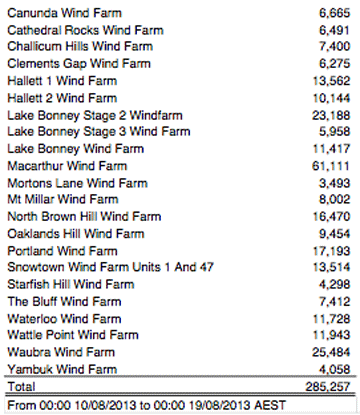
The total generation of those 22 wind farms was 285,257 megawatt hours. But what does that deliver to the energy market? The average Sydney household consumes 11.6 KWh per day, or 0.104 MWh over 9 days. So, the generation of wind farms throughout science week could power ~2.7 million homes – enough for all of Greater Sydney, and all of Greater Adelaide. That statistic alone is a firm reminder that wind power is a formidable player in the supply of energy. Continue reading
Fact checking the clams about “wind turbine syndrome”
DO WIND TURBINES CAUSE HEALTH PROBLEMS? > CHECK THE FACTS HTTP://WWW.FACTSFIGHTBACK.ORG.AU/DO-WIND-TURBINES-CAUSE-HEALTH-PROBLEMS-CHECK-THE-FACTS/ Facts Fight Back, August 20, 2013 ·
Who: “[Health concerns are] justified on the scientific evidence. We know from evidence from field studies… that low frequency noise actually causes health problems, physiological damage to people.” Senator Nick Xenophon
The claim: There is scientific evidence that wind turbines cause health problems.
The facts: In July 2010, the National Health and Medical Research Council reviewed the literature and found that there is currently no published scientific evidence to positively link wind turbines with adverse health effects.
In January 2012, an Independent Expert Panel in the US released a Wind Turbine Health Impact Study Report for the Massachusetts Department of Environmental Protection and the Department of Public Health. The reportfound that literature on human response to wind turbines related to self-reporting of “annoyance”.
The finding: Negative health outcomes appear to be caused by people being stressed by incorrect information about wind turbines not from the actual wind turbines. There is no evidence to show that wind turbines cause health problems.
Discussion of evidence: Reviews of the scientific literature have found that wind turbines cause no ill health effects. Health effects that are reported are consistent with stress and further studies have shown that there is a correlation between these adverse impacts and exposure to negative health information about wind turbines. Senator Xenophon is incorrect to say there is scientific evidence that point to wind turbines causing adverse health effects in humans.
Victorian farmers part-owners in Wimmera’s new wind farm
hopes Coonooer Bridge will be the first of many other small projects involving groups of farmers.
Coonooer Bridge locals win with wind farm http://www.weeklytimesnow.com.au/article/2013/08/16/579559_national-news.html 16 Aug 13, THESE new turbines will help the locals, writes CHRIS McLENNAN To call them mountains would be a stretch: the highest peak on the Yawong Hills rises only to 434 metres.
This formerly unremarkable sheep-grazing country is suddenly hot property.
Wind whistles across the Wimmera plains. The inland side of the Great Divide has nothing to block this steady breeze which is forced up and over this low range at Coonooer Bridge between Charlton and St Arnaud.
Scientists have studied this phenomenon for years and find the average wind speeds of more than eight metres a second amount to some of the best renewable energy resources in the world. Far from the Roaring Forties of Australia’s southern coast, where wind farms jostle for space in western Victoria, the search for green energy has found a new home.
The first wind farm to pass Victoria’s myriad planning obstacles for two years has just won approval at Coonooer Bridge. There are only five turbines, but they are the first in Australia to be part-owned by the neighbouring farmers through Windlab. Continue reading
Heathcote locals unhappy with Victoria’s anti-wind farm laws
 Heathcote locals question Victoria’s anti-wind farm laws http://yes2renewables.org/2013/08/13/heathcote-locals-question-victorias-anti-wind-farm-laws/ August 13, 2013 by Leigh Ewbank
Yes 2 Renewables visited Heathcote recently to present to the local U3A (university of the third age) about wind energy technology. Given that Heathcote is located in the hearth of the McHarg/Macedon Ranges ‘no-go zone’ for wind farms, we took the opportunity to brief attendees about the Victorian government’s anti-wind farm laws. The presentation prompted U3A member, Louise Joy, to submitted the following letter to the editor to The McIvor Times:
Heathcote U3A “Understanding New Technology” group heard Leigh Ewbank from Friends of the Earth speak on “Wind Power” at the Guide Hall for an illuminating and entertaining two hours on Wednesday 3 July 2013 from 10 am.
Such a simple solution to the problems of pollution where unfortunately Victoria leads the way in developed countries. Renewable energy has strong public support with 94% opting for Solar and 87% for wind power. There have been Wind Power community projects planned for Woodend, Surf Coast and Anglesea with opportunities for job creation in manufacturing, construction, maintenance and computer programming. Farms in drought areas benefit, a lid is kept on Electricity prices, communities gain control over their own clean and safe energy future.
So what is stopping implementation with so much community support and so many advantages? There are strong lobby groups with vested interests against Wind Farming. In Victoria, Amendment VC 82 has created no go zones in the Yarra and McHarg Ranges, among others. Heathcote U3A members left the meeting encouraged to make known the advantages of Wind Farming and to lobby politicians to rescind Amendment VC 82.
Western Australian wind farm will benefit farmers across twp shires
 Conditional Approval For Western Australian Wind Farm http://www.energymatters.com.au/index.php?main_page=news_article&article_id=3866 1 Aug 13, The Great Southern Joint Development Assessment Panel has given Moonies Hill Energy conditional approval for a stage of the proposed Flat Rocks Wind Farm.
Moonies Hill Energy director Sarah Rankin saysconstruction of the wind farm could commence in late 2014, early 2015. Construction had originally been intended to commence in 2012/13.
If fully developed, the Flat Rocks Wind Farm will be a 150 MW project. Situated 25km south east of Kojonup, in the Great Southern region of Western Australia, the facility will produce 562,000 GWh of electricity annually – enough to power 90,000 homes – and avoid up to 451,000 tonnes of carbon dioxide equivalent each year. Moonies Hill Energy says the project would inject $130 million into the local community over its lifespan – $30 million during construction and $5 million a year during operation.
The Flat Rocks Wind Farm will host 74 wind turbines perched on 84m towers and will be compatible with existing agricultural activities such as stock grazing and broadacre crops. After construction, the facility will occupy less than 1% of productive farmland.
The wind farm will spread over 6 farming operations and across two shires. The five landowners involved will all be financial beneficiaries of the project. The wind farm will be patched into the South West Interconnected System (SWIS) via the proposed 330kV Muja-Wellstead transmission line, construction of a 132kW line into the Kojonup substation or via the existing 132kV line that traverse the southern part of the project area.
Electricity produced by the Flat Rocks wind farm will be sold into the SWIS under a commercial agreement.
As part of the project, Moonies Hill Energy will establish a Sustainable Communities Fund to operate during the life of the wind farm that will provide support for surrounding community programs.
Wind energy company wins award, but still faces problems on King Island
Hydro Tasmania wins engagement award http://www.weeklytimesnow.com.au/article/2013/07/26/577753_national-news.html
Shannon Twomey | July 26, 2013 HYDRO Tasmania has won the Community Engagement Award at the Clean Energy Council Awards.
The awards are hosted by the Clean Energy Council as part of Clean Energy Week.
Hydro Tasmania won the award for their community engagement on the Musselroe Wind Farm Project in the north east of Tasmania.
The Musselroe Wind Farm is a 56-turbine, 168-megawatt wind farm that provides power to 50,000 homes and prevents the emission of 450,000 tons of greenhouse gas emissions.
Project director Andrew Hickman said from the start Hydro Tasmania have worked closely with communities in the area.
“Many members of the project team have lived and worked in the north east region over the entire construction period and have become a real part of that community,” Mr Hickman said.
“Hydro Tasmania have engaged with local schools, tourists bodies, indigenous elders and business groups to build the relationships that have resulted in genuine community ownership of this project.”
Friends of the Earth and Yes 2 Renewables spokesperson Leigh Ewbank said Hydro Tasmania have a good reputation for strong community engagement.
Hydro Tasmania are currently working on another wind farm development, the TasWind Project, on King Island. Continue reading
Australia’s right wing in a right mess about policy on wind energy
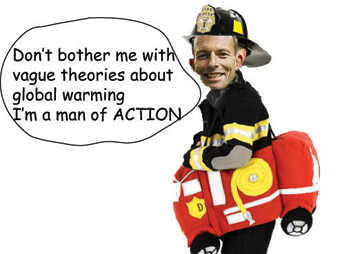 The debate over climate change has been an intellectual debacle for the political right. Their tribal hatred of environmentalists has driven them into a position of denouncing any technology favoured by their enemies. The only invisible substance with which Abbott and his backers should be concerned about is their disappearing intellectual credibility.
The right’s anti-wind campaign is pure scaremongering http://www.guardian.co.uk/commentisfree/2013/jul/23/abbott-wind-turbines-health-effects by John Quiggan, 25 July13 Climate change is a debacle for the Australian right. Their tribal hatred of environmentalists has driven them to denounce any technology favoured by their enemies Tony Abbott’s quip that emissions trading schemes represent “a so-called market in invisible stuff” has been rightly derided as a dog-whistle to climate denialists, unsuccessful only in that it was not pitched high enough to escape detection by the rest of us. Critics have had plenty of fun pointing out the many examples of “invisible stuff” that is, like carbon dioxide, critically important despite the fact that we can’t see it – electricity, financial risk, and so forth.
A point that has attracted rather less attention is the extent to which the views of Abbott’s team on climate are being driven by claims about something that is not only invisible and inaudible, but indeed non-existent – namely the supposed health effects of wind farms. The belief that wind farms are dangerous to human health has been widely propagated on the political right, despite the absence of supporting scientific evidence.
The leading Australian promoters of wind paranoia are the Waubra Foundation, the Australian Landscape Guardians and 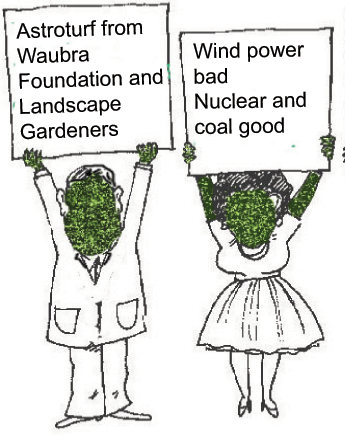 the Australian Environment Foundation (AEF). These groups are often linked with each other and with rightwing organisations like the Institute of Public Affairs (IPA). The AEF in particular is a straightforward front group – it was set up by former IPA senior fellow Jennifer
  Marohasy and originally operated out of the IPA offices in Melbourne.
The supposed health risks of wind turbines have also been pushed byGraham Lloyd in The Australian newspaper, other rightwing columnists like Miranda Devine, and conservative politicians including Craig Kellyand John Madigan.
To get the boring scientific facts out of the way, the National Health and Medical Research Council investigated the issue in 2009 and 2010. The review considered the potential health impacts of infrasound, noise, electromagnetic interference, shadow flicker and blade glint produced by wind turbines and concluded that, “at the time of writing, there was no published scientific evidence to positively link wind turbines with adverse health effects.” Continue reading
South Australian govt considers council rate charges for wind farms on private properties
Council rates bid for wind farm turbines on private property http://www.abc.net.au/news/2013-07-19/council-rates-bid-for-wind-farm-turbines-on-private-property/4830326 Jul 19, 2013
Mr Parnell is on the committee and says farmers pay rates on infrastructure such as sheds, but multi-million-dollar wind farms are currently exempt as they are considered to be plant and equipment.
“A big part of the wind farm debate has been how we share the benefits of renewable energy, so one of the things we have to look at is how do we make sure the returns from wind farms are spread through the community?” he said.
“Rates is one way of doing it, community development funds is another way of doing it. “We’ll see at the end of the day which one the committee recommends.”
Victorian and New South Wales wind farms kick-started by Clean Energy Finance Corporation.
Clean Energy Finance Corporation funding two Australian wind farms – K. Jalbuena Eco Sees, 17 July 13, Two major wind farm projects in Australia will be the beneficiaries of the Australian government’s Clean Energy Finance Corporation. The C.E.F.C., a legislated fund dedicated to investing in clean energy, will invest 50 million Australian dollars ($45.94 million) to refinance Macarthur Wind Farm and will provide 37.5 million Australian dollars in senior debt finance to help build the Taralga Wind Farm.
Largest wind farm in the southern hemisphere
The 420 MW Macarthur Wind Farm in south western Victoria is said to be largest wind farm in the southern hemisphere. It is a joint undertaking between Meridian Energy Limited and AGL Energy Limited through AGL subsidiary Macarthur Wind Farm Pty Limited.
Fully operational since January 2013, the Macarthur Wind Farm can generate enough energy to power 220,000 Victorian households and reduce carbon emissions by 1.7 million tonnes a year…….
Australian engineered and sourced
C.E.F.C. will also be providing 37.5 million Australian dollars in senior debt finance for the construction and operation of the Taralga Wind Farm, 45 kilometers of Goulburn in New South Wales…… Continue reading
New South Wales to get advanced wind power turbines with energy storage
So where are these cutting-edge turbines headed? Sixty-seven of them will be built for installation in the mountains of New South Wales in Australia i, with power expected to be flowing into the grid by the end of 2014.
Gamechanger: Next Generation Wind Turbines With Storage Are Cheap, Reliable And Brilliant Climate Progress, By Ryan Koronowski on Jul 14, 2013 What makes a new wind turbine exciting?
Wind companies are always trying to making their next turbine spin more efficiently and generate more power than the last, just as car companies are looking for better fuel efficiency and engine power. Advances usually come in small jumps in both cases, with a single percentage improvement cause for celebration.
GE announced a new line of wind turbines in May that generate between 20 and 24 percent more power than the previous best turbine in its class. It does this through traditional improvements in turbine design, but also through innovations that address one of the main issues that critics of wind power raise: intermittency. Continue reading
Planning report recommends go ahead for Western Australian wind farm
Report gives conditional nod to wind farm http://www.abc.net.au/news/2013-07-11/report-gives-conditional-nod-to-wind-farm/4814128 Jul 11, 2013 A planning report, compiled for a panel that will decide whether a Great Southern wind farm proceeds, has recommended it go ahead with strict conditions.
Moonies Hill Energy’s Flat Rock Wind Farms project would create a 150-megawatt facility in the shires of Kojonup and Broomehill-Tambellup.
The company says the project could power 90,000 homes and inject $130 million into the local economy.
However, it hit a snag earlier this year when the Great Southern Joint Development Assessment Panel refused to give planning approval to the part of the development in Broomehill-Tambellup.
The company appealed against that decision and another hearing is scheduled for next Friday, when the panel will decide whether to accept the Broomehill-Tambellup Shire planner’s recommendation to approve it.
That recommendation includes strict conditions, including noise regulations and that the development begins within four years of the issuing of a building permit.
1 This month

of the week – Australians for War Powers Reform (AWPR)
To see nuclear-related stories in greater depth and intensity
 Antinuclear