New South Wales losing investment and jobs, as State govt prolongs anti wind farm rules
“There’s $10 billion worth of investment sitting in the pipeline waiting to find out what Brad Hazzard is going to do with their
future.
“Four thousand jobs, 17 million tonnes a year cut from the state’s greenhouse gas emissions, waiting to see what the O’Farrell Government will do.”
 Guidelines wait blows against NSW wind farms http://www.abc.net.au/news/2012-12-14/guidelines-wait-blows-against-nsw-windfarms/4427964 Dec 14, 2012 The Clean Energy Council says a delay in finalising new guidelines for
wind farms in New South Wales is forcing investors to look to other states for opportunities.
It is a year since the New South Wales Government put draft guidelines out for community consultation.
A spokesman for Planning Minister Brad Hazzard says the policy is still being finalised. In the meantime, no new wind farms have been approved.
The Clean Energy Council’s policy director, Russell Marsh, says that is sending investment elsewhere. Continue reading
25 anniversary of Australia’s oldest operating wind turbine, and still going strong
 These days, the wind turbine that could delivers around 80,000kWh a year to the grid, with an estimated 90-95 per cent availability
Blow out the candles: Australia’s oldest wind turbine turns 25 REneweconomy, By Sophie Vorrath 4 December 2012 November might have been a milestone month for solar, with cumulative PV installations reaching 2GW, but it also marked a reasonably big milestone for wind: 25 years since the Breamlea Wind Turbine, near Geelong in Victoria, was commissioned. Continue reading
Senate inquiry finds that “infrasound” from wind turbines is not a problem at all
higher sound levels were recorded with turbines turned off versus when the turbines were running. A strong indication that the origin of most infrasound and low-frequency noise was the wind itself which was slowed by running turbines…….
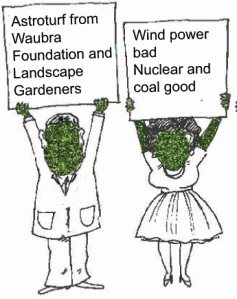 Wind turbine infrasound: What’s all the noise about?, REneweconomy, By Richard Mackie 4 December 2012 On Wednesday the Senate inquiry into excessive noise from wind farms released their report. The inquiry was supposed to focus on audible noise but debate strayed into concerns that wind turbines can cause health problems by producing infrasound (sound of a frequency so low that it is normally inaudible) and low frequency noise.
Wind farm opposition groups such as the Waubra Foundation are prone to making extreme statements about wind turbines such as this from their senate inquiry submission “…characteristic symptom patterns have been reported at distances up 10km away from the nearest wind turbine.” Infrasound is blamed and understandably people get concerned.
So where does this idea come from? The Senate inquiry gives us the answers. Submissions represent a global who’s who in the debate on wind farms and health. Often information provided to support the wind farms-cause-health-problems idea actually demonstrates the opposite. Continue reading
Woodend Integrated Sustainable Energy sets the pace for Victorian community wind energy
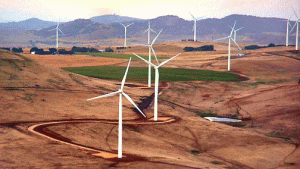 Insight: How communities can take lead in green energy REneweconomy, By Giles Parkinson 30 November 2012 This is the second in a series looking more deeply into issues which affect the development of the clean energy industry in Australia. The first was on the 2kms set-back rule imposed by the Victorian government and at least partially adopted in NSW.
For the past 12 months, a digital display located behind the counter of the newsagent in High Street in the Victorian town of Woodend has logged what Barry Mann describes as a major lost opportunity. Real time data  from a wind mast located in an old timber mill a few kilometres out of town documents the amount of electricity that would have been produced if a proposal to install three wind turbines in a harvested pine forest 6kms from town had been allowed to go ahead.
Before the mast was taken down earlier this month: the data stood at this: 12.6 gigawatt hours of electricity generated over 12 months and four days (12.630 million kilowatt hours) – about enough electricity to satisfy the needs of 2,037 homes and generate $1.5 million in revenue from selling the electrons to the grid. (You can find the data on their website)
Mann is a director of WISE (Woodend Integrated Sustainable Energy) – a local not-for-profit group that says its goal is to ”assist communities to take responsibility for their energy and carbon future.” It is one of dozens of similar groups in Australia that are hoping to implement their own local plans, but don’t have so many electrons to show for it yet.
For the moment, Woodend’s own plans have been frustrated by the election of the Baillieu Conservative government, and the introduction of a 2km setback ruling and the declaration of a “no-go” zone through large slabs of the Mt Macedon ranges – two initiatives that local member Donna Petrovich is proud to take responsibility for. (See addendum below) Continue reading
Broken Hill’s exciting future as Australia’s first renewable energy town

Most rural communities are dying – this is a town that has the potential to move forward.

ALTERNATE WMA VERSION | MP3 DOWNLOAD
Broken Hill a frontrunner in renewable energy adoption ABC Radio AM Margaret Paul reported this story on Tuesday, November 27, 2012 …
DARRIEA TURLEY: There is a possibility that Broken Hill could be the first town that would live on renewable energy, that would be sustained by renewable energy. No other town has done that.
MARGARET PAUL: Broken Hill’s acting Mayor is Darriea Turley.
She’s excited that Broken Hill is set to become home to two major renewable energy projects.
The first, a photovoltaic solar farm, is set to produce 125,000 megawatt hours of electricity every year – enough to power 17,000 homes.
The second is a wind farm to be developed at nearby Silverton that could power as many as 43,000 homes. Continue reading
Whyalla making wind turbines – it’s not wiped off the map by carbon tax
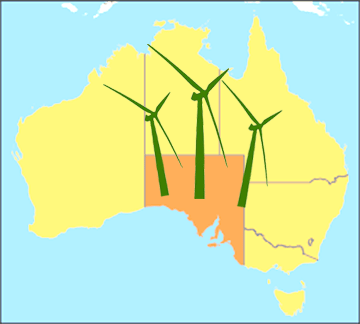 Wind Turbine Towers To Be Manufactured In South Australia, http://www.energymatters.com.au/index.php?main_page=news_article&article_id=3485 by Energy Matters 26 Nov 12, 20 wind turbine towers for South Australia’s Snowtown II wind farm will be constructed in Whyalla.
Siemens Ltd is working with E&A Contractors, who are planning to build a wind tower manufacturing facility in the town using equipment and personnel from former wind tower manufacturers RPG; which was recently placed into Voluntary Administration.
According to a press release from Minister Greg Combet’s office, over 80 per cent of wind turbine towers used in Australia so far have been sourced from Australian suppliers.
“As part of this great project we have actively collaborated with Australian suppliers to supply the towers locally,” said Siemens Ltd’s Vice President David Pryke. “E & A have demonstrated strong business acumen and a commitment to re-establishing the wind tower business for South Australia by acquiring the key assets and people of RPG.”
Minister Combet’s office used the opportunity to again criticise previous comments by Opposition Leader Tony Abbott who suggested Whyalla would be “wiped off the map” as a result of Australia’s carbon tax.
Construction of Snowtown Stage II started late last month and consists of a 90 turbine expansion of the existing Snowtown wind farm, which will add 270 megawatts capacity.
Snowtown II is expected to be capable of generating enough electricity to supply around 180,000 South Australian homes when it is operational by the end of 2014.
Stage 1 of Snowtown Wind Farm was completed in 2008 and generates enough power to supply nearly 70,000 households.
Owned by TrustPower, Snowtown wind farm is situated on the Barunga and Hummocks ranges west of Snowtown, around 150 kilometres north of Adelaide. The turbines use Siemens’ Direct Drive technology, which eliminates the gearbox, and longer blades.
Victoria’s very large wind farm will be operational in early 2013
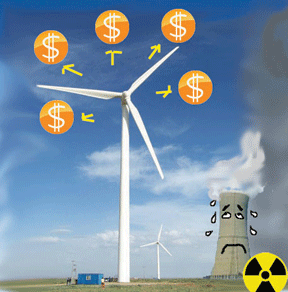 AGL readies biggest wind farm in southern hemisphere November 23, 2012 – AGL Energy, Australia’s largest operator of renewable energy projects, expects its $1 billion Macarthur wind farm to be operating fully in February as the country seeks to reduce it reliance on coal. “It’s on time, on budget and, in fact, may well be completed a little ahead of schedule,” Managing Director Michael Fraser said.
Sydney-based AGL and partner Meridian Energy are starting the 420-megawatt Macarthur project in Victoria, the largest wind farm in the Southern Hemisphere, as Australia moves toward its goal of getting 20 per cent of its power from renewable energy by 2020.
The company expected Macarthur to be completed by the end of March 2013, Fraser said……
With natural gas prices on the east coast of Australia projected set to double and the government’s price on carbon emissions discouraging fossil fuels, the cost of gas-fired power stations may converge with that of wind farms, he said.
Australia in July started charging about 300 of its largest polluters a fixed price of $23 a ton for their carbon emissions. It plans a market-based system beginning in 2015.
http://www.smh.com.au/business/carbon-economy/agl-readies-biggest-wind-farm-in-southern-hemisphere-20121123-29ubz.html#ixzz2D4V3rlIp
Origin and Energy Australia – ignorant critics of wind energy community acceptance
But for Origin and Energy Australia to assert that there isn’t a social license to operate for wind farms in this country is preposterous given their small part in actually developing wind projects
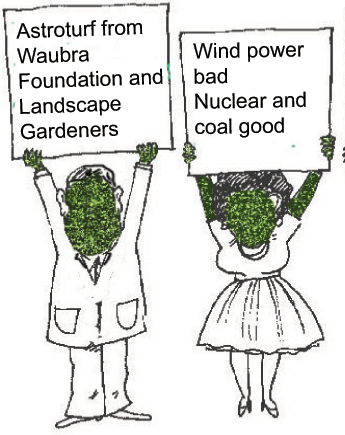 What would Origin and EnergyAustralia know about wind?, Climate Spectator, 21 Nov 2012, Tristan Edis
Origin Energy and EnergyAustralia (formerly TRUenergy) were on the front page of The Australian newspaper yesterday claiming the renewable energy target couldn’t be met because of community opposition to wind farms.
According to Origin Energy, wind farms are causing greater angst in the community than coal seam gas. And Energy Australia felt the around 300 MW of wind installed each year was “already testing the limits of community acceptance.” EnergyAustraia’s CEO Richard McIndoe was cited by the newspaper as claiming that the social licence wasn’t there to ramp up construction of wind farms.
This sounded rather interesting because I regularly talk to people heavily engaged in developing wind farms. These people attend community meetings, talk with local landowners, and deal with planning approval hearings – and this is very different to what they’ve told me. Every one of them of course has a horror story to tell about some particularly challenging people they’ve had to deal with in getting planning approvals. Often these people live several kilometres from the nearest turbine, or even outside of the local community, such as just about everyone involved in the Landscape Guardians and the Waubra Foundation.
But they generally find that if you take the effort to consult extensively within the community, you can get a large proportion of the community on-board. So it poses the question – do Origin and EnergyAustralia actually know what they’re talking about?… Continue reading
Only 5.6% of Australians prefer fossil fuel energy, meanwhile, wind energy growing
Almost three-quarters of the 1000 Australians polled prefer to have their energy supplied by renewable sources, and just 5.6 per cent for fossil fuels – almost the reverse of the country’s actual energy mix………
Tilting towards wind energy, SMH, November 21, 2012, Peter Hannam AUSTRALIANS overwhelmingly want more renewable energy over the next five years and half of them want the brands they regularly buy to declare the source of the energy that went into making them.
That’s two of the findings in a study across 20 countries commissioned by Vestas Wind Systems, the world’s biggest maker of wind turbines, and Bloomberg New Energy Finance. Continue reading
Free energy fuel: South Australia’s wind power is making fossil fuel power too costly

 How wind is changing the energy game in South Australia REneweconomy, By Giles Parkinson on 31 October 2012 Nowhere in Australia has wind energy had as much of an impact on the existing electricity infrastructure as in South Australia. According to the latest figures from the Australian Energy Market Operator, wind energy accounted for more than 22 per cent of capacity and 20 per cent of supply over the past year – although it has been higher over
shorter periods – and at times supplied more than 80 per cent of the state’s energy needs.
The fact that wind energy, once built, supplies energy at near zero marginal cost and lowers the wholesale price of electricity has helped push more expensive fossil fuel generation out of the system, which is why fossil fuel generators are keen to reduce the extent of the renewable energy target. In South Australia, it has forced the closure in winter of the two local coal-fired generators that once supplied nearly one-third of the state’s needs. Continue reading
Wind power for Tasmania, and for export to Pacific islands
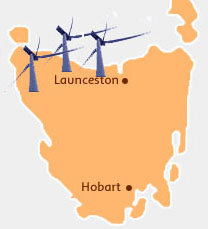 Island communities targeted for wind plant BY:MATTHEW DENHOLM :The Australian October 29, 2012 AUSTRALIA is seeking to export an off-grid power plant – capable of providing 100 per cent renewable energy – to remote and island communities currently reliant on diesel throughout the Asia-Pacific.
A prototype of the plant has been developed by Hydro Tasmania on King Island and by the end of next year will be providing 65 per cent of the Bass Strait island’s energy needs from renewable sources, or 100 per cent on windy days.
By reducing reliance on diesel generators – previously the source of 100 per cent of the island’s power – the wind and solar plant will save $4.5m a year….. http://www.theaustralian.com.au/news/health-science/island-communities-targeted-for-wind-plant/story-e6frg8y6-1226504898547
Senators John Madigan and Nick Xenophon move to stop wind farms
In July 2010, the National Health and Medical Research Council found that there is no published scientific evidence to support adverse effects of wind turbines on health.
Given their currently significant, and potentially enormous, contribution to reducing Australia’s greenhouse gas emissions, wind farms should not be held guilty until proven otherwise.
Wind farms: guilty until proven otherwise? http://www.climatespectator.com.au/commentary/wind-farms-guilty-until-proven-otherwise, 22 Oct 2012 Albert Yu Recent reports show that coal-fired power stations are finding it difficult to operate in the new market environment with falling electricity demand, a carbon price and the renewable energy target. Meanwhile, as noted by the Productivity Commission last week, wind generation is an “increasingly important source of power” in the National Electricity Market, highlighted by news of the first turbines turning at Australia’s largest wind farm to date, the 420 MW Macarthur wind farm.
As reported on Climate Spectator last month, wind power has allowed South Australia to transform itself from almost entirely being an importer of power from Victoria to being an exporter during high wind periods, whilst significantly reducing the state’s carbon emissions.
On the other hand, sitting before the Senate is the Renewable Energy (Electricity) Amendment (Excessive Noise from Wind Farms ) Bill 2012, introduced on June 28 by Senators John Madigan and Nick Xenophon to (in Senator Madigan’s words) “ensure we do not see any expansion in the number of wind farm refugees.” Continue reading
Victorian Wind Alliance to express Victoria’s majority view and promote wind energy
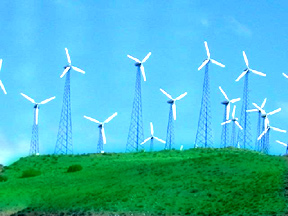 Victorian Wind Alliance to promote industry http://www.weeklytimesnow.com.au/article/2012/10/09/544954_latest-news.html Samantha Landy | October 9, 2012 A NEW organisation aimed at building support for wind energy in Victoria is set to launch tomorrow.
The Victorian Wind Alliance, made up of wind workers, landowners, environmental and community groups and anyone else who supports wind energy, hopes to promote the wind energy sector in the face of a halt in wind farm developments.”The premise is that the majority of Victorians and the majority of Australians support the development of
renewable energy,” Friends of the Earth campaigns co-ordinator Cam Walker said.
“Here in Victoria, the government has largely stalled action on renewable energy. Continue reading
Solar panels best for town home energy: wind turbines better for farms
average wind speed needs to be above 5m/s (18km per hour) to make installing a wind turbine really worthwhile. Ideal locations for wind turbines are in the country, on farms, or on the coast: basically anywhere away from built-up areas. The more buildings around the wind turbine, the less wind there is and the more turbulent any wind present becomes.
While wind power can be ideal on farms, for most suburban settings Energy Matters strongly recommends solar panels.
Backyard Wind Turbines – In Adelaide You Can (For Now) http://www.energymatters.com.au/index.php?main_page=news_article&article_id=3413 by Energy Matters 9 Oct 12, If you live in Adelaide and want to install a wind turbine atop a 10 metre tower in your back yard, it seems to you can do so without the need for council approval. But you may need to be quick. Continue reading
Family First Party tries to stop wind energy for homes
 Push to close turbine loophole before 10m-high structures are erected
http://www.adelaidenow.com.au/news/south-australia/push-to-close-turbine-loophole-before-10m-high-structures-are-erected/story-e6frea83-1226482927714 Emma Altschwager The Advertiser September 27, HOUSEHOLDERS can cash in on wind power by erecting turbines up to 10m high in their backyard that could transform suburban skylines.
But the window of opportunity could be slammed shut by Family First, which wants to change development regulations and allow neighbours to have a say in the erection of any wind turbines in their street. Continue reading
1 This month

of the week – Australians for War Powers Reform (AWPR)
To see nuclear-related stories in greater depth and intensity
 Antinuclear