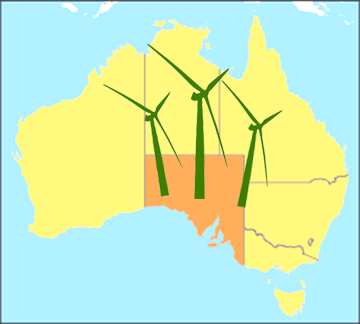
South Australia’s history of small and effective wind turbines
 KJBeinke of ADELAIDE September 27, 2012 I grew up in rural SA and we generated all of our own power as there
was no grid available. When it did become available in the late 1960’s it was cost prohibitive to pay for the poles and transformer to the farm house. The wind power was used to charge a bank of batteries and we used them in lieu of 240 volts.
Now days batteries are much cheaper, more efficient and inverters are more efficient and cheaper. For those who don’t understand, you can become self sufficient on solar and wind power with battery back up to store un-used energy. It
has nothing to do with base load and that argument is irrelevant.
The problem with some of the wind-turbines is they can be noisy. Bird strikes are almost non-existent as in my 17 years relying on wind power, never once did I see a dead bird at the base of the tower. – comment at http://www.adelaidenow.com.au/news/south-australia/wattle-park-mans-development-application-shows-10m-high-wind-turbines-are-allowed-in-adelaides-suburbs/story-e6frea83-1226481983640
Small home wind turbines allowable in South Australia, without Council consent
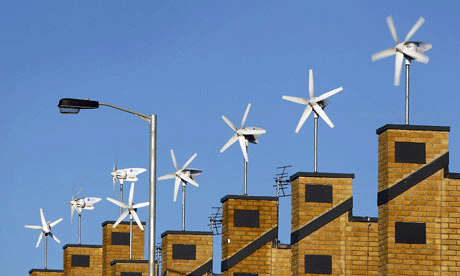 Wattle Park man’s development application shows 10m-high wind turbines are allowed in Adelaide’s suburbs
(picture shows home wind turbines in England – so it’s not really a new idea) http://www.adelaidenow.com.au/news/south-australia/wattle-park-mans-development-application-shows-10m-high-wind-turbines-are-allowed-in-adelaides-suburbs/story-e6frea83-1226481983640
A WATTLE Park man’s bid to build a 6m-high wind turbine in his
backyard has revealed a loophole that could transform suburban skylines. Continue reading
The murky story of how anti-wind energy bullies hijacked a town’s name
The New South Wales and South Australian governments are currently reviewing guidelines for wind farms. Neither government is likely to ignore a recent poll that 77 per cent of Australians support wind farms.
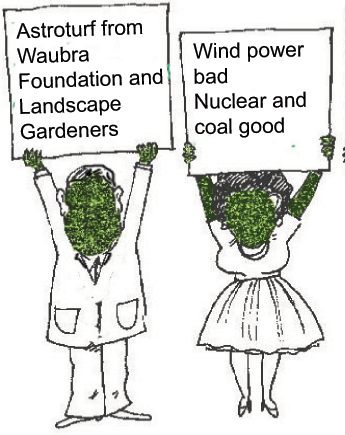
Waubra Fights The Anti-Wind Bullies. New Matilda , 26 Sept 12, By Sandi Keane The town of Waubra has had its name hijacked by anti-wind astroturfers. Locals say they’re happy with wind-farming – and it’s not making them sick. So who are the scare campaigners? Sandi Keane reports
It’s spring in the quiet sheep-farming hamlet of Waubra, an hour’s drive northwest of Ballarat in Victoria. With the shearing done and the crops in, local farmers have turned to a bit of springtime mending. Not fences, but the town’s image. After three years saddled with the negative legacy of the “foundation” that stole their name, local farmer, Karen Molloy, says the community is fighting back with a bumper festival.
Back in 2009, Waubra hit the news when powerful forces linked to mining interests, and Australia’s climate sceptic factory, the Institute of Public Affairs, used what was then the largest wind farm in the southern hemisphere as an easy target for their anti-wind scare campaign. The establishment of the Waubra Foundation followed.
“For three years, we’ve lived here quite happily. We love the wind towers and love Waubra. But it is so much more than wind so we’ve dropped the word “Wind” from the Waubra Community Festival”, Molloy said.
The festival, which takes place on Saturday 6 October, will showcase the positives of renewable energy as well as the fresh produce grown in its red volcanic soil. There’ll be a “Waubra Gift” running race, free rides, entertainment for the whole family, a free bus from Ballarat and a tour of the wind farm. Continue reading
Call for Victorian government to allow small scale community wind farms
 Call to ease regulations for small wind farms http://www.abc.net.au/news/2012-09-20/call-to-ease-regulations-for-small-wind-farms/4271052 Sep 20, 2012 The Hepburn council will lobby the Victorian Government to exempt community-based wind farms from strict regulations. A planning amendment introduced by the State Government last year prohibits new wind farms in certain areas and within two kilometres of houses.
The council adopted a motion at this week’s meeting to express its ongoing support for renewable energy developments.
Mayor Sebastian Klein says small wind farms should not be treated the same as large-scale wind farms. “It basically asks for the State Government to make different considerations for community owned wind farms than I guess large-scale, corporate wind farms,” he said.
“So I guess small-scale community owned wind farms that provide back to the community have a community dividend and also have a much smaller footprint and a much smaller impact on the landscape and on people’s amenity.”
South Australia’s extraordinary wind energy peak – at 85% of the State’s electricity
Wind power peaks in SA http://news.ninemsn.com.au/national/8528671/wind-power-peaks-in-sa Sep 6 2012 South Australia’s wind farms briefly provided 85 per cent of the state’s electricity during windy conditions this week, the Clean Energy Council says.
Policy director Russell Marsh said data from the Australian Energy Market Operator showed 55 per cent of all the electricity used by South Australians on Wednesday was generated by wind power.
But it said wind power peaked briefly at 85 per cent on Monday morning. “South Australia has proven once again that wind energy can generate real power and lots of it,” Mr Marsh said. “All this wind is putting South Australia well ahead of the curve on Australia’s 20 per cent renewable energy target.”
South Australia’s wind energy bonanza
Wind accounts for 58% of energy use in South Australia, By Giles Parkinson on 6 September 2012 It’s been another big week for wind production in South Australia – as another spring weather system with high winds makes wind energy the dominant force in local energy production.
According to figures pulled together by consultants Intelligent Energy Systems using data from the Australian Market Operator, wind energy produced accounted for 57.9 per cent of demand in the state on Tuesday, and followed up with 55 per cent of total demand on Wednesday……
exports from South Australia to other states. On Tuesday, the state was exporting almost all day, as the wind output was quite consistent. On Wednesday, it exported for most of the day and there is a bit of pink at the top in the late afternoon to indicate coal imported from Victoria. (South Australia’s coal generators are in mothballs right now due to the impact of wind, and lower demand, and the carbon price)……
These one day graphs, of course, are just snapshots of an overall trend happening in the state, and across the National Electricity Market, that will only become more apparent as the amount of wind and solar installed in the country increases. Indeed drew Reidy, from IES says these days only rank as the 6th and 12th highest in terms of energy produced on a single day, and 5th and 6th in terms of percentage of demand. The highest day in terms of output was on August 17 this year, while the highest in terms of percentage of demand came in February 5, when wind accounted for 64.1 per cent of demand across the day.
The Clean Energy Council’s Russell March said it was proof that wind energy can generate real power – and lots of it. “This type of significant wind generation is common in South Australia,” he said. In 2011/12, according to AEMO data, wind produced 24 per cent of the state’s generation, overtaking coal. And, Russell noted, AEMO data shows that emissions from South Australia’s electricity sector have dropped every year since 2005/06, and have reduced by more than 27 per cent over the last five years.
“All this wind is putting SA way ahead of the curve on the national Renewable Energy Target, helping provide farmers and local business owners in regional areas with extra income. It also means that the state’s residents collectively have a lower carbon price bill, while getting fully compensated from the Federal Government under the scheme.” Indeed, on Tuesday and Wednesday, the state enjoyed not just by far the cleanest energy in the country, but also the cheapest, with average prices over the day at $43/MWh, compared to more than $52/MWh for NSW….. http://reneweconomy.com.au/2012/wind-accounts-for-58-of-energy-use-in-south-australia-75810
Baillieu governs in the interests of the fossil fuel lobby, damaging the wind farm industry
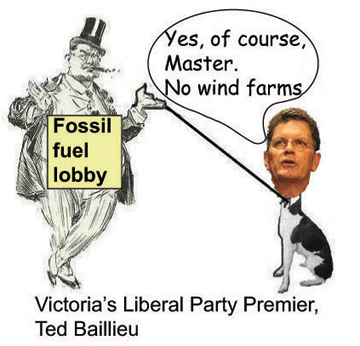 Victorian wind farm laws: a blow to Australia’s clean energy future? , The Conversation, Lisa Caripis Research assistant, Centre for Resources Energy and Environmental Law at University of Melbourne Anne Kallies PhD Scholar at University of Melbourne 4 September 2012,
It’s been just over one year since the Baillieu government introduced the second part of its far-reaching planning law reforms to restrict the development of wind farms in Victoria. The results are an example of how state planning law can be a barrier to achieving national renewable energy goals.
With a majority in both houses of Parliament, the Coalition was able to amend Victoria’s planning framework unhindered to deliver on its 2010 election promise to “restore fairness and certainty to the planning process for wind farms”.
In pursuit of this aim, the planning amendments most notably impose a blanket ban on wind farms in many parts of the state. They effectively give the owners of any dwelling within 2km of a proposed wind farm the power to decide whether or not the development should proceed. A July 2012 amendment clarifies that these changes are targeted at wind farms generating electricity for supply to the grid, not for on-site use.
Economically, reports indicate that the impacts of these changes in terms of lost or stalled wind farm investment and employment have been considerable, in a state that has some of Australia’s best wind resources. While promising to “give the community a greater voice” through these changes, the amendments instead render local, pro-wind initiatives, such as community wind farm projects impossible in many locations .
Not only do the planning law changes have the potential to entrench existing fossil fuel power generation in Victoria, they undermine the Victorian Government’s commitment to the federalRenewable Energy Target (RET).
The RET is designed to ensure that 41,000 GWh – close to 20% – of our electricity comes from large-scale renewable energy by 2020. It implicitly relies on implementation through state and territory planning frameworks, because decisions about what kind of development can take place and where rest with the states. The Climate Change Authority , which reviews the RET, notes
State and territory planning regulations may affect the level of renewable energy generation, its mix, and the geographic distribution of renewable power stations.
This can cause problems when state laws are out of step with national targets, as the electricity market rule-maker pointed out last year . It is of some concern that New South Wales draft guidelines also adopt the 2km consent rule and impose a noise assessment regime stricter than in any other jurisdiction in Australia, the United States or Europe….. http://theconversation.edu.au/victorian-wind-farm-laws-a-blow-to-australias-clean-energy-future-9163
Wind farm for Ballarat, Victoria
 Meridian to build third wind farm in Australia TVNZ September 03, 2012 Meridian Energy, one of the state-owned power companies slated for partial sale, is to start construction of its third wind farm in Australia, with the 131 megawatt Mt Mercer project in the state of Victoria.
Mt Mercer is a 64-turbine wind farm 30 kilometres south of the town of Ballarat with a construction cost of about $A260 million. The two-year project will begin in December and the commitment follows chief executive Mark Binns’s recent comments that the company’s best opportunities for investment new generation are offshore.
Mt Mercer will add to the Meridian owned-and-operated Mt Millar wind farm in South Australia and its project with AGL Energy to build the 420 MW Macarthur wind farm in western Victoria, which is touted as the largest in the southern hemisphere…. http://tvnz.co.nz/business-news/meridian-build-third-wind-farm-in-australia-5057752
Anti wind farm activist appointed to Australian Wind Power Health Review
To direct the review, the NHMRC has created a reference group which also includes two observers….. the second observer is Peter Richard Mitchell, the founder of the Waubra Foundation. , the 77-year-old Mr Mitchell has a long career in the mining and fossil fuel industries Mr Mitchell has used a raft of other arguments to oppose wind farms.
Anti-turbine Activist Given Role as Observer on Australian Wind Power Health Review Desmoblog.com Graham Readfearn, 22 Aug 12, THERE are very few health symptoms these days which anti-wind power activists and suggestible and anxious residents have not at some point blamed on those spinning steel turbine blades.
According to a list compiled by Simon Chapman, the University of Sydney’s Professor of Public Health and much-awarded enemy of the tobacco industry, wind farms have been blamed for more than 180 different symptoms including weak bladders, cancers, weight gain, weight loss, herpes, kidney damage and, in one case, a woman having not one, but five menstrual periods in a single month.
Apparently, wind farms also cause chickens to be hatched with crossed beaks (and eggs being laid without yolks), cats to produce small litters, horses to get club feet and crickets to disappear.
Chapman noted recently at The Conversation that in Australia health complaints about wind farms have been relatively recent, despite some wind farms having been in operation for almost 20 years. In one area, Chapman said complaints had only been made after “a visit to the area by a vocal opponent, spreading anxiety”.
The Australian Government’s National Health and Medical Research Council has begun its second review of the “evidence” for such claims, examining studies and reports from around the world. The agency’s 2010 review looked at a range of issues which anti-wind groups often cite as the causes of symptoms in people living in wind farm areas. These included noise, low frequency sound and infrasound, shadow flicker, blade glint and electromagnetic radiation.
The review concluded that in each case, there was no evidence that wind turbines could have a direct impact on people’s health. The review said it was possible that people were getting annoyed by their sound, but also pointed out that a wind farm with 10 turbines at a distance of 350m was about as loud as a quiet bedroom. People were more likely to be annoyed by the sound if they also didn’t like the look of turbines on the landscape.
However, the review pointed out that “renewable energy generation is associated with few adverse health effects compared with the well documented health burdens of polluting forms of electricity generation”, and then concluded,
This review of the available evidence, including journal articles, surveys, literature reviews and government reports, supports the statement that: There are no direct pathological effects from wind farms and that any potential impact on humans can be minimised by following existing planning guidelines.
Desmogblog (http://s.tt/1lpk2)...
The NHMRC is currently reviewing the scientific literature on wind farms in order to update its public statement, which it hopes to publish by May 2013. Continue reading
New South Wales government stifling wind power development
Answer to NSW’s power problems is blowing in the wind, says report SMH, August 20, 2012 Anna Patty State Political Reporter A REPORT on future power needs in NSW has identified wind energy – which has been publicly derided by the Premier, Barry O’Farrell – as a solution and investment opportunity for NSW.
The Australian Energy Market Operator – an independent company that closely monitors and operates the national electricity network – has released a report that says investment interest is focused on supplying renewable energy such as wind and gas during periods of peak demand on the hottest and coldest days of the year.
The report says investors are less interested in base load generation, which provides energy all year round…..
NSW government’s draft guidelines for new wind farm developments are designed to chronically handicap the expansion of the wind industry in this state,” Mr Foley said.
”The government has also placed prohibitive costs in the way of wind farm developments.”
Mr Foley said the wind industry in NSW had the potential to generate 3000 megawatts of wind energy to help future needs. ”According to the Australian Energy Market Commission, new wind energy projects in
Victoria facilitated by the renewable energy target will actually deliver lower wholesale electricity price increases than what will be seen in NSW,” he said.
”Rather than attacking wind farms, the O’Farrell government should require its own planning review to come up with a sensible and workable planning regime for the development of the wind industry in NSW.” http://www.smh.com.au/nsw/answer-to-nsws-power-problems-is-blowing-in-the-wind-says-report-20120819-24gjh.html#ixzz247RK3VnT
Success of wind and solar energy in South Australia
SA shows wind and solar make energy cleaner and cheaper, REneweconomy, By Giles Parkinson 13 August 2012As Europe has looked towards its biggest and most successful economy Germany to lead the way into green energy, Australians are getting a glimpse into its own grid of the future in the state of South Australia – arguably the advanced economy with the highest wind energy penetration, and now with the highest penetration of rooftop solar PV, in the world.
The latest South Australian Electricity Report (SAER), released by the Australian Energy Market Operator last week, gives some fascinating insights into how wind and now solar PV are changing the nature of the local grid – and providing the state with cleaner, greener and cheaper energy.
For a start, in 2011/12, wind overtook coal as the second biggest producer of energy in the state.
But while solar PV is not included , here’s another interesting set of statistics. South Australia has had the biggest reduction in energy demand compared to forecasts of just a year ago – down 10 per cent from last year’s predictions. Industry demand has fallen, but it still represents growth of 5.4 per cent. The biggest change has been in residential demand, which has fallen 7 per cent. It just so happens that South Australia has the highest penetration of rooftop PV of all the NEM states, meaning – as AEMO states – that ‘”less electricity is being supplied from the grid.”
Indeed, by the end of 2012, two out of five houses in the state had installed rooftop solar PV – more than double the national rate ….. Another interesting snippet from AEMO’s report is that rooftop solar – contrary to some opinion – is helping to meet peak demand….. http://reneweconomy.com.au/2012/sa-shows-wind-and-solar-make-energy-cleaner-and-cheaper-39021
Victoria’s Baillieu government destroying wind industry in that State
the Baillieu government has introduced severe planning restrictions, with 14 of the 18 previously publicly announced wind farm proposals that are now unlikely to proceed located in that state.
The wind farms that Baillieu killed. REneweconomy By Giles Parkinson 9 August 2012 If Victorian Premier Ted Baillieu came to power with a determination to kill off opportunities for wind farm development in Victoria, then he can be proud of his work.

The annual Electricity Statement of Opportunities released today by the Australian Energy Market Operator highlights how much the opportunities for wind farm developments in Victoria have been reduced in the past year. Continue reading
180,000 homes to be powered by Snowtown wind farm, (South Australia)
Siemens and TrustPower to build largest wind farm in South Australia, PACE, 3 August, 2012 Kevin Gomez, TrustPower has appointed Siemens as their turn-key supplier to construct South Australia’s largest wind farm at Snowtown using for the first time in Australia, gearless drive wind turbine technology.
With the project formally reaching financial close, the Snowtown II wind farm development will be capable of generating 270 megawatts of renewable energy and powering approximately 180,000 South Australian homes……. South Australia has now set a target of 33 per cent renewable energy by 2020. The new Snowtown II wind farm is set to help achieve this target.
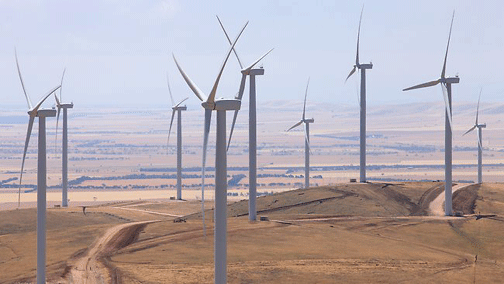
Snowtown II is co-located with the existing Snowtown wind farm, which will more than triple the renewable energy generation of the region. Early preparations have commenced at the site with construction commencing inAugust 2012 to ensure the project is fully operational by the end of 2014…. http://www.pacetoday.com.au/news/siemens-and-trustpower-to-build-largest-wind-farm
Wind farm at Collector supported, despite one small “astroturf” group’s opposition
Wind farm claims local supporters, Canberra Times, July 27, 2012, John Thistleton Proponents of a $400 million, 68-turbine wind farm at Collector say most of the village residents support the project, which has moved a step closer to approval.
RATCH-Australia is expected to take two years building the region’s latest wind farm near the Federal Highway at Collector. It will generate up to 228 megawatts of electricity, or enough energy to power around 80,000 homes annually.
Chief executive Steve Loxton said the 60-day public exhibition period represented the culmination of years of research.
”Our surveys of local Collector residents confirm that there is strong support for renewable energy Continue reading
Victoria’s outstanding potential for renewable energy is being neglected
 Victoria missing out on renewable energy http://www.abc.net.au/news/2012-07-23/victoria-missing-out-on-renewable-energy/4147502?section=vic July 23, 2012 Victoria is “blessed” with its renewable energy capacity: Tim Flannery. The Climate Commission says Victoria’s renewable energy resources are barely being tapped.
Chief climate commissioner Professor Tim Flannery says we are entering a new chapter of climate change and Victoria should be making a sharp shift to renewable energy such as wind and solar power. “Victoria has got fabulous wind resources, the envy of places like Europe and fantastic solar resources too,” Professor Flannery said. Continue reading
1 This month

of the week – Australians for War Powers Reform (AWPR)
To see nuclear-related stories in greater depth and intensity
 Antinuclear