World Heritage for Finders Ranges? Sounds good, but doesn’t prevent nuclear waste dumping
The potential location of the proposed National Radioactive Waste Management Facility at Wallerberdina Station near Hawker would have no impact on the World Heritage proposal for the Flinders Ranges.
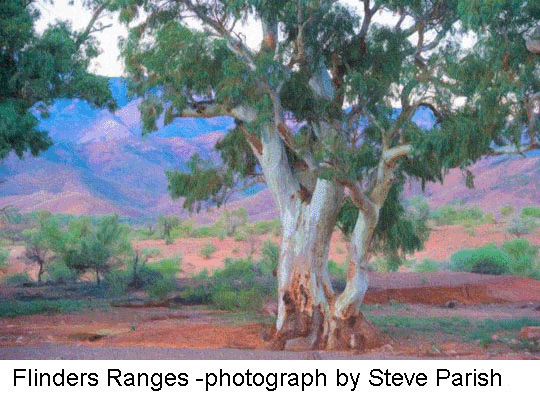
World Heritage for the Flinders Ranges Natural resources, SA Arid lands Over 600 million years old, the Flinders Ranges is one of Australia’s magnificent landscapes. This diverse landscape is world-renowned for its wealth of natural, cultural, historic and scenic values making it an iconic tourism destination with unparalleled visitor experiences.
Particularly extraordinary are the fossils and geology of the Flinders Ranges, which display the history of our planet and the evolution of life on Earth. Some of this critical evidence spans more than 300 million years and includes the world’s finest example of the Ediacaran explosion of life, when the earliest forms of complex multicellular animal life evolved. It is these outstanding geological and palaeontological forms within the Flinders Ranges that make it an important site to pursue for World Heritage Listing.
Pursuing World Heritage Listing for the Flinders Ranges provides an exciting opportunity to recognise this site on a global scale, to celebrate these outstanding values and create economic benefits for the region. Continue reading
Adani coal mine granted UNLIMITED ACCESS TO GROUNDWATER!
 ‘Barbaric’: Farmers rattled as Adani coal mine granted unlimited water access, Brisbane Times, Peter Hannam, 6 Apr 17, The proposed Adani coal mine has been granted unlimited access to groundwater by the Queensland government in a move farmers fear would allow it to drain huge amounts of water from the Great Artesian Basin.
According to a copy of Adani’s water licence obtained by Fairfax Media, the $16 billion Carmichael mine merely needs to monitor and report the amount of water it extracts with a permit that runs until 2077.
The mine, the biggest of nine proposed for the Galilee Basin west of Rockhampton, can conduct its own review of its groundwater model without independent or government oversight.
There are also no impact levels specified that would trigger a halt to mining, with the company able to offset any significant water loss elsewhere, the licence shows.
“It’s bloody-minded and barbaric,” said Bruce Currie, a grazier who lives in the region and has joined legal action against Galilee mines. “This is going to definitely impact on the integrity of [the Great Artesian Basin].”
According to a supplementary environmental impact statement, the mine will draw 26 million litres of water per day from its pits by 2029 as it ramps out annual production to as much as 60 million tonnes. Over its life, the mine’s water tally would reach an estimated 355 billion litres……….
The licence would not be subject to the new Water Act Referral Panel set up to ensure “the sustainable management of water in Queensland”……
Opponents, though, argue the coal is largely poor quality and the basin will require huge subsidies to become viable. Burning the fuel would also release a “carbon bomb” that would contribute to harming the Great Barrier Reef, which is already being hammered by unprecedented coral bleaching blamed on global warming.
Fairfax also sought comment from Adani Mining, the local subsidiary of the Indian company.
Without the water, their businesses are basically finished.
Limited scrutiny Unlike other controversial mines, such as the New Acland coal mine planned for the Darling Downs, Adani’s water usage is not subject to public submissions and appeals, said Jo Bragg, chief executive of Queensland’s Environmental Defenders Office.
Groundwater evidence is often the most controversial feature and public scrutiny is often the most significant aspect of any review, Ms Bragg said. “It’s a matter of grave concern that there’s not that opportunity.”…….http://www.brisbanetimes.com.au/environment/barbaric-farmers-rattled-as-adani-coal-mine-granted-unlimited-water-access-20170404-gvdk5v.html
Uranium mining OR rare and beautiful Night Parrot?
 Still here: Night Parrot rediscovery in WA raises questions for mining, The Conversation, March 29, 2017 The Night Parrot is unquestionably one of Australia’s most enigmatic, elusive and enthralling species. The final frontier of Australian ornithology, this cryptic parrot eluded dedicated expeditions to find it for nearly half a century.
Last week, a momentous chapter in the Night Parrot story was written, with the first photograph of a live Night Parrot in Western Australia. The photos come in the wake of several other recent sightings, including the parrot’s rediscovery in Queensland in 2013.
Despite media reports, the parrot has never been officially listed as extinct, with sporadic evidence of its existence throughout the 20th century. But now we know for sure that the parrots are alive and found across the continent, we can move on to making sure they remain so in the future.
Mystery bird We know that Night Parrots favour spinifex or tussock grasslands, often close to inland wetland systems. But the areas of potential habitat are vast throughout inland Australia.
The Night Parrot has been listed as endangered in the Action Plan for Australian Birds since 1992. It is listed as endangered under federal legislation…….
The significance of the latest find is immense…….The latest record cements the fact that Night Parrots are present at several locations in WA and potentially throughout arid Australia, including in regions rich in mineral resources.
In contrast to the Queensland populations, which have so far been found in national parks and pastoral leases, the WA situation sets up a quandary for how to manage development, Night Parrots and mining…….
Recent developments by other WA resource companies have seldom considered Night Parrots. My personal experience is that surveys usually look for endangered mammals such as Northern Quolls and Bilbies, but rarely search properly for Night Parrots. This is likely due to two main reasons.
The first is the incredibly cryptic nature of the Night Parrot. Clearly the species has evaded detection for so long because it is difficult to find.
The second is what I term “the Thylacine factor”. The only equivalent species in Australia that has the same degree of scepticism and mythology is the Thylacine.
Thylacines have (so far) not been rediscovered. But developers, consultants and regulators take the same attitude to Night Parrot sightings. The parrots are often seen as a mythical animal that doesn’t exist. The idea of looking for them is met with mirth……..
Let’s hope government bodies will strongly enforce the requirement to search for Night Parrots in all areas of potential habitat within their known current and historic range. This should ensure that we don’t lose any parrots before they are even found. https://theconversation.com/still-here-night-parrot-rediscovery-in-wa-raises-questions-for-mining-75384
Fairfax press tones down its “radioactive cow ‘” story, (caves in to Victorian government)
 Radioactive cow site no cause for alarm, says state government, The Age Carolyn Webb, Mark Hawthorne , 27 Feb 17
Revelations of radioactive cow carcasses buried beneath land slated for a $20 billion education precinct in Melbourne’s west should be no cause for alarm, the state government says.
Fairfax Media revealed on Sunday 60 carcasses were buried at a Werribee site the government was trying to sell to a Chinese consortium.
Documents obtained by Fairfax Media estimated the cost of cleaning up the radioactive waste could reach $300 million.
Environment Minister Lily D’Ambrosio did not deny the 775-hectare site was contaminated by toxic waste. But she said a more recent report to be released publicly shortly indicated there had been no flow-on contamination.
“I can assure everyone that with the more recent report into the extent of the contamination of that land … indicates that there is no cause for concern in terms of contamination to ground water in the effects beyond the actual area of the land itself.”
A consortium called Investors Direct is the last remaining bidder on the site, which includes parts of the old State Research Farm, laboratories and veterinary schools, where for decades there was scientific testing on animals. Investors Direct, with former premier John Brumby an adviser, plans to build an Australian Education City, home to 80,000 residents and 50,000 students on land adjoining the planned new youth detention centre.
Documents obtained by Fairfax Media estimated the cost of cleaning up the radioactive waste could reach $300 million, with a further $770 million required to removed thousands more cow carcasses considered a biological hazard…….http://www.theage.com.au/victoria/radioactive-cow-site-no-cause-for-alarm-says-state-government-20170226-gullry.html
Radioactive cows buried in Werribee, Victoria
According to the environmental report, in a worst-case scenario, “some radioactive isotopes may have entered surface water or groundwater”, in which case up to 130,000 cubic metres of contaminated soil would have to be excavated, and disposed of off-site.
That is the equivalent of 8125 standard dump truck loads of radioactive material travelling through Melbourne’s western suburbs, and would add $770 million to the clean-up bill, taking the total cost to $1.07 billion.
The report notes that the burial pits are “unsuitable to remain within the developed site beneath structures or anywhere within sites used for sensitive uses”. One of areas used to bury animal carcasses is now the site of a student residence.
A sewage farm. A youth detention centre. Now meet Werribee’s radioactive cows http://www.theage.com.au/business/a-sewage-farm-a-youth-detention-centre-now-meet-werribees-radioactive-cows-20170224-gul26r.html Mark Hawthorne, Senior Editor
Sixty radioactive cow carcasses are buried beneath land in Werribee that the Andrews government is trying to sell to a Chinese consortium keen to build a $20-billion education precinct in Melbourne’s west.
Documents obtained by Fairfax Media estimate the cost of cleaning up the radioactive waste could reach $300 million, with a further $770 million required to remove thousands more cow carcasses that are considered a biological hazard. Even conservative estimates put the cost of the clean up at $35 million.
Investors Direct is the exclusive bidder on the 775-hectare site, which includes parts of the old State Research Farm, laboratories and veterinary schools, where scientific testing on animals was conducted for decades.
The consortium, which has former Victorian premier John Brumby as an adviser, plans to build Australian Education City – a precinct that will be home to 80,000 residents and 50,000 students – on land that adjoins the site of the planned new Youth Detention Centre.
Fairfax Media can reveal the Victorian state government and VicUrban were told that radioactive cow carcasses were buried on four hectares of land in Werribee in early 2009, when Mr Brumby was premier. Another burial pit, which contains the remains of non-radioactive cows, is located on the site of the planned detention centre.
Coffey Environment completed a phase 1 environmental assessment report on the Werribee site in March 2009. The report found that “animals that have been subjected to testing with radioactive tracer dyes” were buried at the site. The report lists the cow carcasses as a “possible biological and radiological hazard” and says the contamination could impact both soil and groundwater.
The report states that “the tracer dye used was predominantly tritium” which “has a half-life of approximately 12 years”. Continue reading
Turnbull and Trump – twins in their attitudes to environment
 Like Trump, Turnbull’s environmental WTFness is a propelling us to disaster, Independent Australia Sue Arnold 25 February 2017, Like many Americans, Australians are wondering how the hell we ended up with a PM whose environment policies are a recipe for disaster. Sue Arnold reports.
AS THE Trump horror reality show unfolds, a collective shudder is being felt around the world. His anti environmental policies are winding back half a century of progressive laws created to ensure healthy human and animal habitats for current and future generations.
With the U. S. Environment Protection Agency now in the hands of climate sceptic and resource industry front man, Scott Pruitt , the Agency is scheduled to be repealed in 2018. The Endangered Species Act is also on the hit list and a U.S. withdrawal from the Paris Agreement is definitely on the cards.
At the same time, scientists have announced that the ocean oxygen levels have dropped by 2% in 50 years, a truly frightening scenario. According to the WWF Report 2015, populations of marine vertebrates have declined by up to 50% since l970. Coral reefs are predicted to be extinct by 2050.
According to Dr Richard Leakey, author of The Sixth Extinction, within the next 30 years half of the species on earth could die in one of the fastest mass extinctions in the planet’s 4.5 billion years of history.
Yet the legacy of future generations has no currency with the world’s most powerful leader.
Banging the drum for “clean coal” and “putting the miners back to work,” Trump is ensuring pollution of rivers, forests, air, water, and the agricultural lands on which we depend for the very stuff of life. His refusal to acknowledge the damage climate change is wreaking on the planet is a threat to human existence.
A similar scene is unfolding in Australia as Malcolm Turnbull leads the way with a similar mindless rejection of environmental reality. Witness his latest Trump style policy to use the Clean Energy Finance Corporation to fund “clean coal”. Utter madness.
Where does this arrogance originate?…..
It’s almost impossible to separate Turnbull and Trump in terms of their attitudes towards the environment. The record speaks for itself. Given the current PM’s repeated assertions he’s an environmentalist, his sell-out on climate change, and his obvious deference to the extreme right wing of the Liberal Party, perhaps it’s time to change the definition of environmentalism. With “clean coal” now his government’s mantra, the PM is better described as a hypocrite, blind to the appalling state of this country’s environment.
Look at the record.
The most recent State of the Environment Report is dated 2011.
Key findings include: -……….
Several bills languishing in the parliament demonstrate the future of Australia’s unique environmental legacy under a Coalition Government, highlighting the move towards Trump extinction policies.
The Environment Protection and Biodiversity Conservation Amendment (Standing) Bill 2015 aims to remove extended standing for community members (including environment groups) to seek judicial review of decisions made under the EPBC Act. Standing would then be restricted to a person “whose interests are adversely affected by the decision”. If this bill is passed by the Senate, the onus of protecting specific environmental matters would be in the hands of individuals who could demonstrate their “interests are adversely affected by the decision”. Common law has interpreted this to require “special interest”.
The likelihood of individuals mounting lawsuits against the Federal Government is remote. https://independentaustralia.net/environment/environment-display/like-trump-turnbulls-environmental-wtfness-is-a-propelling-us-to-disaster,10056
Oil companies to profit from oil-spill clean-ups under petroleum resource rent tax
It means the costs of cleaning up oil spills from exploration wells would be tax deductible, and could be held over and “uplifted” into future years at an annual rate of 17.5%……
 “The rules are written so if a company created an oil spill with their exploration rig, they could make a profit from it,” – Greens senator Peter Whish-Wilson
“A standard tax deduction for an oil spill clean-up would be bad enough, but in this case the deduction grows in value every year. No other sector, no other set of businesses gets such ridiculous and costly deductions.”
Taxpayers to pay for oil spill clean-ups under petroleum resource rent tax https://www.theguardian.com/australia-news/2017/feb/25/taxpayers-to-pay-for-oil-spill-clean-ups-under-petroleum-resource-rent-tax Treasury confirms companies would be able to claim tax deduction for expenses incurred from cleaning up pollution, Australian taxpayers will be forced to subsidise the clean-up costs of oil spills in the Great Australian Bight thanks to the terms of the controversial petroleum resource rent tax. Continue reading
Australian Conservation Foundation summarises the background of Adani’s Carmichael coal mine and rail project
 The Adani Brief: our summary https://www.acf.org.au/adani_brief_summary
https://groups.google.com/forum/#!topic/wgar-news/QkXUYq11cmQ 15 February 2017:
“Background
The brief is the result of months of international investigation by Environmental Justice Australia and
USA-based environmental law non-profit EarthJustice into the global legal compliance record of the Adani Group.
It puts governments and private stakeholders on notice that backing Adani’s Carmichael
coal mine and rail project in Queensland’s Galilee Basin
may expose them to financial and reputational risks.
“Key findings
“Environmental destruction:
Adani Group companies have a record of environmental destruction and non-compliance with environmental regulations.
Some examples are: …
“‘Black money’: …
“Bribery and illegal exports: …
“Confusing and opaque corporate structures: …
“This is a company the government is entrusting: … ”
The Adani Brief:
What governments and financiers need to know
about the Adani Group’s record overseas
https://groups.google.com/forum/#!topic/wgar-news/QkXUYq11cmQ
https://envirojustice.org.au/sites/default/files/files/Submissions%20and%20reports/The_Adani_Brief_by_Environmental_Justice_Australia.pdf
South Australia’s Nullarbor Plain – a wasteland for nuclear wastes?
At Woomera, I go to look at the grave monuments in the cemetery on the hill outside the town. There are multiple still births and infant deaths, often in the same family. People don’t like to talk about it, but there are stories of women wailing in the streets, driven by unassuagable grief. A local urban myth held that if a pregnant woman stood on the hill facing Maralinga during a bomb test, the sex of the foetus would be revealed in x-ray silhouette……….
This land is already a nuclear waste dump. The locations and proposals change, but the same apparent “emptiness” that brought rockets, nuclear tests and detention centres now attracts commercial interest in storing nuclear waste from other nations. It’s the end of a cycle that starts with the mining and export of Australian uranium. The redistribution of uranium is a very Anthropocene process, part of the dismantling and reassembling of the planet.
Friday essay: trace fossils – the silence of Ediacara, the shadow of uranium, The Conversation, Senior Lecturer in archaeology and space studies, Flinders University , February 3, 2017 As an archaeologist working in the remote areas around Woomera and the Nullarbor Plain, my understanding of South Australia was first informed by rocks and soil. This was a landscape of fossils and trace fossils – the preserved impressions left by the passage of a living body through sediment – jostling for attention. On this land surface, SA presents an arc extending from the “death mask” fossils of early multicellular life to the human leap into the solar system. Sure, you might say, this could be said of other locations on Earth. But here it seems laid bare for any who can read the distinctive pattern of signs.
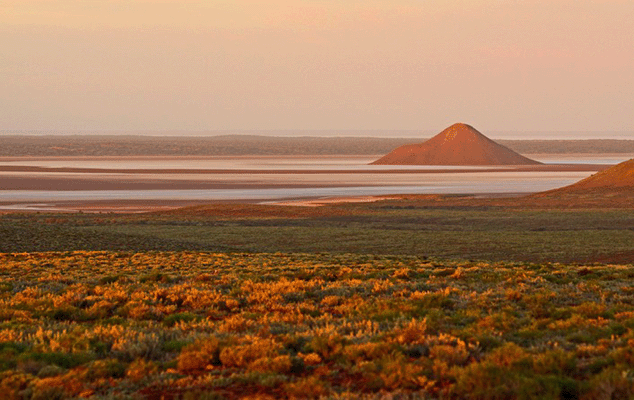
YEELIRRIE URANIUM APPROVAL SETS DANGEROUS EXTINCTION PRECEDENT

State and national environment groups condemn yesterday’s decision by the Environment Minister to approve the Yeelirrie uranium mine, which the EPA recommended be rejected in August 2016.
Conservation Council of WA Director Piers Verstegen said, “The approval goes against the advice of the EPA, against the wishes of the local community, and against the economic reality that this project is not feasible.
“This decision sets a shocking new precedent for WA environmental law – a decision which clearly and knowingly breaches one of the core objectives of the Environmental Protection Act, the Precautionary Principle. This decision allows the extinction of multiple unique wildlife species which exist nowhere else on Earth, which raises some serious legal questions.
“The EPA has made it clear that this project threatens the extinction of unique wildlife. If the Minister allows wildlife of any sort to become extinct for the sake of an unwanted and uneconomic uranium mine, then all of our wildlife is at risk everywhere.
“Minister Jacob and the Barnett Government has long held an ideological position that uranium should be mined – against the wishes of the community, against market reality, and now against the recommendations of the State’s independent environment umpire and the future of unique species.
“In the last few months, the decision to go ahead with the Roe 8 project in known breach of environmental policy, and now to reject EPA advice for the sake of an unviable uranium mine, demonstrates that the Government is willing to put their ideology ahead of their responsibility to protect the environment, and ahead of public interest.”
CCWA Nuclear Free Campaigner Mia Pepper said, “Despite the Minister’s recent rush to see uranium mined in WA, and after two terms of a pro-uranium Government, not one of the WA uranium proposals will have final approvals granted before the State election in March – and none will be economically viable.
“This project and the Minister’s approval will continue to be strongly contested by state and national conservation groups and the local community, and will continue to struggle to attract investors.”
Warning from UNESCO on Great Barrier Reef
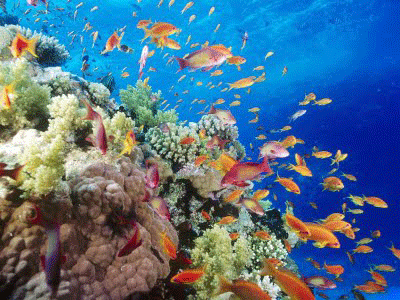 UNESCO says Great Barrier Reef is back in the danger zone
 (includes videos)
 One year on, BHP Billiton held to account for the Samarco tailings dam disaster
 17 Nov 16, BHP Billiton’s AGM | Thursday 17th November at 11 am | Brisbane Convention & Exhibition Centre
At th BHP Billiton Limited AGM in Brisbane this Thursday, dissident shareholders will challenge the company’s board over its response to the Samarco tailings dam disaster. The AGM is being held twelve months on from the disastrous collapse of the Fundão mining waste (‘tailings’) dam at the Samarco iron ore mine in Minas Gerais, Brazil, which is 50-50 owned by BHP Billiton and Brazilian mining giant Vale.
“The dam break led to the destruction of all forms of life in the region. Mud covered everything, resulting in 20 deaths and unmeasurable environmental destruction. We have seen whole communities destroyed by BHP Billiton and Vale’s operations. They have lost everything, without receiving any real compensation. Instead of reparations for the victims, what is becoming evident is the blatant corporate capture of our government by transnational companies”, said Rodrigo de Castro Amédée Péret, of the Churches and Mining Network in Latin America who attended the BHP Billiton London AGM.
The collapsed waste dam killed twenty people [1], left 700 people homeless and polluted hundreds of kilometres of the Rio Doce river valley. Following the 5 November, 2015 disaster, MAB (People Affected by Dams), a coalition of local communities impacted by Brazil’s thousands of dam projects, made four key demands of Samarco and parent companies BHP Billiton and Vale [2].
Natalie Lowrey, of Australia’s Mineral Policy Institute, said, “BHP Billiton and its associates at Samarco are ignoring those most affected – the people whose lives and livelihoods have been devastated by last year’s tailings dam collapse. The demands being made by MAB, the social movement of people affected by dams, should be accepted. People want meaningful participation in decision-making about the clean-up and compensation, and for everyone who has been affected to be recognised – the companies shouldn’t be picking and choosing who gets help.”
Representatives of communities impacted by the broken dam disaster reiterated these demands at BHP Billiton’s London AGM on 20 October 2016 [3][4]. They were unsatisfied with the company’s responses. A panel of inquiry was set up to assess the cause of the waste dam collapse without attributing blame, they released a report in August 2016 [5].
Richard Harkinson, of London Mining Network, said, “BHP Billiton appears to be leading on international lobbying for the industry’s ‘learning lessons’ without regulatory change. The panel’s report [6] questioned the efficacy of changes in waste dam design and the sequence of its modifications, and poor management particularly throughout 2011-12, whereby the bases for failure were established through failure and compounded through avoiding good practice.”
On the day of the company’s London AGM, the Brazilian prosecutor’s office charged 26 people for their alleged roles in the disaster, 21 for qualified homicide. This included BHP Billiton and Vale executives on the Samarco board, including a minority who have now left [7]. London Mining Network and the Mineral Policy Institute welcomed this development as a step towards justice [8].
Notes Continue reading
The danger for Australia as Turnbull wants to change Australia’s environment act
None of these decisions would have been possible without the groups’ standing under Section 487 of the EPBC Act. Removing these provisions undermines the foundational objectives of Australia’s national environmental act at a time when its protective capabilities are needed most.
 Turnbull wants to change Australia’s environment act – here’s what we stand to lose, The Conversation, Director of the Centre for Energy and Natural Resources Law, Deakin Law School, Deakin University October 31, 2016 Prime Minister Malcolm Turnbull is seeking changes to Australia’s national environment act to stop conservation groups from challenging ministerial decisions on major resource developments and other matters of environmental importance.
Turnbull is reviving a bid made by former Prime Minister Tony Abbott to abolish Section 487 of the Environment Protection and Biodiversity Conservation Act (EPBC Act) – a bid rejected in the Senate in 2015. If it goes ahead, the change will significantly diminish the functionality of the act.
The EPBC Act, introduced by the Howard government in 1999, has an established record of success. Judicial oversight of ministerial discretion, enabled by expanded standing under Section 487, has been crucial to its success.
Section 487 allows individuals and groups to challenge ministerial decisions on resources, developments and other issues under the EPBC Act. An organisation can establish standing by showing they have engaged in activities for the “protection or conservation of, or research into, the environment” within the previous two years. They must also show that their purpose is environmental protection.
Repealing this provision would remove the standing of these groups to seek judicial review of decisions. Standing would then revert to the common law position. That means parties would need to prove they are a “person aggrieved” by showing that their interests have been impacted directly.
Many environmental groups will be unable to satisfy the common law test, leaving a very small group of people with the right to request judicial review – essentially, the right to check that federal ministerial power under the EPBC Act has been exercised properly.
This is likely to have a devastating impact on fragile ecological systems and biodiversity conservation strategies.
This is particularly concerning given the dramatic changes affecting the environment from the expansion of onshore resource development and the acceleration of climate change.
Why do we have the EPBC Act?
Australia’s environmental laws are too weak – as shown by the Adani coalmine case
The groups are calling for a new generation of environmental laws that protect critical habitats for threatened species, that halt projects until information about the scale of the impacts is known, and that explicitly deal with impacts on the climate.
They have also called for laws that allow environmental approvals to be challenged in court on their merits. Currently, they can only be challenged by claiming the minister didn’t follow the correct legal processes.
Adani’s Carmichael coalmine proves environment laws ‘too weak’ – report
No consequences for the company if its mine causes greater environmental damage to threatened habitats than expected, says study, Guardian, Michael Slezak, 12 Sept 16, Australia’s environmental laws are too weak, a new report argues, citing the Carmichael coalmine as an example. Even what the environment minister has described as the “strictest” environmental conditions on the development allow the destruction of endangered species habitats, the degradation of ecologically and culturally significant water bodies, as well as the production of fossil fuels for burning, it says.
When the federal environment minister gave the most recent approval for Adani’s huge coalmine in 2014, he said it was done on the basis of “36 of the strictest conditions in Australian history”.
Taking those conditions as the “high-water mark” for environmental protections offered by current laws, a report by the Australian Conservation Foundation and the Environmental Defenders Office of Australia examined whether they protected the environment in the way they were intended to. Continue reading
Federal govt slashes safety checks at Ranger uranium mine
ERA, controlled by Rio Tinto, stopped mining new ore in 2012. Since then, it has been extracting ore – totalling about 2000 tonnes a year – from tailings at a rate that leaves 999 tonnes of waste for every uranium tonne produced.
Under federal statutes, the millions of tonnes of waste rock and billions of litres of water must be stored so “radiological material is separated from the environment for 10,000 years”, Mr O’Brien said.
“All that contaminated matter … all the buildings, the mill, the power plant, all the machinery, all the trucks – everything – has to be put into pits.”
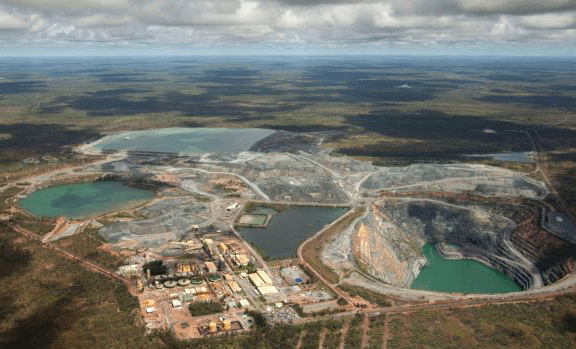
Lone Ranger: Kakadu uranium miner faces fewer safety checks, The Age, Peter Hannam, 30 Aug 16 The controversial Ranger uranium mine in the Top End has had its independent government oversight depleted just years before its closure in a move the local Aboriginal organisation describes as “absurd”.
Since December, the Supervising Scientist Branch – the agency under the federal environment department enforcing standards at the giant mine – has halted atmospheric testing of radon and other radioactive dust from the project owned by Energy Resources of Australia.
Neither has the SSB’s environmental research institute – known as ERISS – tested a range of foods including fish and wallaby eaten by the nearby traditional owners, the Mirarr people, since 2011, according to one insider. Continue reading
1 This month

of the week – Australians for War Powers Reform (AWPR)
To see nuclear-related stories in greater depth and intensity
 Antinuclear