Plutonium ”hot particles” are not as stable as we assumed. Research on contaminated landscape around Maralinga in outback South Australia

We sliced open radioactive particles from soil in South Australia and found they may be leaking plutonium https://theconversation.com/we-sliced-open-radioactive-particles-from-soil-in-south-australia-and-found-they-may-be-leaking-plutonium-161277
Barbara Etschmann, Research officer, Monash University
Joel Brugger, Professor of Synchrotron Geosciences, Monash University
Vanessa Wong, Associate Professor, Monash University
May 21, 2021 Almost 60 years after British nuclear tests ended, radioactive particles containing plutonium and uranium still contaminate the landscape around Maralinga in outback South Australia.
These “hot particles” are not as stable as we once assumed. Our research shows they are likely releasing tiny chunks of plutonium and uranium which can be easily transported in dust and water, inhaled by humans and wildlife and taken up by plants.
A British nuclear playground
After the US atomic bombings of Hiroshima and Nagasaki in 1945, other nations raced to build their own nuclear weapons. Britain was looking for locations to conduct its tests. When it approached the Australian government in the early 1950s, Australia was only too eager to agree.
Between 1952 and 1963, Britain detonated 12 nuclear bombs in Australia. There were three in the Montebello Islands off Western Australia, but most were in outback South Australia: two at Emu Field and seven at Maralinga.
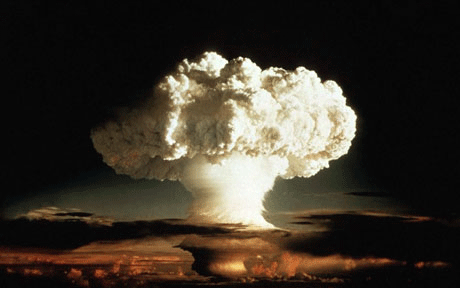
Besides the full-scale nuclear detonations, there were hundreds of “subcritical” trials designed to test the performance and safety of nuclear weapons and their components. These trials usually involved blowing up nuclear devices with conventional explosives, or setting them on fire.
The subcritical tests released radioactive materials. The Vixen B trials alone (at the Taranaki test site at Maralinga) spread 22.2 kilograms of plutonium and more than 40 kilograms of uranium across the arid landscape. For comparison, the nuclear bomb dropped on Nagasaki contained 6.4 kilograms of plutonium, while the one dropped on Hiroshima held 64 kilograms of uranium.
These tests resulted in long-lasting radioactive contamination of the environment. The full extent of the contamination was only realised in 1984, before the land was returned to its traditional owners, the Maralinga Tjarutja people.
Hot potatoes
Despite numerous cleanup efforts, residual plutonium and uranium remains at Maralinga. Most is present in the form of “hot particles”. These are tiny radioactive grains (much smaller than a millimetre) dispersed in the soil.
Plutonium is a radioactive element mostly made by humans, and the weapons-grade plutonium used in the British nuclear tests has a half life of 24,100 years. This means even 24,100 years after the Vixen B trials that ended in 1963, there will still be almost two Nagasaki bombs worth of plutonium spread around the Taranaki test site.
Plutonium emits alpha radiation that can damage DNA if it enters a body through eating, drinking or breathing.
In their original state, the plutonium and uranium particles are rather inactive. However, over time, when exposed to atmosphere, water, or microbes, they may weather and release plutonium and uranium in dust or rainstorms.
Until recently, we knew little about the internal makeup of these hot particles. This makes it very hard to accurately assess the environmental and health risks they pose.
Monash PhD student Megan Cook (the lead author on our new paper) took on this challenge. Her research aimed to identify how plutonium was deposited as it was carried by atmospheric currents following the nuclear tests (some of it travelled as far as Queensland!), the characteristics of the plutonium hot particles when they landed, and potential movement within the soil.
Nanotechnology to the rescue
Previous studies used the super intense X-rays generated by synchrotron light sources to map the distribution and oxidation state of plutonium inside the hot particles at the micrometre scale.
To get more detail, we used X-rays from the Diamond synchrotron near Oxford in the UK, a huge machine more than half a kilometre in circumference that produces light ten billion times brighter than the Sun in a particle accelerator.
Studying how the particles absorbed X-rays revealed they contained plutonium and uranium in several different states of oxidation – which affects how reactive and toxic they are. However, when we looked at the shadows the particles cast in X-ray light (or “X-ray diffraction”), we couldn’t interpret the results without knowing more about the different chemicals inside the particles.
To find out more, we used a machine at Monash University that can slice open tiny samples with a nanometre-wide beam of high-energy ions, then analyse the elements inside and make images of the interior. This is a bit like using a lightsaber to cut a rock, only at the tiniest of scales. This revealed in exquisite detail the complex array of materials and textures inside the particles.
Much of the plutonium and uranium is distributed in tiny particles sized between a few micrometres and a few nanometres, or dissolved in iron-aluminium alloys. We also discovered a plutonium-uranium-carbon compound that would be destroyed quickly in the presence of air, but which was held stable by the metallic alloy.
This complex physical and chemical structure of the particles suggests the particles formed by the cooling of droplets of molten metal from the explosion cloud.
In the end, it took a multidisciplinary team across three continents — including soil scientists, mineralogists, physicists, mineral engineers, synchrotron scientists, microscopists, and radiochemists — to reveal the nature of the Maralinga hot particles.
From fire to dust
Our results suggest natural chemical and physical processes in the outback environment may cause the slow release of plutonium from the hot particles over the long term. This release of plutonium is likely to be contributing to ongoing uptake of plutonium by wildlife at Maralinga.
Even under the semi-arid conditions of Maralinga, the hot particles slowly break down, liberating their deadly cargo. The lessons from the Maralinga particles are not limited to outback Australia. They are also useful in understanding particles generated from dirty bombs or released during subcritical nuclear incidents.
There have been a few documented instances of such incidents. These include the B-52 accidents that resulted in the conventional detonation of thermonuclear weapons near Palomares in Spain in 1966, and Thule in Greenland in 1968, and the explosion of an armed nuclear missile and subsequent fire at the McGuire Air Force Base in the USA in 1960.
Thousands of active nuclear weapons are still held by nations around the world today. The Maralinga legacy shows the world can ill afford incidents involving nuclear particles.
New research on the complexity of particles from plutonium resulting from British atomic bomb tests at Maralinga

 Pu particles from nuclear testing more complex than previously thought https://www.eurekalert.org/pub_releases/2021-05/mu-ppf051821.php Plutonium particles from British nuclear testing in outback Australia more complex than previously thought, scientists warnMONASH UNIVERSITYResearch News 21 May 21 Pu particles from nuclear testing more complex than previously thought https://www.eurekalert.org/pub_releases/2021-05/mu-ppf051821.php Plutonium particles from British nuclear testing in outback Australia more complex than previously thought, scientists warnMONASH UNIVERSITYResearch News 21 May 21More than 100 kg of highly toxic uranium (U) and plutonium (Pu) was dispersed in the form of tiny ‘hot’ radioactive particles after the British detonated nine atomic bombs in remote areas of South Australia, including Maralinga.Scientists say that these radioactive particles persist in soils to this day, more than 60 years after the detonations. Previously, we had limited understanding of how Pu was released from these “hot” particles into the environment for uptake by wildlife around Maralinga. |
But now, a new study published today in Scientific Reports and led by Monash University researchers warns that the particles are actually more complex and varied than previously thought. This means that the processes which slowly release Pu into the environment are also much more complex and varied.
“The British detonated nine nuclear bombs and conducted hundreds of nuclear tests in outback South Australia between 1953 and 1963,” said lead study author Megan Cook, a PhD student from the Monash University School of Earth, Atmosphere and Environment. “The resulting radioactive contamination and cover-up continues to haunt us.”
“The results of our study profoundly changes our understanding of the nature of hot particles at Maralinga – despite the fact that those were some of the best studied particles anywhere in the world,” said study co-author Associate Professor Vanessa Wong.
The research team used synchrotron radiation at the Diamond Light Source near Oxford, UK to decipher the physical and chemical make-up of the particles.
At Monash University they dissected some of the hot particles using a nano-sized ion beam, and further characterised the complex make-up of these particles down to the nano-size in exquisite details.
The researchers demonstrated that the complexity of the hot particles arose from the cooling of polymetallic melts from thousands of degrees Celsius in the explosion cloud during their formation.
“We found that the particles contained low-valence plutonium-uranium-carbon compounds that are typically highly reactive, yet, had been stabilised in the hot-particle matrix for nearly 60 years,” said corresponding author Dr Barbara Etschmann.
Between 1950 and 1988 alone there were more than 230 recorded nuclear weapon accidents, including at least 10 with documented release of radioactive particles into the environment. The risks of such incidents are only increasing as international treaties such as the Intermediate-Range Nuclear Forces Treaty were cancelled.
“Understanding the fate of hot particles in the unique setting of the Australian outback is critical for securing Australia in case of nuclear incidents in the region, and returning all the native land affected by the British tests to the traditional Anangu owners of the Maralinga Tjarutja lands,” said study co-author Professor Joël Brugger.
Australia has another go at cleaning up decades old pollution from old uranium mine Rum Jungle.

This is why Rum Jungle is so important: it was one of the very few mines once thought to have been rehabilitated successfully.
We got it wrong with Rum Jungle …….. Getting even a small part of modern mine rehabilitation wrong could, at worst, mean billions of tonnes of mine waste polluting for centuries.
Let’s hope we get it right this time.
The story of Rum Jungle: a Cold War-era uranium mine that’s spewed acid into the environment for decades https://theconversation.com/the-story-of-rum-jungle-a-cold-war-era-uranium-mine-thats-spewed-acid-into-the-environment-for-decades-160871, Gavin Mudd Associate Professor of Environmental Engineering, RMIT University, May 18, 2021
Buried in last week’s budget was money for rehabilitating the Rum Jungle uranium mine near Darwin. The exact sum was not disclosed.
Rum Jungle used to be a household name. It was Australia’s first large-scale uranium mine and supplied the US and British nuclear weapons programs during the Cold War.
Today, the mine is better known for extensively polluting the Finniss River after it closed in 1971. Despite a major rehabilitation project by the Commonwealth in the 1980s, the damage to the local environment is ongoing.

first visited Rum Jungle in 2004, and it was a colourful mess, to say the least. Over later years, I saw it worsen. Instead of a river bed, there were salt crusts containing heavy metals and radioactive material. Pools of water were rich reds and aqua greens — hallmarks of water pollution. Healthy aquatic species were nowhere to be found, like an ecological desert.
The government’s second rehabilitation attempt is significant, as it recognises mine rehabilitation isn’t always successful, even if it appears so at first.
Rum Jungle serves as a warning: rehabilitation shouldn’t be an afterthought, but carefully planned, invested in and monitored for many, many years. Otherwise, as we’ve seen, it’ll be left up to future taxpayers to fix.
The quick and dirty history
Rum Jungle produced uranium from 1954 to 1971, roughly one-third of which was exported for nuclear weapons. The rest was stockpiled, and then eventually sold in 1994 to the US.
The mine was owned by the federal government, but was operated under contract by a former subsidiary of Rio Tinto. Back then, there were no meaningful environmental regulations in place for mining, especially for a military project.
The waste rock and tailings (processed ore) at Rum Jungle contains significant amounts of iron sulfide, called “pyrite”. When mining exposes the pyrite to water and oxygen, a chemical reaction occurs generating so-called “acidic mine drainage”. This drainage is rich in acid, salts, heavy metals and radioactive material (radionuclides), such as copper, zinc and uranium.
Acid drainage seeping from waste rock, plus acidic liquid waste from the process plant, caused fish and macroinvertebrates (bugs, worms, crustaceans) to die out, and riverbank vegetation to decline. By the time the mine closed in 1971, the region was a well-known ecological wasteland.
Continue readingWith uranium mining closed, Kakadu ‘stagnates” during long wait for proposed federal funding.
| Fears Kakadu is ‘probably going to stagnate’ during the long wait for promised federal funding, ABC By Roxanne Fitzgerald 11 Apr 21, The federal government has been urged to fast-track an investment worth more than $200 million it promised two years ago to revitalise the world heritage-listed Kakadu National Park. Key points: Kakadu National Park has been waiting two years for a pivotal federal investmentPoliticians and traditional owners fear Kakadu will ‘stagnate’ without it A Senior Advisory Group has been established to examine the management of the park. The Australian government has allocated only $5.4 million so far to transition Jabiru — the community in the centre of the park — from a mining town into a world-class tourism hub. Outlined in 2019 federal budget papers, the $216.2 million was also meant to fund road upgrades, a new park visitor centre and more than $50 million in tourism infrastructure over a 10-year timeframe.The federal government’s promised spending has now grown to $276 million. Parks Australia has blamed the COVID-19 pandemic and consultations with traditional owners for delays in approving funding………….. . https://www.abc.net.au/news/2021-04-11/nt-calls-for-kakadu-investment-to-be-fast-tracked/100054140 |
Australia’s part in continuing nuclear havoc in Pacific islands – legacy of atomic bomb tests
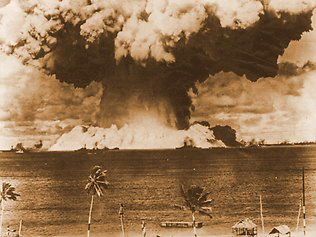
| 75 years after nuclear testing in the Pacific began, the fallout continues to wreak havoc https://theconversation.com/75-years-after-nuclear-testing-in-the-pacific-began-the-fallout-continues-to-wreak-havoc-158208?fbclid=IwAR3q9QJvy507ds2kD0ibOvkD6ZzxFqgGjfHsGrwqJUVMNpujOu8sAeLVPtY April 6, 2021 Patricia A. O’Brien Patricia A. O’Brien is a Friend of The Conversation.Historian, Visiting Fellow in the School of History, Australian National University and Adjunct Professor in the Asian Studies Program, Georgetown University, This year marks 75 years since the United States launched its immense atomic testing program in the Pacific. The historical fallout from tests carried out over 12 years in the Marshall Islands, then a UN Trust Territory governed by the US, have framed seven decades of US relations with the Pacific nation.Due to the dramatic effects of climate change, the legacies of this history are shaping the present in myriad ways. This history has Australian dimensions too, though decades of diplomatic distance between Australia and the Marshall Islands have hidden an entangled atomic past. In 1946, the Marshall Islands seemed very close for many Australians. They feared the imminent launch of the US’s atomic testing program on Bikini Atoll might split the earth in two, catastrophically change the earth’s climate, or produce earthquakes and deadly tidal waves. A map accompanying one report noted Sydney was only 3,100 miles from ground zero. Residents as far away as Perth were warned if their houses shook on July 1, “it may be the atom bomb test”. Australia was “included in the tests” as a site for recording blast effects and monitoring for atom bombs detonated anywhere in the world by hostile nations. This Australian site served to keep enemies in check and achieve one of the Pacific testing program’s objectives: to deter future war. The other justification was the advancement of science. The earth did not split in two after the initial test (unless you were Marshallese) so they continued; 66 others followed over the next 12 years. But the insidious and multiple harms to people and place, regularly covered up or denied publicly, became increasingly hard to hide. Radiation poisoning, birth defects, leukaemia, thyroid and other cancers became prevalent in exposed Marshallese, at least four islands were “partially or completely vapourised”, the exposed Marshallese “became subjects of a medical research program” and atomic refugees. (Bikinians were allowed to return to their atoll for a decade before the US government removed them again when it was realised a careless error falsely claimed radiation levels were safe in 1968.) In late 1947, the US moved its operations to Eniwetok Atoll, a decision, it was argued, to ensure additional safety. Eniwetok was more isolated and winds were less likely to carry radioactive particles to populated areas. Australian reports noted this site was only 3,200 miles from Sydney. Troubling reports of radioactive clouds as far away as the French Alps and the known shocking health effects appeared. Dissenting voices were initially muted due to the steep escalation of the Cold War and Soviet atomic weapon tests beginning in 1949. Opinion in Australia split along political lines. Conservative Cold War warriors, chief among them Robert Menzies who became prime minister again in 1949, kept Australia in lockstep with the US, and downplayed the ill-effects of testing. Left-wing elements in Australia continued to draw attention to the “horrors” it unleashed. The atomic question came home in 1952, when the first of 12 British atomic tests began on the Montebello Islands, off Western Australia. Australia’s involvement in atomic testing expanded again in 1954, when it began supplying South Australian-mined uranium to the US and UK’s joint defence purchasing authority, the Combined Development Agency. Australia’s economic stake in the atomic age from 1954 collided with the galvanisation of global public opinion against US testing in Eniwetok. The massive “Castle Bravo” hydrogen bomb test in March exposed Marshall Islanders and a Japanese fishing crew on The Lucky Dragon to catastrophic radiation levels “equal to that received by Japanese people less than two miles from ground zero” in the 1945 Hiroshima and Nagasaki atomic blasts. Graphic details of the fishermen’s suffering and deaths and a Marshallese petition to the United Nations followed. When a UN resolution to halt US testing was voted on in July, Australia voted for its continuation. But the tide of public opinion was turning against testing. The events of 1954 dispelled the notion atomic waste was safe and could be contained. The problem of radioactive fish travelling into Australian waters highlighted these new dangers, which spurred increasing world wide protests until the US finally ceased testing in the Marshalls in 1958. In the 1970s, US atomic waste was concentrated under the Runit Island dome, part of Enewetak Atoll (about 3,200 miles from Sydney). Recent alarming descriptions of how precarious and dangerous this structure is due to age, sea water inundation and storm damage exacerbated by climate change were contested in a 2020 Trump-era report. The Biden administration’s current renegotiation of the Compact of Free Association with the Republic of the Marshall Islands, and its prioritisation of action on climate change, will put Runit Island high on the agenda. There is an opportunity for historical redress for the US that is even more urgent given the upsurge in discrimination against US-based Pacific Islander communities devastated by the COVID-19 pandemic. Some are peoples displaced by the tests. Australia is also embarking on a new level of engagement with the Marshall Islands: it is due to open its first embassy in the capital Majuro in 2021.It should be remembered this bilateral relationship has an atomic history too. Australia supported the US testing program, assisted with data collection and voted in the UN for its continuation when Marshallese pleaded for it to be stopped. It is also likely Australian-sourced atomic waste lies within Runit Island, cementing Australia in this history. |
New research into the effects of nuclear bomb tests on Montebello islands
 By Susan Standen 22 Mar 21, A new Edith Cowan University research project hopes to collect important data on the impact of historical nuclear testing in the remote Montebello Islands area. Key points:
Sixty years after the British government conducted nuclear explosion testing on the islands, there is little data available to find how much residue plutonium still exists. The project hopes to be the first study to outline how and where man-made radioactivity is still existing in the marine sediment. Collections of sediment are being collected from remote field trips to the islands to analyse amounts of residue plutonium radionuclides.,,,,,,,,,,,, Ms Hoffman says other island nations affected by nuclear blasts will be able to use the Montebello Islands research as a reference baseline to start their own investigations. Will it inform health research? Ms Hoffman says the first step is to find out what remains there as a legacy………….. The project is a collaboration between the Edith Cowan University, the Department of Biodiversity and Conservation and the Australian Radiation Protection and Nuclear Safety Agency. https://www.abc.net.au/news/2021-03-22/montebellos-nucelar-fallout-research/13260242 |
|
Time for Australia to clean up uranium mining damage, and end this toxic industry
 It’s time to clean up not start up! https://www.onlineopinion.com.au/view.asp?article=21352 On this 10th anniversary of the Fukushima nuclear disaster, it is time to learn one simple lesson; radioactive risk is more constant than a politician’s promise. It is time to move beyond the risk of opening a uranium mine to safely rehabilitating existing exploration and trial mine sites. If we fail to act and allow small unproven company assurances to take the place of evidence, then we are both failing those affected by Fukushima and increasing the odds of fuelling a future one.
| By Kerrie-Ann Garlick – , 12 March 2021 |
|
The remediation of Ranger uranium mine: will it really restore the environment?
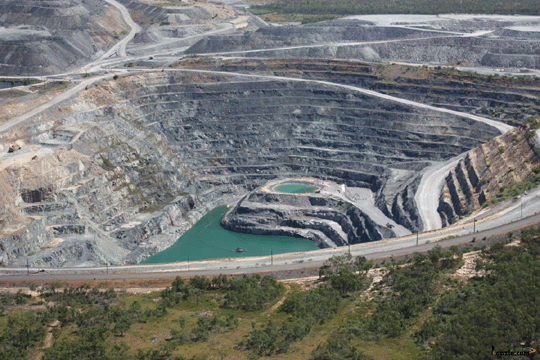
Traditional owners were given land rights in return for their support for the Ranger mine, and Kakadu National Park was born. ……. the land will finally be returned to the traditional owners… the question is, in what state? ……… we could find the site an eroding heap of substandard scrub.
As part of cleaning up the mine site, contaminated buildings and equipment will be buried in one of the mine’s enormous pits.
We’ve been told that burying the equipment and the contaminated material in the mine site is out of step with global best practice in the mining industry.
|
Kakadu in crisis, ABC 22 Feb 2021, Crisis in Kakadu: The turmoil threatening Australia’s biggest national park
“It’s gone downhill. No one basically trusts anybody, no one respects each other anymore. That’s how bad it is here.” Traditional owner Kakadu is one of the great natural wonders of the world. The stunning landscape, teeming with wildlife, is a major tourist destination with scores of Instagram friendly sites. For tourism operators it is an iconic symbol of what Australia has to offer. “It’s one of the most special places in Australia. It’s for so long been one of the reasons why people visit Australia and for Australians, one of their must do life experiences.” Tourism industry representative Despite its beauty, there is trouble inside Australia’s biggest national park. This World Heritage listed site is in crisis. “It’s an absolute mess because the institutions responsible for fixing it up aren’t doing their job.” Traditional owner On Monday Four Corners investigates accusations of mismanagement and neglect which have fuelled a bitter dispute between the park’s traditional owners and the authority that runs the park. |
Mediation continuing over rehabilitation of Range uranium mine
Mediation continues behind closed doors, but the case is a clear reminder that commitments are not set in stone and that clean-up funding for even the most environmentally destructive projects is not guaranteed.
While national and/or state law jurisdictions regulate specific requirements for closure and associated financial assurance, which also determine the period of rehabilitation, it is essential that members of the mining community are aware of applicable law and regulation in all jurisdictions of operation……….
“In the context of price volatility, investment shifts and now Covid-19, many major companies have been mothballing operations and selling mines to juniors, smaller and/or less resourced companies around the world. The most notable may be Blair Athol coal mine in Queensland, sold for $1 in 2016.”
The socio-economic and financial arrangements for closure agreements are especially important in order to avoid dumping the costs on taxpayers and society .
How long should a miner commit to oversight? https://www.mining-technology.com/news/mining-rio-tinto/ Yoana Cholteeva11 February 2021
A subsidiary of Rio Tinto is currently in mediation with the Australian Government over continuing commitments to scientific monitoring of the Ranger mine. We examine the dispute and take a look at some positive examples of land remediation.
Land rehabilitation as part of mining oversight is an essential process where the land in a mining area is returned to some degree of its former state. Recently, a new dispute over the rehabilitation of the Ranger Uranium Mine in the Northern Territory of Australia, owned by a Rio Tinto subsidiary, once again reignited the debate over how long a miner should maintain oversight once operations have stopped.
Rio Tinto’s oversight dilemma
Australian government will probably ignore most recommendations in the environmental report
Jim Green and Mia Pepper (WA) 3 Feb 21, – on the nuclear issues in the final Environmental Protection & Biodiversity Conservation review Samuel report, which finds that the Act is not doing its job and the environment is in big trouble (as we all know).
”Nuclear Actions” in the final report on environment laws in Australia
 In this week’s news, the final report on environment laws in Australia has been made and in summary, recommends that “nuclear actions” remain a Matter of National Environmental Significance (MNES). This means all proposals that are a “nuclear action” eg uranium mining, need to be assessed and approved in accordance with national environmental laws (EPBC Act). Initially “nuclear actions” will have to be assessed and approved based on “the whole of environment” impact – this means they would require a full environmental assessment.
Final Report on environment laws https://dont-nuke-the-climate.org.au/environment-laws-australian-nuclear/, February 2, 2021 The final report on environment laws in Australia has been made public this week.
In Summary, the Final Report:
- recommends that “nuclear actions” remain a Matter of National Environmental Significance (MNES) this means all proposals that are a “nuclear action” eg uranium mining, need to be assessed and approved in accordance with national environmental laws (The EPBC Act).
-
- recommends that State and Territory Governments be accredited to assess and approve projects in-line with the EPBC Act and with “National Environment Standards.” National Environmental Standards do not yet exist but would be legally enforceable standards. In the case of nuclear it is likely that National Environmental Standards would be derived from national and international standards on the nuclear industry. o Nuclear projects, including uranium mines would then be assessed and approved by state and territory governments, not the federal government.
- recommends a second phase of reform that “the EPBC Act and the regulatory arrangements of the Australian Radiation Protection and Nuclear Safety Agency (ARPANSA) should be aligned, to support the implementation of best-practice international approaches based on risk of harm to the environment, including the community.”
-
- describes the section 140A prohibition on some nuclear actions (like nuclear power and reprocessing) reflects a policy choice and that to change this would also be a ‘policy’ or political decision – but notes that legislative changes would be required. Important to note that there is emphasis on elected parliamentarians making policy choices, a subtle hint on the lack of a mandate to lift the prohibition.
Initially “nuclear actions” will have to be assessed and approved based on “the whole of environment” impact – this means they would require a full environmental assessment. It is unclear if this would be retained under the proposal to make ARPANSA the regulator and with National Environmental Standards for nuclear actions or whether assessments and approvals would only be required for aspects of a project that involve radiation.
Clean-up plan for Ranger uranium mine is ”woefully inadequate”
Gundjeihmi and ERA enter negotiations to extend Ranger Uranium Mine rehabilitation
By https://www.abc.net.au/news/2021-01-09/gundjeihmi-era-negotiate-ranger-uranium-mine-rehabilitation/13043076 Matt Garrick
An Aboriginal group in Kakadu National Park says the rehabilitation plan for a decommissioned uranium mine is “woefully inadequate”, and is calling for a 26-year extension to the process.
Key points:
- Mining at the Ranger Uranium Mine wound up yesterday after more than 40 years
- Traditional owners in Kakadu are now calling for an extension of the project’s rehabilitation phase
- The company that runs the mine has signalled its support for the move
Production at the Ranger Uranium Mine, on the outskirts of the national park, drew to a close yesterday after more than 40 years of operation.
Gundjeihmi Aboriginal Corporation, which represents Mirarr traditional owners, has used the closure to demand owner Energy Resources Australia (ERA) rehabilitate the site beyond its current lease expiry in 2026.
Within that timeframe, the company is required to restore the site to its previous pristine state.
“That’s not long enough,” the corporation’s CEO, Justin O’Brien, said.
“We are now awaiting a drafting from the Commonwealth Government for amendments to the Atomic Energy Act such that you can actually put in place an extension to the rehabilitation period.”
Mr O’Brien said traditional owners were pushing for the rehabilitation period to be extended by an additional 26 years, which would carry the process through until 2052.
He said ERA and its parent company, Rio Tinto, had signalled their support for an extended term of rehabilitation — but the timeframe and details of that extension are still being negotiated.
In a statement, the company said it was committed to “achieving all documented rehabilitation outcomes in its Mine Closure Plan (MCP) by January 2026”.
It confirmed negotiations were underway with traditional owners to “determine an appropriate mechanism” to extend the company’s tenure at the Ranger site, which would allow it to continue rehabilitation beyond 2026.
Environmental group the Australian Conservation Foundation yesterday welcomed the end of production at the site, the last active uranium mine in the Northern Territory.
The foundation’s Dave Sweeney, who is an anti-nuclear campaigner, said he was supportive of the push to extend the rehabilitation period.
“The company should not be approaching clean-up asking itself what it can do in five years,” he said.
“It should be approaching clean-up asking ‘What is the best possible way to reduce and address the damage that has happened?’
“What’s the best outcome — not the best outcome we can do in five years.”
The wind-down of production at the mine is expected to prompt an exodus from the nearby town of Jabiru, where ERA holds the lease for about 300 houses.
One hundred and twenty-five ERA staff were made redundant this week.
End of an ERA: four decades of radioactive risk come to an end at Kakadu
Over 40 years of high-impact uranium mining and processing at Energy Resources of Australia’s (ERA) Ranger mine in Kakadu ends today.
Australia’s longest-running uranium operation was licensed to operate until January 8, 2021.
“This is a very good day for Kakadu, the Northern Territory and Australia,” Australian Conservation Foundation nuclear campaigner Dave Sweeney said.
“The Ranger mine has generated controversy, headlines and heartache for four decades. The focus must now be on ERA and parent company Rio Tinto doing comprehensive and credible site rehabilitation and supporting the transition to a post-mining regional economy.
“Today we should also acknowledge the sustained efforts of the Mirarr Traditional Owners and the Gundjeihmi Aboriginal Corporation to protect their country and culture from the impacts of mining.
“The Mirarr opposed the Ranger mine 40 years ago, led a successful campaign to stop ERA developing a further mine at nearby Jabiluka 20 years ago, and are now driving the re-shaping of a culture- and conservation-based local economy.
“Plans for cleaning up the site of the Ranger mine are being hampered by an unrealistic rehabilitation time frame, funding uncertainty, and fears about a tailings dam leaking toxic contaminants into the surrounding national park.
“Closing Ranger, protecting Kakadu, a recent report co-authored by ACF, also found data deficiencies and technical issues, particularly around groundwater and tailings management.
“Australia has a long history of sub-standard mine rehabilitation in both the uranium and wider mining sectors. A far better approach and outcome is needed at Ranger. This work is a key test of the commitment of ERA and Rio Tinto, as well as the NT and federal governments.”
Ranger Danger: Rio Tinto Faces Its Nuclear Test in Kakadu Uranium
|
Ranger Danger: Rio Tinto Faces Its Nuclear Test in Kakadu Uranium Mine, https://sei.sydney.edu.au/opinion/ranger-danger-rio-tinto-faces-its-nuclear-test-in-kakadu-uranium-mine/ Rebecca Lawrence and Dave Sweeney report on growing concerns over the potential failures of the rehabilitation plan for the Ranger mine in Kakadu National Park. By Rebecca Lawrence, Senior Research Fellow, Sydney Environment Institute and Dave Sweeney, Australian Conservation Foundation, 16 December 2020 In the 1950’s uranium mining began in the Alligator Rivers and Kakadu regions in the Top End of the Northern Territory. Since then, the Kakadu uranium story has generated heartache and headlines but it is set to soon come to an end with the closure of the Ranger uranium mine in early January 2021. The story is now moving from one of contest over the impacts of mining to one of concern around the adequacy of rehabilitation. Australia has a notorious record when it comes to mine rehabilitation. Many mines are simply abandoned, and those that are rehabilitated often fail, which means complex and on-going monitoring and management is usually required. In many cases, mining companies and their shareholders are long-gone and it is usually Indigenous communities who are forced to live with toxic legacies and left to fight for governments to finance the clean-up with tax-payer money.
Yet, there are alarming signs we may be headed that way. Significant and crucial knowledge gaps remain around the closure and rehabilitation of the Ranger mine. Despite the looming closure date, mine operator Energy Resources Australia (ERA) is still unable to answer many key questions. For example, ERA has still not completed modelling of the pathways and volumes Another key omission in the mine closure plan is the absence of any substantive social impact research. There is no attention paid to how Aboriginal people have been impacted by uranium mining in Kakadu, or any assessment of how they may be impacted the mine closure. This omission constitutes a profound social injustice and is demonstrably inconsistent with both international best practise and contemporary community expectation. ERA is part of the global Rio Tinto group. Rio, who own 86% of ERA, has been called out for its destruction of ancient Aboriginal heritage and sites at Juukan Gorge in the Pilbara region of West Australia. As the main shareholder in ERA at Ranger, there is a real risk that Rio will also fail at Ranger if they don’t get the rehabilitation right and put in place secure financing for perpetual care and maintenance of the Ranger site post-closure. There is a requirement that the company must isolate large volumes of radioactive mining tailings for 10,000 years, but how can that be done without any funds earmarked for monitoring or post-closure management? The Commonwealth government was the key driver behind opening the Ranger Uranium mine in the early 1980s and yet as closure approaches, they are virtually absent. There is no clear regulatory process for how rehabilitation and post-closure monitoring will be financed or enforced. A successful rehabilitation is dependent upon the Commonwealth Government keeping ERA and Rio Tinto accountable and honest. Despite reassuring rhetoric no mining company will do that on their own – for too many the triple bottom line remains measured in pounds, dollars and euros. The Commonwealth Government needs to step up and ensure that the Kakadu environment and its people are protected and that a dual World heritage listed region is given the attention and focus it deserves and needs. A further key constraint on the likely success of the clean up and closure of Ranger is the unrealistic timeframe that has been mandated for rehabilitation. Ranger is the longest running uranium mine in Australia. It was imposed against the explicit opposition of the region’s Mirarr Traditional Owners and for forty years has conducted deeply contested operations in a monsoonal tropical environment. And not just any tropical environment – the mine is an industrial zone surrounded by Australia’s largest national park – Kakadu. Kakadu National Park is a dual World heritage listed area that is recognised for both its cultural and natural values and properties. The Ranger site is required to be rehabilitated to a standard where it could be incorporated into this unique environment. This is a very high bar to clear and Rio Tinto currently have a very short run-up. The rehabilitation period extends only from January 2021 to January 2026. Five years is simply not enough time to make meaningful and lasting repair to a heavily impacted landscape. As a result, the rehabilitation approach is being increasingly driven by short-cuts and bad decisions, rather than taking the time needed to get it right. The Mirarr people and an increasing number of civil society and wider stakeholders and commentators are urging both the Commonwealth and the company to extend this set period of works to better reflect the complexity of the rehabilitation challenge and to increase the likelihood of a successful result. The closure and clean up of Ranger is a critical test of the commitment, competence and credibility of Rio Tinto and the Commonwealth. Both parties have a responsibility to address decades of environmental damage and community disruption. Without more clarity, funding, time and transparency the future of Kakadu cannot be assured. And this is too high a price to pay. There are many eyes from across Australia and around the world that are focussed on the Ranger rehabilitation and near enough is not good enough. The challenge is clear and considerable – and now it needs to be met. Rebecca Lawrence and Dave Sweeney are part of an expert group who have authored the report, Closing Ranger, protecting Kakadu, released by the Sydney Environment Institute, the Australian Conservation Foundation, the Mineral Policy Institute and the Environment Centre NT. Access the report here. |
|
Australian government’s Bill to weaken Environmental Law will be rejected in the Senate
Key crossbench senators say they won’t support bid to change Australia’s environment laws
The Coalition plan to hand development approval powers to the states hits a further roadblock after Senate inquiry, Guardian, Graham Readfearn, @readfearn 27 Nov 20,
A Morrison government plan to change Australia’s environment laws to allow development approval powers to be handed to the states has hit a further roadblock, with three key crossbench senators saying in a report they will not support them.
The crossbenchers’ opposition means that, together with Labor and the Greens, the Morrison government’s laws would be voted down in the Senate.
But one crossbench senator told Guardian Australia he could change his mind once he had seen details in documents that the government has so far withheld.
A rushed Senate inquiry into the controversial changes delivered four reports late Friday, with Labor, the Greens and a crossbench group all confirming their opposition.
The government had gagged debate to push the legislation through the lower house – a move that outraged the Greens and Labor.
A final report from a major review of the Environment Protection and Biodiversity Conservation (EPBC) Act, carried out by Prof Graeme Samuel, was handed to the environment minister, Sussan Ley, in early November.
That report supported a move to devolve powers to the states, even though Guardian Australia has revealed the government was making moves to devolve powers months before the Samuel review.
Samuel’s interim report, released in July, found the environment was in unsustainable decline and the EPBC Act was not fit-for-purpose.
In their dissenting report to the inquiry, the crossbench senators Rex Patrick, Jacqui Lambie and Stirling Griff said they could not support the bill while key information was withheld……… https://www.theguardian.com/australia-news/2020/nov/27/key-crossbench-senators-say-they-wont-support-bid-to-change-australias-environment-laws
1 This month

of the week – Australians for War Powers Reform (AWPR)
To see nuclear-related stories in greater depth and intensity
 Antinuclear