Australia’s environmental law: the danger in moving powers to the States
 ‘We are relying on a pinky promise’: The problem with the Government moving its environmental powers to states, ABC , By national science, technology and environment reporter Michael Slezak, 13 Sept, 20
Just over a month ago — perhaps an eternity in the political news cycle — Environment Minister Sussan Ley welcomed a landmark review into our national environment laws by reaching across the aisle…….
After years of partisanship on what to do with the laws, Professor Graeme Samuel’s recommendations laid out a middle path. It delivered the deregulation sought by the Morrison Government, while protecting the environment with fundamental safeguards.
With that middle path laid out, Labor also came to the table, dropping their long-held opposition to deregulation.
Fast-forward just five weeks and the Government introduced amendments which, to a large degree, rehashed Abbott-era deregulation amendments, without yet introducing the fundamental protections recommended by Professor Samuel.
And partisanship is back at full throttle.
The Government rushed the amendment through the upper house, quashing debate. The crossbench and Labor called foul, and now conservationists have written to the United Nations calling for it to “express alarm” about the changes. And now the crossbenchers in the Senate appear set to block the bill.
How did we get here and where is all this going? And what could all this mean for the environment?
An old policy by a new name
For years, the Coalition has had one overriding reform planned for Australia’s environmental laws: devolving federal assessment and approval powers to the states.
When a proposed project — think a mine, farm or building — has the potential to damage matters of national environmental significance, it requires environmental approval from both state and federal governments.
Under Abbott, the devolution of federal approval powers to states was called a “one stop shop”. It’s been relabelled “single touch approval” under Morrison but it’s the same thing.
Graeme Samuel’s review recommended that devolution of powers to states proceed with some key safeguards to ensure the environment is protected.
Samuel called for an “independent cop on the beat” — a regulator that would function at arm’s length from the minister. That was immediately rejected.
But crucially, Samuel said the deregulation must be built on what he called “national standards” that would ensure state processes protected the environment. He described these as the “foundation for effective regulation”.
Minister Ley immediately accepted that recommendation.
But last week she introduced a bill to Parliament that devolved approval powers to states, without any reference to national standards.
Rather than allow a parliamentary debate of the matter, the Government rushed it through the House of Representatives, blocking debate, stopping crossbenchers from moving amendments to the bill and sent it straight to the Senate — although too late for it to be considered there this month.
Labor, the Greens and crossbenchers were furious, claiming that democracy was under threat. That anger seemed to jump to the Senate, with crossbenchers now looking to vote the bill down.
The missing national standards
The Minister still insists there will be national standards; that they will be legally enforceable; and they will be “Commonwealth led”. So why weren’t they in that bill?
In an interview with the ABC last week, Minister Ley said the Government already had a bill “ready” that would set up the framework for national standards and would introduce it soon………….
Does it matter?
Dr Megan Evans, an environmental policy expert from UNSW, says the law passed by the lower house gives the minister too much latitude to set the standards.
“It provides the Commonwealth with total discretion over the terms if entering into a bilateral agreement,” Dr Evans said. “This means we are relying on a pinky promise from the Government.”
Dr Peter Burnett from the ANU College of Law said “the mode of setting the Standards does make a difference”. According to him, it’s a matter of who will be able to enforce those standards.
“If they form part of a bilateral agreement between two governments, then it is likely that only the Commonwealth could take action against a state that did not comply with the standards, as only the parties to an agreement can enforce it,” Dr Burnett said.
If the standards were in federal legislation, then it is likely that third parties — like environmental groups — could challenge non-compliance by states in court.
And who’s enforcing the laws could make all the difference.
Of all the threatened species habitat cleared since the laws were first put in place, only seven per cent of it was even assessed under the act.
And according to the Auditor General, among projects that were assessed and approved by the Federal Government, 80 per cent were non-compliant or contained errors.
But how the Government will get these standards agreed to by states — without money on the table to help apply them — is still up in the air.
And this week in NSW, we saw just how fraught state environmental laws can be.https://www.abc.net.au/news/2020-09-13/environmenal-law-deregulation-states/12656318
Australia’s environmental scientists are being gagged
|
Research reveals shocking detail on how Australia’s environmental scientists are being silenced The Conversation Don Driscoll -Professor in Terrestrial Ecology, Deakin University, Bob Pressey, Professor and Program Leader, Conservation Planning, ARC Centre of Excellence for Coral Reef Studies, James Cook University, Euan Ritchie, Associate Professor in Wildlife Ecology and Conservation, Centre for Integrative Ecology, School of Life & Environmental Sciences, Deakin University, Noel D Preece, Adjunct Asssociate Professor, James Cook University, September 9, 2020 Ecologists and conservation experts in government, industry and universities are routinely constrained in communicating scientific evidence on threatened species, mining, logging and other threats to the environment, our new research has found.
Our study, just published, shows how important scientific information about environmental threats often does not reach the public or decision-makers, including government ministers. In some cases, scientists self-censor information for fear of damaging their careers, losing funding or being misrepresented in the media. In others, senior managers or ministers’ officers prevented researchers from speaking truthfully on scientific matters. This information blackout, termed “science suppression”, can hide environmentally damaging practices and policies from public scrutiny. The practice is detrimental to both nature and democracy.
Code of silenceOur online survey ran from October 25, 2018, to February 11, 2019. Through advertising and other means, we targeted Australian ecologists, conservation scientists, conservation policy makers and environmental consultants. This included academics, government employees and scientists working for industry such as consultants and non-government organisations. Some 220 people responded to the survey, comprising:
In a series of multiple-choice and open-ended questions, we asked respondents about the prevalence and consequences of suppressing science communication.
About half (52%) of government respondents, 38% from industry and 9% from universities had been prohibited from communicating scientific information. Communications via traditional (40%) and social (25%) media were most commonly prohibited across all workplaces. There were also instances of internal communications (15%), conference presentations (11%) and journal papers (5%) being prohibited.
Ministers are not receiving full information’Some 75% of respondents reported having refrained from making a contribution to public discussion when given the opportunity – most commonly in traditional media or social media. A small number of respondents self-censored conference presentations (9%) and peer-reviewed papers (7%). Factors constraining commentary from government respondents included senior management (82%), workplace policy (72%), a minister’s office (63%) and middle management (62%). Fear of barriers to advancement (49%) and concern about media misrepresentation (49%) also discouraged public communication by government respondents. Almost 60% of government respondents and 36% of industry respondents reported unduly modified internal communications.
One government respondent said:
University respondents, more than other workplaces, avoided public commentary out of fear of how they would be represented by the media (76%), fear of being drawn beyond their expertise (73%), stress (55%), fear that funding might be affected (53%) and uncertainty about their area of expertise (52%). One university respondent said: I proposed an article in The Conversation about the impacts of mining […] The uni I worked at didn’t like the idea as they received funding from (the mining company)……….
The system is brokenOf those respondents who had communicated information publicly, 42% had been harassed or criticised for doing so. Of those, 83% believed the harassers were motivated by political or economic interests………… https://theconversation.com/research-reveals-shocking-detail-on-how-australias-environmental-scientists-are-being-silenced-140026 |
–
|
Morrison government rushing to make Austraia’s environment laws even weaker: a recipe for extinctions
‘Recipe for extinction’: why Australia’s rush to change environment laws is sparking widespread concern
Critics argue shifting approval powers to the states without an independent regulator will fail to protect the environment, Guardian, Lisa Cox– 6 Sept 20
Anger over proposed changes to national environmental laws is escalating, with legal, health and conservation groups urging that they not pass the Senate, with some warning it would increase the extinction rate.
The government rammed its legislation to change Australia’s Environment Protection and Biodiversity Conservation Act through the lower house on Thursday night, prompting outrage from Labor, the Greens and crossbench.
WWF-Australia says the bill in its current reform is a “recipe for extinction” and lacks standards that would ensure strong protections for nature, as well as a commitment to an independent regulator to enforce the law.
“There is more than just wildlife at stake here,” Rachel Lowry, WWF-Australia’s chief conservation officer, says. “If approved, this bill will fail Australians at this critical moment in time because it fails to incentivise win-win solutions that stimulate our economy and protect the places and animals we love.
“Shifting approval powers to the states without an independent regulator to ensure enforcement would be the most damaging environmental decision to occur within Australia in recent decades.”
The government’s bill would amend Australia’s environmental laws, clearing the way for the transfer of development approval powers to state and territory governments.
The prime minister, Scott Morrison, and the environment minister, Sussan Ley, have argued the changes are necessary to aid Australia’s economic recovery from the Covid-19 pandemic.
The proposed changes passed the lower house on Thursday night after the government used its numbers to gag debate on the bill and amendments proposed by Labor and the crossbench.
No member of the government spoke on the bill, which still has to pass the Senate and will likely be debated during the October budget sittings.
Rachel Walmsley, the policy and law reform director at the Environmental Defenders Office, says the government is trying to avoid scrutiny.
She warns the bill has the potential to undermine the statutory review of the EPBC Act, chaired by the former competition watchdog head Graeme Samuel, which is not due to table its final report until the end of October.
The key finding of Samuel’s interim report was that Australia’s system of environmental protections had failed and the decline of wildlife and habitat was unsustainable.
“It was a fairly atrocious process that, moments before adjournment, they rammed it through,” Walmsley says.
“The gagging of the debate, the fact they prevented voting on amendments and the fact no government MP stood up to justify the policy – it prevented proper parliamentary scrutiny.”
The Climate and Health Alliance, which is a coalition of Australian health organisations, has called on the Senate to block the amendments.
“Australia’s natural environment is declining on every possible measure. We lead the world in animal extinctions,” says the alliance’s executive director, Fiona Armstrong. “There is no economy without a healthy environment.
“The government is trying to rush through amendments to our environmental protection laws that would weaken them in favour of expanding gas and fossil fuel projects that harm the environment and threaten human health.”
The Law Council of Australia has called for the bill to be put before a parliamentary committee for inquiry and not rushed through the Senate.
The government and One Nation have blocked several attempts by the Greens to have a parliamentary committee examine the bill.
International obligations
The Law Council says the government needs to make sure it retains oversight of matters of national environmental significance if it enters into bilateral approval agreements with state and territory governments.
The council says this is particularly important for ensuring Australia still meets its obligations under some 33 international treaties and protocols to which it is signatory, including for world heritage sites…….. https://www.theguardian.com/australia-news/2020/sep/06/recipe-for-extinction-why-australias-rush-to-change-environment-laws-is-sparking-widespread-concern
Environment Law: Scott Morrison’s government shows its disdain for ZaliSteggall and the cross-benchers
Independent MPs furious as government rams environmental law changes through lower house, https://www.sbs.com.au/news/independent-mps-furious-as-government-rams-environmental-law-changes-through-lower-house 4 Sept 20 The Morrison government has been branded a “bully in action” for pushing its environment law changes through the lower house without following usual process.
Independent MPs are furious with the Morrison government for throwing due process out the window and ramming controversial environmental laws through the lower house.
Crossbench MP Zali Steggall flagged amendments to the bill but the government refused to allow them to be voted on.
Instead, the coalition used its numbers to shove the bill through the lower house on Thursday night.
Ms Steggall described the government as a “bully in action”.
“The PM and every coalition MP made a mockery of due process for legislation and bulldozed environmental and water protection,” she said.
“And they were laughing while doing it. This is how they represent you. If you care, contact your MP.”
The changes to the national environment protection laws pave the way for states to take over approvals.
The states would have to abide by a set of national environment standards, which have not been developed.
The changes are in response to an interim review conducted by former competition watchdog Graeme Samuel.
Professor Samuel also recommended installing an independent environmental umpire, but the government has rejected that.
Independent Tasmanian MP Andrew Wilkie says the changes will water down environment protection.
“(The bill) hands decision-making to state and territory governments who have shown time and time again to be conflicted and incapable of protecting the environment,” he said.
“The passage of the amendment through the House of Representatives was also a chilling demonstration of the government’s complete contempt for democracy.
“Most members of the house were prevented from speaking, and foreshadowed amendments were blocked without debate. The government acted again like an elected dictatorship.”
Environment Minister Sussan Ley was quick to defend the changes after outrage over the process.
“There will be more reforms to follow,” she said.
“We will develop strong Commonwealth-led national environmental standards which will underpin new bilateral agreements with state governments.”
The bill is likely to be referred to a Senate committee for scrutiny, pumping the brakes on its progress.
Labor and the Greens oppose the legislation.
Australian government, masks its anti-environment action under the cover of Covid-19
|
And it does all this while lambasting the states for omissions and inefficiencies. Nowhere does it suggest devolving more power to these already incompetent entities. Of course this royal commission is largely focused on natural disasters rather than broader issues of environmental management and climate change, but its findings are telling in their precision: “Current arrangements do not provide a clear mechanism to elevate these matters to national leaders.” Is it possible that our national leaders don’t want these or any other tricky environmental matters elevated to them? What other conclusion can be reached when the government is trying with such energy to push through “new” legislation that greatly reduces its role in environmental issues? This is fundamentally the same proposal that Tony Abbott put forward as prime minister. It was defeated then, but the thought is that it might scrape through now under the cloak of Covid. That is the hard-nosed judgment of the same climate deniers and coal lobbyists who have run the Coalition all these years. And Scott Morrison’s hands remain as black as any. Since there is a full review of current environmental legislation being conducted by Graeme Samuel, which is due to deliver a final report in the blink of an eye (ie October this year) what possible justification can be given for ramrodding legislation into the parliament now?
Samuel’s interim report recommends “national enforceable standards” as an essential part of keeping the states honest in these matters. How necessary that is when, as Ken Henry so powerfully pointed out, the states have a complete conflict of interest in their receipt of royalties from projects and the fact that they are often the proponents of them. But there is no mention of these national standards in the proposal or of referring relevant conflicts to the federal government. …… The Australian government is the signatory to all our international commitments that relate to climate and the environment of which there are many, ranging from The World Heritage Convention to the Bonn Convention on the Conservation of Migratory Species and at least half a dozen others. The states are signatories to none. What is the logic in devolving power to the states at a time when these agreements and the obligations therein are becoming increasingly important? None?.. The root cause of all this ill-conceived thinking is a failure to understand what an economy is. In the government’s view it is an entity unto itself – it seems to operate independently of the world in which we live, until events wrench us back to it. According to this theory, the environment is somehow in conflict with the economy rather than the integral, vital essence of it. ……… https://www.theguardian.com/commentisfree/2020/sep/04/under-the-cloak-of-covid-the-government-is-rushing-ill-considered-changes-to-australias-environment-laws |
|
Aussies call for tougher environment laws
ACF’s chief Kelly O’Shanassy has sent it to Prime Minister Scott Morrison and his Environment Minister Sussan Ley, who are in the midst of tweaking the national protection laws.
The changes are in response to an interim review of the laws, but rather than strengthening environmental standards the first move is to cut red tape.
ACF’s petition calls on the government to create a “new generation of national laws to protect nature and funding to restore ecosystems to bring our wildlife back from the brink”.
In his interim review, former competition watchdog Graeme Samuel found the current laws were ineffective and Australia’s environmental trajectory is unsustainable.
He recommended an independent environmental watchdog, which has been rejected by the government.
Instead the first changes set the stage for states to take over environmental approvals.
They will have to abide by a set of national environmental standards, which have not yet been developed…….
Labor and the Greens oppose the government’s changes, and want Ms Ley to wait until Professor Samuel’s final report is handed down next month before changing the laws. https://www.denipt.com.au/national/2020/09/03/1566977/aussies-call-for-tougher-environment-laws
Murray-Darling River system; mysterious loss of more than 2 trillion litres of water
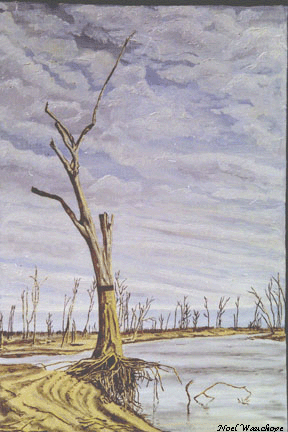
The mystery of the Murray-Darling’s vanishing flows, ABC By national science, technology and environment reporter Michael Slezak, Mark Doman, Katia Shatoba, Penny Timms and Alex Palmer 3 Sep 2020
It might be the biggest whodunnit — or what-dunnit — in Australia.
More than 2 trillion litres of water — enough to fill Sydney Harbour four and a half times — has gone missing from our largest and most precious river system — the Murray-Darling Basin.
And it’s happened in what was already one of the driest periods the basin has seen.
According to an investigation by some of Australia’s top water scientists, shared exclusively with the ABC, 20 per cent of the water expected to flow down the rivers from 2012-2019 was simply not there. That’s despite almost $7 billion being spent to protect the health of the system’s rivers and ecosystems that rely on them.
Was it stolen? Was it lost? Has climate change made it go up in steam? Or was it simply never there in the first place?
There are clues scattered up and down the rivers but one simple message is clear in the scientists’ findings. For the first time, they provide evidence that the Murray-Darling Basin Plan — the most expensive environmental program in Australia’s history — is delivering much less water than was expected.
And the implications could be huge……. EXCELLENT INTERACTIVE GRAPHICS HERE
…..“It’s a huge discrepancy to be missing a fifth of the water that’s meant to be in the rivers,” said Jamie Pittock from the ANU. He’s an expert in water management and a co-author of the Wentworth Group’s report.
“It means that there are all sorts of things that Australians value that won’t be sustained … like more water for towns … the floodplains, growing grass for sheep and cattle, in terms of biodiversity being conserved, waterbirds, red gum forests and conserving our fish.”…………
there are clues. Lots of them. We’ve seen water go missing up and down the river with clear explanations before. And looking closely at the new report, many of those explanations are consistent with the new data.
Clue one: tampered meters and criminal prosecutions
One possible explanation for the shortfall is that some of the missing water has been stolen.
An investigation by Four Corners in 2017 put water theft in the spotlight — much of it around the Barwon-Darling catchment in the Northern Basin.
Irrigators there, according to official figures, use 3 per cent of all the water taken from the entire Murray-Darling Basin.
But on top of those official figures, there has been significantly more water taken in that area. The Murray-Darling Basin Authority itself estimated that in the Northern Basin, as little as 25 per cent of surface water take has been metered.
Some of the water that went unmetered was stolen.
Peter Harris, who was named in the 2017 Four Corners, was this year found guilty of water theft just upstream from those gauges at Brewarrina.
Anthony Barlow, another person named in the program, was found guilty and fined $190,000, for water theft just upstream again.
Since the Natural Resources Access Regulator (NRAR) was formed in NSW in 2018, 15 additional charges have been laid in these locations across the state for water theft and related actions, according to an NRAR spokeswoman.
Emma Carmody, a lawyer at the Environmental Defenders’ Office, said the criminal prosecutions do not represent how widespread water theft has been.
“I’d actually go so far as to say that this situation pre-2018 was catastrophically bad in those northern catchments in relation to compliance and enforcement,” Dr Carmody said………..
Clue two: shadow take
Travel further upstream along the Macquarie River towards Dubbo, and you land in the internationally protected wetlands of the Macquarie Marshes………
In a landscape so flat, structures like roads, engineered channels and small levee banks can divert staggering volumes of floodwater — potentially shepherding it across a farmer’s fields where it is left to soak into the ground, or even pumped into dams.
This water taken by irrigators and graziers from the floodplains — rather than from the rivers — has hardly ever been measured.
Using satellite imagery, flood paths appear guided by seemingly innocuous structures, or completely cut off by others.
Richard Kingsford is a river ecologist at the University of New South Wales who has studied the Macquarie Marshes and the impacts of floodplain harvesting.
He says water that spills over floodplains often drains back into rivers, and interrupting its flow can have big impacts, including contributing to the missing flows.
“There are very few places where we have an accurate estimate of how much water is being taken from the floodplain. And to me, this has been a yawning gap in the policy,” he said…………
Clue Three: The cash splash
If we head all the way to southern NSW, we see a completely different clue.
Billions have been spent subsidising “efficiency measures” to help farmers save water there.
That can be done by upgrading old irrigation systems to deliver water directly to roots, or lining water channels, for example. Then about half of the water saved by the farmers gets handed to the government for the environment.
But according to some experts, the “inefficiencies” prior to the upgrades just meant some of the water used by irrigators flowed back into the rivers. The upgrades mean that “return flow” stops happening………..
In a report published in 2019, Professor Williams estimated that at least 280 billion litres of water per year might have been lost from the rivers — and are unaccounted for — due to this problem.
“That must be a major reason that we’re not getting the flow regimes that we need,” Professor Williams said.
The MDBA commissioned its own analysis of the issue and concluded the loss of return flows was reducing water in the rivers by 121 billion litres a year.……..
Clue Four: Climate change
There is one issue, however, that most experts do agree is a major reason for the missing water in the basin.
“The MDBA considers a changing climate to be the primary contributory factor,” said the MDBA’s Vicki Woodburn.
Since the basin plan was introduced, heat records across the area have been broken in four of the eight years. The last three years have been the hottest ever recorded in the basin.
According to the South Australian royal commission into the Murray-Darling basin plan, the MDBA “completely ignored climate change” when determining how much water needed to be saved.
If true, that means the overall target may have been set too low — that more water needs to be recovered from irrigation to save the river system.
But the same models used to set those targets have also been used to manage the rivers, and now to calculate how much water should be in the rivers. And by inadequately accounting for climate change, those models are likely over-predicting how much water is being recovered.
Climate change means more water is likely being lost between gauges, as it flows along — lost into the dry river beds and the hot air…………..
Clue five: The water was never there
In a twist worthy of any whodunnit, could it be that some of the missing water was simply never there in the first place?
According to the Wentworth Group, the government modelling used to predict how much water we should see in the river has some fundamental flaws which likely exaggerate the volumes.
For example, in 2018, the Murray-Darling Basin Authority found its modelling “has trouble predicting low flows”.
That meant that when water stopped flowing in the river, the model would still show water flowing — something that could have been particularly problematic over the past seven years when low flows were very common………….
What it all means
If there’s less water in the rivers than we ever planned for, what’s to be done about it?……………..
Professor Vertessy, who advises the MDBA, thinks this sort of shortfall could contribute to a rethink of the long-term water recovery targets. https://www.abc.net.au/news/2020-09-03/the-mystery-of-the-murray-darlings-vanishing-flows/12612166?nw=0
“We may have to — I think everyone would accept that these sustainable diversion limits aren’t quantities which you ossify for posterity,” he says.
“They’ve got to be adjusted to fit in with the new climate realities and the social preferences of the day.”
And the scientists say whatever the response to the findings, something has to give.
“The current basin plan tries to pretend that we can do everything with a smaller and smaller cake,” says Professor Pittock.
“What this really means is that society is going to have to make some hard choices. How much irrigated agriculture do we want as a society versus how much do we want to retain by way of wetlands and ecosystems [or] of sites of cultural value to Indigenous people?” https://www.abc.net.au/news/2020-09-03/the-mystery-of-the-murray-darlings-vanishing-flows/12612166?nw=0
Australian government seeks to regurgitate Tony Abbott’s anti environment laws
|
‘Taking an eraser’ to Australia’s wildlife: ad blitz planned to fight environment law
Coalition accused of ‘breach of faith’ as it seeks to introduce almost exact replica of failed Abbott government legislation, Guardian, Lisa Cox, Sat 29 Aug 2020 Conservation groups will launch an advertising campaign aimed at building support for stronger national environment laws in response to what they say is a “breach of faith” by the Morrison government. Groups including Birdlife Australia, WWF and the Australian Conservation Foundation will begin a “Before it’s gone” campaign on Sunday with radio, print, TV and billboard advertisements featuring high-profile species including the koala and greater glider. It follows the Morrison government this week introducing legislation to hand greater powers to the states that included no measures to ensure maintained or strengthened protection for threatened species or ecosystems. Continue reading |
Cut through the propaganda. Population growth is NOT good for Australia
So, KPMG and its big-business clients hope that the masses will be lulled into supporting a return to higher immigration. Well, let’s hope a bit of counter-propaganda will prevent that.
Even on KPMG’s figures, this hit to the Australian economy and therefore living standards of Australians is suspect.
KPMG’s says GDP would be $117 billion lower each year by 2029-30 if we do not have these 1.1 million extra people, and that would leave every one of the 28 million Australians by then $2850 worse off each year – that is a total of $79.8 billion, let’s say $80 billion.
Bear with me with the figures.
Population growth propaganda
There was more fear-mongering, self-serving, and flawed guestimates over population this week – this time from the quintessential accountant and consultant to big business and government, KPMG.
Shock, horror, Australia’s population would be 1.1 million less by 2029-30 because of the reduction in immigration caused by Covid. That would be a “$117 billion” hit to the economy over the decade by dragging down economic growth, KPMG calculates. That would leave every Australian $2850 worse off each year, KPMG says.
So, KPMG and its big-business clients hope that the masses will be lulled into supporting a return to higher immigration. Well, let’s hope a bit of counter-propaganda will prevent that.
Even on KPMG’s figures, this hit to the Australian economy and therefore living standards of Australians is suspect.
KPMG’s says GDP would be $117 billion lower each year by 2029-30 if we do not have these 1.1 million extra people, and that would leave every one of the 28 million Australians by then $2850 worse off each year – that is a total of $79.8 billion, let’s say $80 billion.
Bear with me with the figures.
But if instead we have the extra immigrants, that $80 billion will not be “lost” because of the extra $117 billion in GDP the immigrants would provide. Take that $80 billion for the existing population away from KPMG’s $117 billion, it leaves $37 billion a year for the 1.1 million immigrants themselves, which comes to just $33,636 each immigrant per year, well below the Australian average income. So they are dragging their heels. They are a cost to the Australian community not an asset.
There is clearly something wrong with these “plucked-from-the-air” figures.
KPMG’s study looks at what would happen if there was no vaccine – and therefore no immigration – after one year and after two years. ……
But the 5.5% drop is not down to no immigration. Rather, it is down to all the other economically horrible things caused by a no-vaccine environment: closed businesses, closed borders, lack of confidence etc etc. But KPMG, to suit its own purposes, puts all of the lower GDP ($117 billion) down to no immigration and says the absence of immigration will cost every Australian $2850…..
Covid aside, there are good grounds for concluding that the John Howard-inspired high-immigration policies since the late 1990s have cost Australians dearly, not just in economic terms but also in environmental and lifestyle costs.
It is all very well bringing in immigrants with their immediate incomes which add to overall GDP in the short-term. But GDP per head in the long term is cruelled by that. Schools, hospitals and transport infrastructure have to be built to accommodate them. That might be good for KPMG’s big-business clients just as their immediate consumption needs might similarly benefit them.
But it is not so good for existing residents. Increased congestion and agricultural and wilderness land being consumed by housing are just some of the costs.
High immigration has become a self-perpetuating myth. It was a great thing for Australia from 1945 to about 1970, but thereafter it should have been questioned, but was not……..
The KPMG report is just one more bit of a continuous stream of pro-population propaganda. Couched in statistics and the “science” of economics, it goes unchallenged especially by media that should do better: the ABC, SBS, The Sydney Morning Herald and The Age. They rarely if ever challenge high immigration because of a misguided fear of being branded racist or anti-multicultural.
You don’t have to agree with high immigration to prove you are not a racist or anti-mulitculturalism. You can do that by merely supporting Australia’s laudable non-race-based refugee intake…….
The fact is, existing multicultural communities have the most to lose from high immigration because it puts extra pressure on the very services they need most: public transport, translation services, schools, health services and so on.
Covid, of course, poses a real threat to the present pro-population Ponzi scheme. If Australia experiences a couple of years’ relief from the high-immigration, high-population mantra, ordinary people might like the result. There would be less pressure on schools, hospitals, public transport, housing costs and so on.
Suddenly, people might revolt against high immigration and high population growth which enriches the few at the expense of the many and at the expense of the natural environment and its non-human inhabitants.
Small wonder KPMG and others like them are serving up the scare-mongering manipulated figures they did this week – continuing to serve their big-business clients against the interests of the vast bulk of Australian residents.
Among the many things that Australians should question and change as a consequence of Covid, high immigration should be near the top of the list….. http://www.crispinhull.com.au/2020/08/28/more-pro-population-growth-propaganda/?utm_source=mailpoet&utm_medium=email&utm_campaign=crispin-hull-column-16-nov-2019_99
Slowing of population growth could be a good thing for Australia
Learning to live with less, Online Opinion,
Population growth has been a mantra of our property industry for as long as I can remember. And once again there are predictions of a surge in growth, driven (this time) by people allegedly fleeing Victoria. However, there are good reasons to think this may not happen, and that we may need to prepare for an extended period of minimal growth. This may not be a bad thing. One of the first things to understand about our recent rates of actual and predicted future population growth is that they have been extraordinary in terms of the actual numbers and also in terms of the rate (speed) of growth. On a global scale, our forecast rates of population growth in major cities exceeded many leading world cities and was on a par with places like Shanghai and Beijing. In just 15 years, Brisbane, Sydney and Melbourne were predicted to grow by around a third – roughly three times the rate of growth of cities we often like to compare ourselves with like Copenhagen (for some reason), Los Angeles, San Francisco, London or Paris. Given we started this forecast period with widely acknowledged urban infrastructure deficits (failing to keep up with population growth in the past), how we were supposed to not make the problem worse with these rates of growth is something smarter people than me might like to explain. Let’s just say the Chinese do things very differently so we can’t use Shanghai or Beijing as comparisons. These predicted rates of growth were driven by three components: international migration (net overseas migration or ‘NOM’); interstate growth (net interstate migration or ‘NIM’) and natural growth (more births over deaths). And all three now look severely compromised by the policy responses intended to manage Covid……….. each of three sources of population growth looks challenged in a post Covid Queensland, for the next few years at least. Less NOM, fewer NIM and less breeding. Is this such a bad thing though? Provided we continue with infrastructure projects, it could allow the State to begin to close the infrastructure gap which has widened significantly in recent decades. The pressure is everywhere to see – rising congestion, hospital waiting lists, rising school class numbers, and hostility to development generally. If Covid forces a breather on the rapid rates of population growth we’ve been used to, perhaps it will mean we can actually enhance our quality of life and standards of amenity in the process? It’s also worth keeping in mind that there are many global examples of low growth cities and regions which remain highly attractive and economically prosperous. The surplus of demand by people wanting to live and work there, relative to supply (deliberate limits on housing supply and population caps) invariably makes these very expensive real estate markets, completely unaffordable for many. But from a selfish property market point of view, they are still viable markets for development and redevelopment. Locally, think Noosa. Being horrendously expensive for residential or commercial property hasn’t stopped some of our other property markets before? https://www.onlineopinion.com.au/view.asp?article=21069&page=2 |
|
David Noonan: a new Submission to Senate Environment Inquiry – on BHP Olympic Dam
 David Noonan, Independent Environment Campaigner and Consultant, has provided a “BHP Olympic Dam Case Study” submission to a federal parliament JSCNA Inquiry, which has now made public by the Committee: “A case study on BHP Olympic Dam mine in SA under the Prime Minister’s ‘fast track’ EPBC Act mine expansion Assessment and Approvals“.
FYI – This submission includes a Joint ENGO Briefing Paper “BHP LEGAL PRIVILEGES IN THE OLYMPIC DAM INDENTURE ACT 1982 OVERRIDE SA LAWS” (June 2019) and refers to the Joint ENO Recommendations & Submission to federal government on Olympic Dam mine in Dec 2019.
David Noonan will be variously distributing this submission over the weekend – welcome to discuss any related matter if and as may suit & as raised in the sub.
In addition to the 1982 Indenture over riding Aboriginal Heritage and the PM’s ‘fast track’ assessment & approvals to BHP, my submission raises required protection of GAB Springs and associated cultural heritage from BHP water mining and proposed doubling of GAB water extraction for Olympic Dam mine expansion to 50 million litres a day (annual average) for a 25 year period.
See the JSCNA Inquiry Home Page:
https://www.aph.gov.au/Parliamentary_Business/Committees/Joint/Northern_Australia/CavesatJuukanGorge
Submissions:
Submission No.73 Mr David Noonan B.Sc., M.Env.St. (PDF 330 KB)
https://www.aph.gov.au/DocumentStore.ashx?id=f6b111ae-8125-4cb0-8edb-6f64dbd613c2&subId=690802
Despite Minerals Council lobbying, Australia’s Environmental Law prohibits nuclear and limits uranium mining
K-A Garlick, Nuclear Free WA, 22 July 20, This week, the interim report of the review into the Environmental Protection Biodiversity Conservation (EPBC) Act – Australia’s federal environmental laws was released. This found that the Federal government should maintain the capacity to intervene in uranium mining and that there be no change to the existing prohibition on nuclear activities, including domestic nuclear power.
Environment groups have given a cautious welcome to this continuation of the status quo, especially in the face of lobbying by the Mineral Council of Australia to weaken nuclear protections and scrutiny. This outcome is a tribute to the efforts of those who have worked hard over years to highlight the deep community concerns with the nuclear industry.
While no amount of regulation can make uranium mining socially or environmentally acceptable, it can reduce the impacts. The reports sensible approach means it is now incumbent on both State and Federal government to ensure the highest standards or rigour, transparency and public interest.
The nuclear power ban has been retained despite years of concerted effort by the Mineral Council of Australia and pro-nuclear lobbyists to have this removed. Again, this is testimony to the power, importance and effectiveness of sustained community advocacy and action.
In future updates, there will be more information on further developments and action to take, but in the meantime zip over to the excellent resource page, Don’t Nuke the Climate, Australia for all information and myth-busting to keep sharing that nuclear power cannot solve the climate crisis. Click on website link https://dont-nuke-the-climate.org.au/
Minister Against the Environment, Sussan Ley, in a hurry for Environment Laws to help mining industries?
 Environment Minister Sussan Ley is in a tearing hurry to embrace nature law reform – and that’s a worry The Conversation Peter Burnett, Honorary Associate Professor, ANU College of Law, Australian National University, July 20, 2020 The Morrison government on Monday released a long-awaited interim review into Australia’s federal environment law. The ten-year review found Australia’s natural environment is declining and under increasing threat. The current environmental trajectory is “unsustainable” and the law “ineffective”.
The report, by businessman Graeme Samuel, called for fundamental reform of the law, know as the Environmental Protection and Biodiversity Conservation (EPBC) Act. The Act, Samuel says:
[…] does not enable the Commonwealth to play its role in protecting and conserving environmental matters that are important for the nation. It is not fit to address current or future environmental challenges.
Samuel confirmed the health of Australia’s environment is in dire straits, and proposes many good ways to address this.
Worryingly though, Environment Minister Sussan Ley immediately seized on proposed reforms that seem to suit her government’s agenda – notably, streamlining the environmental approvals process – and will start working towards them. This is before the review has been finalised, and before public comment on the draft has been received.
This rushed response is very concerning. I was a federal environment official for 13 years, and from 2007 to 2012 was responsible for administering and reforming the Act. I know the huge undertaking involved in reform of the scale Samuel suggests. The stakes are far too high to risk squandering this once-a-decade reform opportunity for quick wins.
‘Fundamental reform’ needed: Samuel
The EPBC Act is designed to protect and conserve Australia’s most important environmental and heritage assets – most commonly, threatened plant and animal species.
Samuel’s diagnosis is on the money: the current trajectory of environmental decline is clearly unsustainable. And reform is long overdue – although unlike Samuel, I would put the blame less on the Act itself and more on government failings, such as a badly under-resourced federal environment department.
Samuel also hits the sweet spot in terms of a solution, at least in principle. National environmental standards, legally binding on the states and others, would switch the focus from the development approvals process to environmental outcomes. In essence, the Commonwealth would regulate the states for environmental results, rather than proponents for (mostly) process. …….
From the outset, the government framed Samuel’s review around a narrative of cutting the “green tape” that it believed unnecessarily held up development.
In June the government announced fast-tracked approvals for 15 major infrastructure projects in response to the COVID-19 economic slowdown. And on Monday, Ley indicated the government will prioritise the new national environmental standards, including further streamlining approval processes……..
Here’s where the danger lies. The government wants to introduce legislation in August. Ley said “prototype” environmental standards proposed by Samuel will be introduced at the same time. This is well before Samuel’s final report, due in October.
I believe this timeframe is unwise, and wildly ambitious……
The government’s fixation with cutting “green tape” should not unduly colour its reform direction. By rushing efforts to streamline approvals, the government risks creating a jumbled process with, once again, poor environmental outcomes. https://theconversation.com/environment-minister-sussan-ley-is-in-a-tearing-hurry-to-embrace-nature-law-reform-and-thats-a-worry-141697
Indigenous Australians have been failed by the nation’s environmental protection laws, a review has found.
|
Indigenous ‘tokenism’ in environment laws HTTPS://WWW.BENDIGOADVERTISER.COM.AU/STORY/6841657/INDIGENOUS-TOKENISM-IN-ENVIRONMENT-LAWS/, Rebecca Gredley, 21 July 20, Indigenous Australians have been failed by the nation’s environmental protection laws, a review has found. Forrmer ACCC chairman Graeme Samuel on Monday released his interim review of the Environment Protection and Biodiversity Conservation Act, which says the laws are not fit for purpose. The laws are supposed to recognise the role of Indigenous Australians in conservation, protect cultural places and promote the use of Indigenous biodiversity knowledge. But Professor Samuel says that’s not occurring. “Traditional knowledge is not valued,” he said.
“There is a culture of tokenism and symbolism…. Indigenous Australians want and frankly, they deserve and we deserve stronger protection of Indigenous culture and heritage.” Prof Samuel said the EPBC Act should have an Indigenous knowledge and engagement committee to provide the federal environment minister with advice. He said there should be a standard for best practice for Indigenous engagement and a comprehensive review of national laws to protect Indigenous cultural heritage. “The EPBC Act has failed to fulfil its objectives as they relate to Indigenous Australians,” the interim report says. “Indigenous Australians’ traditional knowledge and views are not fully valued in decision-making, and the Act does not meet the aspirations of traditional owners for managing their land.” Australia’s Indigenous heritage protections recently came under scrutiny after mining giant Rio Tinto destroyed a significant site in Western Australia that dated back 46,000 years. The Australian Conservation Foundation’s Dave Sweeney said there were many examples of when the national laws failed Indigenous communities. Although Tjiwarl native title holders had taken Western Australia to court to prevent a uranium project, the federal government gave expedited approval in 2019. “Right now, the federal government is seeking to build a national radioactive waste store and dump site near Kimba in regional SA,” Mr Sweeney told AAP. “The area’s traditional owners, the Barngarla people, were not included in a local council’s regional ballot to test the public mood on this and remain strongly opposed to the waste plan.” Federal Environment Minister Sussan Ley and Indigenous Australians Minister Ken Wyatt will hold a meeting with their state counterparts in a bid to improve protections. WA-based Labor MP Josh Wilson said the ministers must be clear about a timetable for reform so change can happen. “Labor will consider all and any reasonable changes to legislation that will deliver proper protection of First Nations heritage, stronger consultation with First Nations people, and greater clarity for all stakeholders,” he said. |
|
Federal environment law review calls for independent cop, but Morrison Government rules it out
Federal environment law review calls for independent cop, but Morrison Government rules it out, ABC News, By national science, technology and environment reporter Michael Slezak 21 July 20,
Key points:
The 124-page interim report comes 20 years after the laws were first implemented by the Howard government
The report’s author has called for a “strong, independent cop” on the environment beat
The Federal Government has accepted some recommendations, but rejected the report’s call for an independent regulatorThe independent review into the 20-year-old Environment Protection and Biodiversity Conservation Act (EPBC), released this morning, also flagged legally enforceable “national standards” to stop the decline of Australia’s natural environment.
“The foundation of the report was that there is too much focus on process and not enough focus on outcomes and that should be changed entirely,” Graeme Samuel, the review’s independent author, said.
He concluded that Australia’s environment was getting worse under the laws designed to protect it.
“Australia’s natural environment and iconic places are in an overall state of decline and are under increasing threat,” he said.
Environment Minister Sussan Ley immediately moved to rule out an “independent cop”, which was policy taken to the last federal election by the Opposition.
But the Federal Government accepted the recommendation for national standards, which she said would form the basis of agreements with states, allowing federal approvals to be devolved to the states.
If brought into law it would establish a “one-stop shop” or “single-touch approvals”.
The devolving of federal approval powers to states has long been the aim of the Federal Government.
The report calls for the Government to maintain the power to step in on any decisions it deems important, or when a failure of state processes has been identified.
The 124-page interim report comes 20 years after the laws were first implemented by the Howard government……….
Independent cop call
In his review, Professor Samuel, the former chair of the Australian Competition and Consumer Commission, said a “strong, independent cop on the beat is required”.
“An independent compliance and enforcement regulator, that is not subject to actual or implied political direction from the Government Minister, should be established,” he said.
“The regulator should be responsible for monitoring compliance, enforcement and assurance. It should be properly resourced and have available to it a full toolkit of powers.”
The call echoes Labor Party policy from the last election, which called for a federal environmental protection agency — a move backed by the Australian Conservation Foundation (ACF).
ACF chief executive, Kelly O’Shanassy, said at the moment protecting nature was “optional”.
Regardless, Ms Ley moved quickly to rule out any new regulator……….
Funding cuts and approval delays
The review began in November 2019 but its findings were delayed by the bushfires and then the coronavirus crisis.
While the report was being prepared, the Auditor General released a report finding 80 per cent of approvals under the laws were non-compliant or contained errors.
Federal Labor analysed those findings and concluded that since the Coalition came to power, there had been a 510 per cent blowout in the number of environmental approvals delayed beyond time frames indicated in the laws.
The delays came as the government cut funding to the environment department, which Labor said was now 40 per cent lower than it was before the Coalition came to power……. https://www.abc.net.au/news/2020-07-20/epbc-act-environmental-review-report-recommends-independent-cop/12392594
1 This month


Help Aunty Sue Protect Her Land and Sacred Sites From Destructive Rocket Testing.
.

Australians deserve the truth
about
AUKUS – https://aukuspublicinquiry.com/

PETITION – To: Prime Minister Anthony Albanese and the Australian Labor Government

of the week – Australians for War Powers Reform (AWPR)
To see nuclear-related stories in greater depth and intensity

