The power of suggestion in attitudes to wind power and health
 The results showed that the experience of symptoms and mood during exposure to audible windfarm sound and infrasound was influenced by the type of expectations provided before exposure periods.
The onus falls on the media to report on health fears about wind farms cautiously, particularly given strong evidence that it is the discussion itself that may be creating and perpetuating health complaints.
 Wind turbines don’t make you feel sick or healthy, but spin can http://theconversation.com/wind-turbines-dont-make-you-feel-sick-or-healthy-but-spin-can-20845 Fiona Crichton PhD candidate in psychological medicine at University of Auckland 29 Nov 13
Despite at least 19 reviews of the scientific evidence universally concluding that exposure to wind farm sound doesn’t trigger adverse health effects, people continue to report feeling unwell because they live near wind turbines.
We’ve known for some time that exposure to negative messages about wind farms makes people more likely to report feeling sick after exposure to turbines. And new research, published by my colleagues and I this week in the journal Health Psychology, shows positive messages about wind farms may have the opposite effect – improve perceptions of health.
Infrasound
Speculation in the media and on the internet often attributes the symptoms to sub-audible sound produced by operating wind farms (infrasound). But the reality is that infrasound (sound below 16 hertz) is consistently present in the environment and is caused by wind, ocean waves and traffic. Importantly, research demonstrates there is nothing unusual about the levels of infrasound produced by wind farms. Continue reading
Australians really should be worrying about Ultraviolet Radiation
 UV radiation: A central factor behind Queensland’s record rates of Merkel cell carcinoma http://www.news-medical.net/news/20131125/UV-radiation-A-central-factor-behind-Queenslande28099s-record-rates-of-Merkel-cell-carcinoma.aspx?page=2 November 25, 2013 Queensland has at least double the rates of the world’s deadliest skin cancer on record – yet much of the state are unaware the rare cancer even exists.
Merkel cell carcinoma is a highly aggressive form of skin cancer, with 60 per cent of patients dying within five years of diagnosis, compared to just 7 per cent of melanomapatients.
New research from Cancer Council Queensland, the University of Queensland and the Western Australia Institute of Medical Research has suggested ultraviolet radiation plays an important role in the development of Merkel cell carcinoma, contributing to Queensland’s record rates.
The findings will be presented at The Global Controversies and Advances in Skin Cancer Conference, hosted by Cancer Council Queensland in Brisbane today. Continue reading
A new warning for Australia – on UV radiation and skin cancer
Christina Macpherson 27 Nov 13, Today’s item from the Courier Mail should concern people, especially Queenslanders –
“…..You can still get burnt on windy, cloudy and cool days. UV radiation can penetrate overcast conditions and may even be more intense due reflection off the bottom of clouds, says Cancer Council CEO, Professor Ian Olver.
“Australia experiences extremely high UV levels in summer around the country, so it’s important to slip on clothing, slop on sunscreen, slap on a hat, slide on sunglasses and seek shade,” he warned. http://www.couriermail.com.au/lifestyle/health/ways-to-prepare-for-a-wet-summer/story-fnivsueq-1226768585528
Australia tops the world for getting UV radiation of both types UVA and UVB. The “hole in the ozone layer” seems to be out of fashion as a news topic in Australia. The Antarctic ozone hole is a dramatic thinning of ozone in the stratosphere over Antarctica each spring. This means that Australians are getting much more UV radiation than ever before. We are vulnerable to all types of skin cancer, and now – the most dangerous type is on the increase. They thought that the rare Merkel cell skin cancer was caused by a virus. Now they’re finding that UV radiation may be the cause.
Warning on new killer skin cancer: Merkel cell carcinoma http://www.cqnews.com.au/news/warning-on-new-killer-skin-cancer-merkel-cell-carc/2093729/#comments 24th Nov 2013
THE world’s deadliest skin cancer has taken a grip on Queensland, yet many people have never heard of it. Merkel cell carcinoma is a highly aggressive form of skin cancer, with 60% of patients dying within five years of diagnosis.
That compares to just 7% of melanoma patients. Queensland has at least double the world rate of the rare cancer.
New research from Cancer Council Queensland, the University of Queensland and the Western Australia Institute of Medical Research suggests ultra-violet radiation plays an important role in the development of Merkel cell carcinoma, contributing to Queensland’s record rates. The findings have been presented at The Global Controversies and Advances in Skin Cancer Conference, hosted by Cancer Council Queensland, in Brisbane.
Cancer Council Queensland spokesperson Katie Clift said the five-year relative survival rate for Merkel cell carcinoma was just 41%, compared to 93% for melanoma. “A total of 340 cases of Merkel cell carcinoma were diagnosed in Queensland from 2006 to 2010,” Ms Clift said.
“As with most cancers, the best chance of survival is early diagnosis. “This is particularly important for Merkel cell carcinoma as these tumours tend to grow rapidly.”
It was essential health experts developed public health campaigns to educate people about the cancer, she said. “Merkel cell carcinomas can be difficult to identify, and are sometimes confused with benign skin cancers,” she said.
“It is therefore imperative that Queenslanders get to know their own skin. “If they notice a new spot or lesion, or a spot or lesion change in shape, colour or size, they should visit their GP immediately.”
Important information for Australians about UV rdaiation
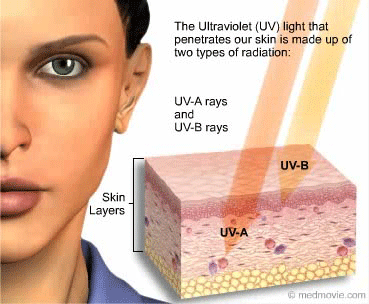 Sunscreen application and skin cancer: an interview with Dr Michelle Hunt, Inner Sydney Dermatology, News Medical, November 13, 2013
How many people does skin cancer affect and is it on the rise?
Unfortunately the incidence of skin cancer has risen in Australia over the past decades. From 1982 to 2007, melanoma diagnosis increased by around 50%, and in 2011, 1544 people died due to melanoma.
Over 434,000 people are treated for one or more non-melanoma skin cancers (NMSC) in Australia each year, and two in three Australians will be diagnosed with skin cancer by the time they are 70.
More than 2000 Australians died from skin cancer in 2011.
How effective is sunscreen at protecting the skin against sun damage? Continue reading
Australia’s timely action to prevent skin cancer from tanning beds
Australia’s Tanning Bed Ban Could Save Thousands Of Lives Taken Each Year By Skin Cancer http://www.medicaldaily.com/australias-tanning-bed-ban-could-save-thousands-lives-taken-each-year-skin-cancer-260693 By Justin Caba | Oct 23, 2013 In light of various studies that link UV exposure produced by indoor tanning beds to skin cancer, Australia is close to implementing a nationwide ban on tanning beds. Australia will join Brazil as the only countries to outlaw sun beds on a federal level once the state of Western Australia passes the ban.
“There’s not lots of them, there’s no big downside for them to stop because most of them have other businesses,” Health Minister Kim Hames told ABC Online.“And, I think given every other state and territory has done it, it’s probably right we follow suit.”
The Australian government successfully outlawed the use of indoor tanning beds by people under the age of 18 back in 2008, theWall Street Journal reports. California, Illinois, Nevada, Oregon, Texas, Vermont, the United Kingdom, Germany, Scotland, France, and some Canadian provinces have also banned minors from using tanning beds. Continue reading
Australia’s exceptionally strong solar radiation – a hazard,but also a blessing?
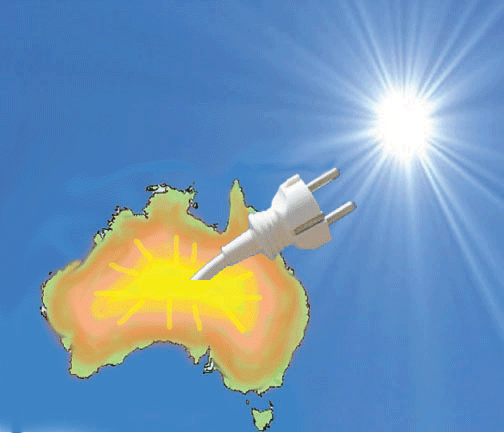 Australia – where the Sun hits the hardest The Starlight Walker, Mathieu Isidro October 8, 2013 “…….Such strong solar radiation also means high ultraviolet radiation (UV is part of the electromagnetic spectrum, like visible light and infrared), which is really bad for your health. In fact, Australia has the highest level of skin cancer in the world.Some 2 out of 3 Australians will be diagnosed with skin cancer before the age of 70, and Australians are 4 times more likely to develop skin cancer than any other form of cancer. So, if you’re coming from abroad, cover up, wear sunglasses and hats and leave your 15+ sunscreen at home, as the minimum recommended here is 30+.
. Finally, the main point I’d like to raise is strong solar radiation also means extreme weather, and it’s getting worse (Read this page to better understand the complex links between solar radiation and greenhouse effect). Australia had a record drought for the better part of the last decade and regularly experiences terrible bushfires. A couple of years ago, Australia also experienced its worst summer. It was so bad that it became known as the Angry Summer. The Climate Council, at the time, produced this scary map summarising it:……..
Australia experiences what might be the world’s strongest solar radiation (and worsening), and it’s a terrible challenge for the country, putting it with other places, particularly in the Pacific and arctic regions, on the frontline of climate change. It has terrible consequences for our environment, for our health and so for our economy.
But it could also be a blessing. Australia could seize this opportunity and invest in a green revolution to harness the Sun’s power in our country, which would in the long term ensure energy independence, sustainability and cheap, permanent energy for the entire country. Surely that is worth thinking about. And like this document will show – published by the Climate Commission in August just before being axed -, there is hope. http://thestarlightwalker.wordpress.com/2013/10/08/australia-where-the-sun-hits-the-hardest/
Tribunal awards war widow pension regarding veteran harmed by Monte Bello nuclear radiation
A decision this month by the Veterans’ Appeals division of the Administrative Appeals Tribunal upheld the finding that Mr Prior’s death was linked to his work with the British Nuclear Test Defence Service.
Relying on 57-year-old log books of Operation Mosaic – the code name given to the atomic weapons testing at the Monte Bello islands – as well as a witness account of the explosion and design points of the aircraft, the tribunal found Mr Prior would have suffered contamination.
 The tribunal heard Mr Prior suffered from a very rare skin condition that could have been caused by ionising radiation.
Specialists said the itching and pain could be so severe as to lead to depression and suicidal thoughts, with itching permeating every aspect of live, including sleeping.
The court found “there was a connection between Mr Prior’s exposure to ionising radiation and his skin condition which caused chronic pain” and upheld the decision to award the pension.
 Wife of veteran involved in Monte Bello Island nuclear test wins war widow pension JESSICA MARSZALEK NEWS LIMITED NETWORK OCTOBER 07, 2013 http://www.couriermail.com.au/news/national/wife-of-veteran-involved-in-monte-bello-island-nuclear-test-wins-war-widow-pension/story-fnihslxi-1226734294281A VETERAN’S wife has won a 10-year fight for the war widow’s pension after she successfully argued her husband committed suicide because of his involvement in atomic bomb testing in Australia.
The retired Air Commodore, who was stationed at Richmond in NSW and served in Vietnam, was 67 years old when he died in October 2001 – a death deemed not to attract the $840 fortnightly war widow payment. Continue reading
New meter to monitor risk of cancer-causing UV radiation
UV meter warns of sunburn risk http://au.news.yahoo.com/thewest/a/-/breaking/18714833/uv-meter-warns-of-sunburn-risk/ Phoebe Wearne, The West Australian August 30, 2013, The Cancer Council WA wants public UV index meters installed in school playgrounds and at popular beaches, parks and sporting grounds to warn of sunburn and skin cancer risks.
Australia’s first public UV index meter, which measures solar radiation intensity every minute, was switched on at Deep Water Point in Mt Pleasant this week. The solar-powered meter is on a 4m nautical-themed sculpture by renowned Perth artist Tony Jones, whose best known works are the sculptures Eliza in Crawley and that of CY O’Connor near Fremantle.
Cancer Council WA SunSmart manager Mark Strickland said the real-time UV index meter, which only recently became possible with new technology, would show when the UV level was above three – the level when people are advised to protect themselves from the sun.

Mr Strickland said it was important people were aware of the UV level because it was not linked to the sun’s heat and people could not see or feel UV radiation. “We hope people will find it a useful reminder to know when they really should be protecting themselves from UV and are at risk of sunburn and skin cancer,” he said.
“People tend to make the false correlation that they need to protect themselves from the sun when it’s hot, but it doesn’t work that way.”
The Deep Water Point sculpture was funded with $20,000 from the City of Melville.
Mr Strickland hoped other councils, schools and businesses with outdoor staff would express an interest in installing the UV meters in public open spaces, playgrounds and workplaces. He wants people to plan their day around the highest risk from UV radiation once they have the information to do so. “We hope people who are in the area will see the signs over a period of time and realise UV is not always correlated with heat,” Mr Strickland said.
“If people know the UV is really going to be cranking in the middle of the day we hope they might move their outdoor activities to earlier or later in the day when the UV level will be lower.”Melville deputy mayor Duncan Macphail said public health and safety was a priority for the city and it supported Cancer Council efforts to educate people.
CT not advisable for bone density scans, less radiation in alternative method
 DXA, not CT, still best for bone density scans, Endocrinology Update, 15 August, 2013 Nicola Garrett Endocrinology Update
But after consulting experts in the field the network concluded that there was no evidence that CT scans were better than DXA.
In fact CT scans posed unique problems not seen with DXA scans, the communication noted. For example spine CT could be ‘spuriously low’ in a patient with normal…(doctors only registration) http://www.endocrinologyupdate.com.au/latest-news/dxa-not-ct-still-best-for-bone-density-scans
Australian Greens call for health care justice for nuclear test veterans
 GREENS CALL FOR MEDICAL CARE FOR AUSTRALIA’S NUCLEAR VETERANS HTTP://WWW.GREENS.ORG.AU/GREENS-CALL-MEDICAL-CARE-
 AUSTRALIA%E2%80%99S-NUCLEAR-VETERANS The Australian Greens have called for hundreds of Australian soldiers who were exposed to radiation from British nuclear bomb testing in the 1950s and ‘60s to automatically receive Veterans’ Gold Card health care.
“Between 1952 and 1963, more than 16,000 Australian civilians and serviceman were exposed to nuclear fallout when British nuclear weapons were tested at the Montebello Islands in Western Australia, Maralinga and Emu fields in South Australia, and over the Christmas and Malden Islands,” spokesperson Assisting on Defence, Senator Scott Ludlam said.
“Some servicemen were clad only in shorts and t-shirts when they were sent into contaminated areas while British scientists in charge looked on wearing full body protective suits.
“In the decades following, many of these men, their wives and families have reported a range of radiation-related disorders ranging from multiple miscarriages to leukaemia, cancers, and respiratory conditions.
“While many radioactive illnesses take decades to manifest after the initial exposure it is widely acknowledged that these men were dangerously exposed. Continue reading
Eye cancer danger to children from UV radiation
Parents told to make kids wear sunglasses to protect them from eye cancer JANE HANSEN THE SUNDAY TELEGRAPH AUGUST 10, 2013 CHILDREN should wear sunglasses because sun exposure in the first 20 years of life increases the risk of eye cancer and other eye problems later in life, Cancer Council NSW research has revealed. The research shows exposure to solar radiation is a cause of eye cancer but while parents may Slip, Slop, Slap, they often overlook sunglasses for their children.
Cancer Council NSW’s Vanessa Rock said it was just as important to protect your eyes as your skin. There is an average of 98 cases of eye cancer per year in Australia.”Unprotected exposure to UV radiation over long periods can cause serious damage to your eyes, including cataracts, and cancer in and around the eye,” Ms Rock said.
Optometrist Association of Australia (OAA) Andrew McKinnon said irreplaceable eyesight is at risk in high glare, high UV settings such as the beach, by the water or the snow. “At the beach, it drives me mad, I want to put sunglasses on all the kids, all the adults have glasses on but a child’s eyes are more vulnerable.” Continue reading
Australian invention: device to measure radiation exposure in pilots
 New technology to measure radiation exposure in pilots (Medical Xpress) 17 July 13, —Researchers from the University of Wollongong have developed a unique device that measures how much radiation pilots and astronauts are exposed to. The silicon-based microdosimeter assesses the radiation risk to astronauts and pilots, and radiation damage to microelectronics, during long-term space missions and high altitude flights.
Exposure to too much radiation can cause cancer, damage to the foetuses of pregnant women and genetic defects that can be passed onto future generations.
Professor Anatoly Rozenfeld, Director of the Centre for Medical Radiation Physics (CMRP) – the largest research body of its kind in the Asia Pacific region – has just been granted a US patent for his invention.
“Silicon microdosimetry is providing a new metric for the estimation of hazards from ionizing radiation in mixed radiation fields. It is an essential contribution toradiation protection of pilots and astronauts in avionics and space, where the radiation environment is not easy to predict,” Professor Rozenfeld said…..
Professor Rozenfeld also recently received a Chinese patent for a skin dosimetry technology that was 10 years in the making. ‘Drop-in’ accurately measures (in real time) the amount of radiation absorbed into a patient’s skin during procedures such as radiotherapy and CT scans that can give off high levels of ionising radiation.
“An accurate skin dose measurement can help prevent a patient’s skin from being overdosed, and at the same time, provide a vital indication of overall radiation safety,” Professor Rozenfeld said. http://medicalxpress.com/news/2013-07-technology-exposure.html
Ignorance among Australians, even doctors, on the radiation hazard of CT scan
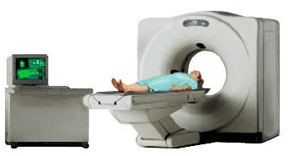 “It’s easier to administer, so it’s used more frequently – and is performed more often on children.
” we were astonished to find that many GPs incorrectly believe that CT scans deliver only a low-to-medium dose of radiation, and that MRIs and ultrasound scans also deliver radiation – they don’t.”
Radiating good health? Health Canal, Karen Green 15 July 13 CT scanning technologies have been simplified, but there are complex issues associated with the procedure, including its unnecessary use and the potential risk to the patient…….
“Australians are very keen to use new technologies. Current generations have different expectations of health care and thehealth system,” says Associate Professor Rachael Moorin, from Curtin’s Centre for Population Health Research……
Although most of us are keen to try medical innovations, Moorin is concerned about our lack of knowledge on some of the technologies we embrace – especially computed tomography, or CT, scanning. Continue reading
Australian science adds to knowledge on radiation risks of CT scans
Another recent study from Australia by John Matthews and colleagues, published in BMJ, helps give us a bit more perspective….The peril was greater for children exposed at younger ages and was linked to many different types of malignancies — including cancers of the brain, skin, blood and gut…….
Dr. Dustin Ballard: Examining the trade-offs with CT scans marinij.com By Dr. Dustin Ballard 07/15/2013 IN MEDICINE, like in life, there are almost always trade-offs. Most treatments, even unassuming ones like oxygen, have side effects. And most medical tests hold the potential of unintended consequences.
Consider the recent evidence about the long-term effects of CAT Scan (CT) radiation in children. But, before we get there — please don’t flip out — CTs can be valuable tools, so please don’t decide that you will boycott them entirely.
That said, it’s undeniable that there’s been an explosion in the use of CTs, and that this is a concerning trend. Mounting evidence shows that CT exposure in childhood results in a small but real increased risk of cancer later in life……. Continue reading
Tasmanian government acting on UV radiation danger of solariums
Tasmania to outlaw use of solariums Examiner By Alex Druce July 7, 2013, WIDELY publicised cancer risks and strict operating laws have seen tanning beds almost phased out of Tasmania. And in 18 months, they will be outlawed completely.
Health Minister Michelle O’Byrne said Tasmania would join New South Wales, Victoria and South Australia in banning solariums from commercial use by December 2014.The move comes four years after the government slapped heavy restrictions on solarium owners, including bans for customers aged under 18, bans for people with very fair skin, and mandatory training for all operators. Continue reading
1 This month

of the week – Australians for War Powers Reform (AWPR)
To see nuclear-related stories in greater depth and intensity
 Antinuclear