Radiation regulator to target miners http://www.governmentnews.com.au/2012/08/03/article/Radiation-regulator-to-target-miners/TODXIXSKLM.html , 03/08/2012, By Julian Bajkowski Radiation safety for workers in the mining and resources sector is set to be probed by the government after the Australian Radiation Protection and Nuclear Safety Agency (ARPANSA) revealed it is scouting for consultants to review the state of radiation exposure reporting. Continue reading
Carbon tax will make Australians healthier, cutting health costs and also productivity losses
 Health economists have evaluated the health benefits associated with emissions reductions in Europe, China, India and Britain, and the findings suggest improvements for health are available immediately – and can amount to billions of dollars saved annually from avoided ill health and productivity gains.
Carbon price’s health bonanza, The Age, Fiona Armstrong June 26, 2012 “………There is however an untold story of good news associated with this, the beginnings of our national emissions reduction strategy, which has been completely overlooked in government communications and in other commentary – and that is the improvements in public health and economic savings that accompany emissions reductions. For while there will indeed be climate benefits, they are far off in the future and will only be realised by a considerable ramping up of emissions reductions, far beyond a 5 per cent by 2020 target or a $23/tonne carbon price.
The health benefits however are available much sooner than that. Continue reading
Doctors slam uranium miner Toro Energy for promoting junk science on radiation safety:
 We call on Toro Energy to stop promoting fringe scientific views to uranium industry workers and to the public at large.
The Medical Association for Prevention of War has released a statement signed by 45 medical doctors calling on uranium mining company Toro Energy to stop promoting the view that low-level radiation is beneficial to human health. Toro Energy, which plans to mine uranium at Wiluna in WA and has interests in uranium exploration ventures in the NT and SA, has sponsored speaking tours by controversial Canadian scientist Doug Boreham. The joint statement notes that recent research has heightened rather than reduced concern about the adverse health impacts of low-level radiation.
TORO ENERGY PROMOTES RADIATION JUNK SCIENCE , Statement by 45 doctors – (signatures at end ) 1 May 2012
Toro Energy is an Australian company involved in uranium exploration in Western Australia, the Northern Territory, South Australia and in Namibia, Africa. The company’s most advanced project is the proposed Wiluna uranium mine in the WA Goldfields.
Toro Energy has consistently promoted the fringe scientific view that exposure to low-level radiation is harmless. Toro Energy has sponsored at least three speaking visits to Australia by Canadian scientist Dr Doug Boreham, who argues that low-level radiation is actually beneficial to human health.
Those views are at odds with mainstream scientific evidence and expert assessment. For example: Continue reading
Brain cancer risk from overuse of dental X rays
Dental x-rays linked to brain tumours, ABC News, 10 April 12, People who get regular dental x-rays are more likely to suffer a type of brain tumour, according to new research, suggesting that yearly exams may not be best for most patients. The study in the US journal Cancer showed people diagnosed with meningioma who reported having a yearly bitewing exam were 1.4 times to 1.9 times as likely as a healthy control group to have developed such tumours.
A bitewing exam involves an x-ray film being held in place by a tab between the teeth. Also, people who reported getting a yearly panorex exam – in which an x-ray is taken outside the mouth and shows all the teeth on one film – were 2.7 to three times more likely to develop cancer, said the study.
A meningioma is a tumour that forms in the membrane around the brain or spinal cord. Most of the time these tumours are benign and slow growing, but they can lead to disability or life-threatening conditions. The research, led by Elizabeth Claus of the Yale University School of Medicine, was based on data from 1433 US patients who were diagnosed with the tumours between the ages of ages 20 and 79 years. For comparison, researchers consulted data from a control group of 1350 individuals who had similar characteristics but had not been diagnosed with a meningioma.
Dental patients today are exposed to lower radiation levels than they were in the past, but the research should prompt dentists and patients to re-examine when and why dental x-rays are given, says Claus. “The study presents an ideal opportunity in public health to increase awareness regarding the optimal use of dental x-rays, which unlike many risk factors is modifiable,” she says……
Associate Professor Matthew Hopcraft of the University of Melbourne Dental School says there are no strict guidelines regarding dental x-rays in Australia. “Dentists in Australia would normally do a risk assessment for their patients … weighing up the risk of disease versus the risk of potential harm from radiation from the x-rays,” says Hopcraft. He says most patients would undergo one x-ray every one or two years, while a patient with a high risk from tooth decay would need one every six months. Hopcraft says improvements in radiographic equipment has seen the dosage rate received by patients undergoing an x-ray reduce over time.
“We’ve moved a lot in Australian practice towards digital radiography from traditional film and that’s allowed the dosage of radiation to decrease significantly as a consequence.” http://www.abc.net.au/science/articles/2012/04/10/3474085.htm
Northern Territory nuclear waste dump not needed for medical wastes, says Public Health Association
Misleading arguments influence nuclear waste dump debate, Public Health Association of Australia, 15 March 12, Linking access to cancer treatment with the need for a nuclear waste dump in the Northern Territory is shameful and misleading, reflecting the pro-nuclear ideologies of Ministers rather than facts, said Clive Rosewarne, spokesperson for the Public Health Association of Australia (PHAA).
 “Waste from nuclear medicine procedures, the majority of which is for diagnostic services rather than treatment, is low level and short term waste can be stored on site and safely disposed of locally. The small amount of higher level waste from nuclear medicine can also be stored locally, as it is currently,” explained Mr Rosewarne.
“Comments by senior Commonwealth Ministers upon the passing of the National Radioactive Waste Management Bill claiming that a dump is needed in order to have a nuclear medicine industry are a gross manipulation of public sentiment and an attempt to create fear in the community over access to health services. It is shameful that senior Ministers are misrepresenting the facts to foster their ideological support of the nuclear industry.
“The increased shipment of radioactive wastes across thousands of kilometres of Australia represents a far greater risk to public health than current storage practices and all of this could be further reduced if the Lucas Heights nuclear reactor was decommissioned and stopped from producing more waste. The only waste stream that requires a dedicated facility is soil waste from former CSIRO work and the ongoing waste generated at the nuclear reactor Lucas Heights.
“There is no long term solution to the highly dangerous radioactive waste produced by the nuclear industry and yet proponents of the industry hide from this fact. Transporting waste thousands of kilometres to a remote site certainly fits the Not In My Backyard syndrome, and attempts to locate the waste out of sight and out of mind.
“The anguish and suffering the passing of this Bill has caused to NT locals represents a low point in this nation’s dealing with Aboriginal people and may have long term health impacts. This does not seem to be of concern for Ministers who have refused to meet with traditional owners opposing the nomination of the Muckaty Station site. It would seem their health is of lower consideration than city folk in this appalling process,” said Mr Rosewarne.
Let’s not forget that other cancer causer – UV radiation
 Students in NSW not sun safe, Sky News, http://www.skynews.com.au/health/article.aspx?id=725215&vId= March 4, 2012 New research shows students in NSW have amongst the poorest sun protection in Australia. The state came second last in a nationwide review of the sun protection policies in government schools by the New South Wales Cancer Council.
It’s now calling for an urgent overhaul of the state’s outdated sun policy so students receive the same sun protection measures as schools in other parts of Australia. Skin cancer prevention manager Vanessa Rock says state schools in NSW were failing to implement basic sun protection measures.
As part of the survey, each state and territory was marked on a list of key sun protection requirements, such as wearing a sun safe hat and using SPF 30+ sunscreen. Queensland, the NT, Victoria and ACT all scored top marks while Tasmania, which has much lower levels of UV radiation, came in at the bottom of the list.
Models banned from tanning, SMH 1 March 12, “….Sue Heward, SunSmart’s manager, calling on Victoria to follow the NSW Government’s decision last month to ban solariums by 2015. ”Not only is solarium use harmful to your health but it can prematurely age the skin making it coarse, pigmented, leathery and wrinkled. It is suggested that 80 per cent of wrinkles are due to overexposure to UV radiation from either the sun or solariums.”
The thinking goes that if the fashion industry sets an example that a tan is not stylish then young women, who are particularly resistant to health warnings, might be persuaded of the dangers of tanning….
.. It has been estimated that each year in Australia, 281 new melanoma cases, 43 melanoma-related deaths, and 2572 new cases of squamous cell carcinoma can be attributed to solarium use.
http://www.smh.com.au/lifestyle/beauty/blogs/beauty-beat/models-banned-from-tanning-20120301-1u4ff.html#ixzz1oYa4mwyR
Medical specialists warn against overuse of whole body CT scanning
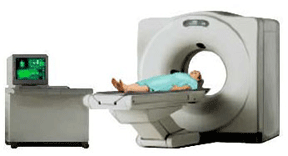 Study: ED CT protocol linked with excess rad exposure Cardioavascular Business 28 Feb 12, The introduction of a whole-body panscan CT protocol for blunt trauma in the emergency department (ED) raised the proportion of patients exposed to more than 20 mSv of radiation by 8 percent, according to a study published in the February issue of Emergency Medicine Australasia.
Given the increasing use of whole-body CT scans, coupled with heightened concerns about radiation exposure, Stephen Asha, MD, of the emergency department at St. George Hospital in Sydney, Australia, and colleagues sought to measure the proportion of patients exposed to radiation dose in excess of 20 mSv before and after the introduction of a panscan protocol for blunt trauma. The researchers also aimed to quantify missed injuries before and after the introduction of the
protocol…
..It is not clear that this increased risk of exposure to a higher radiation dose was offset by a clinical benefit,” Asha et al
wrote…. The researchers concluded by emphasizing that the increased risk of exposure to a radiation dose in excess of 20 mSv was similar regardless of age or injury severity. http://www.cardiovascularbusiness.com/index.php?option=com_articles&view=article&id=32290:study-ed-ct-protocol-linked-with-excess-rad-exposure
Whole body CT scans; their radiation may do more harm than good
the findings suggest that pan-scanning may be 26 times as likely to harm patients in the long run as to immediately help them in the acute care setting…. the results should serve as warning for the emergency department physician against ordering pan-scans for lower-risk patients
CT Pan-Scans Raise Radiation Dose Without Improving Results, Medscape Today, James Brice, February 21, 2012 — An Australian study of emergency department imaging practices has raised radiation safety concerns and new arguments about the clinical benefits of whole-body computed tomography (CT) imaging for the initial emergency department evaluation of critically injured patients.
Pan-scans, a wide field-of-view CT imaging protocol covering the body from the head to the pubic symphysis, stirred intensive debate when they were first introduced in the mid-2000s. A majority of academic authorities eventually accepted the high-speed application for diagnosing life-threatening, multifocal trauma in the emergency department, despite its propensity for exposing patients to levels of radiation of 20 mSv or more.
That single dose is double the amount of ionizing radiation the National Academy of Science’s Seventh Assembly of the Committee on Biologic Effects of Ionizing Radiation says will give a 40-year-old adult a 1-in-1000 chance of future cancer. Continue reading
Aboriginal Peter Watts warns on the radiation danger of uranium
From Aboriginal land to Japan’s nuclear reactors, Antinuke activists draw attention to the link between Australian uranium and Fukushima , Japan Times, By ERIKO ARITA Feb. 19, 2012 Peter Watts, co-chair of the Australian Nuclear Free Alliance, was recently in Japan as one of some 100 speakers at the Global Conference for a Nuclear Power Free World held in Yokohama on Jan. 14 and 15. During an interview with The Japan Times, Watts — who is a member of the Arabunna people, one of several Aboriginal groups living in South Australia — said that among the many things his ancient ancestors knew, such as how to hunt animals in a sustainable way, was the potential danger of radiation released from the uranium beneath their land.
“Our ancestors knew of the uranium,” he said, “They called the places (of uranium deposit) ‘Poison Country.’ It meant: ‘Don’t go there to hunt. Don’t go there to collect food. Don’t go there.’ ” Continue reading
UV radiation – a cancer causer just like ionising radiation
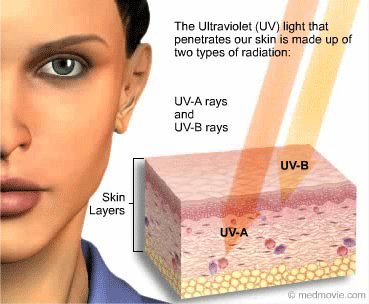 Ultraviolet radiation: the entire spectrum of ultraviolet radiation has some of the biological features of ionizing radiation, in doing far more damage to many molecules in biological systems than is accounted for by simple heating effects (an example is sunburn).
Don’t let Clare’s death be in vain, by:Jerril Rechter , Herald Sun, February 10, 2012 HARMFUL UV rays are a fact of life in a sun-drenched country, but solariums are a choice. They are dangerous, unnecessary, outdated and irrefutably linked to cancer. They must be banned in Victoria and nationally, not just in NSW.
Before her death in 2007, Clare Oliver, 26, became a household name. She told her tragic story of skin cancer, and of a life lost far too early, to warn young women about the consequences of solariums.
She made it clear that the pursuit of attractiveness was never worth losing your life over. It has been estimated that each year in Victoria, 51 new melanomas, seven deaths and 294 new cases of deadly squamous cell carcinoma are attributed to solarium use.
Five years after Clare’s death, 475 tanning beds still operate in Victoria, almost twice as many as the 254 in NSW. Clare’s family, elated at the news that NSW will ban them for good in 2014, are eager to see the day this announcement is made in Victoria…. In 2008, a chain of popular Melbourne tanning salons was found guilty by the Federal Court of Australia for posting not one, but eight misleading claims on its website that tanning was a safe activity.
There is no safe level of solarium use. Solariums emit levels of UV radiation up to three times as strong as the midday summer sun. A recent study found that 15 per cent of tanning beds even exceeded this level, and some emitted up to six times more UVA than midday summer sun.
Using a sun bed before you are 35 boosts your risk of melanoma by 75 per cent. And the more you use them the greater your risk increases, at any age.An estimated one in six melanomas in young Australians aged 18-29 could be prevented if solariums were shut down….. http://www.heraldsun.com.au/opinion/dont-let-clares-death-be-in-vain/story-e6frfhqf-1226267190176
Australia’s compulsory airport scanning will be of the safer type – not ionising radiation
It’s a pity that the Australian government has not yet explained clearly their choice of millimetre wave radio waves scanners for compulsory use in Australian airports.
 They might be compulsory, but these scanners do not emit ionising radiation, and are therefore not a cancer risk in public health terms. The American system, (which does allow passengers the choice of a “pat down” examination instead), uses the “backscatter” type, which does subject passengers to low level of ionising radiation.- Christina Macpherson
Australian Airports To Get Compulsory Body Scans, Gismodo, 5 Feb 12, Danny Allen In a $28 million security upgrade, new “no scan, no fly” laws are expected to be proposed this week for Aussie international airports — removing the option to request a pat down instead. After trials last year, full body scanners (from the same company used in US checkpoints) will roll out in Sydney, Melbourne, Brisbane, Adelaide,
In Sydney and Melbourne, the government trialled competing scanner technology specifically designed not to identify gender or reveal body details. Gizmodo covered these: ThruVision (passive terahertz radiation detection) and L3 Communications (millimetre wave radio waves). Ultimately, the latter got the nod, and has been approved by
Australia’s Privacy Commissioner.
Images will be deleted after each traveller is cleared. Continue reading
A few atomic veterans, previously excluded,can now claim compensation
Aussie nuke testing victims receive compo, News.com.au, 22 Nov 11 A HANDFUL of Australian veterans exposed to British nuclear testing in the 1950s and 60s who missed out on compensation will finally get payments and health care. Tonight the Senate passed laws to close loopholes that had inadvertently excluded about 10 victims….. The radiation victims were involved in maintenance, transporting or decontamination of aircraft used in the British nuclear test program….. Continue reading
Australia’s Maralinga veterans and Aboriginals paid the price for nuclear bomb testing
Finally they can heal together, Adelaide Now, Bryan Littlely, From:The Advertiser, November 12, 2011 THEY are snapshots from a secret time. An insight into a life in one of the harshest and most secure places in Australia. The men who took these photographs at Maralinga during the series of British nuclear testing and clean-up from 1952 to 1967 carry them proudly. Most also carry another legacy of this land and the controversial atomic testing that went on here.
Cancers and other conditions linked to the radiation, plutonium, burilium-laced lands that were left after the testing has claimed the lives of many of the men who were at Maralinga. In 1985, a survey found that of the 12,500 people involved in the British nuclear testing program in Australia, 11,000 had died. Hundreds of Maralinga-Tjarutja people were also forced from their homeland during the testing.
Few of the veterans remain today but the handful who have gone back to Maralinga for the Remembrance Day reunion have done so with the blessing of the traditional owners, so the two groups of people for
whom Section 400 is so significant can heal together…. Australian Nuclear Veterans Association founder Avon Hudson, the Maralinga whistleblower and advocate for compensation claims for the men, said there were only about 50 members of that association left.
“We’re nearly buggered … most of our members are old buggers like me and we are dropping off the perch,” Mr Hudson, 74, said. “We can get a bit of healing coming back here. It brings back a lot of sad memories because almost all my mates are dead but it is mixed feelings because I have a lot of good memories, too.”…
“We were sent on to that Taranaki ground zero site to test some stuff… nobody knew it was contaminated,” he said…..
http://www.adelaidenow.com.au/news/south-australia/finally-they-can-heal-together/story-e6frea83-1226193206591
Still no radiation registering of Northern Territory’s uranium workers
NT URANIUM WORKERS STILL NOT ON NATIONAL REGISTER, GREENS SAY, Safe To Work, By Cole Latimer 20 October 2011 Uranium miners in the Northern Territory are still not on the National Radiation Dose Register, Greens senator Scott Ludlam says. It comes five months after Ludlam originally brought the issue to bear in May, with Ludlam today again quizzing representatives from the Australian Radiation Protection and Nuclear Safety Agency on this issue.
“In July 2010 the register began collecting data on the radiation doses to which workers had been exposed. There are now over 18,000 workers on the database – covering about five years – but there is no information at all on the radiation workers have been exposed to at the Ranger Mine in the Northern Territory. We revealed this in May, and urged the Territory and Federal authorities to address it. ARPANSA told us today that nothing has changed, and to raise the issue with the office of energy and resources minister Martin Ferguson,” Ludlam said in a recent statement.
“We will write to Northern Territory Chief Minister Paul Henderson to encourage urgent action to fix this problem.” The national register was created as a central database to track radiation dose histories of miners….. Under this new development, information on radiation doses will be sent to a central register, where miners can then access their personal records.
“Excluding work in the Northern Territory is a huge crack in the system, and it was revealed five months ago and NT uranium mine workers are still off the radiation dose radar. The system will only have integrity if all radiation doses are included,” Ludlam says….. http://www.safetowork.com.au/news/nt-uranium-workers-still-not-on-national-register
Nearly 60 years later, a few of Australia’s nuclear veterans will get some government help
British nuclear test compensation victory for RAAF personnel, Adelaide Now, September 22, 2011 A SMALL number of veterans of British nuclear tests conducted in Australia in the 1950s and 1960s will now be entitled to health care and compensation. Veterans Affairs Minister Warren Snowdon said the former RAAF personnel had previously been excluded as their involvement fell outside the currently legislated nuclear test areas or time periods. Mr Snowdon said others could also be eligible.
“The quality of the records from the test period, and the secrecy surrounding the operation, means that it is impossible to rule out the likelihood that new information may come to light which warrants further extension of coverage to additional groups of participants,” he told Federal Parliament.
Mr Snowdon said the Department of Veterans Affairs had received claims from a small number of personnel not currently eligible for compensation and health care from their participation in the British nuclear test program.
He said they were involved in the maintenance, transporting or decontamination of aircraft used in the nuclear test program outside the currently legislated nuclear test areas or time periods.
The maintenance and decontamination of the aircraft – mostly Canberra bombers – took place at Woomera and the Edinburgh air base, near Salisbury. Britain exploded seven atomic bombs in the South Australian outback in 1956-57 but continued the nuclear test program through to May 1963 with a large number of minor trials of items such as nuclear initiators. Nuclear test veterans have long sought a better deal, arguing that their health was affected by radiation exposure.
Debate on the Veterans’ Affairs Legislation Amendment (Participants in British Nuclear Tests) Bill 2011 was adjourned….http://www.adelaidenow.com.au/news/south-australia/british-nuclear-test-compensation-victory-for-raaf-personnel/story-e6frea83-1226143449967
1 This month
To see nuclear-related stories in greater depth and intensity
– go to https://nuclearinformation.wordpress.com/


 Antinuclear