Did thorium pollution cause cancers and deaths in the Tweed Valley?
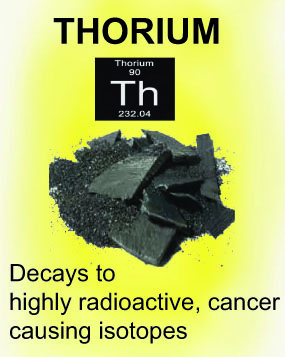 Cancer cluster fears after more than 20 deaths https://www.tweeddailynews.com.au/news/cancer-cluster-scare-black-sand-suspect-in-deaths/2748511/ by Alina Rylko 22nd Aug 2015 Updated: 14th Aug 2017 A MULTI-GENERATIONAL tragedy costing dozens of lives on a short stretch of road in the Tweed Valley is claimed to be evidence of a cancer cluster.
Iodine 131 – a treatment for thyroid disease, but still a radiation risk
Paul Langley Nuclear Fuel Cycle Watch South Australia, 1 Dec 17
Today in this forum, the implication has been made that I131 as a treatment for thyroid disease is a benefit and that therefore, it is implied that the benefit of I131 as a nuclear medicine is harmless to the general public who are not in need of treatment dose I131.
It is easy to point out that low dose I131 is acknowledged as a public risk factor and is a known carcinogen. The cost/benefit equation used in medicine to determine treatments does not apply to members of the community. In fact, in the case of treatment dose radiation therapy patients, the general rule is to minimise addition exposures outside of the medical setting. It is also easy to point that world wide governments approve the medical use of nuclear medicines (radio isotopes) according to strict ethical and medical need guidelines.
What is good for someone seeking to lengthen their survival time in the context of disease is not good for someone who has no illness. Radiation is a double edged sword. In the context of the five year survival time for cancers, radiation treatments work. Longer term limits to treatments include recurring cancers and heart disease. The research clearly shows this.
The hope that I131 may be considered to be innocuous is a false one. Here is a list of US FDA approval nuclear medicines. It is forbidden under US law, Australian law etc to administer these substances to any person for any reason apart from medical need and with patient consent:
Queensland Labor MP angry about delay to act on black lung disease
ANSTO bosses support the global nuclear industry, not the well-being of Australians
Non nuclear production of medical radioisotopes st South Australian Health and Medical Research Institute
 85% of ANSTO Lucas Heights isotope production is for Technetium 99. This can also be made in a cyclotron by using electricity – which makes NO Intermediate Level Waste & NO long lived LLW – thereby negating a national radioactive dump facility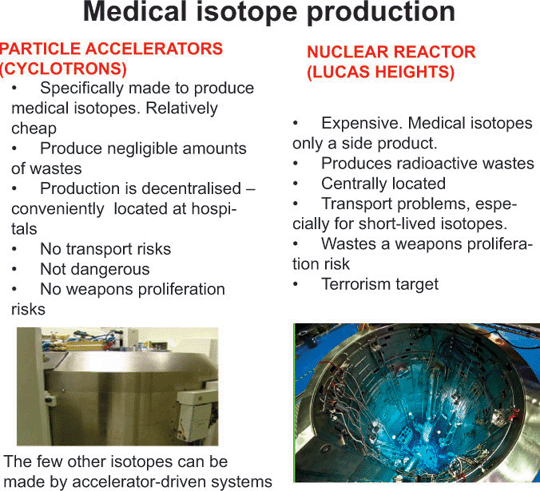
State’s most advanced clinical imaging centre, worth $13m, opens at SAHMRI http://www.adelaidenow.com.au/news/south-australia/states-most-advanced-clinical-imaging-centre-worth-13m-opens-at-sahmri/news-story/a20eb257edad98bb0597dd787aa6837b?nk=ba26857f63080120cbd5fc74c94d3959-1503458683, Brad Crouch, Medical Reporter, The Advertiser February 15, 2017 THE growing South Australian Health and Biomedical Precinct takes another step forward today with the opening of the most advanced clinical imaging centre in the state.
The $13 million Clinical and Research Imaging Centre at the South Australian Health and Medical Research Institute has been established in partnership with Dr Jones and Partners Medical Imaging.
Space on the ground level of the SAHMRI building on North Terrace has become a Dr Jones & Partners clinic, with dedicated time allocated to SAHMRI researchers for clinical research without compromising the scheduling of patient treatments.
State-of-the-art imaging equipment in the centre includes CT, MRI and PET/CT platforms.
Officials say the arrangement is moving SAHMRI in a new direction of commercialisation with industry partners to create a facility to benefit researchers with the aim of improving the treatment and diagnosis of patients. Continue reading
From the doctors’ point of view, promoting Adani coal mine is just like promoting tobacco
He wrote that the Carmichael mine posed a “grave danger to public health both in Australia and globally”, given coalmines leading to a resurgence among mine workers of a chronic, irreversible and previously eradicated lung condition known as black lung disease.
The pollution from coal also causes childhood asthma, heart and lung disease, and some cancers, he added.
“Going ahead with it will send a terrible message to the world – [that] we in Australia really don’t care about the planet, or its inhabitants,” Faulkner wrote.
A number of high-profile doctors and researchers were signatories to Faulkner’s letter, including leading child and public health researcher Prof Fiona Stanley and the former chair of the Western Sydney Local Health District Board, Prof Stephen Leeder. Both are members of Doctors for the Environment Australia’s scientific advisory committee…….https://www.theguardian.com/environment/2017/jun/06/medical-experts-say-lending-to-adani-is-the-same-as-supporting-big-tobacco
Adani coal mine dispute: it’s not only about money, and climate: there’s also black lung disease for miners
Does Queensland really want Adani’s dirty, black lung inducing jobs? Independent Australia David Shearman 30 May 2017, On top of ecological destruction and $1 billion in taxpayer subsidies, will the re-emergence of black lung disease, due to government regulatory incompetence, be the final nail in Adani’s Carmichael mine coffin? Dr David Shearman reports.
ON A DAY WHEN a Queensland Parliamentary Inquiry finds catastrophic administrative failures resulted in the reappearance in pneumoconiosis (black lung disease) – a serious but preventable disease – Queenslanders should be asking themselves some important questions.
In particular, whether their State and Federal governments have the competence to deliver the Adani Carmichael mine with its ephemeral jobs and riches or whether the collateral damage to them and to Queensland is likely to be too great.
The reappearance of black lung disease in our wealthy, advanced country is an indictment of health monitoring in the coal industry, for which the Queensland Government has the ultimate responsibility to set health standards. The Parliamentary ‘Inquiry into the re-identification of Coal Workers’ Pneumoconiosis in Queensland’ identified “major system failures at virtually all levels” and this includes the medical assessments.
Parliamentarians who fondle coal and spruik it as “cheap” need to recognise the true cost of coal lies in the suffering of workers, and the community from air pollution from its mining and combustion. Coal is heavily subsidised by the health services for the cost of care of a significant proportion of the 3,000 Australians who die each year from air pollution.
In promoting this mine, the Queensland and Federal governments have already dismissed the likely demise of the Great Barrier Reef, the significant impact on world greenhouse emissions and the climate of Australia, the increasingly poor image depicted in the international media of Queensland and the concerns of our Pacific Island neighbours about new coal mines. In the face of black lung, the competence of the Queensland Government to regulate and monitor the development and running of this vast mine has to be questioned. It will be difficult to find any reassurance.
Imposed on the Adani mine development are 270 conditions that will need monitoring and supervision by the Queensland Government. Many of these relate to water security, because inland Queensland with its probable drying climate has human and agricultural demands on its water. Unlimited use of water from the Great Artesian Basin is to be allowed in the face of concerns expressed by an eminent scientific committee. These included the impact from possible pressure reduction in bores and impacts on existing settlements.
The possible health consequences of the Adani mine have been detailed by Doctors for the Environment Australia (DEA) in a fact sheet with a foreword by Professor Fiona Stanley.
Let us look at the record of successive Queensland governments…..https://independentaustralia.net/life/life-display/does-queensland-really-want-adanis-dirty-black-lung-inducing-jobs,10348
Turnbull government budget ignores health impacts of climate change
 Shortsighted Budget 2017 ignores health impacts of climate change, Independent Australia Kristine Barnden 19 May 2017, The Turnbull Government has once again prioritised growing the economy over human lives, writes Dr Kris Barnden.
ACTION TO PROTECT AUSTRALIA from climate change was a policy free zone in the 2017 Budget. Despite strong scientific and economic consensus on the urgent need to transition away from fossil fuels, our government has prioritized efforts to grow the economy using a business as usual approach.
Doctors have been speaking out about the adverse health effects of climate change, as well as the health co-benefits of policies aimed at mitigating and adapting to climate change. In Australia, air pollution from coal fired power stations contributes a significant proportion of the over 3000 deaths per annum from pollution and a plea has been made by doctors for a rapid transition away from coal fired power.
Agriculture is another area where actions to reduce green house gas emissions are likely to be associated with multiple benefits, including health. In last week’s Budget, agriculture and regional Australia are seen as winners only from expenditure on rail. However, we need to recognize that agriculture is an important contributor to greenhouse emissions and also extremely vulnerable to their effects as recognized by the farming industry. These factors are budgetary items and need to be built into national financial policy. Indeed as President Obama has noted, food security is a world issue and we carry responsibility as a food exporter……….
Agriculture, the environment, the economy and human health interact at many levels, and we face significant difficulties on all fronts. All will be affected by climate change, and we cannot afford to consider each in isolation. We need strong leadership, and the ability to look beyond short term political and ideological considerations to longer term gains.
Dr Kristine Barnden is a member of the management committee of Doctors for the Environment Australia. https://independentaustralia.net/politics/politics-display/budget-2017-ignores-health-impacts-of-climate-change,10314
Finally, recognition for Australia’s atomic veterans
Atomic veterans to be recognised after 61 years, Mandurah Mail, 8 May 17, The service of veterans exposed to British atomic testing off the coast of Western Australia in the 1950s is to be recognised in the federal budget on Tuesday.
On Sunday Canning MP Andrew Hastie announced $133 million would be spent giving the men who served in the Montebello Islands, where three nuclear weapons tests took place in 1952 and 1956, access to Department of Veterans Affairs gold cards.
Mr Hastie said the gold cards, which entitled the veterans to free public and private health care, were an acknowledgment the men had served in dangerous circumstances.
“It says to them that the Australian government, on behalf of the Australian people, care about them and are going to see their responsibility to care for them through,” he said.
“For these men it is recognition they did serve in hazardous conditions, that they were exposed to nuclear radiation after atomic testing, so for them it means a lot, especially since quite a few of them have suffered from cancer.”
Only 51 of the 89 servicemen who were conscripted to assist with the atomic tests are still alive.
Half of those who have since died succumbed to cancer……..
Many of the veterans said they had not been told of the dangers of nuclear radiation and were not issued protective gear.
“We got up there and didn’t even know what was happening, all we knew is that something big was happening so we got out on the upper deck and the count down came down,” Australian Ex-Services Atomic Survivors Association secretary Jim Marlow said.
“We were told to turn our backs, so we turned our backs and there was a blinding flash and a push of wind and a whole lot of noise and we turned back again and saw the smoke going up.”
Mr Marlow said he was back working in the ship 10 minutes after the blast.
He said the survivors association had been lobbying for recognition for more than a decade. http://www.mandurahmail.com.au/story/4647184/atomic-veterans-to-be-recognised-after-61-years/
Medical profession warns on Adani coal mine as a public health catastrophe
 Adani coal mine is a public health catastrophe http://www.examiner.com.au/story/4485747/adani-coal-mine-is-a-public-health-catastrophe/?cs=97 26 Feb 2017,The international medical community is watching Australia with alarm. This month The Lancet, one of the world’s leading medical journals, published a report about the giant Adani mine, titled: Australia’s new coal mine plan: a “public health disaster”.
Coal mines are a health risk for miners, workers and local communities: they cause higher rates of childhood asthma, heart and lung disease, and some cancers. Frighteningly, there has been a recent resurgence in black lung disease – a potentially fatal disease caused by breathing in coal dust. More widely, the overwhelming majority of scientists say there can be no more coal mines if we’re to have any chance of a safe climate. Medical organisations are increasingly recognising the health risks, with the British Medical Journal describing climate change as, “a health emergency”.
The global health risks include increased severity and frequency of extreme weather, adverse changes in air pollution, the spread of disease vectors such as mosquitoes, food insecurity and under-nutrition, displacement and mental ill health.
In the UK, an alliance of 15 health bodies including seven royal medical colleges and the British Medical Association are calling for a rapid phase-out of coal to protect health and reduce costs. In Australia, the Royal Australasian College of Physicians recently described climate change as a “public health emergency”. The RACP board determined fossil fuel projects are inconsistent with its core business and, along with many other organisations around the world, has divested from fossil fuels.
Just as health professionals advocated against the tobacco industry, so we have a responsibility to speak up against fossil fuel projects such as the Adani mine, which present such unacceptably high risks.
Canada develops nuclear-free production of medical isotopes, Australia subsidises nuclear production
Steve Dale Fight To Stop Nuclear Waste Dump In Flinders Ranges SA., 14 Jan 17, Canada is moving towards clean Cyclotrons for Molybdenum-99 production – yet Australia decides it wants to undermine worldwide Cyclotron development by subsidising Mo-99 for the world. Waste taxpayer’s money to produce unnecessary nuclear waste.
“The ANSTO Nuclear Medicine (ANM) Project will enable ANSTO to triple production of Molybdenum-99 (Mo-99). The increased capacity will enable Australia to meet domestic demand, as well as being able to supply up to 25-30% of global demand.”
Cyclotrons for medical isotopes needed in other States, not monopolised by ANSTO in Sydney
Trisha Dee Fight To Stop Nuclear Waste Dump In Flinders Ranges SA, 28 Nov 16 ANSTO want to pick up where Canada has stepped off. Canada used to provide a significant part of the world’s radioactive isotopes. Now Australia wants to get in on this dying industry. They need to make room at Lucas Heights to do so. Hence their push to bury their toxic waste in the outback. There is no strong case for co-location.Cyclotrons for medical uses – a better option than Lucas Heights nuclear reactor
 A NEW REACTOR? It’s the worst possible option! Nuclear Study Group Sutherland Shire Environment Centre 1998 By R.D. (Bob) Walshe, OAM“…..There are attractive alternatives to a new reactor, especially cyclotrons. Why are they being ignored?

Dr Jim Green says, ‘There are several alternatives to a new reactor, including particle accelerators, spallation sources, and synchrotron radiation sources.’
But none of these were independently evaluated prior to the Federal Government’s 3 September 1997 statement of intention to proceed with a new reactor. Yet, says Dr Green, in all cases ‘the alternatives are preferable to a reactor, in relation to radioactive waste and safety’.
There is not room here to report the claims of all these scientific/technical alternatives, but the keenest contender, the cyclotron, suffices to demonstrate what is possible.
‘Particle accelerators’ are machines that charge particles to enormous velocities, whence they can be directed to hit a target and so produce the medical isotopes that ANSTO has led so many people to believe require a nuclear reactor. The cyclotron is at present the most useful of the accelerators.
Australia already has two cyclotrons, one in Sydney and a smaller in Melbourne. Dr Green says they are much cheaper to buy than reactors, cheaper to run, are powered by electricity not nuclear fuel, leave only a small quantity of low-level radioactive waste, and so avoid the intractable waste problem associated with a reactor.
Attractive indeed. How, then, to explain the churlish attitude of ANSTO to cyclotrons? The unavoidable answer is – because the nuclear industry fears it will be undermined by the cheaper, safer, electricity-based cyclotron industry.
Several authoritative voices have called for funds for cyclotron research; for example, the 1995 Senate Select Committee on Radioactive Waste was urged to recommend that $500,000 be spent over three years on cyclotron research – a fraction of the money lavished on the reactor – but none has been forthcoming.
The relatively cheap, safe and simple cyclotron undermines the case for a new, expensive, waste-proliferating reactor. The cyclotron and other attractive alternatives to a reactor promise better results in nuclear medicine. And ANSTO’s last defence of the reactor – that it alone can produce the much-used isotope Technetium-99m which can’t be imported because its effective life is only six hours – neglects to say that its equally effective longer-lived parent , Molybdenum-99m, is being widely transported around the world. (Moreover, American research into cyclotron production of Technetium-99m has shown promising results in recent years, and further research is proceeding actively. ) http://ssec.org.au/our_environment/issues_campaigns/nuclear/a_new_reactor.htm
Cyclotron – a little ray of light in Premier Weatherill’s otherwise dreary nuclear spiel
From Jay Weatherill’s Response to Nuclear Fuel Cycle Royal Commission Report
“I’m also excited about the many positive commercial opportunities that are on the table for South Australia in nuclear medicine around the SAHMRI cyclotron.”
This IS one positive outcome from this long drawn out process. ra ra http://nuclear.yoursay.sa.gov.au/news/get-to-know-nuclear-discover-discuss-decide-government-delivers-response-to-nuclear-fuel-cycle-royal-commission-report
Urgent need for public education and action on fluoridation of Queensland’s water
 http://www.couriermail.com.au/news/queensland/disappearing-fluoridation-schemes-take-toll-on-childrens-dental-health/news-story/42ba0a46d78f96e5bbdd92f01e9657cc

New Queensland Health data shows 3223 children aged 10 and under required hospital treatment in 2013-14 for dental caries (the scientific term for tooth decay or cavities).
More than 51 per cent of Queensland five to 10-year- olds who attended public dental clinics in 2014-15 had decay in their baby teeth. On average, four teeth were affected.
Decay in Queensland children aged five to 10 was 20 per cent higher than national averages to 2012-14 and 33 per cent higher in the permanent teeth of nine to 14-year-olds.
Queensland’s Chief Dentist Dr Mark Brown said he was concerned by the “high level of tooth decay” in children, describing it as “a significant problem”.
In terms of population, about three-quarters of the state has water fluoridation – up from less than 5 per cent before the Bligh government made fluoridated water supplies mandatory for communities of more than 1000 people in 2008.
But since 2012, changes made under former premier Campbell Newman have allowed councils to pull out of fluoridating water supplies.
“My concern is for the quarter of the population in regional and rural Queensland who don’t have access to fluoridation,” Dr Brown said. “That community is being left behind when most Australians now have access to water fluoridation.”.
Australian Dental Association state fluoride spokesman Dr Michael Foley said there was no doubt water fluoridation reduced the risk of decay.
Dr Foley said he would like to see the State Government take control of fluoridating drinking water, rather than local councils. Continue reading
1 This month

of the week – Australians for War Powers Reform (AWPR)
To see nuclear-related stories in greater depth and intensity
 Antinuclear