Unsettling truths about Australia’s uranium and nuclear history
a few unsettling home truths about Australia, as a far-flung outpost of what the writer B. Wongar has called the ‘Nuclear Empire’.
the plunder of native land for its enormous reserves of uranium has entrenched the country’s problematic engagement in world nuclearism and undermined its international credentials as a leading proponent of nuclear non-proliferation.
 Anzac, New Mexico: Placing Australia in the Nuclear Empire, Meanjin, Robin Gerster, Dec 13 It is a lament that many Australian readers will recognise: an indigenous narrator is telling the story of colonial dispossession, from the time of white settlement to the rampant mining activity of today, expressing his helplessness in the face of an implacable force that reinscribes the very landscape it has taken over, mapped and mined………….
In August 1945, unable to boast a military role in such a king-hit to its hated enemy Japan, Australia sought another way to take a small slice of the wretched glory. Two days after the Hiroshima bombing, the claim was circulated that ‘Little Boy’ was fuelled by Australian uranium: ‘Uranium from S.A. source’, ran a story on page one of the Sydney Morning Herald. But the text itself says nothing more than the fact that uranium is vital to nuclear fission, that it had been mined at Mt Painter in South Australia, and (portentously) that supplies of the element had been ‘flown out’ from the mine’s newly constructed aerodrome. The Herald soon retracted the story, quoting Prime Minister Ben Chifley to the effect that ‘though Australia attempted to secure uranium for the atomic bomb, the production stage was never undertaken’. This was a minor humiliation in the scheme of things, but a reminder that Australia’s part in these epochal events was essentially peripheral. Undeterred, a Courier-Mail correspondent on 9 August, the day of reckoning for Nagasaki, claimed that Australia ‘gained prestige’ from the advent of the atomic bomb merely by being one of the world’s leading sources of the element.
Australia’s miserable history as part of the global nuclear empire
the outrage committed against the land and communities of Aboriginal Australia.
A small community of Aborigines at a nearby station was poisoned by the fallout, though it was unacknowledged at the time and for years afterwards.
Anzac, New Mexico: Placing Australia in the Nuclear Empire, Meanjin, Robin Gerster, Dec 13 “…………The Fox Report fiasco is indicative of contradictions in Australian political attitudes to the nuclear industry. Australia refuses to contemplate nuclear power plants on its own soil, but it is happy to peddle its uranium to numerous countries in Asia and Europe. The meltdown at Fukushima in Japan in 2011 (in a reactor complex owned and operated by a big buyer of Australian uranium) temporarily rocked the markets and embarrassed advocates of nuclear energy…..
The state governments of mining mainstays such as South and Western Australia have a cheerfully gung-ho attitude to uranium. Distant Fukushima is out of mind as well as well out of sight. In addition to hosting established mega-concerns such as BHP Billiton, operator of the Olympic Dam mine near Roxby Downs, South Australia is rolling out the red carpet for new players…….
At Four Mile in the northern Flinders Ranges, another mine has been given the go-ahead. It is majority-owned by a subsidiary of Heathgate Resources, operator of the existing mine at Beverley in the same region, which is itself an affiliate of the nuclear arms maker General Atomics…. ‘Nuclear-free’ Australia has some alarming business connections. …
After the Second World War, Australia wanted to keep some atomic stuff for itself in addition to supplying the product to the United States and Britain. Continue reading
Bikini nuclear tests as cause of 1954 Adelaide earthquake?
The electromagnetic pulse and ionization of the atmosphere resulting from the high-yield nuclear bomb Bravo was clearly associated with Adelaide earthquake.
The Castle Bravo nuclear explosion of 1954. Part 1: Bobby 1’s Blog 21 Nov 13 In the Adelaide, Australia earthquake in the early morning of March 1, 1954, residents of Adelaide, Australia were awakened to a violent shaking in their beds. When they went outside, they saw a brilliant glow in the east. The United States had just set off the Castle Bravo nuclear bomb on Bikini Island, 3,600 miles away.On March 1, 1954, the detonation of an estimated 15 megaton thermonuclear weapon, known as “Bravo” took place – as part of the “Castle” test series. According to the U.S. Radiochemistry Society, “the Bravo test created the worst radiological disaster in US history ….the yield of Bravo dramatically exceeded predictions, being about 2.5 times higher than the best guess and almost double the estimated maximum possible yield (6 Mt predicted, estimated yield range 4-8 Mt).” The bomb was over 1000 times more powerful than those exploded over Hiroshima and Nagasaki in 1945. The Bravo crater in the atoll reef had a diameter of 6,510 ft, with a depth of 250 ft. The cloud top rose and peaked at 130,000 feet (almost 40 km) after only six minutes. Eight minutes after the test the cloud had reached its full dimensions with a diameter of 100 km, a stem 7 km thick, and a cloud bottom rising above 55,000 feet (16.5 km), and after 10 minutes had a diameter of more than 60 miles.
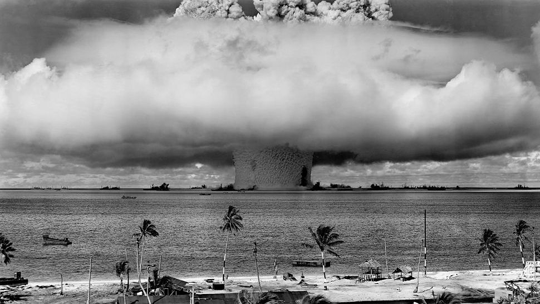
The radioactive fallout from Bravo covered the planet, including the Southern Hemisphere. It was a fission-fusion-fission bomb, designed to release high levels of radioactivity. Its yield was 15 megatons, but it released almost seven times as much radiation than the Russian Tsar Bomba, which had a yield of 50 megatons. Continue reading
British takeover, and their goal of genocide – true history of Aboriginal Australia
Thus there were no treaties concluded with Aboriginal group and no arrangements were made with them to acquire their land, or to regulate dealings between them and the colonists.
Some notable colonial legislation that targeted Aboriginal peoples included:
· 1816 Martial Law (NSW). This proclamation declared Martial Law against Indigenous Australians who could then be shot on sight if armed with spears, or even unarmed, if they were within a certain distance of houses or settlements
· 1824 (Tasmania). Settlers are authorised to shoot Aboriginal peoples
· 1840 (NSW). Indigenous Australians forbidden to use firearms without the permission of a Justice of the Peace
· 1869 (Victoria). The Board for the Protection of Aborigines is established. The Governor can order the removal of any child to a reformatory or industrial school
· 1890 (NSW). In a denial of human rights the Aborigines Protection Board could forcibly take children off reserves and “resocialise” them………
Despite the veil of FIRST WORLD superiority we need to remind all First World nations that they are what they are because of the stolen riches of the countries they have turned into THIRD WORLD and continue to keep them as Third World nations by controlling world trade, the international laws, international rights and justice mechanism and the international media
Britain’s Mass Murder of Indigenous Australians (Aborigines), Lanka Web November 9th, 2013 Shenali D Waduge To those that do not know of Britain’s colonial crimes in their eyes Britain is the epitome of justice, equality, the nation that rears gentlemen of breed and holds the seat of democracy. To those that are aware of British mass murder as ordered by British Governments, the scale of cataloguing these crimes becomes a task in itself and should nullify all claims of any gentlemanly behavior.
The invasion and decimation of Aboriginal Australia was and is entirely a British affair. When Britain devastates a 65,000 year old culture in just 200 years and carries out unthinkable crimes to take over land and exterminate the indigenous population how do we term Britain other than a mass murderer? The Aboriginal experience is depressingly similar to that of Native Americans in the United States. European settlers viciously drove the Aborigines from their land, massacring thousands with impunity. Why does the world remain silent and ignorant of these crimes against humanity?
When the British arrived in Australia in 1788, Australia was NEVER a white country. It was occupied for over 65,000 years by indigenous black Australians later called ‘Aborigines’ by the British. How did these black Aborigines suddenly disappear? British colonial terrorism is the answer. How would the English, such respectable and gentlemanly people get rid of possibly close to 1million indigenous people and take over their lands after their arrival in 1788? How did the Aborigines become less than 100,000 by 1901? The very respectable English settlers cut their food resources and began genocidal massacres and David Cameron speaks to the world on HUMAN RIGHTS! Aborigines did not invade nations or take over lands – the British did and moreover these Aborigines were not warlike people – their culture and livelihood never left room for dissent of the kind that warranted defense. Continue reading
Former Northern Territory Chief Minister speaks out on nuclear waste dump plan
The Commonwealth Radioactive Waste Management Act 2005 was a draconian piece of legislation that took overriding the territory to a new level. It gave the Commonwealth all the powers it needed to build a nuclear waste facility anywhere in the territory. Environment and heritage laws could be set aside, so could the Aboriginal Land Rights Act. This time Howard was determined to remove all possible resistance.
I argued that this was constitutional thuggery but my protests fell on deaf ears. My state colleagues developed temporary deafness as well. I could understand their logic; their state backyards were safe.
 Trucking nuclear waste through Sydney a disaster waiting to happen October 11, 2013 Clare Martin (former chief minister of the Northern Territory.) http://www.smh.com.au/comment/trucking-nuclear-waste-through-sydney-a-disaster-waiting-to-happen-20131010-2vb0a.html
As I drove down Mona Vale Road this week on a visit to Sydney, I began to wonder what would have happened if the tanker involved in last week’s fatalities had been transporting nuclear waste. It is not a fanciful thought because that is the present federal proposal: trucking nuclear waste through Sydney streets to a new national storage facility thousands of kilometres away in central Australia.
The accident made me question yet again the sense of that proposal. Is one site for low- and medium-level nuclear waste preferable to many local? Does storing the waste in remote Australia make it safer, more secure? What are the known dangers inherent in nuclear waste storage? We need to discuss these issues. Continue reading
Coverup of the brutal history of the taking of Aboriginal land
Frontier atrocities against Australian Indigenous people were appalling. Frontier conflict is not pleasant at the best of times, but what happened in Australia has been covered up for too long. I leave you with the words of Henry Reynolds (2006) when summing up attitudes towards frontier conflict – and conflict it was – real, bloodthirsty, brutal – a battlefield and a war, waged almost silently, and with little record of it.
It can be found in almost every type of document – official reports both public and confidential, newspapers, letters, reminiscences. Settlers often counted black bodies either in anger or in anguish; members of punitive expeditions confessed to their participation in a spirit of bravado or contrition. Later observers came across bones and skulls; burnt, buried or hidden and occasionally collected and put proudly on display (Reynolds 2006: 127).
Battlefield Australia : Frontier Conflict in Early Australian Settlement by Sue Carter : HeritageDaily , September 28, 2013 It has been estimated that the first people arrived in Australia possibly around 45,000 years ago and from that time, until the settlement of Europeans on the eastern coast, the Australian Aborigines had been turning space into place for much of that time.
It is equally quite easily demonstrated that Indigenous
people were frequently massacred indiscriminately
and with impunity in Colonial Queensland and
that their remains were treated with disrespect,
if not outright contempt (Ørsted-Jensen 2011: 169)
They viewed their lives as being part of an overall design where everything had a right to live, they carved their position nestled in the landscape, and viewed their lives within it as part of a design in which Country was seen as place. Everything within the Indigenous cultural paradigm was multidimensional and people were attached emotionally, psychologically and metaphysically to the land they inhabited (Bird 1996). They sang songs regarding the history and birth of their part of Country, painted and recited stories which were passed down through generation after generation. ……..
The settlement of the continent included invisible boundaries that were known by the various tribes. Each had their own district where they belonged through spiritual and ancestral bonds and there was interaction between neighbouring tribes where their boundaries overlapped in many complex ways, through spirituality, kinship ties and interaction. A major aspect of the inter-tribal and family relationships was that of sharing; no one owned anything – it belonged to all within the group (Reynolds 2006). They lived with and on the land – protecting, nurturing and preserving – for thousands of years. Continue reading
30 years of the New South Wales Aboriginal Land Rights Act – still a long way to go
 Australia: Spotlight on indigenous affairs today: 20 September 2013 by Charles Harrison, Josephine Heesh, Patricia Monemvasitis, Peter Punch and Janine Smith Carroll & O’Dea ABORIGINAL LAND RIGHTS ACT 1983 (NSW)2013 marks the 30th anniversary of the passing of the New South Wales Aboriginal Land Rights Act 1983 (‘the Act‘), recently celebrated as part of NAIDOC week.
The 1983 Act, passed by the Wran Labor Government, was New South Wales’ first piece of land rights legislation. The Act followed a two year consultation period, facilitated by a Legislative Assembly Select Committee chaired by Maurice Keane, which involved 4,000 individuals across the State and received 262 submissions.
The Act significantly acknowledged prior ownership and occupancy, made unused Crown Land available to claim and established mechanisms to facilitate Aboriginal self-determination. While some Aboriginal activists at the time felt that the Act did not go far enough, the High Court’s previous Justice Kirby once characterised the Act as “little short of revolutionary”, considering its pre-Mabo context.
To mark the anniversary the History Council of NSW organised a seminar during NAIDOC week titled “ Daring ideas: Is Land Rights Enough?“. A panel of lawyers, lecturers, activists and those involved with the administration of the Act discussed and debated the Act’s current operation. There seemed to be consensus amongst the participants, and members of the audience, that while the Act represented a significant step forward, there is still a way to go to deliver meaningful land rights to Aboriginal Australians…….. http://www.mondaq.com/australia/x/263784/indigenous+peoples/Spotlight+on+indigenous+affairs+today
Aboriginal and Torres Strait Islander Commission (ATSIC) – what it meant for Aboriginal Australia
History of government and Aboriginal Affairs prior to 1967 and after The Stringer, by Delephene Fraser September 17th, 2013…..…….History of Aboriginal and Torres Strait Islander Commission (ATSIC)
ATSIC became part of the Australian legislation in 1989 and the government appointed Lois (Lowitija) O Donoghue as ATSIC first Chairperson, ATSIC flung open it doors in March 1990. section 3 of the Aboriginal and Torres Strait Islander Commission Act 1989 sets out ATSIC objectives as follows:
- To ensure maximum participation of Aboriginal and Torres Strait Islander people in government policy
- To promote Indigenous self-management and self-sufficiency
- To further Indigenous economic, social and cultural development, and
- To ensure co-ordination of Commonwealth, state and territory and local government policy affecting Indigenous people.
In order to achieve these objectives, ASTIC was to:
· Advise governments at all levels on Indigenous issues
· Advocate the recognition of Indigenous rights on behalf of Indigenous peoples regionally and nationally and internationally
· Deliver and monitor some of the Commonwealth government Indigenous programs and services. Continue reading
Shabby history of destruction of Aboriginal culture and land ownership
Rudd and Abbott charge the north Eureka Street Dean Ashenden | 19 August 2013 “……..Credit for getting this history under way goes to the pastoral grandees of the colony of South Australia. In the 1860s they funded an obsessive-compulsive alcoholic Scotsman to find out what lay between their northern border and the far coast, and how it could be got. John McDouall Stuart’s six expeditions found little to encourage them, but lust trumped reason, and South Australia set itself to be the first colony in history to found a colony. The two would fuse, in time, to become the Great Central State.
Dreams of imperial glory and speculative fortunes turned almost immediately into a long-running mixture of farce and nightmare. Eventually South Australia got lucky. In 1911 it managed to palm off its colony onto the newly-constituted Commonwealth of Australia. Astonishingly, the Commonwealth even agreed to pay serious money for it, nearly four million pounds, plus another 2.2 million for a railway line that had not even reached South Australia’s northern border, let alone made any money.
Believing, as had the South Australians before them, that there must be a way to turn space into land, the Commonwealth did what South Australia had done, with the same result. An official inquiry report in 1937 was scathing. It found that in the 25 years since the takeover the federal government had spent more than 15 million pounds and was heading further into the red. The previous year’s production had brought in 100 000 pounds less than the Government’s outlay for the year of 600,000 pounds.
But the inquirers nonetheless found that it can be done, if it’s done right. It prescribed the familiar medicine: ports, roads, bridges, railways, ports, industry development boards, the lot.
Much of what the inquiry wanted soon came to pass, but not in result of its proposals. In 1939, war saw tens of thousands of troops stream north to build roads, airfields, a port and other infrastructure. For the first time the white population exceeded the black.
Soon motor vehicles, aircraft, air conditioning and buckets of public money transformed the look and feel of the Territory, but ‘development’ remained elusive. In the Territory, and more particularly in neighbouring tropical Queensland and Western Australia, mining was the only big earner, not necessarily to the advantage of government revenues.
The kind of on-the-ground industries apparently envisaged by Rudd and Abbott — horticulture and agriculture particularly — were confined to coastal enclaves or to the margins of viability. Much of the north proved too hot, too wet, too dry, too far from markets, too barren or too pestilential, with the happy consequence that the frontier failed to do its grim work.
Instead of a near-obliteration of Aboriginal populations of the kind seen on the eastern and southern seaboards, northern Australia witnessed a slow-motion saga of sporadic violence and accommodation, of advance and retreat. Neither side ever looked liked winning, and neither ever looked like giving up.
In the aftermath of the Coniston massacres of 1928 both sides abandoned violence for other means, and since then both have used the law, politics, money and public opinion in hundreds of struggles over land and ‘culture’, some famous or notorious, most not, one side straining to gain ground, the other to resist and to recover.
That 160-year struggle now seems to be reaching a new stage. We like to think that the devastation of one population and culture by another is all in the past, but the apparent failure of Rudd and Abbott to notice that northern Australia is shared country suggests that there might be more to come.http://www.eurekastreet.com.au/article.aspx?aeid=37087#.UhP0g9Jwo6I
Plutonium blown up at Maralinga, in secret “Vixen B” tests
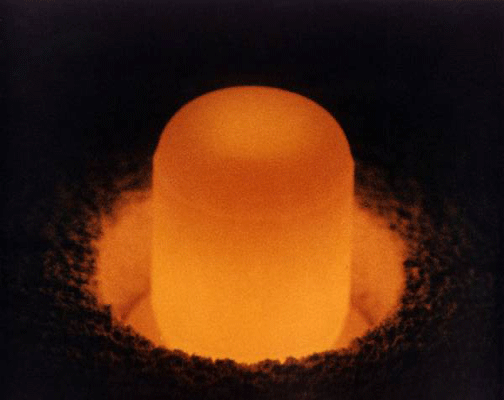 Dig for secrets: the lesson of Maralinga’s Vixen B The Conversation, Liz Tynan, 26 July 13 “……….The tests of far greater consequence were the 12 Vixen B tests, only held at Maralinga These experiments used TNT to blow up simulated nuclear warheads containing a long-lasting form of plutonium.
Vixen B scattered 22.2kg of plutonium-239 around the Maralinga test site known as Taranaki. This form of plutonium has a half-life of over 24,000 years. The extreme persistence of radiation and the threat of cancer posed by inhaling small particles in dust at the site make it especially dangerous.
The Vixen B tests took place amid total secrecy in 1960, 1961 and 1963. Maralinga’s toxic legacy can be summed up in one word: plutonium. When the Maralinga Rehabilitation Technical Advisory Committee (MARTAC) reported in 2002 on efforts to remove contamination from the area it said “Plutonium … was almost entirely the contaminant that determined the scope of the [Maralinga rehabilitation] program.”
The British carried out some clean-up operations after Vixen B and provided a report (by British physicist Noah Pearce) in 1968 that made claims about the level of plutonium contamination at the site. The Pearce report provided the technical basis for the Australian Government to release the UK from any further liability for the Maralinga site.
The technical advisory committee later confirmed that the plutonium contamination at Taranaki was wrong by a factor of 10: “A comparison between the levels reported by the UK at the time (Pearce 1968) and the field results reported by the Australian Radiation Laboratory…(Lokan 1985) demonstrates an underestimate of the plutonium contamination by about an order of magnitude.”……..” http://theconversation.com/dig-for-secrets-the-lesson-of-maralingas-vixen-b-15456
The primary documents in Australian Aboriginals’ fight to keep their land
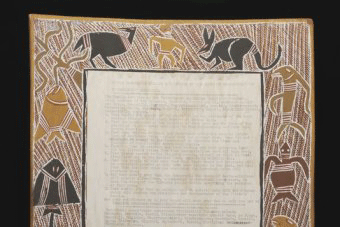 50 YEARS ON, YIRRKALA CELEBRATES BARK PETITIONS THAT SPARKED INDIGENOUS LAND RIGHTS MOVEMENT Yahoo 7 News, 11 July 13, The remote community of Yirrkala in East Arnhem Land is celebrating 50 years since the signing of the historic bark
petitions that paved the way for the Indigenous land rights movement……… Local NAIDOC week coordinator Rosealee Pearson says what
the leaders achieved at a time before Indigenous Australians were even counted on the national census cannot be overstated.
“It’s pretty astounding that a group of people who weren’t even counted as human beings decided to do that,” she said.
“It’s because of them and the fight they fought that I exist as a person.”
The ochre-framed bark petitions were adorned with the clan designs of all that was threatened by mining – from the snakes to the sand dunes. They were first traditional documents to be recognised by the Australian Parliament.
Ms Pearson says the combination of traditional and modern forms of communication helped bridge a gap between the two cultures at the time. The petitions were created in 1963 to protest against the Federal Government’s removal of 300 square kilometres of land from the Arnhem Land reserve so that bauxite found there could be mined…… Despite not achieving the constitutional change sought, the petitions were the spark which lit the flame for the eventual recognition of Indigenous rights in Commonwealth law.
Less than five years later, a referendum was held and the Australian
Constitution amended to count Indigenous Australians in the national census.
Less than a decade after that, the Northern Territory Aboriginal Land Rights
Act was passed…….
http://au.news.yahoo.com/latest/a/-/article/17938240/50-years-on-yirrkala-celebrates-bark-petitions-that-sparked-indigenous-land-rights-movement/
Recognition of the Aboriginal law system in Australia
In 1971 Justice Blackburn dismissed the Yolngu claim but importantly did acknowledge for the first time in an Australian higher court the existence of a system of Aboriginal law
The Yirrkala Bark Petitions. How an old typewriter helped change the course of Australian history, Crikey BOB GOSFORD | JUL 07, 2013 “………In a small display case in a dimly lit room in Australia’s Parliament House in Canberra – cheek by jowl with a facsimile of the Magna Carta and Australia’sConstitution – sit three panels of richly painted stringy-bark.

It is significant that these documents, all of which inform contemporary law in this country, can be found within metres of each other. The Magna Cartaand The Australian Constitution are fundamental elements of European law in this country. Few Australians know of the content, importance and continuing relevance of the Magna Carta and our Constitution and even fewer know, let alone realise the significance of, these three small pieces of bark, each with ancestral images wrapped around a sheet of yellowing paper with faint text.
The first two of these petitions were presented to the Commonwealth Parliament 50 years ago in August 1963 and represent the first documents received by that parliament that recognised the existence – but not the primacy – of Aboriginal law and claims to ownership of their ancestral lands.
The petitions were unsuccessful – the first was the subject of an extraordinary technical challenge by then Territories Minister Paul Hasluck – but that did not deter the Yolngu traditional owners, who in December 1968 issued writs in the Supreme Court of the Northern Territory against the Nabalco Corporation, which had secured a bauxite mining lease from the Federal Government. In that claim the Yolngu claimed unextinguished communal native title to their lands. Continue reading
Remembering Senator Jean Melzer , an anti nuclear hero
Jean Isobelle Melzer died on June 18, 2013. An Australian Senator, Jean Melzer represented the Australian Labor Party and the state of Victoria. She was elected at the 1974 election, becoming the first woman Labor senator from Victoria . In 1978 she was the first woman elected as the Secretary of the Labor Caucus. She served two terms. In 1980, despite Melzer’s great popularity in the labor party and electorate, the ALP executive moved her to an unwinnable 3rd ticket position, replacing pro uranium Robert Ray at the top ticket. This ensured Melzer’s defeat at the 1980 election.
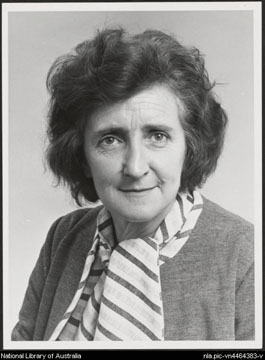
In 1984, Jean Melzer as Convener of the Movement Against Uranium Mining led the campaign opposing Labor’s move to a pro uranium mining policy.
She also stood unsuccessfully as the lead Victorian senate candidate for the Nuclear Disarmament Party in the 1984 election.
Jean Melzer was also a great campaigner for Aborigines, migrants, pensioners, and for anti discrimination in all areas. She stood up for the rights of the disadvantaged.
Pushed out of her Senate position by the pro nuclear ALP, Jean Melzer continued working in the community and in environmental protection.
In 2004 she was awarded the Medal of the Order of Australia (OAM).
Jean Melzer will be remembered for her many contributions to Australia, and for her warning:
“Don’t let Australia become the quarry and waste dump of the world” Noel Wauchope 25 June 2013
Nugget Coombs, an economist who understood Aboriginal society
 THE WAY AHEAD: The new land grab Tracker, BY JEFF MCMULLEN, JUNE 21, 2013“……..Even in the Labor Party, some like Dr Gary Johns and Aboriginal businessman, Warren Mundine, then National Vice President of the ALP, jeered at what they saw as the old ’Nugget Coombs’ model of communal Aboriginal society and they cheered for private land ownership, arguing that “communal land holding was retarding Aboriginal people.
While neo-liberalism was beginning to shape the views of some prominent Aboriginal operators like Warren Mundine, Noel Pearson and
Marcia Langton, the biggest influence on John Howard’s inner circle of advisers and parts of the bureaucracy in Canberra came from the poison pen of Professor Helen Hughes, a Senior Fellow at the right-wing Centre for Independent Studies,
Hughes painted what I consider a grossly distorted picture of the Aboriginal policy of self-determination by attacking the vision of the
former Reserve Bank head, Nugget Coombs. She derided Coombs for his remote community “experiment that was to give Aborigines and Torres Strait Islanders a socialist utopia, leading to the establishment of a separate nation.”
Nugget Coombs had and still has many bitter and twisted ideological opponents, but the truth is he was an establishment economist with a
good grasp of animist attachment to land. He advocated autonomy for remote Aboriginal homelands based on traditional Cultural divisions, the kind of Indigenous control that I have seen bring rapid improvement to the wellbeing of many First Nations societies in the
United States and on the Saami lands of Norway, Finland and Sweden…..
But Helen Hughes and other neo-liberals do not seem to be influenced by history or evidence.
The striking difference between this vision of self-determination and the neo-liberal approach to developing Aboriginal lands is that
neo-liberalism involves dispossessing people of communal lands through dubious promises of payoffs if they sign long leases and chase the great Aussie Dream of a mortgage and “private home ownership”…….http://tracker.org.au/2013/06/the-way-ahead-the-new-land-grab-2/http://tracker.org.au/2013/06/the-way-ahead-the-new-land-grab-2/
Nuclear weapons were the real goal in Australia’s uranium industry, and Lucas Heights reactor
Australia and the Bomb http://workersbushtelegraph.com.au/2013/04/14/australia-and-the-bomb/ Ian CurrAfter WW II both Liberal and Labor parties in Australia supported the development of a nuclear bomb – that is why the nuclear reactor at Lucas Heights in Sydney was developed. They also supported uranium mining and export and nuclear power. So the major parties were not merely allowing the British to test their bomb at Maralinga they supported Australia getting a nuclear bomb. Australia did not acquire a nuclear weapon because it needed American support to get the technology to make a bomb. The US refused that support to both Australia and Canada but supported the British acquisition and testing on the bomb on Aboriginal land in South Australia.If anyone in the Labor party disagrees with my take on the history, lets hear what you have to say about it.
There was a ban the bomb movement in Australia and members of the ALP and trade unions participated in that movement, but ALP policy was to join the nuclear race. So it is little wonder that when Hawke came to power in 1983 he made sure the ALP government mined and exported Uranium.
Both Liberals & Nationals supported Australian involvement in the nuclear club throughout this period.
“Plains of Maralinga” describes the British atomic bomb tests at Maralinga and their deadly side-effects on the Pitjantjatjara people. Song performed when Alistair was on tour with David Rovics in Australia in 2008.
1 This month
7 April – WEBINAR – Australia and the Doomsday Clock – Preventing nuclear war through NoFirstUse and other policies
Online | Tuesday April 7, 4:00-5:30pm, Australian Eastern Time / 8:00-9:30am Central Europe Time
– Access the registration link
15 April – Zoom –Nuclear Power is Not the Solution
Apr 15, 2026 01:00 AM in Canberra, Melbourne, Sydney

Join the International Physicians for the Prevention of Nuclear War (IPPNW) on Tuesday, April 14th for a timely webinar exploring the risks associated with nuclear power and challenging the myth that it offers a simple, safe, carbon-free solution to the climate crisis

21 April Webinar: No Nuclear Weapons in Australia
Start: 2026-04-21 18:00:00 UTC Canberra, Melbourne, Sydney (GMT+10:00)
End: 2026-04-21 19:30:00 UTC Canberra, Melbourne, Sydney (GMT+10:00)
Event Type: Virtual
A virtual link will be communicated before the event.
Host Contact Info: australia@icanw.org

of the week – Australians for War Powers Reform (AWPR)
To see nuclear-related stories in greater depth and intensity
 Antinuclear