Is John Howard lying about the reasons for going to war in Iraq?
 Howard ignored official advice on Iraq’s weapons and chose war SMH, April 12, 2013 Margaret Swieringa Former prime minister John Howard’s justification this week on why we went to war against Iraq in 2003 obfuscates some issues.
I was the secretary to the federal parliamentary intelligence committee from 2002 until 2007. It was then called the ASIO, ASIS and Defence Signals Directorate committee – which drafted the report Intelligence on Iraq’s Weapons of Mass Destruction. Howard refers to this committee in his speech justifying our involvement in the war.
The reason there was so much argument about the existence of such weapons before the war in Iraq 10 years ago was that to go to war on any other pretext would have been a breach of international law. As Howard said at the time: ”I couldn’t justify on its own a military invasion of Iraq to change the regime. I’ve never advocated that. Central to the threat is Iraq’s possession of chemical and biological weapons and its pursuit of nuclear capability.”
So the question is what the government knew or was told about that capability and whether the government ”lied” about the danger that Iraq posed. At the time, Howard and his ministers asserted that the threat to the world from Iraq’s weapons of mass destruction was both great and immediate. On February 4, 2003, he said Saddam Hussein had an ”arsenal” and a ”stockpile” and the ”illegal importation of proscribed goods ha[s] increased dramatically in the past few years”. ”Iraq had a massive program for developing offensive biological weapons – one of the largest and most advanced in the world.”……
None of the government’s arguments were supported by the intelligence presented to it by its own agencies. None of these arguments were true.
Howard this week quoted the findings of the parliamentary inquiry, but his quotation is selective to the point of being misleading.
What was the nature of the intelligence on Iraq’s weapons of mass destruction provided to the government? The parliamentary inquiry reported on the intelligence in detail. It gathered information from the Defence Intelligence Organisation and the Office of National Assessment. It said:
1. The scale of threat from Iraq’s weapons of mass destruction was less than it had been a decade earlier.
2. Under sanctions that prevailed at the time, Iraq’s military capability remained limited and the country’s infrastructure was still in decline.
3. The nuclear program was unlikely to be far advanced. Iraq was unlikely to have obtained fissile material.
4. Iraq had no ballistic missiles that could reach the US. Most if not all of the few SCUDS that were hidden away were likely to be in poor condition……
The committee concluded the ”case made by the government was that Iraq possessed WMD in large quantities and posed a grave and unacceptable threat to the region and the world, particularly as there was a danger that Iraq’s WMD might be passed to terrorist organisations.
”This is not the picture that emerges from an examination of all the assessments provided to the committee by Australia’s two analytical agencies.”
Howard would claim, no doubt, that he took his views from overseas dossiers. But all that intelligence was considered by Australian agencies when forming their views….. Read more: http://www.smh.com.au/comment/howard-ignored-official-advice-on-iraqs-weapons-and-chose-war-20130411-2hogn.html#ixzz2QIaBzFWL
Western Australia’s asbestos town – a prelude to uranium towns?
WA GOVERNMENT TO MOVE LAST RESIDENTS FROM ASBESTOS TOWN ABC Radio National 3 April 2013 By:Catherine Van Extel The West Australian Government is looking to move a group of residents who continue to live in the deadly asbestos mining town of Wittenoom, in the Pilbara region of Western Australia. But while there are moves to finally clean up the toxic site, many continue to face the legacy of their time spent growing up in or visiting the notorious town.

The 1990 Midnight Oil song ‘Blue Sky Mine’ was inspired by Wittenoom and its deadly mining industry. It’s estimated that more than 20,000 people lived at Wittenoom before the mine closed in 1966.
Asbestos-related diseases have killed more than 2000 former workers and family members of Wittenoom, a death toll that continues to rise.
In 2007, the state government withdrew Wittenoom’s town status—disconnecting services like water and electricity—but a small group of residents stayed. Now the government wants them out in order to remediate the contaminated site. Continue reading
Kevin Buzzacott supports Scotland’s Scrap Trident Coalition
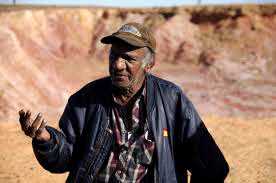 Sadly, the scandalous devastation and exploitation of land which carries great spiritual significance for the Aboriginal people did not end there. Almost 50% of the world’s estimated stocks of Uranium ore occur in Australia, the vast majority of which are to be found on Aboriginal land. These are minerals which are much coveted by large mining companies who wish to remove them despite the costs to workers, the natural landscape and the safety of the globe. Despite the fact that Aboriginal Australians continue to endure standards of living and health far below those of non-indigenous Australians, the indigenous communities in general remain steadfastly opposed to the exploitation of their traditional lands for these poisons.
Scrap Trident – A message from the Arabunna Nation for the people of Scotland http://scraptrident.org/scrap-trident-a-message-from-the-arabunna-nation-for-the-people-of-scotland/ 19 March, 2013 We here at the Scrap Trident Coalition are immensely proud to have received the message of support from Arabunna Nation elder Kevin Buzzacott. Continue reading
Australia’s shame – the wrong done to Maralinga’s soldiers and Aboriginal communities
 That 8000 of our men could be placed so close to ground zero seems impossible to believe. That we as a nation have refused to compensate these men is bad enough; that we won’t even grant them full access to health benefits is just plain staggering.
You will not be surprised to learn that cancer rates are 23 per cent higher in these men than in the rest of the population. Their children have higher rates of cancer as well. Deformities, miscarriages and the like are too easy to find among their families.
These men were put in harm’s way by the Australian government
We must right the wrong of Maralinga BY:GRAHAM RICHARDSON The Australian March 01, 2013 THERE was never much chance that Bob Menzies would knock back a request from the government of Britain. The future Lord Warden of the Cinque Ports was an Anglophile of the highest order.
In the early 1950s, when the old country requested that a stretch of Australia should be set aside to allow the Brits to explode nuclear bombs, Menzies was only too eager to please. A few bombs were tested on Montebello Island off Western Australia, but the area was pretty small and when more territory was sought, Maralinga was chosen.
It must have been an easy choice at the time. A long way from anywhere, no population to speak of apart from a few Aborigines who could easily be moved on, inhospitable desert unfit for living creatures apart from lizards, snakes and witchetty grubs – no doubt his view was that this would be uncontroversial, and he was right.
As Australia recovered from the aftermath of World War II there were bigger things to worry about than Maralinga. In fact, Menzies thought so little of all this that he acceded to the request without even putting it to his cabinet. Continue reading
1982 – Northern Territory government’s secret plans for uranium enrichment plant
 Plan for nuke plant NT News, NIGEL ADLAM | January 1st, 2013 THE
Territory Government was keen to set up a uranium enrichment plant in
the NT, according to Cabinet documents from 1982 made public today
under the 30-year rule. Paul Everingham’s administration wanted to
process yellowcake from the Ranger mine, which had opened a year
earlier. ..The project was stillborn because it failed to win Federal
Government approval.. Yellowcake is trucked 220km from Ranger, near
 Jabiru, to Darwin for export.
The trade used to attract fierce opposition. Protesters often tried to
halt the shipments, which left from Fort Hill wharf until the East Arm
port was built, by climbing cranes. It would usually take several
hours for police to get them down….
Joh Bjelke Petersen’s secret plans for uranium enrichment at Ipswich
The revelation came as a shock to Cr Tully, elected to the Ipswich
City Council in 1979.
Cr Tully had no inkling the Bjelke-Petersen government had Ipswich in
its sights.
“That’s news to me. It’s outrageous that any government would consider
Ipswich or any other city as a potential site and keep it secret from
the city,” he said.
Cr Tully said government documents should be released after 10 years
“What are governments thinking about now? They are talking about
uranium mining in Queensland now; will we have to wait 30 years to
hear about it?”
Papers reveal Bjelke-Petersen uranium plant plan for Ipswich
http://www.qt.com.au/news/papers-reveal-uranium-plant-plan-for-ipswich/1702063/
Kieran Banks 1st Jan 2013
Sunshine Coast Daily Archives – 21 June 1976
IPSWICH was identified as a possible site for a uranium enrichment
plant following a secretive government investigation in the 1980s,
confidential cabinet documents reveal today. Continue reading
How the Western Australian govt and mining companies sabotaged Aboriginal land rights
 By December 1984, the government’s commitment to national land rights
was in disarray as the mining industry dug in and Mr Burke introduced
legislation that did not permit any veto over mining or exploration,
restricted Aboriginal applications to land with little economic
potential, retained the state’s power to resume land and imposed a
four-year time limit on claims.
Miners and Brian Burke sank land rights hope
http://www.theaustralian.com.au/in-depth/cabinet-papers/miners-and-brian-burke-sank-land-rights-hope/story-fngr9pxq-1226545827125
BY: STUART RINTOUL The Australian January 01, 2013 A CONCERTED
campaign by the mining industry, backed by the Burke Labor government
in Western Australia, left the commonwealth’s commitment to national
land rights in disarray by the end of 1984. Continue reading
Past Queensland govt wanted uranium enrichment, and no federal control over uranium industry
the Queensland Government had told the
Commonwealth it wanted control over dealing with nuclear materials in
its state.
In a submission to the Federal Government on the Atomic Energy Act
1953, the Queensland Government argued any new legislation should
reflect the state’s right to control the minerals.
Caboolture was earmarked for Qld uranium plant by Joh, Caboolture News,
Ava Benny-Morrison 1st Jan 2013 CABOOLTURE was
earmarked for a potential uranium plant by the Joh Bjelke-Petersen
Government, previously confidential cabinet documents have revealed.
The papers showed that a long-running, secretive investigation into a
plant in Australia identified Caboolture as well as Ipswich as
notional sites.
The Bjelke-Petersen Government had its vision for uranium exploration
in Queensland in full swing in 1982, pitching its interest to be home
of an east coast enrichment plant. Continue reading
Australian town powered by solar energy 1981 – 2004
 Historic Australian Solar Farm To Become A Museum http://www.energymatters.com.au/index.php?main_page=news_article&article_id=3526 25 Dec 12, Long before the solar power boom in Australia, the White Cliffs Solar Power Station was generating clean electricity for a town.
Located at White Cliffs, New South Wales, which had no grid connection at the time; it was constructed in 1981 by a team from Australian National University.
The solar farm originally featured fourteen three-metre parabolic dishes covered in thousands of mirrors and mounted on heliostatic mountings; which followed the sun throughout the day. Continue reading
Australian security scholar Des Ball saved us all from nuclear war
Des Ball: the man who saved the world, The Age, December 21, 2012, David Wroe, THAT America could launch a limited nuclear strike against Russia was a fashionable belief in US strategic theory of the 1970s. Policymakers thought that if Cold War tensions boiled over, they could hit selected Soviet targets in a way that controlled further
escalation and forced Moscow to back down.
It took the iconoclastic Australian security scholar Des Ball to point out that the theory was bunkum. In his influential essays of the early 1980s, Ball argued that reasoned strategic theory was likely to go out the window once the missiles started flying. Among the first targets would be the other side’s command and control centres – its eyes and ears. Once blinded, a superpower – consisting of real people responding with human instincts – would not distinguish a ”controlled” strike from a full-scale attack and would retaliate with everything it had.
A controlled exchange would quickly become all-out nuclear war. Today, none other than former US president Jimmy Carter says that Ball’s work helped save the world from potential holocaust. In a new book of essays honouring Ball’s four decades helping to keep Australia and the world a safer place, Carter says Ball’s ”counsel and cautionary advice, based on deep research, made a great difference to our collective goal of avoiding nuclear war”.
Released last week, the book, Insurgent Intellectual: Essays in Honour of Professor Desmond Ball, is an extraordinary outpouring of praise for a colossus of strategic thinking in Australia – albeit one who stands out as an odd fit among his generation of largely conservative colleagues.
Ball, who is marking his 25th year as a special professor at the Australian National University’s Strategic and Defence Studies Centre, cuts an unusual figure with his beard, rumpled clothing and rat’s tail hair………
http://www.theage.com.au/national/des-ball-the-man-who-saved-the-world-20121220-2bpdd.html#ixzz2FiJCmAdw
Australia’s new Solar Hall of Fame
Solar Hall Of Fame For Australia http://www.energymatters.com.au/index.php?main_page=news_article&article_id=3505 by Energy Matters, 10 Dec 12, Australian pioneers of solar power are receiving some well-earned recognition via the new Australian Solar Hall of Fame.
“The inaugural inductees in the Solar Hall of Fame include some of Australia’s greatest scientists, innovators and entrepreneurs and collectively represent an extraordinary contribution to tackling global climate change,” said John Grimes, Chief Executive of the Australian Solar Council.
Mr. Grimes says Australia has “punched well above its weight” with regard to solar research, development and deployment and last year, Australian households installed more home solar panel systems than any other country in the world.
Some of the inaugural inductees to the Hall of Fame include: Continue reading
How Australia was sold the idea of atomic bomb testing, uranium mining, nuclear power
…. all manner of consumer and industrial goods were arrayed as icons of the coming atomic utopia.
‘ON THE BEACH: AUSTRALIA’S NUCLEAR HISTORY, Discontents Tim Sherratt, 7 Dec 12
“…..The crossroads of destiny At 8.00 am on the 1 July 1946 the inhabitants of eastern Australia tuned in to the atomic age. In a live radio broadcast from Bikini Atoll, they listened as the world’s fourth atomic bomb was exploded – ‘Bomb’s away! Bombs away!’ came the excited radio announcer’s call.
Some weeks later, a fifth atomic bomb was detonated, again at Bikini. Continue reading
Queensland’s scandalous uranium history: a bad idea to start it again
 Queensland Forgets Its Uranium History http://newmatilda.com/2012/10/24/queensland-forgets-its-uranium-history Jim Green, New Matilda, 24 Oct 2012 The Queensland Government is unwise to reverse the ban against uranium mining and there is no stronger reason than the industry’s sordid track record in the state.
French company Minatome undertook trial mining at Ben Lomond, near Townsville, in the early 1980s. Federal MP Bob Katter spoke at length about Ben Lomond in Parliament on 1 November 2005. He noted that Minatome initially denied reports of a radioactive spill, but then changed its story and claimed that the spill posed no risk and did not reach the water system from which 210,000 people drank.
 Bob Katter’s version of the story is on Hansard: “For the next two or three weeks they held out with that story. Further evidence was produced in which they admitted that it had been a dangerous level. Yes, it was about 10,000 times higher than what the health agencies in Australia regarded as an acceptable level. After six weeks, we got rid of lie number two. I think it was at about week 8 or week 12 when, as a state member of parliament, I insisted upon going up to the site. Just before I went up to the site, the company admitted — remember, it was not just the company but also the agency set up by the government to protect us who were telling lies — that the spill had reached the creek which ran into the Burdekin River, which provided the drinking water for 210,000 people. We had been told three sets of lies over a period of three months.”
 Queensland’s other misadventure with uranium was the Mary Kathleen mine in western Queensland. In the mid-1970s, a whistleblower from Mary Kathleen Uranium Mining leaked documents which revealed the existence of a global uranium cartel leading to protracted international scandals and fines totalling hundreds of millions of dollars.
The leaked documents also revealed evidence of shoddy environmental practices at Mary Kathleen; close surveillance of environmental organisations; the close relationship between then-ACTU President Bob Hawke and the chairman of uranium miner Conzinc Riotinto Australia; and advice from government officials about how companies could circumvent non-proliferation treaties in order to sell uranium to countries that had not signed the Nuclear Non-Proliferation Treaty.
One million litres of radioactive liquid were released in February 1984 from Mary Kathleen’s evaporation ponds during a wet spell. Even now, 30 years after the mine’s closure, there is ongoing seepage of saline, metal and radionuclide-rich waters from tailings, as well as low-level uptake of heavy metals and radionuclides into vegetation.
Bob Katter’s son, state MP Rob Katter, claims that uranium mining represents a potential $20 billion export industry for Queensland which could generate 2600 jobs. The simple facts are that uranium accounts for just 0.2 per cent of Australia’s export revenue ($610 million in 2010-11) and less than 0.02 per cent of Australian jobs (1760 jobs including mining, exploration and regulation). Queensland is home to just 3 per cent of Australia’s uranium resources.
Rob Katter claims that Queenslanders support uranium mining but he provides no evidence. The latest poll reported in the Courier Mail in November 2008, found that 47 per cent of Queenslanders oppose uranium mining compared to 45 per cent in support. Two-thirds of Queenslanders oppose uranium sales to nuclear weapons states. A majority of Australians believe that the “safeguards” system, which aims to prevent nuclear weapons proliferation, is ineffective.
Before the last state election, the Queensland Liberal National Party said it had no intention of reversing the ban against uranium mining. Campbell Newman’s LNP Government ought to take its new position to the next state election. Better still, a referendum could be held on the question of uranium mining when Queenslanders next go to the polls.
The uranium industry has no capacity to deliver serious economic benefits to Queensland but, if given the chance, it will create more long-term environmental and public health hazards such as Ben Lomond and Mary Kathleen.
In 1950s Australian government set scene for USA missile bases here
Australia’s untold reaction to the Cuban Missile Crisis, The Conversation, Laura Stanley, 16 Oct 12 Fifty years ago, the United States and the Soviet Union stood on the brink of nuclear war over Soviet missiles in Cuba. Since then, the Cuban Missile Crisis has been recognised as one of the most definitive moments of the 20th Century.
In the past twenty years, declassified government records have revealed indeed how close the parties came to nuclear conflict. More records continue to be declassified…….. What has not been greatly explored to this point, however, is Australia’s reaction to this crisis. Continue reading
Lies and coverups about radiation, from Maralinga to Fukushima
In 1953, Lallie Lennon was engulfed by a bomb fallout cloud. She became ill. She still suffers painful scars, though they have improved. From 1952 she began asking for a diagnosis. She asked throughout the 1950s, the 1960s, the 1970s. Not until the 1980s did she get an answer.
And then, the Young Doctors ignored radiation as a factor. They brushed aside her mention of the fallout which caused her health to decline and which caused her suffering. She is not the only one.
Nuclear sector seeks to regain trust after Fukushima< Paul Langley’s Nuclear History Blog, Sep 13, 2012
“……..Over the last year and a half I have watched world nuclear authorities act increasingly in the same manner as the British nuclear authorities acted in Australia. They lied about the amount and impact of fallout. They lied about the extent of contamination residue on land and in water and food.
They lied about casualities, they lied about and with held diagnosis for decades, they with held hospital records, they claim to have lost ALL of the Maraling nuclear test health records.
They claim radiation affected no nuclear veteran, even at the same time as they admit that nuclear veterans suffer 23% higher risk of disease. They are perplexed, in public about this. Even today, the land which British authorities claimed was perfectly clean,remains, forever, banned from permanent human use. Yet Aboriginal people, whose land it is, know very well that the game they catch up there may well British radionuclides in its flesh…… Continue reading
1 This month

of the week – Australians for War Powers Reform (AWPR)
To see nuclear-related stories in greater depth and intensity
 Antinuclear