History of Australian children exposed to nuclear radiation
Australian Map of Nuclear Sites, Overview Jim Green Sept 2012
Some of the recurring patterns in Australia’s nuclear history are discussed here under the following headings: children exposed to radiation; racism; struggle; unresolved radioactive contamination issues; deceit; whistleblowers; secrecy; rhetoric versus reality; lessons not learnt; and surveillance, intimidation, and police brutality.
Children exposed to radiation
Due to the lack of fencing, the contaminated Port Pirie Uranium Treatment Complex site was used as a playground by children for a number of years. The situation was rectified only after a six-year community campaign.
After mining at Rum Jungle in the NT ceased, part of the area was converted to a lake. As a crocodile-free water body in the Darwin region, the site became popular despite the radioactivity.
In November 2010, the Rum Jungle South Recreation Reserve was closed due to low-level radiation in the area. The Department of Resources advised the local council to shut down the reserve as a precautionary measure.
In 2012, damage to a security gate allowed children to enter a contaminated site near Kalgoorlie. More than 5,000 tonnes of tailings from the Yeelirrie uranium deposit, near Wiluna, were buried there in the 1980s. BHP Billiton said it would improve security.
In a 1997 report, WMC admitted leaving the contaminated trial uranium mine at Yeelirrie, WA, exposed to the public with inadequate fencing and warning signs for more than 10 years. A spokesperson for WMC said a 1995 inspection revealed the problems and also admitted that the company could have known about the problems as early as 1992. WMC said there was inadequate signage warning against swimming in a dam at the site, which was found to be about 30 times above World Health Organisation radiation safety standards and admitted that people used the dam for “recreational” purposes including swimming.
Children and adults alike have been exposed to radiation from the contaminated uranium processing site at Hunters Hill in Sydney (and children are more susceptible to radiation-induced cancers due to their growing bodies). Only in recent years has the contamination come to light after decades of deceit and obfuscation. The NSW Health Commissioncovered up the dangers of Hunters Hill. An internal memo in 1977 told staff to “stall and be non-committal” when responding to queries. Residents were told there was “no logical reason” to carry out radiation or health tests even though the NSW government knew that there were compelling reasons to do so.
A similar attitude has been displayed towards people living near the Lucas Heights research reactor. An internal 1998 federal Department of Industry, Science and Resources briefing document, obtained under Freedom of Information legislation, warns government officials: “Be careful in terms of health impacts − don’t really want a detailed study done of the health of Sutherland residents.”
Another incident with child safety concerns occurred in May 1997 when a radioactive source was stolen from an ANSTO promotional display at Menai High School. An ANSTO spokesperson said the source could be handled “quite safely but shouldn’t be for long periods.” The radioactive source was never recovered.
In the 1950s, the British-Australian nuclear cabal suppressed research demonstrating the contamination of grazing sheep and cattle with strontium-90 from nuclear bomb tests in Australia. Whistleblower Hedley Marston warned that proof of widespread contamination would be found “in the bones of children”. The nuclear cabal and the Australian government initiated a testing program in 1957, but it was done in secret using stolen body partsfrom dead babies, still-borns and infants.
The Advertiser conspicuously failed to inform residents of Adelaide of the plume of radioactivity which contaminated the city after the bungled nuclear bomb test of 11 October 1956. The Advertiser did however run a story in 1957 titled ‘Radioactive Children Are Brilliant’ − a baseless theory from a British psychiatrist linking strontium 90 to ‘brilliant’ children……….. http://australianmap.net/overview/
How Aborigines were cheated out of their land in Victoria
The most important outcome of this event was that Batman became the first and possibly the only early Anglo-Australian to formally recognise the indigenous Aboriginal population as property owners.
 On this day: annulment of the Batman treaty AUSTRALIAN GEOGRAPHIC 27 Aug 12 IN 2012, MOST MELBOURNIANS would be confused if you offered them a handful of tomahawks, a few handkerchiefs, some blankets and some scissors for their land. One hundred and seventy-seven years ago in the rough-shod days of early Australian settlement, however, they
represented a princely sum. And that is exactly what settler John Batman used for currency to acquire the 250,000ha on which Melbourne and Geelong sit. Continue reading
Former South Australian Premier Mike Rann – a uranium legacy in tatters
 In the end, they weren’t able to deliver the new jobs, the billions in taxes and the mining boom.
The Olympic Dam expansion is now a genuine “mirage in the desert”…..
How Olympic Dam became a mirage in the desert, Crikey, by Kevin Naughton of InDaily, 23 Aug 12, It’s seven years since an excited Premier Mike Rann and his then-deputy Kevin Foley started briefing media executives about an imminent mining boom. Central to the spruik was BHP’s new estimation of Olympic Dam, the copper, gold and uranium mine in South Australia that it had just bought from Western Mining Corporation……
Ousted by the party’s powerful right wing in July, Rann brokered a deal to hang on until late October, so he could see the amended Olympic Dam Indenture Agreement deal through Parliament, adding to his legacy. That legacy now has a hole in it; on a political scale, larger than the one BHP talked of digging.
In a curious political twist dating back 30 years when the ALP was split over whether the original mine should go ahead, Rann labelled it a “mirage in the desert”. Rann had come to SA in 1977 as an anti-uranium campaigner from New Zealand and scored a job with then-premier Don Dunstan. Dunstan resigned in 1979 and incoming Liberal premier David Tonkin became an advocate for mining in the state’s north, but the numbers in Parliament were tight. Continue reading
In Cold War, Russia targeted Australia’s USA military bases, not our cities
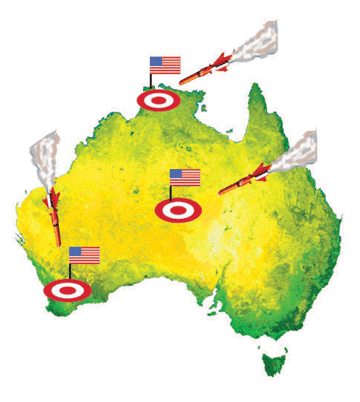 the US-Australian naval communications station at North West Cape in Western Australia would be a high-priority nuclear target
risks of nuclear attacks on the Pine Gap signals intelligence satellite ground station in central Australia and the missile launch detection facility at Nurrungar
Secret’s out: Soviets did not target cities http://www.smh.com.au/opinion/political-news/secrets-out-soviets-did-not-target-cities-20120805-23ny1.html#ixzz22nPnXqyD August 6, 2012 Philip Dorling THE US-Australian joint defence installations were almost certainly Russian nuclear targets during the Cold War. However, Australia’s cities might well have survived unscathed if superpower tensions had erupted into a global conflagration, according to a top secret intelligence assessment released by the National Archives of Australia.
More than three decades after it was written, the Australian government has finally declassified its most secret study of the
potential impact on Australia of a nuclear war between the US and the former Soviet Union. Continue reading
A reminder of the disgraceful history of Beverley uranium mine in South Australia
police brutality against environmentalists and local Aboriginal people. An online video clip details this brutality. Heathgate applauded the police action (in a 2000 media release which is no longer available online). After a 10-year legal case, 10 people were awarded a total of $700,000 damages.
. At least 59 spills have been documented at the mine. The company sells uranium to nuclear weapons states (all of which are in breach of their disarmament obligations under the Nuclear Non-Proliferation Treaty),
A refresher on who’s behind one of our uranium mines, Jim Green, The Punch, 2 Aug 2012http://www.thepunch.com.au/articles/a-refresher-on-whos-behind-one-of-our-uranium-mines The story behind the corporation that owns the Beverley uranium mine in north-east South Australia is scarcely believable.
Heathgate Resources − a 100 per cent-owned subsidiary of General Atomics (GA) − owns and operates Beverley and has a stake in the adjacent Beverley Four Mile mine. Over the years GA CEO Neal Blue has had commercial interests in oil, Predator drones, uranium mining and nuclear reactors, cocoa, bananas and real estate. Continue reading
Australia’s relentless growth is destroying Australia’s environment
We’re losing the natural places and things that make Australia Australia. And we’re losing our ability to get out there, to notice and to care about that.
Next year let’s give the environment its first proper slice of the Budget pie.
Crumbs not enough for our environment, The West.com.au Charlie Sherwin May 17, 2012, “……….In this day and age do we really so desperately need another coal mine, or another surge of urban growth? Enter the pesky greens, so that now it’s not just the wildlife getting in our way, but the environmental regulations that stop us taking more habitat and growing our bottom line.
The COAG business forum, the Premiers, the Government and the Opposition are right now ganging up to protect the bottom line by “streamlining” regulation and reducing the Federal Government’s role in environment protection.
It’s a global economy, and after a couple of hundred years of this we’ve grown and used a quarter of the Earth’s natural energy, half of its freshwater run-off and two-thirds of its habitable land surface to feed our unrelenting growth.
So we’re displacing other species. Australia’s landscapes, bush and wildlife are paying for our growth. Continue reading
The New South Wales Pacific Highway’s ‘toxic ditch’
Ben Colton said his uncle Robert Deards was one of the initial police officers called to the crash and handled the drums,  which “made him sick to the point he nearly died”. Mr Colton said his uncle and another officer spent 14 hours at the scene – and were later told to go for a swim to wash off any radioactive particles – but their complaints and recognition of their exposure fell on deaf ears.
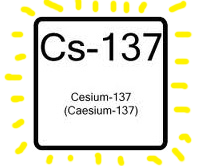 CAESIUM-137 A radioactive isotope formed as a by-product of nuclear fission usually involving uranium. It has a half-life of 30 years. It remains the main health risk and source of radiation around the Chernobyl nuclear power plant. Short term high-level exposure can produce nausea, vomiting, diarrhoea, head aches and blisters, which can return
up to weeks later in the body. It is also blamed for birth defects.
Lethal, toxic truth buried in a highway ditch Herald Sun, By Richard Noone and Neil Keene From: The Daily Telegraph April 19, 2012 WHY radioactive materials, a banned pesticide and food were on the same truck that crashed on the New South Wales Pacific Highway in 1980 is a mystery….. An ANSTO spokesman said the drums – one 60 litres and another smaller one – carrying the nuclear material were undamaged in the crash and later taken with the undamaged food to Brisbane. The rest, including the DDT, was believed to have been buried.
Despite full knowledge of its location the then RTA proceeded with the $60 million upgrade, awarded to BMD Constructions, in March last year without removing it first. Continue reading
Road workers recovered, mystery of 1980 toxic spill remains
 [ on December 4, 1980] The first two police officers on the scene were senior constables Robert Deards and Terry Clifton, who remained there for 12 hours, handling two drums of radioactive material, and handling burst bags containing DDT.
Mystery illness recalls 1980 toxic spill, SMH, Ben Cubby, Nick Ralston, April 19, 2012 FIVE road workers have recovered after exposure to a mystery toxic chemical they unearthed while building a new section of the Pacific Highway near Port Macquarie. The workers were struck by nausea, vomiting and sore throats after excavations uncovered a patch of greyish clay that became streaked with orange after it was exposed to the air.
The site, between Herons Creek and Stills Road near the town of Laurieton, is notorious as the location of one of Australia’s most controversial spills of toxic chemicals and radioactive material. In 1980 a truck rolled over while carrying several tonnes of the insecticide DDT, two drums of radioactive material and some other chemicals. Some of the DDT was apparently buried on site. It sparked a chain of events that saw allegations of a ”massive cover-up” by a local doctor who claimed 13 people involved in the clean-up fell ill, and a parliamentary investigation.
Although the affected workers were exposed nearly three weeks ago and have since returned to work, the cause of the illness remains unknown and a 50-metre exclusion zone has been imposed around the construction site, NSW Roads and Maritime Services said. The Roads Minister, Duncan Gay, said there was no sign of radioactivity, though further tests would be undertaken. Continue reading
Radioactive transport accident New South Wales 1980
Let the Facts Speak: 1980, December 4 PORT MACQUARIE, AUSTRALIA
An accident near Port Macquarie involved a truck carrying a 60-litre drum labelled ‘danger radioactive – Americium 241’, plus a smaller container labeled ‘Caesium 137’ and foodstuffs. When Sydney police called the Atomic Energy Commission at Lucas Heights for advice, they were told to call back later ‘when the AEC opens’. Dr. John McKay of Port Macquarie claimed that 16 people who attended the accident are suffering from symptoms of radioactive poisoning.
Dr. McKay has accused the AEC of a cover-up regarding the dangers of the accident, and has claimed that this lack of concern may endanger the 8,000 people in nearby Laurieton if radiation poisons the town’s water supply. The NSW Minister for Public Health accused Dr. McKay of ‘causing public mischief’. The Minister said the Health Commission report had found that, although the protective containers of the radioactive material were damaged, both were considered to be safe with no spillage or leakage of radioactivity.
Sydney Morning Herald – 16 April 1981; Canberra Times – 11 March 1981; WISE Vol.3 No.3 June/July 1981 p.16; Canberra Times – 11 March 1981
Tony Fitzgerald, former NT Anti Racial Discrimination Commissioner, condemned Norther Territory Intervention
The central recommendation made by the Anti Discrimination Commission was:
The Northern Territory Emergency Response in its present form should be scrapped and transformed from a quick fix, law and order plan into a range of long term initiatives aimed at overcoming remote Indigenous disadvantage and raising indigenous quality of life.
Tony Fitzgerald – an unlikely Territorian hero Crikey, April 1, 2012 – , by Bob Gosford – he quotes Patrick Dodson: “…….Tony was the NT Anti Racial Discrimination Commissioner from 2002 until his passing in 2009.
As Commissioner, Tony was passionate about the need to promote a fair and just society that was free from racial discrimination and inequality…. the report from that review, the Little Children are Sacred Report, became the catalyst for the Howard Government to initiate the Northern Territory National Emergency Response.
Tony was highly critical of the Commonwealth Government’s Emergency Response to Aboriginal communities. He was particularly appalled at the intervention’s suspension of the Racial Discrimination Act, which since its enactment in 1975 has been important in ensuring the protection of all Australians from racial discrimination… Continue reading
In 1998 South Australian Aboriginals fought against plan for radioactive waste dump
 Dumping on Traditional Owners: the ugly face of Australian racism The Drum, Jim Green, 29 March 12 “…..A win for the Kungkas In 1998, the federal government announced its intention to build a national radioactive waste dump near Woomera in South Australia. Leading the battle against the dump were the Kupa Piti Kungka Tjuta, a council of senior Aboriginal women from northern South Australia. Many of the Kungkas personally suffered the impacts of the British nuclear bomb tests at Maralinga in the 1950s.
The Kungkas were sceptical about the government’s claim that radioactive waste destined for the Woomera dump was ‘safe’ – after all, the waste would be kept at the Lucas Heights reactor site south of Sydney if it was perfectly safe, or simply dumped in landfill.
The proposed dump generated such controversy in South Australia that the federal government secured the services of a public relations company. Correspondence between the company and the government was released under Freedom of Information laws. In one exchange, a government official asks the PR company to remove sand-dunes from a photo selected to adorn a brochure. The explanation provided by the government official was that: “Dunes are a sensitive area with respect to Aboriginal Heritage”. The sand-dunes were removed from the photo, only for the government official to ask if the horizon could be straightened up as well.
In July 2003, the federal government used the Lands Acquisition Act 1989 to seize land for the dump. Native Title rights and interests were extinguished at the stroke of a pen. This took place with no forewarning and no consultation with Aboriginal people.
The Kungkas continued to implore the federal government to ‘get their ears out of their pockets’, and after six long years the government did just that. In the lead-up to the 2004 federal election, with the dump issue biting politically, the government decided to cut its losses and abandon its plans for a dump in SA.
The Kupa Piti Kungka Tjuta wrote in an open letter:
“People said that you can’t win against the Government. Just a few women. We just kept talking and telling them to get their ears out of their pockets and listen. We never said we were going to give up. Government has big money to buy their way out but we never gave up.”
Toxic trade-off: dumping on Northern Territorians
The ears went straight back in the pockets the following year with the announcement that the government planned to establish a radioactive waste dump in the Northern Territory.
A toxic trade-off of basic services for a radioactive waste dump has been part of this story from the start. Governments have systematically stripped back resources for remote Aboriginal communities, placing increased pressure on them to accept projects like the radioactive waste dump…. http://www.abc.net.au/unleashed/3919296.html
Lest we forget – the history of Australia’s Aboriginal tent embassy
 Lease of ‘own land’ was impetus for campaign, Canberra Times, BY BREANNA TUCKER 28 Jan, 2012 It was pitch black in the earliest hours of the morning the minute the tent embassy was born.
About 1am on January 26, 1972, four Aboriginal men from Sydney had pitched a beach umbrella on the lawns of Old Parliament House and waited for the sun to rise so they could declare a new ”embassy” for Canberra.
The Koori men – Billie Craigie, Tony Coorie, Michael Anderson and Bert Williams – claimed to be ”aliens in our own land” after the federal government of the day announced a land rights policy suggesting Aboriginal people take out 50-year leases on land parcels they believed already belonged to them. A mate of the crew, Aboriginal activist Chicka Dixon, later said the men decided that if their country would not treat them fairly, they would establish an embassy to fight for their rights as foreigners.
”I … joined them on the Friday. The Member for the ACT, Kep Enderby, informed me that there was no legislation under the federal Act to remove campers, so we put up eight tents and gave ourselves portfolios,” he said. ”A dear, kind lady from Canberra gave us a big blue tent which became the official tent embassy.
”Like all embassies we needed a flag, so Harold Thomas, [designer of the Aboriginal flag] from Adelaide, gave us his flag to fly.” The creation of the tent embassy became the trigger for what would become a controversial 40-year campaign for Aboriginal rights…
.. The embassy was pulled down by authorities and re-established by demonstrators time and time again, moving from Old Parliament House to an army corporal’s home in Red Hill, across to Capital Hill and back to its roots at Old Parliament House.
The tent embassy has recorded several victories with the creation of the Aboriginal Land Rights Act, the negotiation of an Aboriginal rights treaty and a National Heritage Listing that made the camp the only nationally recognised site for the political struggle of Aboriginal people. http://www.canberratimes.com.au/news/local/news/general/lease-of-own-land-was-impetus-for-campaign/2435783.aspx
 Mr Fraser said. “The Cold War was still in progress. It was a different world. “We’ve gotten far too close to the Americans.”……
In 1985, the then PM Bob Hawke withdrew support for the missile tests after a meeting with US Secretary of State George Shultz.
US planned to fire missile at Australia, secret Cabinet papers from 1980s reveal By  Samantha Maiden The Sunday Telegraph January 01, 2012
- Fraser agreed for US missiles to be fired at Australia
- Were to be fired into Tasman Sea off Cape Pillar
A SECRET US plan to test MX missiles by firing them from California to the coast of Australia was signed off on by then prime minister Malcolm Fraser. And it can be revealed that the federal Cabinet agreed to keep the intercontinental ballistic missile tests secret because it was “preferable for the matter not to become an election issue”. Continue reading
Reflecting on ALP conference, and on the 1976 Fox Report on uranium mining
The Fox Inquiry (often referred to as the Ranger inquiry) was comprehensive. It travelled around Australia, to hear evidence from 281 people, recorded in 12,575 pages of transcript.
The specific Fox recommendation that Labor decided to finally reject today was as follows:
“No sales of Australian uranium should take place to any country not party to the N[uclear] N[on]-P[roliferation] T[reaty]. Export should be subject to the fullest and most effective safeguards agreements, and be supported by fully adequate back-up agreements applying to the entire civil nuclear industry in the country supplied.” (Report No 1, 1976, p.186)
Then and now: Labor’s nuclear conflict, The Drum Dan Cass , 6 Dec 11, My father, Moss Cass, phoned just now and we talked about the Labor Party’s national conference decision to export uranium to India, a country not in the Nuclear Non-Proliferation Treaty.
Uranium mining was a big issue in our household when I was growing up and it became the reason that I decided to not to follow Moss into the Labor Party…… In 1984 the Labor Party national conference adopted the ‘three mines policy’ which sanctioned the largest uranium mine in the world at Roxby Downs (Olympic Dam) and the Ranger and Nabarlek mines, while preventing any new mines from opening.
I knew then that it would not be possible for me to join Labor, on account of its ‘half-pregnant’ stance on this issue…..
In 1995 I finished at university and decided to join a political party: The Australian Greens.
Mr Fox and the nuclear industry Continue reading
In Australia Liberal and Labor follow G.W. Bush in fostering spread of nuclear technology and weapons
 How Labor finished Bush’s uranium script The debate over uranium exports to India has ignored the most important argument of all, writesAndy Butfoy Inside Story, 23 November 2011 THE biggest threat facing humanity is the uncontrolled spread of nuclear weapons. Because it is the custodian of the world’s largest reserves of uranium, Australia has a special responsibility to help protect the global rules containing this danger. But you wouldn’t know this from reading Julia Gillard’s announcement backing the sale of uranium to India, or from listening to the subsequent comments from the opposition’s foreign affairs spokeswoman Julie Bishop. Continue reading
1 This month
7 April – WEBINAR – Australia and the Doomsday Clock – Preventing nuclear war through NoFirstUse and other policies
Online | Tuesday April 7, 4:00-5:30pm, Australian Eastern Time / 8:00-9:30am Central Europe Time
– Access the registration link
15 April – Zoom –Nuclear Power is Not the Solution
Apr 15, 2026 01:00 AM in Canberra, Melbourne, Sydney

Join the International Physicians for the Prevention of Nuclear War (IPPNW) on Tuesday, April 14th for a timely webinar exploring the risks associated with nuclear power and challenging the myth that it offers a simple, safe, carbon-free solution to the climate crisis

21 April Webinar: No Nuclear Weapons in Australia
Start: 2026-04-21 18:00:00 UTC Canberra, Melbourne, Sydney (GMT+10:00)
End: 2026-04-21 19:30:00 UTC Canberra, Melbourne, Sydney (GMT+10:00)
Event Type: Virtual
A virtual link will be communicated before the event.
Host Contact Info: australia@icanw.org

of the week – Australians for War Powers Reform (AWPR)
To see nuclear-related stories in greater depth and intensity
 Antinuclear