Indigenous and several other groups, nut just Greens, taking Adani to court

 Green groups not the only ones taking Adani to court, Daily Mercury Emily Smith | 20th Jun 2016 GREEN groups may be copping the blame for Carmichael coal project delays, but Adani is tied up in three times as many court cases with resources groups.
It’s a point Mackay Conservation Group’s Peter McCallum highlighted following a statement put out by Queensland Resources Council’s Michael Roche last week, that said it was a “relentless barrage of ‘lawfare'” from green acitivsts holding up the $16 billion coal mine.
Out of the 12 cases Adani is fighting in the Queensland courts at the moment, nine are with resources companies, two are with environmental groups and one is with an indigenous group.
Adani is also involved in another Federal Court case with the Australian Conservation Foundation.
“It shows the Queensland Resources Council and the company are just focussed on making us the bad guys,” Mr McCallum said.
“Really, the company is just as litigious as everyone else.”
Politicians have also called for government to introduce a time limit on how long environmental groups have to launch these court cases.
However, Mr McCallum believes new legislation would only make the approvals process “even more convoluted and entangled” than now, because rather than simply initiating a case, groups would first fight for the right to litigate.
“There will be even more litigation as people try and establish themselves as a litigate,” he said…..http://www.dailymercury.com.au/news/resources-companies-taking-adani-court/3048386/
Legal battle ahead for The Australian govt’s plan to impose nuclear waste dump on sacred Aboriginal land
Plan for Flinders Ranges nuclear waste dump faces legal battle MEREDITH BOOTH, VERITY EDWARDS THE AUSTRALIAN MAY 5, 2016 Environmentalists and traditional owners say eight years of legal wrangling, which saw the withdrawal of Muckaty Station in the Northern Territory as a site for a nuclear waste dump, is a precedent for the fight they are prepared to wage against a dump planned in South Australia.Wallerberdina Station, part-owned by former Liberal senator Grant Chapman and adjoining Adnyamathanha sacred sites in the northern Flinders Ranges more than 550km north of Adelaide, has been chosen ahead of five others as the preferred site for a national low-level nuclear waste dump.
The decision was made independently of the state’s Nuclear Fuel Cycle Royal Commission, which hands down its findings tomorrow and is expected to recommend that the state stores high-level radioactive waste from overseas.
Conservation Council of South Australia chief executive Craig Wilkins said he hoped the fight to stop the Wallerberdina dump did not reach court, but he was prepared to support a legal battle. “Muckaty Station was an eight-year campaign. We’re deeply hopeful that we don’t need to do that again,’’ he said yesterday. “Not only is it incredibly sacred country for the Adnyamathanha people, the land is subject to flash flooding and frequent earthquake activity.’’
Elder Regina McKenzie, who lives next to the station, said she was prepared to go to court to prevent a nuclear waste dump being built on burial areas and through a 70km storyline that was particularly sacred to indigenous women.
“It’s desecration on all fronts, it’s an attack on our religion, it’s cultural genocide,” she said. “There are Aboriginal bones that have calcified and turned to stone and what right do they have to move those?”
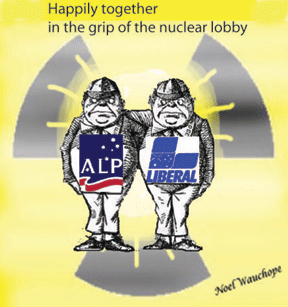 The Greens have slammed Labor and the Liberals for “teaming up” to defeat a motion calling on the government to acknowledge traditional owners’ opposition to the dump.
Federal Resources Minister Josh Frydenberg said that a final decision had not been made.
Approval of Adani’s Queensland coalmine faces another legal challenge
 ‘Conservationists claim the state government failed to ensure the planned Carmichael mine was ecologically sustainable’
Joshua Robertson | The Guardian Australia
http://www.theguardian.com/environment/2016/apr/27/approval-of-adanis-queensland-coalmine-faces-another-legal-challenge
“Adani’s plan for Australia’s largest coalmine faces yet another snag, with a conservation group mounting what is now the eighth legal challenge to the contentious project. …
The Coast and Country spokesman, Derec Davies, said the decision to grant environmental authority to the Galilee basin mine “ignored climate change totally and failed to properly take account of the true jobs figures – 1,464 net jobs not the 10,000 advocated”. …
The federal court is yet to rule on an Australian Conservation Foundation appeal against federal
environmental approval of the mine. … representatives of the mine site’s traditional owners, the Wangan and Jagalingou people, have several legal actions under way to challenge a land use deal with Adani … “
South Australian Laws to be repealed to allow tax-payer funding for nuclear activity
 The State Government will move this week to repeal laws that prevents it from consulting on the merits of a nuclear waste storage facility once the Royal Commission hands down its final report to Government due in May.
Section 13 of the Nuclear Waste Storage Facility (Prohibition) Act 2000, states: “Despite any other Act or law to the contrary, no public money may be appropriated, expended or advanced to any person for the purpose of encouraging or financing any activity associated with the construction or operation of a nuclear waste storage facility in this State.”
UN report finds in favour of Julian Assange
Assange also remains fearful of a potential future extradition to the US, where a secret grand jury has been looking into whether to prosecute him over WikiLeak’s publishing activities……..
the former chair of the UN working group, Mads Andenas, defended its finding, saying: “There is no doubt that the normal course of action for the Swedish authorities would have been to interview Assange in London. The extradition request was disproportionate
 Julian Assange: ‘sweet’ victory soured by British and Swedish rejection
No release in sight despite UN panel deciding WikiLeaks founder is being arbitrarily detained at Ecuador embassy, Guardian, Esther Addley,Owen Bowcott,David Crouch in Gothenberg, and Jessica Elgot 5 Feb 16 A UN panel may have found that Julian Assange is subject to “arbitrary detention” and called for him to be allowed to walk free, but the WikiLeaks founder remains exactly where he has been for the past 44 months – inside Ecuador’s London embassy and locked in a three-nation war of words.
Britain and Sweden immediately rejected the UN report, which declared that Assange had been “arbitrarily detained” since his arrest in 2010 and during his lengthy stay in the embassy, where he sought asylum in June 2012. The British foreign secretary, Philip Hammond, described the findings as “ridiculous” and the Australian as a “fugitive from justice”.
However, the panel’s findings, leaked on Thursday and published in full on Friday morning, were a welcome victory for Assange, and a moment he intended to savour fully. At 4.01pm he emerged on to the balcony of the west Londonembassy to greet a crowd of several hundred supporters and journalists, pausing first, just briefly, to glance at the sky he has rarely seen for more than three years.
“How sweet it is,” said Assange, holding aloft a copy of the UN report while supporters shouted: “We love you, Julian!” It had been, he said, “a victory of historical importance”, and a decision reached after a process to which both Britain and Sweden had made submissions. “They lost. UK lost; Sweden lost.”
The Swedish government, however, has insisted the report changes nothing, and that it cannot interfere in an independent prosecutor’s ongoing attempt to extradite Assange for questioning over an allegation of rape dating from 2010, which he denies.
Meanwhile, for Ecuador – the Australian’s (mostly) willing host – the findings meant it was time for the two countries to allow Assange to walk free, and to compensate both him and them for the lengthy period he has been holed up in one of its few rooms……
After exhausting all his legal options in the UK and Sweden some time ago, there is no question that the report represents a boost for Assange’s legal team. Continue reading
Total Environment Centre’s legal challenge to South Australia solar tariff proposal
Solar penalty tariff proposal for SA households subject of Federal Court challenge, ABC News By Candice Marcus, 16 Nov 15, An environment group wants the Federal Court to uphold the energy regulator’s decision to reject a penalty tariff on South Australian households with solar power.
The Total Environment Centre has intervened in a court case in which SA Power Networks is challenging the Australian Energy Regulator.
The regulator rejected a pricing proposal for households to face a solar tariff and a social tariff, which SA Power Networks said would have been directed toward helping low-income earners facing hardship in paying their bills.
It was estimated the solar tariff could cost the average solar-powered household about $100 annually.
The Total Environment Centre lodged submissions with the Federal Court urging it uphold the regulator’s rejection of the penalty pricing proposal.
Extra tariffs would be solar ‘disincentive’
Mark Byrne from the environment group said imposing additional tariffs would be a disincentive for people to install and use solar power.
“We’ve got half a million people living under solar roofs in South Australia already though and it’s going to negatively impact on them as well as making it less advantageous for new customers to install solar,” he said.
“Obviously in the long run we want to see more solar because it helps reduce greenhouse emissions as well as household electricity bills.”
He said SA Power Networks had a flawed argument.
“Their argument effectively is that solar customers should be paying more because they use less energy and the network is entitled to a fixed amount of revenue,” he said.
“The unfortunate thing about that is it discriminates against solar customers and will result in them paying about another $100 a year.
“What the network should be doing is introducing a tariff that affects everyone equally and recovers more of their revenue during those peaks, when they’re worried about the impact on prices because they have to build more to meet peak demand.”……..http://www.abc.net.au/news/2015-11-16/court-hears-challenge-on-sa-solar-penalty-tariff-proposal/6944870
Aboriginal and Torres Strait Islander’s legal action against coal port at Abbot Point
Seed – Risking the Reef Campaign http://www.seedmob.org.au/risking_the_reef
“Right now, there’s currently a proposal to build the world’s biggest coal port on the Great Barrier Reef at Abbot Point. If built it would unlock the Galilee basin – one of the largest reserves of coal in the world.
Aboriginal and Torres Strait Islander communities are already facing the impacts of climate change today, we need to be moving beyond coal and gas and transitioning to clean renewable energy, not digging up more of our sacred land. This means ensuring the proposed Abbot Point port expansion,
subsequent railway line and coal mines don’t go ahead. …
The Wangan and Jagalingou Traditional Owners have launched a legal case in the Federal Court to reject this project. … We’re sending a clear message to the banks that if they invest in reef and climate destruction, then were dumping them. …
Take action now by heading to riskingthereef.org.au “
Judge defending the NSW Land and Environment Court
‘If you have a degraded environment, you’re impoverished’: Justice Brian Preston, Peter Hannam ENVIRONMENT EDITOR, THE SYDNEY MORNING HERALD August 14, 2015 – Brian Preston, chief judge of NSW Land and Environment Court, joins Peter Hannam for a chat over lunch……. The Land and Environment Court was the first so-named court in the world when it was established in 1979, according to Ben Boer, Emeritus Professor at Sydney Law School and Preston’s first lecturer on environmental law, and a long-time friend and collaborator. There are now about 700 such courts globally.
But long before he got the top job at the court, he helped found another key organ of environmental law: the Environmental Defender’s Office of NSW.
It was the EDO that last week won a ruling in the Federal Court that found Environment Minister Greg Hunt had not properly considered advice on two threatened species, the Yakka skink and the ornamental snake, when approving Adani’s huge $16 billion Carmichael coal mine in Queensland.
The verdict prompted Prime Minister Tony Abbott to declare that courts were being used to “sabotage” mining projects, adding that Australia “must, in principle, favour projects like this”. The NSW Bar rejected the comments..
While our lunch preceded Mr Abbott’s outburst, Preston defended the importance of judicial independence, and later remarked that miners too often view environment checks as merely red tape.
Preston makes time for our lunch between his court duties, ongoing research for a book on environmentally sustainable development, and his work for a global effort to find ways the law can be used to curb climate change. He also teaches biodiversity law at Sydney University, and has helped develop environmental law in China and Thailand – two nations particularly in need of regulatory control –……..
He says that having a specialist court with judges well-read in environmental issues does not imply – as some miners argue – that developers won’t get a fair hearing.
“You should be environmentally literate,” he said. “All courts strive to make the right decision and you’re more likely to make that if you’ve got more knowledge.”……..http://www.smh.com.au/environment/lunch-with-justice-brian-preston-20150812-gixcdb.html
Tobacco corporation Philip Morris sues Australia over cigarette plain packaging
ISDS provisions have been criticised by the High Court Chief Justice Robert French and the Productivity Commission which warned they gave foreigners greater legal rights than Australian companies, exposed local business to potentially large liabilities and were red tape-heavy.
There are concerns similar provisions in the yet-to-be-concluded 12-nation Trans-Pacific Partnership agreement, it would constrain the listing and pricing of medicines under the Pharmaceutical Benefits Scheme
Tobacco giant sues Australia, The West Australian, Andrew Probyn July 28, 2015, More than $50 million of taxpayer money is expected to go up in smoke defending cigarette plain packaging in a secretive international tribunal in Singapore.
But costs will pile much higher if Australia loses on its first defence that Philip Morris indulged in cynical “venue shopping” by shifting its headquarters to Hong Kong to sue Australia.
The West Australian can reveal the Attorney-General’s Department, which is running the case in defence of plain packaging, called former Labor treasurer Wayne Swan as a witness before a special tribunal sitting in Singapore back in February. Continue reading
Western Australia’s Barnett goverment moving Aborigines off their land to benefit miners
 It is a trend that points to one thing — move indigenous people off their country so that the miners get a free hand and they can do as they will.
Michael Martinez: WA stance on indigenous Australia a worrying sign, MICHAEL MARTINEZ GEELONG ADVERTISER JULY 09, 2015 “…….. Mr Barnett and his pro-mining party members are trying to change the Aboriginal Heritage Act so that one bureaucrat can make a decision determining if a site is sacred or not.
There has already been a Supreme Court decision questioning the deregistering of a sacred site in Port Headland, and there are 22 other sites that the West Australian Government has removed during the past few years.
 A government committee in Western Australia and the minister decided that the land and waters around parts of Port Hedland port should no longer be considered an Aboriginal sacred site because it had not been used for religious purposes.
Justice Chaney said in his judgment: “I conclude that the committee did not give consideration to the question of whether or not the Marapikurrinya Yintha was a place of importance or special significance because the question did not arise for consideration in light of the conclusion that it was not a sacred site.” Continue reading
Legal win for Australia’s nuclear veterans
Radiation in court: landmark success for Australia’s nuclear veterans, Ecologist Chris Busby 24th June 2015A legal judgment in Australia has fatally damaged the ‘official’ ICRP model of health damage by nuclear radiation, writes Chris Busby – reflecting the fact that cancer originates through the mutation of individual cells, not whole organs or organisms. The ruling is good news for Britain’s bomb test veterans whose day in court is coming up; and for all who suffer radiation induced cancers.
At the end of last month the Veterans Appeals Tribunal Decision on the CaseJean Mahoney vs. Australian Repatriation Commission was published.
The result was a win for the appellant, setting aside of the earlier Australian government decision not to grant a pension to the widow of a veteran who worked among the ruins of Hiroshima and later died from metastatic colon cancer.
I was the expert witness in this case and persuaded the Australian Tribunal (in an expert report and with oral cross examination by telephone, Brisbane to Riga) that the radiation risk model of the International Commission on Radiological Protection (ICRP) was not applicable to the kind of internal exposure to radioactive particles which her late husband, George Mahoney will have received. Continue reading
Greenpeace warns of legal showdown over charitable tax status
Greenpeace has warned of a legal challenge to any moves to strip environmental groups of their charitable status. (subscribers only)
http://www.theaustralian.com.au/national-affairs/treasury/greenpeace-warns-of-legal-showdown-over-charitable-tax-status/story-fn59nsif-1227401137358
We need a proper judicial investigation of wind farm danger claims

a judge should investigate the following:
1. ‘Abandoned homes’
How many Australian families have really “abandoned” their homes near wind farms,………
2. Medical records
The judge should request the medical records of complainants from periods both before and after the operation of wind farms……
3. Has there ever been a wind disease diagnosis?
Next, public notices should be placed in the press and publicised in the attempt to find any medical practitioner who has ever diagnosed even a single case of “wind turbine syndrome” in Australia.
4. Experimental tests
Claims made by prominent opponents of wind farms that wind turbines can rock a stationary car at 1 km, cause lips to vibrate 10km away, “bring some men to their knees when out working in their paddock” near wind farms and be heard 100km away could be easily subjected to tests under blinded experimental conditions……..
5. Magical mystery tour
Similarly, Senator Madigan may like to cooperate in organising a fully supervised experiment where those claiming to be adversely affected by wind turbines at distances up to 10km could have this claim experimentally tested……..
Let’s appoint a judge to investigate bizarre wind farm health claims The Conversation, Simon Chapman Professor of Public Health at University of Sydney 14 May 2015, On April 30, 2015, South Australian Family First Senator Bob Day published an opinion piece on his website titled Wind turbines’ inconvenient truth. In gotcha-style exuberation, Senator Day noted that wind turbine motors incorporate rare earths, which are often sourced from heavily polluting mining in inner Mongolia.
Highlighting in bold an excerpt from a 2011 Daily Mail report, Day emphasised:
Whenever we purchase products that contain rare earth metals, we are unknowingly taking part in massive environmental degradation and the destruction of communities.
The subtext was plain: green wind energy supporters are indifferent to the environment and suffering and so are massive hypocrites.
A small problem with this accusation is that by far the main use of rare earths are not in wind turbine motors, but in a wide range of electronics that include billions of mobile phones, computers, DVDs and fluorescent lights, all of which Senator Day uses himself.
Senator Day, who has no training or experience in assessing medical evidence, also wrote to The Australian recently that he had heard “compelling” evidence about the adverse effects of wind turbines on humans and animals. Continue reading
Judge overturns West Australian Government’s decision to deregister Port Hedland Aboriginal sacred site
WA court overturns decision to deregister Port Hedland Aboriginal heritage site http://www.abc.net.au/news/2015-04-01/aboriginal-heritage-test-case-port-hedland/6366250/?site=indigenous&topic=latest By Nicolas Perpitch and Laura Gartry April 01, 2015 The Supreme Court has quashed a decision by a West Australian Government committee to deregister a Port Hedland Aboriginal sacred site, in a test case that opens the door to a class action by traditional owners.
In his judgement, Justice John Chaney referred the case back to the Aboriginal Cultural Materials Committee (ACMC).
The committee had recommended to State Indigenous Affairs Minister Peter Collier that land and waters around parts of Port Hedland port should no longer be considered an Aboriginal sacred site because it had not been used for religious purposes.
“I conclude that the committee did not give consideration to the question of whether or not the Marapikurrinya Yintha was a place of importance or special significance because the question did not arise for consideration in light of the conclusion that it was not a sacred site,” Justice Chaney said in his judgement.
“The ACMC asked itself the wrong questions and identified the wrong issues, thereby falling into jurisdictional error.” Continue reading
Nuclear waste storage banned by law in South Australia
 South Australia Nuclear Waste Storage Facility (Prohibition) Act 2000 An Act to prohibit the establishment of certain nuclear waste storage facilities in South Australia; and for other purposes.
—Objects of Act The objects of this Act are to protect the health, safety and welfare of the people of South Australia and to protect the environment in which they live by prohibiting the establishment of certain nuclear waste storage facilities in this State.
nuclear waste means— (a) Category A, Category B or Category C radioactive waste as defined in the Code of Practice; or (b) any waste material that contains a radioactive substance and is derived from— (i) the operations or decommissioning of— (A) a nuclear reactor; or (B) a nuclear weapons facility; or (C) a radioisotope production facility; or (D) a uranium enrichment plant; or (ii) the testing, use or decommissioning of nuclear weapons; or (iii) the conditioning or reprocessing of spent nuclear fuel;
nuclear waste storage facility means any installation for the storage or disposal of nuclear waste; public authority has the same meaning as in the Environment Protection Act 1993; radioactive substance means any substance that spontaneously emits ionizing radiation. 5—Act binds Crown This Act binds the Crown in right of the State and, in so far as the legislative power of the State permits, in all its other capacities……..
13—No public money to be used to encourage or finance construction or operation of nuclear waste storage facility Despite any other Act or law to the contrary, no public money may be appropriated, expended or advanced to any person for the purpose of encouraging or financing any activity associated with the construction or operation of a nuclear waste storage facility in this State……
1 This month
7 April – WEBINAR – Australia and the Doomsday Clock – Preventing nuclear war through NoFirstUse and other policies
Online | Tuesday April 7, 4:00-5:30pm, Australian Eastern Time / 8:00-9:30am Central Europe Time
– Access the registration link
15 April – Zoom –Nuclear Power is Not the Solution
Apr 15, 2026 01:00 AM in Canberra, Melbourne, Sydney

Join the International Physicians for the Prevention of Nuclear War (IPPNW) on Tuesday, April 14th for a timely webinar exploring the risks associated with nuclear power and challenging the myth that it offers a simple, safe, carbon-free solution to the climate crisis

21 April Webinar: No Nuclear Weapons in Australia
Start: 2026-04-21 18:00:00 UTC Canberra, Melbourne, Sydney (GMT+10:00)
End: 2026-04-21 19:30:00 UTC Canberra, Melbourne, Sydney (GMT+10:00)
Event Type: Virtual
A virtual link will be communicated before the event.
Host Contact Info: australia@icanw.org

of the week – Australians for War Powers Reform (AWPR)
To see nuclear-related stories in greater depth and intensity
 Antinuclear