Ashurst, Lawyers for the global nuclear industry
 Ashurst is a big global law firm, which does lots of stuff. However they do specialise in resources and in the nuclear industry
From Ashurst’s website:
- Ashurst: Nuclear – Our Nuclear Group advises on the unique issues that affect stakeholders on nuclear projects and transactions across the globe http://www.ashurst.com/expertise-detail.aspx?id_Content=6596
- Ashurst: 2013 – a year of opportunity All up, 2012 has had its ups and downs in SA but with a Government which is, in its own words, “unashamedly pro-mining” [see: www.pir.sa.gov. au/minerals/press_and_events/ news_releases/marathon_accepts compensation_for_arkaroola], http://www.ashurst.com/publication-list.aspx?id_content=1361&expandExpertiseList=true&id_queryContent=6596
- Nov 15 2012 Australia Grid Australia used Ashurst to shut up an outspoken farmer –http://www.smh.com.au/business/grid-australia-and-the-campaign-to-gag-outspoken-farmer-20121114-29cfc.html#ixzz2F1k8McI7
- Dec 13 2012 Ashurst firm has recently initiated a number of redundancies, with the firm’s energy & resources practice being particularly badly hit.
- 2009 Ashurst advised Babcock International on acquisition of UK Government’s atomic commercial operations
- Ashurst – curiously they describe the parlous state of UK’s nuclear industry – Failed Technologies http://www.ashurst.eu.org/download/grpprj/nuclear.txt
Legal challenge by Pacific Nations against sale of uranium to India?
 Pacific nations could challenge Australian uranium sales to India, ABC News, Stephanie March, Oct 12, 2012 Until last year, the Labor government in Australia had refused to sell uranium to India because it isn’t a signatory to the Nuclear Non-Proliferation Treaty, and is a nuclear weapons producing state A move by Australia to allow the export of uranium to India could face a legal challenge from Pacific nations…….International law expert Professor Donald Rothwell has told Radio Australia’s Asia Pacific program that could lead to a challenge under a 1985 treaty which governs nuclear testing and the use of nuclear materials from the region.
“Australia therefore has an obligation to ensure that its sale of uranium mined from within Australia is dealt with consistently with the provisions of the South Pacific Nuclear Free Zone Treaty,” he said.
“To that end, there’s very much an expectation that any sale would be only to countries that meet the Nuclear Proliferation Treaty obligation and that immediately raises an issue, because India, of course, is not a party to the NPT.”
The South Pacific Nuclear Free Zone Treaty, or the Treaty of Rarotonga was signed in 1985 by 12 nations in the Pacific and Australia.
Any objection under the Treaty of Rarotonga would have to be brought by one of the Pacific Nations that are signatories to the agreement.
Mr Rothwell says due to its history, the South Pacific does have a very strong record of being anti-nuclear
“The region fiercely contested France’s nuclear weapons testing program in the 1970s and as recently as the 1990s,” he said.
“So any concerns that might be raised by Australia’s conduct could well come from within the region and given the history of the region, it shouldn’t be completely ruled out…… http://www.abc.net.au/news/2012-10-12/an-australian-uranium-sales-to-india-could-face-pacific-challen/4311024?section=business
More delay and uncertainty for Australian company Lynas’ rare earths project in Malaysia
Activists and local residents have vowed to shut the plant – the biggest outside China – which has emerged as a controversial issue in the country’s national elections
opposition politicians and environmentalists have expressed fears that radioactive waste it produces can seep into the ground and water, harming the environment and people’s health.
 Hearing on Lynas Malaysia plant postponed http://www.theaustralian.com.au/news/breaking-news/hearing-on-lynas-malaysia-plant-postponed/story-fn3dxix6-1226488399907 THE AUSTRALIAN AAP October 04, 2012 A MALAYSIAN court has postponed until next week a hearing on a temporary operating licence granted to Australian miner Lynas Corp for a rare earths plant, an activist says.
Thursday’s decision to postpone hearing to next Wednesday further delays the start of operations at the $US800 million ($A786.82 million) facility, which has been dogged by environmental protests and concerns about radiation.
Lynas secured the operating licence in early September but Kuantan High Court in eastern Pahang state, where the plant is based, put it on hold later that month after an appeal by activists. Continue reading
Contradictions abound in the accusations against Julian Assange
Julian Assange hopeful a photo could help clear him of sexual assault allegations Herald Sun, Abul Taher Daily Mail August 27, 2012 IT seems an unremarkable image: a group of friends smiling broadly. But it is the photograph Julian Assange hopes will clear his name.
The Mail on Sunday has published a photo of a beaming woman, pictured with Assange and three other people, who would later tell police that 48 hours before the picture was taken, the WikiLeaks founder pinned her down in her flat and sexually assaulted her.
If the case ever reaches court – Mr Assange is currently holed up in the Ecuadorian Embassy in London – his lawyers will argue that the photograph undermines the 33-year-old woman’s entire story. And, they claim, there is more.
In the two days after the alleged assault in Sweden, Mr Assange and Woman A, as she is known, attended a conference and two dinner parties where it is claimed they were practically inseparable. During one party, Woman A tweeted that she was “with the world’s coolest, smartest people!”…..
http://www.heraldsun.com.au/news/world/julian-assange-hopeful-a-photo-could-help-clear-him-of-sexual-assault-allegations/story-fnd134gw-1226458585105
International Court of Law likely to protect Julian Assange’s bid for asylum
Assange could go to international court THE AUSTRALIAN : AAP August 23, 2012 JULIAN Assange’s legal team will likely apply to the International Court of Justice (ICJ) to get the activist out of London to diplomatic asylum in Ecuador.
Former judge at Spain’s top criminal court, and head of Mr Assange’s legal team, Baltasar Garzon, says they are exploring a number of ways to guarantee his safety.
The ICJ is the world’s top arbitration body for disputes between states.
Speaking through an interpreter on the sidelines of the International Council of Archives Congress in Brisbane, Mr Garzon said the United Kingdom is bound by international law to offer his client safe passage to asylum. Continue reading
Assange’s case may go to International Court of Justice
Assange looks to international court THE AGE August 18, 2012, Karen Kissane, Europe WIKILEAKS founder Julian Assange will appeal to the International Court of Justice if Britain prevents him from going to Ecuador, according to a senior Spanish human rights lawyer. Baltasar Garzon, who is working on Assange’s defence, told Spanish newspaper El Pais that Britain was legally required to allow Assange to leave once he had diplomatic asylum.
“What the United Kingdom must do is apply the diplomatic obligations of the refugee convention and let him leave, giving him safe conduct,” he said. “Otherwise, he will go to the International Court of Justice.” Continue reading
Olympic Dam anti uranium protestors facing court
Olympic Dam protest has court sequel http://www.abc.net.au/news/2012-08-09/olympic-dam-protest-charges-heard/4188096?section=sa August 09, 2012 Some of the protesters arrested near the Olympic Dam mine recently have faced the Magistrates Court at Port Augusta. Those who pleaded guilty were fined $150 and had no conviction recorded. Others who did not attend or pleaded not guilty will face a pre-trial conference in mid-September.
One man who was charged with interfering with a motor vehicle for allegedly chaining himself to a semi-trailer refused to enter a plea. He argued the court had no jurisdiction over him as he observed the laws of the Arabunna nation.
He also refused to stand in the dock, claiming it was where criminals stood and he was not a criminal.
Hundreds of people protested near the BHP Billiton mine, urging it be closed down rather than expanded.
Support grows for Aboriginal traditional owners’ legal battle to stop Muckaty nuclear waste dump

 Muckaty traditional owners fight Ferguson’s nuclear dump, July 3, 2012, Jim Green, Four Muckaty traditional owners — Penny Phillips, Jeannie Sambo, Kylie Sambo and Delvine Spiteri — visited Melbourne on June 25 to attend a federal court hearing concerning the nomination of Muckaty, 120 kilometres north of Tennant Creek in the Northern Territory, for a national nuclear waste dump.
Legal proceedings against the federal government and the Northern Land Council began in June 2010 and a trial is anticipated in the first half of 2013. A small group of traditional owners support the dump proposal, in return for a financial package. But most are opposed and are challenging the right of the government to establish the dump at Muckaty without their consent.
Legislation pushed through parliament by federal resources minister Martin Ferguson — the National Radioactive Waste Management Act — allows for the imposition of a dump without consultation with or consent from traditional owners. In a previous federal court hearing, lawyers for the Commonwealth argued that the Muckaty nomination was valid even if the wrong traditional owners were consulted.
The most pressing issue for the government is the return of spent nuclear fuel reprocessed waste from France and Scotland in coming years. The government is aware that its Muckaty plan is unravelling and has moved to firm up an alternative plan — interim storage of the reprocessing waste at the Lucas Heights nuclear research reactor site south of Sydney, from where the spent fuel originated. Plans are in train to increase storage capacity at Lucas Heights.
Trade unions & emergency services
Some of Australia’s most powerful unions have pledged support for the campaign. The Maritime Union of Australia’s Victorian Secretary, Kevin Bracken, attended a media event with traditional owners after the June 25 court hearing, and traditional owners briefed MUA members the following day.
In Darwin, the MUA is organising a protest at Stokes Hill Wharf on July 12, marking seven years since the NT was first targeted for a nuclear waste dump. The MUA is sending delegates from around the country to attend this event.
In May, the Australian Council of Trade Unions Congress passed a resolution expressing disappointment that the Muckaty site will continue to be pursued under the National Radioactive Waste Management Act. It affirmed that the ACTU “stands in solidarity with traditional owners and communities resisting federal government plans for a radioactive waste dump and commits to supporting trade unions refusing to cooperate with implementation of the policy.”
The ACTU Congress resolution further states that “the recent application by ANSTO for reprocessed spent fuel waste to return to the Lucas Heights facility in Sydney and acknowledges this as an opportunity to review radioactive waste management in Australia by conducting an independent and comprehensive public commission into all aspects radioactive waste transport, storage and management in Australia”…… www.greenleft.org.au/node/51545
Muckaty traditional owners not consulted about nuclear waste plan, – legal case begins
 Nuclear dump court battle begins, SMH, Farah Farouque June 26, 2012 “……While much has been made of the environmental implications of building a nuclear waste facility at Muckaty, less understood is that the takeover ”heralds a significant unwinding of Aboriginal land rights”, according to Sydney lawyer George Newhouse.
”The Commonwealth’s preparedness to accept and act upon a deeply flawed and contested nomination at Muckaty, a home to at least seven Aboriginal family groups, represents a retrograde move in the history of indigenous land rights.”
Maurice Blackburn solicitor Elizabeth O’Shea says a nuclear dump in plain terms ”will mean the traditional people cannot access the land again”. The two lawyers are among a high-octane legal team who have donated their time to advance the cause of the elders. The barristers involved include Melbourne QCs Ron Merkel and Julian Burnside.
A leading issue in the Federal Court challenge, defended by the federal government and Northern Land Council, is that key traditional owners will testify they were never consulted while others say that they were not properly consulted and never consented to the nomination.,,,,,” http://www.smh.com.au/national/nuclear-dump-court-battle-begins-20120625-20ylj.html#ixzz1yyh9D5bG
Aboriginal elder’s legal battle to stop giant uranium mine
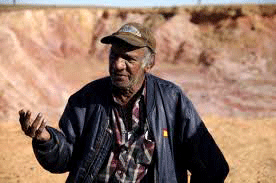 Elder continues fight against SA mine 9 News, 19 June 12, Aboriginal elder Kevin Buzzacott is pushing ahead with his bid to block the giant expansion of the Olympic Dam copper, uranium and gold mine in South Australia after an initial court decision went against him.
The Federal Court ruled in April that the commonwealth had properly taken into account the long-term impact of the mine, rejecting Mr Buzzacott’s argument that federal Environment Minister Tony Burke had not given enough consideration to the risks posed by storage of radioactive tailings at the site in SA’s north.
Mr Buzzacott has appealed against the court’s decision and a hearing has been scheduled for Thursday. Grounds for the appeal include an argument that Justice Anthony Besanko was mistaken in ruling that the minister did not need to consider existing conditions imposed by the state government on water extraction for the mine from the Great Artesian Basin.
The Arabunna elder also argues the approval was uncertain because so much of the project was left to be defined by studies and plans that were yet to be completed.
Mr Buzzacott said he was hoping for a “better result this time round”. “We hope that the three judges that will hear the appeal will seriously reconsider Justice Besanko’s interpretation of our argument,” he said in a statement……
Conservation Council and Aboriginal Elder lodge appeals against Wiluna uranium mine
Appeals lodged against first WA uranium mine SMH, Courtney Trenwith June 7, 2012 – Several appeals against the environmental approval for WA’s first uranium mine have been official lodged.
In a landmark decision , the state’s independent Environmental Protection Authority last month approved mining company Toro’s $280 million project to mine uranium near Wiluna in the South-West. ….However last night, the Conservation Council of WA lodged an appeal claiming the EPA’s decision contained numerous “critical deficiencies”.
Aboriginal elder and Wiluna resident Glen Cooke also lodged a separate challenge.
The appeals will be heard by an appeal convenor and considered by the Minister for Environment Bill Marmion, in line with the EPA decision. The state government is yet to make a final decision on the project.
CCWA director Piers Verstegen claimed the EPA had failed to properly assess the proposal before approving it. “Importantly, the state government has made commitments to ‘world’s best practice’ regulation of uranium mining in WA, but their own independent report has found that the current system fails that test,” CCWA director Piers Verstegen said.
“We do not believe that the EPA assessment adequately deals with critical environmental risks including the management of radioactive mine tailings, contamination of groundwater and the transport of radioactive material through WA communities.” CCWA also claims there was a denial of procedural fairness and the EPA failured to comply with their own procedures during the assessment process.
“West Australians rely on the EPA to prevent environmental harm, yet they have recommended approval for mining and transporting one of the most dangerous materials known to exist by a junior minerals exploration company that has never successfully mined anything and have not completed all necessary environmental management plans,” Mr Verstegen said….: http://www.watoday.com.au/wa-news/appeals-lodged-against-first-wa-uranium-mine-20120607-1zxzz.html#ixzz1xFFVXxMn
High Court rules for Aboriginal land rights, against South Australian govt
In December, the South Australian Supreme Court found Ms Portolesi had denied landowners “procedural fairness” by ignoring for seven months a request for authority over land at Lake Torrens in the state’s mid-north. On the same day she responded to their request, she approved a mining company’s application to disturb a site of significance.
SA Labor’s land rights appeal rejected BY: SARAH MARTIN From: The Australian May 12, 2012 THE High Court has thrown out an appeal by the South Australian Labor government against Aboriginal landowners, deeming it not to be in the public interest. Continue reading
South Australian government backing miners, bankrupting Aboriginals with legal costs
 State seeks day in High Court over land rights, BY:SARAH MARTIN, SA POLITICAL REPORTER The Australian May 11, TRADITIONAL owners have warned that a government High Court challenge over land rights in South Australia’s mid-north could send them bankrupt.
In the High Court today, the South Australian Labor government will appeal to have a finding against it overturned. Lawyers will seek costs of up to $300,000 from the Adnyamathantha Traditional Lands Association.
The South Australian Supreme Court ruled in December that former Aboriginal affairs minister Grace Portolesi had “deprived the traditional owners of the opportunity to protect and preserve their heritage” by failing to respond to a request for authority over their land at Lake Torrens, about 345km north of Adelaide.
The court found the government ignored the request from traditional owners for control over the land for about seven months.
However, on the same day Ms Portolesi responded to their request expressing “concerns” over the application, she approved the destruction of significant cultural sites on the land by a mining company, Straits Exploration.
Lands association chairman Vince Coulthard said he was surprised the government was attempting to overturn the ruling and impose costs on the group.
“It could potentially bankrupt us, but maybe that is what the state government wants,” he said.
“I feel it is a mean attack on us, given this whole thing could have been avoided.”
The court found Ms Portolesi had denied traditional owners “procedural fairness” by authorising drilling at the Lake Torrens site while failing to respond to a request for a delegation of ministerial powers to the traditional owners.
Under the Aboriginal Heritage Act – which the government is now reviewing – the minister must transfer authority to traditional owners if requested……..
The High Court will consider today whether it will accept the state’s application for a hearing. http://www.theaustralian.com.au/national-affairs/indigenous/state-seeks-day-in-high-court-over-land-rights/story-fn9hm1pm-1226352471154
Multi $billion company BHP and Australian Government out to punish Aboriginal elder who dared to oppose uranium mine
 DEMOCRACY AT A PRICE: DECISION BY BHP BILLITON AND FEDERAL GOVERNMENT TO SEEK COSTS FROM ARABUNNA ELDER PUNITIVE AND VINDICTIVE, 1st May 2012 The Australian Nuclear Free Alliance (ANFA) is deeply concerned by the decision of BHP Billiton and the Federal Government to seek costs from Arabunna elder uncle Kevin Buzzacott arising from his challenge of the Federal approval of the Olympic Dam expansion.
“ANFA members fully support Uncle Kevin and admire his stand for country. We know that history will be the fairest judge of this struggle. BHP and the minister who approved the expansion of Olympic Dam will be forever linked to the toxic legacy of this mine, for thousands of years to come,” said Larrakia woman Donna Jackson, co-chair of ANFA.
“The court decided that Kevin Buzzacott had standing to pursue this challenge, as is his right under both the Environment Protection and Biodiversity Act and the Administrative Decisions (Judicial Review) Act,” said ANFA Committe member Nectaria Calan. “Where does this leave the right to judicial review of such projects if those who seek such a review are then punished with costs?”
Dean Della Vale, president of BHP’s Uranium Customer Sector Group which is responsible for the Olympic Dam project, is a founding member of the Australian Uranium Associations Indigenous Dialogue Group, established to facilitate dialogue with traditional owners.
“BHP pursuing costs undermines any claims by the Indigenous Dialogue Group that they are seeking to engage with aboriginal communities in good faith. Aboriginal communities do not have the right to say no to mining on their land, and here we have an elder using one of the few legal options available to them to ensure that at least the impacts of the project were properly considered, and they may be facing a massive bill for doing so,” said Ms Calan.
“The message BHP are sending is that there are repercussions for taking on the mining giant. Last financial year the company recorded a total net profit of US$23. 95 billion – they certainly don’t need the money,” Ms Calan concluded.
Australia’s Environment Protection and Biodiversity Conservation Act is not much use
MINING GIANT SEEKS COSTS FROM ARABUNNA ELDER AFTER RULING ON CHALLENGE TO FEDERAL APPROVAL OF THE OLYMPIC DAM EXPANSION 20 April 12, In a packed courtroom today Justice Besanko dismissed Uncle Kevin Buzzacott’s challenge of the Federal approval of the Olympic Dam expansion. The judge did not discuss his reasons in the court.
Both BHP and the Federal government are seeking costs from Kevin Buzzacott. The hearing was held in the Federal Court on the 3rd and 4th April, after which the Judge reserved his judgement. Both BHP Billiton and the South Australian government had successfully sought to become parties to the proceedings.
“The speed with which this decision was made suggests pressure to resolve the matter as quickly as possible so as not to impact the project,” said Nectaria Calan of Friends of the Earth Adelaide.
“The judgement is really a product of the constrained nature of such administrative challenges. It really rests on interpretation of two pieces of legislation which govern the Ministers approval. The merits of the project were never on the table for discussion.”
“If such an approval with so many future plans yet to be approved constitutes a proper approval under the Environment Protection and Biodiversity Act, how can such an open-ended project be judicially reviewed?” said Ms Calan. “The question we are left with is whether the EPBC Act protects the environment,” Ms Calan continued.
“This is a very sad day,” said applicant Kevin Buzzacott. “We offered the judge the issue on a platter, and he wasted an opportunity to make changes that will reverberate in this nation for thousands of years.”
“But we’re not going away. This isn’t over yet,” Mr Buzzacott concluded. Both Kevin Buzzacott and Nectaria Calan will be available for comment on the details of the ruling early next week once the lengthy judgement has been considered.
1 This month
17 October, Free Public Talk on Nuclear Issues in South Australia
David Noonan will speak on public interest concerns over the new Roxby Downs Indenture Act 2026 on BHP copper-uranium mining and ore processing in SA, and on how AUKUS may face SA with a High-Level nuclear waste agenda.
Dr Jim Green will discuss international developments in the field of nuclear power including ‘small modular reactors’ and Generation 4 ‘advanced’ nuclear reactor concepts.


Help Aunty Sue Protect Her Land and Sacred Sites From Destructive Rocket Testing.
.

Australians deserve the truth
about
AUKUS – https://aukuspublicinquiry.com/

PETITION – To: Prime Minister Anthony Albanese and the Australian Labor Government

of the week – Australians for War Powers Reform (AWPR)
To see nuclear-related stories in greater depth and intensity

