Sydney University fined for carelessness with a radioactive device
The fallout of the University’s radiation case, by Bella Gerardi, May 2, 2022,
Last week, the University of Sydney was fined $61,000 for failing to properly dispose of a radioactive source belonging to a decommissioned medical imaging machine. For an institution that claims to have a strong commitment to the environment, conviction of a criminal environmental offence appears at odds with its sustainability strategy.
The source, which contained a sealed radioactive isotope, was found when a truck delivering scrap metals to a recycling yard set off alarms during a routine radiation check.
Identified as belonging to a PET scanner owned by the University, the Environmental Protection Agency (EPA) charged the University with four individual breaches of the Radiation Control Act. The case didn’t go to court as the University pled guilty, and in exchange the EPA dropped two of the four charges.
So, how did this happen?
By accident, the court ruled.
…………… the court noted that if the source had not been detected before entry to the second metal recycling yard, environmental contamination would have been “very likely”. In this scenario, the source would have gone on to be reprocessed, a procedure that would involve breaking the seal of the source and dispersing the material into usable metal. It would have ultimately ended up in consumer material, which the court noted has occurred overseas.
………… It is disappointing, but not surprising, that it took a criminal conviction to reach the safeguards imposed today. Unfortunately, the University’s prior lack of clear procedure is indicative of the broader attitude institutions and corporations hold toward environmental crimes. Environmental crimes are often entangled with accidents, negligence, or oversight, and are often not viewed as holding the same gravity as other offences.
Corporations and institutions are responsible for the majority of environmental harm, yet complex corporate hierarchies make it uncommon for individuals to face repercussions for offences, which in turn promotes a lax attitude toward environmental damage. ………………………………….. more https://honisoit.com/2022/05/the-fallout-of-the-universitys-radiation-case/
UNEXPLAINED ORDNANCE: A MISSILE ON ABORIGINAL LAND AND A BREAKTHROUGH LEGAL COMPLAINT
ARENA ONLINE, MICHELLE FAHY, 21 APR 2022
A ground-breaking legal complaint has arisen after First Nation’s elders Andrew and Robert Starkey discovered an unexploded missile on their country. The brothers discovered the missile, manufactured by arms multinational Saab, in Lake Hart West, a registered Indigenous heritage site within the vast Woomera Prohibited Area. The Starkeys are Kokatha Badu (respected senior figures, or lore men) from the Western Desert region of South Australia who have devoted decades to protecting heritage sites on their land.
In a complaint to the OECD, the Starkeys alleged that Saab had breached OECD guidelines by failing to undertake or maintain ‘adequate human rights due diligence which could prevent their product from being used in human rights violations’, and which also resulted in a failure to ‘protect and preserve the integrity of [those] heritage sites’ for which the Starkeys have custodial responsibilities
Michelle Fahy, 4 Feb 2022
Australia hasn’t seen anything like this case before. In fact, in the world of OECD complaints, it’s a first.
The Starkey complaint has resulted in a precedent-setting initial assessment from the OECD that could have ramifications for multinational weapons companies. The OECD’s Australian contact point has decided that arms export permits granted by national governments do not provide weapons companies with immunity from responsibility for human rights violations resulting from the use of their products or services.
This decision overturns earlier OECD precedents set by other countries, including the United Kingdom and the United States, which allowed weapons companies to shelter behind arms export permits. The initial assessment in the Starkey complaint says that government-issued arms export permits on their own are insufficient protection, and that the OECD guidelines require global arms manufacturers to conduct ongoing due diligence on human rights issues. Manufacturers of weaponry used to commit war crimes against civilians in Yemen, for example, could now be exposed to similar complaints.
The Defence Department, which has long fobbed off the Starkeys’ heritage concerns, took a year to remove the missile. Andrew says they next tried to approach Saab—whose marketing tagline is ‘It’s a human right to feel safe’—but were again brushed off and referred back to Defence. The Starkeys then lodged their complaint with the OECD’s Australian National Contact Point (AusNCP) in September 2021.
The OECD Guidelines for Multinational Enterprises are a comprehensive code of responsible business conduct that governments have committed to promoting. Each country that chooses to adhere to the guidelines must establish a national contact point to promote and implement the guidelines. The complaints procedure is intended to provide a non-adversarial ‘forum for discussion’ to examine and resolve complaints against multinationals.
The OECD covers most of the world’s weapons makers— 80 of the top 100 arms corporations, according to an analysis of data compiled by the Stockholm International Peace Research Institute. These companies represented 80 per cent (US$425 billion) of the US$531 billion in sales by the top 100 in 2020. Saab, ranked thirty-sixth, had US$3.4 billion in sales in 2020.
Saab responded to the Starkeys’ complaint saying, amongst other things, that its supply of weaponry to Defence was subject to ‘strict export control laws’ aimed at preventing their use in harmful ways and that Swedish export controls ‘require human rights issues to be considered’. This rote argument is parroted across the arms industry and is one that Australia’s Defence Exports Controls Office relies on to justify its continued arms exports to nations engaged in serial human rights abuses, including Saudi Arabia, the United Arab Emirates, Israel and Indonesia.
‘No nation gets to pick and choose which laws to comply with, nor do they get to choose who will or will not be held accountable’, says the Starkeys’ international human rights lawyer John Podgorelec. ‘The international law has to be applied as evenly to the Saudi Yemen conflict as it would to the Russia Ukraine conflict.’
Weapons companies have long benefited from a myopic reliance on one-off export permit approvals. However, the extensive evidence of war crimes and the resultant catastrophe still unfolding in Yemen, fuelled in large part by US– and UK supplied weaponry, shows that the so-called strict permit approval system is an abject failure in protecting human rights.
The AusNCP’s initial assessment sounds a warning to the arms industry worldwide. The AusNCP has now offered its ‘good offices’ to facilitate a negotiated resolution between the Starkeys and Saab. The Starkeys are ready to negotiate. Whether the ‘good offices’ phase proceeds depends on Saab, which has so far said it will ‘review the findings, and continue to engage with the AusNCP, to determine any further required actions’.
Andrew Starkey is pleased with the result so far, but his relief is tempered with discontent. ‘The situation is so bad in Australia. The legislation is so weak that we needed to rely on international law to get justice.’
Dr John Pace, who is also advising the Starkeys, is a globally recognised expert in human rights law with more than fifty years’ experience, including at the United Nations. Pace says that the obligation for due diligence on human rights grounds never abandons the equipment. ‘It is an ongoing, responsive and changing process, not a one-off rubber stamp.’
Amnesty International has noted, in Human rights policies in the defence sector, that, ‘There is now a clear global consensus that companies have a responsibility to respect all human rights wherever they operate’. There is also increasing acceptance that good business practices in one area do not offset harm in another. Corporate behaviour must be globally consistent.
A significant factor influencing the handling of the Starkeys’ complaint is the web of conflicting interests in which Saab features strongly. Such conflicts were not disclosed to the Starkeys during the complaint process. It is this inconsistency in its corporate behaviour that has brought Saab undone. As Andrew says, ‘Defence seems more interested in protecting a Swedish company than in protecting Australian culture’………………………………………………………………
The due diligence guidelines are clear about avoiding adverse impacts on human rights and, in particular, the importance of engaging with Indigenous peoples who might be affected by the activities of the business. One adverse impact noted by the OECD in relation to human rights is ‘Failing to identify and appropriately engage with indigenous peoples where they are present and potentially impacted by the enterprise’s activities’.
The Starkeys are concerned that similar problems will recur. Says Andrew, ‘For us this is the same as the British atomic tests. We are the ones left to deal with the mess. They are erasing us one site at a time up there’.
| Christina Macpherson <christinamacpherson@gmail.com> | Apr 22, 2022, 9:02 PM (11 hours ago) |  | |
| to me |
Lies leave the Assange case exposed – this is a political persecution
Lies leave the Assange case exposed – this is a political persecution, https://www.counterfire.org/articles/opinion/22480-lies-leave-the-assange-case-exposed-this-is-a-political-persecution
John Rees on how a false testimony has further confirmed that the Assange case is a political attack against critical journalists
Watching the US government’s case against Julian Assange is like watching a levitation act at the music hall. You can see that the object floats, but you’ve no idea how. If normal gravitational laws applied, the Assange case would have crashed to the ground already.
After all, a leading prosecution witness has admitted lying in his evidence to the court and the defendant and his lawyers have been spied on by the intelligence agency of the government attempting to extradite him. In any other case, the mere facts of these revelations would be enough to halt court proceedings, but the detail makes the case for abandonment of the extradition even more compelling.
The most recent bombshell is that Sigurdur ‘Siggi’ Thordarson has admitted to Icelandic journalists at Stundin that he lied when he gave evidence alleging that Julian Assange had instructed him to hack US government accounts. Thordarson’s evidence is not marginal to the US case: it’s woven all through the prosecution’s argument, and it is specifically referred to by the judge in the Westminster Magistrates’ Court in those parts of her judgement which are hostile to Assange.
Indeed, when the Trump administration realised that their case was weak, they specifically sought out Thordarson in Iceland and reissued their charges against Assange so that it would be, they imagined, strengthened by his evidence. They should have known better.
To say that Thordarson is an unreliable witness is a very considerable understatement. His allegations had been reviewed by the Obama administration and found too problematic to be taken seriously. Trump’s administration re-animated Thordarson in an attempt to breathe life into their flagging case.
Thordason had been a volunteer for WikiLeaks, working to raise funds. He stole some $50,000 from WikiLeaks and he misrepresented himself to the outside world in order to embezzle money. He was also convicted of sexual abuse of children. On both counts, Julian Assange helped put him in jail. His motive for lying once again for the Trump administration is plain: revenge. And his false evidence is meant to bolster a central contention of the US case: that Julian Assange is a hacker, not a journalist.
Quite what has now convinced this serial liar to admit that he invented the material on which the US case so heavily relies we cannot know. But his decision to do so blows a hole through the centre of the case for extradition.
Thordarson admitted to the Stundin investigative team that Assange never asked him to hack anything. In fact, he now says that his previous claim that Assange had instructed or asked him to access computers is false.
Yet this is precisely the evidence on which the US prosecution relies. Indeed, it was so important to them that they tore up their original indictment of Assange on the very eve of the extradition hearing so that they could reissue a second indictment specifically including Thordarson’s evidence – evidence now admitted to be a total fiction.
At this point most cases which had been exposed as relying on perjured testimony would collapse. Not so the Assange case, which is now heading to the Appeal Court where the US will try to overturn the decision of the Magistrates’ Court at the start of this year, which found that the US prison system is so ‘oppressive’ that Assange would be a suicide risk were he committed to it.
It’s not even as if the Thordarson revelations are the first time that evidence has emerged which would normally halt court proceedings in their tracks. It is already a matter of record that Assange and his legal team were spied on by a Spanish security firm reporting to the CIA. The firm, UC Global, were employed by the Ecuadorean embassy to protect Assange when he was granted asylum. They were suborned by the CIA and then supplied them with both audio and video recordings of Assange and his legal team in the embassy. All this has been revealed in an ongoing court case in Spain.
Again, in any normal trial, the revelation that attorney-client privilege had been abused in this way would have been grounds for dismissal. But not in the Assange case. The court seems content to accept the US government’s argument that the CIA would respect departmental boundaries and never tell the Department of Justice any information obtained from the spying operation on Assange. This excuse beggars belief, since the exact function of the CIA is to tell the US government about the threats to national security, as they see it.
And there is the whole core of the problem: the US government under Trump allowed the fiction to develop that the fundamental business of investigative journalism is a threat to national security. Accordingly, Julian Assange became reclassified as a ‘cyber-terrorist’, not a journalist.
In pursuit of this dangerous fantasy, the US government is keeping a multiple award-winning journalist banged-up in a high security jail specifically used for terrorists, in spite of the Magistrates’ Court decision against them.
It’s time that both the US government and the British government brought this embarrassing farce to an end. Every major human rights organisation on the planet has said it is wrong. Journalists’ unions across the globe say its wrong. Parliamentarians in Italy are protesting in their legislature to says its wrong. German MPs are demanding Angela Merkel tells Joe Biden its wrong. Australian MPs are campaigning for Assange’s release in unprecedented numbers. British MPs have been protesting outside Belmarsh because they are not even being allowed a briefing with Assange.
As the Assange case goes to the High Court, we are reaching a critical moment. This is the crucial freedom of the press case of the twenty-first century. If it is lost, the shadow of authoritarian government will be cast longer and darker over the body politic. We should not allow that to happen.
Julian Assange appeals to the Supreme Court,
Julian Assange appeals to the Supreme Court, https://www.bindmans.com/insight/updates/julian-assange-appeals-to-the-supreme-court, Kate Goold, 03 FEBRUARY 2022.
In December 2021, the High Court ruled that Julian Assange could be extradited to the USA, reversing a previous decision of Westminster Magistrates’ Court that extradition would be unjust or oppressive due to Mr Assange’s mental condition.
The ruling of the High Court was based on a package of diplomatic assurances provided by the US government about how and where Mr Assange would be detained if extradited and/or convicted. The assurances had been provided after the Magistrates’ Court found that Mr Assange was at a high risk of suicide if imprisoned in the very harsh regime that can be imposed on prisoners, who are considered a threat to national security, by the US. These fresh assurances were said by the USA to be sufficient to meet that concern, and the High Court agreed.
Among the assurances were undertakings that Mr Assange would not, at this time, be subject to Special Administrative Measures (SAMs), restricting his correspondence, visits and use of the telephone, nor detained at USP Florence ADMAX (ADX), a maximum-security prison in Colorado.
Crucially, however, these assurances were subject to the caveat that the US retained the power to impose such conditions if Mr Assange were to commit any future act that meets the tests for the imposition of SAMs or designation to ADX.
Application to the Supreme Court
As anticipated, Mr Assange sought permission to appeal the High Court judgment to the Supreme Court on the basis that there is a point of law of general public importance involved in the decision. He argued that the Supreme Court’s guidance was required on three questions of law regarding the assurances.
Firstly, he submitted that the Supreme Court ought to consider the question of whether a court can consider assurances that are introduced for the first time on appeal.
The second and third questions related to the caveat in the assurances concerning future acts. Mr Assange questioned whether it could be lawful to allow for potential exposure to conditions under SAMs or in ADX if the imposition of those prison regimes was judged by the US authorities to be justified by his own conduct. In Mr Assange’s case, this was said to be particularly important because conduct could involve speech, and also because it was accepted that he suffers from a severe mental condition.
On 24 January 2022, only the first question was certified by the High Court as an issue of general public importance:
In what circumstances can an appellate court receive assurances from a requesting state which were not before the court of first instance in extradition proceedings.
In the view of the High Court, this point of law is settled, but the High Court has certified a point of law of general public importance with regards to the provision of assurances at a later stage in proceedings, as the Supreme Court has not yet considered this specific question. The High Court concluded that the Supreme Court should have an opportunity to do so, since assurances are at the heart of many extradition proceedings and are increasingly relied on.
In extradition proceedings, assurances are not currently classed as ‘evidence’, but as ‘issues’, and therefore do not necessarily attract the same scrutiny. This also means they can be introduced after all evidence has been heard and tested.
The Supreme Court itself will now decide whether or not it should hear the appeal on this point.
Extradition practitioners largely welcome Supreme Court guidance on this point as late assurances designed to alleviate the court’s concerns about human rights violations following extradition have become a highly contentious issue, especially when provided by States with a poor record in human rights themselves.
It is of note that the High Court refused to certify the point of law with regards to future acts and did not appear to be overly concerned regarding the conditional nature of the diplomatic assurances provided. Mr Assange’s lawyers argued that the principle of absolute protection against inhuman or degrading treatment, contrary to Article 3, should also apply in cases where an individual’s mental condition is such that even if they are moved to a severe regime due to their behaviour (including speech), extradition should still be barred as oppressive (s91 Extradition Act) because the severity of the regime will cause such a deterioration in their mental health. The assurances provided do not rule out this possibility. This would have been an interesting issue for the Supreme Court to have considered, but that opportunity is no longer available.
Wider issues
Meanwhile, Mr Assange is likely to appeal to the High Court those grounds where he was unsuccessful before the District Judge at Westminster, as he was unable to cross appeal while the US appealed the District Judge decision. These grounds will largely focus on political motivation, freedom of speech and fair trial issues. If leave to appeal on the certified point is refused by the Supreme Court, Mr Assange still therefore has an opportunity to appeal to the High Court and his fight continues.
$53 million raised to help Julian Assange’s legal fight for freedom
AssangeDAO concludes raise with $53M to help Julian fight for freedom COINTELEGRAPH, BRIAN QUARMBY, 9 Feb 22,
The AssangeDAO pulled in 17,422 Ether from 10,000 people to be used to win the NFT auction that is supporting Assange’s legal battles. The Decentralized Autonomous Organization (DAO) supporting Wikileaks founder Julian Assange’s legal plight has concluded its raise, generating a whopping 17,422 Ether (ETH), worth roughly $53.7 million.
As previously reported by Cointelegraph, the AssangeDAO intends to use the fund to bid on a one-of-one NFT from a drop called “Censored” by digital artist Pak in collaboration with Assange. The proceeds of the sale will go towards Assange’s defense fund and additional awareness campaigns as he fights extradition to the United States this month.
Assange has been languishing in a United Kingdom jail for the past three years, with U.S. prosecutors seeking to try him on espionage charges. Supporters say that Assange is a whistleblower, journalist and publisher…………………… https://cointelegraph.com/news/assangedao-concludes-raise-with-53m-to-help-julian-fight-for-freedom
UK court should slap down the US Justice Department in the Assange case

UK court should slap down the US Justice Department in the Assange case https://thehill.com/opinion/judiciary/591776-uk-court-should-slap-down-the-us-justice-department-in-the-assange-case?fbclid=IwAR1FwC11pSY_hGdiCvIdBqIj6mttfTheEDtcNR3EUpQG38xWS3-ZRC6TLhw
BY JAMES C. GOODALE, 6 Feb 22, As the lead attorney for the New York Times in the “Pentagon Papers” case in 1971, I’ve been doing a slow burn ever since over the government’s behavior in that instance: lies, disregard of court rules, arrogance, destruction of documents. All of this was brought to mind earlier this week when a British court hinted in the Julian Assange case that the U.S. government has acted in the same way once again.
It asked Britain’s supreme court to determine the appropriateness of a late filing by the government that completely undercut a ruling that Assange could NOT be extradited to the U.S. This followed British trial court Judge Vanessa Baraitser, who was hearing Assange’s extradition case, ruling that Assange might commit suicide if held in a U.S. prison in solitary confinement under what is called Special Administrative Measures (SAMs) and, so, he could not be extradited.
As soon as she announced her decision, the U.S. government filed assurances that Assange would not be held in that kind of detention, although it reserved the right to revoke the assurance if circumstances changed.
The judge was unmoved by this assurance, but she was reversed on appeal. The U.K.’s supreme court has now asked to consider the timeliness of this filing.
I do not believe the U.S. government’s assurances are worth the paper on which they have been written. Its behavior in this case has been rampant. Most outrageously, the CIA discussed a plot to kidnap Assange from the Ecuadorian Embassy in London, where he was holed up, and to kill him. The CIA also tapped into conversations in the Ecuadorian Embassy, including those with Assange’s lawyers.
There is not much question whether all of this is true. There was testimony about it in open court, and Mike Pompeo, the CIA director at the time and later secretary of State during the Trump administration, has conceded that there is “some truth” in the foregoing.
I do not pretend to be particularly familiar with the extradition laws of the U.K. But common sense tells me that you deliver highly important documents about a case — such as government assurances — before the case begins, not after it has been decided. U.K. counsel representing the U.S. disagrees, saying he can deliver documents when he wants and if he loses the appeal, he will start the extradition proceedings all over again.
This is the very same arrogance that was on display in the Pentagon Papers case, in which then-U.S. Solicitor General Erwin Griswold said the usual rules of evidence did not apply. His view of the law manifested itself in his introduction of new evidence in the case anytime the government was so moved. The claims were always extravagant: Publication of the new evidence would be a disaster for the country’s national security, etc., etc. They never were. Indeed, most of them turned out to be previously published.
The other principal fallacious claim made by the government back then was that the Times had revealed that the United States had broken the Vietnamese code. This also proved to be so much hogwash.
The government also destroyed — or, in its words, “lost” — New York Times briefs in the case. It prevailed upon me to give them these briefs to protect national security and to be returned if the government indicted the Times. A later research request evoked the response “they were lost.”
We do not know if the U.K.’s supreme court will take the Assange case to determine the issue of the timing of the U.S. government’s filing. Let’s hope that it does and then decides the U.S. government should not get away with the latest example of its less than appropriate behavior in a national security case.
James C. Goodale is the former general counsel and vice chairman of the New York Times and the author of “Fighting for the Press: The Inside Story of the Pentagon Papers and Other Battles.”
UK High Court gives very little chance for Julian Assange
UK: HIGH COURT DECISION WELCOME IN ASSANGE CASE BUT CONCERNS REMAIN OVER LIMITATIONS ON APPEAL , Amnesty UK 26 Jan 22, Following today’s High Court decision to certify one issue in the Assange appeal as of ‘general public importance’, Massimo Moratti, Amnesty International’s Deputy Research Director for Europe, said:
“While we welcome the High Court’s decision to certify one narrow issue related to the US’s assurances as being of ‘general public importance’, and so to allow the Supreme Court to consider granting an appeal on this issue, we are concerned the High Court has dodged its responsibility to ensure that matters of public importance are fully examined by the judiciary. The courts must ensure that people are not at risk of torture or other ill-treatment. This was at the heart of the two other issues the High Court has now effectively vetoed.
“Torture and other ill-treatment, including prolonged solitary confinement, are key features of life for many people in US federal prisons, including those imprisoned on charges similar to Assange’s.
“The ban on torture and other ill-treatment is absolute and cannot be upheld by simple promises from a state that it won’t abuse people.
“The Supreme Court should have had the opportunity to deliberate and rule on all of the points of law raised by Assange at this crucially important point but the High Court has limited its scope to do so. If the question of torture and other ill-treatment is not of general public importance, what is?”
“We now hope that the Supreme Court will grant leave to appeal on the certified issue concerning at what stage in extradition proceedings should such assurances be submitted and considered.”
US and British governments are effectively using “lawfare” to ensure Assange’s continued detention
Although the threat of imminent extradition has been stayed, Assange stands on thin ice. What began as a case on the most fundamental rights of journalists to expose war crimes and torturehas been whittled away by the British judiciary to the single question of how “assurances” of Assange’s safety should be given by one criminal state to another.
Whatever the outcome, the US and British governments are effectively using “lawfare” to ensure Assange’s continued detention, even though he has been convicted of no crime.
Assange granted leave to appeal to UK Supreme Court against extradition, https://www.wsws.org/en/articles/2022/01/24/assa-j24.html?pk_campaign=assange-newsletter&pk_kwd=wsws Oscar Grenfell, Thomas Scripps, 24January 2022
The UK High Court has provided WikiLeaks founder Julian Assange a route to appeal to the Supreme Court in his extradition case against the United States government.
Assange is seeking to overturn the High Court’s direction last December that he be extradited, against the earlier ruling of the lower Magistrates’ Court that to do so would be “oppressive” on health grounds.
The High Court upheld a US appeal against the Magistrates’ Court ruling despite accepting evidence of Assange’s intense physical and psychological ill-health. It also did not contest the likelihood that the conditions he would be subjected to in the US, as discussed throughout the entire preceding court process, would likely result in his death by suicide.
The December ruling was overwhelmingly based upon supposed US assurances, issued months after deadlines had elapsed, that Assange’s conditions in an American prison would not be as bad as previously accepted.
With numerous caveats and loopholes, the US assurances asserted that Assange would not be held under Special Administrative Measures (SAMs), a regime of total isolation, to which those convicted of terrorism offenses, along with drug lords and major serial killers, are sometimes subjected in federal prison.
The High Court found that the Magistrates Court should have solicited such assurances prior to its ruling.
In response to Assange’s request for leave to appeal this decision yesterday, the judges certified a single point of law of public importance, the requirement for an issue to be heard in the Supreme Court. This was: “In what circumstances can an appellate court receive assurances from a requesting state which were not before the court of first instance in extradition proceedings [in this case, the magistrates’ court].”
Assange’s lawyers had argued that “profound issues of natural justice arise where assurances are introduced by the Requesting State for the first time at the High Court stage… These issues have never been addressed by the Supreme Court.”
As his solicitors elaborated in an explanatory note, “There has long been a general approach by the courts that requires that all relevant matters are raised before the District Judge appointed to consider the case in the Magistrates’ Court,” but this has been undermined by the treating of assurances as “issues” rather than “evidence”, allowing them to be introduced at a later stage in proceedings.
“The defence argument is that despite being as demanding of close evidential scrutiny as the evidence already heard, and despite the content of the assurances being applicable to the testimony of witnesses already heard but not to be heard again, assurances have been afforded a different procedural position.”
The assurances in question, accepted in “good faith” by the High Court, are given by a state with a decades-long history of lies and dirty tricks whose record in the Assange case was exposed a month before the High Court ruling as including plans to kidnap and assassinate the heroic journalist.
Based on the statements of 30 former US officials, Yahoo! News revealed that the Trump administration and the Central Intelligence Agency (CIA) had discussed kidnapping or assassinating Assange when he was a political refugee in Ecuador’s London embassy in 2017. The US indictment was first conceived of as a pseudo-legal cover for a possible CIA rendition.
The character of that indictment, as a concoction from spies and criminals, had been proven in June 2021. Sigurdur “Siggi” Thordarson, whose testimony still forms a crucial part of the indictment, admitted that all his substantive allegations against Assange were lies proffered in exchange for immunity from US prosecution. The star US witness is reportedly facing prosecution in Iceland on fraud charges, having been convicted of child molestation and embezzlement offenses prior to his latest collaboration with the American government.
Although the threat of imminent extradition has been stayed, Assange stands on thin ice. What began as a case on the most fundamental rights of journalists to expose war crimes and torturehas been whittled away by the British judiciary to the single question of how “assurances” of Assange’s safety should be given by one criminal state to another.
The Magistrates’ Court upheld the sweeping US attacks on democratic rights contained in the attempt by a state to prosecute a journalist for publishing true information about its unlawful activities. This forced Assange to defend the US appeal on the grounds of the threat to his mental health posed by extradition and imprisonment in the US. The High Court’s acceptance of the US appeal means Assange’s defence is now limited to the question of when assurances should have been provided.
In keeping with the UK’s courts’ trashing of democratic rights throughout this case, the High Court rejected out of hand the point of appeal that the assurances are worthless because the US asserts the right to withdraw them if Assange violates, or is alleged to have violated, certain conditions.
Assange’s lawyers argued “oppressive treatment” is barred, “whether or not the requesting state justifies its imposition by reference to conduct.”The High Court replied that it did not consider these arguments to “raise certifiable points” for the Supreme Court’s consideration.
It is now technically down to the Supreme Court to agree to hear Assange’s case; it would be highly unusual, though not impossible, for it to refuse to consider an issue certified by the High Court.
If Assange’s appeal is unsuccessful and his case is sent to Home Secretary Priti Patel to rubber-stamp his extradition, then his lawyers can seek to cross appeal the Magistrates’ Court’s original decision on the substantive issues of the case—press freedom, the espionage act and the bar on extradition for political offences. But leave to do so is not assured and would mean years more incarceration as the new appeal works its way through the courts.
Whatever the outcome, the US and British governments are effectively using “lawfare” to ensure Assange’s continued detention, even though he has been convicted of no crime.
He remains in the maximum-security Belmarsh Prison, dubbed the UK’s Guantanamo Bay. With the British government allowing the mass spread of Omicron, in the latest stage of its homicidal “herd immunity” policy, the prison has reportedly been hit by COVID outbreaks. Assange, because of his fragile health, is at intense risk of succumbing to the virus. The repeated prison lockdowns intensify his isolation.
Is US extradition inevitable for Julian Assange? | The Stream
Aljazeera English, 14 January 2022, It’s been more than a decade since the website WikiLeaks released hundreds of thousands of classified documents and videos – some of which revealed possible US war crimes. Now WikiLeaks founder Julian Assange has one more chance to appeal a UK ruling that would allow him to be extradited to the US.
Last month, a UK High Court ruled that Assange could be extradited to the US to face charges of hacking and violating the US Espionage Act. The ruling goes against a lower court that previously said harsh US prison conditions would endanger Assange given his worsening mental and physical health.
Assange’s legal team has since filed an appeal to Britain’s Supreme Court, but in order for the appeal to be considered, it must be deemed of “general public importance”.
n 2019, the Trump administration indicted Assange for violating the US Espionage Act on counts related to the WikiLeaks release of secret US military documents and diplomatic cables. The US argues the release of classified information put the lives of American allies in danger.
Twenty-four civil liberties and press freedom groups, including the ACLU, Human Rights Watch, PEN America and Reporters Without Borders have called on the Biden administration to stop its prosecution against Assange. In a joint letter to the US Justice Department, they argue that Assange’s prosecution could set a precedent that would harm press freedom and the safety of journalists reporting on national security issues.
Assange spent seven years in refuge at the Ecuadorian Embassy in London and was eventually arrested in 2019. Last week, Assange’s supporters marked his 1,000th day of imprisonment at London’s Belmarsh high security prison.
In this episode of The Stream, we’ll discuss the outlook for Assange’s case and its broader implications for press freedom worldwide.
The disgraceful case mounted against Assange by a corrupt U.S. Department of Justice and their hired guns in Britain.

It is this institutional lying and duplicity that Julian Assange brought into the open and in so doing performed perhaps the greatest public service of any journalist in modern times.
JOHN PILGER: U.S. wins extradition appeal against Julian Assange, Independent Australia, By John Pilger | 11 December 2021, ”…….. Miscarriage of justice is an inadequate term in these circumstances. It took the bewigged courtiers of Britain’s ancien regime just nine minutes on Friday to uphold an American appeal against a District Court judge’s acceptance in January of a cataract of evidence that hell on Earth awaited Assange across the Atlantic: a hell in which, it was expertly predicted, he would find a way to take his own life.
Volumes of witness by people of distinction, who examined and studied Julian and diagnosed his autism and his Asperger’s Syndrome and revealed that he had already come within an ace of killing himself at Belmarsh Prison, Britain’s very own hell, were ignored.
The recent confession of a crucial FBI informant and prosecution stooge, a fraudster and serial liar, that he had fabricated his evidence against Julian was ignored. The revelation that the Spanish-run security firm at the Ecuadorean embassy in London, where Julian had been granted political refuge, was a CIA front that spied on Julian’s lawyers and doctors and confidants (myself included) — that, too, was ignored.
The recent journalistic disclosure, repeated graphically by defence counsel before the High Court in October, that the CIA had planned to murder Julian in London — even that was ignored.
Each of these “matters”, as lawyers like to say, was enough on its own for a judge upholding the law to throw out the disgraceful case mounted against Assange by a corrupt U.S. Department of Justice and their hired guns in Britain. Julian’s state of mind, bellowed James Lewis, QC, America’s man at the Old Bailey last year, was no more than “malingering” — an archaic Victorian term used to deny the very existence of mental illness.
To Lewis, almost every defence witness, including those who described from the depth of their experience and knowledge the barbaric American prison system, was to be interrupted, abused, discredited. Sitting behind him, passing him notes, was his American conductor: young, short-haired, clearly an Ivy League man on the rise.
In their nine minutes of dismissal of the fate of journalist Assange, two of the most senior judges in Britain, including the Lord Chief Justice, Lord Burnett (a lifelong buddy of Sir Alan Duncan, Boris Johnson’s former Foreign Minister who arranged the brutal police kidnapping of Assange from the Ecuadorean embassy) referred to not one of a litany of truths aired at previous hearings in the District Court.
These were truths that had struggled to be heard in a lower court presided over by a weirdly hostile judge, Vanessa Baraitser. Her insulting behaviour towards a clearly stricken Assange, struggling through a fog of prison-dispensed medication to remember his name, is unforgettable.
What was truly shocking on Friday was that the High Court Judges – Lord Burnett and Lord Justice Timothy Holroyde, who read out their words – showed no hesitation in sending Julian to his death, living or otherwise. They offered no mitigation, no suggestion that they had agonised over legalities or even basic morality.
Their ruling in favour, if not on behalf of the United States, is based squarely on transparently fraudulent “assurances” scrabbled together by the Biden Administration when it looked in January like justice might prevail.
These “assurances” are that once in American custody, Assange will not be subject to the Orwellian SAMs – Special Administrative Measures – which would make him an un-person; that he will not be imprisoned at ADX Florence, a prison in Colorado long condemned by jurists and human rights groups as illegal: “a pit of punishment and disappearance”; that he can be transferred to an Australian prison to finish his sentence there.
The absurdity lies in what the Judges omitted to say. In offering its “assurances”, the U.S. reserves the right not to guarantee anything should Assange do something that displeases his gaolers. In other words, as Amnesty International has pointed out, it reserves the right to break any promise.
There are abundant examples of the U.S. doing just that. As investigative journalist Richard Medhurst revealed last month, David Mendoza Herrarte was extradited from Spain to the U.S. on the “promise” that he would serve his sentence in Spain. The Spanish courts regarded this as a binding condition.
Medhurst wrote:
‘Classified documents reveal the diplomatic assurances given by the U.S. Embassy in Madrid and how the U.S. violated the conditions of the extradition. Mendoza spent over six years in the U.S. trying to return to Spain. Court documents show the United States denied his transfer application multiple times.’
The High Court Judges – who were aware of the Mendoza case and of Washington’s habitual duplicity – describe the “assurances” not to be beastly to Julian Assange as a “solemn undertaking offered by one government to another”. This article would stretch into infinity if I listed the times the rapacious United States has broken “solemn undertakings” to governments, such as treaties that are summarily torn up and civil wars that are fuelled. It is the way Washington has ruled the world, and before it Britain — the way of imperial power, as history teaches us.
It is this institutional lying and duplicity that Julian Assange brought into the open and in so doing performed perhaps the greatest public service of any journalist in modern times.
Julian himself has been a prisoner of lying governments for more than a decade now. During these long years, I have sat in many courts as the United States has sought to manipulate the law to silence him and WikiLeaks………….. https://independentaustralia.net/life/life-display/john-pilger-us-wins-extradition-appeal-against-julian-assange,15842
Classified Documents Invalidate United States’ Appeal Against Assange — Richard Medhurst
‘‘I’m scared that will be Assange. They will make him go nuts.”
“I’m a nobody. If they’re capable of doing this to me, just imagine what they can do to Assange.”
The United States Broke Diplomatic Assurances for David Mendoza, It Will Do the Same with Julian Assange Richard Medhurst’s Newsletter
| Richard MedhurstNov 29 |
| Richard Medhurst Nov 29 In 2009, David Mendoza Herrarte was extradited from Spain to the United States, on condition he be allowed to serve his sentence in SpainClassified documents reveal the diplomatic assurances given by the U.S. Embassy in Madrid and how the U.S. violated the conditions of his extraditionMendoza spent over 6 years in the United States trying to return to Spain. Court documents show how the United States denied his transfer application multiple timesWhile in prison, Mendoza sued the United States, and Spain for failing to uphold the conditions of his extradition and violating his human rights. His case was recently taken up by the United Nations |
- Mendoza’s case was raised last month in the English High Court, where the United States is attempting to extradite Julian Assange to the U.S.
- The United States has offered similar diplomatic assurances that Assange could serve a sentence in Australia
- Assange’s lawyers cite Mendoza’s case as evidence that these assurances cannot be trusted
- James Lewis, the lead U.S. prosecutor, said that these assurances are bulletproof. He told the High Court that, “The United States have never broken a diplomatic assurance, ever”. Court documents and diplomatic assurances obtained by Richard Medhurst show this to be untrue
- David Mendoza Herrarte was born and raised in the United States. His mother being from Spain, he would go there every summer, describing it to me as his second home. He is both an American and Spanish national.
Mendoza was wanted by the United States for drug trafficking. In the early 2000s, he used helicopters to transport marijuana, known commonly as BC Bud, from Canada across the U.S. border into Seattle. Today, marijuana is legal in Seattle……………………………………………… - The diplomatic assurance did not specifically state that Mendoza would be sent to Spain to serve his sentence. It only said that the United States “does not object to Mendoza making an application to serve his sentence in Spain”– something the United States cannot object to anyway, as it is every prisoner’s right to apply for a treaty transfer.
Mendoza tells me, “This shows the deviance of these people. They use this ambiguous language on purpose. There’s precedent in federal court that if they don’t specifically agree to the transfer, it’s not valid”.
Recently, the United States offered similar diplomatic assurances to the United Kingdom, namely that Assange could could serve a sentence in his home country of Australia.
Mendoza says for this to be valid, the diplomatic assurances from the U.S. must explicitly state in advance that the U.S. Department of Justice and Australia accept Assange’s transfer— otherwise it’s meaningless.
“With the Assange thing, I can see it black and white. They [Australia] are not going to do a thing. Under the treaty, all three parties must agree: Julian, Australia, and the United States. But the U.S. can tell Australia behind the scenes: ‘screw this guy, don’t do anything’.”
- The Convention on the Transfer of Sentenced Persons specifically states under Article 3 (f) that a sentenced person may be transferred “if the sentencing and administering States agree to the transfer.” (The administering state meaning Australia)Being one of the few journalists to cover Assange’s extradition, I can confirm that as of now Australia has not given any indication that it would accept Julian Assange’s request to serve a sentence there, should he apply……….
- April 2009: David Mendoza Herrarte is extradited to the United States
After signing the Acta de Entrega, Mendoza was officially under U.S. jurisdiction. He recalls being handed over to U.S. authorities: “The first thing they do when they get you, is they strip you naked. The marshals look in your mouth, your ass, your ears, every orifice. They attempt to humiliate you in every fashion: ‘Squat! Now do this…’. They tell you: you’re under US jurisdiction now, and our law is what is going to apply to you.”
June 2009: Once in the United States, Mendoza took part in what is known as an arbitration hearing or settlement conference. This is where plea bargains are hashed out in the presence of the judge, between prosecutors and defendant……………………………………………
- It now became clear that the United States never intended to send Mendoza back to Spain. They had squeezed him for every last penny, then violated the diplomatic assurances given to Spain………….
- Mendoza expects the United States government will play the same trick on Assange if they refuse to send him to Australia and he contests it in court.“Within that note, it must specifically state that Julian has a right to contest non-compliance of the United States, even as a non-signatory to the treaty. Because the US will start playing games.”…………….
- Instead of being sent to Spain immediately to carry out his sentence, Mendoza was told to apply for a treaty transfer. He applied, and the answer from the United States was ‘no’……………
In total, Mendoza applied three times for treaty transfer to Spain. All three applications were denied, violating the conditions of his extradition. Each time he applied, he had to wait 8 months for a decision, and even longer to apply again. The denial states: “There is no administrative appeal from this decision. Unless otherwise noted above, the prisoner may reapply two years after this denial.”
Mendoza told me: “That’s when I realized I’m in the wrong court. I’m going to get nothing here. ……………………..
The other assurance offered by the United States appears to state that Assange would not be jailed at ADX Florence or placed under oppressive prison conditions known as Special Administrative Measures (SAMs).
Similiar to those offered for Mendoza, the assurances for Assange are ambiguous and vaguely-worded. The United States says he will not be subject to SAMs or imprisoned at ADX unless “in the event that, after entry of this assurance, he was to commit any future act that met the test for the imposition of a SAM pursuant to 28 C.F.R. § 501.2 or § 501.3”
Once in U.S. custody, the United States could simply allege that Assange did something that “met the test for the imposition of a SAM”, place him in isolation, and then claim that it never violated its assurances, because it already gave itself a backdoor to do so.
This is why Mendoza told me that assurances must be explicitly spelled out, with no room for derogation.
Assange’s extradition was blocked by a UK judge in January 2021, on grounds that U.S. prison conditions would be too oppressive, leading him to commit suicide.
While in the U.S., Mendoza was imprisoned at a medium-high security facility in Englewood, Colorado. This is near ADX Florence, where Assange is likely to be sent.
“Believe me, European prisons aren’t nice. But U.S. prisons are much worse. I was in Colorado, one of the biggest s–tholes I’ve ever been to. It was dirty; they let you out of your cell one hour a day– when they decided, not when I wanted.”…….. It’s 3am, for example, they would buzz you and say: do you want your hour of recreation?”. Prisoners who declined would not be able to leave their cell until the next day.
Mendoza explained to me the process of dehumanization and sleep deprivation in prison: “You don’t have a name; you have a number, and you have to repeat it during every count. Counts are every three hours in higher security federal prisons. Another thing guards would do is instead of pointing their flashlight up to the ceiling, they would flash it right in your face.”
“I’m scared that will be Assange. They will make him go nuts. The only thing that kept me sane is this legal work; writing to the judges and the press, going after the United States in civil court.”
What Mendoza went through is a step down from what Assange would be in. Not only is ADX Florence a federal super-maximum prison, but Assange would also be placed under Special Administrative Measures (SAMs), in extreme isolation.
Mendoza tells me that visitation had to be approved by specific people. ……………………
Mendoza’s case is an incredible story on its own merits.
Nevertheless, it must be examined in the context of Assange’s extradition. When James Lewis told High Court judges that “the United States have never broken a diplomatic assurance, ever”— this is simply untrue.
The above documents [on original] make it clear that the United States violated its agreement and broke diplomatic assurances to Spain. Mendoza was to be returned to Spain to carry out his sentence, instead he spent six years and nine months in various U.S. prisons. Only after suing both the United States and Spain— his own countries— for failing to enforce the conditions of his extradition, was he allowed to return. Only after the Spanish Supreme Court ruled in his favor, threatening the U.S.-Spain Extradition Treaty itself, could he compel the United States to enforce the conditions of his extradition and return him to Spain.
Mendoza was fortunate enough to have the Spanish Supreme Court, senior judges and public on his side. Were the United States to violate the assurances of Assange’s extradition, it is extremely unlikely given the “Special Relationship” between the U.K. and U.S., that Assange would be able to successfully lobby the British government into compelling the U.S. to uphold the conditions of his extradition.
James Lewis told the English High Court that diplomatic assurances are “solemn undertakings, given out at the highest order; they are not dished out like smarties”. He is correct. It is therefore incumbent on the Court to consider what happened to Mendoza, for whom the United States did offer diplomatic assurances, and assess whether those offered for Assange are adequate, but more importantly, whether they can be enforced once he is no longer under British jurisdiction.
Mendoza’s experience shows that for Assange, any diplomatic assurances or agreements must be written in explicit language and signed by all parties, including Assange, so that in the eventuality of non-compliance, he may be afforded the opportunity to contest this in court, despite his status as a non-signatory of the United Kingdom-United States Extradition Treaty.
Mendoza’s case offers the Court extraordinary insight into the innerworkings of American diplomacy, legal proceedings, and extradition to the United States. It is a serious warning which High Court Justices should heed, who at their discretion, have the power to prevent gross miscarriages of justice which gravely imperil the respondent, before they arise.
“I’m a nobody. If they’re capable of doing this to me, just imagine what they can do to Assange.” https://richardmedhurst.substack.com/p/mendoza
Independent MP Andrew Wilkie implores the Prime Minister to pick up the phone to the US president and UK prime minister to end the prosecution of Julian Assange.
MP urges PM to pick up phone over Assange, https://www.mandurahmail.com.au/story/7548246/mp-urges-pm-to-pick-up-phone-over-assange/?cs=9397Dominic Giannini
MP urges PM to pick up phone over Assange, https://www.mandurahmail.com.au/story/7548246/mp-urges-pm-to-pick-up-phone-over-assange/?cs=9397
- Dominic Giannini 12 Dec 21
Independent MP Andrew Wilkie has implored the prime minister to pick up the phone to the US president and UK prime minister to end the prosecution of Julian Assange.
The former intelligence analyst said the prosecution of Mr Assange has always been political which meant it could be solved politically by Prime Minister Scott Morrison.
“The reality is this has always been an intensively political matter and it can be solved politically by Scott Morrison picking up the phone to Joe Biden and Boris Johnson,” Mr Wilkie told the ABC.
It comes after reports the 50-year-old WikiLeaks founder suffered a stroke in prison in October.
“Jail is killing Julian Assange,” Mr Wilkie said.
“There is no way he will survive continued incarceration in the UK.”
Mr Assange has just suffered a legal blow after the UK High Court ruled he could be extradited to face charges in the US.
Mr Assange’s lawyers say they intend to appeal the decision in the UK’s highest court.
Appeal to UK’s Supreme Court will just lengthen Julian Assange’s legal torment – of course Australia doesn’t care.
Edward Fitzgerald QC, for Assange, previously told the High Court that Australia had not indicated whether it would accept Assange, who “will most likely be dead before it can have any purchase, if it ever could”……..
Assange lawyers eye UK Supreme Court, The North West Star.Jess Glass and Tom Pilgrim, PA
11 Dec 21, Julian Assange’s lawyers intend to take his case to the Supreme Court, his fiancee says, after the High Court allowed the WikiLeaks founder’s extradition to the United States.
Assange, 50, is wanted in the US over an alleged conspiracy to obtain and disclose classified information following WikiLeaks’ publication of hundreds of thousands of leaked documents relating to the Afghanistan and Iraq wars
US authorities brought a High Court challenge against a January ruling by then-district judge Vanessa Baraitser that Assange should not be sent to the US, in which she cited a real and “oppressive” risk of suicide.
After a two-day hearing in October, the Lord Chief Justice Lord Burnett, sitting with Lord Justice Holroyde, ruled in favour of the US on Friday………..
The judges ordered that the case must return to Westminster Magistrates’ Court for a district judge to formally send it to UK Home Secretary Priti Patel.
Assange’s fiancee Stella Moris called the ruling “dangerous and misguided” and said his lawyers intended to seek an appeal at the Supreme Court……..
The legal wrangling will go to the Supreme Court, the United Kingdom’s final court of appeal.
“It is highly disturbing that a UK court has overturned a decision not to extradite Julian Assange, accepting vague assurances by the United States government,” Assange’s lawyer Barry Pollack said.
“Mr Assange will seek review of this decision by the UK Supreme Court.”
Supporters of Assange gathered outside of the court after the ruling, chanting “free Julian Assange” and “no extradition”.
They tied hundreds of yellow ribbons to the court’s gates and held up placards saying “journalism is not a crime”.
If Assange’s lawyers do take his case to the Supreme Court, justices will first decide whether to hear the case before any appeal is heard.
During October’s hearing, James Lewis QC for the US said that the “binding” diplomatic assurances made were a “solemn matter” and “are not dished out like Smarties”.
The assurances included that Assange would not be held in a so-called “ADX” maximum security prison in Colorado or submitted to special administrative measures (SAMs) and that he could be transferred to Australia to serve his sentence if convicted.
But lawyers representing Assange had argued that the assurances over the WikiLeaks founder’s potential treatment were “meaningless” and “vague”.
Edward Fitzgerald QC, for Assange, previously told the High Court that Australia had not indicated whether it would accept Assange, who “will most likely be dead before it can have any purchase, if it ever could”……..
The United Nations’ special rapporteur on torture Nils Melzer sharply criticised the verdict.
“This is a shortcoming for the British judiciary,” Melzer told the DPA news agency on Friday.
“You can think what you want about Assange but he is not in a condition to be extradited,” he said, referring to a “politically motivated verdict”.
with reporting from Reuters and DPA https://www.northweststar.com.au/story/7547237/assange-lawyers-eye-uk-supreme-court/?cs=13136
The latest court case for Australian Julian Assange – and the death of democracy
Assange is too important to the establishment to let get away. No matter that the C.I.A. wanted to kill him; no matter that the C.I.A. spied on his privileged conversations with his lawyers; no matter that the chief witness in the computer conspiracy charge admitted he made it all up.
The Old Boy Network of trust between the rulers of the Anglo-Saxon powers was enough.
To save their hides from more exposure about how they try to violently and deceptively dominate the world, they are willing to sacrifice the last vestiges of their pretend democracy.
Julian Assange is that important to them.
Democracy Dying in the Darkness of the Assange Case https://consortiumnews.com/2021/12/10/democracy-dying-in-the-darkness-of-the-assange-case/ December 10, 2021 The establishment figures on the bench took American promises as “solemn undertakings from one government to another” because Assange is too important to let go, By Joe Lauria.
It is a very dark day indeed for the future of press freedom. If Julian Assange does not find relief at the U.K. Supreme Court, it won’t be an exaggeration to say that democracy, already on life support, is done for. The U.S., and its best ally Britain, have behaved in this affair no better than any tinpot dictator tossing a critical reporter into a dungeon.
This judgement by the High Court today to allow Assange’s extradition to the U.S. comes on U.N. Human Rights Day; the day that Washington concluded its so-called Democracy Summit and the day when the Nobel Prize was awarded to two journalists, one of whom dismissed Julian Assange and said the purpose of journalism is to support national security.
That’s exactly what the national security state wants from its journalists. And they reward them with the highest honors. Assange did the opposite. He fulfilled journalism’s supreme purpose and he may be about to pay for it with his life.
The Choices Available
The High Court could have denied extradition to a country whose intelligence service plotted to kill or kidnap him. It could have sent the case back to magistrate’s court to be reheard.
Instead Lord Chief Justice Ian Burnett and Lord Justice Timothy Holroyde found an extremely narrow way to overturn the lower court’s decision not to extradite Assange.
Continue readingTraditional owners apply for judicial review to stop South Australia nuclear waste dump
Traditional owners apply for judicial review to stop South Australia nuclear waste dump
Barngarla people say they were never consulted over the project which ‘should never be built’ Guardian, Tory Shepherd, Tue 7 Dec 2021 .
Traditional owners say they will keep fighting to stop a nuclear waste dump planned for South Australia.
Late last month, the federal government confirmed a facility will be built at Napandee, 24km from Kimba, and it is beginning the regulatory and design processes.
However, the Barngarla people say they’ve been excluded from consultation and will now lodge an application for a judicial review of the entire project.
The first hearing is expected to be in March – the month the SA election is due and the federal election could be held. That could then be appealed and the case could end up in the high court, and in a different political context.
Plans to build a nuclear waste facility in South Australia have been thwarted for more than two decades. After a series of governments, inquiries, and a state royal commission, one was meant to be operational in 2020. Now it is planned for 2030.
Barngarla Determination Aboriginal Corporation chair Jason Bilney said if they win the legal challenge, it opens the way for the government to nominate other sites.
They didn’t include us from the start,” he said. “What we’ve always hoped for and fought for is to stop the nuclear waste dump because it should never be built on Napandee. It didn’t have our support,” he said.
A ballot of ratepayers found more than 60% supported the facility. The traditional owners say they were excluded because they do not live in the council area. They held a separate ballot, in which they unanimously rejected the proposal.
Bilney said if you added those two ballots together, the support would have been less than half.
“This [judicial review] will delay it,” he said.
“Everyone has the right to question this government and the processes they go through.”
Bilney also said the site was just a “Band-Aid solution” and echoed conservationists who are pushing for the low and intermediate level waste to be stored at the Australian Nuclear Science and Technology Organisation’s facility at Lucas Heights………..
The Australian Conservation Foundation said it was a “long way from a done deal”.
“This plan will face scrutiny in the federal court, but it also needs to face the court of public opinion. The government needs to give Australians, particularly South Australians and the Barngarla people, a genuine say about this plan and its inter-generational risks and impacts,” campaigner Dave Sweeney, said. https://www.theguardian.com/australia-news/2021/dec/07/traditional-owners-apply-for-judicial-review-to-stop-south-australia-nuclear-waste-dump
1 This month.
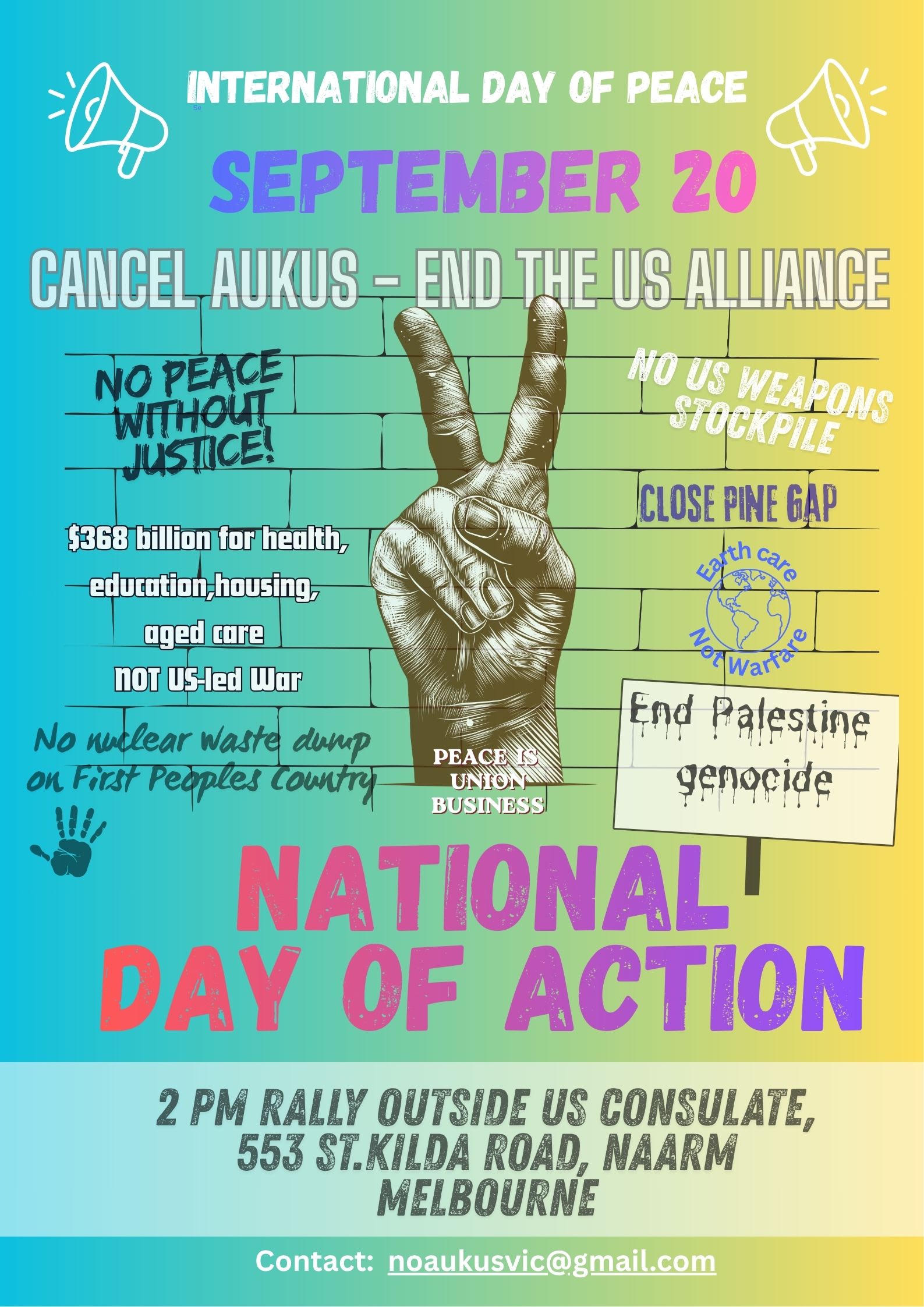
20 September –National Day of Action in Melbourne on the International Day of Peace

Help Aunty Sue Protect Her Land and Sacred Sites From Destructive Rocket Testing.
.

Australians deserve the truth
about
AUKUS – https://aukuspublicinquiry.com/


PETITION – To: Prime Minister Anthony Albanese and the Australian Labor Government

of the week – Australians for War Powers Reform (AWPR)
To see nuclear-related stories in greater depth and intensity
 Antinuclear