Killing Australia’s democracy – first kill the ABC
Latest $84 million cuts rip the heart out of the ABC, and our democracy, The Conversation, Alexandra Wake, Program Manager, Journalism, RMIT University, Michael Ward, PhD candidate, University of Sydney, 24 June 20
In the latest cuts, wrapped up as part of the national broadcaster’s five-year plan,
- 250 staff will lose their jobs
- the major 7:45am news bulletin on local radio has been axed
- ABC Life has lost staff but somehow expanded to become ABC Local
- independent screen production has been cut by $5 million
- ABC News Channel programming is still being reviewed………
- Clearly the coronavirus pandemic has slashed Australia’s commercial media advertising revenues. But the problems in the media are a result of years of globalisation, platform convergence and audience fragmentation. In such a situation, Australia’s public broadcasters should be part of the solution for ensuring a diverse, vibrant media sector. Instead, it continues to be subject to ongoing budget cuts.
Moreover, at a time when the public really cannot afford to be getting their news from Facebook or other social media outlets, cutting 250 people who contribute to some of Australia’s most reliable and quality journalism and storytelling – and literally saving lives during the bushfires – appear to be hopelessly shortsighted.
The latest Digital News Report 2020 clearly showed the ABC is the media outlet Australians trust the most.[table on original shows this]……
- the end of short wave radio services to the Northern Territory
- a reduction in live concerts on Classic FM
- a contraction of Australian drama
- cut costs for Australian children’s programming
- reductions in women’s and local sport
- an end to the coverage of international events such as the Olympics cancelled
- an end to non-news and current affairs television outside of Sydney and Melbourne
- the closure of ABC Open
- 100 websites shut down.
- ……… It is against this background the latest funding freeze, due to a failure to meet the impact of inflation costs, occurs. While it doesn’t sound like a lot, the three year impact is $84 million, and has resulted in the cuts announced today.But more importantly, these ongoing cuts represent an attack by the federal government on the broadcaster, its role in democracy, and in keeping Australians safe, informed and entertained. https://theconversation.com/latest-84-million-cuts-rip-the-heart-out-of-the-abc-and-our-democracy-141355
Another Australian wonderful lead – in CLIMATE DENIAL!!!!
 The number of climate deniers in Australia is more than double the global average, new survey finds, The Conversation, Caroline Fisher, Co-author of the Digital News Report: Australia 2020, Deputy Director of the News and Media Research Centre, and Assistant Professor of Journalism, University of Canberra, Sora Park, Lead Author of Digital News Report: Australia 2020, Associate Dean of Research, Faculty of Arts & Design, University of Canberra, June 16, 2020 Australian news consumers are far more likely to believe climate change is “not at all” serious compared to news users in other countries. That’s according to new research that surveyed 2,131 Australians about their news consumption in relation to climate change.
The Digital News Report: Australia 2020 was conducted by the University of Canberra at the end of the severe bushfire season during January 17 and February 8, 2020.
Read more: Media ‘impartiality’ on climate change is ethically misguided and downright dangerous
It also found the level of climate change concern varies considerably depending on age, gender, education, place of residence, political orientation and the type of news consumed.
Young people are much more concerned than older generations, women are more concerned than men, and city-dwellers think it’s more serious than news consumers in regional and rural Australia.
15% don’t pay attention to climate change news
More than half (58%) of respondents say they consider climate change to be a very or extremely serious problem, 21% consider it somewhat serious, 10% consider it to be not very and 8% not at all serious.
Out of the 40 countries in the survey, Australia’s 8% of “deniers” is more than double the global average of 3%. We’re beaten only by the US (12%) and Sweden (9%).
While most Australian news consumers think climate change is an extremely or very serious problem (58%), this is still lower than the global average of 69%. Only ten countries in the survey are less concerned than we are.
Strident critics in commercial media
There’s a strong connection between the brands people use and whether they think climate change is serious.
More than one-third (35%) of people who listen to commercial AM radio (such as 2GB, 2UE, 3AW) or watch Sky News consider climate change to be “not at all” or “not very” serious, followed by Fox News consumers (32%)……. https://theconversation.com/the-number-of-climate-deniers-in-australia-is-more-than-double-the-global-average-new-survey-finds-140450
Australian media watchdog found Andrew Bolt breached press standards by vilifying Greta Thunberg
Andrew Bolt breached media standards calling Greta Thunberg ‘deeply disturbed’, watchdog rules, SBS, The Australian media watchdog has found Andrew Bolt breached press standards by attempting to “diminish the credibility” of Greta Thunberg on the basis of her disability.
BY MAANI TRUU, 5 June 20 A column by News Corp writer Andrew Bolt mocking teenage climate change activist Greta Thunberg breached standards by attempting to “diminish the credibility” of her opinions on the basis of her disability, the Australian media watchdog has found.
The column, published online in August last year, referred to the 17-year-old as “freakishly influential”, “deeply disturbed”, and a “strange girl”.
“I have never seen a girl so young, with so many mental disorders, treated by so many adults as a guru,” Bolt wrote.
The Australian Press Council found the article breached General Principle 6 of its standards of practice, which requires media organisations to avoid causing offence, distress, prejudice, or a substantial risk to the health and safety of an individual, unless publishing the story is in the public interest. …..
“[The column] attempts to diminish the credibility of Ms Thunberg’s opinions on the basis of her disabilities and by pillorying her supporters on the basis of her disabilities,” the watchdog’s findings, published on Thursday, read. ……. https://www.sbs.com.au/news/andrew-bolt-breached-media-standards-calling-greta-thunberg-deeply-disturbed-watchdog-rules
Today’s News Corp cuts represent an enormous threat to Australian democracy
 Dark day for journalism as Murdoch’s global empire sells democracy down the river
Today’s News Corp cuts represent an enormous threat to Australian democracy — and a grim reminder of the power of a single family. ERIC BEECHER AND PETER FRAY, MAY 28, 2020
Australian news journalism has never seen a day as black as today — and not just because News Corp has closed 12 of its 17 regional daily newspapers, leaving Australia with just 20 remaining.
Today also demonstrates the grotesque power of
one company — and one family — to decimate a large slice of a country’s
news in a single media release.
A company worth $16.3 billion, run from New York, has wielded a knife through large swathes of Australian democracy….. (subscribers only) https://www.crikey.com.au/2020/05/28/rupert-murdochs-global-empire-sells-democracy-down-the-river/?utm_campaign=Weekender&utm_medium=email&utm_source=newsletter&wkndr=VWI3bngzTjl0a0V6UEhQbEJJeTFxUT09
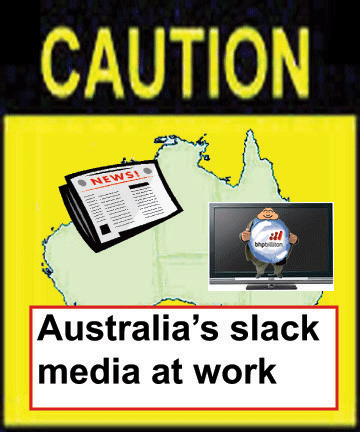
Australian media is not doing its job to expose power and corruption
|
What lies beneath must be resurfaced — or the media is not doing its job to expose power and corruption
And yesterday, the government released a discussion paper proposing that the declining role of gas in Australia’s energy production and manufacturing sectors instead be significantly expanded, which would also directly benefit Santos. In between, the government’s COVID economic recovery panel, chaired by another energy company executive, also urged that gas be used as part of Australia’s economic recovery. Both ideas would require massive government subsidies for gas companies like Santos. As a result Santos has had a good week. Last Friday, the company saw its share price close at $4.60. Yesterday it closed at $5.29, a 15% rise compared to just 3% on the ASX 200. This represents a handy return on investment. Santos is the country’s second-biggest fossil fuel industry political donor after Clive Palmer, having given over $1 million to the Coalition in the last decade. It has a rich history of exchanging staff with Coalition governments…… [In the media coverage] The story was treated as an energy or climate policy story, rather than one about corruption and power……. When even good, experienced journalists fail to give a full account of the fossil fuel companies working to not merely stymie climate action but to turn climate policies to their financial advantage, it points to a serious problem in our media — an inability to explore how surface events reflect underlying structures of power in Australia. And it results in a normalisation of corruption. Why do we instinctively see corruption if Trump does something, but if the government here does exactly the same thing, it’s written up seriously as an energy policy story, with the government and business on one side of a serious debate and “green groups” on the other? We see through the words a figure like Trump uses to disguise their corruption; here, the same words are taken at face value, and debated as serious contributions to policy…… Turnbull at least spoke and wrote about the role of fossil fuel interests and News Corp (which he correctly described as a foreign political party, rather than what it purports to be, an Australian media company) ….. Despite the woeful level of transparency around influence-peddling, there is considerable information available about the financial and personal links between key stakeholders and policymakers across federal politics.
At the ABC, Stephen Long is one of the few mainstream media journalists who sees his “investigative” role as extending to the structures of power rather than simply the surface. Paul Karp of The Guardian is also attuned to the tendency of donors to benefit from political parties. But they are, sadly, exceptions. We’ve seen before what happens when the media ignores the underlying reasons for decisions by policymakers. For years, the extensive donations by the major banks to the Liberal Party, and the revolving door between the executive suites of banks and the ranks of both ministerial staff and ministers themselves, was ignored by the media. The donations and revolving doors operated for both political parties, but the Liberals had — and have — by far the deepest and richest links with the banks. But the role of these financial and personal links in the Liberals’ long-running protection of the banks from regulation, and their constant attacks on industry superannuation funds, received little attention……. Australia’s political system is corrupted. Corrupted not merely or even particularly in the NSW Labor way of bags of cash and dodgy deals for mates, but systemically, institutionally corrupt, a pervasive soft corruption in which the powerful use money and lobbying to influence policymakers and get favourable policies, indeed, as we’ve seen this week, often get to craft policy themselves. All it takes to understand and explain that is to look beneath the surface. Is the Australian media holding policymakers to account? Let us know your thoughts by writing to letters@crikey.com.au. Please include your full name to be considered for publication in Crikey’s Your Say column. https://www.crikey.com.au/2020/05/22/political-reporters-not-doing-their-job-power-corruption/ |
|

The Liberal coalition government killing the ABC by 1000 cuts – but a possible way exists to save it
 With luck the ABC can be saved , Crispin Hull, 8 May 20, This week’s report on ABC funding should alarm Australians.
The death by a thousand cuts of the ABC and the slow strangulation of Medicare have become woven into in Liberal Party’s DNA since John Howard turned Robert Menzies’ broad church of a liberal-conservative Liberal Party into a purely conservative one by shutting out almost everyone left of the nave.
A different liberal-conservative Liberal Party, on the other hand, would have recognised them as essential Australian institutions to be nurtured and supported. After all, the ABC has been around since 1932 and Medicare (in one form or another) since 1973.
The Liberal Party’s desired outright abolition of both has been impossible because of the two institutions’ ingrained popularity. So the onslaught has to be cunningly dressed up as measures to “improve” Medicare and to voice support for the independence of the ABC and promise “no cuts” while ever trying to bully the ABC; sway its board to the right; and to apply cuts to stifle its voice.
This week’s report by the independent think tank Per Capita says that the ABC has lost $783 million in funding since the Coalition came to power in 2013, starting with $245 million in the 2014 Budget, despite Tony Abbott’s promise before the 2013 election that he would not cut the ABC.
More cuts in staff and programming will come before the end of this financial year. They follow seven years of program and staff slashing, critically a 50 per cent cut in the hours of scripted Australian drama.
The Per Capita report concludes that real funding per year since 1985-86 is down 30 per cent or $370 million. Per head of population, the ABC’s funding has been halved in that time. The cuts have come despite the ABC having to provide extra services to keep up with the digital age.
Very likely the Government will cut more as it seeks to claw back from the Covid-19 crisis, even though the ABC – especially the excellent Dr Norman Swan – did so much to inform Australians about the pandemic, as it always does in times of crisis.
What can be done? The ABC itself is down to the bone, though perhaps it could cut out all sport which the commercials to well enough. It is doubtful a Coalition Government would ever increase real funding for the ABC. Perhaps the best we can hope for is that Labor makes some suggestions that the Coalition feels obliged to match or that they become reality with a Labor Government (whenever that might be). ……..
funding solution used in Britain, New Zealand, and only Western Australia among the Australian states to fund culture which could help fund the ABC – a lottery. The Federal Government should set up its own national lottery to boost ABC funding……..
The BBC is well-funded and broadcasters throughout the world line up to pay for its product. The result is a lot of soft-power dividend for Britain. Australia, too, would get a lot of benefit from properly funding the ABC, not least a better-informed community.
Silly me. It’s that last bit the Coalition detests more than anything. http://www.crispinhull.com.au/2020/05/08/with-luck-the-abc-can-be-saved/?utm_source=mailpoet&utm_medium=email&utm_campaign=crispin-hull-column-16-nov-2019_99
Institute of Public Affairs (IPA) continues attacks on ABC
 Surprise! Surprise! IPA continues attacks on ABC https://www.abcfriends.org.au/ipa_continue_attacks_on_abc
Latest news from ABC Friends , Margaret Reynolds, President ABC Friends National, 28 February 2020 The Institute of Public Affairs has (IPA) commissioned a survey by global firm Dynata to continue its campaign against the ABC and public broadcasting in Australia.
Yes, this is the same IPA which tries to influence the Liberal Party to privatise the ABC!
Guess the results: less than a third of Australians agreed that the ABC was out of touch with ordinary Australians.
So, all you extraordinary Australians who value the ABC may like to phone, text, write or visit the IPA to record why you value the essential services the ABC provides.
Website: ipa.org.au/contact-us
Email: ipa@ipa.org.au
Phone: (03) 9600 4744
Next time the IPA commissions a survey they may like to consider a poll on how many Australians value the IPAs contribution to Australian public policy debate!
Australia goes backwards in latest world press freedom index
 Government ‘absolutely committed’ to press freedom as Australia drops in rankings, Brisbane Times, 24 Apr 20 Australia slipped five places to 26th in Reporters Without Borders’ latest world press freedom index, the global watchdog citing Australian Federal Police raids targeting reporters and cost-cutting in the industry as threats to public interest journalism.Attorney-General Christian Porter said the government was committed to protecting press freedom as media organisations and Labor seized on Australia’s slump in the rankings to renew calls for reform. Government ‘absolutely committed’ to press freedom as Australia drops in rankings, Brisbane Times, 24 Apr 20 Australia slipped five places to 26th in Reporters Without Borders’ latest world press freedom index, the global watchdog citing Australian Federal Police raids targeting reporters and cost-cutting in the industry as threats to public interest journalism.Attorney-General Christian Porter said the government was committed to protecting press freedom as media organisations and Labor seized on Australia’s slump in the rankings to renew calls for reform.
The drop in rankings comes after a campaign by the “Australia’s Right to Know” coalition of major media organisations, who have urged the Parliament to legislate on a suite of proposals to curb government secrecy. Labor labelled the global result “worrying” and called for action. Mr Porter said the government was “absolutely committed” to a free press and was awaiting the findings of an inquiry by Parliament’s intelligence and security committee…… The media organisations have put forward six key recommendations, including public interest exemptions from national security laws, expanded safeguards for whistleblowers, freedom of information reform, the right to contest search warrants and defamation changes…… Mr Porter said the the committee’s previous plan to report by early this year had been disrupted by the COVID-19 crisis. The reporting deadline had already been delayed multiple times last year, with members citing the complexity of the task and late submissions. Sources familiar with the committee’s deliberations told The Sydney Morning Herald and The Age the plan was now to deliver the findings by the middle of the year. Reporters Without Borders said Australia “used to be the regional model but is now characterised by its threats to the confidentiality of sources and to investigative journalism”. The organisation also noted the concentration of media ownership, the closure of national news agency Australian Associated Press and that the Australian constitution was “completely lacking in guarantees for the right to inform and to be informed”. A spokesman for Australia’s Right to Know said the coalition had long pursued changes and the High Court’s ruling last week on the search warrants executed at the home of News Corp journalist Annika Smethurst “again illustrated the increasing urgency for law reform in this area.” Journalists’ union the Media, Entertainment and Arts Alliance said the press freedom index result highlighted Australia was going backwards. “Overseas observers are recognising what Australians already know: that press freedom in our country is under sustained assault,” MEAA official Marcus Strom said. Shadow attorney-general Mark Dreyfus and opposition communications spokeswoman Michelle Rowland said in a joint statement the slide down the index “underscores the need for action by the government on law reform to support media diversity, support press freedom and address the concerns of Australia’s Right to Know coalition and civil society organisations”. https://www.brisbanetimes.com.au/politics/federal/government-absolutely-committed-to-press-freedom-as-australia-drops-in-rankings-20200423-p54mn6.html |
|
Government’s latest pressure on the ABC is slammed by Paul Keating
‘Ideological contempt’: Keating slams pressure to sell ABC offices, The Age, By Jennifer Duke and Fergus Hunter, March 3, 2020 Former prime minister Paul Keating has slammed the government for encouraging the ABC to canvass a sale of its inner-city offices, saying it shows “ideological contempt” and is an attempt to “fracture” the public broadcaster.
Communications Minister Paul Fletcher wrote to ABC managing director David Anderson on Monday recommending the broadcaster consider reviewing its capital city property portfolio, which includes offices in Sydney’s Ultimo and Melbourne’s Southbank. Mr Fletcher did not refer to specific property assets in the letter, but government sources who declined to be identified said the Ultimo office in particular was under-used.
Mr Keating said the pressure on the ABC to explore these sales represented “nothing other than an attempt by the Liberal and National parties to fracture the ABC at its foundations, in settlement of its ideological contempt for the organisation”.
“For the first time in its long history, the Ultimo, Sydney and Southbank, Melbourne premises delivered to the ABC a consolidation of workplaces which facilitated cross-platform and cross-divisional facilitation of a kind that was impossible in the old fragmented locational structure,” he said in a statement.
The ABC is grappling with a funding freeze projected to shave up to $84 million off its annual budget and is set to present a five-year strategic plan for the broadcaster later this month. ……
Mr Anderson said the broadcaster’s costs had risen while it was also confronting the funding freeze. The unprecedented bushfire season saw the ABC’s emergency broadcast requirements surge, adding about $3 million on top of expected spending.
“We estimate that it’s going to cost us an extra $5 million per annum from next financial year where we are going to have to build up our ability to respond [to] this being the new normal,” he said…… https://www.theage.com.au/politics/federal/ideological-contempt-keating-slams-government-pressure-to-sell-abc-offices-20200303-p546ev.html
Cosy little cocktail party for Liberal and Labor MPs, with coal industry bigwigs
Climate campaigners condemn ‘insidious’ cocktail party for MPs and coal industry
Parliament House event represents an effort to undermine climate action, environmental group 350 Australia says, Guardian, Christopher Knaus @knauscWed 4 Mar 2020 Environmental campaigners say a cocktail night involving the fossil fuel industry and federal politicians represents an “insidious” lobbying effort to undermine climate action.
The pro-coal Liberal MP Craig Kelly and Labor’s Joel Fitzgibbon hosted a cocktail event at Parliament House to discuss carbon capture and storage with industry leaders on Wednesday night.
An invite seen by the Guardian was sent out by Kelly and Fitzgibbon, who chair the parliamentary friends of resources, together with representatives of Santos and the carbon capture body CO2CRC. The event is described as a “cocktail event to mark the inaugural meeting of the CO2CRC Carbon Capture and Storage Policy Forum”.
That forum features companies such as BHP, Chevron, Coal21, ENI, Exxon, the Global Carbon Capture and Storage Institute, JPower, Shell and Woodside.
The invite says the forum aims to “work with governments, industry and other stakeholders” to create “suitable policy settings and a regulatory framework to accelerate the development and deployment of CCS technology in Australia”…..
Environment group 350 Australia says the event shows the need to “crack down on the undue influence of lobby groups on our democracy”.
The 350 Australia chief executive, Lucy Manne, said the event was an “insidious effort by the fossil fuel lobby to undermine action on the climate crisis”.
Manne said carbon capture and storage had proven a “pipe dream of the coal and gas lobby” and diverted millions away from proven renewables…..
“It’s outrageous that instead of working out how to rapidly transition to the renewable energy future the vast majority of Australians and businesses want, our elected representatives will tonight be sipping cocktails with the coal lobby and discussing how to extend the life of dirty coal-burning power stations.”
Such lobbying is generally hidden from the public unless revealed by the media. The Fitzgibbon-Kelly cocktail event was reported in News Corp papers.
It does not appear in any of the transparency measures governing lobbying. Federal ministers are also not required to disclose who they have met with, unlike in states like Queensland and New South Wales. ……https://www.theguardian.com/australia-news/2020/mar/04/climate-campaigners-condemn-insidious-cocktail-party-for-mps-and-coal-industry
THE AUSTRALIAN newspaper joins in right-wing media reactions and conspiracy theories surrounding coronavirus
- The Australian, a national newspaper part of Rupert Murdoch’s News Corp., published an anti-trans article on February 9 that compared coronavirus to a “global epidemic” of transgender teens. The outlet has a history of anti-trans reporting and spreading misinformation about trans youth.
A guide to right-wing media reactions and conspiracy theories surrounding coronavirus, MEDIA MATTERS BY KAYLA GOGARTY & COURTNEY HAGLE RESEARCH CONTRIBUTIONS FROM NOOR AL-SIBAI, ALEX KAPLAN, NIKKI MCCANN RAMIREZ & MADELINE PELTZ 02/28/20
-
As the lethal outbreak of coronavirus continues to spread around the world and the U.S. government warns that it will almost certainly also spread within the United States, right-wing media outlets and online accounts are spreading misinformation and conspiracy theories which could have deadly consequences.
The strain of novel coronavirus known as COVID-19 is a respiratory disease that was first detected in the city of Wuhan, China. It swiftly spread and has now been detected in 53 countries, including the United States. So far, the outbreak has led to nearly 3,000 deaths and more than 82,000 cases worldwide, according to The New York Times.
The Centers for Disease Control and Prevention describes the disease behind the current outbreak as part of “a large family of viruses that are common in many different species of animals, including camels, cattle, cats, and bats.” The CDC adds that “rarely, animal coronaviruses can infect people and then spread between people.” Earlier patients in the COVID-19 outbreak appeared to have a link to seafood and animal products, but the virus has since been shown to spread person-to-person.
On January 30, the International Health Regulations Emergency Committee of the World Health Organization declared the outbreak a “public health emergency of international concern,” and on January 31, Health and Human Services Secretary Alex Azar declared a public health emergency in the United States.
As the impact of coronavirus continued to be reported, concerns began to arise that it was driving xenophobic attacks toward people of Asian descent. In New York City, a man assaulted a woman wearing a face mask while calling her a “diseased b****.” On a Los Angeles subway, one man declared that “every disease has ever came from China.” In another incident, a Costco worker in Washington state told an 8-year-old child to “get away” because she believed he may be “from China.” Across the country, there has been an uptick in physical and verbal attacks toward Asian Americans.
In addition to xenophobic sentiments, conspiracy theories and agenda-driven narratives began to arise on the internet and throughout right-wing media, adding more panic and confusion to an already chaotic situation. These conspiracy theories include claims that the Chinese government created coronavirus at a lab in Wuhan; that the United States is using the virus to attack and undermine China from within; and that coronavirus was previously created and patented by former Microsoft CEO Bill Gates.
The virus has also triggered anti-Semitic sentiments, medical and scientific disinformation, and fearmongering from the religious right about the end of the world. In the United States, President Donald Trump and his allies in right-wing media have also absurdly argued that Democrats and the media are politicizing coronavirus for their own gain to make him look bad and cause panic in the stock market, which has plunged in reaction to the potential pandemic. Continue reading
Media coverage of Kimba nuclear waste dump is found wanting
|
Marc Daniel, Commenting on the story: Kimba nuclear dump laws hit parliament So much misinformation in this article. It does not have broad community support. The voting pool was narrowed to 800 and the vote was won by 70 votes. That’s not broad support. It’s a manipulated outcome. Then the actual figures ‘vanish’ and they talk of percentages and broad support. ” ‘I thank the people of Kimba, Hawker, Quorn and surrounds, Traditional Owner groups, the Kimba District and Flinders Ranges councils and the Outback Communities Authority for their participation in this process,’ Pitt said today.” They took the Kimba traditional owners to court to specifically exclude them from the poll. Funny how the first site was offered by the sitting Liberal member Rowan Ramsey, and this was only withdrawn when someone pointed out the conflict of interest so blatant but unrecognised by him. It’s actually against the laws of South Australia, a law that was given broad discussion and brought in by the SA Rann Government, now to be overridden by federal law. 45 Jobs. Maybe, but that’s during construction. Maybe. They promise 25 in operation, but who can trust that figure when any new process built in a modern era can be fully automated. Maybe 2 security guards on the gate if its not remotely monitored from a capital city somewhere. Where is the nearest hospital and medical services? Kimba has none. How will it get there? None have been consulted about this, especially in Whyalla, the port that a report nominates as the shipping point. This article has taken the Government’s “facts” and failed to examine any of them. Its not reporting, its propaganda. Marc Daniel https://indaily.com.au/opinion/reader-contributions/2020/02/14/your-views-on-a-city-stadium-nuclear-dump-and-planning-reform/ |
|
|
|
Kimba nuclear dump laws hit parliament. In Daily 13 Feb 20Draft laws to turn a Kimba farm into a national nuclear waste facility have hit federal parliament, only weeks after the site on SA’s Eyre Peninsula was announced.
Resources minister Keith Pitt said today legislative amendments had been introduced to parliament to “support the delivery” of the facility, at Napandee near Kimba. …… [Pitt goes on to put the “medical “argument for the waste dump – not a word about spent fuel rods from the Lucas Heights nuclear reactor] Under this Government, decisive action has been taken to finally provide a facility where we can consolidate existing and future radioactive waste stream.” The Bill would also enable the establishment of a $20m community fund to help deliver on federal commitments to Kimba, which Pitt said “broadly supports” the facility. Kimba was chosen after a four-year process and is expected to be a nuclear waste dump for 100 years. About 45 people will be employed at the site, which the government says will store low-level waste permanently and intermediate-level waste temporarily. Environmental and indigenous groups oppose the dump, but a recent poll conducted around Kimba returned a 62 per cent vote in favour of the facility. A site near Hawker was ruled out after a community survey found minority support. Native title has been extinguished at the Kimba site, but the government insists it wants to protect indigenous cultural heritage and work with the Aboriginal community near the facility. “I thank the people of Kimba, Hawker, Quorn and surrounds, Traditional Owner groups, the Kimba District and Flinders Ranges councils and the Outback Communities Authority for their participation in this process,” Pitt said today. The draft laws will be considered by a parliamentary committee so stakeholders can give feedback. https://indaily.com.au/news/2020/02/13/kimba-nuclear-dump-laws-hit-parliament/ |
|
Murdoch media and climate change denial
How Rupert Murdoch Is Influencing Australia’s Bushfire Debate, Critics see a concerted effort to shift blame, protect conservative leaders and divert attention from climate change. NYT By Damien Cave, Jan. 8, 2020 WOMBEYAN CAVES, Australia — Deep in the burning forests south of Sydney this week, volunteer firefighters were clearing a track through the woods, hoping to hold back a nearby blaze, when one of them shouted over the crunching of bulldozers.
|
Climate scientists do acknowledge that there is room for improvement when it comes to burning the branches and dead trees on the ground that can fuel fires. But they also say that no amount of preventive burning will offset the impact of rising temperatures that accelerate evaporation, dry out land and make already-arid Australia a tinderbox.Even fire officials report that most of the off-season burns they want to do are hindered not by land-use laws but by weather — including the lengthier fire season and more extreme precipitation in winter that scientists attribute to climate change……. “Leaders should be held to account and they should be held to account by the media,” said Penny D. Sackett, a physicist, astronomer and former chief scientist for Australia……. https://www.nytimes.com/2020/01/08/world/australia/fires-murdoch-disinformation.html?auth=login-facebook&fbclid=IwAR3HGR6KpEAxoU55izrFtdg9O1RUqVF2LtcjHttj8hiHuDJx77RzH_XOarY&smid=fb-nytimes&smtyp=cur |
|
Murdoch media: The Australian, Herald Sun and Courier Mail downplay bushfire news
The Australian: Murdoch-owned newspaper accused of downplaying bushfires in favour of picnic races https://www.theguardian.com/media/2020/jan/04/the-australian-murdoch-owned-newspaper-accused-of-downplaying-bushfires-in-favour-of-picnic-races
Herald Sun relegates bushfires to page 4 while Courier Mail brings good news via ‘Onion Oracle’Amanda Meade, Sat 4 Jan 2020 The Australian, Rupert Murdoch’s flagship newspaper, has defended itself against criticism it downplayed unprecedented bushfires by failing to put a picture of the disaster on the front page of an edition, even as newspapers across the world featured the harrowing scenes.
Many of the world’s leading mastheads featured pictures of the devastation of the Australian bushfires on page one on Thursday. But the Australian’s first edition ran an upbeat picture story about the New Year’s Day picnic races at Hanging Rock.
Sources at the newspaper said the newsroom was short-staffed over the holidays, however it was noted that resources were found to attack the ABC with gusto over its New Year’s Eve concert.
“Our readers have been fully informed across the nation both online and in paper all week,” editor John Lehmann told Guardian Australia.
The national broadsheet’s lead story on Thursday was about a secret proposal by police to ban alcohol in Indigenous communities in Western Australia – a story deemed more important than the bushfire report, which said eight people were dead and mass evacuations were underway.
There wasn’t a single photo of the catastrophic bushfires until page 4.
Before readers got to that coverage, they were given an exclusive interview with “rebel marine scientist Peter Ridd” who has challenged reef scientists to test whether or not human actions have caused a collapse in the growth rate of corals on the Great Barrier Reef.
The later editions of the paper dropped the racing story and replaced it with photographs of bushfire victims surveying the damage.
The Australian is not the only Murdoch-owned newspaper that has been accused of downplaying the bushfires.
On the same day, Sydney’s Daily Telegraph blamed the Bureau of Meteorology for inaccurate weather predictions, which may have “lulled residents into a false sense of security about conditions”.
But it was the Courier Mail’s story about the “Onion Oracle” that had some readers wondering what was going on at News Corp.
The Queensland tabloid carried the optimistic news that “Onion Oracle” Halwyn Hermann was predicting rain using an old German tradition. They even compared the Onion Oracle’s predictions to those of the bureau of meteorology.
The Australian has been consistent on one front. Throughout the bushfire season it has kept up its coverage of climate denialism.
Before Christmas, the Australian attempted to smear Greg Mullins and his Emergency Leaders for Climate Action group as “largely a vehicle for Tim Flannery”. Flannery is a leading environmentalist and chief counsellor at the Climate Council.
The former fire and emergency chiefs from multiple states and territories say Australia is unprepared for worsening natural disasters from climate change and governments are putting lives at risk.
The Australian says they are a front for Flannery who is an “alarmist” for urging that coal-fired power stations be shut down.
On New Year’s Eve, the paper led with another “exclusive” report that pushed the line Australia should not speed up its response to global warming.
Pro nuclear nonsense from Geoff Russell – “we’re all toast without nuclear power”
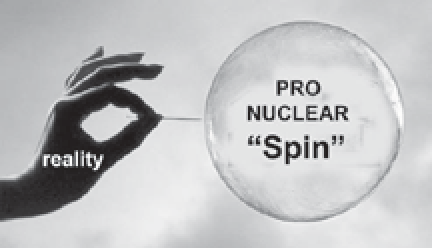 Once again, New Matilda gave nuclear lobbyist Geoff Russell a forum for an attack on a critic of the nuclear industry. (Steggall’s Chicken On Nuclear Family, While Party Politics Buggers Inquiry, 16 Dec 19.) On this occasion, New Matilda was trashing a very mild nuclear critic, Zali Steggall.
So we’re “all toast” without nuclear power? This is nonsense. Even Geoff Russell knows that to get up and running the thousands of nuclear power plants that would be needed to stall global heating – would take decades. That means that, with the speed of global heating, nuclear power would be too late to make any difference. (And that’s if nuclear power really were effective against climate change – which it isn’t, when you consider the whole carbon emitting nuclear fuel cycle from uranium mining to deep disposal of wastes) Meanwhile, energy efficiency, wind and solar power, are quickly set up, quickly effective, and provide energy fuel that is genuinely zero carbon.
1 This month


Help Aunty Sue Protect Her Land and Sacred Sites From Destructive Rocket Testing.
.

Australians deserve the truth
about
AUKUS – https://aukuspublicinquiry.com/

PETITION – To: Prime Minister Anthony Albanese and the Australian Labor Government

of the week – Australians for War Powers Reform (AWPR)
To see nuclear-related stories in greater depth and intensity

