Paul Waldon Fight To Stop Nuclear Waste Dump In Flinders Ranges SA, 19 Nov 18
News of fires in the radioactive contaminated red forest of Chernobyl get a mention. News of fires on the radioactive ground of California get a mention. Yet this year the media has suppressed the news of two separate fires on land contaminated with radioactive materials released from Lucas Heights. Is this the typical case of when they can’t control nuclear they try to control the media.? https://www.facebook.com/groups/344452605899556/
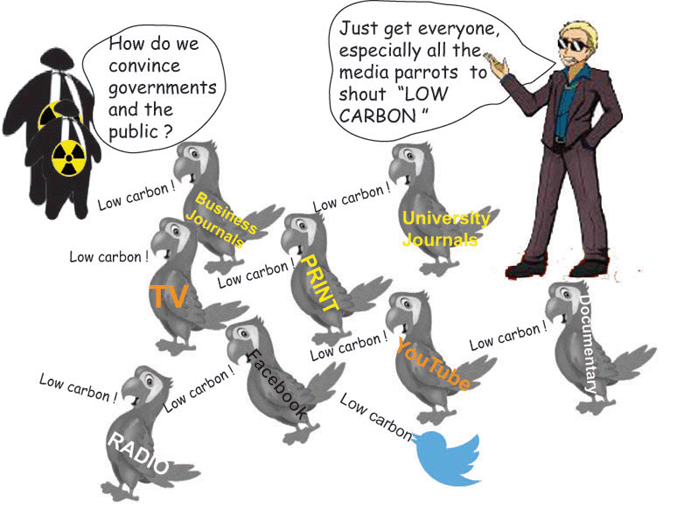
The nuclear fuel chain emits carbon all the way through, and I find it extraordinary that journalists mindlessly parrot these lies from the nuclear lobby. Makes you wonder – do the mainstream journalists actually compose the stuff that they write, about nuclear power, or do they just copy the handouts from the industry?
Quite simply, nuclear industry leaders want to get financial help – subsidies, tax credits, from governments that have been duped into believing that nuclear power is “low” or even “zero” carbon.
The also want the “respectability”, public approval, that comes from being seen as combatting climate change. (even though most were previously in the denying climate change camp).
Anyway – it’s common sense to see that nuclear power is quite a strong emitter of greenhouse gases. Any thinking non-expert can see that. However, experts see it too. Only one step in that uranium-nuclear chain is low emission – though all nuclear lobbyists claim that this step is “no emission” – the reactor’s operation.
The 60 Minutes Fukushima nuclear infomercial, Independent AustraliaNoel Wauchope 23 October 2018 A FEW YEARS AGO, Channel 9’s 60 Minutesdid an excellent investigation of the Fukushima nuclear accident.
This Fukushima investigation was compered by Liz Hayes. I recall that, at the time, the program was a much more thorough, serious and well-resourced presentation than anything put forward by even the ABC or SBS.
The main message of this program is a call to scrap Australia’s legislation against establishing the nuclear industry. The argument given is that we need nuclear power because it is supposedly cheap and dependable. We also need it because it is supposedly essential to combat climate change.
This time, the reporter is not Liz Hayes. It’s Tom Steinfort, who is described as a “seasoned Channel 9 star”. Does a seasoned Channel 9 star just accept without question the claims made in this episode?
Among claims made:
that the evacuation of the Fukushima prefecture was unnecessary — which implies that the Japanese Government and scientists acted stupidly;
that there were no deaths and will not be any deaths resulting from the radiation from the meltdown, a point on which many experts disagree;
If Mr Steinfort really is a star reporter, I would expect him to have done his homework before swallowing these claims hook line and sinker. ………
So, what do we make of this latest offering about Fukushima, from 60 Minutes? It must have taken a lot of money and a lot of negotiation to get a 60 Minutes camera team inside the Fukushima nuclear station. I assume that the negotiations were largely arranged by Ben Heard, who has influential nuclear contacts overseas — particularly in Russia and South Africa, where he has been a prominent nuclear spokesperson. In Russia, Heard launched Rosatom National Geographic — a nuclear soft sell environmental program.
I think that we can be sure of one thing. As Japan plans for the 2020 Olympics – some sections of which are to take place in Fukushima Prefecture – the Japanese Government is not likely to permit a team with any anti-nuclear perspective access to the crippled nuclear power plant.
The 60 Minutes media team would have had to have the Japanese authorities on side. I would bet, some companies keen to set up the nuclear industry in Australia would also be on side and keen to assist.
There have been rumblings, too, of yet another resurgence for nuclear energy in Australia, with Prime Minister Scott Morrison declaring that he is ‘open to the idea of nuclear power’ and that ‘the source of Australia’s energy doesn’t bother him and he isn’t interested in an ideological debate’.
“I listened with great interest to Ben Heard’s narrative regarding conditions in living areas adjacent to the Fukushima Nuclear Power Plant. The following academic paper which adds to the knowledge available to Australians and the world population regarding the Japanese nuclear event: “Exposure and current health issues in Minamisoma” by M. Tsubokura Minamisoma Municipal General Hospital, 2-54-6 Takamicho, Haramachi-ku, Minamisoma, Fukushima Prefecture, Japan; e-mail: tsubokura-tky@umin.ac.jp Full paper here:http://journals.sagepub.com/doi/pdf/10.1177/0146645316666708
The whole paper needs to be read. The learned author of the paper says, among other things, that : “In September 2011, whole-body counters were installed in the (Minamisoma )hospital and have since been used for screening. In total, some 100,000 people have been screened. For approximately 99% of all children, including elementary and middle school students, in the city, internal exposure levels were below the minimum level for detection (Tsubokura et al., 2015a)…..”
However, the author also states that “More than 5 years since the disaster, internal exposure levels on the order of several thousand or several tens of thousands of becquerels are still being detected in those who regularly consume wild boar, wild birds, wild vegetables, or mushrooms that are highly contaminated, with a frequency of about several persons per 10,000 people (Tsubokura et al., 2014). However, internal exposure levels are not likely to increase for those who consume foods distributed through regular channels.” end partial quotes.
I topped my class in Agricultural Science and was trained by the Australian Army as a Radiological Safety NCO during the Cold War. The matters are complex and the exclusion zones in Japan are valid in my opinion from what I have read from the literature.
I have a question for the 60 minutes team, Ben Heard and viewers: Given the fact of bio-accumulation as proven by the dosimetry of those scanned Japanese people who hunt and collect their own food, including those who eat food obtained not from “official” supply chains, would you be happy to give up hunting, fresh water fishing (many papers on that one) and collecting edible plants and mushrooms as one’s ancestors have done since the dawn of time? Or is this a small matter in the context of the current 10 year window nuclear power has before it is rendered totally redundant in the Australian context. There is no need to panic. It’s all very interesting. Paul Langley.”
Of course Channel 9 Sydney will not be reading the above letter from a viewer during the 60 Minutes feedback segment anytime this side of the next ice age.
Steve Dale Nuclear Fuel Cycle Watch South Australia That poor guy [ 60 Minutes reporter Tom Steinfort]- he has to learn that people can seem very nice and sincere but still be feeding you a load of crap.
Just watched a “60 minutes extra video” where he has an extended interview with Geraldine Thomas. He talks about his Geiger counter on the plane (a Safecast unit that Ben Heard is seen holding in the actual 60 minutes report) and says –
“…the Geiger counter is hovering around 3.5 to 3.6 micro Sieverts – that is about “50 times” the normal exposure you would get in Melbourne or Sydney…”
3.5 is 35 times the average background value 0.1 micro Sieverts. The nuclear propagandists exaggerate the effects of airflight non-contaminating radiation because it suits their agenda. Such dishonesty, such desperation..
It really seems like the nuclear propagandists have thrown everything at this poor unwitting journalist to get this segment – I wonder who actually paid for the airflights (which from the video looked like first/business class)
Oh – and from the display on the Geiger Counter we can say the date of the flight was 23rd of September – and I know Heard was also in Fukushima back in April, so this makes 3+ trips to Fukushima power station.
Andrea Carson Incoming Associate Professor at LaTrobe University. Former Lecturer, Political Science, School of Social and Political Sciences; Honorary Research Fellow, Centre for Advancing Journalism, University of Melbourne
If you value the media’s watchdog role in democracy, then the opening words in the deal enabling Channel Nine to acquire Fairfax Media, the biggest single shake-up of the Australian media in more than 30 years, ring alarm bells.
The opening gambit is an appeal to advertisers, not readers. It promises to enhance “brand” and “scale” and to deliver “data solutions” combined with “premium content”. Exciting stuff for a media business in the digital age. But for a news organisation what is missing are key words like “news”, “journalism” and “public interest”.
Those behind the deal, its political architects who scrapped the cross-media ownership laws last year, and its corporate men, Fairfax’s and Nine’s CEOs, proffer a commercial rather than public interest argument for the merger. They contend that for two legacy media companies to survive into the 21st century, this acquisition is vital.
Perhaps so. But Australia’s democratic health relies on more than a A$4 billion media merger that delivers video streaming services like Stan, a lucrative real estate advertising website like Domain, and a high-rating television program like Love Island.
The news media isn’t just any business. It does more than entertain us and sell us things. Through its journalism, it provides important public interest functions.
Ideally, news should accurately inform Australians. A healthy democracy is predicated on the widest possible participation of an informed citizenry. According to liberal democratic theorists, the news media facilitate informed participation by offering a diverse range of views so that we can make considered choices, especially during election campaigns when we decide who will govern us.
Journalists have other roles too, providing a check on the power of governments and the excesses of the market, to expose abuses that hurt ordinary Australians.
This watchdog role is why I am concerned about Nine merging with Fairfax. To be clear, until last week, I was cautiously optimistic about the future of investigative journalism in Australia.
Newspapers like The Sydney Morning Herald, The Age, the Newcastle Herald and the Financial Review have a strong record of using their commercial activities to subsidise expensive investigative journalism to strengthen democratic accountability by exposing wrongdoing. Channel Nine does not.
Since the formation of The Age’s Insight team in 1967, Fairfax investigations have had many important public outcomes after exposing transgressions including: judicial inquiries, criminal charges, high-profile political and bureaucratic sackings, and law reforms. Recent examples include the dogged work of Fairfax and ABC journalists to expose systemic child sex abuse in the Catholic Church and elsewhere, leading to a royal commission and National Redress Scheme for victims. Another was the exposure of dodgy lending practices that cost thousands of Australians their life savings and homes, which also triggered a royal commission.
The problem with Nine’s proposed takeover of Fairfax (if it goes ahead) is that it is unlikely to be “business as usual” for investigative journalism in the new Nine entity. First, there is a cultural misalignment and, with Nine in charge, theirs is likely to dominate.
With notable exceptions such as some 60 Minutes reporting, Nine is better known for its foot-in-the-door muckraking and chequebook journalism than its investigative journalism. In comparison, seven decades of award-winning investigative journalism data reveal Fairfax mastheads have produced more Walkley award-winning watchdog reporting than any other commercial outlet.
Second, even as the financial fortunes of Fairfax have waned in the digital age, it has maintained its award-winning investigative journalism through clever adaptations including cross-media collaborations, mainly with the ABC. This has worked well for both outlets, sharing costs and increasing a story’s reach and impact across print, radio, online and television.
How will this partnership be regarded when Fairfax is Nine’s newlywed? Will the ABC be able to go it alone with the same degree of investigative reporting in light of its successive federal government budget cuts?
Third, my latest research (see graph, on original) ) has shown that in Australia, as in Britain and the United States, investigative stories and their targets have changed this decade to accommodate newsroom cost-cutting.
Investigations are more likely to focus on stories that are cheaper and easier to pursue. This means some areas such as local politics and industrial relations have fallen off the investigative journalist’s radar. Here and abroad, this reflects cost-cutting and a loss of specialist reporters.
Echoing this, The Boston Globe’s Spotlight editor, Walter Robinson, warned:
There are so many important junctures in life where there is no journalistic surveillance going on. There are too many journalistic communities in the United States now where the newspaper doesn’t have the reporter to cover the city council, the school committee, the mayor’s office … we have about half the number of reporters that we had in the late 1990s. You can’t possibly contend that you are doing the same level or depth of reporting. Too much stuff is just slipping through too many cracks.
Of concern, Australian award-winning investigations already cover a smaller breadth of topics compared to larger international media markets. The merger of Fairfax mastheads with Channel Nine further consolidates Australia’s newsrooms. If investigative journalism continues, story targets are likely to be narrow.
Finally, investigative journalism is expensive. It requires time, resources and, because it challenges power, an institutional commitment to fight hefty lawsuits. Fairfax has a history of defending its investigative reporters in the courts, at great expense.
Will Nine show the same commitment to defending its newly adopted watchdog reporters using earnings from its focus on “brand”, “scale” and “data solutions”? For the sake of democratic accountability, I hope so.
Addressing a room full of federal and circuit judges at the Ninth Circuit’s annual judicial conference, David McCraw, the deputy general counsel for The New York Times, explained that regardless of how one feels about Assange and traditional news outlets receiving the same kind of deference over publishing leaked materials, his prosecution would be a gut punch to free speech.
“I think the prosecution of him would be a very, very bad precedent for publishers,” McCraw said. “From that incident, from everything I know, he’s sort of in a classic publisher’s position and I think the law would have a very hard time drawing a distinction between The New York Times and WikiLeaks.”
McCraw went on to clarify that while Assange employs certain methods that he finds discomfiting and irresponsible, such as dumping unredacted documents revealing the personal information of ordinary people, Assange should be afforded the same protections as a traditional journalist.
“Do I wish journalism was practiced in a certain way, like it is with The New York Times, The Washington Post, or The Wall Street Journal? Of course. But I also think new ways of publishing have their value. Our colleagues who are not only challenging us financially but journalistically have raised an awareness that there are different ways to report,” McCraw said.
“But if someone is in the business of publishing information, I think that whatever privilege happens to apply – whatever extension of the law that would apply – should be there. Because the question isn’t whether he’s a journalist. It’s in that instance was he committing an act of journalism.”
Assange has long considered himself a journalist operating no differently than other news outlets. This has complicated matters, because if Assange can be prosecuted for publishing leaked information, why not prosecute news organizations like The New York Times?
Earlier this month, a grand jury returned an indictment against twelve Russian military spies for hacking into the servers and emails of the Democratic National Committee and state election officials, stealing documents and staging the release of those documents to interfere with the 2016 presidential election. While the indictment did not name Assange and WikiLeaks specifically, it has been widely suggested that WikiLeaks received the materials and could very well be the group referred to in the indictment as “Organization Number 1.”
Barry Pollack, who represents Assange in an ongoing criminal investigation in the Eastern District of Virginia, weighed in on the indictment Tuesday.
“If you read the indictment that just came out on Russians and you look at what Organization Number 1, which is clearly WikiLeaks, is alleged to have done in that indictment, it is doing exactly what The New York Times and The Washington Post do every day of the week,” Pollack said. “He [Assange] is communicating with a source, the source provides him with information, he publishes that information.
“There are no questions about the truthfulness or accuracy or authenticity of that information. And then he encourages the source to give him more information. He says ‘don’t give it to my competitors, give it to me. This story will have more impact if I publish it.’”
Pollack and McCraw spoke as part of a panel titled “The Law of Leaks,” a session on how the United States has ramped up efforts to prosecute people who have leaked state secrets. Thirteen people have been prosecuted under the first law against leaking state secrets, the Espionage Act of 1917, most under the Obama administration.
President Donald Trump has waged an unprecedented war against the media, taking to Twitter last year to call the media “the enemy of the American people.” Yet no publisher has ever been indicted over leaks, and both McCraw and Pollack expressed doubts about whether it will happen any time soon.
“Unlike firing off a tweet, bringing a prosecution requires a career professional prosecutor to sign off on the prosecution, so there also is a tremendous check there that doesn’t exist in some of the rhetoric we hear,” Pollack said.
“Prosecutions of journalists would be difficult,” McCraw said. “I think they’d be unpopular, I think they’d be wrong, and I think they’d be unsuccessful. I see this PR campaign against the press as almost an alternative to legal measures.”
A modern tragedy: Nine-Fairfax merger a disaster for quality media, The Conversation, Denis Muller, Senior Research Fellow in the Centre for Advancing Journalism, University of Melbourne,
It means the death of Fairfax and is the most consequential change in Australian media ownership in 31 years.
It also means that three of Australia’s best and biggest newspapers – The Age, The Sydney Morning Herald and The Australian Financial Review – are now subsumed into a media conglomerate whose editorial culture is characterised by mediocre journalism.
Nine’s news bulletins consist largely of police stories with a tincture of politics, and highlights of colourful or violent events overseas.Its current affairs program, A Current Affair, is a formulaic procession of stories about consumer rorts and personal tragedies.
So there is a huge question mark over the future editorial quality of the newspapers.
A particularly pressing question is: what will happen to The Age’s investigative unit?
It is led by two of the best investigative reporters Australia has produced, Nick McKenzie and Richard Baker.
In addition to breaking an extraordinary range of major stories on subjects like organised crime and scandals in the banking industry, they have developed a highly successful collaboration with the ABC’s Four Corners team.
It seems very unlikely Nine would allow this collaboration to continue, since it involves a rival television channel.
There is also a question about editorial independence.
Fairfax has a charter of editorial independence, which all owners since 1990 have signed up to. Will Nine sign up to it? Will the charter have any meaning when the newspapers are owned by a company whose chairman, Peter Costello, was treasurer in the Liberal-National Coalition government of former Prime Minister John Howard?
The answers to these questions will not be known for some time. They will depend largely on who is given editorial control of the combined operation. Since the Nine CEO, Hugh Marks, is to be CEO of the combined operation, it seems more likely than not that it will be a Nine executive who calls the editorial shots, too.
The takeover also means a further loss of diversity in an already highly concentrated media-ownership landscape. The big players are now down to four: News Corp, Nine, Seven West Media and the ABC.
And it is almost certain to mean the loss of yet more journalists’ jobs.
Since 2012, more than 3,000 jobs have been lost across Australian journalism. Yet, if the takeover is really going to represent “compelling value” for shareholders, as Fairfax chairman Nick Falloon says, then newsroom “synergies” – to borrow the corporate jargon – are likely to be essential.
The so-called cross-media rule gave Australia 30 years of media diversity, especially between Australia’s major television networks and its capital city print.
Those barriers in the wholesaling of news underwrote diversity of opinion, guaranteeing an altogether better informed and livelier public debate.
It is true that the technology has brought myriad voices to a public eager for diversity of information. But the atomisation of web-based content, much of it other than local, cannot in terms of impact, be compared with the big local media players, particularly in consolidations of the kind announced today.
The announced takeover of Fairfax by Channel Nine will change the news landscape of Australia altogether.
Notwithstanding the obvious disruption that international platforms like Google and Facebook have made to advertising and traditional media revenues, the answer for Australia is diversity of income streams for Australia’s majors and not a closedown in news and content with major print being taken over by major television.
This is an exceptionally bad development.
……… If in the announced arrangement Channel Nine has a majority of the stock, Channel Nine will run the editorial policy.
The problem with this is that, in terms of news management, Channel Nine, for over half a century, has never other than displayed the opportunism and ethics of an alley cat.
There has been no commanding ethical or moral basis for the conduct of its news and information policy.
Through various changes of ownership, no one has lanced the carbuncle at the centre of Nine’s approach to news management. And, as sure as night follows day, that pus will inevitably leak into Fairfax.
For the country, this is a great pity.
And, of course, if the government really had its way, Australia would face this much closed down and managed landscape without an ABC as it is today – an independent national broadcaster.
On competition grounds and those of the imperative of local diversity, the competition commissioner should put this proposal under high scrutiny.
Subject: ANSTO – Lucas Heights – covert poisoning of pregnant women – miscarriages
I have just read your story about a breakdown at the Lucas Heights nuclear reactor operated by ANSTO.
ANSTO, as part of normal operations, manufacture and release radioactive poisons into the air.
These radioactive poisons are known to cause miscarriages (and other problems).
ANSTO give no warnings of these “controlled emissions” and justify this by claiming that they are not a health hazard – this claim is based on dodgy seventy year old data from Japan plus a bunch of dodgy number crunching.
Australian women suffer many many thousands of “unexplained” miscarriages (and many Aussies get “unexplained” cancer dementia etc etc).
And this is not the only dodgy aspect of ANSTO’s operations – the reactor is not needed at all for medicine – as in Canada, cyclotrons can be used to produce the required isotopes safely and reliably and without creating problematic “radioactive waste”.
ANSTO are using the lie that “nuclear medicine requires a nuclear waste dump” as a central part of the taxpayer funded bribery and deception program called the National Radioactive Waste Management Facility project.
The taxpayer funded National Radioactive Waste Management Facility project is illegal under South Australian law and is clearly a “foot in the door” for the (now decades old) nuclear industry campaign to make South Australia a nuclear waste repository as per the dodgy recommendations of the dodgy Scarce Royal Commission.
I encourage you to look in to this horror story of taxpayer money funding nuclear fanatic traitors.
James Cogan’s speech at Sydney rally to free Julian Assange
Constant attacks on the ABC will come back to haunt the Coalition government The Conversation Denis Muller Senior Research Fellow in the Centre for Advancing Journalism, University of Melbourne,
In January 1931, as the newly elected United Australia Party government of Joseph Lyons was contemplating the establishment of a national broadcasting service, the prime minister received a deputation of prominent Melburnians, including a barrister and member of the Victorian parliament, Robert Gordon Menzies.
They urged that the new broadcasting service “be organised on an independent basis and that cultural potentialities of the Broadcast Service be considered a matter of primary importance”. The broadcast service came to be named the Australian Broadcasting Commission and went to air for the first time on July 1 1932.
It is a measure of how far today’s Liberal Party has drifted away from the values and ideals of its founder, Menzies, that last Saturday its federal council should have resoundingly adopted a motion that the ABC should be privatised.
One of the proponents of the motion was Mitchell Collier, the federal vice-president of the Young Liberals. He said there was no economic case to keep the broadcaster in public hands.
No economic case. Where the ABC is concerned, that is a false premise on which to proceed. The ABC was explicitly not established for economic purposes or in pursuit of an economic ideology. It was established for social, educational and cultural purposes.
It was also established on an explicitly non-commercial basis: it takes no advertising. Why? Because it was believed advertising would weaken its independence. The policymakers of the 1930s had seen only too clearly how beholden the newspaper proprietors of the day had become to commercial imperatives: the demands of advertisers and the pressure to increase circulation, even at the cost of editorial quality and integrity.
The newspapers of the day had also become mouthpieces for sectional interests. In Melbourne, The Argus stood for the interests of the mercantile classes and conservative political causes; The Age for a kind of Protestant liberalism and social justice. It supported the miners at Eureka.
The bipartisan political vision for the ABC was that it should not be vulnerable to sectional interests or commercial pressures, but should exist to serve the public interest in the widest sense.
The first paragraph of its charter captures the essence of these expectations:………
A motion to privatise the ABC, no matter how vigorously repudiated by the government, is political poison, especially in regional, rural and remote Australia.
These voters have watched as the Abbott-Turnbull administrations have cut the ABC’s funding by $338 million since 2014. They have watched as the ABC has been used – in Guthrie’s words yesterday – as a punching bag by narrow political, commercial or ideological interests
Guthrie was too diplomatic to nail the government or the Murdoch press. But the overt hostility to the ABC shown by the government over the past four years may now reap a political harvest.
That hostility has been demonstrated not only by the funding cuts but by sustained carping criticisms, vexatious complaints and political stunts exemplified by the current competitive neutrality inquiry.
It would be more accurately called the editorial neutering inquiry. Its focus is clearly on the ABC news service, as its own issues paper makes clear. That is the part of the ABC most detested by the government and the politician for whom the government is a cat’s paw in this, Pauline Hanson.
Each Tuesday, I engage in a pro-bono 25-minute segment on media issues with the presenter of ABC Radio Statewide Drive, Nicole Chvastek. The program is broadcast across regional Victoria and southern New South Wales, covering the National seats of Riverina, Mallee, Murray and Gippsland, and the Liberal seats of Farrer, Wannon, McMillan, Corangamite and McEwen.
Yesterday the talkback calls ran hot on this one issue: privatisation of the ABC. Yes, the ABC needed scrutiny; yes, the ABC was a bunch of lefties. But: where would we be without it?
ABC managing director Michelle Guthrie has hit back against critics with a Deloitte Access Economics assessment that the public broadcaster contributed more than A$1 billion to the Australian economy in the last financial year.
This was on a par with the public funding of the organisation, she told the Melbourne Press Club, in an address coming days after the Liberal Federal Council urged the ABC be privatised – a call rejected by the government.
Far from being a drain on the public purse, the audience, community and economic value stemming from ABC activity is a real and tangible benefit,“ she said. The Deloitte study was commissioned by the ABC; Guthrie said its report was still being compiled and would be released next month.
Of the $1 billion, “more than a third is economic support for the broader media ecosystem. Far from being Ultimo-centric, the ABC is boosting activity across the country,” she said, giving as examples the filming of Mystery Road in the Kimberley and the production of Rosehaven outside Hobart.
Deloitte calculated the ABC was helping sustain more than 6000 full-time equivalent jobs across the economy. “It means that for every three full-time equivalent jobs created by the ABC, there are another two supported in our supply chain – local artists, writers, technicians, transport workers and many more.
“In hard figures, the research shows that the ABC helps to sustain 2500 full-time equivalent jobs in addition to the 4000 women and men who are directly employed by the public broadcaster.
“When broken down this equates to more than 500 additional jobs in production companies, over 400 jobs elsewhere in the broadcast sector, and close to 300 full-time equivalent jobs in the professional services.
“Amidst the debate over the ABC’s purpose and its funding we should all remember that there are 2500 jobs outside public broadcasting at risk in any move to curtail our remit and activities”.
Addressing the critics’ argument that the ABC’s about $1 billion funding wasn’t well spent, Guthrie pointed out that the broadcaster’s per capita funding had halved in real terms in three decades while the demands on it had increased, and that this financial year 92% of its budget would be spent on making content, supporting content makers and distribution.
“Thirty years ago, the ABC had five platforms and 6000 people working around the country. Today, Your ABC has two-thirds the number of people operating six times the number of platforms and services with half the real per capita funding”.
Guthrie argued that the claim that the latest 1% efficiency dividend could easily be accommodated ignored the accumulation of efficiency takes over the past four years, and the fact these efficiencies robbed the organisation of its ability to finance new content and innovation.
She rejected what she described as two other “fallacies” – that the ABC should be stripped back to servicing gaps in the market, becoming a “media failure operator”, and that the ABC served only sectional interests.
Referring to the ABC charter, she said that “as the independent national public broadcaster, our purpose is to provide a balance between broadcasting programs of wide appeal as well as specialised interest”.
Public broadcasting was “about providing the distinctive programs that Australians young and old, left and right, rich and poor, in Bourke and in Brisbane, both want and need”.
She attacked those commentators and politicians who liked “to pigeonhole our audience as being of a particular political bent or social strata.
“In the two years since I’ve been in this role, I have been constantly reminded how wrong that is”, she said, citing the 12 million Australians who would watch ABC TV this week, the nearly five million who’d listen to ABC radio, and the 13 million ABC podcast downloads that occurred every month.
“If all those listeners and viewers were on the one side of politics, there wouldn’t be much politicking left to do.
“I note also the findings of the recent Reuters Digital News Report. Australia may have an increasingly polarised media sector, but ABC television attracts viewers from across the political spectrum for its news coverage”.
Guthrie said that Australians regarded the ABC “as one of the great national institutions” and “deeply resent it being used as a punching bag by narrow political, commercial or ideological interests”.
Steve Dale shared a link. Fight To Stop Nuclear Waste Dump In Flinders Ranges SA, 18 June 18
If the ABC was privatised, I think the public would hear even less about our nuclear fight. The IPA supports nuke power and apparently the privatisation of the ABC. From the following article:
“In Mayo, the council motion has handed Ms Sharkie a small gift. There will be interest in what Ms Downer, who comes from the IPA, has to say about how she would like to see the future of the ABC.” https://www.facebook.com/groups/344452605899556/
A re-elected Turnbull government wouldn’t sell the ABC, whatever scare Bill Shorten might be raising. But you’d have to be an optimist to think that if it wins, it won’t intensify its bullying and denigration of the public broadcaster.
ust a while ago, the Government was surfing on the skirmishing on refugee policy ahead of the ALP national conference, only to see that dispute put on the backburner when Labor delayed the conference because the byelections were set for the same date.
The council motion came from the Young Liberals — who over the years are variously on the left or the right ofthe party — and called for “the full privatisation of the Australian Broadcasting Corporation, except for services into regional areas that are not commercially viable.”
Unlike Labor, where conference policies formally carry heft with the MPs, Liberal council motions are non-binding.
This one has been described as “virtue-signalling” to the base. I think it is rather more serious than that. It will reinforce the anti-ABC sentiment of some in government ranks — which has reached, frankly, absurd levels.
The fact that Malcolm Turnbull and his colleagues did not, would not, could not prevent its passage says a lot, especially about the Prime Minister.
When he was clawing his way towards the leadership, Mr Turnbull was the conspicuous friend of the ABC. Now he’s critic-in-chief, as Communications Minister Mitch Fifield and the Prime Minister’s Office fire off complaints about errors and interpretations.
No-one should object when the Prime Minister or ministers call out journalists’ factual mistakes (though they make quite a few of their own). And it is absolutely their right to argue the toss on commentary.
But we know there’s a lot more to this than robust criticism. Much of it is an attempt — that to a degree has been successful — at intimidation.
This isn’t the first government to engage in ABC bashing. On the other side of politics the Hawke government at one stage had (to borrow a Turnbullism) a red hot go. But I don’t remember any government sustaining the onslaught so strongly for so long.
What makes the assault even more concerning is that it’s part of the culture wars now engulfing multiple fronts of public debate. The media provide battlegrounds and targets in these wars.
News Corp, fuelled by financial imperatives as well as ideology, relentlessly stalks the ABC. News Corp is squeezed between the strains on the commercial media’s business model and the successful expansion, especially online, of the ABC.
The ABC is cast not simply as another competitor, but one that must be discredited in terms of both professionalism and legitimacy, by portraying it as out of touch with the “mainstream” and robbing the commercial media of what’s rightfully theirs.
As parts of News Corp have increasingly become bold, self-declared standard-bearers for the right, they are ever drawn to the ABC as a useful punching bag.
A gesture of frustration?One can see what’s in this for the ABC’s commercial competitors, and indeed for a right-wing think tank such as the Institute of Public Affairs (IPA), which urges that the ABC be privatised.
It’s more difficult to discern what the Government gets out of its obsession with attacking the ABC to a degree disproportionate to the alleged sins of individual journalists or the organisation as a whole.
Perhaps it’s a gesture of frustration — kicking the car tyres when you find you have a puncture. Or the feeling that if you can just cow the buggers, they mightn’t be so “biased” — ignoring that the perception of “bias” mostly varies according to where you’re coming from, and in journalism the notion of giving diverse viewpoints a fair go can be a more manageable one.
It’s noteworthy that for all their carrying on, ministers still seem anxious to appear on the ABC. If it were so bad, so unresponsive to the “mainstream”, you’d think some might be calling for a boycott now and then.
One reason why they line up is they actually know the public regards it as a trusted and credible media outlet.
The Australia Institute at the weekend released an ABC question taken from its earlier ReachTEL poll in Mayo that showed crossbencher Rebecca Sharkie leading Liberal Georgina Downer 58-42 per cent in two-party terms. The June 5 poll asked: “In the budget the Government cut the ABC’s funding by $83.7 million. Do you think funding for the ABC should be reduced, increased, or stay the same?” Nearly three-quarters said funding should be increased (40.5 per cent) or stay the same (33.5 per cent), with only 23 per cent saying it should be decreased.
Last week Mr Shorten promised a Labor government would restore that funding. The Liberal council motion has played into his hands.
In Mayo, the council motion has handed Ms Sharkie a small gift. There will be interest in what Ms Downer, who comes from the IPA, has to say about how she would like to see the future of the ABC.
Not quite as interesting, however, as hearing members of the Turnbull team protest they really are committed to the ABC, however badly they behave towards it. That they have to do so is a sort of perverse justice — the price of overreach.
Michelle Grattan is a professorial fellow at the University of Canberra and chief political correspondent for The Conversation, where this article first appeared.







 Antinuclear