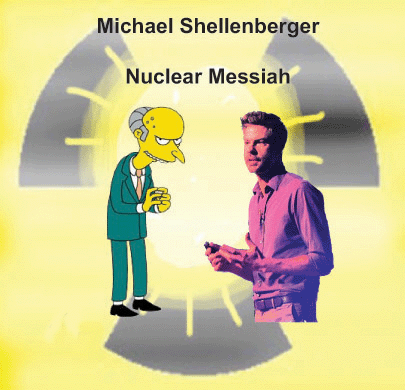
I missed that interview, but apparently the ABC interviewer asked some hard questions.
Shellenberger commented: “fighting to survive a brutal interview by a tough young reporter in Oz On ABC (the Aussie BBC)”
Australia’s own nuclear propagandist, Ben Heard, commented: “Shabby interview. Host evidently unfamiliar with topic”
However, those pro nuclear spinners were happy with shock jock Alan Jones on 2GB Alan Jones Breakfast Show. Jones said:
“Michael has turned on wind and solar with a passion: he’s now advocating for an all-atomic energy future, simply because the latter provides reliable power, whereas the former are a childish nonsense…..
the Finkel review totally ignored nuclear power as an option and pushed harder for more and more renewable energy. So Victoria’s looking at 25% renewables by 2025, South Australia 50%, the ACT 100%, Queensland 50%……
one of the world’s leading new-generation environmental thinkers has said the renewable energy experiment with wind and solar has failed. Michael Shellenberger is a former renewables advocate and adviser to Barack Obama when he was President. [ed. not true. Shellenberger sent an unsolicited submission to President Obama] He is now global champion for nuclear energy, which he said was the only option to replace coal and gas on a global scale. ……”
Shellenberger said:
every major study for the last 40 years finds that nuclear power is the safest way to make reliable electricity. You don’t have the risks that come with coal and fossil fuels, both in terms of mine collapses and air pollution, and the accidents themselves that everyone worries so much about hardly have any impact on people’s lives…
Wind and solar – They’re the worst. Really, all renewables are. The reason is easy to understand, in the sense that the fuels are very dilute, they’re very diffuse, and so you have to cover a huge amount of land with wind and solar……. solar produces huge quantities of toxic waste……They produce two to three hundred times more toxic waste than nuclear plants, which are the only way of producing electricity that contain all of their potentially harmful waste. Of course it’s been contained so well that nobody has ever been harmed by the radiation from nuclear power waste, ever……
The other problem is that you just end up getting too much wind energy when you don’t need it, like the middle of the night. Solar and wind, it’s like they’re almost set up to destroy cheap, clean, reliable energy.
What happened was that there was a smaller group of anti-human so-called environmentalists that opposed nuclear precisely because it allowed for so much cheap and abundant power, and they thought, “Well, if we’re going to stop the human cancer, we have to cut off its energy supplies.” …..
You’ve got some really crazy anti-nuclear people down there…..
Alan Jones: “I’ll tell you something, when you arrive in this country, Michael we’ll have you on again. We can’t hear enough of you. It’s time we had a good healthy dose of common sense”
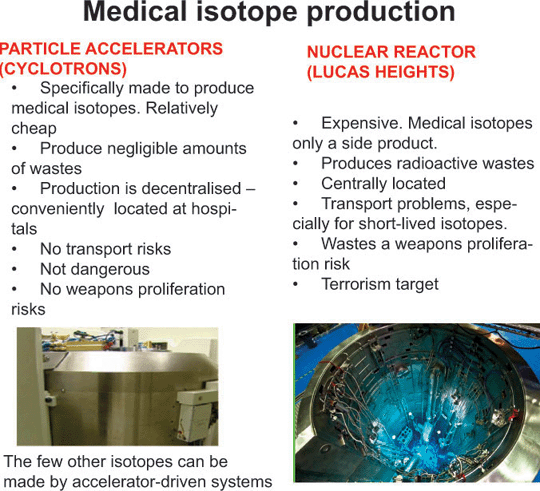
The post below this is an extract from the ABC article “Nuclear medicine production in Australia at risk if dump site can’t be found, industry head says”. I left out the bits where ANSTO officials orgasmically discussed how much Australia needsthe Lucas Heights nuclear reactor for medical reasons.
Anyone would think that this humanitarian motive is the sole raison d’etre for this nuclear reactor. The ABC apparently buys that story.
ANSTO at Lucas Heights I believe already has a cyclotron. . The Nuclear Fuel Chain Royal Commission recommended expanding a cyclotron industry in South Australia, to develop medical radioisotopes.
Reactor at Lucas Heights was initially intended as prelude to nuclear weapons production. The medical use was tacked on to make it look more respectable. It remains a fig leaf on the nuclear industry.
Another attack on the Bureau, but top politicians have stopped listening to climate change denial, The Conversation Michael J. I. Brown Associate professor, Monash University, August 4, 2017 Has the Australian climate change debate changed? You could be forgiven for thinking the answer is no.
Those at the top of Australian politics are no longer debating the existence of climate change and its causes. Instead, four years after the Coalition was first elected, the big political issues are rising power prices and the electricity market. What’s happening?
A few years ago, rejection of climate science was part of the Australian political mainstream. In 2013, the then prime minister Tony Abbott repeated a common but flawed climate change denial argument:
Australia has had fires and floods since the beginning of time. We’ve had much bigger floods and fires than the ones we’ve recently experienced. You can hardly say they were the result of anthropic [sic] global warming.
Abbott’s statement dodges a key issue. While fires and floods have always occurred, climate change can still alter their frequency and severity. In 2013, government politicians and advisers, such as Dennis Jensen and Maurice Newman, weren’t shy about rejecting climate science either.
The atmosphere is different in 2017, and I’m not just talking about CO₂ levels. Tony Abbott is no longer prime minister, Dennis Jensen lost preselection and his seat, and Maurice Newman is no longer the prime minister’s business advisor.
Which Australian politician most vocally rejects climate science now? It isn’t the prime minister or members of the Coalition, but One Nation’s Malcolm Roberts. In Australia, open rejection of human-induced climate change has moved to the political fringe……..
Have those who rejected global warming and its causes changed their tune? In general, no. They still imagine that scientists are up to no good. The Australian’s latest attacks on the Bureau of Meteorology (BoM) illustrate this, especially as they are markedly similar to accusations made in the same newspaper three years ago.
This week, the newspaper’s environment editor Graham Lloyd wrote that the BoM was “caught tampering” with temperature logs, on the basis of measurements of cold temperatures on two July nights at Goulburn and Thredbo. For these nights, discrepant temperatures were in public BoM databases due to automated weather stations that stopped reporting data. The data points were flagged for BoM staff to verify, but in the meantime an amateur meteorologist contacted Lloyd and the Institute of Public Affairs’ Jennifer Marohasy.
In 2014, Lloyd cast doubt on the BoM’s climate record by attacking the process of “homogenisation,” with a particular emphasis on data from weather stations in Rutherglen, Amberley and Bourke. Homogenisationis used to produce a continuous temperature record from measurements that may suffer from artificial discontinuities, such as in the case of weather stations that have been upgraded or moved from, say, a post office to an airport.
Lloyd’s articles from this week and 2014 are beat-ups, for similar reasons. The BoM’s ACORN-SAT long-term temperature record is compiled using daily measurements from 112 weather stations. Even Lloyd acknowledges that those 112 stations don’t include Goulburn and Thredbo. While Rutherglen, Amberley and Bourke do contribute to ACORN-SAT, homogenisation of their data (and that of other weather stations) does little to change the warming trend measured across Australia. Australia has warmed over the past century, and The Australian’s campaigns won’t change that…….
It is an absurd situation we find ourselves in. The public support for these new technologies is overwhelming, as it is in business (apart from those seeking to protect stranded assets), and among most politicians – even many in the Liberal Party, as NSW energy minister Don Harwin revealed late last month.
Yet here we are: Short-term policies; a patchwork of rules on energy efficiency; the worst building stock in the world; the most inefficient and polluting cars; and the world’s most expensive and dirty grid, soaring emissions, and rising temperatures.
And two years after obtaining power, prime minister Malcolm Turnbull is still defending policies he once describes as “bullshit,” too afraid to call out the nonsense spread by those keeping him in power.
Conservatives have been railing against renewables and carbon pricing for at least a decade. So ingrained has it become in our national psyche that it is like a State of Origin contest between energy sources and their fans. “Queenslander”, shout the league fans. “Fossil fuels” screech the incumbents.
But it plumbed further depths this week. And it got really stupid and really nasty. Conservatives in the government and the media rebooted their attacks on wind and solar energy, and extended it to battery storage and vehicle emission standards, with the Murdoch media dubbing the latter as a “carbon tax on cars.”
Craig Kelly, the chair of Coalition’s energy policy committee, said renewable energy “would kill people”, a claim happily repeated by columnist Andrew Bolt.
Resources Minister Matt Canavan urged the Queensland government to “forget about climate change”, while the LNP in Queensland will this weekend consider a motion urging Australia to quit the Paris climate deal.
Worse, the conservatives started attacking individuals. The verbal assault on chief scientist Alan Finkel was launched way back in February when it was clear he would not toe the fossil fuel line. And even after delivering what many consider a “soft option”, the conservatives rekindled their attack. Continue reading →
Perfecting Trickery: Referendum Council #noconsent to Recognitionhttp://www.sovereignunion.mobi/content/perfecting-trickery-referendum-council“On his return from Uluru, Ghillar, Michael Anderson, Convenor of the Sovereign Union, last surviving member of the founding four of the Aboriginal Embassy and Head of State of the Euahlayi Peoples Republic, details the rigged processes of the Referendum Council’s National Convention and the subsequent media:
““I was absolutely shocked and horrified at the disjointed discussion that occurred on ABC TV Q&A last night ( 29 May 2017) from Parliament House, Canberra.
“In my opinion the conclusions that occurred at the Referendum Council’s National convention at Uluru were totally betrayed by the Q&A panel.
“Having been permitted to sit as an observer in the main National Convention of the Referendum Council at Yulara near Uluru, I was privy to observe the proceedings and I sat through the ‘Synthesis’ of the Regional Dialogues and what they called the breakout workshops as well, where the key topics were ‘The Voice’, ‘Treaty’, ‘Strategy’.
“In respect of the Synthesis (summary) of the Dialogues it was very clear that nationally the specially selected people by the Land Councils (invitation-only delegates) independently concluded that is must be made clear that First Nations sovereignty was never ceded.
“The next key point was the fact the people, from around this island continent, who attended these Regional Dialogues, were emphatic that they did not want a minimalist approach to constitutional reform and they did not want it to be symbolic. They wanted something substantive that would effect real and positive change. It was very clear that they did not just want to remove Section 51(26) the Race Power, because they did not want anything in the constitution that could be used in a manner that
would be detrimental to First Nations Peoples exercising their rights and their right to be self-determining.
“More importantly, the presentation in the Synthesis/Summary does suggest that an overwhelming majority of people, who attended these Regional Dialogues, were determined that, because sovereignty was never ceded, that Treaties should be made with Sovereign First Nations throughout the continent and they determined that our ancient tapestry of languages and cultures cannot be destroyed and lost forever to our future generations. …
“Despite all the rigging and wrongdoings, the consensus that was finalised was:
1) Sovereignty was never ceded;
2) Rejection of being ‘recognised’ in the constitution;
3) No support a minimalist approach to constitutional reform;
4) Agreement that a Treaty/Makaratta Commission be established to develop a national framework going forward
that would permit each Sovereign Nation State to negotiate their own respective Treaty;
5) Removal of section 51 (26) from the constitution;
6) Establishment of Truth and Justice Commission;
7) Resolved also that the constitution of Australia should have a Bill of Rights; and
8) Establishment of an elected Voice to the parliament and to ensure that this Voice has constitutional backing. …
It takes a very special person to label the photographed, documented, filmed and studied phenomenon of mass coral bleaching on the Great Barrier Reef“fake news”.
You need lashings of chutzpah, blinkers the size of Donald Trump’s hairspray bill and more hubris than you can shake a branch of dead coral at.
It also helps if you can hide inside the bubble of the hyper-partisan Breitbart media outlet, whose former boss is the US president’s chief strategist.
So our special person is the British journalist James Delingpole who, when he’s not denying the impacts of coral bleaching, is denying the science of human-caused climate change, which he says is “the biggest scam in the history of the world”.
Delingpole was offended this week by an editorial in the Washington Post that read: “Humans are killing the Great Barrier Reef, one of the world’s greatest natural wonders, and there’s nothing Australians on their own can do about it. We are all responsible.”
Like the thriving polar bear, like the recovering ice caps, like the doing-just-fine Pacific islands, the Great Barrier Reef has become a totem for the liberal-left not because it’s in any kind of danger but because it’s big and famous and photogenic and lots and lots of people would be really sad if it disappeared. But it’s not going to disappear. That’s just a #fakenews lie designed to promote the climate alarmist agenda.
Now before we go on, let’s deal with some language here.
When we talk about the reef dying, what we are talking about are the corals that form the reef’s structure – the things that when in a good state of health can be splendorous enough to support about 69,000 jobs in Queensland and add about $6bn to Australia’s economy every year.
The Great Barrier Reef has suffered mass coral bleaching three times – in 1998, 2002 and 2016 – with a fourth episode now unfolding. The cause is increasing ocean temperatures.
“Is the Great Barrier Reef dying due to climate change caused by man’s selfishness and greed?” asks Delingpole, before giving a long list of people and groups who he thinks will answer yes, including “the Guardian” and “any marine biologist”.
“Have they been out there personally – as I have – to check. No of course not,” says Delingpole.
Yes. James Delingpole has been out there “personally” to check, but all those other people haven’t. He doesn’t say when he went but he has written about one trip before. It was back in late April 2012. Everything was fine, he said, based on that one visit. I can’t find any times when he has mentioned another trip since.
So here’s the rhetorical question – one that I can barely believe I’m asking, even rhetorically.
I mean, come on? Why can those two things – Delingpole making a boat trip with mates and a coordinated and exhaustive scientific monitoring and data-gathering exercise – not be the same?
So it seems we are now at a stage where absolutely nothing is real unless you have seen it for yourself, so you can dismiss all of the photographs and video footage of bleached and dead coral, the testimony of countless marine biologists (who, we apparently also have to point out, have been to the reef ) and the observations made by the government agency that manages the reef.
Senator Pauline Hanson and her One Nation climate science-denying colleagues tried to pull a similar stunt last year by taking a dive on a part of the reef that had escaped bleaching and then claiming this as proof that everything was OK everywhere else…….
Government ministers at federal and state levels, of both political stripes, claim they want to protect the reef.
How the fossil fuel industry has screwed energy consumers, REneweconomy, By Giles Parkinson on 24 March 2017 As we absorb the hysterical claims – in the ABC, Fairfax, the Murdoch media and commercial TV – about the prospect of imminent power shortages, let’s just cast our eyes back just two and a half years when the fossil fuel industry was predicting …. wait for it …. an unprecedented supply glut.
According to the Australian Energy Market Operator at the time, there would be no need for any new generation for up to 10 years in south-eastern Australia, because of what was then described as that “unprecedented glut”.
“What we’re saying is that is that there’s an oversupply of generation capacity at present,” an AEMO spokesman, Joe Adamo, told the ABC at the time. And you can see that from those forecasts there. [graph on original]
The fossil fuel industry and big business seized on those forecasts to argue forcefully that the renewable energy target should be heavily cut, if not scrapped.
The Abbott government needed no encouragement, and despite being foiled by the Senate in its attempts to kill it entirely, it did succeed in cutting the RET, and sparking an investment drought that lasted from 2013 until the end of last year.
As Alan Pears and David Leitch each wrote in separate pieces on Thursday, Australian consumers and businesses are now paying the price for that act of policy vandalism, and the huge delays in investment in renewable energy that occurred thanks to the Abbott government.
Fast forward to now, and even though there has been no increase in demand, the fossil fuel industry is revelling in unprecedented profits, as spot and future price soar across the nation – particularly in the coal states.
Because of the lack of competition that could have been introduced if the RET policy was held steady, the incumbent generators can now use their market power to artificially inflate prices, and somehow convince mainstream media and conservative politicians that it is all the fault of wind and solar.
“It looks like the generators succeeded, as expected, in delaying investment until they could enjoy a price bonanza as they withdraw faster than replacement can get underway now,” says one senior executive, who declined to be named.
It actually shows the most extreme demand scenarios that it can think of – a one in ten year likelihood in this case – and graphs that over and above what it considers to be the “average” supply. Repeat. That is average supply, not total supply available.
the idiotic and ignorant reporting in the mainstream media is allowing the fossil fuel generators and their protectors in the Coalition to blind public perceptions with complete nonsense. Fake news indeed.
By Giles Parkinson on 23 March 2017 (Excellent graphs) The warnings of blackouts provoked by the imminent closure of the Hazelwood brown coal generator in Victoria– already so prevalent on right wing blogs, the Murdoch media and the ABC – reached fever pitched proportions on Thursday.
Fairfax Media led the front page of The Age newspaper (see image right) [on original] with an “exclusive” story that warned of 72 days of potential blackouts across the state over the next two summers.
“Victoria’s energy security has been thrown into question, with the state facing an unprecedented 72 days of possible power supply shortfalls over the next two years following the shutdown of the Hazelwood plant next week,” the story by Josh Gordon begins.
And how does it come to this breathless conclusion? Fairfax, like other media, such as the ABC’s political editor, Chris Uhlmann, is basing the forecasts of blackouts on this graph that appears on the website of the Australian Energy Market Operator.
It purports to show – in the light red at the top – the periods when Victoria could face a shortfall of supply. The graph for South Australia is even more dramatic. But is that really what is says? Blackouts all summer?
Not at all, says the AEMO – a reply they would happily give anyone who bothered to ask. Continue reading →
there we have it. A report that says South Australia could easily aim for 40 per cent renewable energy is portrayed as a warning that 20 per cent is the natural limit. It boggles the mind.
Weatherill – to his credit – keeps on repeating that the blackouts and near misses in South Australia have not been about technology choices, but about grid management. Even AEMO agrees. But some journalists don’t want to know.
But don’t expect to read much about those exciting developments in much of the mainstream media. They just don’t seem interested.
How The Australian distorted S.A. renewables advice http://reneweconomy.com.au/how-the-australian-distorted-s-a-renewables-advice-19781/By Giles Parkinson on 22 March 2017 Readers of Rupert Murdoch’s The Australian newspaper would have been fascinated to learn this week that the South Australian government had apparently ignored advice in 2009 to limit the amount of wind energy in their state’s grid to 20 per cent. South Australia has, of course, gone well beyond that, with wind energy now meeting more than 40 per cent of the state’s electricity demand, and rooftop solar another 5-6 per cent. The combined total is likely to exceed 50 per cent by the end of the year, well ahead of its 2025 target.
But this target is under attack from the fossil fuel industry and their proxies in the Murdoch media – as Media Watch documented so well on Monday – and by some in the ABC itself.
On Sunday, the ABC’s political editor Chris Uhlmann wrote that it was “well documented” that any more than 20 per cent wind energy created problems for the grid.
ABC’s political editor Chris Uhlmann continues with his ill-informed campaign against wind and solar, warning in an article on Sunday of the risk of widespread blackouts and claiming there is a limit of 20 per cent renewables before problems arise.
“Once wind energy passes about 20 per cent of generation it creates a series of well-documented challenges for electricity grids in both managing intermittency and stabilising the system’s frequency,” Uhlmann writes, without citing any such documents.
That, indeed, is what the fossil fuel industry would have you believe. It was what many engineers believed back in the 1980s and 1990s. And some still may do. But it is not true. Continue reading →
South Australia shows up the federal government … and rightwing commentary,Guardian, Jason Wilson, 16 Mar 17 The reaction to the South Australian energy plan from the federal government and rightwing media shows just how out of touch with public opinion they are. The South Australian government announced on Tuesday that it would address market failure with the time-honoured measure of government intervention. In addition, the Weatherill government has chosen to continue to rely extensively on renewable energy. Together, these themes in the government’s announcement have provoked the kind of howling rightwing atavism that shows exactly why they are increasingly at odds with the Australian public on this issue.
Cast your mind back to 2016, when South Australia suffered from major power outages. The right took this as a propaganda opportunity for the promotion of dirty power. The problem, op-ed after op-ed from Einsteins like Chris Kennyproclaimed, was the reliance on wind. Magic words like “baseload” were relentlessly defecated into the pail of our energy debate. The verdicts of experts were roundly ignored, if not castigated. It was all of a piece with the madness that has produced Senate inquiries into imaginary ailments and the veneration of inanimate carbon in the parliament.
Sensibly, the South Australians have brushed aside pretty much all of this. Weatherill’s statement laid the blame where it belonged: a dysfunctional national energy market, an absence of national policy, lazy coal-fired generators which don’t maintain their plant, and a perfect storm. Through a mix of public and private initiatives, the government will build in redundancies using battery storage and a 250MW gas-fired plant. And the energy minister will direct the market.
Environmental groups and the Greens are concerned about the continued presence of gas in the energy mix, but even some of these groups managed to give qualified approval. Industry leaders seem relieved that someone is approaching these problems rationally. But the lizard brain faction of the right – encompassing the Australian’s opinion section, certain thinktanks, and the dominant faction of the Coalition – is furious.
In the Australian on Wednesday, their somewhat ironically titled environment editor bravely spun the announcement as a slap in the face for “armchair electrical engineers” who advocate battery power – even though battery power is part of the mix. Coming heartbreakingly close to grasping the idea of market failure, he called it a “slippery slope to further nationalisation”………
Fellow travellers in the media like Chris Uhlmann – himself a big fan of the cultural Marxism conspiracy theory – were trying to save face over previous prognostications on the power grid by pretending they were right all along.
From farther out the fringes, the usual clown troupe has clumsily piled on. The IPA took us through the looking glass by accusing the South Australian government of an “ideological opposition to coal”, in between ritual incantations of the word “baseload”. And Malcolm Roberts seemed to think that carbon-reduced power generation posed some unspecified risk to carbon-based life.
The difficulty that the right will face on this issue going forward is a microcosm of their more general problem. Their increasingly fanatical dedication to fossil fuel, and their relationship with miners and generators, is increasingly at odds not only with public opinion, but with the lived experience of many Australians.
Malcolm Turnbull and Josh Frydenberg are not following public opinion as they investigate obstacles for the SA proposal. They are, in effect, pandering to the rightwing tail that wags the Coalition dog…….
The West Australian correctly pointed out that the Australian’s coverage of the state election showed how far adrift it, too, is of community sentiment on a range of issues.
When will ABC stop parroting fossil fuel lobbyist lines?, REneweconomy, By Giles Parkinson on 16 March 2017 Where’s the ABC Fact Check department when you need it? Ah, that’s right, it’s closed. And that’s a pity, because it would be kept mighty busy by some of the recent editorialising by Andrew Probyn, the 7.30 Report’s new political editor.
Probyn, like his predecessor, Chris Uhlmann, has got into the nasty habit of parroting fossil fuel myths as if they are fact. They’ve become obsessed with concepts such as “synchronous” generation and “baseload”, using them to slap down wind and solar without really understanding why or how.
This is a problem for ABC viewers because they are not getting a clear and unbiased picture of energy issues. A complex subject is being poorly served. Labor is accused by Probyn of being a “slave” to wind and solar ideology, while Uhlmann thinks more wind and solar will lead to a national blackout.
Last night, Probyn tried to wrap up the gas talks, led by prime minister Malcolm Turnbull, and the push into battery storage into one big omnibus piece. But then he got diverted by his own prejudice, or misconceptions.
The report started promisingly. Michael Ottaviano, the CEO of Perth-based Carnegie Clean Energy, was explaining how a local company could do exactly what Tesla’s Elon Musk could do – provide battery storage, make wind and solar dispatchable, and provide grid security.
And, he said, they could do it at the same competitive prices, and in the same time frame. They could match Tesla and Musk on every front, with the exception of tweeting.
But in an instant after Ottaviano had explained how wind and solar and storage were a current reality, Probyn had decided it was something only for the future. (Full transcript here).
“Wave, solar and wind power may be key to the future energy mix, but the intermittent nature of renewables means they can’t yet guarantee baseload generation.”
Er, yes they can. Ottaviano just told you they can – not baseload, that is a redundant term invented by the fossil fuel lobby to justify coal generation, but dispatchable generation, which is what really counts.
When South Australia announced its new energy plan on Tuesday, it didn’t announce a baseload plant, it sought instead battery storage and a peaking gas plant. This is about dispatchability, not baseload.
It’s a crucial point. The energy market is in a massive technological transition. Running such lines about baseload is like arguing a car can’t do what a horse and cart can do because it doesn’t eat straw.
The Queensland government has attacked the LNP opposition and the Murdoch media for unfounded, baseless and “lazy” criticism of its plans to source 50 per cent of its electricity needs from renewable energy by 2030.
The conservative LNP has been getting a big run in the Murdoch press with a new anti-renewables campaign, which has wound up significantly since the start of the year with a host of new solar projects that will add 1GW of solar power to the state’s grid.
But Bailey wondered why the LNP hadn’t even bothered to make a submission to the government’s renewable energy review that it attacks so much. In total, 2,300 submissions were received, but none from the LNP or any of its MPs.
“Once again, all we’re hearing is anti-renewables doom and gloom, but of the 2023 submissions received by the Independent Panel following their public forums across the state, not one of them was from the LNP,” he said.
“On the leash of their Canberra mates, they run around the state, scaremongering and threatening to scrap Queensland’s RET if elected, but they were too lazy to do the work – to make a submission where it actually counts.
The LNP, in recent days, have been trying to make much of a report in The Australian which breathlessly announced in an “exclusive” story on its front page on Monday that it had acquired a “leaked” copy of an Australian Energy Market Operator submission into the Queensland government plans.
And while AEMO had warned that coal generators in Queensland may close earlier than expected, a line that the Murdoch media was keen to play up (it even wrote a follow-up story and an editorial the following day), Bailey pointed out that these generators were young, and most importantly, mostly government-owned.
That means that the Queensland government will not be in the same position as South Australia, which has had to watch with growing frustration as the private owners of the biggest gas plants in the state decide not to switch on during high demand periods, claiming they can find no economic incentive to help keep the lights on for their customers.
On the subject of South Australia, premier Jay Weatherill said the state had no intention of rowing back on its 2025 target of 50 per cent renewables, saying to do so it would have to effectively “physically prevent” developments in their tracks.
That much is true, because the build-out of the Hornsdale wind farm and the Tailem Bend solar project will take the state to 50 per cent wind and solar by the end of this year.
Weatherill says the biggest threat to power prices in South Australia is the lack of competition among generators, something that can addressed by having more renewable energy and other technologies such as battery storage.
Weatherill says the state will “soon” release” its planned intervention to ensure that no more rolling stoppages occur – as they did last month – while some gas generators sit idle. From that point of view, he must envy Queensland’s ownership of power generators.
Back in Queensland, Bailey also said Queensland has a high amount of (mostly government-owned) flexible gas-fired generation, which enables the system to ramp up quickly.
He said the government had confidence in the modelling, and in its conclusions that it would be broadly cost neutral to electricity consumers, and would not affect reliability.
Bailey also said the Palaszczuk Government is committed to transitioning to a clean energy future gradually and sustainably, while keeping affordability and network reliability front and centre.
“We’ve kick-started a renewable energy boom with more than 1GW of privately funded renewable energy projects currently in the works delivering more than $2 billion of new investment to Queensland and more than 1900 direct jobs, mostly in our regions,” he said.
“Energy is undergoing a transformational change in the way it is generated, transported and used – the former LNP government did nothing to prepare for this.
“Importantly, the benefits of the RET to the Queensland economy, particularly in regional areas will be largely driven by the additional $6 billion investment in renewable energy, and a projected increase of around 6,400-6,700 jobs per year on average between 2020 and 2030.
“The anti-renewables LNP have no credibility on energy policy. They oversaw the loss of 1300 renewable industry jobs while in government and inflicted 43 per cent electricity price hikes on consumers.”
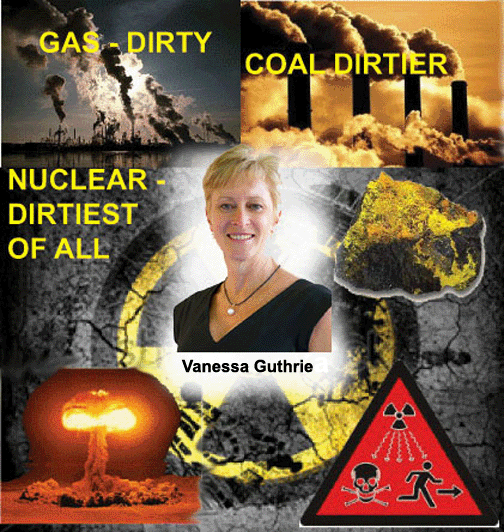
In an interview with the Australian Financial Review last year, Dr Guthrie attacked social media activism against fossil fuels, taking aim at “inner-city smashed avocado eaters” for unfairly targeting coal and the minerals industry more broadly…….
Turnbull government ignores advice, appoints Minerals Council boss Vanessa Guthrie to ABC, SMH, Adam Gartrell28 Mar 17
The Turnbull government has overruled an independent selection panel to appoint the chairwoman of the Minerals Council to the ABC board.
Communications Minister Mitch Fifield said Vanessa Guthrie has the “requisite skills” to be on the board, despite not making the final list of recommendations put forward by the Nomination Panel for ABC and SBS Board Appointments.
The five-year appointment comes amid heated political debate about the role of fossil fuels and renewable energy in Australia, and follows government criticism of the public broadcaster’s coverage of coal mining and energy security.
The Perth-based Dr Guthrie has more than 30 years of experience in the mining and resources industries, holding a variety of senior executive roles at Alcoa, Woodside Energy and Goldfields Limited.
She was WA’s first female mine manager and eventually rose to the rank of managing director and chief executive officer of Toro Energy, a job she left last year. She is the first female chair of the Minerals Council, one of the most powerful lobby groups in the land…….
The government has been fiercely critical of the ABC’s coverage of energy, with Resources Minister Matt Canavan accusing it in December of running “fake news” as part of a campaign against the proposed Adani coalmine in Queensland.
The ABC was also accused of bias against the NSW Shenhua coal mine proposal but was cleared by a review.
The Institute of Public Affairs – which has spawned a number of Coalition MPs – claims the ABC has a “systemic bias”, giving the renewable energy industry favourable coverage but showing hostility towards coal and other fossil fuels.
In an interview with the Australian Financial Review last year, Dr Guthrie attacked social media activism against fossil fuels, taking aim at “inner-city smashed avocado eaters” for unfairly targeting coal and the minerals industry more broadly…….
Labor frontbencher Mark Dreyfus said the ABC should be above politics and called on Senator Fifield to explain why the panel’s recommendations were disregarded.
Advertiser reporter Paul Starick apparently wrote this. But pro nuclear lobbyist Ben Heard claimed credit for it tweeting:
“New push for nuclear industry in South Australia: This effort was brought to you by Bright New World “
New push for high-level international nuclear waste dump in South Australia Paul Starick, Chief Reporter, The Advertiser March 2, 2017 FORMER Port Adelaide Football Club chief Brian Cunningham and Economic Development Board chairman Raymond Spencer are among prominent South Australians launching a fresh push to progress a proposed $257 billion international nuclear waste repository.
In a new open letter to state MPs, 42 influential people demand the State Government commits to completing first-stage investigations of the proposed high-level repository.
The group, which also includes Adelaide Football Club chairman Rob Chapman and renowned brewer Tim Cooper, urges modest expenditure to investigate the proposal’s viability.
This would include assessing whether other countries were willing to participate and contribute financially, analysing potential competitors and developing a clear exit strategy……..
Many of the signatories were behind a similar open letter in December last year, which demanded political leaders not block study of the proposed repository, which would involve a purpose-built waste storage and disposal facility for international used nuclear fuel…….