Dick Smith got his nuclear energy costs wrong
Nuclear is the most expensive option when you take into account the external factors, followed by coal and coal seam gas. These external factors include devastating effects on health, agricultural output, land degradation, acid rain and the ability for us to feed ourselves, and of course in the case of the fossil fuels, climate change.
Already, in India and China renewables are either the cheapest form of new generation, wind is beating fossil fuels in Brazil and elsewhere. Even in Australia, wind and solar are considered the cheapest option for new capacity.
 Dick Smith wrong on energy costs – renewables are cheapest http://reneweconomy.com.au/2013/dick-smith-wrong-on-energy-costs-renewables-are-cheapest-34249 By Matthew Wright on 2 August 2013
I am from Energy security think-tank Zero Emissions and I wrote the Zero Carbon Australia Stationary Energy Plan which is briefly showcased during the film.
The stationary energy plan, the first of its kind to show that Australia could run on 100% renewable energy a combination of wind power, rooftop solar photovoltaic, and solar thermal with storage (featured in the film), along with a huge “mining” effort to find energy efficiency in housing, commerce and industry. It was a landmark that helped caused the Australian Energy Market Operator (AEMO), the organisation that runs Australia’s electricity supply, to write and publish this year its own plan and validate much of our work.
Whether you care about climate change or not, we’re moving rapidly away from coal because domestic and international banks, including the World Bank, will no longer invest in coal fired power. And a shift to gas would involve the burning of coal seam gas, due to a massive upswing in demand in Asia especially Japan the cost of gas here is becoming prohibitive. Continue reading
Sloppy science writing in Australia’s media
 The death of science journalism in Australia Independent Australia by MatthewDonovan 24 July, 2013 As the mainstream media struggles – particularly newspapers – the loss of journalists is a worrying trend; Noel Wauchope explains why she is most concerned about the loss of qualified science journalists. INVESTIGATIVE journalists would do well to investigate what is happening to science news writing in Australia…..
I knew that quality science journalism in Australia was dwindling. It took the most recent pro-nuclear advertorial in the Fairfax media to really wake me up to this. John Watson, ‘Senior writer’ at Fairfax Media, wrote an article entitled, Want to kill fewer people? Go nuclear…..
Why have The Age, Sydney Morning Herald and others sunk to this level of sloppy journalism?
Apart from the obvious fact they don’t want to offend their corporate backers, this kind of writing is symptomatic of what happens when you get rid of your qualified dedicated science journalists. Amongst the plethora of Fairfax journalists encouraged to depart their jobs were science editor Deborah Smith, health editor Julie Robotham, health correspondent Mark Metherell and environment reporter Rossyln Beeby.
That’s Fairfax. But what about the Murdoch media? The Murdoch media never had much of a problem in its coverage of science. The Australian blithely publishes science articles written by journalists who are clearly far from expert in the field of science.
This has been documented by Tim Lambert with his article, The Australian’s War on Science. In it he goes about scrutinising, in depth, writers such as Maurice Newman and Graham Lloyd.
The Australian did have one qualified science writer, Leigh Dayton. When she was sacked, the reason given by her editors was they: Continue reading
Trans Pacific Partnership talks focus on media control
 Big Media’s push for extreme new Internet censorship rules stalls secretive Trans-Pacific Partnership talks http://www.straight.com/news/402631/big-medias-push-extreme-new-internet-censorship-rules-stalls-secretive-trans-pacific-partnership-talks By David Christopher Big Media lobbyists and unelected bureaucrats are holding closed-door meetings in Malaysia this week, as they continue secret talks on the Trans-Pacific
  Partnership (TPP).
The TPP is a highly secretive and extreme trade deal being negotiated by Australia, Brunei, Canada, Chile, Japan, Peru, Malaysia, Mexico, New Zealand, the United States, Singapore, and Vietnam.
Reports from Malaysia indicate that the TPP talks are stalled over five key issues—including a key chapter on copyright and intellectual property rights that would censor and criminalize Internet use. Continue reading
Australian Labor and Liberal against Aboriginal Land Rights being enshrined in the Constitution

As far as I can see, corporate Australia will get its way, as usual, with a pretty meaningless and toothless reference to Aborignals in the Australian Constitution
 Major parties cool on ‘locking in’ land rights, ABC News 9 July 13 By Melanie Arnost The Federal Government and Opposition have both reacted coolly to a call from the Northern Land Council to have the Aboriginal Land Rights Act enshrined in the Australian constitution.
Land council chairman Wali Wunungmurra, speaking ahead of NAIDOC week’s celebrations of the Yirrkala bark petitions, said last week he wanted the act included in the constitution.
“(To) protect it from people watering it down, tearing it apart,” Mr Wunungmurra said…….The Yirrkala bark petitions were presented to Federal Parliament in 1963.
Mr Wunungmurra was one of 12 signatories to the petitions, which are credited with galvanising the land rights debate across Australia.http://www.abc.net.au/news/2013-07-08/cool-reaction-to-calls-for-land-rights-act-to-be-put-in-constit/4805192
“Plutonium Pollyanna” – a review of film “Pandora’s Promise”
Finally (as Beyond Nuclear and other watchdog groups have noted), relying on nuclear power to mitigate CO2-driven climate change is unaffordable and impractical since it would require putting a new reactor online every two weeks……
Ultimately, Pandora’s Promise comes across as a well-executed but disingenuous exercise in special pleading. Instead of devoting 89 minutes to honestly and fully assessing the pros and cons of renewable technologies alongside the risks and benefits of new, untried nuclear power systems,Pandora’s Promise promotes a narrow agenda. As a result, the film winds up as little more than a tunnel-vision exercise in “plutonium Pollyannaism.”
 Another Take on Pandora’s Promise EARTH ISLAND JOURNAL BY GAR SMITH – JUNE 28, 2013 Pro-nuclear power film obscures as much as it reveals You’ve got to give the producers of Pandora’s Promise credit for gumption. It takes a lot of chutzpah to release a pro-nuclear polemic in the wake of the triple meltdown in Fukushima, Japan. The film also suffered the ignominy of opening the same week that the owners of California’s troubled San Onofre Nuclear Generating Station announced the permanent shutdown of the facility’s two crippled reactors. Even the film’s title takes a bit of nerve; it was Pandora’s Box, after all, that unleashed a host of once-contained evils into the world.
So, given the extensive history of nuclear mishaps and near-catastrophes, how do the producers of Pandora’s Promise manage to spin their counter-narrative of a “safe, green” nuclear future? Basically by: (1) at first accepting the criticisms of traditional nuclear power and then (2) arguing that the solution lies in “new, improved” nuclear reactors. Like a smart defense attorney, director Robert Stone begins by admitting all of the defendant’s worst foibles up front, thereby depriving the prosecution of an opportunity to score points by revealing these issues later…….
The filmmakers pronounce the radioactive contamination “infinitesimal” and proclaim there has been “no evidence of medical consequences.” No citations are offered to support this positive conclusion. The fact that 40 percent of Fukushima’s evacuated children have subsequently developed thyroid abnormalities goes unmentioned.
Where Are the “Anti-nuclear Environmental Leaders”? Continue reading
Australia’s news media now toes the line for big business
The real, untarnished news is getting through to a greater number of people after decades of being deliberately distorted or discarded by the power of money. Mobile phones have worked communication miracles in many countries.
The importance of Australia’s September election is beyond any in the nation’s history. The power of money has strangled good national government before. It can also deny us the full power of the NBN at the very time when we will most need its maximum capabilities.
Big money versus good government Independent Australia, Australia’s September election is more important than any in the nation’s history, writes Rodney E. Lever, as big money tries to strangle a good government. 23 June 13 “……Now newspapers are dying. Propaganda rules our lives. Good honest journalists are losing their jobs. Editorials expressing proprietorial views are on the front page.…..In the past few decades, Australia’s newspapers have gradually been taken over by ignorant multi-millionaire proprietors with other interests, and now journalists are ordered to write stories to political requirements….
 … Rupert Murdoch ‒ who claims to be a journalist ‒ is a fraud. He has never written anything, except on Twitter, reads little more than balance sheets and dictates terse letters. He shows up in the working areas of his newspapers only when cameras are around.
This is why Australian politics is in turmoil. People think they are being informed by what were once called “the mirrors of the world”. They are, in fact, reading manufactured pages of falsehoods and duplicity. On top of that, we are bombarded by mentally-deficient radio shock-jocks and screwed by much of the electronic media. Continue reading
Australia’s mainstream media actively promotes climate change denialism
How Australia’s old media sows doubt about climate change Independent Australia 20 June 13, Australia’s corporate media does not properly hold politicians accountable or give the public the full picture — and is most especially remiss concerning climate change, says Brad Farrant, David Holmes and Assistant Professor Mark G Edwards. “…….
Why are they getting away with it?..….You would think most journalists would be forensically questioning any politician who denied the science or failed to devise and support adequate policies to address this threat.
Unfortunately, very few, if any, of our mainstream journalists have ever really challenged climate-science-denying politicians.
In fact, the opposite has been true. According to research by Robert Manne, many major media outlets – notably the Murdoch media, and particularly The Australian – have actively created doubt about the science. They have misreported the science and supported inaction among politicians who should be developing climate policies and offering national and international leadership on the issue. Continue reading
Australian Financial Review joins the spruikers for Australia as the world’s nuclear waste dump
Christina Macpherson 15 June 13, Today the Financial Review published a very worthy(?) article entitled “Energy sources to be a diverse mix by 2100” I should have been warned, when I saw it quoting Australian Renewable Energy Agency chairman Greg Bourne sayng that 100 per cent renewable energy power supply is not realistic.
But no – I read on this lengthy article, and then comes the real message – at the end:
 AUSTRALIA COULD BE ‘THE WORLD’S REPOSITORY OF NUCLEAR WASTE’
“In any discussion of Australia’s future energy needs and mix of sources, there is always a very big elephant in the room: nuclear energy. Australia is the Saudi Arabia of uranium, with almost 1.4 million tonnes of known recoverable resources. That is 1.4 times the resources of the number two supplier, Kazakhstan, and 2.6 times the resources of number three, Canada.
But Australia does not use the metal – exporting all it produces – and has no plans to do so. “Nuclear energy is quite simply the purest, cleanest and lowest-emission form of energy there is, and Australia has enormous reserves of that form of energy,” says Professor Stephen Martin,chief executive of the Committee for Economic Development of Australia (CEDA).
“If Australia is serious about mitigating the effects of climate change, then nuclear must be on the table. It has the potential to provide low-cost, clean, baseload energy and will be an important back-up if other renewable or clean energy options do not come to fruition. If we want to improve environmental outcomes, if we want to lower emissions, nuclear energy is a no-brainer,” Martin says…….
From the mini-reactors being developed, which are buried in the ground, to the ‘Generation IV’ reactors, and the potential of small-scale thorium reactors, it’s a pretty exciting outlook for nuclear energy. In fact, through technological changes, Australia could be the world’s repository of nuclear waste – which we could then refine and re-use,” Martin says.
Michael Angwin, chief executive of the Australian Uranium Association, agrees there needs to be a “reconfiguration of the Australian political dynamic” for our uranium to be used domestically for power, but says the case is compelling.
“Nuclear power is one technology that can supply electricity reliably for large population centres, with no emissions. It does this all over the world. If Australia had a nuclear industry we would be very keen to supply it,” Angwin says. http://www.afr.com/p/2100/energy_sources_to_be_diverse_mix_A2laV1flAoEMOCg5XYHneL
VIDEO: Senator Ludlam asks Minister Carr about Wikileaks and Bradley Manning
Assange no concern of ours, says Carr, The Age, 7 June 13
- The Australian government has washed its hands of Julian Assange as prosecutors at the trial of US soldier Bradley Manning have openly targeted the WikiLeaks publisher as a conspirator engaged in espionage.
Foreign Minister Bob Carr has told a Senate budget estimates committee that the government would make no more representations to the US on Assange’s circumstances because his case “doesn’t affect Australian interests”.
Senator Carr’s declaration that he would not “over-service” Assange’s consular needs came after US military prosecutors left no doubt that they regard the WikiLeaks chief not as a journalist dealing with sources but as a conspirator in the theft of classified information. Continue reading
Is the Canberra Press Gallery scared of “Independent Australia” ?
Way way down this page, an article about how the Canberra Press Gallery is a closed shop
I found this article particularly interesting, because of the reasons given by David Speers Press Gallery Committee, for shutting out Independent Australia. In brief – because IA’s journalist Callum Davidson is “not established”, and because IA is “opinion-based rather than a news site”
This raised several questions in my mind. Davidson is a freelance journalist, has an Advanced Diploma in Journalism, (and lives near Parliament House). Well, in this climate of journalists being retrenched all over the place – pretty hard to get “established” . Do we, the public, have to wait until all the old Established journalists die off, or something?
Which brings me to an even more important question. Despite IA having broken some really big stories, Speers considers that it is not a news site. It’s an opinion-based site.
As if all the Murdoch media, and even the Fairfax are NOT opinion -based. This pretense of impartiality is one of the big weaknesses of the weak Australian mainstream media.
My guess is that they are scared of Independent Australia, crikey.com, New Matilda, Inymedia, Green Left and even little websites like this one. This one is called Antinuclear – no pretense of impartiality here. And if the mainstream media had any guts, its business sites would be headed “Pro Corporations” – and particularly “Pro-Nuclear” – Christina Macpherson
Australia’s Opposition Party and the sound-bite media
 UKIP’s dangerous precedent for Australian conservatives, REneweconomy, By Giles Parkinson on 6 May 2013″………modern media has trained their readers to consumer news and politics in uncomplicated sound-bites, and now want their policy platforms to be delivered in the same way. It’s worked marvellously for Tony Abbott. The Australian Opposition leader popularity is based around three-word homilies such as “Stop the boats” and “axe the tax”. Never mind the detail – these policies bear little scrutiny and are impossible or impractical to implement: In sound-bite politics, no-one cares.
It shouldn’t be forgotten that Abbott was delivered to the top job in the Coalition – and a likely prime ministership – by a highly conservative rump of the Coalition that ended bipartisan support on climate change policies. It was led by senior politicians, such as Nick Minchin, who didn’t and don’t accept climate change science. Many still remain in the party.
Even more dangerously, bipartisan support is now fracturing around renewables, despite the fact that theAustralian Energy Market Operator has found that 100 per cent renewables is emminently achievable, and not so costly, and that other studies such as Bloomberg New Energy Finance suggests that wind, and soon solar, are cheaper to build than new coal and gas fired generation – all of which needs to be replaced in the coming decades.
Despite this, all the state-based coalition governments remain married to the policy altar that deems that renewables are costly and useless, and don’t reduce emissions, and they want the renewable energy target killed or neutered.
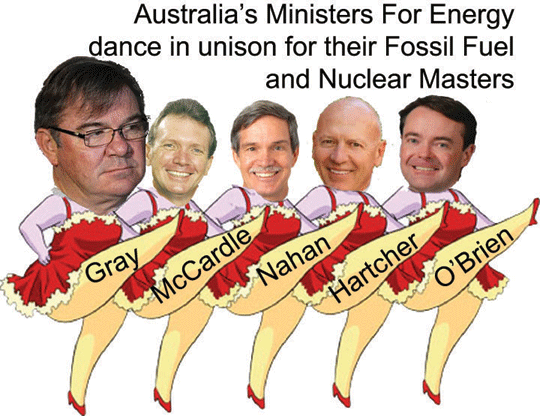
Many of its new recruits – such Nahan, the Nationals’ Angry Anderson, the Liberals Angus Taylor and Zed Seselja, and the Canberra based would fit comfortably within the UKIP platform. As would many of the incumbents – Joyce, Corey Bernardi, Eric Abetz, Andrew Robb, Simon Birmingham, Michaelia Cash, Alby Shultz, Bill Heffernan, Ian Macdonald, and a host of others.
John Howard had just as many arch-conservatives in his own party, but he had the strength of leadership to keep the factions under control. The importance of this should not be underestimated. Even Labor’s right factions would have fought hard against progressive climate change and energy policies if they hadn’t been effectively neutered by the coalition with the Greens and the country independents.
The question is whether Abbott has the authority to keep these Tea Party and UKIP style politics under control, or even if he wants to. He owes a debt to those who thrust him into power in the first place, and has never convincingly laid his “climate change is crap” remark to rest. He may just gladly go along with those that want to extend those policies to curb renewables. Has anyone heard a Coalition politician say they shouldn’t? http://reneweconomy.com.au/2013/ukips-dangerous-precedent-for-australian-conservatives-13428
The Canberra Mainstream Media Press Gallery – a Closed Shop
 How the Canberra Press Gallery shut out Independent Australia, Independent Australia, 29 April, 2013 The Canberra Press Gallery Committee has knocked back Independent Australia and its nominee from gaining representation. Callum Davidson explains what happened. by Callum Davidson A few months back, myself and David Donovan, managing editor ofIndependent Australia, agreed it was high time that the vocal and growing online community of Australian political blogs deserved a voice in the Press Gallery of Parliament House.
As it turns out this is a difficult task to accomplish.”…..I hold an Advanced Diploma in Journalism and have been working freelance for a while now; but infinitely more importantly, I live a stone’s throw from Parliament House in Canberra……The press gallery is a bizarre and fascinating beast. Most of the Australian public still digest their political discourse from those guardians of information tethered to the cramped dorms on Capital Hill. All major mainstream news outlets, both television and print, have long had reporters stationed directly within our political elite. From Fairfax to News Limited to ABC, journalists mix with Federal politicians and their staffers, conversing with media opposition and rapaciously competing when necessary. But with the aspirational digital age and the declining fortunes of traditional media, would they let an outsider in?
[ David Speers Press Gallery Committee says ] “The Committee has decided to decline your request.

Generally new entrants to the Press Gallery will only be approved if they are established journalists working as such.
Your website appears to be opinion-based rather than a news site……”.
All news outlets are opinion based to some degree (some significantly more so than others) where does one draw the line? CertainlyIndependent Australia has developed a huge following not through opinion pieces, but through its original investigative reporting – that is, “new” news – such as the Jacksonvilleand Ashbygate investigations and the outstanding environmental exposés of Sandi Keane amongst many others.
The real question is, did Speers’ committee really take a close look at Independent Australia without any preconceived notions, or did they simply see it as just another “blog” and dismiss it out of hand? Is this another example of old media snobbery?……
Malcolm Turnbull recently made a rather hip appearance at the Woodford Folk Festival lamenting the current state of political media coverage.
He said:
“Broadcasters, or politicians or writers…who think that they are respecting ‘struggle street’, the battlers, … by dumbing things down into one-line soundbites are not respecting them — they are treating them with contempt.”
He urged bloggers et al to scrutinise politics and policy in the manner he believed necessary for a functional democracy. The question here is whether or not this is possible without complete ‘access’.
There are a number of brilliant online publications (with Independent Australia being right up there of course!) that do a fantastic job of sifting through the endless political data to provide material for palatable consumption to inform the public.
But, is this enough?
(For more information about how Canberra Press Gallery accreditation is awarded, please read this February 2013 Crikey article.) http://www.independentaustralia.net/2013/business/media-2/how-the-canberra-press-gallery-shut-out-ia/?utm_medium=email&utm_campaign=IA+Newsletter%3A+Our+Samizdat+Years&utm_source=YMLP&utm_term=Read+the+story+on+IA
How the Australian media situation resembles that of Soviet Russia
The article below, from Independent Australia, talks about Samizdat. This was new to me. So anyway, I guess that the analogy is that we, in Australia, are now “informed” by the blanketing propaganda of the Murdoch media. So, we have to rely on alternative media, like Independent Australia, New Matilda, Crikey, and various blogs to learn the truth.
Samizdat n.wikipedia.org/wiki/Samizdat Samizdat (Russian: самизда́т; IPA: [səmɨzˈdat]) was a key form of dissident activity across the Soviet bloc in which individuals reproduced censored publications by hand and passed the documents from reader to reader. This grassroots practice to evade officially imposed censorship was fraught with danger as harsh punishments were meted out to people caught possessing or copying censored materials.
Vladimir Bukovsky defined it as follows:
I myself create it,
edit it,
censor it,
publish it,
distribute it, and …
get imprisoned for it.[1]……History
Self-published and self-distributed literature has a long history, but samizdat is a unique phenomenon in the post-Stalin USSR and other countries with similar systems of tyranny. Under the grip of censorship of the police state, these societies used underground literature for self-analysis and self-expression.[9]…..
Australia: cult Murdoch is ruling us, and telling us what we should think
Our samizdat years, (includes 2 good videos) Independent Australia 4 May, 2013 Never before have we had a press so controlled, says Bob Ellis, with all the anti-Abbott or anti-Coalition news being deliberately minimised. “…… the Newspoll fraud continues, with Katter preferences going not to Labor but the Liberals, meaning an actual preferred vote for Labor of 49 is being disguised as 45.5, and landline surveys on holiday weekends are not adjusted, and shown as crises for Labor on days when they are winning or competitive. This is as serious as the Malaysian stuffing of ballot boxes will be tomorrow, but in Australia it has become routine.
Cult Murdoch is ruling us, and telling us what we should think. It is what Soekarno liked to call a ‘guided democracy’, where the Dear Leader conceals the bad news and gives himself 98 percent in the orderly elections.
Murdoch, a crook, derided by the House of Commons as ‘unfit to run an international organisation’, owns eighty percent of our newspapers and vigilantly decides what is in them, including Newspoll. And, as in America, where his pollster Rasmussen always showed Romney inexplicably doing well, he shows Abbott ahead still though he has lost policy round after policy round in the past two months and been repeatedly accused of criminality…..http://www.independentaustralia.net/2013/politics/our-samizdat-years/
I have been aware for a year now that Labor was competitive and the good policies ‘overshadowed’ by the Rudd challenge would eventually achieve the light of day and win for them, but now I am not so sure. It may well be that the Karl Rove-style implacability-of-attack of the broadcasters and pundits may have achieved its end, and so smirched Labor that it will lose, I fear, by one seat.
But it may not be so……http://www.independentaustralia.net/2013/politics/our-samizdat-years/
Journalists should scrutinise Australia’s politicians on their ignorance on climate change science

many Australian politicians – and the Australian media. Very rarely have politicians who reject climate science in Australia been asked to explain their justifications on scientific grounds.
According to the Political Leaders and Climate Change Index (PLCCI) published in 2010 by the Global Change Institute at the University of Queensland, the number of politicians in the parliament who either don’t or won’t accept the science of climate change in Australia is significant.
The likelihood of a Coalition government winning in 2013 makes the public statement of personal opinions on human induced climate change an issue of national and global importance.
Your MP doesn’t ‘believe’ in climate change? Ask the tough questions, The Conversation, Brad Farrant, Fiona Armstrong, Karen Kiang, Mark G Edwards , 27 April 13 As we head into an election, you’d be justified in asking what your local member is basing their climate change decisions on.
If your MP says “I don’t support policies to prevent dangerous climate change” because “I don’t believe climate change is occurring” or “I’m not sure climate change is human caused” is this position justifiable simply because it’s his or her personal opinion?
While everyone may be entitled to their own opinion, are our elected leaders being ethically responsible when they justify inaction on climate change based on personal opinions? Sustainability ethicist Donald A. Brown, from Widener University School of Law, emphatically argues, “no” – they are not.
In a recent widely republished blog post on ethicsandclimate.org, Brown argues government officials have an ethical responsibility to understand the state of climate change science. Politicians hold crucial leadership positions where they can enact policies that can prevent or minimise great harm. These policies, to put it bluntly, affect millions, if not billions, of people around the world.
Governments and elected officials cannot ethically choose to rely on their own uninformed opinion or ideology instead of the scientific consensus. Continue reading
1 This month


Help Aunty Sue Protect Her Land and Sacred Sites From Destructive Rocket Testing.
.

Australians deserve the truth
about
AUKUS – https://aukuspublicinquiry.com/

PETITION – To: Prime Minister Anthony Albanese and the Australian Labor Government

of the week – Australians for War Powers Reform (AWPR)
To see nuclear-related stories in greater depth and intensity

