Dead in the Water- The AUKUS Delusion

Australian Foreign Affairs – February 2024
The latest issue of Australian Foreign Affairs examines Australia’s momentous decision to form a security pact with the United States and the United Kingdom that includes an ambitious, expensive and risky plan to acquire nuclear-power submarines – a move that will have far-reaching military and strategic consequences.
Dead in the Water looks at whether the AUKUS deal will enhance or undermine Australia’s security as tensions between China and the US rise, at the impact on Australia’s ties with its regional neighbours, and at whether the submarines plan is likely to ever be achieved….. more https://www.australianforeignaffairs.com/
‘Mr Dutton is right’: Murdoch’s News Corp papers grant nuclear power glowing coverage

News Corp has done a climate turnaround, spruiking the Coalition’s new nuclear policy at every opportunity. But how much Kool-Aid have its reporters drunk?
DAANYAL SAEED, MAR 06, 2024, https://www.crikey.com.au/2024/03/06/news-corp-peter-dutton-nuclear-policy/
The Coalition’s solution to the climate crisis is set to be unveiled, with Peter Dutton reportedly planning to announce sites for a number of nuclear power stations, which would necessarily involve lifting Australia’s long-standing ban on nuclear power.
While the Coalition’s policy has been rubbished as “misinformed bulldust” by the likes of Andrew Forrest, a “dumb idea” by experts and “hot air” by the energy minister, the News Corp papers have been at the forefront of nuclear advocacy.
In the past month, The Australian has published a number of articles on nuclear power, with only one of its many op-eds (the aforementioned “hot air” piece by Energy Minister Chris Bowen) arguing in favour of Australia’s ban on nuclear.
Conversely, the paper has run several opinion pieces in favour of nuclear power, including two editorials advocating for its use, the most recent of which was published this morning.
The paper’s editorial on March 6 said it was “time for a properly costed plan on the nuclear option”, stating “Peter Dutton’s embrace of a nuclear option for consideration is worthwhile”.
“Dutton is right to develop a net-zero plan that includes nuclear,” the piece continued. “Refusing to lift the ban or even consider the issue … makes the federal government look out of touch with what is happening in the modern energy world.”
Crikey asked The Australian’s managing editor Darren Davidson on March 5 whether the paper had an editorial view on the merits of nuclear energy, and how it balanced any view it may have with the Coalition’s policy position, as well as any ethical obligations that may arise in its reportage. He declined to comment.
This morning’s editorial comes on the heels of one published on February 17 headlined “Nuclear option made easy by the renewables miscue”. It went on to describe nuclear power as “a logical option for emissions-free power”, a “sensible option”, but admitted it was “incendiary politics”
It rekindles the climate wars and undermines the certainty that is craved by business.”
Political editor Simon Benson has been responsible for much of this nuclear coverage, penning an op-ed on February 25 that argued the Labor government was “at risk of ending up on the wrong side of history in its fanatical opposition to nuclear power”.
Benson was also responsible for an exclusive, also published on February 25, that showed Newspoll data conducted for The Australian that showed 55% of Australian voters “supported the idea of small modular nuclear reactors as a replacement technology for coal-fired power”.
As early as February 15 Benson had insights into the Coalition’s policy, penning a piece titled “Liberals’ nuclear policy has potential to electrify”.
The Australian has also ran a number of opinion pieces over the past month in favour of the Coalition’s policy, including one by Peta Credlin headlined: “Liberal true believers stand firm against false net-zero gospel”.
However the paper also ran a piece by Sarah Ison on February 16 that highlighted one of the limits of the introduction of nuclear power in Australia. Ison interviewed Australian Industry Group climate change director Tennant Reed, who said that Australia may be waiting for more than 20 years for economically viable nuclear power.
The Show Trial against Julian Assange

If the US authorities succeed in convicting a journalist for exposing war crimes, this would have another serious consequence. In the future, it would become even more difficult and dangerous to expose the sordid reality of wars,
How US and British authorities are bending the law and undermining press freedom
FABIAN SCHEIDLER, FEB 24, 2024 ore https://fabianscheidler.substack.com/p/the-show-trial-against-julian-assange
“Those who tell the truth need a fast horse,” says an Armenian proverb. Or they need a society that protects the truth and its messengers. But this protection, which our democracies claim to offer, is in danger. As a journalist, Julian Assange has published hundreds of thousands of files documenting war crimes committed by the USA and its allies in Afghanistan, Iraq, Guantanamo and elsewhere. The authenticity of the documents is beyond question. However, none of the perpetrators have been brought to justice or convicted. In contrast, the messenger has been incarcerated in a high-security prison in London for five years with life-threatening health problems, having previously spent seven years locked up in the Ecuadorian embassy. He has been charged with no crime in the UK, in any EU country or in his home country of Australia. The only reason for his grueling deprivation of liberty is that the US government has initiated extradition proceedings accusing the journalist Assange of espionage, invoking a law dating back more than a hundred years to the First World War: the Espionage Act.
Never before has a journalist been charged under this law. The extradition process therefore sets a dangerous precedent. If it is successful, every journalist on Earth who exposes US war crimes would have to fear suffering the same fate as Assange. That would be the end of freedom of the press as we know it. Because it is based on the capacity to bring to light the dark sides of power without fear of punishment. Where this freedom is extinguished, it is not only the freedom of journalists that dies, but the freedom of us all: the freedom from the arbitrariness of power.
For this reason alone, this extradition process should never have been accepted by the courts in a functioning legal system. Julian Assange did not act as a spy in any way, but as a journalist and as such is subject to special protection. Incidentally, the key witness for the espionage charge was the notorious fraudster and convicted paedophile Sigurdur Ingi Thordarson, who admitted in 2021 that he had lied on behalf of the FBI and had been granted immunity from prosecution.
Let us imagine the case with reversed roles: Suppose an Australian journalist had published war crimes committed by the Russian military and intelligence services and sought protection in a Western European country. Would the courts seriously consider extradition proceedings to Moscow for espionage, especially if the key witness is a convicted criminal?
Assange is facing the absurd sentence of 175 years in the USA. It is to be feared that he will not survive the extremely harsh conditions in the notorious US prison system. For this reason, the London Magistrates’ Court initially halted his extradition in 2021. The US government then published a paper stating that Assange would not face solitary confinement. However, according to Amnesty International, this declaration is “not worth the paper it is written on”, as the non-binding diplomatic note reserves the right for the US government to change its position at any time. The Court of Appeal, however, found this paper sufficient to clear the way for extradition – a travesty of justice, as Amnesty noted.
The hearings, which took place on February 20 and 21 at the High Court in London and whose verdict is expected in March, are the last opportunity for Assange to obtain an appeal against this extradition decision. However, there is a high risk that the law will once again be turned on its head. As the investigative platform Declassified UK reports, one of the two judges, Jeremy Johnson, previously worked for the British secret service MI6, which is closely intertwined with the CIA and whose illegal activities came to public attention through the work of Julian Assange.
For Julian Assange, the trial itself has already become a punishment. Nils Melzer, the UN Special Rapporteur on Torture, concluded after detailed investigations that Assange had been subjected to systematic psychological torture for years. The fact that the US was prepared to go even further came to light in September of the same year: according to reports in the Guardian, senior intelligence officials, including the then head of the CIA and later Secretary of State Mike Pompeo, planned to kidnap and murder Assange in 2017.[v]
The background:
Wikileaks had published documents that year that became known as “Vault 7”. They show the CIA’s massive activities in the field of cyber warfare and prove how the secret service systematically and comprehensively intervenes in web browsers, IT systems in cars, smart TVs and smartphones, even when they are switched off. This was one of the most sensational revelations by Wikileaks since the leaks by Edward Snowden, who uncovered the massive illegal surveillance by the NSA. The CIA was not to forgive Assange for this coup and subsequently classified Wikileaks as a “non-state hostile intelligence service” – a momentous neologism that allowed journalists to be declared enemies of the state. After Pompeo became Secretary of State in 2018, the US government initiated the extradition proceedings. This move replaced Pompeo’s original kidnapping and killing plan, with the goal remaining the same: the destruction of an inconvenient journalist.
The revelations of whistleblowers such as Edward Snowden and Chelsea Manning and journalists such as Julian Assange have shown that in the shadow of the so-called war on terror, a vast parallel universe has emerged in recent decades that is obsessed with the illegal spying on its own citizens and the arbitrary imprisonment, torture and killing of political opponents. This world is largely beyond democratic control, indeed it is undermining the democratic order from within.
However, this development is not entirely new. In 1971, leaks revealed a secret FBI program for spying on, infiltrating and disrupting civil rights and anti-war movements, which became known as COINTELPRO. In the same year, the New York Times published the Pentagon Papers leaked by whistleblower Daniel Ellsberg, which showed that four successive US administrations had systematically lied to their citizens about the extent and motives of the Vietnam War and the massive war crimes committed by the US military. In 1974, Seymour Hersh revealed the CIA’s secret programs to assassinate foreign heads of state and the covert operation to spy on hundreds of thousands of opponents of the war, which ran under the code name “Operation CHAOS”. Driven by these reports, the US Congress convened in 1975 the Church Committee, which carried out a comprehensive review of the secret operations and led to greater parliamentary control of the services.
Julian Assange is part of this venerable journalistic tradition and has made a decisive contribution to its renewed flourishing. However, there is one important difference to the 1970s: Today, the most important investigative journalist of his generation is openly persecuted, criminalized and deprived of his freedom. When states declare the investigation of crimes to be a crime itself, society enters a dangerous downward spiral, at the end of which new forms of totalitarian rule can emerge. As early as 2012, Assange remarked, at the time with regard to the increasingly comprehensive surveillance technologies: “We have all the ingredients for a turnkey totalitarian state”.
If the US authorities succeed in convicting a journalist for exposing war crimes, this would have another serious consequence. In the future, it would become even more difficult and dangerous to expose the sordid reality of wars, especially those wars that Western governments like to sell as civilizing missions with the help of embedded journalists. If we do not learn the truth about these wars, it becomes much easier to wage them. Truth is the most important instrument of peace.
Julian Assange has not yet been extradited and sentenced. Over the years, a remarkable international movement has formed for his release and the defense of press freedom. Many parliamentarians around the world are also raising their voices. The Australian parliament, for example, supported by Prime Minister Anthony Albanese, passed a resolution by a large majority calling for Assange’s release. A group of over 80 members of the German parliament have joined in. However, the German government is still refusing to exert any serious pressure on Joe Biden’s government, which continues to persecute Assange. German Foreign Minister Annalena Baerbock, who as the Green Party’s candidate for chancellor had spoken out in favor of freeing Assange, has persistently avoided questions on the subject since joining the government. Her ministry has left questions from MPs about the case unanswered for months, only to then make elusive rhetorical excuses. The leading politicians of the governing German coalition, who like to loudly present themselves as the guardians of democracy and the rule of law, must finally take action in this case of political justice and unequivocally demand the release of Julian Assange before it is too late. However, this would require overcoming the cowering attitude towards the godfather in Washington and actually standing up for the much-vaunted values of democracy.
Cancelling the Journalist: The Australian ABC’s Coverage of the Israel-Gaza War
- January 18, 2024, by: Dr Binoy Kampmark, https://theaimn.com/cancelling-the-journalist-the-abcs-coverage-of-the-israel-gaza-war/#
What a cowardly act it was. A national broadcaster, dedicated to what should be fearless reporting, cowed by the intemperate bellyaching of a lobby concerned about coverage of the Israel-Gaza war. The investigation by The Age newspaper was revealing in showing that the dismissal of broadcaster Antoinette Lattouf last December 20 was the nasty fruit of a campaign waged against the corporation’s management. This included its chair, Ita Buttrose, and managing director David Anderson.
The official reason for that dismissal was disturbingly ordinary. Lattouf had not, for instance, decided to become a flag-swathed bomb thrower for the Palestinian cause. She had engaged in no hostage taking campaign, nor intimidated any Israeli figure. The sacking had purportedly been made over sharing a post by Human Rights Watch about Israel that mentioned “using starvation of civilians as a weapon of war in Gaza”, calling it “a war crime”. It also noted the express intention by Israeli officials to pursue this strategy. Actions are also documented: the deliberate blocking of the delivery of food, water and fuel “while wilfully obstructing the entry of aid.” The sharing by Lattouf took place following a direction not to post on “matters of controversy”.
Human Rights Watch might be accused of many things: the dolled up corporate face of human rights activism; the activist transformed into fundraising agent and boardroom gaming strategist. But to share material from the organisation on alleged abuses is hardly a daredevil act of dangerous hair-raising radicalism.
Prior to the revelations in The Age, much had been made of Lattouf’s fill-in role as a radio presenter, a stint that was to last for five shows. The Australian, true to form, had its own issue with Lattouf’s statements made on various online platforms. In December, the paper found it strange that she was appointed “despite her very public anti-Israel stance” (paywalled). She was also accused of denying the lurid interpretations put upon footage from protests outside Sydney Opera House, some of which called for gassing Jews. And she dared accused the Israeli forces of committing rape.
It was also considered odd that she discuss such matters as food and water shortages in Gaza and “an advertising campaign showing corpses reminiscent of being wrapped in Muslim burial cloths.” That “left ‘a lot of people really upset’.” If war is hell, then Lattouf was evidently not allowed to go into quite so much detail about it – at least when concerning the fate of Palestinians at the hands of the Israeli war machine.
What also transpires is that the ABC managers were not merely targeting Lattouf on their own, sadistic initiative. Pressure of some measure had been exercised from outside the organisation. According to The Age, WhatsApp messages had been sent to the ABC as part of a coordinated campaign by a group called Lawyers for Israel.
The day Lattouf was sacked, Sydney property lawyer Nicky Stein buzzingly began proceedings by telling members of the group to contact the federal minister for communication asking “how Antoinette is hosting the morning ABC Sydney show.” Employing Lattouff apparently breached Clause 4 of the ABC code of practice on impartiality.
Stein cockily went on to insist that, “It’s important ABC hears from not just individuals in the community but specifically from lawyers so they feel there is an actual legal threat.” She goes on to read that a “proper” rather than “generic” response was expected “by COB [close of business] today or I would look to engage senior counsel.”
-ADVERTISEMENT-
Did such windy threats have any basis? No, according to Stein. “I know there is probably no actionable offence against the ABC but I didn’t say I would be taking one – just investigating one. I have said that they should be terminating her employment immediately.” Utterly charming, and sufficiently so to attract attention from the ABC chairperson herself, who asked for further venting of concerns.
Indeed, another member of the haranguing clique, Robert Goot, also deputy president of the Executive Council of Australian Jewry, could boast of information he had received that Lattouf would be “gone from morning radio from Friday” because of her anti-Israeli stance.
There has been something of a journalistic exodus from the ABC of late. Nour Haydar, an Australian journalist also of Lebanese descent, resigned expressing her concerns about the coverage of the Israel-Gaza conflict at the broadcaster. There had been, for instance, the creation of a “Gaza advisory panel” at the behest of ABC News director Justin Stevens, ostensibly to improve the coverage of the conflict. “Accuracy and impartiality are core to the service we offer audiences,” Stevens explained to staff. “We must stay independent and not ‘take sides’.”
This pointless assertion can only ever be a threat because it acts as an injunction on staff and a judgment against sources that do not favour the accepted line, however credible they might be. What proves acceptable, a condition that seems to have paralysed the ABC, is to never say that Israel massacres, commits war crimes, and brings about conditions approximating to genocide. Little wonder that coverage on South Africa’s genocide case against Israel in the International Court of Justice does not get top billing on in the ABC news headlines.
Palestinians and Palestinian militias, on the other hand, can always be written about as brute savages, rapists and baby slayers. Throw in fanaticism and Islam, and you have the complete package ready for transmission. Coverage in the mainstays of most Western liberal democracies of the Israeli-Palestinian conflict, as the late Robert Fisk pointed out with pungency, repeatedly asserts these divisions.
After her signation Haydar told the Sydney Morning Herald that, “Commitment to diversity in the media cannot be skin deep. Culturally diverse staff should be respected and supported even when they challenge the status quo.” But Haydar’s argument about cultural diversity should not obscure the broader problem facing the ABC: policing the way opinions and material on war and any other divisive topic is shared. The issue goes less to cultural diversity than permitted intellectual breadth, which is distinctly narrowing at the national broadcaster.
Lattouf, for her part, is pursuing remedies through the Fair Work Commission, and seeking funding through a GoFundMe page, steered by Lauren Dubois. “We stand with Antoinette and support the rights of workers to be able to share news that expresses an opinion or reinforces a fact, without fear of retribution.”
Kenneth Roth, former head of Human Rights Watch, expressed his displeasure at the treatment of Lattouf for sharing HRW material, suggesting the ABC had erred. ABC’s senior management, through a statement from managing director David Anderson, preferred the route of craven denial, rejecting “any claim that it has been influenced by any external pressure, whether it be an advocacy group or lobby group, a political party, or commercial entity.” They would, wouldn’t they?
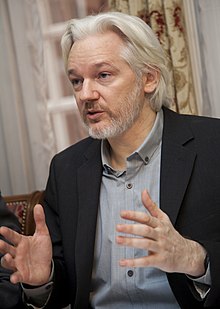
Australians Call to End Long Persecution of WikiLeaks’ Julian Assange.
ROBIN ANDERSEN, 25 Oct 23 https://fair.org/home/australians-call-to-end-long-persecution-of-wikileaks-julian-assange/
As WikiLeaks founder and Australian citizen Julian Assange has nearly exhausted his appeals to British courts against a US extradition order, Australia has ramped up its advocacy on his behalf. Six Australian MPs held a press conference outside the US Department of Justice on September 20 to urge the Biden administration to halt its pursuit of Assange (Consortium News, 9/20/23).
They came representing an impressive national consensus: Almost 80% of Australian citizens, and a cross-party coalition in Australia’s Parliament, support the campaign to free Assange (Sydney Morning Herald, 5/12/23). Opposition leader Peter Dutton joined Prime Minister Anthony Albanese in urging Assange’s release.
The day before, an open letter to the Biden administration signed by 64 Australian parliamentarians appeared as a full-page ad in the Washington Post. It called the prosecution of Assange “a political decision” and warned that, if Assange is extradited, “there will be a sharp and sustained outcry” from Australians.
Given what is at stake for freedom of the press in the Assange case, and the intensified pressure from Australia—a country being wooed to actively enlist in the US campaign against China by spending $368 billion on nuclear submarines and supersonic missiles (Sydney Morning Herald, 8/10/23)—we ought to expect coverage from the Washington Post, New York Times and major broadcast networks. But coverage of the press conference was virtually absent from US corporate media.
Prosecuting publishing
The US has been seeking to extradite Assange from Britain on charges relating to the leaking of hundreds of thousands of documents to international media in 2010 and 2011, many of which detailed US atrocities carried out in the Afghanistan and Iraq wars and other human rights violations, such as the torture of detainees at Guantánamo Bay (Abby Martin, 3/10/23).
In 2019, President Donald Trump’s administration brought Espionage Act charges against Assange for obtaining and publishing leaked documents, a dramatic new attack on press freedom (FAIR.org, 8/13/22). Assange could face 175 years in a supermax prison if convicted under the Espionage Act, “a relic of the First World War” meant for spies (American Constitution Society, 9/10/21), and not intended to criminalize leaks to or publications by the press. The Biden administration has rolled back much of the legal mechanism used by Trump to attack journalists, but President Joe Biden has reaffirmed the call to extradite Assange.
Assange also coordinated with international news outlets to publish other material known as Cablegate about the “inner-workings of bargaining, diplomacy and threat-making around the world” (Intercept, 8/14/23). Indeed, the New York Times (e.g., 11/28/10) published many articles based on the WikiLeaks documents, which had been sent to Assange by US army whistleblower Chelsea Manning.
US officials have repeatedly justified their case by charging that Assange put lives at risk; to date, no evidence has surfaced that any individuals were harmed by the leaks (BBC, 12/1/10; Chelsea Manning, Readme.txt, 2022). As the Columbia Journalism Review (12/23/20) admonished, don’t let the Justice Department’s
misdirection around “blown informants” fool you—this case is nothing less than the first time in American history that the US government has sought to prosecute the act of publishing state secrets, something that national security reporters do with some regularity.
US officials have repeatedly justified their case by charging that Assange put lives at risk; to date, no evidence has surfaced that any individuals were harmed by the leaks (BBC, 12/1/10; Chelsea Manning, Readme.txt, 2022). As the Columbia Journalism Review (12/23/20) admonished, don’t let the Justice Department’s
misdirection around “blown informants” fool you—this case is nothing less than the first time in American history that the US government has sought to prosecute the act of publishing state secrets, something that national security reporters do with some regularity.
In failing health after suffering a stroke, Assange has been held in London’s high-security Belmarsh Prison since he was removed from the Ecuadorian Embassy in April 2019. He had sought asylum at the embassy in London in 2012 to avoid being sent to Sweden for questioning over sexual assault allegations, because Sweden would not provide assurances it would protect him from extradition to the US. Sweden dropped charges against Assange in November 2019 (BBC, 11/19/19), after he was in British custody.
International condemnation
The Australian diplomatic mission coincided with the convening of the UN General Assembly in New York City, where President Lula da Silva of Brazil condemned the prosecution of Assange, offering yet another opportunity for US corporate media to cover the strong international opposition to Assange’s treatment.
A video (9/19/23) of Lula speaking at the opening of the UN General Assembly was widely circulated on social media. “Preserving press freedom is essential,” Lula declared. “A journalist like Julian Assange cannot be punished for informing society in a transparent and legitimate way.”
Former British ambassador Craig Murray commented about Lula’s reception at the UN (Twitter, 9/17/23):
It is really not normal for the hall at the UN General Assembly to break into this kind of spontaneous applause. The US has been losing the room internationally for a decade. The appalling treatment of Julian is a focus for that.
US media absence
Yet, with a few exceptions (Fox News, 9/20/23; The Hill, 9/21/23; Yahoo News, 9/21/23), none of this made the major US news outlets.
Over a week later, Business Insider (10/1/23) ran a long piece that featured an interview with Gabriel Shipton, Assange’s half-brother. It pointed out that Assange had become an obstacle to US plans to involve Australia in its aggression toward China, quoting the PM. But the piece also hashed through a number of long-debunked claims, including one that reminded readers that Mike Pompeo once called Assange “a fugitive Russian asset” (FAIR.org, 12/03/18; Sheerpost 2/25/23), and another that repeated US assertions that WikiLeaks releases would put the US at risk.
The New York Times has been conspicuously absent from the coverage of Assange. Though the Times signed a joint open letter (11/28/22) with four other international newspapers that had worked with Assange and WikiLeaks, appealing to the DoJ to drop its charges, the paper has remained almost entirely silent on both Assange and the issues raised by his continued prosecution since then.
As FAIR pointed out, during the Assange extradition hearing in London, the Times
published only two bland news articles (9/7/20, 9/16/20)—one of them purely about the technical difficulties in the courtroom—along with a short rehosted AP video (9/7/20).
There were no editorials on what the case meant for journalism. FAIR contributor Alan MacLeod noted that the Times seemed to distance itself from Assange and WikiLeaks, and its own reporting on the Cablegate scandal, coverage that boosted the papers’ international reputation.
Other opportunities for coverage have been missed by the Times. For instance, Rep. Rashida Tlaib wrote a letter (4/11/23), signed by six other members of the Progressive Caucus, calling for the DoJ to drop the charges against Assange. Tlaib cited support from the ACLU, Amnesty International, Reporters Without Borders, the Committee to Protect Journalists, Defending Rights & Dissent and Human Rights Watch, and many others, stating that his prosecution “could effectively criminalize” many “common journalistic practices.” The letter was covered by The Nation (4/14/23), the Intercept (3/30/23), Fox News (4/1/23), The Hill (4/11/23) and Politico (4/11/23), but the Times and other major newspapers were conspicuously silent.
When Assange lost his most recent appeal against extradition in June, a few outlets reported the news online (e.g., AP, 6/9/23; CNN, 6/9/23), but not a single US newspaper report could be found in the Nexis news database. (Newsweek‘s headline framed the news as a “headache for Biden”—6/8/23—rather than a blow for press freedom.) The Times only vaguely referred to the news (Assange “keeps losing appeals”) two weeks later in a feature (6/18/23) on the late whistleblower Daniel Ellsberg, who had criticized Biden’s decision not to drop the case against Assange.
The world is watching
A huge collective breath is being held as the world watches to see what will happen to Assange, the most famous publisher on the globe. Will he be returned to his country and his family by Christmas, as the Australian MPs have requested? Or will Britain and the US continue to slowly execute him?
Assange’s case is expected to be discussed during Prime Minister Albanese’s current visit to the US, which includes a state dinner hosted by Biden on October 25. MP Monique Ryan, part of the pro-Assange delegation, told news outlets: “Our prime minister needs to see this as a test case for standing up to the US government. There are concerns among Australians about the AUKUS agreement, and whether we have any agency” (Business Insider, 10/1/23).
As Common Dreams (9/19/23) quoted from the delegation’s letter:
We believe the right and best course of action would be for the United States’ Department of Justice to cease its pursuit and prosecution of Julian Assange…. It is well and truly time for this matter to end, and for Julian Assange to return home.
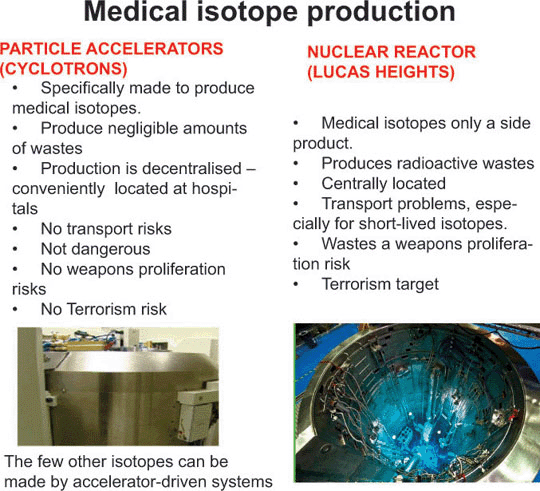
Australia does not need a new “nuclear medicine” factory – clean, safe, cyclotrons can do the job.

I read with interest Liam Mannix’s report in yesterday’s edition of The Sydney Morning Herald regarding the new nuclear medicine factory but was surprised that with his scientific knowledge he did not question the need for this facility so aptly described as a factory
27 Sept 23
Mannix would be well aware that the medical profession worldwide is turning away from reactor generated medicine due to its inherently dangerous and risky nature and its extremely high manufacturing costs
The isotopes generated by reactors for medical purposes such as at Lucas Heights are being replaced mainly by cyclotron produced isotopes but also other alternatives which are completely free of any risk to the patients and can be produced by relatively easier and safer means at a greatly reduced cost than at Lucas Heights
The only reason that isotopes produced by nuclear reactors are used for medical purposes is that their manufacture is invariably highly and unrealistically subsidised by government grants as is the case with ANSTO in Australia which is globally a prime example of that largesse .
The rapid growth in the international use of cyclotron isotopes for medical therapies is making the production of isotopes by nuclear reactors (like at Lucas Heights) obsolete
As a result there is now need for a new facility for the continued production of isotopes for medical purposes by ANSTO and in fact the current production at Lucas Heights could be stopped immediately with huge savings in government expenditure and no effect on the provision of medical therapies due to the use of much safer alternatives
ANSTO is claiming that the major part of its existence representing 80% of its undertaking is the current production of nuclear medicine isotopes by using its OPAL reactor at Lucas Heights for that purpose but this appears to be no more than a self perpetuating exercise to justify its survival
It is therefore a completely nonsensical if not deliberately disingenuous statement by Science Minister Ed Husic to claim that the “nuclear medicine precinct (of ANSTO) in Sydney will revolutionise the domestic production of nuclear medicines and improve the lives of thousands of Australians”
Australian theatre company stages On the Beach, Nevil Shute’s nuclear-doomsday novel

WSWS Kaye Tucker, 1 Sept 23
On the Beach, Nevil Shute’s 1957 book, was recently staged by the Sydney Theatre Company (STC) in a two-act adaptation by playwright Tommy Murphy (Significant Others, Gwen in Purgatory, Holding the Man). The show was directed by Kip Williams, the STC’s artistic director.
Shute’s story is set in the Australian city of Melbourne in 1963—in other words, a few years into the future—following a devastating nuclear war in the northern hemisphere, and what are the final months of human civilisation. All human life has been wiped out in North America, Europe, China and the Soviet Union, and a deadly radiation cloud is moving southward towards Australia.
City residents, along with the captain and crew of the visiting American nuclear submarine USS Scorpion, are preparing for their inevitable deaths with only state-sanctioned suicide pills to ease their final days…………………………….
Shute’s novel was an immediate financial success in 1957, selling over a hundred thousand copies in the first weeks after its publication, and quickly becoming an international best seller. Twelve years after the US atomic bombing of Hiroshima and Nagasaki, millions of people around the world were deeply concerned about the possibility of nuclear war.
US director Stanley Kramer acquired the rights and the movie, shot in Melbourne and featuring some of Hollywood’s greats—Gregory Peck, Ava Gardner, Fred Astaire and Anthony Perkins—was released in 1959. “It was a fictional scenario,” Gardner said of the film, “but my God, everyone in the cast and crew knew it [nuclear war] could happen… I was proud of being part of this film.”
Other film and television productions have since been made. These include a made-for-television version in 2000 with Armand Assante, Rachel Ward, and Bryan Brown, followed by a full-cast audio dramatisation in 2008. In 2013, Lawrence Johnston directed Fallout, a documentary about the production of the Kramer’s film.
The STC’s staging of On the Beach—the first ever theatrical production—is timely and politically significant. Its four-week season at the 800-seat Roslyn Packer Theatre in central Sydney was well attended, indicating that Shute’s frightening story still resonates, not just with those who read it in the late 1950s, but for a new generation.
In fact, the ongoing and increasingly public speculation by government and military officials about the possible use of nuclear weapons in the US-led NATO war against Russia in the Ukraine, make Shute’s novel even more relevant than when it was released. Likewise, the Albanese government’s deepening involvement in US-led preparations for war against China, with multi-billion dollar purchases of nuclear submarines and other deadly weaponry, and the hosting of major military exercises in northern Australia, is encountering growing popular opposition.
Underpinning Shute’s book is his determination to raise awareness about the possibility and dangers of nuclear war. This is effectively presented in the opening pastiche of the STC production that gives a real sense of the impending danger that drives the author’s narrative………………………………………………………………………………………
On the flap of a 2010 edition of the novel, a Guardian reviewer rightly states, “On the Beach played an important role in raising awareness about the threat of nuclear war. We stared into the abyss and then stepped back from the brink.”
Rather than circumventing the crises “currently staring us in the face” or creating “a sense of hope,” as Williams suggests, Shute directly confronts his readers with the cataclysmic consequences of inaction……………………………………………………………………………………. https://www.wsws.org/en/articles/2023/08/31/nlzx-a31.html
—
Australian Financial Review gets it not quite right about why nuclear power is the wrong solution.
31 Aug 23
The Australian Financial Review says the question of why nuclear power isn’t the right solution for Australia deserves a serious answer.
Fair enough.
The Financial Review argues the rest of the world is moving to nuclear. An odd claim, when the world added 295GW of wind and solar last year but just 1.5GW of nuclear power. The International Energy Agency predicts that “only a small number of units are likely to start operating this decade”.
In fact, there are five serious answers to why nuclear is the wrong solution for Australia.
When thinking about the conundrum of how we manage this massive transformation to a lower-emissions energy grid, it is hard to think of a more ill-fitting solution for Australia than going down the nuclear road.

No.1 issue: cost. Proponents of nuclear energy simply dismiss the multitude of evidence that nuclear power is the most expensive form of energy available. Or, worse, seek to undermine the rigorous independent analysis that finds it so.
GenCost, independently prepared by the CSIRO and Australian Energy Market Operator, is one of many studies which find nuclear the most expensive form of energy. Despite the political attacks on AEMO and CSIRO in recent weeks, it is a robust report and their analysis stands up to scrutiny.
As AEMO has said: “Recent media commentary that AEMO’s Integrated System Plan (ISP) does not include transmission and storage, as well as generation costs associated with providing electricity to Australian customers, is wrong.” And the finding is clear: renewables (including the cost of transmission and storage) are cheaper than nuclear by several multiples.
If you don’t like the work of AEMO and CSIRO, sure, look around for an alternative report. Take a recent report by Lazard on the levelised cost of energy in the US. It found that between 2009 and 2021, utility-scale solar costs came down 90 per cent and wind 72 per cent, while new nuclear costs increased by 36 per cent.
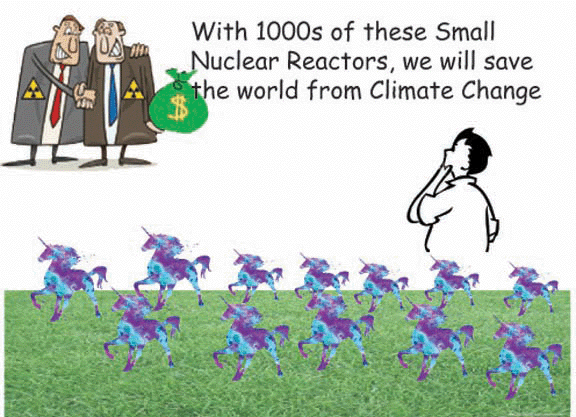
Small modular reactors (SMRs) can supply up to 300 megawatts per plant. They are conservatively costed at $5 billion each. You need quite a few 300MW SMRs to replace say a 2GW coal-fired power station like Eraring. That is an extremely expensive transaction. The leader of the Nationals has said nuclear power wouldn’t cost Australia “a cent”. How can an alternative government make such a ridiculous claim with a straight face?
2. Second, the much-vaunted small modular reactor technology is unproven. There is no commercial SMR operating anywhere in the world. There are two demonstration plants: one floating around on a barge in Russia and one in China.
Last week’s Financial Review editorial lauds Ontario’s plans. Really? Ontario Power Generation has not released any costings for its proposed SMRs and it is yet to receive (or even apply for) environmental approvals. Are we to hang our hat on this technology for our national energy plan?
3. Third, nuclear is notoriously slow to build. Can anyone credibly claim that Australia could have a nuclear plant operating by the early or even mid-2030s, when we need no-emissions technology to be supplying the vast bulk of our power? The answer to that question, reasonable observers would agree, is “no”.
4. inflexibility. The fourth serious answer to the Financial Review’s suggestion of a nuclear path is that it is not a flexible source of energy. As we move to more renewables, we need peaking and firming that can be tuned on and off at short notice to fill gaps in renewable supply. Coal-fired power stations can be turned down, but not off. Likewise, a nuclear power station cannot easily be turned off once it is running.
Nuclear power is largely useless as peaking and firming support for renewables. This is where gas-fired power stations are a useful back-up to renewables. The latest technology allows gas-fired power stations to be turned on with two minutes’ notice.

5. Finally, there’s the matter of nuclear waste. Small modular reactors would produce no small amount of waste. A Stanford University study finds that “… most small modular reactor designs will actually increase the volume of nuclear waste in need of management and disposal, by factors of 2 to 30 for the reactors …”
For 235 years, Australia has searched for comparative advantage. We have found one. It is renewable energy. Imagine having abundant resources of the cheapest form of energy available and choosing, as a matter of policy, to deploy a source of energy much more expensive and slower to build instead? That’s what advocates of nuclear power are arguing for.
After 10 years of denial and delay on climate action, I’m not interested in more years of distraction by a debate on an energy source which clearly doesn’t stack up for our country.
Australian Financial Review’s sloppy journalism makes a nonsense of its case for nuclear SMRs

Why does this matter? It’s lazy journalism, bad editing, and is typical of the inflated hopium of the nuclear booster industry.
Just one example: Coalition energy spokesman Ted O’Brien said this week that Canada sources 60 per cent of its power from nuclear. Not true, it is 15 per cent, and falling.
should we expect better from the nation’s business daily?
Giles Parkinson 25 August 2023, https://reneweconomy.com.au/afrs-sloppy-journalism-makes-a-nonsense-of-its-case-for-nuclear-smrs/
The Australian Financial Review has been trying to make a big thing about nuclear power, and small modular reactors in particular. But it seems its ideological enthusiasm for the technology is trumping its fact checking capabilities.
To read the AFR series you’d be forgiven for thinking that SMRs already exist in western grids. Everything is in the present tense, as though the machines are already operating, or in commercial production.
Of course, that’s not the case. The first SMRs are unlikely to be built much before the end of the decade, and it could be years after that before they represent a commercial alternative, if then.
But it’s not just the fake tenses that detract from the AFR’s journalism, it’s the facts, or the lack of them, that grate the most.
Let’s take the latest instalment on the progress of SMRs in Canada, written by the paper’s Washington correspondent. We’ve taken a screen shot of the opening paragraphs of the online article above. [on original]
“By the end of the decade it (the Ontario government utility) expects to begin generation up to 1.2 gigawatts of electricity, enough to supply 1.2 million homes with carbon-free energy,” it proclaims.
Er, no. The minister’s statement announcing the expanded program of a single 300MW SMR to four SMRs totalling 1.2GW makes it very clear that the three additional units won’t be online until 2034 or 2036.
That means, by the end of the decade, there might be one, sized at 300MW and it will only serve 300,000 customers.
That’s important because the nuclear fan club likes to make out the SMRs are not far away and mass deployment is at hand, and that we – Australia – can afford to stop wind and solar and wait.
But it’s clear that even in Canada – one of the biggest and most established users of nuclear in the world, with all the experience and regulatory and grid infrastructure – the authorities can’t see a second unit coming on line until the mid 2030s.
That misinformation certainly fooled the person responsible for the “key statistics” box on the right hand side of the AFR article (above on original)) – which is designed to be a ready reference for those not bothered to read the article itself and in this case is completely misleading.
It tells readers that 1.2 million households will be served by the first SMR. No they won’t. The official release makes clear it is 300,000.
The key statistics box in the AFR article says there will be a total of 1.2 million gigawatts of nuclear. No, just 1.2 gigawatts, eventually. That’s one million times less than what is claimed by the AFR. Maybe just a blooper. But it is more than just a few zeros.
Why does this matter? It’s lazy journalism, bad editing, and is typical of the inflated hopium of the nuclear booster industry.
It’s perhaps telling that the only US politician the AFR quotes in support of nuclear is Vivek Ramaswamy – who shares conspiracy theories about 9/11, blames the recent Hawaii bush fires on “woke water” policies, and reckons Donald Trump has been the greatest US president of the 21st Century.
Ramaswamy, like the other seven Republican candidates in their primary debate this week, did not put his hand up when asked if he accepted climate science. “The climate change agenda is a hoax,” he added. Climate denial and nuclear boosterism often go hand in hand, because it is essentially about a delay to renewables.
Ramaswamy went further: “Unlock American energy, drill, frack, burn coal, embrace nuclear,” he declared. And this is the AFR’s go-to man in the US to push the nuclear argument.
Some might argue Ramaswamy’s “drill, frack and burn” mantra could be a fair summary of the AFR’s own view of the world. It’s not a view that is shared by the bulk of its business readers.
But neither is nuclear – it’s a marginal proposition at best. The Australian energy industry has looked its costs and decided no thanks, it’s too slow and too expensive. As the former head of the US nuclear regulatory commission observed, the drive for nuclear is – more than anything – about ideology.
Of course, the AFR is not the only source of misinformation in this new campaign for nuclear, nor is it the most egregious.
The rot starts at the top. The Coalition – which wants wind and solar stopped while we wait for SMRs – is not the least bit bothered by facts. Just one example: Coalition energy spokesman Ted O’Brien said this week that Canada sources 60 per cent of its power from nuclear. Not true, it is 15 per cent, and falling.
The Murdoch media does its bit, of course, but it is the social media campaign against renewables and for nuclear that is more insidious, and more outrageous – with sometimes absurd claims about wind turbines (they can’t spin by themselves and have to be powered by coal) and solar doing the rounds.
That campaign, depressingly, has taken root – and little more can be expected from the sometimes toxic nature of social media channels, Sky after Dark and even the “mainstream” Murdoch publications. But should we expect better from the nation’s business daily?
Nuclear issues turn Radio-Active dial up
Georgia Curry, August 5, 2023, https://canberraweekly.com.au/nuclear-issues-turn-radio-active-dial-up/
With Hiroshima Day this Sunday, 6 August, (and Nagasaki Day on 9 August) plus the cinema release of Oppenheimer, there’s no better time to highlight Australia’s longest running show about nuclear issues – Radio Active.
Canberra’s oldest community radio station, 2XXFM 98.3, airs the program every Sunday morning and, sadly, nuclear issues are just as topical now as they were when the show started in 1976.
According to the Doomsday Clock, which was created by the Bulletin of the Atomic Scientists (founded in 1945 by Albert Einstein and University of Chicago scientists who helped develop the first atomic weapons), it is 90 seconds to midnight.
The Doomsday Clock is set every year and has become a universally recognised indicator of the world’s vulnerability to global catastrophe caused by man-made technologies.
This ticking clock feeds the longevity of Radio-Active. Canberra’s 2XXFM is one of 20 community radio stations broadcasting the show around Australia for the past 47 years.
The show is produced at Melbourne’s community radio station 3CR by producer Michaela Stubbs.
“All of the show’s presenters are activists, which is probably why the show has gone on for so long because we have quite a big movement that is multi-generational and we’re really passionate about the issues,” Michaela says. “My mum was part of the peace and nuclear disarmament movement in the ‘80s so I had an awareness of Hiroshima Day.”
Michael has a vast archive of tapes to draw from and recently aired a show about “Down Winders”, people affected by the Trinity nuclear test site in New Mexico, USA, the site of the first detonation of a nuclear weapon.
“That was such an important story,” Michaela says. “They are the voices that don’t get heard.”
There are also old cassettes of protests such as Australia’s Jabiluka blockades in the ‘70s against the Jabiluka uranium mine in the Northern Territory.
Michaela recently interviewed an Indigenous woman whose family was affected by the British Government atomic tests at Emu Field, South Australia. This occurred 70 years ago this October and her family is still seeking reparations.
“We have always had a strong focus on amplifying the voices of people who are directly impacted by nuclear development,” Michaela says.
Australia’s longest running show on nuclear issues also focuses on peace and sustainability. Radio-Active is broadcast on Canberra community radio 2XXFM 98.3 every Sunday, 7.30am-8am.
The right’s nuclear stupidity is enough to make us cough up Phlegm Orville

From National Times Facebook page 2 Sept
The right’s nuclear stupidity is enough to make us cough up Phlegm Orville ( Bernard Keane and Crikey )
President Macron has reversed France’s original plan to reduce its nuclear energy from 70% to 50%, indeed as part of a nuclear renaissance, France will build six new large reactors and shortly commence testing on a nuclear power plant in Phlegm Orville, which is set to open early next year.
Er, what? Phlegm Orville in France? Sounds like a haute cuisine serving of mucus. Presumably the IPA scribe misheard when Dutton referred to Flamanville Nuclear Power Plant (thank God he didn’t refer to Finland’s Olkiluoto). Or perhaps they couldn’t believe Dutton was seriously invoking Flamanville as an advertisement for the wisdom of nuclear power.
Crikey first mentioned the new reactor being built at Flamanville in 2009, when it was due to open in 2013 and was already one-third over budget. By 2016 it was 200% over budget and scheduled to start in 2018. By 2018, the builder EDF discovered serious construction problems that delayed the start until 2020, and blew the budget out again. In 2020, the French government labelled Flamanville a “mess”. Early in 2022, when it was going to open at the end of the year, there was another delay and the budget rose to €12.7 billion (A$21.3 billion). At the end of last year, there was another delay into 2024 and the budget went over €13 billion.
So, all up, a decade overdue, and a final cost triple the initial estimate — if it starts next year. And it’s what Dutton thinks is an advertisement for nuclear power. Perhaps he should have mentioned Olkiluoto instead. It finally commenced in April this year… 14 years overdue.
Such criticisms, however, are now airily dismissed by nuclear power advocates. The future is small modular reactors (SMRs), which take much less time to build and are far cheaper — even if there are none actually operating outside Russia or China yet. “A single SMR can power some 300,000 homes. A microreactor could power a regional hospital, a factory, a mining site or a military base,” Dutton told the IPA.
At the same time as Dutton is spruiking SMRs, the Financial Review is as well. It’s run a three-part series on plans in Canada, Japan and the United Kingdom for SMRs (as one AFR reader acerbically noted, the keyword is “plans”).
The AFR also editorialised about the glories of SMRs. Conveniently absent, however, was the fact that even the new wonder technology needs massive taxpayer subsidies. The SMR that gets advocates most excited is the small prototype that US firm NuScale received regulatory approval to build in Idaho earlier this year — celebrated as a major milestone for the technology. Except it won’t commence operation until 2030 at the earliest and has already received US$1.4 billion in subsidies. That hasn’t stopped the proposed facility’s cost per MW-hour already increasing by more than 50% — three times the current cost of large-scale nuclear power in the US.
Why has the cost gone up for this SMR? Because, erm… cough cough… there’s been a massive blowout in the construction cost: 75%, to more than US$9 billion. Sure, it’s not a Phlegm Orville 300% blowout, but it is only a small reactor. And who will insure SMRs? In the United States, the government provides that insurance, with nuclear power plant owners paying hundreds of millions of dollars a year in premiums, further adding to the cost.
Another issue not mentioned by either the AFR or Dutton — both of whom like to whine about too much government spending — is what to do with the waste produced by SMRs. See, while they may be small, SMRs produce much more waste per unit of energy produced — and waste with higher radioactivity levels — than normal reactors. Good luck finding somewhere to store that for 10,000 years. You can bet no company will be doing that — it will fall to taxpayers, yet again.
So, apart from taking a long time to build, blowing out costs, requiring a massive infrastructure solution in terms of waste disposal and requiring colossal taxpayer support, the SMRs championed by Dutton and the AFR are completely different to traditional nuclear power.
What’s driving all this? Why does the right think SMRs are the solution? The delays that are typical of nuclear power, and which would be typical of SMRs as well, aren’t the problem — they’re the point. Switching focus to nuclear power and away from renewables and storage would delay decarbonisation and give fossil fuel industries extra years — indeed, extra decades — to keep operating while a nuclear “solution” was prepared. Like carbon capture, like gas, it’s another scam used by fossil fuel interests to try to delay meaningful climate action.
It’s enough to make you cough your lungs out.
Australian media’s alarm over Chinese spy ship highlights stark double-standard
Pearls and Irritations, By Brian Toohey, Jul 31, 2023
The mainstream media has once more tried to generate alarm about the presence of two relatively innocuous Chinese electronic spy ships in international waters during the latest biennial Talisman Sabre military exercise spread across the Australian mainland and offshore oceans. It involves 30,000 troops from 13 countries. Although the Indian prime minister Narendra Modi had publicly assured his Australian counterpart Anthony Albanese that his country would attend, India did not turn up.
The unnamed enemy is China. A London based journalist reported from Townsville that the latest exercise was occurring against a “changing security landscape in which China grows evermore belligerent”. Apparently, he didn’t see any need to give evidence for this dubious claim. The defence minister, Richard Marles said Talisman Sabre provided an opportunity to practice “high-end” warfare. Just how participants such as PNG, Tonga and Fiji can do this is not clear. In a war, their role would be to let the US operate from their territory.
During the last exercise, the ABC’s national television news each night ran a video of the spy ships across the top of the screen. It hasn’t gone that far this time, but has given extensive coverage to the spy ships without explaining what harm they might be doing.
The participants don’t seem alarmed. During the last exercise, an ABC journalist asked an American soldier on an amphibious ship if he was worried about the presence of Chinese spy ships. He replied, “No, we do it to them and they do it to us”. An Australian military spokesman said this time that it had taken the appropriate precautions to ensure the spy ships don’t cause any harm. A core reason is that all signals traffic is encrypted. The reality is that the US and its allies conduct electronic intelligence gathering on a much greater scale than China can. The Pine Gap satellite ground station in central Australia, for example, generates billions of pieces of intelligence every day. This did not stop the ABC defence correspondent Andrew Green commenting on the activities of one Chinese spy ship, “If knowledge is power, China has just become more powerful”.
The RAAF’s P8A Poseidon electronic spy planes pose an aggressive threat to China by dropping sonar buoys in the South China Sea where its submarines are based on Hainan island close to the mainland. The small buoys contain an underwater microphone to pick up the sounds from submarines and relay the data to the spy planes conducting surveillance for potential military use.
Australia’s behaviour in the South China Sea is the same as if Chinese planes dropped sonar buoys outside the Fremantle base for Australian and US submarines. But the Chinese planes don’t do this. …………………………………………………………………………………
Certainly, Australian media would consider it provocative if China developed a long-range air capability and dropped sonar buoys off the submarine base at Fremantle. Albanese portrays the co-operation between the US and Australia to conduct potentially aggressive military activities in the South China Sea as part of the struggle between autocracies and democracy. Unfortunately, the draconian nature of some of Australia’s national security laws, deprive Australia of the right to call itself a liberal democracy.
Similar problems arise with Albanese’s iron grip on the Labor party’s federal conference in Brisbane on August 17-19. Although he describes Labor as a democratic party, he has effectively banned any parliamentarians attending the conference from supporting motions in favour of scrapping the AUKUS pact or the acquisition of nuclear submarines. Albanese has also banned any parliamentarian from supporting the existing conference policy of making it a priority to recognise of Palestine as a state. https://johnmenadue.com/australian-medias-alarm-over-chinese-spy-ship-highlights-stark-double-standard/
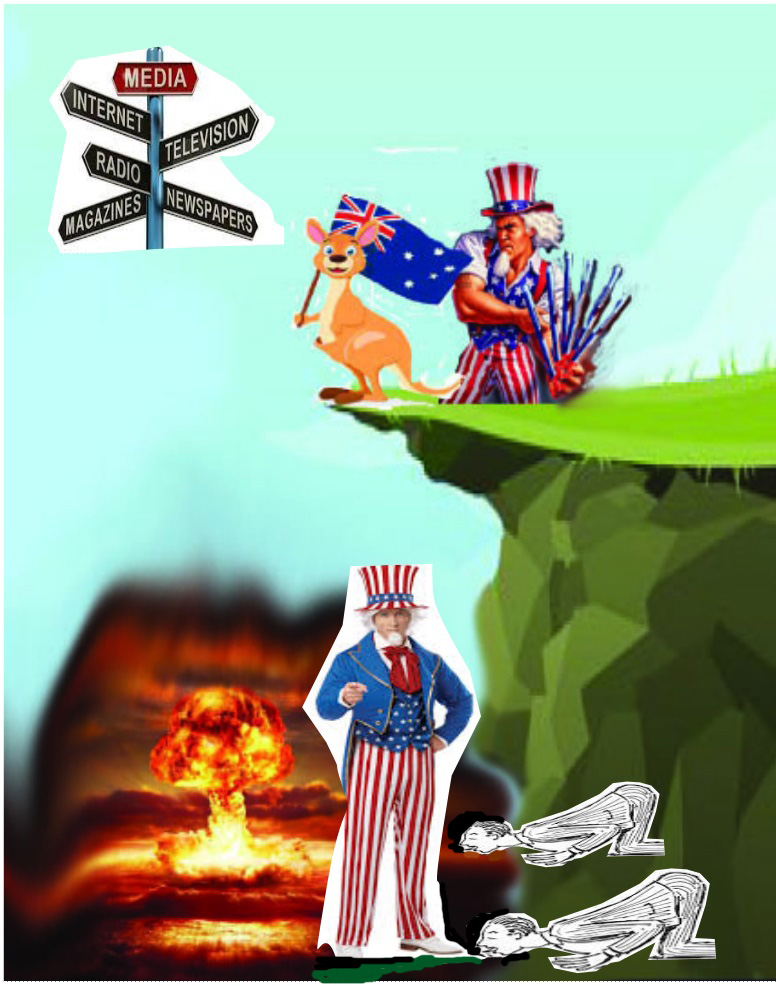
Readers disgusted with pro militarism report on Australia getting a “missiles industry”.
‘Hugely significant’: Australia to manufacture and export missiles to US’ (SMH)
‘Australia to manufacture and export missiles to US and others’ (9 News)
‘US to help Australia develop guided missiles by 2025’ (Aljazeera)

Above are just a few of the rapturous headlines in the print media. Then the joyous Australian TV and radio media – orgasmic delight at Australia’s new subservience to USA militarism.
BUT – by today – 204 comments on thed Sydney Morning Herald’s delighted article by Matthew Knott. July 28, 2023. Yes quite a few comments rejoicing in the prospect of the missiles industry . BUT the overwhelming majority of commentators were disgusted. Below are some of the comments.
Australia will be the front line in a US war with China
And make Australia a target for attacks un-necessarily ? Australia should NOT be drawn into any activity that is war-like in nature. We are a peaceful country that should not be militarily engaged in other nations issues. Sure we can have a voice BUT NOT ACT MILITARILY .. If the Americans want to stick their nose in other nation’s affairs, so be it .. Don’t drag us in militarily !!!
We voted Labor and they are throwing any semblance of autonomy we had away.Terrible idea !We can’t make Under Pants, Socks, Kettles, Washing Machines, Dustpans.
The Syrian war and Ukraine wars have generated 10 million refugees who have fled into the rest of Europe. The South China Sea has 200 million people living within 10 km of the coastline. Australians were easily convinced to turn back the boats and create a cruel offshore detention program all for the expediency of the LNP’s re election. The obsession with contributing to the US led arms race and the insistence of provoking a war over Taiwan will inevitably lead to our shiny new missiles and military arsenal being used as an expediency to turn back the thousands of boats
Just how (and why) are we finding the capacity to make death ?
More military lunacy.
We can’t make Under Pants, Socks, Kettles, Washing Machines, Dustpans.
Just how (and why) are we finding the capacity to make death ?
We can’t make Under Pants, Socks, Kettles, Washing Machines, Dustpans.
Just how (and why) are we finding the capacity to make death ?As Fraser said, we should have got out of Anzus at the end of the Cold War. Seems now we’re more captured by the US’s foreign policy agenda than ever before.
For Labor it’s clearly about the domestic optics. They want to be seen as the tough guy on military and defence matters, so long that being the Coalition’s political play.
Because of Morrison, and no Choice. We ended up with ALBO the United States Cheerleader.
Albo will NOT
provide leadership and he will not provide intellectual input in the following areas;
•‘Made a public call for building an autonomous Australia in a persistent attempt to shake off Australia’s shackles and prove that it is not the vassal of The United States.
•that Australia should be one pole of multipolarity with its own independent position to serve its own interests, and cannot be a vassal of other forces,
•When dealing with its relations with the US, it is hoped that Australia can truly safeguard its own core interests and get rid of the shackles the US has placed on it in the fields of economy, trade, ideology and even security,
Finally he has no idea on how to make Australia a world class manufacturing hub as declared in his election policy speech.
I’d much rather see Australia manufacturing things like solar panels and wind turbines and exporting them to the rest of the world to help tackle the growing threat of global climate change. Instead we focus on weapons and the machinery of war. Strange priorities from a Labor government…..disappointing really!
Big cheers for this ‘Hugely significant’!!! We finally became like North Korea, soon we will be able to replace New Year celebrations with real deadly missiles.
With the added bonus for politicians: whenever they make a mess they just fire missiles to distract the electorates … and at the same time it would be ‘Hugely Great’. The Rednecks and war mongers will be cheering all the way … it’s win win… well done Albo
We are being conned.
Can we go back to making cars. At least they were useful.
Missiles are for war.
Unless we agree to annilate all Mankind we are walking down the wrong path.
In a car you can go somewhere.
And so the violence industry marches on. By setting such an example is it little wonder there is so much killing & maiming in the world today?
So now new funding just extending the Morrison/Dutton Missile manufacturing policy announced in 2021?
Will it be like the F18 program all over again – assembling kits from the US? How much will the taxpayer subsidise the program?
So we’ve been sold out to the military industrial complex and will become fully integrated into the US War machine as the US makes its last ditch attempt to maintain its global hegemony and it control over the pacific region.
We are being marched into WWIII by the crazy neo cons in the USA and we are too blind to see it, chanting USA, USA, USA as we are led like lambs to the slaughter.
Unbelievable.
How are we a ‘peaceful country’ – name a war we HAVEN’T been involved in! We’re sycophants, hiding under the US’s skirt.
After being a gigantic quarry for so many years, our new major export industry will be providing weapons of war.
This is shameful. Surely we have the intelligence and foresight to do better than this.
Unbelievable.
After being a gigantic quarry for so many years, our new major export industry will be providing weapons of war.
This is shameful. Surely we have the intelligence and foresight to do better than this.
This is a step up from days of Lithgow Small-Arms .303s and these days, our Bushmasters. We’ll just be making them here to another nation’s specs & IP, all for the promise of jobs.
Blinken & Bush: “We have no greater friend, no greater partner, no greater ally than Australia.
A charm offensive that Albanese must take heed.
We import foods & goods from our neighbours for survival only for them to be killed by our missiles. How gross!
While the US and Australia are incessantly focusing on arms and the military in the Pacific, China’s hospital ship, the Peace Ark is in Tonga and will depart Nuku’alofa on 4 August 2023. It will also visit Kiribati, Vanuatu, Solomons Islands and Timor-Leste during its mission. The ‘Peace Ark’, on her third goodwill visit to Tonga on a humanitarian medical mission from 28 July to 4 August 2023.
So which country is doing more for the people in the Pacific?
American owned, designed, parts supplied. We are just like a 3rd world country assembling stuff, all profits going offshore with no tax paid. What a waste………… And paying for the privilege
And another target added to the growing number of American bases.
..and what about all the bs about becoming self-sustaining after the pandemic when we saw how reliant we are on imports? Or this is suddenly irrelevant? They need a Royal Commission into the capabilities of Australia when another and worse pandemic hits. Oh, I can write the summary now “We will be stuffed – starvation, no drugs, no products”. But yes, focus on warheads. Made with Australian metal I hope? Stick some kangaroo prints on it so when it is dug out of children we can be proud.
Yes, “assembled ‘Down Under’ from imported components subject to our strict specifications so you can rest assured that when you get hit by a genuine ‘Aussie’ missile it’s gonna hurt”…………….. Exactly! How gullible we are to trust the Americans? It’s unbelievable!
Now imagine if an LNP government announced we were making killing things for Uncle Sam. You’d never hear the end of it. Oh the hypocrisy.
Nice not, when we have industry again it is all about weapons and destruction.
What have we become? So we are not making products that will make our life easier and more comfortable? We are not making tools and machines to facilitate our normal daily activities? We are no building metro lines to reduce commute times? We are not making electric vehicles to reduce carbon emissions? Yet we are going to making missiles for wars that will kill human beings. What a weird sense of priority we’ve got ???
Lloyd Austin moved from the board of Raytheon to Secretary of Defence. Is it any wonder we are now getting sucked into arms manufacturing a cycle of endless wars, which is a bona fide policy of the US. We need to be much more discerning than “all the way with Uncle Sam” this is a very poor sign of our priorities, and the “jobs and growth” mantra has been taken from the liberal playbook to justify this stupid and dangerous choice.
So the plan is to continue a longstanding trend to make us even more financially and militarily dependent on foreigners right?
“Sydneysiders are aghast at the level of gun violence breaking out. On to happier news, Australia is going to create its very own missile manufacturing plants”.RESPECT8
We’re being used again, it won’t be to our advantage everything the US does is for theirs.
We are their lapdog.
The anti-China brigade in Canberra is pushing hard to get Labor to think China wants to go to war & so we have to be closely allied with the US.
NO it is the USA that always wants to go to war – look how many we’ve followed them into and look at China, only min-wars or skirmishes on their borders, never ever far afield.
I think this idea stinks.
ALP – American Lapdog Party
What is hugely significant is Albo’s lost his marbles.
No way. To restore our manufacturing capacity, I’d rather prefer we start making electric vehicles and solar panels, not missiles.
We’re becoming completely dependant upon the American military machine. AUKUS are about all our government seems to care about anymore. Meanwhile… over 1 million young people are living in poverty and koalas are going extinct. It’s all about priorities and it’s 100% obvious what and who our leaders are working for and it ain’t the people or the country. With friends like Labor, who needs Liberals?
Who cares what Simon Birmingham thinks, or says.
He represents a government that made defence decisions that were more photo-op than substance; cancelled the SEA1000 project that put us squarely into the ship-building “Valley of Death” that the COALition hyperventilated over; failed abysmally in both defence and foreign policy, all the while telling us what absolute standouts they were in government.
It was the COALition that left us with this mess called AUKUS.
I can’t see us receiving nuclear-powered submarines, despite the efforts to push through with AUKUS. At some point, the taxpayers of Australia will simply say “enough!” The options being offered are far too expensive.
“US defence contracting giants Lockheed Martin and Raytheon have been selected by the government as preferred partners for its guided weapons and explosive ordnance enterprise“. The Hawkei is made by Prime contractors including Thales Australia (French) Boeing (US) Plasan (Israel). The Virginia submarines are designed and built by US General Dynamics Electric Boat (EB) and Huntington Ingalls Industries. Virtually all military equipment purchased or being built in Australia by foreign, usually US companies. Australia is feeding overseas military complexes, not developing anything new.
A gigantic error from the government here. The only priorities here are for shareholders of Raytheon and Lockheed Martin. The US are always looking for the next endless war. History repeating itself over and over. We will be used as pawns between the US and China.
Western media as cheerleaders for war
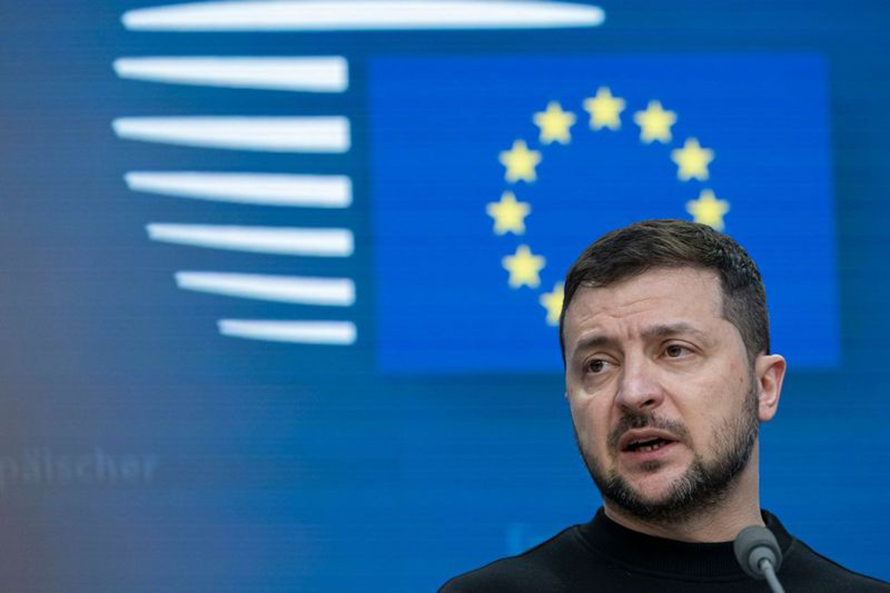
Carried away by the logic of one-upmanship that they impose on the world of politics, the media are co-producing Western countries’ progressive entry into the war against Russia. Everything about the way they treat the conflict suggests that such a confrontation is inevitable. This battle of opinion, which began a year ago, is now being waged on three fronts at once. First, the beatification of Zelensky,
Western journalists are all but unanimous that negotiating with Russia would equal forgiving it its aggression. Nothing short of a crushing victory for Ukraine is conscionable. The risk of escalation is rarely mentioned.
Le Monde Diplomatiqe by Serge Halimi & Pierre Rimbert, Translated by George Miller March 2023
After speeches by British prime minister Rishi Sunak and Ukrainian president Volodymyr Zelensky at a joint press conference on 8 February at a military base in southwest England, it was time for questions. BBC Ukraine correspondent Natalia Goncharova greeted Zelensky with, ‘I would really like to hug you, but I’m not allowed.’ Ignoring his security service, Zelensky got down from the podium and embraced her to general applause. Then Goncharova asked Sunak, ‘You know that Ukrainian soldiers are dying every day. Don’t you think that that decision about warplanes is taking too long?’ In 2003, during the invasion of Iraq, the embedding of journalists with the US military had caused some in the profession to wince; 20 years on, in the Ukraine war, it’s become a journalism of the all-out embrace.
In France, too, the code of conduct set out by Hubert Beuve-Méry, founder of the daily Le Monde (and this publication), counselling ‘contact and distance’, has been set aside. At least when it comes to Volodymyr Zelensky: ‘In real life, he’s nice, quite cool, often funny and not at all grudging with his time,’ said Isabelle Lasserre, Le Figaro’s diplomatic correspondent and darling of the media, France Inter and news channel LCI in particular, since she adopted an uncompromising stance on Ukraine. ‘He has an incredible leadership style, a very intense charisma. He gets straight to the point, he always speaks with conviction,’ she told C politique on France 5 (12 February 2023).
Eulogies, hugs, gushing questions: the Western press’s veneration of this president in khaki fatigues suggests media in thrall to political leaders. But that impression is misleading. Since Donald Trump’s election in 2016, and particularly since Russia’s aggression in Ukraine, ‘journalism’ in the United States and also in Europe has increasingly behaved like an autonomous political force with its own ideological agenda.
Unlike traditional political parties, the media are simultaneously bringing to life and feeding rival tendencies that form two branches of the market for news: one on the hard right (Fox News, The Sun, CNews etc), the other liberal (the New York Times, the Washington Post, CNN, the Guardian, Le Monde etc). With these two audiences, both of which demand their own partisan reading of events, ‘journalism’ is careful not to alienate the faithful by ever making them doubt the bewitching story it serves up.
Media in combat mode have polarised the US around fictitious issues (‘Trump is the Kremlin’s puppet’, ‘Joe Biden’s election victory was rigged’). Since the invasion of Ukraine, they have involved the West in a war against Russia by suppressing any public debate on the risks of military escalation.
This undertaking has been aided by instincts inherited from the cold war: (much-replayed) archive footage of American schoolchildren learning how to protect themselves from a Soviet nuclear attack; a long-standing obsession with communist subversion in the US; and recurrent paranoia about the ‘enemy within’.
It was conceivable, though, that the demise of the Soviet Union and the election of a president who enjoyed strong support in the West, and was almost servile towards it — Boris Yeltsin — would call for more cordial relations between the two former protagonists in a confrontation that had become futile. The Russian people longed for this just as much as their leaders: in the early 1990s, when former Soviet citizens were asked about their favourite international partner, 74% of them picked the US (1).
To ensure US hegemony
This enthusiasm was not mutual. US politicians and media treated Russia as a defeated country, whose role was to not only bend to the rules of then-triumphant neoliberal capitalism, but also to remain strategically weak so that no hostile power could ever again threaten US hegemony. In 1992, only a few weeks after the end of the Soviet Union, the leaked draft Defense Planning Guidance (DPG), better known as the Wolfowitz Doctrine, a Pentagon document that the press published immediately, already had Russia in its sights. It stated that Washington would henceforth need to ‘refocus on precluding the emergence of any future global competitor’. The power of American ‘conviction’ would be all the more compelling because the Pentagon promised to back it up with a military capable of ‘preclud[ing] hostile competitors from challenging our critical interests’ (2). However, ‘the master of the Kremlin’ was then Boris Yeltsin, not Vladimir Putin.
But that barely mattered, because with rare exceptions — notably Saudi Arabia and Israel — the US and its media were almost equally inflexible towards and dismissive of their puppets (Yeltsin), their ‘allies’ (European states) and their enemies (China, Russia, Iran). The idea in the Wolfowitz Doctrine that the international order is ultimately guaranteed by the United States and that the US must be in a position to ‘act independently, as necessary’ when international support is ‘sluggish or inadequate’ was the consensus in the State Department, Washington think tanks and newsrooms. This imperial prism explains the unquestioning acceptance with which all American wars, including the most illegal ones, have been greeted by Fox News and the New York Times.
Journalists have gone back to basics. In the Ukraine war, Chinese, Indian, Latin American, Arab or African viewpoints don’t count?
So Russians gradually became disenchanted with the West…………and NATO’s ongoing expansion, together with the experience of privatisation, finally convinced the Russian public that the US intended, if not to ‘humiliate’ Russia, then at least to subordinate it. ……….
In the US, the construction of the Russian enemy had proceeded in parallel as disagreements and tensions between the two former superpowers grew. ………………………………………….
‘Trump, Putin’s lackey’
Much inanity flowed from this belief. And the European media picked up most of it…………………………………………………….
The US mainstream media’s war on Trump illustrated the transformation of the news business into a political force………………………………………………….
……..journalist Jeff Gerth, who spent three decades on the New York Times, recently published a rolling investigation of the media’s Russiagate coverage in the respected Columbia Journalism Review (5). This mountain of fake news, whose main purveyors were the New York Times, the Washington Post, CNN and MSNBC, asserted that, without collusion between Trump and Putin, Clinton would have been sitting in the Oval Office. Unfortunately for them, after two years of investigation, special prosecutor Robert Mueller, a darling of the Democrats, burst this bubble and disproved any collusion (6). The Washington Post even had to correct several of its scoops and take down the most grotesque fabrications from its website.
The Columbia Journalism Review’s investigation can be read like a textbook of journalistic errors: elision of information that doesn’t corroborate a reporter’s thesis, a competitive race for scoops at the expense of rigour, passing off as ‘Russian disinformation’ stories that are true but embarrassing to the Democrats, the misleading presentation of statistics, misuse of anonymous sources (a thousandfold during the Trump era) vaguely described as ‘administration officials’ or ‘intelligence officials’.
Misleading use of statistics
Even when the agencies corrected or denied the information they had published, the press, acting as an autonomous political force, went on to make doctored ‘revelations’ to keep up the pressure on the White House. ……………………………………………….
As if to confirm this damning indictment of the press, the media outlets involved greeted Gerth’s investigation with stony silence, no doubt confident that their readers would rather have their convictions reaffirmed than be disabused. The result, Gerth explained, is that a profession that is highly influential in public life faces no penalty when it goes wrong……………………………….
Russiagate had turned questions about a ‘Russian threat’ into a domestic political weapon; the media emerged from it discredited. But the war in Ukraine saved them in a sense. It enabled them to recycle their obsession, this time based on real aggression and in a more favourable political context, since both US parties agree that their country should be arming Ukraine against Russia for as long as it takes.
The cult of ‘Western values’

A similar consensus exists in Europe. The 1999 Kosovo war had already seen Germany’s Greens commit themselves wholeheartedly to NATO; even today, the most fervent support for Kyiv is found among the liberal left and environmentalist groups that were once tempted by pacifism. . For these educated sections of society, defending Ukraine is a secular religion: journalists, high priests of the cult of ‘Western values’, preach the salvation of progressive souls at last mobilised against Moscow’s imperialism. Putin’s nationalist diatribes and reactionary traditionalism encourage this militancy, as does the presence of a Democrat in the White House.
The almost total absence of dissenting voices within the ‘progressive’ universe is also partly explained by the price exacted for straying from the bellicose line that is asserted with almost imperceptible shades of difference by LCI and France 2, Médiapart and Paris Match, L’Opinion and Politis, RTL and France Inter. Any reservation expressed about the general mobilisation for Ukraine sparks controversy or scandal,………………………………………………………………
This question gives rise to others. Why do the hosts of this morning show have guests who are almost unanimously in favour of increasing military aid to Kyiv: François Hollande, Bernard Guetta, Isabelle Lasserre, Pierre Servent etc? Why is it that from 8pm on LCI, under the leadership of Darius Rochebin (an admirer of Bernard-Henri Lévy), ‘debates’ on Ukraine assemble panels of Atlanticist journalists (a rotating cast of Pierre Servent, Isabelle Lasserre and Nicolas Tenzer), former NATO researchers (Samantha de Bendern), an exiled ‘former KGB agent’ and Ukrainian activists? Why do magazine covers look like leaflets distributed in Kyiv (‘Ukraine must win’, ran the headline in L’Express on 16 February 2023)? Why do reporters make do so often with simply illustrating a story devised in newsrooms in Paris and why, finally, do editorials only add a patina of respectability to this crusading tone?
It is as if everyone had agreed there is only one possible foreign policy, the policy being pursued by Ursula von der Leyen and the US State Department, and summed up by the German foreign minister on 25 January: ‘We’re waging a war against Russia’. The absence of pluralism is all the more noticeable because any leftwing opponents stay silent or invisible (8). …………….. journalists have gone back to basics. In the Ukraine war, Chinese, Indian, Latin American, Arab or African viewpoints don’t count
Carried away by the logic of one-upmanship that they impose on the world of politics, the media are co-producing Western countries’ progressive entry into the war against Russia. Everything about the way they treat the conflict suggests that such a confrontation is inevitable. This battle of opinion, which began a year ago, is now being waged on three fronts at once. First, the beatification of Zelensky, who has become the most famous influencer on the planet, to the extent that no book fair, film festival or American football match can claim success without his blessing via video link.
……………………………………………………………..The fear of offending Kyiv sometimes borders on self-censorship: when the New York Times ran a story online initially headlined ‘Ukraine corruption scandal stokes longstanding aid concerns in US’ (27 January 2023), it was immediately amended to read: ‘US officials overseeing aid say Ukrainian leaders are tackling corruption.’
The West’s sanctions campaign
The second front is the campaign to destroy Russia economically and militarily through sanctions and stepping up arms deliveries to Ukraine in the form of artillery, missiles, tanks and fighter planes. Not content with brushing aside the debate on the dangers of such a military escalation, the media equate any idea of negotiation with giving Moscow a full pardon (shades of Munich, 1938). As for economic retaliation, they are reluctant to admit their relative failure;…………………………………………………………..
The third front, which is probably most effective because least visible, is the avoidance of any historical perspective on the conflict and unfolding events. When France Inter’s geopolitics commentator Pierre Haski, who is also the president of Reporters Without Borders, rightly accused the Russians of ‘hitting cities and infrastructure’ (14 February 2023), he failed to point out that this is precisely what NATO did during the war in Kosovo. ………………………………………
The idea that other people might compare Russian imperialism to that of the US — wars without a UN mandate in Kosovo and Iraq, Washington’s denunciation of several disarmament agreements with Moscow, embargoes and boycotts against Cuba and Iran, extra-judicial executions by drone, the persecution of Julian Assange and Chelsea Manning — is unwelcome in most newsrooms. As a result, these Western decisions are erased from memory or treated as exceptions, not part of a pattern.
………………………………………………. But the biased presentation of history does not just impoverish Westerners’ ability to judge the ongoing war. It also renders less comprehensible the reaction of other peoples who are aware of facts that their media are willing to tell them. For Arabs, Africans or Latin Americans, the assertion that Ukraine is ‘fighting for our values’ (11) can only reawaken memories of the Iraq war. At the time when the US was preparing to invade that country on a false prospectus, it received the support of eight European leaders — from the Czech Republic, Spain, Portugal, Italy, the UK, Hungary, Poland and Denmark — in the form of a joint letter published in the Wall Street Journal on 30 January 2003. It began, ‘The real bond between the United States and Europe is the values we share: democracy, individual freedom, human rights and the Rule of Law.’ The result: a country destroyed and hundreds of thousands of lives lost.
Does this mean that beyond Ukraine, other acts of aggression, massive destruction, violations of people’s right to self-determination have not aroused the same indignation, the same batteries of sanctions, the same abundance of military assistance to the besieged country? Silence in the ranks! https://mondediplo.com/2023/03/08media
1 This month


Help Aunty Sue Protect Her Land and Sacred Sites From Destructive Rocket Testing.
.

Australians deserve the truth
about
AUKUS – https://aukuspublicinquiry.com/

PETITION – To: Prime Minister Anthony Albanese and the Australian Labor Government

of the week – Australians for War Powers Reform (AWPR)
To see nuclear-related stories in greater depth and intensity

