Australian Dr Tilman Ruff co-chair of International Physicians for the Prevention Of Nuclear War
Dave Sweeney, 2 Sept 12, The International Physicians for the Prevention Of Nuclear War Hiroshima Congress has finished up and there was enough positive content and connections to make it all worthwhile from an Australian uranium perspective. The final conference statement re-lman Ruff affirms IPPNW’s position that the “entire nuclear chain – including uranium mining and processing, the production of energy from fissionable materials in dangerous reactors, and nuclear weapons themselves – is fraught with risks to health, our environment and our security..”…so we continue to build the voices and momentum against the uranium industry.
ICAN’s Tilman Ruff was elected as a co-Chair of IPPNW – this is both a recognition of his important and sustained work and a positive sign of increased Australian involvement in the global nuclear free movement.
A group of around 25 of us – including half a dozen Australians – are now heading to participate in three days of talking and listening about the implications and impacts of Fukushima at events in Tokyo and through a visit to the region.
In the week where BHP – the world’s biggest miner – has cited Fukushima as one of the reasons it has shelved its long held plan to develop Olympic Dam into the world’s biggest uranium mine it is timely to be here and to help ensure the reality of Australia’s uranium exports remains on the radar.
With solidarity and great regard for everybody’s efforts to nail this toxic trade,
Unionists and dedicated environmentalists walk to oppose Wiluna uranium mining project in Western Australia
Remote walk against uranium mining in WA ABC News Aug 31, 2012 A major union is vowing to overturn Labor leader Mark McGowan’s decision on uranium mining. Earlier this year, Mr McGowan softened Labor’s anti-uranium stance, saying if the party wins power at the State election it will not close any mines that have already received final approval.South Australian company, Toro Energy, is within a whisker of that deadline.
It hopes to open WA’s first uranium mine near Wiluna and is expecting the project to be approved by the end of the year.
But Steve McCartney from the Australian Manufacturing Workers Union says the union will be lobbying hard to reverse Mr McGowan’s decision.
“Our main objections are we don’t want our members exposed to uranium,” he said. “We believe it’s unsafe. We believe that this is an industry we don’t need in Western Australia.”
The union’s comments come as anti-nuclear protestors trek about 200 kilometres from Yeelirrie to Leonora to protest against uranium mining in Western Australia.
It may seem like a futile gesture, trying to raise awareness in one of Australia’s most remote locations.
But, the protestors, who have come from across Australia to take part in the walk, believe the event is all the more important given this week’s sale of WA’s largest uranium reserve, Yeelirrie, to Canadian uranium producer, Cameco.
Brisbane retiree, June Norman, says she is taking part in the walk because she is worried about Australia’s future.
“I’m really really concerned. I have grandchildren and I have great grandchildren and I want them to live in the beautiful country that I’ve grown up in and my children have grown up in and at the rate things are going, I worry about that,” she said….. http://www.abc.net.au/news/2012-08-31/remote-walk-against-uranium-mining-in-wa/4236918
New South Wales Uranium Free Charter gathers political strength
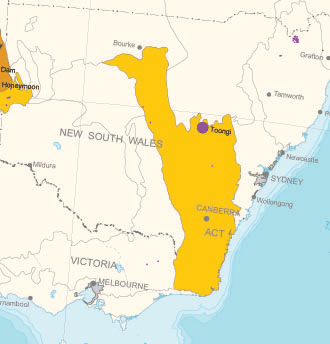 The waste from any uranium mining in NSW would remain dangerous long after the O’Farrell government is gone from Macquarie Street.
Rather than promoting the unsafe uranium sector the government should building an energy future that is renewable, not radioactive
(Map: yellow shows area where uranium exploration could occur)
Nuke South Wales? http://www.onlineopinion.com. au/view.asp?article=14007 By Natalie Wasley and Pepe Clarke -, 20 August 2012 Earlier this year, in a sharp break with a long standing and bi-partisan ban, the NSW Government announced it would allow uranium exploration across the state. This abrupt reversal of a 26-year prohibition came without warning or consultation and against the backdrop of the global nuclear industry reeling from the continuing
Fukushima disaster.
At the time, Premier O’Farrell cited the narrowly won ALP national conference vote allowing uranium sales to India as rationale for the policy change, but outside of cabinet responses ranged from wariness to outright hostility.
The decision to allow uranium exploration was – and is – fiercely opposed by NSW Labor and the Greens. Speaking against the move in both state parliament and a recent public meeting, Shadow Environment Minister Luke Foley captured the strength of this resistance: “As long as I am in public life I will argue against this dangerous industry
Civil society and community groups are increasing both the light and the heat on the Premier’s atomic ambitions including through this week’s launch of a NSW Uranium Free Charter in Sydney. The Charter highlights the dangers of the nuclear industry,calls on government to rule out uranium mining in New South Wales and has already gathered strong support state and national trade unions, environment groups, public health and student organisations. (see attached and
www.nccnsw.org.au/uranium ).
The Charter signals the start of a new campaign to keep NSW free from uranium mining and promises to increasingly locate this controversial mineral on the state political radar . Continue reading
BHP will have a hard time depicting anti uranium protestors as useless bludgers
many of the group.. had taken leave without pay to travel to Roxby Downs to spread their message.
“There are other alternatives (to uranium for power) and I think an event like this can bring that more into discussion.”

We’re no bludgers, say mine protesters, Ben Hyde, The Advertiser July 20, 2012 THEY came from interstate and even overseas to protest against uranium mining, and some could be camped on the doorstep of BHP Billiton’s Olympic Dam mine for another two weeks. The group of Lizard’s Revenge protesters, which peaked at about 400 activists last weekend, were an eclectic bunch, united in their anti-nuclear stance. Continue reading
Protest continues at Olympic Dam uranium mine: 5 more arrests
 Protests flare again at Olympic Dam news.com.au 19 July 12, FIVE people have been arrested after renewed protest action at the Olympic Dam uranium and copper mine in South Australia’s north.
The arrests on Thursday brought to 18 the number of people taken into police custody since about 350 anti-nuclear activists converged on the area on Saturday.
The official protest was scheduled to conclude on Wednesday but up to 100 people remained in the area. Police said about 40 people blocked Olympic Way, just south of the declared protected area, on Thursday morning. They pushed a car onto the road, let down its tyres and locked the steering.
The action forced a truck to stop on the road and two men then chained themselves to the underside. They were arrested and charged with illegal interference. Three other people were charged with refusing to follow police direction.
Closing of the Lizard’s Revenge Festival at Olympic Dam, but the anti uranium struggle will go on
 A RETURN TO THE GATES OF HELL? 19th July 2012 Yesterday was the last official day of the Lizards Revenge Music and Arts Festival of Resistance at the Olympic Dam Uranium mine, where over 500 protestors have gathered for the past week.
Dr Helen Caldicott visited the Lizards Revenge to run a workshop addressing health issues relating to uranium yesterday afternoon. She pointed out that there has never been an epidemiological study undertaken in Australia to monitor the health effects of radiation exposure on mine workers and that 50% of uranium mine workers die of cancer related illness.
Elder Kevin Buzzacott has extended an invitation to the festival participants to join him on Arabunna country to visit the mound springs in the Lake Eyre region, which have been impacted by the extraction of water from the Artesian Basin for the uranium mine. Water extraction will increase from an average of 35 million litres per day to 42 million litres per day if the expansion goes ahead. The mound springs are sacred to the Arabunna people and integral to the desert ecosystem.
Organisers are extremely happy with the event, with people coming from all states and territories and as far as Japan, Canada and Europe to participate.
“The week has seen a diverse range of peaceful and creative actions including a fashion parade at the Gates of Hell, a breakfast not bombs picnic on the road blocking access to the mine, and three minutes of silence to commemorate all the victims of the nuclear industry,” said Nectaria Calan.
“However, we are extremely disappointed by the tactics of police, which have included barricading us into our camp, constant surveillance and spotlighting by helicopter, motorbikes and patrol cars 24 hours a day. With close to a one on one ratio of protestors to police it is hard to understand how the state can justify this excessive deployment of resources. The deprivation of civil liberties that we have experienced in the last week is unprecedented at event like this in Australia.”
“The heavy handed tactics by police at Tuesdays cricket match, followed by the deliberate misinformation by the police regarding the days events, suggests that the police have sought to escalate the situation in order to justify the excessive deployment of resources for the event.”
Despite this, the ground swell of support Lizards Revenge is receiving is extremely encouraging; this is just the beginning.
The bipartisan political support this project enjoys in South Australia, despite widespread concerns regarding its local and international implications, highlights the failure of the political system to accommodate community concerns. This battle will not be fought in the parliament but in the desert. For further comment or photos please contact: Nectaria Calan 0432 388 665
1 This month

of the week – Australians for War Powers Reform (AWPR)
To see nuclear-related stories in greater depth and intensity
 Antinuclear