Yami Lester, victim of nuclear testing urges communities to fight nuclear waste dumping
SA Government ‘open’ to nuclear waste dump proposal despite previous opposition: Weatherill, ABC News, 13 Nov 15, “…… Greens MP Mark Parnell said he wanted to see more detail on the proposal, but was suspicious of the agenda from Canberra. He was concerned accepting a site in South Australia could lead to the storage of high level radioactive waste.
“It’s no surprise that the Federal Government has its eyes on South Australia for its nuclear waste dump,” Mr Parnell said. “But what will worry people in this state is whether this is a precursor to a high level radioactive waste dump.”…
 Indigenous man Yami Lester, from Mintabie in the APY Lands, said the state and federal governments should not mine uranium, let alone store it.
Mr Lester was blinded from a radiation fallout in 1953 when the British and Australian governments conducted uranium testing near his community, west of Coober Pedy.
“It was terrible. Some older people died, I went blind and my cousin went blind, skin rash, diarrhoea and all that sickness,” he said.
“We had no treatment at all, the hospital nearest the clinic was 160 kilometres [away] at Ernabella, and we were sitting here, no doctor nothing.
“That’s why I’m scared of the government mining uranium. Better to leave it under the ground. Don’t touch it.”
Mr Lester urged the communities close to the proposed waste sites to fight against the dumps.
He said the state and federal government should learn from past mistakes.
“I don’t agree with [experts] at all. The Australian Government and the South Australian Government, people haven’t learnt from the mistakes that happened overseas, in Germany, Japan they haven’t learned from that,” he said…..http://www.abc.net.au/news/2015-11-13/sa-govt-consider-nuclear-waste-proposal-royal-commission/6937530
Residents near Sally’s Flat, NSW, appalled at their area as potential radioactive trash site
 Locals frightened by ‘appalling’ prospect of living near nuclear waste dump http://www.abc.net.au/am/content/2015/s4351066.htm Michael Edwards reported this story on Friday, November 13, 2015
 Earlier this year landholders were invited to nominate land for the facility that will house almost all of Australia’s nuclear waste material. Sally’s Flat, north of Bathurst in central west New South Wales, is one of the areas that has been short-listed. Locals say they’re appalled at the prospect of living near a nuclear dump.
Michael Edwards reports.
MICHAEL EDWARDS: Twenty-eight landowners nominated their properties as a potential site for a nuclear waste dump. The Federal Government has whittled that list down to six potential areas – three in South Australia, one in the Northern Territory, one in Queensland and one in New South Wales.
Sally’s Flat, in the western New South Wales, is one of the places. It’s an area renowned for producing world-class wool.
LINO ALVAREZ: It’s a very fine place. There’s no industries here as such. Everybody works on the land.
MICHAEL EDWARDS: Lino Alvarez lives in Hill End, the nearest town to Sally’s Flat which is about ten kilometres away. The suggestion the area could be home to a nuclear waste dump scares him.
LINO ALVAREZ: It’s a disgusting proposition that in a lovely part of the world in which people come and enjoy from cities like Sydney, it will be a danger to everything. Continue reading
Malcolm Turnbull gets delivery of radioactive trash (fake) from Greenpeace
Greenpeace delivers fake nuclear waste to Malcolm Turnbull’s office, By Georgina Mitchell Celsius, 30 Oct 15, The environmental group turned up to Prime Minister Malcolm Turnbull’s electorate office in Sydney on Thursday equipped with a truck, white suits and six yellow barrels painted with radioactive symbols to deliver a message that nuclear waste is everyone’s problem.
On Wednesday, Mr Turnbull said Australia could plausibly mine uranium, sell it overseas for use in nuclear power stations, then take it back as waste.
This proposition was abhorrent to Greenpeace, who said the waste would impact Australia for “literally thousands of years”.
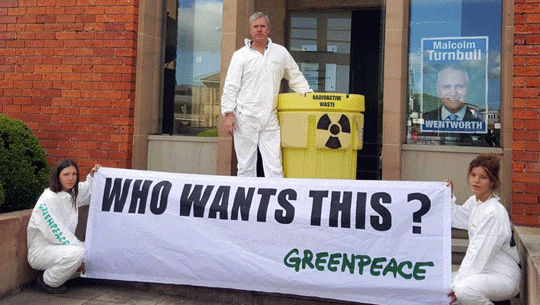
“The new Prime Minister has given some significant signals that his government is more interested in science and good policy than his predecessor, but the nuclear thought bubble is just plain wrong headed,” said Emma Gibson, Greenpeace Australia Pacific’s head of program.
“If the government really wants to boost the Australian economy, how about making us a world leader in solar power and the renewables industry?
“Mr Turnbull has indicated that he wants to lead a government focused on innovation, but nuclear power is heavy old tech. We need to move towards clean, modern solutions to our energy needs, like solar power and other renewables,” she said…..http://www.celsius.news/story/3456818/greenpeace-delivers-fake-nuclear-waste-to-malcolm-turnbulls-office/?cs=4695
Don’t let Western Australia be a radioactive quarry and waste dump
CCWA Campaign: Let’s keep WA nuclear free! Don’t let WA be a radioactive quarry and waste dump http://ccwa.org.au/campaigns/nuclearfreewa
(Check out the information provided here about uranium exploration in WA and the Kintyre, Wiluna, Mulga Rock and Yeelirrie uranium mine proposals – and radiation and health issues)
Nuclear Free WA , 23 Oct 15 WA has never had a commercial uranium mine; we’ve had state wide bans on uranium mining and federal restrictions on uranium mining and a long history of public opposition.
After the 2007 state election the newly elected State Liberal Government lifted a long standing ban on uranium in WA. This came shortly after the Australian Labor Party changed the three mine policy which has since the 1980s meant that there could only be three uranium mines operating in Australia. With these two decisions WA has become the target for many uranium miners.
There are now approximately 140 companies with uranium interests in WA, there are three proposed mines which are engaged in the State’s EPA approvals process followed closely by another two proposals which are advancing their exploration programs followed by about 80 + other uranium explorations.
Uranium mining in WA is not a done deal
No uranium mine has been approved in WA at a state level or a federal level and there is mounting concern in the communities about the dangers and implications of mining uranium. There are strong calls for a public inquiry into uranium mining from environment, social justice and public health groups, from traditional owners, unions and politicians.
WA has a strong history of opposition against the nuclear industry, we know it’s radioactive, we know that uranium and its by products can cause cancer, we know uranium mining and milling is water intensive and that we’re a dry state, we know that in Australia despite regulations and controls we have contaminated mine sites and weapons test sites that have never been cleaned up to a safe standard.
Nuclear and climate change
The nuclear industry and those who support it continue to talk about nuclear power being the solution to climate change, but we know there is carbon pollution associated with every stage of the nuclear fuel chain. We know that as ore grades decline mining and milling processes become more and more carbon intensive. Nuclear Power is polluting, radioactive, expensive and finite; it is unsafe, unwanted and un-necessary.
South Australian protest against expanding nuclear industry
Protesters warn of SA nuclear risks 9 News 11 Mar 15 Protesters have raised the spectre of the Fukushima nuclear disaster to warn against expanding the industry in South Australia.
The SA government has launched a royal commission to investigate whether the state should embrace nuclear enrichment, power production and the storage of waste.
Environmentalists have argued that the industry could generate catastrophic risks for the state.
Propping up a giant inflatable “nuclear waste” barrel, the protesters held signs reading “Aus Uranium Fuelling Fukushima” and “SA: Renewable not Radioactive”. http://www.9news.com.au/national/2015/03/11/13/05/protesters-warn-of-sa-nuclear-risks#5MFxGQZ8vrKyHfPv.99
South Australia’s proud history of the win against nuclear waste, a win led by Aboriginal women
One media narrative, as espoused in the AFR, is that this defeat was the result of a revolt by SA politicians. But this version of the story ignores the powerful campaign led by the Kupa Piti Kungka Tjuta, the senior aboriginal women’s council of Coober Pedy.
This story has been recorded by movement researchers Nina Brown and Sam Sowerwine and in a book, Talking Straight Out: Stories from the Irati Wanti Campaign.
Many members of the Kunga-Tjuta were survivors of the British government’s atomic testing in the 1950s and 60s, and so understood the devastating history of the nuclear industry. Upon hearing about the waste dump proposal, the group issued this statement:
We are the Aboriginal Women. Yankunytjatjara, Antikarinya and Kokatha. We know the country. The poison the Government is talking about will poison the land. We say, “No radioactive dump in our ngura – in our country. It’s strictly poison, we don’t want it.

The traditional residents of this supposedly “benign and sparsely populated geology” fought hard to protect their country using the tools they had available. They explained, demanded, marched and sang. They worked with green activists and wrote passionate letters. They urged politicians to “get your ears out of your pockets”. They won.
As South Australia faces another push from the nuclear industry, we would do well to remind ourselves of these stories. To paraphrase the late historian Howard Zinn, we need to emphasise what is possible by remembering those moments in our recent history when people demonstrated their capacity to resist, come together, and occasionally, to win.http://theconversation.com/south-australias-broad-brush-nuclear-review-is-meant-to-sideline-opponents-38110
Western Sydney residents again face threat of radioactive waste dump at Kemps Creek
 Controversial radioactive clean-up to go ahead,SMH January 18, 2015 Kirsty Needham State Politics Editor, The Sun-Herald A bitter fight over radioactive waste between Sydney’s western and northern suburbs is set to be reignited by the Baird Government on the eve of the state election.
The NSW government will push ahead this year with a $12.4 million clean-up of Hunters Hill land contaminated by a uranium smelter 100 years ago, a government report has revealed.
But the only site in Australia identified by a string of government studies as the best option to store the waste – Kemps Creek near Penrith – is in a marginal Liberal seat where sitting MP Tanya Davies campaigned against the dump while in opposition. Continue reading
12 months of Nuclear Free Action in Australia
December sees action in the Top End with spirited protests over uranium and fracking concerns outside the MCA’s NT mining conference and 4000 formal public submissions opposing the R3D plan, ICAN holds a successful set of gatherings on the humanitarian impacts of nuclear war in Vienna – including a presentation from Sue Coleman Haseldine and an open letter from ENGO’s to Julie Bishop, Energy Metals Australia move to seek approval to mine Mulga Rocks – but Mia Pepper is in the way, the long waited for Olkala land handover in Cape York see’s further constraints put on Areva’s plans to dig, PM Abbott flags uranium sales to Ukraine – from the land that fuelled Fukushima to the country that is home to Chernobyl, Barry Brook leads a call for nuclear power to be accepted by ENGO’s, Minister Macfarlane accepts that the push through approach to dump siting has failed and announces modest public input into a new model.
 Nuclear Free snapshot 2014 Dave Sweeney, Australian Consevation Foundation, 31 Dec 14 January started with Top End storms washing out a section of the Ghan rail line and further highlighting transport risks with hazardous materials, concerns over the spectacular December 2013 uranium slurry spill at Ranger mine remained high and around 4000 people gathered in Redfern for the opening of John Pilger’s film Utopia
In February the Muckaty Federal Court case had detailed directions hearing in Melbourne, a delegation of MP’s from Greenland heard directly about the impacts of uranium mining on country and culture when they were briefed by ACF, FoE and Gundjeihmi while on a fact finding mission, mid-month saw activists from WA and beyond meet in Perth for an effective planning session aimed at keeping the West uranium free, the CCWA led a series of workshops to facilitate public engagement with the Kintyre mine approvals process and also drove a detailed response from national groups while Scott Ludlum took time off from electioneering to join a nuke free session at Melbourne’s Sustainable Living festival, Paladin put the Kayelekera mine in Malawi on care and maintenance, Uranium Free NSW activists lodged formal objections to the Dubbo Zirconia project and after making the Black Mist publication pozible and reminding Peter Costello and the Future Fund that there is no future in nuclear weapons ICAN reps took the nuclear weapons abolition message further with a successful conference in Nayarit (Mexico)
March saw the annual national nuke free strategy and planning gathering with crew from around the country Continue reading
Australia well represented at Vienna Conference on the Humanitarian Impact of Nuclear Weapons, (though not by government)
 Gem Romuld ,Outreach Coordinator International Campaign to Abolish Nuclear Weapons- Australia www.icanw.org.au gem@icanw.org 10 Dec 14 The Vienna Conference on the Humanitarian Impact of Nuclear Weapons concluded last night. It went for two days after ICAN’s Civil Society Forum.
Dubbo residents meet to oppose uranium mining
 Residents gather to oppose threat of uranium mining The Daily Liberal By MARK RAYNER Oct. 25, 2014 A strong crowd has turned out to voice their opposition to the Alkane Zirconia Mine, arguing the minerals it will extract pose a risk to the Dubbo community. About 70 people attended the meeting, entitled Alkane Rare Earth Mine: Radioactive Risk?, which was run by Uranium Free NSW.
They heard from the Central West Environmental Council’s Bev Smiles and Dr Gavin Mudd, who gave their opinions on rare earth and uranium mining. They are lobbying for a rejection of the Alkane proposal by the Planning and Assessment Commission on the basis uranium and thorium will be extracted. A decision is expected in November.
David Mould from Uranium Free Dubbo questioned the value of the project to the whole city.
“So far Alkane’s plans have not taken the health of Dubbo residents into account building a radioactive project without adequate consideration of engineering risks upstream of Dubbo’s drinking water supply.” Mr Mould said.
“Five out of 11 councillors stand to make money out of this project and the expansion of mining in Dubbo. How can Dubbo and Central West residents feel secure that their government cares for people over profit?”
Ms Smiles said with one of the largest deposits of uranium in NSW thought to exist in Toongi, the decision by the current state government to overturn a moratorium on uranium mining could be a negative thing for the region.
“The people of the Central West are concerned that this area has been targeted by the NSW government to open up uranium mining in NSW,” she said……..
The Planning Assessment Commission review for the Alkane Zirconia Project is November 4. Written submissions and applications to speak at the review close 1pm Wednesday October 29. Email pac@pac.nsw.gov.au or phone (02) 9383 2112.
Sad news for the nuclear free movement. Vale Mrs Wingfield.
Suzanne Haseldine wunyie@gmail.com 22 Aug 14, After an amazing life fighting for country and culture Kokatha Elder Mrs Wingfield passed away at her home in Port Augusta on August 8,2014.
Mrs Wingfield experienced first hand the impacts of the nuclear testing in the South Australian desert. She dedicated her life to protecting her desert country and future generations from the effects of the nuclear industry. At Cane Grass Swamp in the early 1980s she lay in front of bulldozers to try and stop the construction of the Olympic Dam uranium mine. Her tireless work continued in the 1990s with the Kupa Piti Kungka Tjuta, a senior women’s council based in Coober Pedy who led and won a successful campaign against the federal government’s plan for a nuclear waste dump in SA.
Mrs Wingfield worked with people and groups of many backgrounds, she traveled extensively to attend forums and events and lobby politicians. In 2009 she was made honorary president of the Australian Nuclear Free Alliance in recognition of her significant involvement. Mrs Wingfield will be widely remembered and acknowledged for her contribution to the nuclear free and peace movements in Australia and worldwide. Her resilience, passion and dedication remains an inspiration to everyone that met her.
May she Rest in Peace.
Funeral details: Friday August 29, 2014. 11am at the Lutheran Church, cnr of Dartmouth and Fern St, Port Augusta. The family have asked that everyone feel welcome to attend.
You can send a message to Mrs Wingfield family: 2 Cain Street, Port Augusta SA 5700.
Memories or photos to be passed on to the family when appropriate, can be emailed to: wunyie@gmail.com
Financial contributions towards Mrs Wingfield’s wake would also be greatly appreciated by her family and friends. Donate to:
Janice Wingfield Commonwealth Bank SAV BSB: 065507 AC: 10213429
Radioactive Tour brings anti nuclear discussion to Olympic Dam, Alice Springs and Tenant Creek
 Uranium deal with India a hot topic – 23-Apr-2014 http://www.themonitor.com.au/news-articles/140423-uranium-deal-with-india-a-hot-topicThe Australian Government’s signing of a uranium export deal with India was a hot topic of discussion at the recent Olympic Dam visit by members of environmental group Friends of the Earth.
The annual radioactive tour has been operating since the 1980s, and has taken thousands of people to the heart of the industry at destinations from Melbourne to Tenant Creek.
Local BHP Billiton employees from various sectors of the Olympic Dam operation, including environmental, radiation, community and external affairs took time to show the group through the operation on Tuesday, April 16.
The tour was followed by an informal question time in Richardson Place, where members of the group particularly focused on the company’s commitment to indigenous traditional land owners and the Federal Government’s stance on direct supply or uranium to India.
A BHP Billiton spokesperson told the group the company was working closely with the traditional land owners, including through employment programs and through financial dispensation into a trust.
He said the amount of money awarded to the trust was ‘confidential’, but ‘substantial’.
The group asked many questions regarding the company’s ethical stance on supply of Olympic Dam Uranium to countries which could be using the product to fuel their nuclear armament programs.
The topic was particularly sensitive for one Indian representative , who said his country’s unstable government, lack of regulation, extremist religious groups and dense population were recipes for disaster.
The representative said India’s suspected nuclear armament activities were of major concern to humanity across the globe, and that companies like BHP Billiton should have an moral and ethical commitment to ensure their uranium did not reach the hands to those planning to build nuclear weapons.
Currently, BHP Billiton and other Australian uranium miners have legislative and regulatory obligations that cover mining, processing and the transport of uranium on road and by sea.
The onus of responsibility for the product then passes to the Government at the port of destination.
The group continued on to Alice Springs and Tenant Creek on Tuesday afternoon as part of the 14 day tour, and will return to Melbourne on Sunday, April 27.
Call for no uranium exported through Queensland port: Protect Barrier Reef!
 Anti-nuclear campaigner seeks port uranium assurances http://www.abc.net.au/news/2013-12-05/anti-nuclear-campaigner-seeks-abbot-point-uranium/5137248 An anti-nuclear campaigner is calling on the Queensland Government to rule out that uranium will be exported through the Port of Mackay.
Last year, the Newman Government reversed a long-standing ban on uranium mining in Queensland.
The port’s operator, North Queensland Bulk Ports (NQBP), said it could be used to transport associated mining equipment.
Mark Bailey from Keep Queensland Nuclear Free says he has serious concerns about the possibility of the resource being shipped through the reef.”I don’t think any of us want uranium on the Great Barrier Reef and we certainly don’t want our tourism industry affected by an incident like a grounding on the reef in bad weather with a uranium ship,” he said.
“This has happened before, you know Cameco had a ship that hit bad weather in the Pacific. If that happens on the reef, the publicity will be very bad.”
He says he wants assurances Abbot Point will not be used.
A spokesman for NQBP says there are no plans to export the commodity through the Port of Mackay at this stage.
Arabunna elder highlights the costs of BHP’s uranium trade at annual meeting
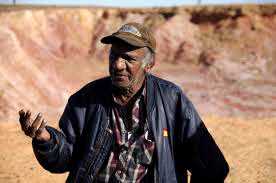 21 Nov 13, Mr Kevin Buzzacott, the President of the Australian Nuclear Free Alliance and a respected Arabunna elder will today take his concerns over the proposed expansion of the Olympic Dam uranium mine in South Australia to BHP Billiton’s annual meeting in Perth. Mr Buzzacott has been vocal in opposing the Olympic Dam uranium mine and the planned expansion. Mr Buzzacott unsuccessfully tried to halt the expansion through the courts and has now been ordered to pay court costs to the Government and to BHPB. At today’s meeting he will be asking whether BHP, the world’s largest miner, will be seeking to follow this cost order.
“I’m an Arabunna elder and I’ve spent the last thirty years trying to protect my country and the water from my country from this monster mine,” said Mr Buzzacott. “Now I’ve come all the way from South Australia because this is so important for me, I’m getting old and this could be my last chance to get BHPB to quit to shut Olympic Dam down and leave the desert and us in peace.”
“All my life I’ve stood up for my country because that is the right thing, that’s what we’re taught to do. Now BHPB have a choice whether they’re going to penalise me, take me for the court costs, for standing up for my country – or whether they’re going to respect my rights to protect those sacred places.”
The planned massive expansion of Olympic Dam has been shelved because of low uranium prices and market uncertainty. The current Olympic Dam mine consumes over thirty five million litres of water day from the Great Artesian Basin from Arabunna country and any future expansion would increase pressure on water resources.
“Now you say the expansion is on hold well we have a right to know whether you’re going to try and get this expansion happening or not. I mean it doesn’t make sense to dig deeper when people are waking up and saying no to the nuclear industry around the world.”
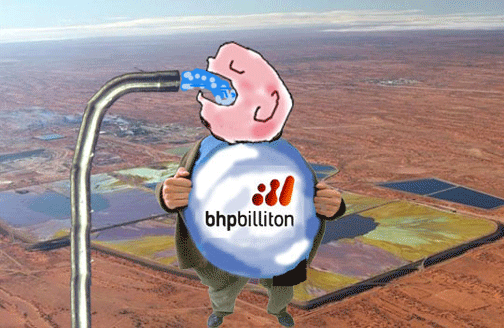
“Our land is our life and we will follow BHP Billiton to the ends of the earth to stop this mine from damaging our country and draining our water,” concluded Mr Buzzacott.
National pressure growing in Australia against Muckaty radioactive waste plan
 Dump under the pump: Pressure grows against Muckaty radioactive waste plan. Territory trade unions, medicos and environmentalists have been joined by their national counterparts in a call to end a planned radioactive waste dump in the NT.
 The groups have placed an advertisement (attached) in the Tennant and District Times today to highlight their concerns over federal plans to dump radioactive waste on Aboriginal land at Muckaty, north of Tennant Creek and their commitment to continuing campaigning on the dump plan after this Saturday’s federal election.
1 This month
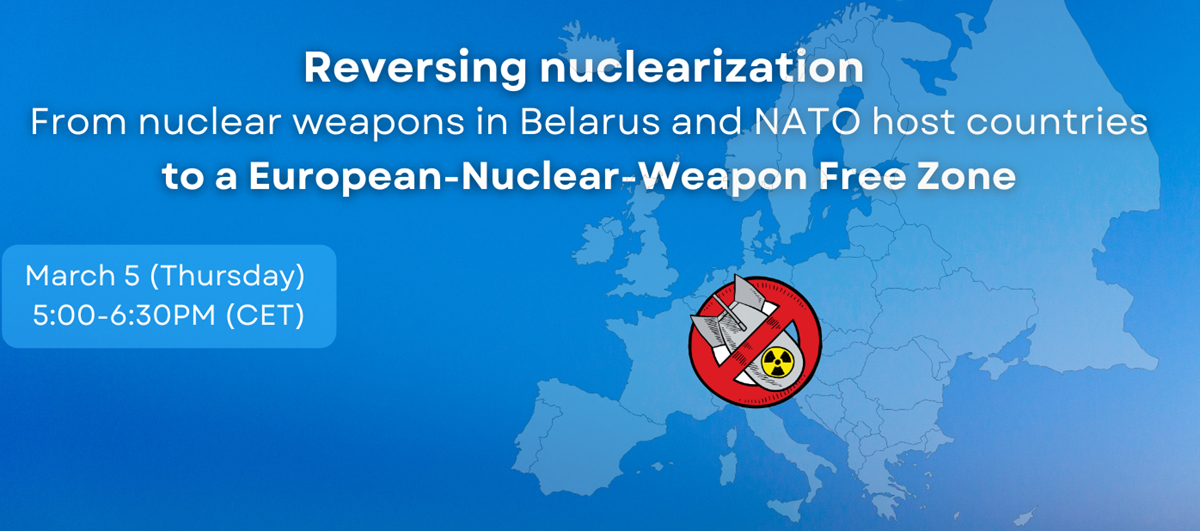
6 March -Online – Reversing nuclearization:
From nuclear weapons in Belarus and NATO host countries to a European-Nuclear-Weapon Free Zone
Mar 6, 2026 03:00 AM in Canberra, Melbourne, Sydney

of the week – Australians for War Powers Reform (AWPR)
To see nuclear-related stories in greater depth and intensity
 Antinuclear