Ukrainian drone attack on Moscow is ‘international terrorism’ – Russia’s Foreign Ministry
RT.com 24 July 23
Two UAVs crashed into buildings in the Russian capital, with fragments reportedly found not far from the Defense Ministry
The attempted Ukrainian drone attack on Moscow early Monday morning, which damaged several non-residential buildings, is “an act of international terrorism,” Russian Foreign Ministry spokeswoman Maria Zakharova has said.
The spokeswoman condemned the attack on Monday morning while speaking to RTVI TV. Earlier, the Russian Defense Ministry said Ukraine attempted to stage “a terrorist attack” against Moscow using two drones, which were suppressed by electronic warfare systems……………
Kiev applauded the raid, with Mikhail Fedorov, Ukraine’s minister for digital transformation, promising that “there will be more” of these incidents.
Amid the conflict with Russia, Kiev has previously tried to launch drone raids on Moscow and its suburbs. Earlier this month, the Russian Defense Ministry said that air defenses downed four drones in the southeastern districts of the capital, and another UAV was neutralized by electronic warfare systems west of Moscow…………………………… more https://www.rt.com/russia/580185-ukrainian-drone-attack-moscow-international-terrorism/—
Congressional Concerns: Stalling Nuclear Submarines for Australia

Australian Independent Media July 23, 2023, Dr Binoy Kampmark
Any security arrangement with too many variables and multiple contingencies, risks stuttering and keeling over. Critical delays might be suffered, attributable to a number of factors beyond the parties concerned. Disputes and disagreements may surface. Such an arrangement is AUKUS, where the number of cooks risk spoiling any meal they promise to cook.
The main dish here comprises the nuclear-powered submarines that are meant to make their way to Australian shores, both in terms of purchase and construction. It marks what the US, UK and Australia describe as the first pillar of the agreement. Ostensibly, they are intended for the island continent’s self-defence, declared as wholesomely and even desperately necessary in these dangerous times. Factually, they are intended as expensive toys for willing vassals, possibly operated by Australian personnel, at the beckon call of US naval and military forces, monitoring Chinese forces and any mischief they might cause.
While the agreement envisages the creation of specific AUKUS submarines using a British design, supplemented by US technology and Australian logistics, up to three Virginia Class (SSN-774) submarines are intended as an initial transfer. The decision to do so, however, ultimately resides in Congress. As delighted and willing as President Joe Biden might well be to part with such hulks, representatives in Washington are not all in accord.
Signs that not all lawmakers were keen on the arrangement were already being expressed in December 2022. In a letter to Biden authored by Democratic Senator Jack Reed and outgoing Republican Senator James Inhofe, concerns were expressed “about the state of the US submarine industrial base as well as its ability to support the desired AUKUS SSN [nuclear sub] end state.” Current conditions, the senators went on to describe, required “a sober assessment of the facts to avoid stressing the US submarine industrial base to the breaking point.”
On May 22, a Congressional Research Service report outlined some of the issues facing US politicians regarding the procurement of the Virginia (SSN-774) submarine for the Australian Navy……………………………
The report has proven prescient enough. Republicans on the Senate Armed Services Committee have realised that stalling aspects of AUKUS might prove useful, if it entails increasing military spending beyond levels set by the current debt-limit deal………………………………………
Then came another problem: almost 40% of the US attack submarines would be incapable of deployment due to maintenance delays………………………….
The terms, for Wicker, are stark. “To keep the commitment under AUKUS, and not reduce our own fleet, the US would have to produce between 2.3 and 2.5 attack submarines a year.”…………………………………………..
Such manoeuvring has caught the Democrats off guard……………………………………………..
As US lawmakers wrestle over funds and the need to increase submarine production, the Australian side of the bargain looks flimsy, weak, and dispensable. With cap waiting to be filled, Canberra’s undistinguished begging is qualified by what, exactly, will be provided. What the US president promises, Congress taketh. Wise heads might see this as a chance to disentangle, extricate, and cancel an agreement monumentally absurd, costly and filled with folly. It might even go some way to preserve peace rather than stimulate Indo-Pacific militarism. https://theaimn.com/congressional-concerns-stalling-nuclear-submarines-for-australia/
Dutton’s Nuclear Folly: Small Modular Reactors a political mirage

by Rex Patrick | Jul 23, 2023 https://michaelwest.com.au/duttons-nuclear-folly-small-modular-reactors-a-political-mirage/
As Peter Dutton talks up nuclear power, it is not surprising to see Andrew Liveris shifting his pitch from a ‘gas led recovery’ to a call for Small Modular Reactors (SMRs) to be considered for the 2032 Brisbane Olympics. Dutton is engaged in politics, Liveris in fantasy. Rex Patrick reports on the nuclear distraction.
What’s a Small Modular Reactor?
Small modular reactors (SMRs) are nuclear powered reactors with an electrical power output of less than 300 megawatts (MW).
There’s potential for these reactors to be mass produced and deployed at significantly lower costs to traditional nuclear reactors to replace coal and gas fired power plants with low carbon, base-load, synchronous power generation.
But for a sunburnt country with an abundance of space, they will never compete with solar and wind, supplemented by base-load technologies such as batteries, hydro, pumped-hydro and molten salt.
A Liveris’ Fantasy
Liveris’s 2032 suggestion was beyond belief.
Russia has packaged two low powered nuclear ice breaker reactors in a floating barge to claim a first SMR. China has a demonstration SMR in Shidaowan. Apart from that, they don’t exist.
The US is aiming to have its first SMR generating power in 2029. Its proponent, NuScale Power, has assigned a memorandum of understanding with Polish mining firm, KGHM, to deploy a plant to support its copper and silver production in Poland.
While there are over 70 SMR designs being developed across 18 countries, few are even close to being commercially mass produced.
Australia has had some involvement in SMRs through ANSTO, the operator of the Australia’s only 20 MW nuclear reactor used for nuclear medicine, research, scientific and industrial purposes.
Since late 2020 ANSTO has been participating in a three year International Atomic Energy Agency’s co-ordinated research project on the economic appraisal of SMRs. It has assembled a team of its own and other Australian experts to analyse the economics of the technology.
They have also supported a University of Queensland PhD candidate to model the deployment of SMRs across the Australian National Energy Market. The student is due to conclude his PhD work in a few month’s time.
Eight days after Minister Chris Bowen was sworn in he sought an ANSTO briefing on SMRs.
The Politics of Dutton
While ANSTO has been at work, CSIRO has also been working with the Australian Energy Market Operator to work out the Levelised Cost Of Electricity (LCOE) for each technology.
For 2030, wind and solar are sitting on or around $50/MWh while SMRs are somewhere between $150 and $300/MWh
For 2050, wind and solar are sitting on or below $50/MWh while SMRs are somewhere between $125 and $150/MWh.
Peter Dutton is not one to let facts get in the way of a political position.
Turnbull foiled, Teals fuelled
Across 2017 and 2018 Prime Minister Malcolm Turnbull was working up a National Energy Guarantee (NEG) policy to deliver energy to Australia which balanced out cost, reliability and emissions cleanliness. It was policy designed by engineers and economists.
Dutton moved to exploit deep seated division in the Liberal National Party (LNP).
He wasn’t interested in climate change. He wasn’t interested in good policy. He was interested in himself. He used NEG to challenge Turnbull’s leadership and, while he failed, he managed to kill off the policy. A second challenge saw Scott Morrison sworn is as Prime Minister and the NEG abandoned.
Dutton was the person responsible for a moment in time that created opportunity for the Teals, who went on to displace a number of LNP members in the 2022 election.
A lack of vision
Dutton promoting nuclear will appeal to the LNP base. To the informed, he won’t appeal to those concerned about cost of living and, yet again, he’s certainly not offering leadership and vision.
Yes, there is a case for a mix of wind, solar and nuclear (in place of gas and coal), but it is not a case that’s filled with vision. A better future for Australia is one that seeks to capitalise on abundant space and renewables; a mix of wind, solar, batteries, hydro, pumped-hydro, batteries, molten-salt and other technologies.
That’s what Malcolm Turnbull was trying to do with NEG and Snowy Hydro 2.0. Sadly, Snowy Hydro 2.0 is a project that’s turning out to be a good idea poorly executed.
Originally envisaged to cost $2b, new estimates have its final costs sitting at $10b. A value for money re-assessment must occur, with one alternate pumped-hydro solution being Tasmanian with a second cable being funded to clean electrons across the Bass Strait?
Fusion power
Solutions are available as we wait for fusion energy to arrive.
Fusion received international attention in late 2022 when a US based group made more energy that was put into a fusion reaction, showing proof of concept.
It’ a long way off, a source that won’t be fielded until beyond 2050, but something we should be aiming for.
Wasted opportunity
We don’t pass our planet on to our children and grandchildren; it’s actually on loan from them. It should be treated accordingly.
We should cast our mind forward to 2070, when the world has fully embraced base-load renewables and fusion.
A young man named Dutton will be asking himself ‘what exactly was my great-grandfather thinking”, as he grapples with the still controversial and unsolved problem of dealing with high level nuclear waste from AUKUS submarines and a foray into SMRs.
The answer to the young man’s question will be, “folly”.
Nevil Shute’s ‘On the Beach’ warned us of nuclear annihilation. It’s still a hot-button issue with a new play at the Sydney Theatre Company

ABC News The Conversation / By Alexander Howard, 23 Jul 23
“……………………………….. the nuclear threat is still very much at the top of our collective mind.
The Sydney Theatre Company is staging the very first stage adaptation of Shute’s novel “On the Beach”. And Oppenheimer, one of 2023’s two most-hyped films, tells the story of the man referred to as “the father of the atomic bomb”.
‘Australia’s most important novel’
Journalist Gideon Haigh calls On the Beach “arguably Australia’s most important novel — important in the sense of confronting a mass international audience with the defining issue of the age”.
British-born Shute emigrated in 1950 to Australia, where he lived outside Melbourne. As well as writing novels, he worked as an aeronautical engineer.
The title of On the Beach — which started life as a four-part story called The Last Days on Earth — ostensibly referred to a Royal Navy expression for reassignment. (Shute spent time in the Royal Naval Reserve during World War II.) However, as readers of Eliot’s poetry will know, the phrase also appears late in The Hollow Men:
In this last of meeting places
We grope together
And avoid speech
Gathered on this beach of the tumid river.
As in Eliot’s poem, the characters that cluster together in the pages of Shute’s novel, set in and around Melbourne between 1962 and 1963, tend on occasion to avoid speech…………………………
The reason why the guests at Peter’s party are so keen to avoid serious talk is both simple and depressing. They are trying very hard to forget that they are all going to be dead from radiation poisoning in a matter of months.
Shute brings the reader up to speed after the dinner party wraps up. A massive nuclear war has devastated the entire northern hemisphere, wiping out all forms of life there. And the radioactive fallout generated during the conflict is now creeping — slowly but surely — into the southern hemisphere.
Shute makes it clear there is absolutely nothing anyone can do about this. In tonally dispassionate prose, he reveals that vast swathes of Australia have already been rendered uninhabitable due to radiation poisoning. The only thing the characters who remain can do is wait.
…………………………………………………………………………… This is the way Shute’s novel of nuclear extinction ends: not with a bang but with a whimper. Released at the height of the Cold War, On the Beach struck a chord with millions of concerned readers.
………………………………………………………………………Shute’s didactic inclinations are evident towards the end of the novel. “Peter,” the character Mary asks, “why did this all this happen to us?” Even at this late stage, Mary, whose radiation-racked body is spasming uncontrollably, wants to know whether things might have panned out differently. Her husband’s reply is revealing:
“I don’t know … Some kinds of silliness you just can’t stop,” he said. “I mean, if a couple of hundred million people all decide that their national honour requires them to drop cobalt bombs upon their neighbour, well, there’s not much that you or I can do about it. The only possible hope would have been to educate them out of their silliness.”
………………………..While the science in the novel was somewhat flawed, Shute’s cautionary tale undoubtedly spoke to the collective zeitgeist.
………………………………………………..
Shute’s vision of humanity’s self-inflicted destruction is eerily resonant in our time of climate emergency. The nuclear threat remains, too, in our perilous historical moment of democratic backsliding and failing nuclear states.
It seems increasingly likely the world as we know it is coming to an end — if it hasn’t already. The question remains: will it be with a bang or a whimper?
On The Beach runs at the Sydney Theatre Company July 24 to August 12, 2023, with previews July 18–21. https://www.abc.net.au/news/2023-07-23/nevil-shute-on-the-beach-nuclear-annihilation-hot-button-issue/102621052
AUKUS’ nuclear waste dump is the secret no-one talks about. So what’ll it cost?
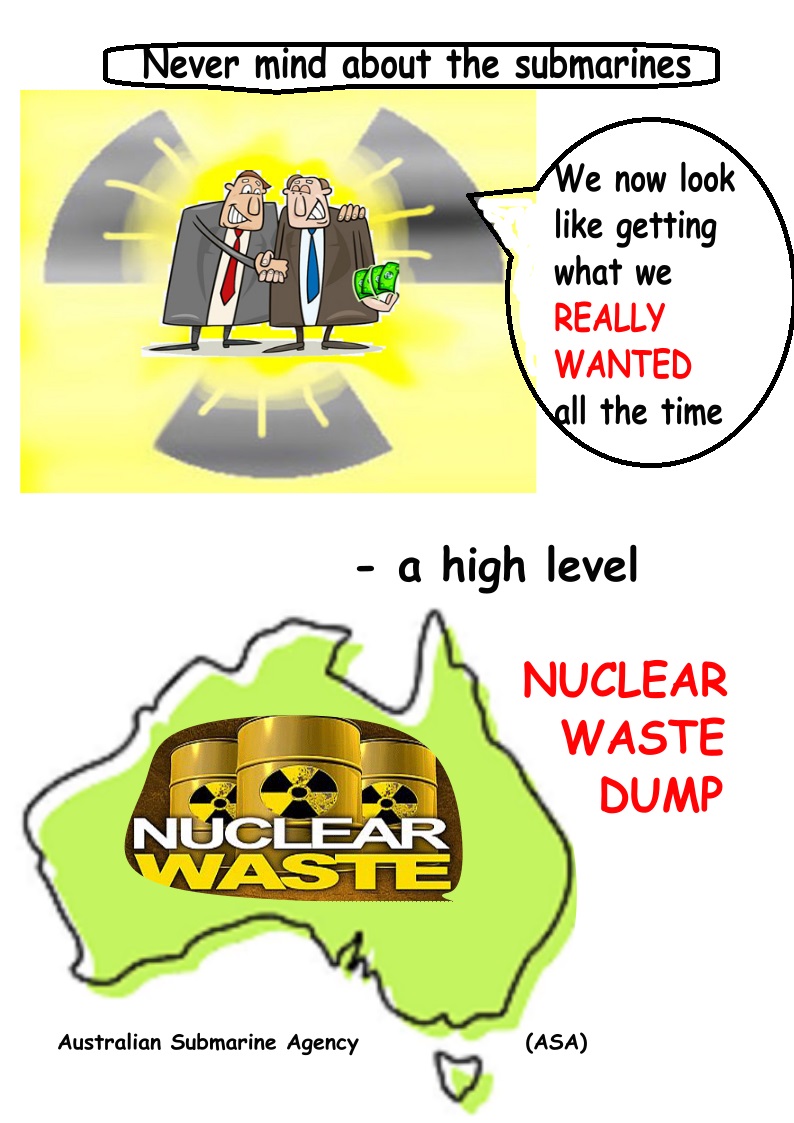
The $360 billion cost of AUKUS might be startling, but on top of that is another undiscussed figure: the cost of building storage for nuclear waste.
Crikey, DAVID HARDAKER, JUL 24, 2023
In late 2021, it came as a shock when Australia woke up to find that its government, under then-prime minister Scott Morrison, had secretly agreed to join the nuclear submarine club with old friends, the US and the UK.
The secret within that secret was that Australia would be responsible for the radioactive waste generated by its involvement in the AUKUS program. For the first time, Australia had signed up to construct a storage facility for high-grade nuclear waste, robust enough to last 1000 years.
Australia had never done it. Nor the US. Nor the UK. Was the iron-clad commitment to building a waste dump part of the deal struck by Morrison when he announced the AUKUS partnership? If so, he didn’t mention it at the time. Nor was it mentioned by US President Joe Biden, UK Prime Minister Rishi Sunak or Australian Prime Minister Anthony Albanese at the official AUKUS announcement in San Diego in March…………. (subscribers only) more https://www.crikey.com.au/2023/07/24/aukus-nuclear-waste-dump-cost-australia/
Black Mist Memories
Aboriginal and veteran delegates tell Australian parliament the horrors of nuclear testing
By Gem Romuld, International Campaign to Abolish Nuclear Weapons, Australia
In mid-June, four special people who know intimately the personal impacts of nuclear weapons testing, on physical health, mental health, and on the land, travelled to Parliament House in Canberra, Australia’s capital city.
The four were:
Karina Lester: Yankunytjatjara Anangu woman, senior Aboriginal language worker, ICAN Ambassador. Karina’s late father was blinded by the Totem 1 nuclear test at Emu Field.
June Lennon: Yankunytjatjara, Antikarinya and Pitjantjatjara woman who survived the Totem 1 nuclear test as a baby. Her mother, Lallie, and brother Bruce, were recipients of compensation due to their ill-health, caused by radioactive contamination.
Douglas Brooks: was stationed at Monte Bello Islands as a serving member of the Royal Australian Navy in 1956. He was aboard HMS Alert when a 98 kiloton nuclear bomb was detonated just ten miles away, exposing him and the rest of the crew to the full blast of the explosion.
Maxine Goodwin: is the daughter of an Australian nuclear veteran, who became ill as a result of his involvement in the first atomic test in Western Australia. He passed away at 49, leading Maxine to a lifelong search for the truth on how the tests have affected veterans and their families.
The delegates brought their expertise and personal testimonies to speak with parliamentarians about recognition, respect, and repair, and to urge Australia to sign and ratify the Treaty on the Prohibition of Nuclear Weapons……………………………………
They spoke about the shock of witnessing a nuclear test, the post-traumatic stress disorder that followed, the oily black mist that coated and poisoned the land, the wide range of mental and physical health impacts, the loss of loved ones far too early, the lack of recognition of suffering, the lack of accountability, the impact of government lies and obfuscation.
They argued that Australia must join the ban to prevent such humanitarian harm from happening again, and also to fulfill its obligations under Articles 6 & 7 to provide assistance to victims and remediate impacted environments. It’s about the past, the present and the future.
………………………………………………………………….. Josh Wilson MP and Senator Jordon Steele-John both delivered powerful speeches in Parliament, respectively available here and here.
………………………………………Further detail on the delegates’ meetings and media attention is in this blog post. https://beyondnuclearinternational.org/2023/07/23/black-mist-memories/
US Republicans threaten to block AUKUS deal

By Anthony Galloway, The Age, July 21, 2023
Australia’s AUKUS submarine deal with the United States has hit a hurdle with Senate Republicans threatening to block the sale unless President Joe Biden boosts funding for the domestic production line.
Republican members of the Senate Armed Services Committee on Friday moved to block legislation which would enable the sale of US Virginia-class submarines to Australia.
Under the AUKUS deal, Washington was set to sell Canberra between three and five of its own nuclear submarines in the 2030s before Australia begins building a new class of boat with Britain.
But the ranking Republican on the Senate Armed Services Committee, senator Roger Wicker, said Biden needed to commit more money to guarantee “we have enough submarines for our own security before we endorse that pillar of the agreement”.
Wicker said Australia’s commitment of US$3 billion ($4.4 billion) for the US production line would not be enough to meet the needs of both countries.
“The president needs to submit a supplemental request to give us an adequate number of submarines,” he told US news outlet Politico…………………………………………………….. https://www.theage.com.au/politics/federal/foolish-us-republicans-threaten-to-block-aukus-deal-20230721-p5dqc3.html
UK campaigners call on Australian PM to withdraw Kimba nuke dump threat.

UK campaign groups opposed to nuclear waste dumps were ‘delighted’ to hear that their counterparts in Australia, the Barngarla Determination Aboriginal Corporation, have just won their court case against the imposition of a similar dump on their Traditional Lands.
In a historic judgement given earlier this week (18 July), Her Honour Justice Charlesworth in the Federal Court of Australia handed down a decision to quash Federal Government plans to move nuclear waste from the reactor at Lucas Heights to an unwanted waste dump at Napandee near Kimba in South Australia. Justice Charlesworth charged government officials with ‘pre-judgement’ and ‘apprehended bias’.
In March, the UK/Ireland Nuclear Free Local Authorities joined Radiation Free Lakeland, Millom against the Nuclear Dump / South Copeland against GDF, and Guardians of the East Coast, which are local groups fighting plans to locate a so-called Geological Disposal Facility in either West Cumbria or East Lincolnshire, wrote a joint letter to the Australian Government to raise their international objections to the plan.
Our objections were that there was no need for such a dump as the facility at Lucas Heights has capacity to take the waste and that the rights to the land by the Traditional Owners were being wilfully and shamefully disregarded, contrary to international law, with the government giving no proper consideration to the position of the Barngarla.
The attempt to impose a nuclear waste dump is all par for the course in Australia with the ill-treatment of Indigenous Peoples by corporations, political elites and the military over nuclear matters having an established history, with First Nation territories ravaged by uranium mining or shattered by British atomic weapon testing.
Following the damning judgement, the four British organisations have today written to the Prime Minister of Australia Anthony Albanese asking him to ‘take the honourable and courageous course of action’, withdraw the plan and ‘leave the Barngarla in peace’.
A copy of the letter and a message of solidarity will be sent to the Barngarla Determination Aboriginal Corporation. more https://www.nuclearpolicy.info/news/uk-campaigners-call-on-australian-pm-to-withdraw-kimba-nuke-dump-threat/
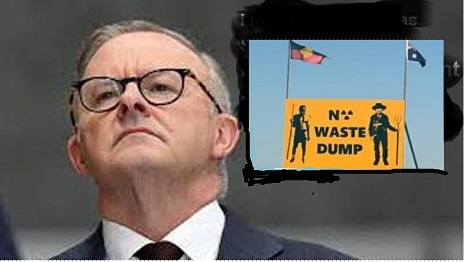
Prime Minister Albanese must abandon South Australian nuclear waste dump
Friends of the Earth Australia ‒ 18 July 2023
The Federal Court has today quashed the declaration of a proposed nuclear waste dump site near Kimba in SA, citing ‘pre-judgement’ and ‘apprehended bias’. The court case was initiated by Barngarla Traditional Owners, who are unanimous in their opposition to the proposed nuclear dump.
Dr. Jim Green, national nuclear campaigner with Friends of the Earth Australia, said:
“Today’s decision is an incredible victory for Barngarla Traditional Owners. Now Prime Minister Albanese must kill the nuclear dump plan stone dead.
“It is an outrage that the Albanese government has been attempting to impose a national nuclear waste dump on Barngarla country despite the unanimous opposition of the Traditional Owners.
“It is deeply hypocritical that the Albanese government has been championing a Voice to Parliament at the same time as it ignores and overrides the unanimous voice of the Barngarla Traditional Owners.”
Jane Stinson, Chair of the SA Parliament’s Environment, Resources and Development Committee, said last year: “In this day and age, when we’re talking about Voice, Treaty and Truth, we can’t just turn around and say, ‘Oh, well, those are our values but in this particular instance, we’re going to ignore the voice of Aboriginal people’. I think that’s just preposterous and it’s inconsistent with what most South Australians would think.”
Susan Close, now Deputy Premier of South Australia, said in 2019 that it was a “dreadful process from start to finish” that led to the nomination of the proposed Kimba dump site and that SA Labor is “utterly opposed” to the “appalling” process which led to Kimba being targeted.
Susan Close noted in 2020 statement, titled ‘Kimba site selection process flawed, waste dump plans must be scrapped’, that SA Labor “has committed to traditional owners having a right of veto over any nuclear waste sites, yet the federal government has shown no respect to the local Aboriginal people.”
Dr. Green continued:
“It is appalling that the Albanese government has been willing to violate the United Nations Declaration on the Rights of Indigenous Peoples while at the same time professing to support the Declaration.”
The UN Declaration on the Rights of Indigenous Peoples states that: “States shall take effective measures to ensure that no storage or disposal of hazardous materials shall take place in the lands or territories of indigenous peoples without their free, prior and informed consent.”
Dr. Green concluded:
“To date, the issue has been managed by federal resources minister Madeleine King. There appears to have been little or no input from caucus, Cabinet or the Prime Minister’s Office.
“Prime Minister Anthony Albanese needs to take control and declare that the rights of Barngarla Traditional Owners will be respected, today’s Federal Court decision will not be challenged, and the government will now abandon the plan to impose a nuclear waste dump on Barngarla country.
“Federal Labor should adopt SA Labor’s policy giving traditional owners a right of veto over proposed nuclear waste dump sites. That would give traditional owners across the country some confidence that their voices will be heard as the government progresses plans to store and dispose of waste arising from nuclear-powered submarines in the coming decades.”
Contact: Jim Green 0417 318 368
Background: ‘Labor must hear Indigenous voice against Kimba nuclear site’, inDaily, July 17.
Start from scratch call as nuclear dump plan shelved
Yahoo Sport, Tim Dornin, Wed, 19 July 2023
The Commonwealth needs to go back to the drawing board on plans for a nuclear waste dump and put all options back on the table, the South Australian government says.
Following the Federal Court’s move to set aside a decision to build the dump on SA’s Eyre Peninsula, Deputy Premier Susan Close said it was important for the Commonwealth to take a cautious approach to where the facility might best be located.
“I think it’s important they start from the beginning about where it’s most suitable,” she said.
“Where is the material coming from, where is the geological stability and where is the community acceptance?”
Dr Close said the previous coalition government had botched the process, exaggerating the urgency for the facility and excluding the Indigenous community.
“As a result, it’s come a cropper in the court, as it should have,” she said.
The deputy premier said given the level of angst surrounding the Kimba location in SA, it would be best to start from scratch.
The previous government decided to build the dump at Napandee, near Kimba, in November 2021, when it announced it had acquired 211 hectares of land with the proposed facility subject to heritage, design and technical studies…….
But the proposal faced strong opposition from the Barngarla traditional owners and environmental groups.
Earlier this year the Barngarla went to the Federal Court seeking a judicial review of the government’s declaration and on Tuesday Justice Natalie Charlesworth upheld one of their four grounds.
She said the only appropriate order was to set aside the whole of the declaration made by former resources minister Keith Pitt.
The Barngarla Aboriginal Determination Corporation welcomed the decision, describing the fight against the dump as crucial to First Nations people around the country.
Resources Minister Madeleine King said Labor had worked with the Barngarla people in the last term of parliament to ensure they secured the right to seek judicial review of the decision to acquire the site and that she would review the judgment. 2023
https://au.sports.yahoo.com/start-scratch-call-nuclear-dump-072229979.html
Karina’s father went blind at Emu Field. Now, she’s fighting for a treaty on nuclear weapons.

The Yankunytjatjara Anangu woman talked about the devastating effect the testing had on her family, including the loss of her father.
Karina Lester knows the fallout nuclear weapons can cause.
Her father, the late Yami Lester, went blind as a young man after the British tested atomic weapons in Emu Field.
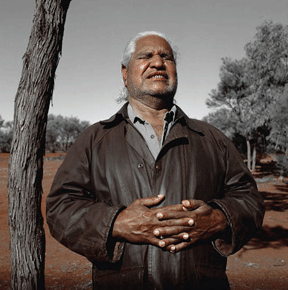
“The scars are still felt on our Country,” said Ms Lester, a Yankunytjatjara Anangu woman from north-west South Australia.
“And the scars are still evident on our people.”
A group of Australian atomic survivors and relatives visited Canberra on Wednesday to speak with government decision-makers about their experiences of the British nuclear testing program in WA and SA.
They are calling on Prime Minister Anthony Albanese to sign the Treaty on the Prohibition of Nuclear Weapons.
In 1953 the British initiated a program of nuclear testing in Australia at the Montebello Islands, off the coast of WA and in Emu Field in South Australia.
Two years later, the British government announced a larger site for the tests at Maralinga.
Ms Lester carries her family’s stories about the impacts of the tests on her people.
“I had a grandmother of mine needing to dig a grave to bury her parents because soon after the radiation fallout, the elderly people started to suffer and die,” she said.
“My father never saw me or my children.
“It’s all because of a decision by governments of the day to say ‘That is no man’s country, go and test your bombs’.
“It’s been a huge, painful journey for us but it’s such an important story that needs to be told.”
Maxine Goodwin is the daughter of an Australian nuclear veteran who became ill as a result of his involvement in the first atomic test in WA.
“Signing the Treaty on the Prohibition of Nuclear Weapons is a significant step towards addressing the harm experienced by individuals and communities,” she said.
In October 1953 when the British detonated the Totem I and II nuclear bombs at Emu Field, Yankunytjatjara, Antikarinya and Pitjantjatjara woman June Lennon was only a few months old.
Her family witnessed the tests and have suffered from ill-health since.
“The government didn’t tell the truth about the nuclear testing program,” she said.
“There were so many lies. They didn’t tell people what they were doing.”
International Campaign to Abolish Nuclear Weapons Australia director Gem Romuld said it was important for policy makers to hear stories firsthand.
“Nuclear survivors are experts on the devastating humanitarian impacts of nuclear weapons,” she said.
“Australia’s experience with nuclear weapons testing is a powerful motivation to join the nuclear weapon ban treaty.”
The delegation will be in Canberra on Wednesday and Thursday to meet parliamentarians, including Foreign Minister Penny Wong and speak at an event hosted by the Parliamentary Friends of the Treaty on the Prohibition of Nuclear Weapons.
Examining the impact of the legal decision against the planned Kimba nuclear waste dump.

Here’s what we know about the Kimba nuclear storage facility decision, By Josephine Lim ABC News 18 Jul 23
This week the federal court ruled in favour of traditional owners who have been fighting against the
development of a nuclear waste facility
The federal government had selected a site in South Australia’s Eyre Peninsula to store low and
intermediate level radioactive waste, but the court’s decision has left the future of the project uncertain.
The uncertainty extends far beyond the court’s decision as the facility will never see the light of day due to i t s c o m p l e t e a n d i n h e r e n t unsuitability which includes the environmental implications and the lack of compliance with international standards and prescriptions relating to nuclear installations and their .safety
Here’s what we know so far. What did the original proposal entail?
In November 2021, Napandee near the town of Kimba, was acquired to be the storage facility for low and
medium-level nuclear waste.
The 211-hectare property was chosen from a shortlist of three sites, including the outback town of
Lyndhurst and Wallerberdina, a property in the northern Flinders Ranges
At the time, Coalition resources minister Keith Pitt said the site would create 45 permanent jobs in
the Kimba community.
Absolute nonsense since based on overseas experience similar but larger facilities employ some 15
people with very minimal external support staff.
T h i s h a s b e e n c o n s t a n t l y disingenuous information by Pitt for which he should be severely taken to task as it developed completely unrealistic expectations by the Kimba community.
Yesterday, he said on ABC’s Afternoon Briefing that he was “incredibly disappointed for the
people of Kimba” following the court’s findings.
If a proper survey were done then
most people of Kimba would be
heartened by and pleased with the
court’s decision as they are
completely against the proposed
facility.
“The piece of land on which this was going to be cited did not have a native title. It is a dryland wheat
farm,” he said.
No, it is not
It is like most of Kimba prone to ground water seepage and basic geological and geophysical surveys
show this to be the case making it grossly unsuitable for the facility
He said more than 60 per cent of the local community supported the project, citing a postal ballot that only local ratepayers were allowed to vote in.
If a proper ballot were now held (which should have been the case in the first place) with the voting accompanied by in favour and a g a i n s t a r g u m e n t s a n d a n unrestricted voting base then the majority against the facility would be significant even if it still excluded the Barngarla people
Why did the Barngarla people fight the plan?
The Barngarla people have a sacred site for women near Kimba, which they fear a facility would destroy.”The Seven Sisters Dreaming is through that area,” Barngarla woman Dawn Taylor said.
“But the Seven Sisters Dreaming means a lot to all of us as women, in each tribe, throughout the country.”
The Barngarla Determination Aboriginal Corporation (BDAC)launched the challenge in the Federal Court in a bid to stop the site from going ahead altogether.
BDAC chairman Jason Bilney said he felt “very emotional” winning a “David versus Goliath” battle.
“It’s the fight that we continue and you feel it from the heart no matter where we are, whether it’s our
Country or other people’s Country,” he said outside court.
D a v i d a n d G o l i a t h is an understatement when the federal government has spent nearly $14
million fighting the application by the Barngarla who have apparently spent less than $700,000 to mount
the review application in totality.
What did the court find?
The Federal Court upheld a complaint by the Barngarla people on the ground there was apprehended bias in the decisionmaking process by former federal minister Keith Pitt in selecting the site
In upholding the apprehension of bias argument, Justice Natalie Charlesworth found that the
Coalition minister, who formally declared the site in 2021, could be seen to have a “foreclosed mind” on
the issue “simply because his statements strongly conveyed the impression that his mind was made
up”
Lawyer for the Barngarla people, Nick Llewellyn-Jones, said findings of apprehended bias against a
minister were “very rare” and the judgement was significant in terms of legal precedent.
“It’s set a precedent for Aboriginal groups to take a stand, it’s set a precedent also in terms, I believe, of what standards are required of Commonwealth ministers,” Mr Llewellyn-Jones said.
“What we’ve had here is a finding of apprehension of bias, we haven’t reviewed the decision fully, but it’s
obviously got some consequence in terms of the conduct the minister did at the time and it will have some authority value in terms of that as well
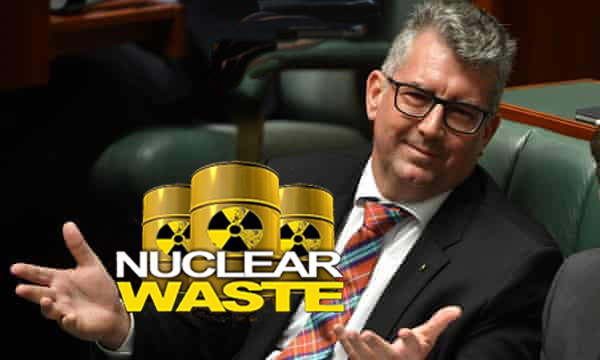
The bias on the part of Pitt may have been even more than apprehended since well before the passing of the enabling legislation for formal decision of the site he had selected and nominated Napandee as the location for the facility and was upset at the delay in passing that legislation for reasons that to him were unnecessary and lengthy
“Our clients have won and it’s obviously a great victory for them but in fact it’s a vindication of the
entire system that we have that people out there do have options when government affects their
lives.”
Justice Charlesworth also found there was an error of law, but concluded it did not have a “material effect” on the outcome of the declaration of the site.
How has the government responded?
Federal Labor Minister for Resources Madeleine King issued a statement that the court’s decision will be reviewed in detail but declined to comment further.
“Labor worked with the Barngarla people in the last term of Parliament to ensure they secured the right to seek judicial review of the decision to acquire the facility site,” she said
That is absolutely untrue since the Barngarla people had to continue with the review application and the enabling legislation as eventually agreed to by Labor was still well short of what was requested and expected of which I have personal knowledge as among other things I had many discussions with various members of parliament and had assisted in drafting an appropriate amendment to the legislation
When the legislation was eventually passed in the Senate I contacted Minister King who was then shadow minister for resources and explained that it was a totally unacceptable piece of legislation which she strongly and quite ignorantly refuted.
I had previously drafted an amendment to the legislation while it was still at the bill stage in the Senate under which the government and the responsible ministers would have been required to adhere completely to the codes and standards and the prescriptions of the International Atomic Energy Agency (IAEA) which was not accepted
Had this amendment been adopted than none of the present litigation with its accompanying acrimony would have been necessary since IAEA would have ensured that the government completely complied with and adhered to its standards and prescriptions.
“The principle of judicial review is an important process that the Albanese Government fully supports.”
The best way to support this application for a review would have been to agree to the review without
any contest. An appeal by the government will be an absolute lie to this proposition.
What have those in favour of the waste facility said?
Kimba farmer Kerri Cliff said the court outcome was ” pretty devastating for the majority of the
community” and expressed concerns about the economic future of the town.
“It’s a decision being made about Kimba, but not by the people that live here,” she said.
Aside from jobs at the facility, an Australian Government economic impact assessment report found the
project would have brought over $95 million to Kimba and the Flinders Ranges in the first 33 years.
Regrettably, the unconvincing notion that the facility would have brought a new economic life to Kimba is
completely misconceived and untrue
If anything it may have well destroyed a well-established and long-standing agricultural industry in the whole of the Eyre Peninsula.
What happens now?
The future of the project is in severe doubt and legal costs are also yet to be determined. The federal government is yet to say whether it would make an appeal against the court’s decision or look at a different location to store nuclear waste.
The government should be careful in considering a possible appeal since it may in any case face fresh legal opposition to its proposals by the general community at Kimba for failing to comply with all the safety codes and requirements of IAEA Local federal member
Rowan Ramsey told ABC Radio Adelaide’s Jules Schiller that the Australian Radiation Protection and Nuclear Safety Agency said that there would be no more room to store nuclear waste at Sydney’s Lucas Heights site “beyond 2028”
“Given that now the government has to find a new site and build a new facility in five years, you may as well be whistling into the wind,” Mr Ramsey said.
But Australian Conservation Foundation campaigner Dave Sweeney said 95 per cent of radioactive waste had been storedsecurely at the Lucas Heights facility and that “material can remain there securely for decades to come”.
He said he hoped the federal government could use this decision to discuss how to better manage nuclear waste in Australia. “It’s a result that will hopefully draw a line under decades of mismanagement of radioactive waste and inject some responsibility, some respect and some recognitioninto future discussions,” he said
“It’s long overdue now, and particularly against a context of AUKUS nuclear submarines and speculation about domestic nuclear power, we need to be serious and stop playing politics and stop looking for a vulnerable community to dump radioactive waste in.”
Australia must far better manage its nuclear waste This lack of proper management stems from the ignorance and incapacity of the federal government from ministerial level through its various departments and agencies failing to accept or acknowledge the international requirements for that
purpose
In conclusion I can only hope that t h e m e m b e r s o f t h e K i m b a community who feel aggrieved by the court’s decision and are seeking the establishment of the facility as an alternative to the district’s economic growth would actually be bitterlydisappointed if that were to occur
In any case, they should realise that the government is attempting to create a false economy which will
not survive and is based on the wholly unsuitable plan for the facility that will not get the necessary approvals for its establishment.
While it was suggested in an interview on Sky News this morning that many people had left the Kimba
district in the past four years this I understand stems from them being unconvinced and even fearful of the facility’s presence.
If the government as the proponent of the facility were prepared to fund a proper and independent expert review of its plans for Kimba then I am sure that those people will be shocked at the result.
Time for dump to be dumped for good.

The state’s peak environment group has strongly welcomed today’s Federal Court judgement that sets aside the declaration of Napandee (Kimba) as the site for the Australia’s nuclear waste facility.
“Today is an extraordinary vindication of the years’ long struggle by the Barngarla people to stand up for their Country, their Dreaming and their right to be heard,” said Conservation SA Chief Executive Craig Wilkins
“This case was never about whether imposing nuclear waste on Kimba was the right thing to do, but now the court has declared that the process the Federal Government undertook was never even legal.
“The Morrison Government, first with Matt Canavan as Minister, then with Keith Pitt, tried to force through a deeply divisive and deeply flawed proposal.
“They stuffed up the process and their relationship with the local community, particularly the Barngarla Traditional Owners.
“Now this comprehensive judgement has been handed down, there is only one appropriate course of action open for the Albanese Government and the Federal Resources Minister Madeleine King: to declare the Kimba waste dump dead and buried.
“It was Labor’s amendment to the Morrison Government’s legislation that gave the Barngarla their day in court today. The Albanese Government now needs to move quickly to reassure the Barngarla they will shelve the project in its entirety.
“Today’s monumental decision offers an exciting opportunity to reset the relationship between the Federal Government, Aboriginal people and nuclear waste.
“In many ways the real work starts now: to find the final resting place for Australia’s long lived radioactive waste – not a deeply deficient and illegal process to park the waste temporarily in above ground sheds in South Australia.
“Huge congratulations to Jason Bilney, Chair of the Barngarla Aboriginal Determination Corporation, Barngarla Elders and the rest of the community for the stunning result, and for standing strong on behalf of all Australians,” he said.
South Australian Greens Welcome Court Decision to Stop Nuclear Waste Facility in Kimba

The Greens have welcomed the decision of the Federal Court to overturn the federal Ministerial declaration to select Napandee near Kimba as the proposed site for a national nuclear waste facility.
The decision comes after the Barngarla people, the traditional owners of Kimba, challenged the proposed facility, arguing that they had failed to be properly consulted and the facility would impact sacred sites.
Quotes attributable to Tammy Franks MLC:
“It was a major concern that the Barngarla people as traditional owners had not consented to this proposed facility, contradicting longstanding SA legislation. The Greens are proud to have stood in solidarity with the Barngarla people in their pursuit of justice.
“It has been a longstanding view of SA Labor that for a nuclear radioactive dump or storage facility the traditional owners should have a right of veto. The Greens look forward to the Malinauskas Government working with traditional owners to ensure their sites and stories are protected.
Not nuclear, but wind and solar still cheapest – CSIRO

By Peter Roberts https://www.aumanufacturing.com.au/not-nuclear-but-wind-and-solar-still-cheapest-csiro 18 July 23
There is a huge amount of hype around new energy sources to replace fossil fuels and none more so than the phenomenon of small modular nuclear reactors (SMR).
But the hype remains just that according to the latest GenCost 2022–23 study released today by CSIRO and Australian Energy Market Operator.
While SMRs are likely cheaper to build that traditional large nuclear power stations, renewable power from onshore wind turbines and solar PV are increasingly important as the cheapest sources of new energy generation capacity according to the report.
This holds true whether the costs of integration into the grid are taken into account, or not.
Each year the two bodies work with industry to give an updated cost estimate for large-scale electricity generation in Australia, and each year wind and solar come out on top
The 2022-23 report found that onshore wind and solar PV are ‘the lowest cost generation technology by a significant margin’, despite cost increases averaging 20 per cent for new-build electricity generation in Australia.
Offshore wind is higher cost but competitive with other alternative low emission generation technologies.
CSIRO Chief Energy Economist Paul Graham said: “Innovation in electricity generation technology is a global effort that’s strongly linked to climate change policy ambitions.
“Technology costs are one piece of the puzzle, providing critical input to electricity sector analysis.
“To limit emissions, our energy system must evolve and become more diverse.”
GenCost said the next lowest cost flexible technology in 2023 is gas generation with carbon capture and storage, but only if it could be financed at a rate that does not include climate policy risk.
Fossil fuels were more expensive and faced hurdles such as government legislation and net zero targets, and historically high energy costs.
GenCost said that with SMRs, ‘achieving the lower end of the nuclear SMR range (of cost estimates) requires that SMR is deployed globally in large enough capacity to bring down costs available to Australia’.
As for SMRs, none of this should not be surprising as even the International Atomic Energy Agency does not claim nuclear power is cheaper.
The agency claims only that SMRs, advanced nuclear reactors that have a power capacity of up to 300 MW(e) per unit or about one-third of typical sizes, provide cheaper power than traditional large nuclear stations.
Their advantage over traditional nuclear is linked to the nature of their design – small and modular.
According to the IAEA more than 70 commercial SMR designs are being developed around the world.
The IAEA says on its website: “Though SMRs have lower upfront capital cost per unit, their economic competitiveness is still to be proven in practice once they are deployed.”
.
1 This month
25 October – Film –Britain’s Nuclear Bomb Scandal: Our Story – part of the Adelaide Film Festival,
Screening and Conversation
A screening of Britain’s Nuclear Bomb Scandal: Our Story (2024) followed by a talk with 2026 Bettison and James Awardee and Tradtional Owner Karina Lester in conversation with Simone Tur.
When: Sun 25 Oct, 12:00pm-Screening, 1:15pm-Talk
Where: The Mercury
Free admission, register below by clicking on BUY TICKETS and select free event tickets, at end of web page:
https://www.adelaidefilmfestival.org/program/2026/britains-nuclear-bomb-scandal-our-story
.

Australians deserve the truth
about
AUKUS – https://aukuspublicinquiry.com/

PETITION – To: Prime Minister Anthony Albanese and the Australian Labor Government

of the week – Australians for War Powers Reform (AWPR)
To see nuclear-related stories in greater depth and intensity

