Australian Naval Infrastructure (ANI) is conducting a ‘community consultation’ about its plan to lodge a site licence application for the ‘Nuclear-Powered Submarine Construction Yard Project’. An application has to be lodged with the new Australian Naval Nuclear Power Safety Regulator before it can prepare a site for a Naval Nuclear Propulsion facility.
We wonder why they are in such a hurry to apply for a site licence when the Strategic Impact Assessment (SIA – Commonwealth process) and the Environmental Impact Statement (EIS – State government process) haven’t even been finalised. FoE Adelaide made submissions to both these processes (click to read our SIA submission & our EIS submission) in March 2025, but no public submissions and no follow-up report have been published. We also made a submission on the new nuclear powered submarine Regulations, which came into effect on 1 November 2025 without any response to the public comments received.
Click here (251123FoEAdelaideSubmission) to read our submission to ANI’s site licence ‘community consultation’.
And let us never forget that acquiring nuclear powered submarines is a bad idea in the first place.
The Great Artesian Basin covers a fifth of Australia and contains water that has been there for millions of years. Now, decades of extraction are taking their toll and traditional owners are fighting a mining giant for compensation.
“Each spring carries a story that connects it to the traditional owners — the Arabana people. But they say the environment — and their cultural connection to it — is under threat. Some of the springs have dried up, and the health of others has deteriorated.
“The Arabana people are now fighting mining giant BHP for compensation over what they say is damage to their cultural heritage and the loss of kuta, the Arabana word for water.”
“The federal government estimates business activity in the basin — including agriculture and mining — contributed $33.2 billion to the economy last year.
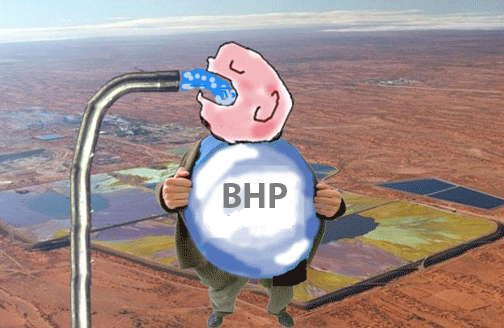
“Just a few kilometres away from the springs on Arabana Country is a BHP-owned wellfield — known as Wellfield A — that, according to the company, pumps more than four million litres of water per day to its Olympic Dam mine
“The company takes another 29 million litres per day from another area — Wellfield B — further to the west.
“There’s plenty of monitoring data that shows that the extraction that BHP have engaged in supporting the Olympic Dam project has caused draw down and significant reductions in the pressure of the GAB aquifer or aquifers near their site,”
AUKUS was hailed as Australia’s biggest defense agreement, one that could redefine the security architecture in the crucial Indo-Pacific region and challenge China’s rising belligerence.
The pact involved providing Australia with eight nuclear-powered submarines.
The Pillar-I involved Canberra buying 3–5 used Virginia-class SSNs from the U.S., and the Pillar-II involved developing and constructing a new SSN-AUKUS submarine class jointly by Australia and the United Kingdom, incorporating US technology, with deliveries to the Royal Australian Navy beginning in the early 2040s.
However, even four years after signing the over USD 368 billion pact, there is little progress on the crucial project.
After months of uncertainty, US President Donald Trump finally endorsed the deal last month, assuring Canberra that “they’re getting them (SSNs).”
However, now a new worry is troubling Australia. The fear of spying by “adversary countries” on sensitive nuclear-propulsion technology can further delay the already-delayed project.
China-India Spying On AUKUS?
Australian media outlet The Australian has reported that Australia’s Defense Force has rejected one in ten applicants for AUKUS submarine work due to dubious foreign ties or security risks.
The highly classified nuclear submarine project employs strict vetting processes, turning away individuals with dual citizenship and suspicious links to China and India.
This affects the recruitment drive for the US$368 billion project, which aims to build a highly-skilled workforce of over 20,000 personnel, including engineers and technicians for nuclear submarine construction and maintenance.
Individuals with family, professional, or financial ties to these nations, particularly those who’re in some way connected to the armed forces or state intelligence agencies, are routinely flagged.
The article further notes that U.S.-imposed ITAR regulations further restrict access for non-citizens or those with overseas parentage from high-risk countries, such as China, exacerbating hiring challenges.
These reports followed Australian Security Intelligence Organisation (ASIO) Director-General Mike Burgess’s warning that foreign spy agencies are intensifying efforts to infiltrate AUKUS through job applications and online networks.
The tactics involve posting fake recruitment ads on social platforms like LinkedIn, and then trying to lure the applicants with a defense background to provide insider information on project timelines and technology specifications.
These fake recruitment ads target people associated with the AUKUS project and sometimes prompt them to unwittingly share sensitive details about the project’s timelines during the interview process.
The tactics involve posting fake recruitment ads on social platforms like LinkedIn, and then trying to lure the applicants with a defense background to provide insider information on project timelines and technology specifications.
Recent programs have confirmed ABC News is increasingly under the control of pro-Coalition activists, as Alan Austin reports.
IN A SHAMEFUL display of partisan politicking for Australia’s discredited Coalition parties, ABC News devoted almost the entire Insiders program on 9 November to the Liberals and the Nationals.
This had no relevance whatsoever for viewers. Over the next ten years, the Federal Coalition will have less impact on citizens’ lives than the Australian Jugger League, the Yowie Research group and Ferret Owners Australia Inc.
Irrelevance of the Federal Liberal Party
After the May Election, the Coalition held 43 seats in the 150-member Lower House. Should the next election see a 3.9% swing back to the Coalition – same as the recent swing against them – they would gain only 14 seats and end up with 57 MPs, still a dismal minority.
So Labor will get a third term in 2028, or earlier, with a majority strong enough to propel it into a fourth in 2031 and probably a fifth in 2034
This is not fanciful. With polls showing Labor leading the Coalition 56% to 44% in its fourth year in office, it is virtually certain Prime Minister Anthony Albanese will serve as Prime Minister longer than Bob Hawke’s nine years, and likely exceed John Howard’s 11 years and nine months.
While it is improbable Albo will beat Bob Menzies’ 16 years in the top job, it is conceivable Labor could break the Coalition’s record 23-year reign. Records are made to be broken.
Insiders copies the Sky News obsession with the Coalition
A bizarre Insiders program on Sunday 9 November devoted all but nine of its 59 minutes to the Coalition parties and their brawling over climate, abortion and leadership.
“Andrew Hastie sees himself as a future leader. He has many good attributes, to be honest. He has lots of strengths.”
Karvelas also boosted Roshena Campbell:
“…who was on my show on Friday and contributed really interestingly, I think, to this debate and still has an appetite to go into politics at the federal level.”
The program allotted three minutes to Labor’s housing policy, with a 13-second clip from Housing Minister Clare O’Neil and three minutes on the economy. Mentions were made of a transferring ABC colleague and Graeme Richardson’s death.
Contributions from Labor MPs were seven seconds from Albo in Parliament, four seconds from Energy Minister Chris Bowen, ten seconds from Treasurer Jim Chalmers and two short comments from Clare O’Neil.
No time was allocated to anyone who, besides Labor, will actually influence parliamentary decisions in the foreseeable future — the Greens, who hold 11 Senate seats, One Nation with four senators and the six individual minor party or Independent senators.
This Insiders episode is not an isolated aberration. Other programs obsessing over the loser Liberals include 7.30, Radio National Breakfast, ABC AM and others.
Embracing the malice of Murdoch’s malevolent network
Kim Williams’ appointment as ABC Chair in March 2024 – after many years serving Rupert Murdoch – has disappointed those who hoped he would arrest the shift towards the Murdoch model of falsifying information and boosting right-wing political causes.
The 9 November Insiders actually played a clip direct from Sky News – with a free plug – of Shadow Energy Minister Dan Tehan extolling the gas extraction industry, one of the Liberal Party’s big donors.
There is no excuse for this. There is abundant evidence from court cases, Press Council adjudications, parliamentary inquiries, academic research, admissions from former employees and defamation settlements that distorting the news and fabricating “stories” is News Corp’s core business model.
Other ABC departments complicit
An email sent to the ABC’s mailing list last Tuesday from a unit called ‘ABC Yours’ asked for donations based on false claims.
It read:
‘Across Australia, the demand for food relief is surging, with 77% of charities reporting more people are seeking support than ever before.’
Yes, some citizens still need free food, particularly those with chronic drug dependency, severe mental health issues or who have decided to disassociate from government services. The numbers, however, are now at the lowest as a percentage of the population than ever, as shown by the Productivity Commission, the Bureau of Statistics and other agencies.
Do the food banks report strong demand? Of course. Everyone loves free meals, regardless of wealth or income.
IA asked the ABC’s media department which charities were surveyed and on what analysis the poverty claims were made, but received no substantial response.
Unfortunately, falsifying hardship in Australia to discredit Labor is a persistent ABC failing, as exposed here, here and here.
Let’s hope the national broadcaster shifts its focus henceforward to more relevant issues than the Coalition — like ferrets, yowies and the nation’s magnificent pompfen champions.
COMMENT. Even the Australian is being critical of AUKUS.
They don’t mention that the $368 billion doesn’t cover a high level nuclear waste dump and associated transport, or upgrades needed for the LeFevre peninsula to host a sub building facility at Osborne.
Some of Australia’s top naval experts have cast doubt on the government’s $368bn AUKUS price tag, warning that the cost will be ‘significantly more’.
Some of Australia’s top naval experts have cast doubt on the government’s $368bn AUKUS price tag, saying the program to acquire two classes of nuclear-powered submarines will cost “significantly more” than originally thought, with higher upfront outlays.
UNSW Canberra’s naval studies group has called for an urgent and comprehensive audit of AUKUS costs “to provide a realistic financial baseline” for the program, which is already cannibalising the wider defence budget.
Labor argues it can fund the program without a major increase in defence funding beyond its currently planned outlays, which are set to rise from about 2 per cent of GDP to 2.33 per cent by 2033-34.
UNSW Canberra’s new Maritime Strategy for Australia warns the proposed expenditure “will likely be inadequate” to deliver on the government’s naval ambitions. “This is already evidenced by cuts to lower priority projects and sustainment,” the strategy says.
It argues the AUKUS ‘Pillar I’ submarine program “was not comprehensively costed at the outset and its full demand on the Defence budget is still to be fully quantified”.
The paper says a substantial increase to defence funding will be needed, urging the government to “conduct a comprehensive, independently verified costing of AUKUS Pillar I as a matter of urgency to allow for re-baselining of Defence financial requirements and recalculation of required overall Defence funding”.
The strategy also sounds the alarm over the navy’s “long-neglected” mine countermeasures and undersea mapping capabilities, saying they pose “a critical gap that must be regenerated to guarantee maritime access to ports and littoral (coastal) waters”.
It comes amid a Defence-wide cost-cutting drive, revealed by The Australian, that has forced service chiefs to slash sustainment budgets, reduce “rates of effort”, and look at axing some capabilities.
Former RSL president Greg Melick took aim at the funding issue last week, using his Remembrance Day speech to warn hat the nation’s military preparedness was being undermined. The speech earned him a rebuke from Paul Keating, who branded him a “dope” and accused him of seeking a war with China.
But retired Vice-Admiral Peter Jones endorsed Major General Melick’s warning, saying the stretched defence budget was “the elephant in the room at the moment”.
Admiral Jones, the lead author of the maritime strategy and head of the Australian Naval Institute, told The Australian: “It appears the cost (of AUKUS) is significantly more than what was originally thought, including greater upfront costs before submarine construction.”
The paper comes as the government finalises its updated defence strategy and capability investment program, both of which will be released ahead of next year’s federal budget.
Labor announced a $12bn upgrade to Western Australia’s shipbuilding precinct in recent weeks as a downpayment on AUKUS infrastructure in the state, which is likely to cost more than twice that figure.
Workforce costs are also soaring as hundreds of Australian sailors take up training places on US and British submarines, and Australian tradespeople are deployed to shipyards in both countries to gain experience building nuclear boats.
Defence Minister Richard Marles revealed the government’s $368bn AUKUS cost estimate two years ago when he announced the program’s “optimal pathway” to obtain three to five Virginia-class submarines from the US and a new class of AUKUS submarines to be built in Adelaide. He said this was equivalent to about “0.15 per cent of GDP for the life of the program”.
The Australian asked the minister’s office how the figure was arrived at, whether it had any statistical measure of its likely accuracy, and whether it would seek an independent assessment of the program’s cost. It declined to respond to all three questions.
A spokeswoman for Mr Marles instead issued a boilerplate statement repeating the government’s case for acquiring nuclear submarines.
“The acquisition of conventionally armed, nuclear-powered submarines for the Australian Defence Force is a multi-decade opportunity, representing the single biggest capability acquisition in our nation’s history and creating around 20,000 direct jobs over the next 30 years,” she said.
“Working with our AUKUS partners, Australia is not just acquiring world-leading submarine technology but building a new sovereign production line, supply chain and sustainment capability here in Australia. This includes growing the capabilities, capacity and resilience of business – particularly small and medium-sized enterprises.
“People don’t quite grasp how much waste we’re talking about.”……………………… cases of cancers, arsenic poisoning and birth and joint deformities linked to years of unregulated dumping.
Marjorie Valix, a professor of chemical engineering at the University of Sydney, who researches sustainable mineral processing, said Australia has plenty of opportunity — and responsibility — in this space.
“Rare earths aren’t rare in Australia — especially light rare earths,” said Professor Valix.
“But water is one of the vulnerabilities.”
The bottleneck
When researcher Jane Klinger first visited China’s Bayan Obo mine at Baotou in Inner Mongolia — the world’s largest rare-earth operation — more than a decade ago, she expected to see the future of green technology.
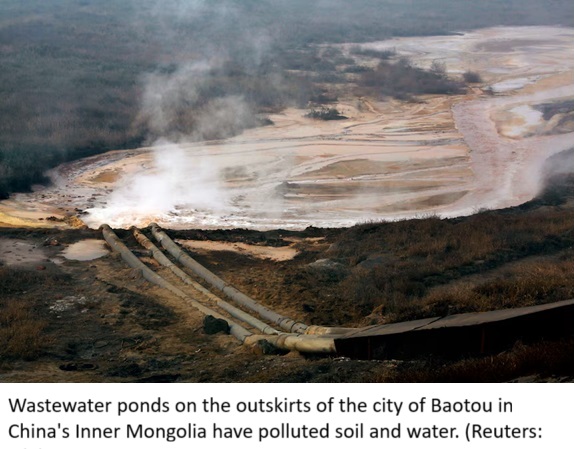
What she found instead was a cautionary tale: acidic wastewater and radioactive residue in unlined ponds along with contaminated rivers and farmland.
“The stuff we want is typically a very small percentage of what’s dug up,” Professor Klinger, author of Rare Earth Frontiers, told the ABC.
“And then there’s the waste that’s generated to separate the valuable bits from the rest of the rock.
“People don’t quite grasp how much waste we’re talking about.”
For every tonne of rare-earth oxide produced, roughly 2,000 tonnes of acidic wastewater are left behind.
It was a local taxi driver, pointing to a new hospital built to treat bone disorders, who tipped her off to what was unfolding around Baotou.
She discovered cases of cancers, arsenic poisoning and birth and joint deformities linked to years of unregulated dumping.
Australian National University professor of economic geology John Mavrogenes said the Chinese companies were mining by drilling and pouring chemicals into the holes.
“They found it was so bad environmentally that even China decided maybe they should quit,” he said.
The health and environmental impacts were so severe Beijing has since tightened regulations and cleaned up some sites.
It has also shifted much of its most-polluting refining methods to neighbouring Myanmar.
In Jiangxi province, China’s other main rare earth mining hub in the south, more than 100 mine sites have been shut down in the past decadeand converted into parks, according to local media.
Learning from China’s mistakes
Experts insist Australia can do better.
The Donald Rare Earth and Mineral Sands mine in western Victoria — which was given major projects status last month — will use a method that uses fewer chemicals than hard-rock mining to extract rare earths.
Once operational, the site is expected to become the fourth-largest rare earth mine in the world outside China.
The company behind the project, Astron, plans to rehabilitate the land and send its rare-earth concentrate to Utah for further processing, where uranium will also be recovered.
Victoria bans uranium mining outright, but the US intends to use the by-product as fuel for nuclear power plants.
Professor Klinger said one of the most impactful lessons from what she found in China was simple.
“Don’t dump this stuff in tailings ponds without liners,” she said.
“Don’t contaminate groundwater, but also pay attention to ‘who’ is doing the modelling and monitoring.”
When the Donald mine starts production next year, processing is to take place in enclosed sheds, with waste sealed into containers and shipped off-site.
China dominates the separation and refining of rare earths, controlling over 90 per cent of global production.
In Western Australia, Iluka Resources is building Australia’s first rare earths refinery.
The process — crushing rock, separating minerals, and neutralising the waste — requires vast amounts of water.
Iluka’s refinery will consume just under1 gigalitre of groundwater per year.
Iluka head of rare earths Dan McGrath told the ABC the refinery would operate as a zero liquid discharge facility.
“Our design avoids generating liquid waste altogether, and the reagents we use create a saleable fertiliser by-product instead of requiring disposal.
“All remaining solids will be disposed of in existing mine voids, removing the need for new waste containment facilities or above-ground disposal facilities.”
Professor Mavrogenes said water scarcity was already shaping where new mining projects could go ahead.
“Water is an issue because most ores are located in areas that don’t have enough water,” he said.
The Iluka refinery will produce both light and heavy rare earth oxides used in advanced manufacturing of items, including medical devices and defence weaponry.
A wastewater treatment plant will form part of the facilities, but the plan has drawn criticism amid ongoing water shortages.
In Victoria, Astron has secured water entitlement from Grampians Wimmera Mallee Water.
Geologists including Professor Mavrogenes have warned that a secure water supply and planning needed to account for climate change.
“Flooding can shut down processing, especially with heap leaching,” he pointed out.
Heap leaching is where a chemical solution is trickled through a heap of crushed ore, often in a pond, to dissolve the metals.
Other environmental concerns once shadowed Lynas Rare Earths, Australia’s largest producer of rare earths, which ships semi-processed concentrate to Malaysia for refining.
The company initially faced local protests over low-level radioactive waste.
Kuan Seng How, assistant professor in Universiti Tunku Abdul Rahman’s Department of Mechanical and Materials Engineering, said Lynas had since built a permanent, sealed facility to prevent groundwater seepage — an expensive but necessary fix.
Together, Iluka’s new refinery and Lynas’ remediation effort illustrate the same lesson: refining is not just an engineering problem but a resource-management one.
A cleaner frontier
China now lines its wastewater ponds with bentonite clay to reduce leakage and collects some run-off for reuse.
Yet even those measures have not stopped some seepage leaking outward, according to a recent article published in the Chinese journal Modern Mining.
Industry and researchers are now exploring waterless extraction technologies such as solvolysis — a process that uses chemical solvents instead of water to extract rare earths.
“It can leach and separate the metals in one step,” Professor Valix said.
“But it hasn’t been scaled up yet — and right now it’s more expensive.”
She sees water management as the defining test of Australia’s ambitions.
Her colleague Susan Park from the University of Sydney added that as countries raced to upgrade rare earth processing, Australia must invest more in knowledge.
“One of the issues is the absence of long-term research and development into these technological processes and training people,” she said.
China may already be a step ahead, testing new techniques on a large scale.
In January, the Chinese Academy of Sciences claimed a breakthrough: an electrokinetic extraction technique that slashes the use of leaching agents by 80 per cent, mining time by 70 per cent and energy consumption by 60 per cent.
According to the scientists who revealed the development in the journal Nature Sustainability, the method could soon be viable for large-scale production.
For Australia, Professor Valix said the barrier was not capability but commitment.
“It’s not that we don’t have the technology,” she said.
“What we don’t have is the investment and the uptake market here like battery makers or manufacturers.”
Cooperation between Australia and China could send a useful message to the Trump regime and other countries around the world about both the possibility of developing alternatives to failing American leadership and the institutional order it did so much to create.
If we are to survive, unprecedented levels of cooperation are needed, no matter how unlikely. Mark Beeson writes.
GLOBAL GOVERNANCE is failing. Nothing highlights this reality more dramatically than our collective inability to address the degradation of the natural environment adequately. Addressing an unprecedented problem of this magnitude and complexity would be difficult at the best of times. Plainly, these are not the best of times.
Even if climate change could be dealt with in isolation, it would still present a formidable challenge. But when it is part of a polycrisis of intersecting issues with the capacity to reinforce other more immediate, politically sensitive economic, social and strategic problems, then the prospects for effective cooperative action become more remote.
Indeed, the polycrisis makes it increasingly difficult to know quite which of the many threats to international order and individual well-being we ought to focus on. The “we” in this case is usually taken to be the “international community”, which has always been difficult to define, generally more of an aspiration than a reality, frequently more noteworthy for its absence than its effectiveness.
Nation-states, by contrast, can still act, even if we don’t always like what they do. The quintessential case in point now, of course, is the administration of U.S. President Donald Trump. Because it is by any measure still the most powerful country in the world, what America does necessarily affects everyone. This is why its actions on climate change – withdrawing from the Paris Agreement, gutting the Environmental Protection Authority, encouraging fossil fuel companies – matter so much.
But nation-states can also be forces for good and not just for those people who live within the borders of countries in the affluent global North. On the contrary, states that oversee a reduction in CO2 emissions are not only helping themselves, but they are also helping their neighbours and setting a useful example of “good international citizenship”.
When global governance is failing and being actively undermined by the Trump regime, it is even more important that other countries try to fill the void, even if this means cooperating with the unlikeliest of partners. Australia and China really could offer a different approach to climate change mitigation while simultaneously defusing tensions in the Indo-Pacific and demonstrating that resistance to the Trump agenda really is possible.
Friends with benefits
In the long term, if there still is one, environmental breakdown remains the most unambiguous threat to our collective future, especially in Australia, the world’s driest continent. And yet Australia’s strategic and political elites remain consumed by the military threat China supposedly poses, rather than the immediate, life-threatening impact of simultaneous droughts, fires and floods.
One of the only positives of the climate crisis is that it presents a common threat that really ought to generate a common cause. Some countries are no doubt more responsible for the problem and more capable of responding effectively, so they really ought to overcome the logic of first-mover disadvantage. No doubt, some other country will take over Australian coal markets, but someone has to demonstrate that change is possible.
China is possibly at even greater risk from the impact of climate catastrophes because of water shortages and, paradoxically enough, rising sea levels that will eventually threaten massive urban centres like Guangzhou and Shanghai. While there is much to admire about the decrease in poverty in the People’s Republic, it has come at an appalling cost to the natural environment. China also has powerful reasons to change its ways.
Unfortunately, Chinese policymakers, like Australia’s and their counterparts everywhere else, are consumed with more traditional threats to national strategic and economic security. This may be understandable enough in a world turned upside down by an unpredictable administration bent on creating a new international order that puts America first and trashes the environment in the process.
But in the absence of accustomed forms of leadership from the U.S. and the international community, for that matter, states must look to do what they can where they can, even if this means thinking the unthinkable and working with notional foes. China and Australia really do have a common cause when it comes to the environment and they could and should act on it.
Yes, this does all sound a bit unlikely. But if we are to survive in anything like a civilised state, unprecedented levels of cooperation would seem to be an inescapable part of limiting the damage our current policies have inflicted on the environment. In this context, Australia and China really could lead the way by simply agreeing to implement coordinated domestic actions designed to set a good example and address a critical global problem.
Leading by example
As two of the biggest consumers and producers of coal, Australia and China could make an outsize contribution to a global problem that would almost certainly win near universal praise, not to say disbelief. In short, China could agree not to build any more coal-fired power stations and Australia could commit to not opening any more new mines and rapidly moving to close down existing ones.
This would be a challenge for both countries, no doubt, but if we are ever going to address the climate challenge seriously, this is the sort of action that will be needed. There are no easy or painless solutions. But voluntarily abandoning the use of one of the most polluting fossil fuels is a potentially feasible and effective gesture that would make a difference. After all, China is a world leader in the development and use of green energy already, so the transition would be difficult but doable.
Australia has a shameful record of exporting carbon emissions and could live without the coal industry, which produces most of them, altogether. Coal extraction doesn’t employ many people and Australia is a rich enough country to compensate those affected by the loss of what are awful jobs in a dirty industry. If Australia can find $368 billion for submarines that will likely never arrive, to counter an entirely notional threat from China, it ought to be able to find a couple of billion to deal with a real one.
No doubt there would be significant pushback from coal industry lobbyists and politicians who think their future depends on being “realistic”, even if it means wrecking the planet. And yet it is possible, even likely, that such actions on the part of Australia and China would be very well received by regional neighbours, who would directly benefit from their actions and who might also be encouraged to consider meaningful cooperative actions themselves.
Given the failure of regional organisations like ASEAN to tackle these issues, normative pressure could be useful.
China might even get a significant boost to its soft power and regional reputation. President Xi Jinping frequently talks about the need to develop an “ecological civilisation”. Moving away from coal and collaborating with an unlikely partner for the collective good would be an opportunity to demonstrate China’s commitment to this idea, and to offer some badly needed environmental leadership.
If that’s not an example of what Xi calls win-win diplomacy, it’s hard to know what is.
A sustainable world order?
In the absence of what U.S. Senator Bernie Sanders calls a “revolution” in American foreign policy, multilateralism may well be in terminal decline. Indeed, it is an open question whether interstate cooperation will survive another four years of Trumpism, especially when the United Nations faces a funding crisis and politics in the European Union is moving in a similarly populist and authoritarian direction.
Cooperation between Australia and China could send a useful message to the Trump regime and other countries around the world about both the possibility of developing alternatives to failing American leadership and the institutional order it did so much to create. American hegemony was frequently self-serving, violent and seemingly indifferent to its impact on the global South, but we may miss it when it’s gone.
If multilateralism is likely to be less effective for the foreseeable future, perhaps minilateralism or even bilateralism can provide an alternative pathway to cooperation. Narrowly conceived notional strategic threats could be usefully “decoupled” from the economic and environmental varieties. In such circumstances, geography may be a better guide to prospective partners than sacrosanct notions about supposed friends and enemies.
Someone somewhere has to show leadership on climate change and restore hope that at least one problem, arguably the biggest one we collectively face, is being taken seriously. There really isn’t any choice other than to contemplate unprecedented actions for an unprecedented problem. Australia and China may not save the world, but they could make things a bit less awful and inject some much-needed creativity and hope into international politics.
Mark Beeson is an adjunct professor at the University of Technology Sydney and Griffith University. He was previously Professor of International Politics at the University of Western Australia.
As Russia and the US both threaten to resume nuclear testing and China has tripled its stock of nuclear arms, former foreign minister Gareth Evans has written an essay for Australian Foreign Affairs Magazine arguing that Australia should lead a new arms control push. He says “nuclear arms control has never been more necessary, and never more difficult to achieve. The important arms control agreements of the past are dead, dying or on life support. And the recent behaviour of the actors that matter most – the United States, Russia and China – has fed concerns that things can only get worse.”
Guest: Gareth Evans, Distinguished Honorary Professor, Australian National University, former Australian Foreign Affairs Minister, author of “Doomsday diplomacy: Australia can lead a new arms control push”, for Australian Foreign Affairs
Australian businesses are missing significant investment and innovation opportunities in Asia.
Education, business and professional exchange programs must be expanded.
Speaking from experience – CPA Australia has nearly 50,000 members in the region.
One of the world’s leading accounting bodies, CPA Australia, is urging the Federal government to take bold steps to strengthen Australia’s Asia capability, warning that Australian businesses are missing out on significant opportunities in the region.
Rebecca Keppel-Jones, Chief Member Operations Officer at CPA Australia, says many Australian businesses, particularly SMEs, remain domestically focused and are not capitalising on opportunities in Asia.
“Asia is central to Australia’s future prosperity. To remain competitive, we must build Asia capability from the classroom to the boardroom,” Ms Keppel Jones said.
“With Asia home to some of the world’s fastest-growing economies, Australia risks falling behind unless it invests in Asia capability now. We need more investment into existing programs, such as the New Colombo Plan, to improve Australians’ understanding of Asia.”
CPA Australia is proud to have maintained a strong presence in Asia for more than 70 years. It now represents nearly 50,000 members in mainland China, Hong Kong, Malaysia, Singapore, Indonesia, Vietnam and the UAE.
“Australia must better leverage its people-to-people connections and professional networks to unlock economic potential,” Ms Keppel-Jones said.
CPA Australia’s four key recommendations:
Expanding Asia-focused training for SMEs to improve business readiness and regional engagement.
Showcasing Australian success stories in Asia through a government-supported case study library to inspire and educate.
Increasing scholarships and professional placements for young Australians to study and work in Asia.
Revitalising Asian language and cultural education in schools and universities to reverse declining enrolments and build long-term regional literacy.
“As global dynamics shift, our ability to engage with Asia is more critical than ever. We need to ensure Australia’s workforce is globally competitive,” Ms Keppel-Jones said. “We are ready to work with government, educators and industry to turn these recommendations into action.”
The submission highlights CPA Australia’s active contributions to regional policy development, education and professional exchange, including a reciprocal work placement exchange program with Malaysia.
Eligible CPA Australia members can enjoy temporary work placements in Malaysia as part of a broader Young Professionals Exchange Program organised by the Department of Foreign Affairs and Trade. The exchange program is designed to enhance business engagement between Australia and its Southeast Asia partners and is available in Malaysia first, before being rolled out to other Southeast Asian markets.
South Australians have a Right to Say No to undemocratic Federal imposed storage of AUKUS High Level nuclear waste in our State. All Federal MPs & Senators from SA, Members of the SA Parliament and candidates for the SA State Election on 21st March should declare their position:
Q: Will you accept or reject Federal imposed storage of AUKUS nuclear waste in SA? The Federal Government quietly took up new AUKUS Regulations (2 Oct) as powers to impose AUKUS wastes by override of State laws that prohibit nuclear waste storage in SA, NT and WA.
AUKUS Regulation 111 “State and Territory laws that do not apply in relation to a regulated activity” names and prescribes our SA Nuclear Waste Storage (Prohibition) Act 2000. The Objects of this key SA Law set out what is at stake: “To protect the health, safety and welfare of the people of SA, and the environment in which they live” from nuclear waste storage.
Federal Labor’s draconian powers to compromise public health, safety and welfare protections. n SA Law, lacks social licence, are an affront to civil society, and damages trust in governance. This is also a threat to Indigenous People with a cultural responsibility to protect their country.
Community expects our State Labor Government to give a clear State Election commitment to protect SA from the risks and impacts of untenable and illegal AUKUS High Level nuclear waste storage, see “The lethal legacy of Aukus nuclear submarines will remain for millennia – and there’s no plan to deal with it” (The Guardian, 10 August 2025, interview with Prof Ian Lowe).
Labor has a further key leadership test ahead of our Election: to commit to support Indigenous People’s human rights, set out in the United Nations Declaration on the Rights of Indigenous Peoples Article 29 (UNDRIP 2007), to “Free, Prior and Informed Consent” over storage of hazardous materials on their lands. AUKUS wastes absolutely are hazardous materials!
a Question for Premier Peter Malinauskas: Will you respect and support Indigenous Peoples Rights to Say No to Federal siting of AUKUS nuclear waste storage on their country in SA?
Call for full disclosure on a N-waste siting process after Labor breaks its commitment: The public has a Right to Know what regions are being targeted for storage of High-Level nuclear wastes. A secretive ongoing Defence review “to identify potential nuclear waste disposal sites” (ABC News March 2023) must be made public ahead of the SA State Election.
AUKUS Minister Marles has broken his commitment to announce a process by early 2024 to identify a site to dispose of AUKUS High-Level nuclear wastes. The failure by Defence to set out any process – other than to take up powers to impose nuclear wastes – is unacceptable.
REPORTER: Is a high-level nuclear waste dump the price that South Australia will have to pay for the jobs that go to the state? (Minister Marles Press Conference 14 March 2023)
MARLES: Well, as I indicated there will be a process that we will determine within the next 12 months for how the site will be identified. You’ve made a leap there, which we’re not going to make for some time. It will be a while before a site is ultimately identified. But we will within the next 12 months establish a process for how we walk down that path.
It is now over 4 years since Federal Labor agreed with Morrison’s AUKUS nuclear sub agenda.
SALabor to let ‘national security interests’ decide siting for AUKUS nuclear waste?
National press reported the Woomera Area to be a ‘favoured location’ for storage and disposal of nuclear sub wastes back in August 2023 (“Woomera looms as national nuclear waste dump site including for AUKUS submarine high-level waste afr.com). WA, Qld and Vic political leaders have rejected a High-Level nuclear waste disposal site in their States, with WA suggesting the Woomera Prohibited Area in SA: “would be one obvious location within the Defence estate, however, we will await the outcomes of the federal review” (SMH 15 March 2023).
Premier Malinauskas has so far only said AUKUS nuclear waste should go to a ‘remote’ location in the “national security interest” (see “Site for high-level nuclear waste dump under AUKUS deal must be in national interest, SA premier says” ABC News 15 March 2023).
The Premier’s “Office for AUKUS” (Letter, 7 Oct 2025) accepts “safe and secure disposal” of High-Level nuclear waste, including spent fuel, produced when subs are decommissioned. The Office says no decision has been made on a location but declines to reveal what is underway, expresses no concerns over unprecedented nuclear waste storage or‘social license’, and expects “community acceptance” (in SA?) for a nuclear ‘disposal solution’:
“I can confirm that no decision has been made on a location within Australia for the disposal of intermediate, or high-level radioactive waste from nuclear-powered submarines. Determining suitable locations and methods for safe and secure disposal will take time, but Australia will do so in a manner that sets the highest standards … and which builds community acceptance for a disposal solution.”
SA is left in the dark, without a say, as an ongoing target for an AUKUS nuclear waste dump.
AUKUS is to store US origin nuclear wastes from 2nd hand Virginia Class subs in Australia:
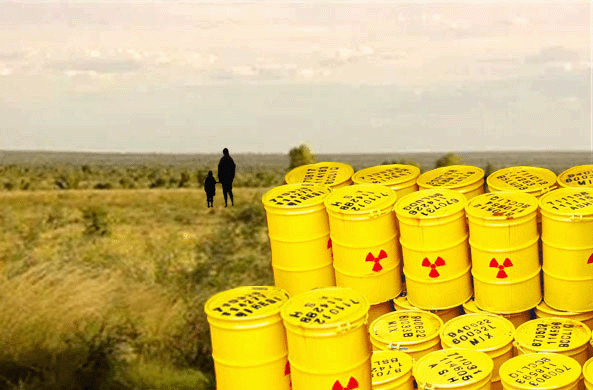
AUKUS aims Australia take on second-hand US Virginia Class nuclear powered subs in the early 2030’s loaded with up to a dozen years of US origin military High-Level nuclear waste and fissile Atomic-Bomb fuel accrued in operations of US Navy High Enriched Uranium nuclear reactors. Swapping an Australian flag onto this US military nuclear reactor waste places an untenable ‘for ever’ burden on all future generations to have to cope these US nuclear wastes.
Scenario: an AUKUS nuclear dump imposed on SA, High-Level military waste shipped into Whyalla Port to go north, nuclear subs to be ‘decommissioned’ at Osborne Port Adelaide.
Whyalla Port is back on a nuclear waste target range. How else could AUKUS nuclear waste get to a storage site in north SA? The Woomera Area is expected to be on a regional short list for an AUKUS dump, requiring nuclear waste transport routes across SA. Port Adelaide community has a Right to Say No to nuclear decommissioning plans for expanded Osborne submarine yards.
SA politicians must protect SA and rule out both an untenable AUKUS nuclear dump and decommissioning nuclear subs and nuclear reactors at Osborne or else-where in SA.
SA must respect Traditional Owners Human Rights to Say No to imposition of nuclear wastes.
The SA public have Rights to full disclosure and for politicians to have to declare their positions, We need an informed public debate ahead of our State Election. Silence by our political leaders, while a path is paved toward nuclear decisions, makes a nuclear waste dump future more likely.
Info: see Rex Patrick & “AUKUS waste in perpetuity”, and David Noonan in Pearls and Irritations.
As one of the most advanced solar nations in the world, Australia is well placed to experiment with giving people free power – and if it succeeds, other countries may look to copy its approach
Australians received a welcome surprise this week with the news that every household will soon receive 3 hours of free electricity every day, as part of a world-first initiative to share the benefits of solar power. If successful, it could be a model for other to follow in a future that will increasingly be powered by sunshine.
The Australian electricity grid is zinging with excess capacity during the day thanks to solar power, but it is strained at night when people return from work and use most of their appliances. To address this, the Australian government says its “Solar Sharer” scheme will be rolled out from July 2026 in three states – New South Wales, South Australia and the south-east corner of Queensland – with the rest of the country joining in 2027…………………..(Subscribers only)..…………………. https://www.newscientist.com/article/2503532-australia-is-getting-free-electricity-will-other-countries-follow/
Liberals risk joining ‘baddies’ with fossil-fuel push
CanberraTimes, By Tess Ikonomou, November 9 2025
A senior Liberal has warned his party would push Australia towards joining “baddies” in rejecting international climate goals as it prepares to back fossil fuel-fired power.
Political infighting within the coalition has intensified over the Liberals’ commitment to a target of reaching net-zero emissions by 2050, a position the party is poised to follow junior partner the Nationals in dumping.
The Liberal Party’s formal position on the climate target will be decided following meetings in Canberra mid-week.
Liberal frontbencher and leading moderate Andrew Bragg on Sunday indicated he could quit shadow cabinet if his party decided it would pull out of the Paris Agreement and not maintain a clear goal for lowering emissions.
“If we left Paris, we’d be with Azerbaijan, Iran, Syria, you know, and a few other baddies,” he told ABC’s Insiders program.
“Australia has never been with those people before.
“Australia needs to be in Paris, in my opinion, and then we need to try to find a way to do net-zero better than Labor. That is better for jobs, better for industry, and better for decarbonisation.”
Senator Bragg added the Liberals were “not fringe dwellers” and most Australians want the nation to play a fair role in reducing emissions, an objective seen as key for the party to reverse its electoral decimation in urban seats.
Under the Paris Agreement, signed in 2015, members must increase their emissions targets every five years and cannot water down their goals……………………………………………………………………………………………………….
Opposition energy spokesman Dan Tehan has flagged subsidies could be offered to keep current coal-fired power plants operating for longer under the coalition’s long-awaited climate and energy plan………………………………………………………………………………………………
Mr Tehan also foreshadowed the Liberals would continue their pre-election policy of supporting the development of nuclear power plants.
The Coalition’s favoured energy technology is quite clearly nuclear – perhaps for no other reason than it is not wind or solar.
The Coalition no longer pretends that nuclear is the best option to address climate change, because they are tearing up their agreement on net zero, the softest of climate targets. That may be an admission that nuclear is very slow to build, particularly for a country that has never done so, and is still built on democratic principles.
Nor can they pretend that nuclear is the best technology on economics. Real world examples continue to defy the carefully constructed modelling commissioned by the Coalition.
In the UK, financing has finally been landed for the planned Sizewell C nuclear plant – and it turns out to be £38 billion, or around $A76 billion, for a 3.2 gigawatt facility. That translates to around $24 million a megawatt capacity cost, which is more than twice as much as the Coalition modelling would have you believe.
Sizewell C is expected to be a replica of Hinkley Point C, whose costs are now estimated at up to $A94 billion, and it seems that Sizewell kept its capital costs under control, because the UK government had to step in to take a 44 per cent stake. (The builder, the French government owned EDF, only wanted 12 per cent, because of the cost risks.)
It also changed the nature of the funding game – turning the new nuclear plant into a regulated asset (like Australia’s electricity networks), which will require consumers to start paying for the nuclear plant more than a decade before it is actually built.
Remember, this is the 5th or 6th plant to be built using the French EPR technology – and yet there is no sign of it getting any cheaper. And we haven’t see the inevitable delays and cost blowouts yet. Civil construction costs are blowing up projects all over the world, and nuclear is about as big as they come.
The UN starts another climate party
The Coalition’s anti-climate and no-to-net-zero stance comes as the UN climate conference is poised to start in Belem, Brazil, where UN secretary general Antonio Guterres has lamented “more failure” to do enough to keep the world on track to cap average global warming at 1.5°C.In remarks that might have been addressed specifically at the Coalition, but were directed at the world, Guterres said:
“Too many corporations are making record profits from climate devastation, with billions spent on lobbying, deceiving the public and obstructing progress,” Guterres said.
“Too many (political) leaders remain captive to these entrenched interests,” noting that countries are spending about ($A1.54 trillion) each year subsidising fossil fuels.
“We can choose to lead – or be led to ruin. Every fraction of a degree means more hunger, displacement and loss – especially for those least responsible. This is moral failure – and deadly negligence.”
What is the real target?
Those fractions of a degree are significant. The latest “emissions gap” report published by the UNEP says the world is headed for average of 2.9°C of warming based on current enacted policies, and 2.3°C and 2.5°C based on announced commitments.
What does a world of 3°C look like. Australia’s National Climate Risk report made it clear – catastrophic impacts, rising sea levels, collapsing ice sheets, the destruction of the Great Barrier Reef. Much of northern Australia would be uninhabitable.
Gina Rinehart, who appears to hold so much sway over the Nationals, wants to build a “defence dome” over northern Australia to protect its mineral riches. It might need a geodesic dome just to make it habitable.
What could possibly be done? As the UNEP notes: “The required low-carbon technologies to deliver big emission cuts are available. Wind and solar energy development is booming, lowering deployment costs. This means the international community can accelerate climate action, should they choose to do so.”
Astonishingly, the Coalition battle over net zero has been playing out in mainstream media as nothing more than political porn, focusing on personalities, egos and power. Climate science, and the renewable solutions, have barely been mentioned.
I’ve seen and heard maybe half a dozen interviews with Opposition energy and emissions reduction spokesman Dan Tehan and can’t remember him once being asked about climate science, or the economics and the engineering of the energy transition.
Does Australia really want to host COP31
Sometime in the next two weeks we will get an answer on whether Australia wants to host COP31, the next UN climate talks in 2026.
The plan is to do it in Adelaide, which would be a grand opportunity to show off the world’s most advanced renewable grid, with South Australia already at a world-leading share of 75 per cent wind and solar, and aiming for 100 per cent “net” renewables by 2027.
The state hosted the world’s first big battery and was the first to roll out “grid forming inverters,” which will help kill the need for fossil fuel generators and often has rooftop solar meeting the equivalent of all state demand. None of which was considered possible just a few years ago.
But if it is this hard to agree to a venue (Türkiye still has its hand up), does Australia want the hassle and embarrassment of presiding over a UN conference with no particular landmark goal, squabbling nations and the notable absence of the world’s biggest economy, the US?
Some in the ALP machine are thinking not. The delays and the massive oil and gas projects still being approved and rolled out, could make logistics tricky and the politics difficult. Which would be a shame: It is a rare opportunity for the Pacific Island nations to also have their say.
They have done so before when Fiji was the official host of COP23, but that was – for obvious reasons – held in Bonn, Germany. That might happen again, with Australia and Türkiye sharing “hosting” duties and various lead-up events, expos and talk-fests.
Duck! Free solar is coming your way
As the Coalition tries to tear itself apart over its position on climate and energy, federal energy minister Chris Bowen’s advocacy of “free solar” may turn out to be a political masterpiece – if only because it promises to change the conversation about the green energy transition.
Bowen wants to force energy retailers to offer at least three hours of “free electricity,” taking advantage of the abundance of rooftop and other solar in the middle of the day, and to make sure the benefits are shared with the 60 per cent of households that do not yet have, or can’t have, rooftop solar.
It’s sparked a predictable fury about heavy handed regulation: You can’t do that! And it’s true that some retailers already do offer such a tariff, although potential customers may want to assess the rates that are being charged in the evening peaks.
Morgan Stanley says the implications are significant enough – savings of up to $660 a year for non-solar households able to take up the offer (you need a smart meter and a big enough midday load so it can make sense), and estimates it might cost big retailers like AGL and Origin around $60 million each.
That suggests an uptake of less than 100,000 customers, which sounds about right. But it’s the messaging that counts – both to the long-forgotten consumer, and to the legacy retailers who are reminded they need to be on their toes to negotiate this energy transition.
Customers should no longer be the forgotten part of the energy transition. They now own rooftop PV, and are busy installing batteries and buying EVs. That will accelerate, but the benefits should not be theirs and theirs alone. Sadly, the legacy players sometimes need to be told to do the right thing.
Podcasts to listen to
This week on the Energy Insiders podcast, we talk to Vestas’ Jan Daniel Kaemmer about the prospects for wind industry in Australia, and of course the news of the week. See: Energy Insiders Podcast: The future of wind energy
Getting access to documents concerning a nuclear submarine base in NSW has become an FOI riddle wrapped in a submarine mystery inside a nuclear enigma. Rex Patrick reports.
You can’t have the documents. Hang on, maybe you can? Nope, they’re too sensitive. OK, they’re not sensitive, you can have them all. Except you can’t.
If you’re struggling to follow this, I’ll try to explain. But keep this in the back of your mind – all Australian taxpayers are paying for the Department of Defence’s part in this, and those NSW taxpayers also get to pay the NSW Crown Solicitor’s part.
It started with a single backflip. When I first asked the NSW Government for access to documents relating to the consideration of a nuclear submarine base in NSW, they said I couldn’t have the documents because they were Cabinet-in-Confidence.
When I took the case to the NSW Civil and Administrative Tribunal (NCAT), the NSW Government backflipped. They stated that their Cabinet exemption claim was wrong and asked NCAT if the Government could remake the decision.
Double backflip
The Tribunal said, “Yes, remake your decision”.
A month later, the NSW Government issued me a new decision. No! Again, “you can’t have them”! Across 12 pages of carefully worded legalese, they tried to explain why the public can’t see the documents.
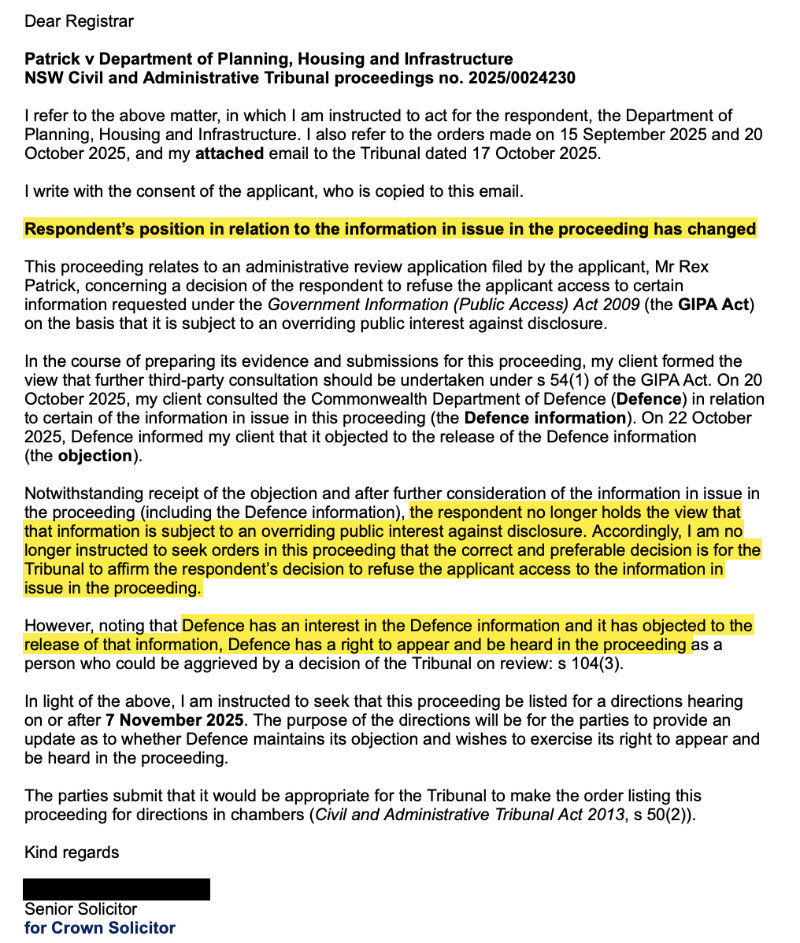
That was September. Fast forward to late October and, out of the blue, the NSW Crown solicitor wrote to me and advised, “the [NSW Government] position in relation to the information in issue in the proceedings has changed … The [NSW Government] no longer holds the view that information is subject to an overriding public interest against disclosure.”
Woo-hoo! Transparency at last. But wait…
Defence secrecy
The email went on to say, “… Defence has an interest in the Defence Information and it has objected to the release of that information. Defence has a right to appear and be heard in the proceedings …”
What secrets?
I am yet to find out the basis of Defence’s objection to releasing the material, but in a very closely related request for information, Defence objected to the release of information because those documents identified or described Defence infrastructure or capability (e.g. base locations, site suitability studies, strategic assessments).
But seriously, how sensitive can a base’s location be? How sensitive can buildings be? In five minutes, anyone with internet access can use Google Earth to avail themselves of the location and layout of HMAS Stirling in Western Australia, where US and UK nuclear submarines are currently visiting.
Moreover, the buildings that will support the permanent basing of submarines at HMAS Stirling can be seen by visiting the website of the Federal Parliament’s Public Works Committee.
Yellow peril
But what about the Chinese? Won’t they find out?
Defence may be worried that if the location is known, then the Chinese might buy land next door to the planned base. The problem is, the Chinese have already purchased land in the Port Kembla and Newcastle port precinct.
In fact, Newcastle Port is operated by a consortium with 50% Chinese ownership (98-year lease) through China Merchant Port Holdings;
“they probably already know more about Newcastle Port and its environs than Defence does.”
The Chinese purchases in both cities provide considerable ability for them to monitor and evaluate key infrastructure servicing and capacity developments; high voltage power supply arrangements, natural gas supply details, potable water arrangements, fire water supply details, rail and road access arrangements and area telecommunications.
And the Chinese won’t only have access to future strategic plans for the port areas; their purchases are significant enough that they could help shape those plans, having a seat at the table as interested constituents and ratepayers. We know Chinese officials have already used their property interest to have meetings with the Mayor of Newcastle.
And as for the details of what Australia will need to safely support a nuclear sub force,
“the Chinese already know that from their 50 years of operating nuclear attack subs.“
1×1515
0:05 / 5:59
1×1515
0:05 / 5:59
Getting access to documents concerning a nuclear submarine base in NSW has become an FOI riddle wrapped in a submarine mystery inside a nuclear enigma. Rex Patrick reports.
You can’t have the documents. Hang on, maybe you can? Nope, they’re too sensitive. OK, they’re not sensitive, you can have them all. Except you can’t.
If you’re struggling to follow this, I’ll try to explain. But keep this in the back of your mind – all Australian taxpayers are paying for the Department of Defence’s part in this, and those NSW taxpayers also get to pay the NSW Crown Solicitor’s part.
It started with a single backflip. When I first asked the NSW Government for access to documents relating to the consideration of a nuclear submarine base in NSW, they said I couldn’t have the documents because they were Cabinet-in-Confidence.
When I took the case to the NSW Civil and Administrative Tribunal (NCAT), the NSW Government backflipped. They stated that their Cabinet exemption claim was wrong and asked NCAT if the Government could remake the decision.
A month later, the NSW Government issued me a new decision. No! Again, “you can’t have them”! Across 12 pages of carefully worded legalese, they tried to explain why the public can’t see the documents.
That was September. Fast forward to late October and, out of the blue, the NSW Crown solicitor wrote to me and advised, “the [NSW Government] position in relation to the information in issue in the proceedings has changed … The [NSW Government] no longer holds the view that information is subject to an overriding public interest against disclosure.”
Woo-hoo! Transparency at last. But wait…
Defence secrecy
The email went on to say, “… Defence has an interest in the Defence Information and it has objected to the release of that information. Defence has a right to appear and be heard in the proceedings …”
Backflip, with Defence objection (Source: NSW Crown Solicitor)
What secrets?
I am yet to find out the basis of Defence’s objection to releasing the material, but in a very closely related request for information, Defence objected to the release of information because those documents identified or described Defence infrastructure or capability (e.g. base locations, site suitability studies, strategic assessments).
But seriously, how sensitive can a base’s location be? How sensitive can buildings be? In five minutes, anyone with internet access can use Google Earth to avail themselves of the location and layout of HMAS Stirling in Western Australia, where US and UK nuclear submarines are currently visiting.
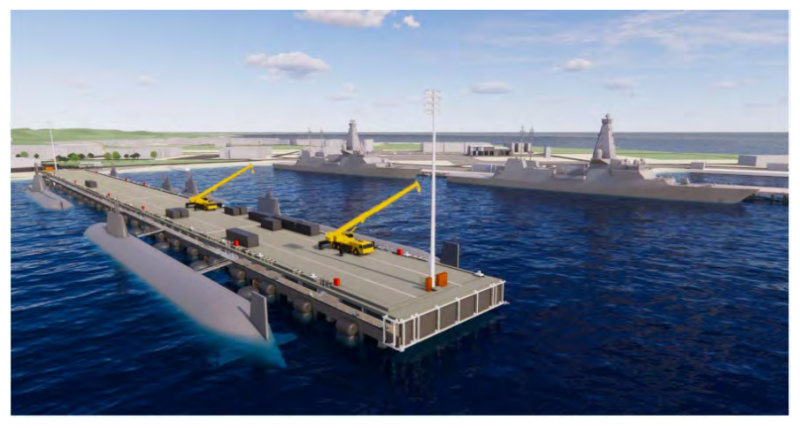
Moreover, the buildings that will support the permanent basing of submarines at HMAS Stirling can be seen by visiting the website of the Federal Parliament’s Public Works Committee.
Nuclear Submarine Piers (Source: Defence)
Yellow peril
But what about the Chinese? Won’t they find out?
Defence may be worried that if the location is known, then the Chinese might buy land next door to the planned base. The problem is, the Chinese have already purchased land in the Port Kembla and Newcastle port precinct.
In fact, Newcastle Port is operated by a consortium with 50% Chinese ownership (98-year lease) through China Merchant Port Holdings;
they probably already know more about Newcastle Port and its environs than Defence does.
The Chinese purchases in both cities provide considerable ability for them to monitor and evaluate key infrastructure servicing and capacity developments; high voltage power supply arrangements, natural gas supply details, potable water arrangements, fire water supply details, rail and road access arrangements and area telecommunications.
And the Chinese won’t only have access to future strategic plans for the port areas; their purchases are significant enough that they could help shape those plans, having a seat at the table as interested constituents and ratepayers. We know Chinese officials have already used their property interest to have meetings with the Mayor of Newcastle.
And as for the details of what Australia will need to safely support a nuclear sub force,
the Chinese already know that from their 50 years of operating nuclear attack subs.
But that won’t stop Defence objecting to the release of information that would otherwise be reasonable for the grant of social licence. It’s a department addicted to secrecy (how else are they going to keep their multi-billion dollar procurement blunders from public scrutiny).
A political ruse
Greens Senator David Shoebridge offered his perspective on the Federal Government’s secrecy:
“The Albanese government isn’t worried that China will find out where they want to put another US nuclear submarine base, they are worried the Australian public will. “The community of the Illawarra have already made it crystal clear that a nuclear submarine base has zero social licence to operate at Port Kembla. “The other potential target for Defence is Newcastle, and with a growing revulsion there with the use of the Williamtown F35 hub to arm Israel’s genocide in Gaza, Labor knows that option is also deeply unpopular. “Hiding these documents isn’t about preventing a foreign adversary from organising against Labor’s war plans, it’s about preventing the public opposing them.”
So, despite the NSW Government’s double backflip (which, despite them being cavalier in the first place, I do appreciate), it looks like I’ll have to keep fighting for transparency.
At least the backflips mean I’ll stand at the bar of NCAT with the NSW Government on my side of the argument. Meanwhile, we’ll all keep having to pay for both sets of lawyers, all necessary to keep politically sensitive topics from the public.
Western Australia’s South West Interconnected System – the world’s biggest isolated grid – has reached a remarkable new record high of 89 per cent renewables, led by rooftop solar.
The new peak – 88.97 per cent to be precise – was reached at 11am on Monday, beating the previous record of 87.29 per cent set just a day earlier, and the previous peak of 85.36 per cent set on October 23. “Another milestone for WA’s clean energy future,” Sanderson wrote. “It’s another strong sign of the transformation underway in our energy system as we become a renewable energy powerhouse.”
The Australian Energy Market Operator says the record share was led by rooftop solar, which accounted for 64 per cent of generation at the time. Large scale wind accounted for just over 16 per cent, with the rest from large scale solar, solar battery hybrids, biomass and battery storage.









 Antinuclear