US big defense and Australia’s nuclear crossroads
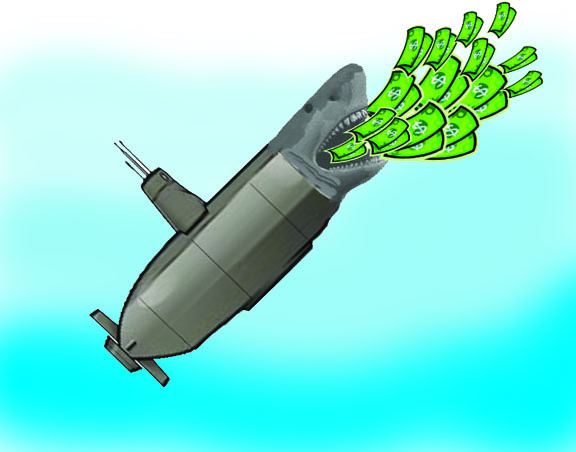
For the fiscal year 2022, the Pentagon budget proposal includes billions of dollars for new nuclear delivery vehicles, with a handful of contractors as the primary beneficiaries, including General Dynamics, Northrop Grumman, Lockheed Martin and Raytheon, along with Huntington Ingalls, Honeywell, and Bechtel.
Australia’s privilege is to pay the bill.
In Canberra, some conservatives see these trends as positive. They want to turn Australia into a world-class military-industrial complex – a more advanced version of the “arms depots” in Taiwan and Ukraine.
The Biden administration has made Australia a central part of its defense strategy. It needs a military-industrial complex in the country which is being forced into the kind of nuclear escalation that two of three Australians oppose.
These strategic objectives are very much in the interest of US Big Defense. But they are not in Australia’s national interest.
By Dan Steinbock | chinadaily.com.cn | 16 Nov 2022-
In late October, Australia dropped its opposition to a landmark treaty banning nuclear weapons in a vote at the United Nations. The shift in its voting position to “abstain” after five years of “no” is significant.
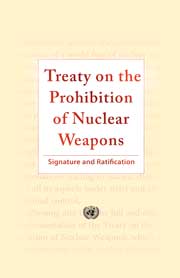
The Treaty on the Prohibition of Nuclear Weapons (TPNW) prohibits the development, testing, stockpiling, use and threats regarding the use of nuclear weapons.
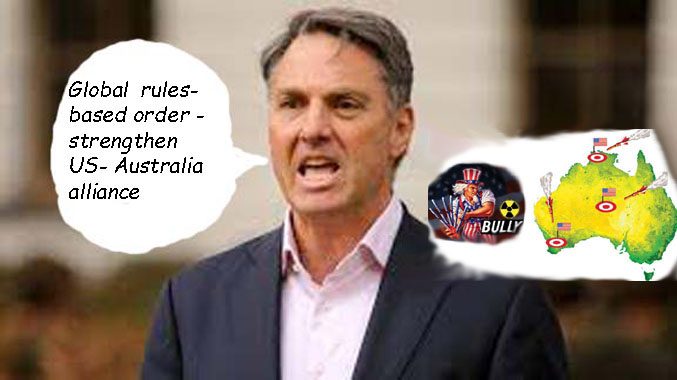
The change comes as the US is planning to deploy nuclear-capable B-52 bombers to the country, where the weapons will be positioned close enough to strike China.
US pressure vs. Australian aspirations
Defending the vote, foreign affairs minister Penny Wong stresses Australia has “a long and proud commitment to the global non-proliferation and disarmament regime” and the government supports the treaty’s “ambition of a world without nuclear weapons.”
The Australian labor government is now facing extraordinary pressure due to its stand. Recently, the US warned Australia against joining the TPNW. As the US embassy in Canberra put it, the treaty “would not allow for US extended deterrence relationships.” It argues that the agreement could hamper defense arrangements between the US and its allies.
The original commentary was published by China-US Focus on Nov 15, 2022.
Beatrice Fihn, executive director of the International Campaign to Abolish Nuclear Weapons (ICAN), the Nobel-awarded organization behind the TPNW, called the US embassy’s comments “irresponsible” adding, “Using nuclear weapons is unacceptable, for Russia, for North Korea and for the US, UK and all other states in the world. There are no ‘responsible’ nuclear armed states. These are weapons of mass destruction and Australia should sign the #TPNW!”
Only 6% of Australians support nuclear arms
Australian Prime Minister Anthony Albanese believes that “nuclear weapons are the most destructive, inhumane and indiscriminate weapons ever created.” That was the basis for his 2018 motion to commit the Labor Party to supporting the TPNW.
The Labor’s 2021 platform included a commitment to signing and ratifying the treaty “after taking account” of factors including the development of “an effective verification and enforcement architecture.”
Recently, New Zealand said it was “pleased to observe a positive shift” in Australia’s position in the UN vote and “would, of course, welcome any new ratifications as an important step to achieving a nuclear weapon-free world.”
The treaty now has 91 signatories, 68 of which have formally ratified it, and it entered into force last year.
An overwhelming majority of Australians backs the government’s position. According to an Ipsos poll taken in March, 76% of people support the country signing and ratifying the treaty, while only 6% are opposed.
The real gap is between the profit objectives of the US Big Defense and the peaceful aspirations of Australian people.
AUKUS at stake
In 2021, Australia angered France by canceling a deal to build a fleet of submarines and opting to build nuclear-powered submarines with US and UK technology. According to the new trilateral security pact (AUKUS) between the United States, the UK and Australia, Washington and London will “help” Canberra to develop and deploy nuclear-powered submarines……………………………
Winners and losers
If the stakes are so high, why this interest in the weapons of mass destruction? Here’s the simple answer: follow the money.
The Pentagon and the Department of Energy have been ramping up a three-decades-long plan to build a new generation of nuclear-armed bombers, submarines and missiles, coupled with new warheads. The price tag for operating current weapons and building new ones could reach a confounding $2 trillion. The cost of nuclear weapons deployment, development, and procurement could soar to $634 billion.
For the fiscal year 2022, the Pentagon budget proposal includes billions of dollars for new nuclear delivery vehicles, with a handful of contractors as the primary beneficiaries, including General Dynamics, Northrop Grumman, Lockheed Martin and Raytheon, along with Huntington Ingalls, Honeywell, and Bechtel. Australia’s privilege is to pay the bill.
In June, Australia announced a $585 million settlement with France’s Naval Group as compensation for scuppering a submarine contract with Paris. According to current estimates, Australia’s nuclear submarines could cost up to $171 billion.
Australia is today among the four largest importers of arms, globally. In 2021, it spent over $1.2 billion on the import of weaponry, according to SIPRI, making the formerly-peaceful nation the world’s No.1 importer of deadly capability. Since two-thirds of Australia’s military imports come from the US, America’s Big Defense is the great beneficiary of the trend
According to recent disclosures by The Washington Post, the Pentagon’s high-level influence operations in Australia have escalated since the mid-2010s. The results are stunning. Between 2012-16 and 2017-21, Australia’s share of global arms exports doubled. In the period, that translates to an increase of a stunning 92%; more than in any other arms exporter worldwide, except for South Korea and India.
Economic costs of geopolitics
In Canberra, some conservatives see these trends as positive. They want to turn Australia into a world-class military-industrial complex – a more advanced version of the “arms depots” in Taiwan and Ukraine.
In the past, US-Australian bilateral interests converged in security matters, but diverged in trade and investment. However, a decade ago, I argued in a Reuters analysis that Australia was “no longer immune to the stagnation in the West.” Worse, the past decade has witnessed a drastic shift toward hawkish geopolitics at the expense of welfare……………………………..
Whose national interest?
In January, Australia agreed to a $3.5 billion deal with the US to acquire more than 120 tanks and other armored vehicles to upgrade its military fleet. In November, Australian media reported that up to six US nuclear-capable B-52s would be sent to the Royal Australian Air Force’s Tindal base in northern Australia. The move led China to accuse the US of stoking nuclear tensions in the region.
The Albanese government faces the prospect of a blowout in defense spending which reflects annual growth of 7.4% in nominal terms and 3.8% in real terms. While the economy faces prospects of stagnation and the population is aging, defense spending is increasing two to three times faster than economic growth. That’s untenable.
The Biden administration has made Australia a central part of its defense strategy. It needs a military-industrial complex in the country which is being forced into the kind of nuclear escalation that two of three Australians oppose.
These strategic objectives are very much in the interest of US Big Defense. But they are not in Australia’s national interest.
https://www.chinadaily.com.cn/a/202211/17/WS63758e0ea31049175432a3c8.html
Albanese must use Xi meeting to return us to the Howard-Abbott golden age of Australia-China relations (this from Murdoch’s Sky News !!!)
Good leadership isn’t about exclusivity. It’s about the careful management of competing interests and alliances and a recognition we need to lean on China for economic success and prosperity.
Sky News Sherry Sufi SkyNews.com.au Contributor and Political Commentator November 16, 2022
It feels like yesterday when Prime Minister Tony Abbott hosted Chinese Premier Xi Jinping in 2014 for a State Reception at Parliament House, Canberra.
In his address, Xi praised Australia’s goodwill towards China.
The fact that this friendship has since deteriorated with our largest trading partner is lamentable.
Prime Minister Anthony Albanese’s recent willingness to meet with Xi should be welcomed by both sides of politics.
A meeting of this nature is long overdue.
In recent years, there has been no shortage of quasi-apocalyptic warnings by commentators about China’s emerging global assertiveness.
The one-sided nature of this commentary hasn’t helped de-escalate the tensions either.
We’ve been fixated on China’s treatment of Uighur minorities in Xinjiang, its overreach in Tibet, Hong Kong and Taiwan, as well as its handling of COVID-19.
China insists there is no persecution of minorities.
Rather, it’s only cracking down on Uighur separatist terrorists affiliated with the East Turkestan Islamic Movement (ETIM).
The United States had ETIM listed as a terrorist organisation from 2002 to 2020.
The listing was only removed after the pandemic when relations with China began to deteriorate — intriguing in its own right.
Chinese intellectuals argue that if China had been the one to annex a strategically vital British port city — let’s say Portsmouth — and turned it into a Chinese colony for 156 years, Britain would also be doing all it could to re-integrate the liberated territory back into its administrative architecture.
That’s how China sees Hong Kong.
China maintains the US actively backed the Kuomintang party during the Chinese Civil War (1927-1949) because the American objective was to run an American-aligned vassal state — Taiwan — in the middle of the South China Sea.
That’s how China sees Taiwan — an American puppet in China’s maritime backyard.
Yet the US would never, for instance, tolerate China backing Puerto Rican separatists and running a Chinese-aligned vassal state in the middle of the Gulf of Mexico in America’s maritime backyard.
Every time the Chinese hear us say “China can’t be trusted because it’s militarising the South China Sea” — they chuckle at our hypocrisy.
Guess what, the South China Sea was already heavily militarised — just not by the Chinese, but by our allies, the Americans.
For decades, the US has hosted combat-ready military bases across South Korea, Japan, the Philippines and Guam.
We keep telling ourselves “our problem is the Chinese government, not Chinese people”.
This almost implies that since we’re not anti-Chinese “people” somehow that gives us a free pass to be anti-Chinese on everything else — including its right to manage strategic risks using precedents set by none other than the US itself.
Let’s face it, Australian governments since the Abbott era inserting themselves into Chinese domestic affairs has brought us zero benefits for Australia.
As for those wondering, should we just let China bully us economically?
Obviously not — but there’s more to this than simplistic rhetoric.
Remember, it wasn’t China that forced Australian businesses to export our iron ore, coal, copper, precious stones, cotton, barley, wine, dairy, beef and seafood among other commodities.
Australian businesses made conscious decisions to enter into agreements with Chinese trading partners due to the allure of lucrative mutual benefits — that is Capitalism 101.
Free trade is what gave China economic leverage over us. …………………………………………
What’s not reasonable is running one-sided commentary on how China deals with its domestic issues across Xinjiang, Tibet, Hong Kong or Taiwan.
That stuff was never our core business…………………………………………
It’s now up to Albanese to return us to the golden age of Australia-China relations.
Dr Sherry Sufi is a Political Commentator and Analyst. His PhD thesis was on language and nationalism. https://www.skynews.com.au/insights-and-analysis/albanese-must-use-xi-meeting-to-return-us-to-the-howardabbott-golden-age-of-australiachina-relations/news-story/96780217a608f66f9daa52f47f99ceb4
US nuclear strategy gravely threatens global security
https://www.globaltimes.cn/page/202211/1279678.shtml By Kong Jun Nov 16, 2022 The US Department of Defense recently released its 2022 Nuclear Posture Review (NPR), which continues the US’ consistent Cold War mentality and hegemonic logic, plays up great power competition and bloc confrontation, and exploits nuclear deterrence as a geopolitical tool. The international community is widely concerned that the US nuclear strategy will severely deteriorate the global strategic security environment.
The NPR shows that the incumbent US administration has not adopted a policy of “no first use” of nuclear weapons or the policy that “the sole purpose of our nuclear arsenal weapons is to deter -and, if necessary, retaliate for – a nuclear attack against the United States or its allies” as it promised during the 2020 presidential campaign, but has continued its longstanding policy of reserving the option of launching a preemptive nuclear strike.
While shouting the slogan of “reducing the role of nuclear weapons,” the US claims to deter nuclear and non-nuclear strategic attacks with nuclear weapons. Its hypocrisy is evident for all to see. Daryl G. Kimball, executive director of the Arms Control Association, recently published an article that suggested the NPR “sends muddled messages about the role of nuclear weapons in US defense strategy and foreign policy at a time when the United States should be more clearly de-emphasizing the salience of nuclear weapons and the threat of nuclear weapons use.”
The US nuclear strategy undermines strategic mutual trust among major powers. The US has long pretended to be a victim, hyping up nuclear threats from China and Russia and exaggerating that “by the 2030s the United States will, for the first time in its history face two major nuclear powers as strategic competitors and potential adversaries,” and openly tailored its nuclear deterrence strategy against China, Russia and other countries. The size of China’s nuclear arsenal is not on the same level with that of the US, and China has pledged to “no first use” of nuclear weapons at any time and under any circumstances. The US’ hyping up of the “China nuclear threat theory” will not change the fact that the US’ nuclear weapons pose a threat to the world, nor will it justify its nuclear expansion. Instead, it will only severely impair the strategic security relations of major powers.
The US nuclear strategy raises the risk of nuclear conflict. US President Joe Biden expressed his opposition to his predecessor’s plan to deploy a low-yield nuclear warhead called the W76-2. However, the NPR has retained this type of nuclear warhead and earmarked it for tailored deterrence against China and Russia, and also stated its intention to deploy a new B61-12 nuclear bomb. In January, the Joint Statement of the Leaders of the Five Nuclear-Weapon States on Preventing Nuclear War and Avoiding Arms Races reiterated that “a nuclear war cannot be won and must never be fought.” Going back on its own words, the US is developing nuclear weapons for combat use, in a complete disregard of the consequences of increasing the risks of nuclear conflict.
The US nuclear strategy stimulates a nuclear arms race. As a country with the largest nuclear arsenal, the US bears special and primary responsibilities for nuclear disarmament and should reduce its nuclear weapons in accordance with the international consensus. Regrettably, the US does not have any substantive nuclear disarmament measures, but instead seeks to upgrade its nuclear triad. The US expansion of nuclear arsenal has undermined global strategic balance and stability. It cannot be ruled out that other nuclear-weapon States will follow suit. It will also stimulate non-nuclear-weapon States to develop nuclear weapons of their own or seek “nuclear umbrella,” thereby impeding the international arms control and disarmament process.
The US nuclear strategy undermines the international nuclear non-proliferation and disarmament regime. Washington talks about strengthening regional nuclear deterrence and detailed plans to deploy strategic bombers, dual-capable fighter jets and even nuclear weapons in the Asia-Pacific region. This is exactly the same as its nuclear submarine cooperation with the UK and Australia under AUKUS and its connivance of the talks about nuclear sharing in Japan and the ROK, which fully exposes the reality that it puts geopolitical self-interest above nuclear non-proliferation obligations and is a complete destroyer of the international nuclear non-proliferation system.
Washington mentions China dozens of times in the report and speculates on and smears the modernization of China’s nuclear capabilities. In fact, since possessing nuclear weapons, China has explicitly undertaken not to be the first to use nuclear weapons at any time and under any circumstances, and unconditionally committed itself not to use or threaten to use nuclear weapons against non-nuclear-weapon states or nuclear-weapon-free-zones, and always keeps its nuclear capabilities at the minimum level required for national security. The US, which has long been in a hegemonic position, should change its hegemonic mentality of maliciously speculating about other countries.
At the moment, the global security structure, as well as international arms control, disarmament and non-proliferation mechanisms, are facing the most severe challenge since the end of the Cold War. The risk of nuclear arms race and nuclear conflict keeps rising. How the US uses its huge nuclear arsenal has a major bearing on world peace and development. We urge the US to abandon the Cold War mentality and the logic of hegemonism, pursue a rational and responsible nuclear policy, and play its due role in maintaining global strategic stability and world peace and security.
What’s happening with the radioactive waste facility in South Australia?

Ed. I always like it when the nuclear lobby brings up their tired old argument about bananas. It shows their contempt about the intelligence of ordinary people.
“Australian Radioactive Waste Agency CEO Sam Usher standing in front of a 100-tonne TN-81 transport and storage cask that contains intermediate level waste (ILW) at ANSTO’s Interim Waste Store.
The container is so well shielded that a person standing 10m away for one hour would receive the equivalent radiation dose to eating half of one banana. Credit: ARWA.”
When high level nuclear waste is returned to Australia ANSTO reclassifies it as intermediate level on the very weak argument of the classifications in Europe being different to Australia…… it seems ludicrous that it should assume its own manner of classification and against the treaty adopted classifications of IAEA and adhered to by other countries.
Cosmos By Clare Peddie / 18 November 2022,
Multiple hurdles stand in the way, but the Australian Radioactive Waste Agency is pressing ahead with plans for Kimba.
More of a mausoleum than a crypt, the burial chamber planned for Australia’s decaying radioactive waste will consist of free-standing concrete vaults, above-ground, on agricultural land near Kimba on South Australia’s Eyre Peninsula.
The first National Radioactive Waste Management Facility (NRWMF) will be 1710km west of Australia’s Nuclear Science and Technology Organisation (ANSTO), by road. That’s an 18-hour drive from Lucas Heights in Sydney, across the Hay Plains and through the Riverland, on the most direct route.
While precise transport routes remain undecided, the federal government is clear that the vast majority (97%) of the waste destined for Kimba will come from ANSTO.
The NRWMF will be the final resting place for Australia’s low-level waste (LLW) and a secure half-way house for intermediate-level waste (ILW), which will be interred for 50 years before being moved to a more suitable facility, below ground.
At least, that’s the current plan. There’s a court case to be heard, a public inquiry to be instigated and a series of regulatory hurdles to be cleared before construction can begin.
2021 Radioactive Waste Inventory
Australia’s National Inventory of Radioactive Waste 2021 reveals ANSTO is expected to produce 12,972 cubic metres of LLW and 3753 cubic metres of ILW. (That adds up to 16,725 cubic metres, out of the national total 17,163 cubic metres.)
Australia has no High Level waste. [ed note: The government and ANSTO reclassify spent nuclear fuel as not being high level waste, but “Intermediate Level“]
| OWNER | FUTURE | LEGACY | TOTAL |
| ANSTO | 10,665 | 2,307 | 12,972 |
| Defence | 88 | 70 | 158 |
| CSIRO | 40 | 44 | 84 |
| ARPANSA | – | 66 | 66 |
| Hospital | 2 | – | 3* |
| Other Commonwealth | – | 2 | 2 |
| Research and education | 1 | 1 | 2 |
| Total | 10,796 | 2,490 | 13,286 |
Australia’s low level waste, in cubic metres. Source.
| OWNER | FUTURE | LEGACY | TOTAL |
| ANSTO | 2,198 | 1,555 | 3,753 |
| CSIRO | 62 | 12 | 74 |
| Defence | 2 | 21 | 23 |
| ARPANSA | – | 22 | 22 |
| Industry | 3 | – | 3 |
| Hospital | – | – | 1* |
| Other Commonwealth | – | 1 | 1 |
| Research and education | – | – | – |
| Total | 2,265 | 1,611 | 3,877 |
Australia’s intermediate level waste, in cubic metres. Source.
On November 29, the Morrison Government’s Resources Minister, Keith Pitt, declared the NRWMF would be established 24km west of Kimba at Napandee, a 211 hectare property.
But the Traditional Owners, the Barngarla People, did not provide consent. And they had made their opposition abundantly clear, in the lead-up to the announcement.
So within a week, the Barngarla Determination Aboriginal Corporation (BDAC) announced their intent to challenge the Minister’s decision. The application for judicial review was lodged in the Federal Court on December 20 and a separate constitutional challenge followed. The case will go to trial in March.
Federal Resources Minister Madeleine King says she “will not pre-empt the outcome of the court process currently underway” and has repeatedly refused requests from BDAC, conservationists and Greens Senator for SA, Barbara Pocock, to halt work on the project until the case is heard…………………………..
Australian Radioactive Waste Agency (ARWA) Chief Executive Officer, Sam Usher, says the declaration of the site was a “significant milestone for Australia and its nuclear industry” and the “culmination of a long process” of site selection.
But it’s also the start of another lengthy process, with many regulatory hurdles along the way…………….
“Even going through the construction, we still need to apply for operating licences for the facility through ARPANSA (the Australian Radiation Protection and Nuclear Safety Agency) … We are not anticipating the facility to become operational until early in the next decade.”
Key regulatory and approval steps
- Draft Environmental Impact Statement
- EPBC Environmental Impact Assessment
- NRWMF Siting License
- Safeguards Permit
- Public Works Committee Approval
- NRWMF Construction License
- NRWMF Operating License
Recruited from the nuclear waste industry in Britain and appointed in January, Usher was called to address the Committee to help resolve the timing of a public inquiry required under state law.
The Nuclear Waste Storage Facility (Prohibition) Act 2000 seeks to “protect the health, safety and welfare of the people of South Australia and to protect the environment in which they live by prohibiting the establishment of certain nuclear waste storage facilities in this State”.
It states: “If a licence, exemption or other authority to construct or operate a nuclear waste storage facility in this State is granted under a law of the Commonwealth, the Environment, Resources and Development Committee of Parliament must inquire into, consider and report on the likely impact of that facility on the environment and socio-economic wellbeing of this State.”
When the Committee sought Usher’s opinion on the timing of a public inquiry, he suggested the Environmental Impact Statement, “expected to be completed in the next three or four years or so”, would address the “environmental and socio-economic wellbeing impacts” on the state.
But he added that “delivery of the facility is a matter of national importance” and override powers within the National Radioactive Waste Management Act 2012 would be used where necessary.
As ARWA Principal Legal Counsel Kirsty Braybon put it: “Commonwealth legislation puts in place a process whereby we can effectively override the state laws that stop us from doing what we need to do.”
On reflection, Committee chair and Labor MP Jayne Stinson told Cosmos that she felt the “threshold” for a public inquiry had not been met and would not, for a long period of time.
“It’s really the most massive exercise in ‘How long is a piece of string?’. There are so many movable parts in this equation that it’s very difficult to tell, but it is most likely that this could stretch out well beyond the next term of parliament,” she said.
She said the phrase “construct or operate” was significant, pushing the timing of the inquiry further into the future. The Committee would also want to see the court case resolved first, especially as the Premier recently reinforced SA Labor’s long-held position that the Barngarla People should have the right to veto the project.
“In this day and age, when we’re talking about Voice, Treaty and Truth, we can’t just turn around and say, ‘Oh, well, those are our values but in this particular instance, we’re going to ignore the voice of Aboriginal people’. I think that’s just preposterous and it’s inconsistent with what most South Australians would think,” Stinson said.
“So yes, we do think that the voices of Aboriginal people should be front centre in this debate, and I would say that’s not just the view of the Premier, but of our Cabinet and also our Party.”
Barngarla Determination Aboriginal Corporation Chair, Jason Bilney, is frustrated about having to fight another legal battle so soon after the two-decade effort to win native title.
While it is true that there is no native title on the site in question, that’s because it is freehold land. The former farm is surrounded by parcels of native title land, within the Barngarla Determination boundary. (Native title is extinguished by certain forms of property tenure).
Mr Bilney maintains that the site is a “very significant place for Barngarla people, we’ve travelled through it, it’s part of our songlines, our storylines and it’s connected to female dreaming, through the aquifers running underneath it”.
Objections to the facility also run deep, because there is a history of past injustices surrounding nuclear weapons testing, so any talk of radioactive waste reopens old wounds. And then there are questions around the “temporary” storage of long-lived radioactive waste.
“We don’t want the dump on our country, and we were excluded from the start,” he says……………………….
Nuclear industry expert Professor Ian Lowe, says ILW “needs to be securely stored for many thousands of years in a properly engineered site”.
He agrees that the “sensible approach … would be to continue storing the ILW securely at Lucas Heights while there is a proper process of designing a permanent disposal site and consulting communities to negotiate informed consent for a location”.
ARWA is working with CSIRO to review and assess technical ILW disposal options, but this process has barely begun………………………
Money is flowing into the town, with the third round of community grants announced on November 2 injecting a further $2 million into projects such as upgrades to the Kimba District Hospital facilities, a new Kimba Youth and Community Hub, a ‘shop local’ marketing initiative to support local businesses, and refurbishment of the Kimba Op Shop. This builds on $4 million of grants and 50 projects already funded in Kimba under the program.
There’s the promise of 45 ongoing jobs in the facility, plus all of the construction work.
And there’s plenty of work for scientists in the next phase of “site characterisation works” to begin this week………….. https://cosmosmagazine.com/technology/radioactive-waste-facility-australia/
Australia sticks to US nuclear subs despite French criticism
Australia’s prime minister says he remains committed to building a fleet of submarines powered by U_S_ nuclear technology despite the French president describing the plan as a “confrontation with China.”
abc news, ByROD McGUIRK Associated Press, November 18, 2022, CANBERRA, Australia –– Australia’s prime minister said Friday he remained committed to building a fleet of submarines powered by U.S. nuclear technology despite the French president describing the plan as a “confrontation with China.”…………..
Prime Minister Anthony Albanese has stood by the so-called AUKUS agreement to embrace nuclear technology since he came to power at elections in May. Whether Australia opts for a version of the U.S. Virginia-class or British Astute-class submarine will be announced in March………..
Macron on Thursday criticized the AUKUS deal, telling reporters that France had offered Australia, which has no nuclear energy industry, diesel-electric subs that could be independently maintained.
“It was not in a confrontation with China because these were not nuclear-powered submarines,” Macron said through an interpreter.
But Albanese’s predecessor Prime Minister Scott Morrison chose the “exact opposite: To enter into a confrontation by going nuclear,” Macron added.
When the AUKUS deal was announced in September last year, China’s foreign ministry condemned the export of U.S. nuclear technology as “highly irresponsible.” Some of Australia’s neighbors fear it could lead to an arms race in the region………
Macron on Thursday said the prospect of France supplying Australia with submarines remained “on the table.”
Albanese said Australia was continuing to discuss with France “how we can cooperate in defense.”……………… https://abcnews.go.com/International/wireStory/australia-sticks-us-nuclear-subs-french-criticism-93538269
Radioactive waste works at Napandee, South Australia, ‘pre-emptive and unjustified’.

Dave Sweeney, Australian Conservation Council, 15 Nov 22, Preliminary earthworks at a contested site proposed for a national radioactive waste facility in regional South Australia are pre-emptive and unjustified, Australia’s national environment group says.
Federal Resources Minister Madeleine King has confirmed ‘site characterisation works’ are set to commence this week at Napandee, near Kimba on the Eyre Peninsula.
While these works are not the start of facility construction, they are a clear sign of intention and are inconsistent with repeated federal government assurances that it will not pre-empt the outcome of a current Federal Court challenge by Barngarla Native Title holders to the validity of the former government’s selection of the site.
“Advancing this project at this time is effectively pre-empting the court process,” said Australian Conservation Foundation nuclear free campaigner Dave Sweeney.
“This is a political choice, not a radiological requirement. ACF calls on Resources Minister Madeleine King to revisit this decision and reconsider this project.”
The federal waste plan, initiated by the former government and driven by former ministers Canavan and Pitt, faces a growing list of critics as well as a legal challenge.
SA Premier Peter Malinauskas recently supported the Barngarla Native Title holders’ right to veto the project and last month the SA Labor state convention stated the waste plan ‘undermines efforts toward reconciliation.’
Eyre Peninsula grain producers, Barngarla people and Unions SA, along with state and national environment, Indigenous and civil society groups, have united in opposition to the plan and the highly curated process.
“Federal Labor inherited a divisive and deficient approach to radioactive waste management from the former government,” Dave Sweeney said.
“The plan is not responsible, necessary or consistent with international best practice or Labor’s stated values and platform.
“The decision to commence site works is a poor one, but not an irreversible one. It should not be advanced by a federal Labor government.”
Prep work to start next week on Kimba Nuclear Waste dump, despite Government assurances not to pre-empt court case

https://www.nationaltribune.com.au/prep-work-to-start-next-week-on-kimba-nuclear-waste-dump-despite-government-assurances-not-to-pre-empt-court-case/?fbclid=IwAR1twuStY12rRYgZ-APTeOHNplE3dAStSxXM19ZZN1KQEkB7S957Bh8UfxQ 11 Nov 2022 Australian Greens
In a letter from Minister for Resources, Madeleine King to Greens Senator Barbara Pocock, it is revealed that despite the ongoing court case against the Barngarla Determination Aboriginal Corporation (BDAC), preparatory works will be going ahead starting next week.
In Senate estimates last night, Senator Pocock pushed the Senator representing the Minister for Resources, Tim Ayres, for answers around the future of the Kimba Site.
SA Labor does not support the dump, the SA people do not support the dump and have not been properly consulted, the Traditional Owners have unequivocally opposed it at every opportunity. The Government is continuing to spend $50 000 per week of taxpayer money in legal costs for something with no social license.
Senator Tim Ayres used the ongoing court case to dodge Senator Pocock’s questioning throughout estimates. He stated that the Government would respect and not pre-empt the outcome of the case. Despite this, it’s clear initial works will be proceeding as early as next week as per Minister King’s Letter.
It’s clear the process of site selection was mishandled. The Labor government now has the opportunity to halt works and review the decisions made previously, to show the Kimba community and the Barngarla people that they are committed to proper consultation and respecting first nations voice and rights.
“Minister for Resources, Madeleine King, has today informed me that preparatory works will be starting on the Kimba Site next week. Although it is not construction of the facility yet, this is a significant escalation that goes against reassurance in last nights estimates that court proceedings will be respected.
“Throughout estimates questioning last night, Senator Tim Ayres repeatedly stated that they would respect and not pre-empt the outcome of the court case. The letter I received right before estimates is a direct contradiction to this statement.
“I am deeply concerned that these preparatory works are going ahead.
“The site selection process was done without proper community consultation. This is a terrible decision inherited from the previous government. Labor can still turn this around. They must stay true to their word and immediately halt all works.
Australia’s reassessment of the Treaty on the Prohibition of Nuclear Weapons
https://www.icanw.org/australia_tpnw 15 Nov 22,
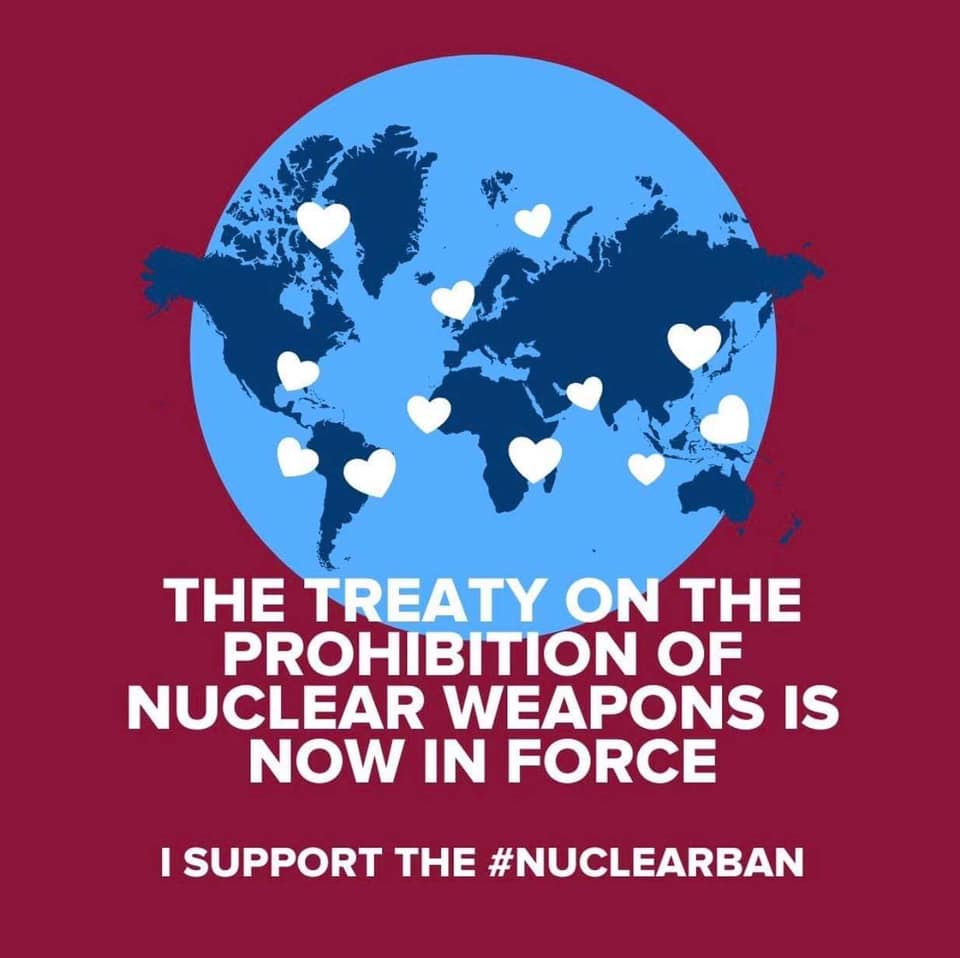
At the United Nations in October, Australia formally ended five years of opposition to the 2017 Treaty on the Prohibition of Nuclear Weapons. Rather than voting against an annual UN General Assembly resolution urging countries to join the landmark treaty – as it had done in previous years under its former conservative government – Australia abstained for the first time. Campaigners welcomed this shift as a “small but important step forward”.
Indonesia and New Zealand, two of Australia’s closest neighbours, also praised the move. The Indonesian ambassador to Canberra, Siswo Pramono, said the change would “give encouragement to others to believe that we are on the right path” in seeking a world free of nuclear weapons: “Your voice matters. Your stance matters.” New Zealand’s foreign ministry said it was “pleased to observe a positive shift” in Australia’s position and “would, of course, welcome any new ratifications as an important step to achieving a nuclear-weapon-free world”.
But the United States warned Australia against joining the treaty, arguing it could hamper defence arrangements with its allies, as the treaty “would not allow for US extended deterrence relationships, which are still necessary for international peace and security”. It added: “The United States does not believe that progress toward nuclear disarmament can be decoupled from the prevailing security threats in today’s world.”

ICAN Australia’s director, Gem Romuld, said Australia must make its own decision on joining the TPNW based on the will of the Australian people. “It’s no surprise that the US don’t want their allies to sign on, because if we claim protection from their so-called ‘nuclear umbrella’ then it helps justify their continued retention and possible use of these illegal and indiscriminate weapons,” she said. An opinion poll in March found 76 per cent of Australians support signing the TPNW, with 6 per cent opposed and 18 per cent undecided.
Until last month’s UN vote, Australia was the only member of a regional nuclear-weapon-free zone treaty to oppose the annual resolution on the TPNW. Nuclear-weapon-free zones cover 116 countries, including all those in Southeast Asia and the South Pacific – many of which were instrumental in the negotiation and adoption of the TPNW in 2017. Under the 1985 South Pacific Nuclear Free Zone Treaty, Australia accepted a legal obligation never to acquire nuclear weapons or host them on its territory.
Following the election of a Labor government this May, Australia began a reassessment of its position on the TPNW. According to the foreign ministry, it is examining a number of important questions “to inform [Australia’s] approach to the TPNW in close consultation with partners, and civil society stakeholders”. Specifically, it is “taking account of the need to ensure an effective verification and enforcement architecture, interaction of the [TPNW] with the Nuclear Non-Proliferation Treaty (NPT) and achieving universal support”.
The review stems from a resolution adopted by the Australian Labor Party at its national conference in 2018, which committed the party to sign and ratify the TPNW in government after considering the above factors. Anthony Albanese, the Labor leader and new prime minister, initiated the resolution. He said at the time: “Our commitment to sign and ratify the nuclear weapon ban treaty in government is Labor at its best.” The party reaffirmed its position in 2021.
Three in four federal Labor parliamentarians, including Mr Albanese, have also individually pledged to work for Australia’s signature and ratification of the treaty. So too have parliamentarians from the Australian Greens and other parties. In September, 10 independent federal parliamentarians issued a joint statement urging the Labor government to “make use of every opportunity to advance Australia’s position in support of the [TPNW]”, and a cross-party parliamentary friendship group for the TPNW was formed.
As evidence of the Labor government’s “constructive engagement” with the TPNW, Australia attended as an observer the first meeting of states parties to the TPNW in Vienna in June. Susan Templeman, a Labor parliamentarian, headed the official delegation. Ahead of the meeting, 55 former Australian ambassadors and high commissioners sent a letter to the prime minister urging him to act swiftly on Labor’s pre-election pledge to sign and ratify the treaty.
“Membership of the TPNW is compatible with Australia’s alliance commitments and will make a positive contribution to the security objectives we share,” the ex-diplomats wrote. “We have previously signed and ratified treaties – on landmines, cluster munitions and nuclear testing – to which the United States is not a party.” Notably, three other Asia–Pacific countries designated by the United States as major non-NATO allies are TPNW states parties: New Zealand, the Philippines and Thailand.
According to the Albanese government, it “shares the ambition of TPNW states parties of a world without nuclear weapons and is committed to engaging constructively to identify possible pathways towards nuclear disarmament”. Its decision to attend the first meeting of states parties, its abstention on the recent UN vote, and its ongoing engagement with civil society organisations, including ICAN, reflect this commitment.
While a formal cabinet decision to support and join the TPNW is still pending, the government’s initial steps in this direction are cause for optimism. “We look forward to a formal decision by the Albanese government to sign and ratify the TPNW – in line with its pre-election pledge,” said Ms Romuld. “The overwhelming majority of Australians support joining this treaty, and progress towards disarmament is more urgent than ever.”
Australia’s Science Minister Melissa Price closer to the Liberal Opposition than to Labor, as she backs small nuclear reactors to beat climate change,
Cain Andrews, Broome Advertiser13 November 2022
https://thewest.com.au/news/broome-advertiser/melissa-price-backs-nuclear-option-at-kimberley-economic-forum–c-8830423?utm_source=csp&utm_medium=portal&utm_campaign=Isentia&token=I%2B8Lt5WlhmDNscyeuxIQVQFzxLQ5%2B1qpkHjt6nRSfUzPC3SzvTQhzcbYGKkZDsSmzHZw4gVfNhHWTYBPdyPXwA%3D%3D
Durack MP Melissa Price called for Australia to adopt nuclear power to tackle climate change.
Speaking at the Kimberley Economic Forum on November 10, Ms Price said that the Coalition failed to effectively communicate its climate policy heading into the election, and the Opposition was now calling for an “informed and honest debate” on how nuclear technologies can be part of Australia’s decarbonisation mix over the next four years.
Echoing Federal Opposition Leader Peter Dutton, Ms Price cited new reactor technologies, Australia’s large uranium deposits and the potential to lower power prices as key factors in the Coalition’s advocacy for nuclear energy.
“Australians are hungry for affordable, reliable and secure sources of power that emit zero emissions,” Ms Price said.
“And while renewables play a huge part in painting this picture, it’s at times when the wind is not blowing and the sun’s not shining, that nuclear could play its part.
“In fact, there’s over 70 designs of small modular reactors that are currently in development or construction in 18 separate countries.”
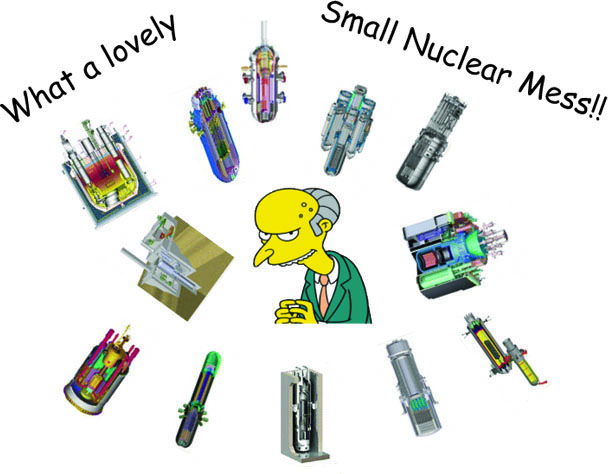
Despite her comments, one of Australia’s leading scientific agencies, the Commonwealth Scientific and Industrial Research Organisation , still views nuclear power as a non-starter, even with new reactor technologies.
A CSIRO report released in June found there was “no prospect” of nuclear small modular reactors being introduced to Australia in the next decade given the technology’s “commercial immaturity and high cost”.
It also found renewables such as solar and wind remained the “cheapest new-build electricity generation option in Australia”.
The Australian nuclear lobby is at it again. Nine right-wing rural senators push to change the laws on nuclear activities
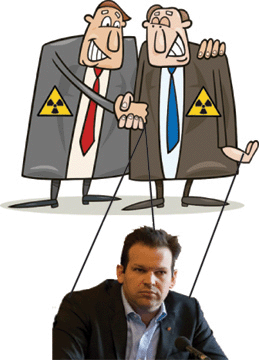
Senator Matt Canavan has a chequered history when it comes to his attitudes and statements on energy and resources
Sept 2021 Canavan cold on the push for nuclear power – and talked up the prospects of coal exports. “Obviously, if we can’t find a long-term solution for that level of waste it’s pretty hard to fathom that we could go beyond that for the production of nuclear energy that does produce a larger amount and more waste of a higher category to manage.”
Augus 31 21 Canavan tweeted called on Australia to boycott Glasgow, labelling the conference a “sham”
August 28 21 – lead the charge in his party’s anti-science war, with the CSIRO a main target
August 11 21 “Myself and Member for Flynn, Ken O’Dowd, we’re happy to have a nuclear power station in our backyard.”
Canavan was called out, in March 21 for his inaccurate hype about small nuclear reactors
.
“On 27 October 2022 the Senate referred the Environment and Other Legislation Amendment (Removing Nuclear Energy Prohibitions) Bill 2022 to the Environment and Communications Legislation Committee for inquiry and report by 31 March 2023.
The close date for submissions is 12 December 2022.
About this inquiry:
The bill would amend the Australian Radiation Protection and Nuclear Safety Act 1998 to remove the prohibition on the construction or operation of certain nuclear installations; and Environment Protection and Biodiversity Conservation Act 1999 to remove the prohibition on the Minister for Environment and Water declaring, approving or considering actions relating to the construction or operation of certain nuclear installations. https://www.aph.gov.au/Parliamentary_Business/Committees/Senate/Environment_and_Communications/Nuclearprohibitions?fbclid=IwAR1ZJyT5tShsXWXm9q2XGv4aHPnN7r_gj6V1VNNNmET3YAfCQWG7RSJ21bQ
The leader is this push is Senator Matt Canavan, Strangely, Canavan resigned from the task of being in charge of the nuclear waste dump program, in order to pursue his own politcal ambitions in a spill in the National Party.
Others include Jacinta Yangapi Nampijinpa Price– Country Liberal Party, (Northern Territory)
David Julian Fawcett – Liberal Party, (SA), Alex Antic – Liberal (SA) David Van -Liberal Party (Victoria), Ross Cadel – National Party (NSW), Gerard Rennick – Liberal National Party ( Queensland)
·Note from Kazzi Jai – at Fight to stop a nuclear waste dump in South Australia
I’ll get back to you on this, but judging by last Thursday’s Senate Estimates, it sounds like there is again a push for nuclear energy by vested interests….Seems people like Matt Canavan – the Senator who RESIGNED from being Minister in charge of the dump SO THAT HE COULD PURSUE HIS OWN POLITICAL AMBITIONS in a spill in the Nats….and now crows about putting SCIENCE into these debates AND NOT POLITICS – absolutely LAUGHABLE….anyway he OPENED the Global Uranium Conference 2022 last week
AND he was in my opinion disruptive in the Senate Estimates sitting, interjecting when Minister Ayres was answering a question FROM A DIFFERENT SENATOR! Matt Canavan was given A LOT OF LATTITUDE in my opinion from the Seat…..GIVEN ALSO THAT BOTH HOUSES OF PARLIAMENT ARE NOT RULED BY THE COALITION! Seems OLD HABITS die hard!
Australia “should not face intimidation from so-called allies under the auspices of defense cooperation”

Australia “should not face intimidation from so-called allies under the auspices of defense cooperation,” said Kate Hudson, general secretary of the Campaign for Nuclear Disarmament. “The TPNW offers the best chance for lasting global peace and security and a clear road map for nuclear disarmament.”
‘So Irresponsible’: US Condemned for Warning Australia Against Joining Anti-Nuclear Treaty.
Australia “should not face intimidation from so-called allies under the auspices of defense cooperation,” said one advocate. https://www.themoscowtimes.com/2022/11/08/russia-us-eye-nuclear-arms-reduction-talks-in-coming-weeks-kommersant-a79313 JULIA CONLEY, November 9, 2022, Anti-nuclear weapons campaigners rebuked the Biden administration on Wednesday over its opposition to Australia’s newly announced voting position on the Treaty on the Prohibition of Nuclear Weapons, which could signal the country’s willingness to sign on to the agreement.
As The Guardian reported, the U.S. Embassy in Canberra warned Australian officials that the Labour government’s decision to adopt an “abstain” position regarding the treaty—after five years of opposing it—would obstruct Australia’s reliance on American nuclear forces in case of a nuclear attack on the country.
Australia’s ratification of the nuclear ban treaty, which currently has 91 signatories, “would not allow for U.S. extended deterrence relationships, which are still necessary for international peace and security,” the embassy said.
The U.S. also claimed that if Prime Minister Anthony Albanese’s government ratifies the treaty it would reinforce “divisions” around the world.
Australia “should not face intimidation from so-called allies under the auspices of defense cooperation,” said Kate Hudson, general secretary of the Campaign for Nuclear Disarmament. “The TPNW offers the best chance for lasting global peace and security and a clear road map for nuclear disarmament.”
The TPNW prohibits the development, testing, stockpiling, use, and threats regarding the use of nuclear weapons.
The Australian chapter of the International Campaign to Abolish Nuclear Weapons (ICAN) noted that Albanese’s vocal support for achieving nuclear disarmament puts him in line with the majority of his constituents—while the U.S., as one of nine nuclear powers in the world, represents a small global minority.
According to an Ipsos poll taken in March, 76% of Australians support the country signing and ratifying the treaty, while only 6% are opposed.
Albanese has won praise from campaigners for his own anti-nuclear advocacy, with the prime minister recently telling The Australian that Russian President Vladimir Putin’s nuclear saber-rattling “has reminded the world that the existence of nuclear weapons is a threat to global security and the norms we had come to take for granted.”
“Nuclear weapons are the most destructive, inhumane, and indiscriminate weapons ever created,” Albanese said in 2018 as he introduced a motion to commit the Labour Party to supporting the TPNW. “Today we have an opportunity to take a step towards their elimination.”
Labour’s 2021 platform included a commitment to signing and ratifying the treaty “after taking account” of factors including the development of “an effective verification and enforcement architecture.”
Australia’s decision to change its voting position comes as the U.S. is planning to deploy nuclear-capable B-52 bombers to the country, where the weapons will be positioned close enough to strike China.
Gem Romuld, Australia director of ICAN, said in a statement that “it’s no surprise the U.S. doesn’t want Australia to join the ban treaty but it will have to respect our right to take a humanitarian stance against these weapons.”
“The majority of nations recognize that ‘nuclear deterrence’ is a dangerous theory that only perpetuates the nuclear threat and legitimizes the forever existence of nuclear weapons, an unacceptable prospect,” Romuld added.
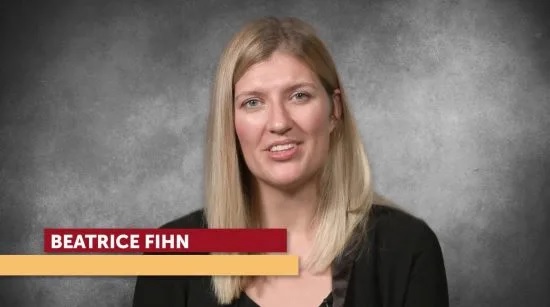
Beatrice Fihn, executive director of ICAN, called the U.S. embassy’s comments “so irresponsible.” “Using nuclear weapons is unacceptable, for Russia, for North Korea, and for the U.S., U.K., and all other states in the world,” said Fihn. “There are no ‘responsible’ nuclear armed states. These are weapons of mass destruction and Australia should sign the TPNW!”
A Father Fights for His Son & What’s Left of Democracy
The film Ithaka, about the quest of Julian Assange’s father to save his son, makes its U.S. premiere on Sunday in New York City. It is reviewed by Joe Lauria.
By Joe Lauria
Special to Consortium News
To the extent that the media has covered the tragedy of Julian Assange at all, the focus has been on politics and the law.
Consortium News, which has provided perhaps the most comprehensive coverage of the prosecution under the Espionage Act of the WikiLeaks publisher, has also focused more on the case and less on the man.
The great issues involved transcend the individual: war, diplomacy, official deception, high crimes, an assault on press freedom and on the core of what little democracy is left in a militarized and money-corrupted system.
Assange supporters sometimes also overlook the person and concentrate instead on the larger issues at stake. Ironically, it has been Assange’s enemies and detractors who’ve long focused on the person in the worst tradition of ad hominem assaults.
He has been attacked to deflect public attention from what WikiLeaks has revealed, from what the state is doing to him and to hide the impact on freedom in the media and standards in the courtroom.
There has been a steady and organized stream of smears against Assange, from ridiculous stories about him smearing feces on Ecuadoran Embassy walls to the widely reported falsehood that he was charged with rape. That case was dropped three times before any charges were filed, but the “rape” smear persists.
These personal attacks were planned as far back as March 8, 2008 when a secret, 32-page document from the Cyber Counterintelligence Assessment branch of the Pentagon described in detail the importance of destroying the “feeling of trust that is WikiLeaks’ center of gravity.” The leaked document, which was published by WikiLeaks itself, said: “This would be achieved with threats of exposure and criminal prosecution and an unrelenting assault on reputation.”
An answer to these slurs and the missing focus on Assange as a man is Ithaka. The film, which makes its U.S. premiere Sunday night in New York, focuses on the struggle of Assange’s father, John Shipton, and his wife, Stella Assange, to free him.
f you are looking for a film more fully explaining the legal and political complexities of the case and its background, this is not the movie to see. The Spanish film, Hacking Justice, will give you that, as well as the more concise exposition in the brilliant documentary, The War on Journalism, by Juan Passarelli.
Ithaka, directed by Ben Lawrence and produced by Assange’s brother, Gabriel Shipton, humanizes Assange and reveals the impact his ordeal has had on the people closest to him.
The title comes from the poem of that name by C.P. Cavafy (read here by Sean Connery) about the pathos of an uncertain journey. It reflects Shipton’s travels throughout Europe and the U.S. in defense of his son, arguably the most consequential journalist of his generation.
The story begins with Shipton arriving in London to see his son for the first time behind bars after the publisher’s rights of asylum were lifted by a new Ecuadoran government leading to him being carried out of the embassy by London police in April 2019.
“The story is that I am attempting in my own … modest way to get Julian out of the shit,” Shipton says. “What does it involve? Traipsing around Europe, building up coalitions of friendship.” He meets with parliamentarians, the media and supporters across the continent. Shipton describes the journey as the “difficulty of destiny over the ease of narrative.”……………………………
We learn that Julian Assange’s frustration with the inability to stop the 2003 Iraq invasion, despite the largest, worldwide anti-war protests in history, motivated him to start WikiLeaks.
The releases he published about the Iraq and Afghanistan wars, leaked by Army intelligence analyst Chelsea Manning, were published not only by WikiLeaks but by its partners at The New York Times, Die Spiegel and The Guardian, yet only Assange has been prosecuted.
The main focus of the film is the extradition hearing in Westminster Magistrate’s Court that began in February 2020 and ended in September of that year…………………………
One of several scenes that drives home the personal side of the story is audio of Assange speaking from Belmarsh Prison to Stella about what children’s books to read to their two sons. The toll it is taking on her is seen as she breaks down emotionally during the recording of a BBC interview that has to be paused.
“Extraditions are 99 percent politics and one percent law,” Stella says. “It is entirely the political climate around the case that decides the outcome. And that is shaped by the media. For many years there was a climate that was deliberately created through false stories, smears; through a kind of relentless character attack on Julian to reduce that support and make it more likely to successfully extradite him to the United States.”
“This is the public narrative that has been spread in the media for ten years,’ Nils Melzer, the now former U.N. Special rapporteur on torture, says in the film.
“No one has been able to see how much deception there is. Why is this being done? For ten years all of us were focused only on Julian Assange, when he never wanted it to be about him. It never was about him. It was about the States and their war crimes and their corruption. That’s what he wanted to put a spotlight on – and he did. And that’s what made them angry. So they put the spotlight on him.”
“He just needs to be treated like a human being,” says Stella, “and be allowed to be a human being and not denied his dignity and his humanity, which is what has been done to him.”
Ithaka makes its first theatrical showing in the U.S. at the SVA Cinema, 333 W. 23rd St, New York, N.Y., on Sunday, Nov. 13, at 7:45 pm. There will be a Q&A following the first screening with Ben Lawrence, Gabriel Shipton, Adrian Devant, cinematographer Niels Ladefoged, and John Shipton.
For ticket information: https://docnyc.net/film/ithaka/ https://consortiumnews.com/2022/11/11/a-father-fights-for-his-son-whats-left-of-democracy/
Memo G20 – there is a greater enemy than China to fight
But Australia’s biggest diplomatic effort is going into creating a bifurcated world, preparing to fight another war for another imperial power, surrendering our sovereignty and our military in the process – and happy to remain in the rear on climate.
The Albanese Government shows no sign of changing course, plunging ahead with Australia’s biggest defence spend – submarines designed to sit off China’s coast as part of an offensive force – and hosting American long-range strategic bombers.
Michael Pascoe, The New Daily, 12 Nov 22,
When Earth faces an existential threat in the movies – aliens, rogue asteroids, that sort of thing – human beings unite to fight Armageddon.
Turns out real life isn’t like that.
Right now our quality of life and, for many millions, perhaps billions of people, their actual lives are in imminent danger. So what policy is Australia championing in the face of global disaster?
As a middle power that, in the past, has sometimes punched above its weight, what influence are we trying to exert to save the world? Unite and fight the killer aliens? Pool our talents to divert the asteroid? Nah.
We’re pushing for a hopelessly divided world, ignoring the real problem to fiddle about with less challenging matters, concentrating on supporting one superpower’s economic interests over another.
Tipping Points
Earth is approaching horrific climate change tipping points. It’s not a matter of an extra few tenths of a degree, some more monster bushfires and extra floods.
It’s about sudden collapse in the systems that sustain us.
But Australia’s biggest diplomatic effort is going into creating a bifurcated world, preparing to fight another war for another imperial power, surrendering our sovereignty and our military in the process – and happy to remain in the rear on climate.
The United States’ determination to exert its global primacy isn’t the main game. Much of the world understands that, but not our insular Anglosphere and certainly not the group think that pervades Canberra.
Once Australia hoped to be a bridge between the US and China. That hope was dashed by the gross ineptitude and crass stupidity of the Morrison government, leaping at the opportunity to out Sinophobe the Americans, locking Australia into America’s confrontational agenda.
The Albanese Government shows no sign of changing course, plunging ahead with Australia’s biggest defence spend – submarines designed to sit off China’s coast as part of an offensive force – and hosting American long-range strategic bombers.
“It makes sense to actually normalise the relationships,” Mr Albanese said before heading off to Asia for ASEAN and G-20 summits and, hopefully, a meeting with President Xi.
“We want to see a stabilisation in the relationship.”
Upping the ante
Upping the offensive weaponry ante seems a strange way of normalising a relationship while demanding China roll back the trade penalties imposed after Morrison’s diplomatic blundering. (And regarding Mr Albanese’s alleged “$20 billion” trade sanctions – the figure is bogus. Our wine industry has certainly been hurt, but our other commodity exports have had no trouble finding other markets paying just as well, if not better. Ask any coal miner.)
Back in the main game, climate change doesn’t seem to figure as a headline issue for Mr Albanese at the G20. And it seems not to be for US President Biden ahead of his meeting with President Xi. He is more interested in establishing rules for dividing the world.
Meanwhile, the COP27 climate change summit is underway in Egypt. All the news coming out of it ranges from bad to worse.
Joe Biden is dropping in on his way to Asia. Prime Minister Albanese is skipping it. The approaching climate change tipping points are a very real threat to Australia. Despite what you’re likely to hear on television and read in the mainstream newspapers, China is not.
We won’t be serious about climate change until it is seen as a human problem, not one with national borders. Like COVID, borders don’t register with greenhouse gases. One of the issues at COP27 is rich nations (high carbon intensity people) needing to pay to help poor nations (low carbon intensity people) move to sustainable energy.
Caught in bizarre inertia
Australians are among the world’s very worst polluters. Our previous and present governments prefer not to look at the problem like that, the Albanese government is content with being a little less worse on climate than the coalition governments of the previous nine years………… https://thenewdaily.com.au/opinion/2022/11/12/michael-pascoe-g20-china/
Climate change, not China, is Australia’s real security danger

The definitive case against nuclear subs The Saturday Paper, Albert Palazzo -adjunct professor at UNSW Canberra. He was a former director of war studies for the Australian Army. November 12, 2022 “……………………………………………………………. Too many security officials hold to the mistaken belief that China is the most significant threat Australia faces. In fact, climate change deserves the top spot. Climate scientists, United Nations officials and military commanders themselves, including current US Secretary of Defense Lloyd Austin, consider climate change an existential threat to survival. Any threat posed by China is much more limited. At worst, China’s challenge to the US-led world order could result in America’s withdrawal from the Western Pacific. Climate change could lead to the end of the human project and take countless other species down with us.
China represents, at most, a second-order threat, but it is China that draws the obsessive focus of much of the current generation of security thinkers. It does not make sense for Australia to invest so much in a weapon system that has no utility against the nation’s most dangerous threat, yet this is what is happening.
Advocates of nuclear-powered submarines also propose that constructing these vessels in Adelaide will help sustain a sovereign shipbuilding industry. In fact, the opposite is the likely result. Once in service these vessels will actually increase Australia’s dependence on the US and foreign contractors. This is because many of the sub’s critical components, weapons and systems will be made by foreign parties. Australian sailors might even need shadow US sailors to co-staff technical positions until Australia generates enough nuclear-savvy personnel of its own.
The government has announced it will invest between $168 billion and $183 billion in what it has called a national naval shipbuilding enterprise, with the goal of sustaining and growing a domestic shipbuilding capability and securing Australian jobs for the future. Such a capability is a noble goal, but what has been left unexplained is why it should be such a priority compared with foreign-dominated industries that are more critical to the nation’s future wellbeing.
Last summer, for example, Australian transport risked grinding to a halt as a result of the urea crisis, which led to a serious shortage of AdBlue, a vital diesel fuel additive. Without AdBlue, the nation’s fleet of long-haul trucks would have stopped moving, resulting in supermarkets running out of food, farmers not harvesting their crops and the mining industry coming to a halt. Yet there has been no talk of taxpayer-supported AdBlue production in Australia. Similarly, many medicines are imported, as are a host of important everyday items, such as baking powder and matches. Unlike shipbuilding, these industries apparently warrant no support.
If one wanted a truly sovereign defence industry, then the product that might mandate the level of support proposed for the subs is microchips. Virtually all military and civilian technology contains chips, yet Australia is happy to remain fully reliant on overseas suppliers for this most important of components. Establishing a domestic industry would require a huge subsidy, as well as additional investment in tertiary education and precursor manufacturing processes. Without these chips, however, no weapon system is truly sovereign.
So why the nuclear-powered subs, if they make so little sense? The obvious answer is to support the alliance. Instead of aiming for self-reliance, Australia has always preferred to seek the protection of a great power. But there is another reason: like a kid in a lolly shop, Australia has been given permission to buy the biggest treat on display. Nuclear-powered subs are one of America’s most closely guarded technologies. If Australia gets them, it will be a clear sign that, like Britain, we have been admitted to a very exclusive club, the inner sanctum of US security. What is missed, however, is that being in the inner sanctum generates a massive obligation – and some day that bill may fall due. https://www.thesaturdaypaper.com.au/opinion/topic/2022/11/12/the-definitive-case-against-nuclear-subs
Internal briefing reveals Northern Territory government approach to defence regarding AUKUS nuclear submarines
ABC By Jacqueline Breen 8 Nov 22
The Northern Territory government quietly approached the defence department seeking to discuss Australia’s nuclear submarine program, according to internal briefing documents.
Key points:
- Defence says it initiated talks with ‘priority’ states, while the NT approached the department for talks
- The NT government says a review of the Top End’s ‘suitability and readiness’ is underway
- A government advisor says nuclear submarines from the AUKUS partners could rotate through Darwin
Amid rising tensions in the Indo-Pacific region, Australia last year announced plans to build a fleet of nuclear submarines as part of the AUKUS defence pact with the United States and United Kingdom.
The NT’s interest in the nuclear submarines has been revealed in a defence department briefing given to the incoming Albanese government after the May election.
The briefing was released under Freedom of Information laws in September, but the NT’s approach to the department’s Nuclear-Powered Submarines Taskforce has not been previously reported.
Large parts of the undated brief were redacted but a short section on “stakeholder engagement” was published in full…………………………………
The ABC asked what the NT government had sought to discuss with the taskforce, including whether it included the prospect of hosting the nuclear submarines in Darwin harbour.
A spokesperson for Chief Minister Natasha Fyles said: “The NT government is undertaking a review to assess the Territory’s suitability and readiness to support the Federal Government.”………………….
Defence hints at ‘services and support’ that might be needed in Darwin harbour
Visiting Australian and international submarines are seen periodically in Darwin harbour.
But it is generally considered an unfavourable training ground or deployment point because of the long stretches of shallow waters stretching out from the coast.
A shortlist of three potential locations for a new base for the nuclear submarines — all of them on the east coast — was announced in the lead up to the federal election…………………………
US and UK nuclear subs should rotate through Darwin, advisor says
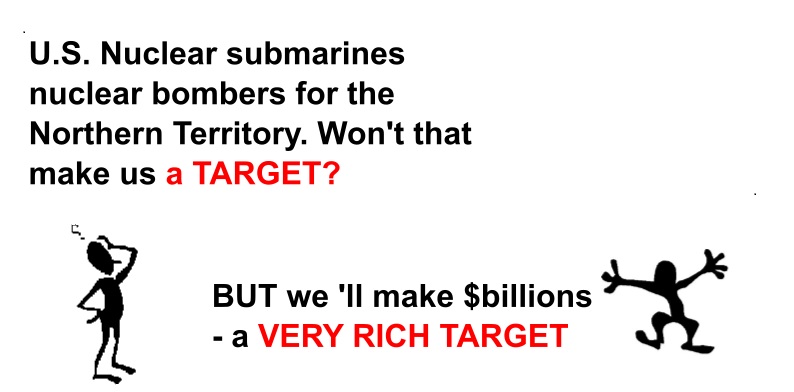
Last week, Four Corners revealed plans for the deployment of up to six nuclear-capable American B-52 bombers in the Top End, as part of an ongoing expansion of military activity in Australia’s north.
Following the report, deputy chief minister Nicole Manison was asked whether the deployment would put the NT at greater risk from potential adversaries………..
Defence and national security are among the key “growth” sectors the NT government hopes will drive its ambitious push to achieve a $40 billion economy by 2030.
To help maximise defence investment in the Top End, Labor created the Canberra-based position of Defence and National Security Advocate to lobby government and industry on the NT’s behalf.
The current advocate, defence analyst Alan Dupont, declined an interview request.
But he has previously argued for an NT role in the transition to nuclear boats, which may not be ready before Australia’s current conventional fleet needs replacing.
“The navy’s nuclear-powered submarines are unlikely to be in the water much before 2040,” he wrote after the AUKUS deal was announced.
“Having our submariners train and operate as joint crews on American and British nuclear submarines rotating through Darwin and Perth would help fill the looming submarine capability gap.” https://www.abc.net.au/news/2022-11-08/nt-govt-seeking-involvement-aukus-nuclear-submarine-program/101585724
1 This month
7 April – WEBINAR – Australia and the Doomsday Clock – Preventing nuclear war through NoFirstUse and other policies
Online | Tuesday April 7, 4:00-5:30pm, Australian Eastern Time / 8:00-9:30am Central Europe Time
– Access the registration link
15 April – Zoom –Nuclear Power is Not the Solution
Apr 15, 2026 01:00 AM in Canberra, Melbourne, Sydney

Join the International Physicians for the Prevention of Nuclear War (IPPNW) on Tuesday, April 14th for a timely webinar exploring the risks associated with nuclear power and challenging the myth that it offers a simple, safe, carbon-free solution to the climate crisis

21 April Webinar: No Nuclear Weapons in Australia
Start: 2026-04-21 18:00:00 UTC Canberra, Melbourne, Sydney (GMT+10:00)
End: 2026-04-21 19:30:00 UTC Canberra, Melbourne, Sydney (GMT+10:00)
Event Type: Virtual
A virtual link will be communicated before the event.
Host Contact Info: australia@icanw.org

of the week – Australians for War Powers Reform (AWPR)
To see nuclear-related stories in greater depth and intensity
 Antinuclear