US Air Force to deploy nuclear-capable B-52 bombers to Australia
The US Air Force is preparing to deploy up to six nuclear-capable B-52 bombers to northern Australia in a show of “nuclear deterrence” to China.
news.com.au Frank Chung @franks_chung, October 31, 2022 ,
The US Air Force is preparing to deploy up to six nuclear-capable B-52 bombers to northern Australia in a show of “nuclear deterrence” to China, amid growing fears of an invasion of Taiwan.
According to an investigation by the ABC’s Four Corners airing on Monday, Washington has drawn up plans to build a dedicated a “squadron operations facility” at the Tindal air base south of Darwin that will house “six B-52s”.
The giant aircraft, with wingspan of 56 metres, have a combat range of more than 14,000 kilometres and are capable of delivering both nuclear and conventional weapons.
Documents obtained by Four Corners show the planned facilities, which will include a parking area and adjoining maintenance centre, will be used for “deployed B-52 squadrons”.
“The ability to deploy US Air Force bombers to Australia sends a strong message to adversaries about our ability to project lethal air power,” the US Air Force told the program.
The Defence Department has been contacted for comment.
According to the program, the Tindal air base plan — expected to cost up to $US100 million and be completed by 2026 — is part of a much larger upgrade of defence assets across northern Australia, including the Pine Gap spy base.
Anti-nuclear activist Richard Tanter from the Nautilus Institute told Four Corners the move greatly expanded Australia’s commitment to any US war with China.
“It’s a sign to the Chinese that we are willing to be the tip of the spear,” he said.
“It’s very hard to think of a more open commitment that we could make. A more open signal to the Chinese that we are going along with American planning for a war with China.”
The plans were hinted at in last year’s annual Australia-United States Ministerial (AUSMIN) meetings, which agreed for “enhanced air co-operation” which would see “rotational deployment of US aircraft of all types in Australia”, although B-52s were not explicitly mentioned……………………..
NSW Greens Senator David Shoebridge slammed the “dangerous escalation”.
“It makes Australia an even bigger part of the global nuclear weapons threat to humanity’s very existence — and by rising military tensions it further destabilises our region,” he said……………………………………………………. more https://www.news.com.au/technology/innovation/military/us-air-force-to-deploy-nuclearcapable-b52-bombers-to-australia/news-story/dd7cc13dc270dbabb332cc200e279b7c
Government Confirms No Nuclear for Australia, At Least Any Time Soon

https://www.gizmodo.com.au/2022/10/australia-nuclear-energy/ Asha Barbaschow, October 31, 2022 “……………………………… Addressing Senate Estimates on Friday, representatives from the Department of Prime Minister and Cabinet put this to bed.
Summarising the government’s position, the department’s acting deputy secretary for the economy, industry and G20, James Chisholm, said the cheapest form of new energy for investment is renewable energy. We’ve got too much sun and wind to not make the most of it.
That is because it has zero marginal cost,” he said.
“By that I mean there’s a cost associated with building it, seeking approval for it and its initial construction, but once that happens it doesn’t have the same costs associated with it that traditional base-load generation, whether it’s coal-fired or nuclear, has.”
There are a lot of costs associated with those forms of energy, with the CSIRO forecasting that small nuclear modular reactors would have a levelized cost of energy of between $136 and $326 per megawatt hour in 2030. Whereas the levelized cost of energy such as renewable energy is a lot lower.
“It would be estimated to cost between something like $53 to $82 per megawatt hour,” Chisolm explained.
“Really importantly, that includes firming costs.
“Often what happens is people look at these figures and say, ‘Yes, but with renewables you’re not factoring in firming and integration costs.’ But the CSIRO work does factor that in. According to CSIRO, and this is consistent with other analyses, it comes in way cheaper. And that flows through to bills.”
Although this report was published a few months ago, Chisholm said as time goes on, that cost comparison becomes more stark.
“We’re seeing it play out in other markets. If you look at those markets where nuclear power is a significant proportion of the generation mix, nuclear is experiencing the same challenges that coal-fired generation has experienced, simply because of how high the cost is. When it comes to competitive markets for energy, it is difficult for those forms of energy to compete with renewables, particularly for firmed renewables,” he said.
Well, there you have it.
The Pentagon builds a network in our Australian Department of Defence amidst media silence

https://johnmenadue.com/pentagon-takes-over-australias-defence-policies-amidst-media-silence/ By John MenadueOct 29, 2022,
It is more than inter-operability and inter-changeability with the US military. Anthony Albanese and Richard Marles need to break up the American network in our Department of Defence that the Washington Post has exposed.
The Washington Post has found that a retired US Admiral is ‘now a Deputy Secretary of Defense for Australia’.
I wonder how the Admiral handles ASTEO documents- for Australian eyes only?
In the last few days in Pearls and Irritations, Mike Scrafton and Richard Tanter have exposed how retired US Admirals have been employed as highly paid consultants to shape our policies on submarines.
At the same time our media has shown no interest or concern. This is more than ‘foreign influence’. It looks more like foreign control.
As Paul Keating recently put it,‘our strategic sovereignty is being outsourced to another country, the US’.
It was the Washington Post, not our Corporate Media that has given us an insight into the abdication of responsibility of our politicians, public officials and journalists who have been on a Washington drip feed for so long. They have been captured by American interests, particularly the US military and industrial complex that former President Eisenhower warned us about.
Following the first Washington Post exposures, the authors then ran a webinar from which the Post has printed a Q and A.
The webinar includes the following:
“In court papers, the Justice Department and Pentagon officials were very clear about this: They argued that disclosing the documents might subject retired generals, admirals and others to embarrassment and/or harassment, and would be an invasion of their privacy.”
“We have more stories we’re working on – stay tuned. Congress has taken some half-steps in recent years to require the Pentagon to disclose more details about retired generals and admirals working for foreign governments. But the Pentagon hasn’t been very forthcoming. Maybe that will change now.”
Q: “What was something which personally shocked you during your investigation?
From Nate Jones:
“I was surprised to learn Admiral Stephen Johnson is now a deputy Secretary of Defense for Australia.”
From Craig Whitlock:
“I was surprised by how many retired U.S. generals went to work as advisors and consultants to the Saudi Crown Prince AFTER he approved the assassination of Saudi journalist Jamal Khashoggi in 2018. I mean, hello?”
Q: “Do they have to disclose anything about what they do?
From Nate Jones:
“Here is a sample of former national security advisor James Jones’s application. You can see he discloses some things in a page or two.”
From Craig Whitlock:
“The war in Yemen is a good example of a terrible, unintended consequence. The Pentagon and State Dept have authorized more than 300 retired US military personnel to work as contractors or consultants for Saudi Arabia and UAE since 2015. During that time, KSA and UAE have bombed the heck out of Yemen, turning their civil war into a far worse humanitarian disaster. US has enabled that to a significant degree by allowing so many veterans to build up the KSA and UAE armed forces.”
From Craig Whitlock:
“With one exception, there were no instances of retired US personnel seeking to work for nations that the US govt categories as “foreign adversaries” eg., China, North Korea, Iran, Cuba or Venezuela. The lone exception was a retired US Air Force officer who sought – and received – approval to work for a satellite launch company owned by the government of Russia.”
The Washington Post revealed that one of the American consultants was (probably still is) being paid $6000 a day for his consultancy to Prime Minister Morrison, plus whatever he might have been receiving from Peter Dutton, plus presumably a fee for participating in a longer running US Defence project. No doubt he was also on some sort of “compensation” from the US Defence Industry. Presumably he was the mystery source when Dutton persisted in claims that he could get a couple of US submarines much earlier.
The inclusion of the UK in AUKUS was only a cover for the US/Australia deal.
But all the $10m of funding to US Admirals is of lesser concern than the peddling of US interference in our national security debate. We have known all along that the need for the submarines stemmed from concerns in the US defence community years ago about the so-called “submarine gap” in the containment ring around China – which they intended Australia to fill. And we would pay for it!
And all of that has been borne out by the relentless pressure applied recently by US service chiefs and Pentagon officials to promote so shamelessly major new Australian defence procurement in advance of the Smith/Houston review.
While Morrison and Dutton created the astonishing network, it appears that Albanese and Marles have not moved to break it up. They should do so quickly.
This has all the makings of a major can of worms which both major parties will be keen to keep the lid on.
This is not just a national disgrace. It is positively dangerous.
Malcolm Fraser called the US a dangerous ally.
I have written many times about how we are joined at the hip to an ally that is almost always at war. And we keep tagging along in one US defeat after another. The US is now goading China.
Our future is not to be a spear carrier for the US in our region. Our future is learning to live securely in our own region.
China is not going away but the US ultimately will.
Our captured corporate media will not examine the offence to our national dignity that the Washington Post has exposed. Our media has abandoned all pretence of independence and professionalism.
Can our Parliament rouse itself and help restore some trust in our institutions and expose what is going on?
John Menadue is the Founder and Editor in Chief of Pearls and Irritations. He was formerly Secretary of the Department of Prime Minister and Cabinet under Gough Whitlam and Malcolm Fraser, Ambassador to Japan, Secretary of the Department of Immigration and CEO of Qantas.
Australia changes policy tack – moves in the direction of supporting the UN Treaty on the Prohibition of Nuclear Weapons.

Australia drops opposition to treaty banning nuclear weapons at UN vote
After former Coalition government repeatedly sided with US against it, Labor has shifted position to abstain
https://www.theguardian.com/world/2022/oct/29/australia-drops-opposition-to-treaty-banning-nuclear-weapons-at-un-vote— Daniel Hurst, 29 Oct 22,
Australia has dropped its opposition to a landmark treaty banning nuclear weapons in a vote at the United Nations in New York on Saturday.
While Australia was yet to actually join the Treaty on the Prohibition of Nuclear Weapons, the shift in its voting position to “abstain” after five years of “no” is seen by campaigners as a sign of progress given the former Coalition government repeatedly sided with the United States against it.
The foreign affairs minister, Penny Wong, said through a spokesperson that Australia had “a long and proud commitment to the global non-proliferation and disarmament regime” and that the government supported the new treaty’s “ambition of a world without nuclear weapons”.
The previous Coalition government was firmly against the Treaty on the Prohibition of Nuclear Weapons, a relatively new international agreement that imposes a blanket ban on developing, testing, stockpiling, using or threatening to use nuclear weapons – or helping other countries to carry out such activities.
Australia voted against opening negotiations on the proposed new treaty in late 2016 and did not participate in those talks in 2017. Since 2018 it has voted against annual resolutions at the UN general assembly and first committee that called on all countries to join the agreement “at the earliest possible date”.
That changed early on Saturday morning when Australia shifted its voting position to abstain. Indonesia, New Zealand, Malaysia and Ireland were among countries to co-sponsor this year’s supportive UN resolution.
Australia traditionally argued the treaty would not work because none of the nuclear weapons states had joined and because it “ignores the realities of the global security environment”.
It also argued joining would breach the US alliance obligations, with Australia relying on American nuclear forces to deter any nuclear attack on Australia.
But the treaty has gained momentum because of increasing dissatisfaction among activists and non-nuclear states about the outlook for disarmament, given that nuclear weapons states such as the US, Russia and China are in the process of modernising their arsenals.
The treaty currently has 91 signatories, 68 of which have formally ratified it, and it entered into force last year.
The Nobel peace prize-winning International Campaign Against Nuclear Weapons (Ican) had been urging Australia to vote in favour of the UN resolution on Saturday – or at least abstain in order to “end five years of opposition to the TPNW under the previous government”.
Three in four members of the Labor caucus – including Anthony Albanese – have signed an Ican pledge that commits parliamentarians “to work for the signature and ratification of this landmark treaty by our respective countries”.
Labor’s 2021 national platform committed the party to signing and ratifying the treaty “after taking account” of several factors, including the need for an effective verification and enforcement architecture and work to achieve universal support.

These conditions suggest the barriers to actually signing may still be high. But Gem Romuld, the Australia director of Ican, said the government was “heading in the right direction” and engaging positively with the treaty.
Romuld said it “would be completely self-defeating to wait for all nuclear-armed states to get on board” before Australia joined.
“Indeed, no disarmament treaty has achieved universal support and Australia has joined all the other disarmament treaties, even where our ally – the US – has not yet signed on, such as the landmine ban treaty,” Romuld said.
In 2017 the US, the UK and France declared that they “do not intend to sign, ratify or ever become party” to the new treaty, and the Trump administration actively lobbied countries to withdraw.
Wong told the UN general assembly last month that Australia would “redouble our efforts” towards disarmament because Russian president Vladimir Putin’s “weak and desperate nuclear threats underline the danger that nuclear weapons pose to us all”. https://www.theguardian.com/world/2022/oct/29/australia-drops-opposition-to-treaty-banning-nuclear-weapons-at-un-vote—
‘Small but important step’: Australia’s shift on treaty banning nuclear weapons applauded

Australia abstained from voting on the UN treaty banning nuclear weapons for the first time in five years. Previously, the country had opposed the treaty.
SBS News 29 Oct 22,
Anti-nuclear campaigners welcomed the shift in the Australian government’s position on a UN treaty banning the proliferation of nuclear weapons.
Australia was among 14 nations to abstain from voting. There were 43 nations who voted against the UN resolution co-sponsored by New Zealand, Indonesia, Malaysia and Ireland. A total of 124 nations voted in favour of the motion.

The Australian branch of the International Campaign to Abolish Nuclear Weapons (ICAN) described the move as “a small but important step forward”.
“ICAN looks forward to a formal decision by the Albanese government to sign and ratify the TPNW (the treaty) – in line with its pre-election pledge,” the group said.
The overwhelming majority of Australians support joining this treaty, and progress towards disarmament is more urgent than ever.”
ICAN said it was encouraging to see that the majority of nations stood united on the risks of nuclear war, particularly “in light of the war in Ukraine”.
It ends years of Canberra siding with the United States by actions on the treaty to ban the deadly weapons and comes as Australia looks to nuclear submarines to boost its navy…………………………………
Australia also recently faced criticism from nuclear powers for joining a Pacific push to help deal with the consequences of nuclear testing.
New Zealand, a signatory to the nuclear weapons ban, has previously pushed for Australia to join.
A total of 93 countries have signed the treaty, including 68 nations that have formally ratified it. https://www.sbs.com.au/news/article/small-but-important-step-australias-shift-on-treaty-banning-nuclear-weapons-applauded/j3cz2yr7l
Flaps up and blinkers on: politicians happy with the unknown unknowns of fighting war
the system had “failed utterly” when former prime minister John Howard “alone decided and authorised ADF lethal force elements to be joined with the US-led coalition invasion of Iraq … preceding the public announcement on March 18, 2003, only to be followed by the bombing of Iraq in the early hours of the following morning.
“Howard’s decision has since been revealed to have been based on false and misleading intelligence. History has also revealed serious defects in the decision to commit Australian forces to war in Vietnam, to Afghanistan, to Syria not to mention other secret clandestine intelligence collection operations in the post-WW2 period,”
Michael West Media by Zacharias Szumer | Oct 27, 2022,
When it comes to the powers vested in politicians to send Australians into foreign conflicts, the major parties stand by the cliche: if it ain’t broke don’t fix it. But the system is broken, as war reform advocates have told Zacharias Szumer.
For advocates of war powers reform, Labor’s recently announced Inquiry into International Armed Conflict Decision Making hasn’t got off to a promising start. The defence minister and defence subcommittee deputy chair have already come out against parliamentary approval for overseas military deployments, the desired reform that advocates are seeking.
The Minister of Defence, Richard Marles, has said he is “firmly of the view” that the current system is “appropriate and should not be disturbed”. In a letter referring the Inquiry into International Armed Conflict Decision Making to the Joint Standing Committee on Foreign Affairs, Defence and Trade, Marles said the current arrangements “enable the duly elected government of the day to act expeditiously on matters of utmost national importance in the interests of the safety and security of our nation and its people.”
Greens senator Jordon Steele-John, the party’s spokesperson for foreign affairs, peace and nuclear disarmament, told MWM that “Marles’ comments reflect a Labor Party that is self-conflicted. We see Richard Marles endorsing the current system, meanwhile many members of the Labor caucus are pushing for an inquiry.”
Labor MPs Julian Hill and Josh Wilson put forward the resolution at the last ALP conference that got the inquiry added to the party’s policy platform. The defence subcommittee, which is handling the inquiry, is chaired by Hill and also includes Wilson. However, the subcommittee doesn’t feature anyone from the Greens, who have long championed requiring parliamentary approval before overseas deployment of troops.
Liberal MP Andrew Wallace, the deputy chair of the defence subcommittee, recently told the Guardian that he was “surprised that the Labor Party is even contemplating” a change to a system that had “stood us in good stead for many many years.”
“The executive has got to be given the power to govern the country and particularly in relation to national security issues. I don’t care whether it’s Labor or Liberal – they can’t be hamstrung by the parliament,” he added.
Steele-John said that it was “sad to see Andrew Wallace and the Liberals so adamantly opposed to an inquiry on this matter, but transparency, investigating and making decisions based on that investigation are not the attributes of the party that thought invading Iraq was a good idea.”
Greens senator David Shoebridge, the party’s spokesperson for defence and veterans’ affairs, echoed Steele-John’s sentiments. “This is a disturbingly accurate insight into the attitude of the Coalition and many in Labor – they don’t want parliamentary democracy to get in the way of their ‘parties of government’ club. Imagine letting government be ‘hamstrung by parliament’,” the senator tweeted earlier in October.
“Seeing a democratically elected politician so readily reject oversight by parliament on “national security” issues should worry us all. Democracy is not optional in times of crisis or when the drumbeats of war start,” Shoebridge added.
Steele-John also questioned Marles and Wallace coming out against reform so soon after the inquiry was announced. “I hope to see all political parties and MPs approach this committee in good faith,” he said. “The ability for all MPs and parties to scrutinise the decision of ADF deployment will add a level of transparency and accountability designed to avoid repeating the catastrophic mistakes the executive government has made in the last 20 years,” he said.
Beyond the halls of parliament
Peter Hayes, a former RAAF group captain and Vietnam War veteran, told MWM that he was “disappointed” by Marles’ statement, which he said “seemed to pressure the Inquiry rather than to await with an open mind its conclusions and recommendations.”
“The inquiry could have accepted submissions from the Defence Department and others without any need for Minister Marles to make his personal views public,” said Hayes, who has also previously served as Director of Information Warfare at Australia’s Air Command Headquarters.
Hayes also took issue with Wallace’s argument that the current system had “stood us in good stead for many many years”, saying that the system had “failed utterly” when former prime minister John Howard “alone decided and authorised ADF lethal force elements to be joined with the US-led coalition invasion of Iraq … preceding the public announcement on March 18, 2003, only to be followed by the bombing of Iraq in the early hours of the following morning.”
“Howard’s decision has since been revealed to have been based on false and misleading intelligence. History has also revealed serious defects in the decision to commit Australian forces to war in Vietnam, to Afghanistan, to Syria not to mention other secret clandestine intelligence collection operations in the post-WW2 period,” Hayes added………………………………….
if the aim is to minimise threats against Australia or its citizens, Fernandes does not believe the system has kept us in “good stead”:
In Afghanistan, the real objective was to show Australia’s relevance to the United States. We stayed because of US domestic politics rather than the military situation on the ground. After the Taliban’s comeback in 2008, the Obama administration did not want to be attacked in domestic elections for being unable to defeat the Taliban. And we can see the results – in 2001, Islamic terrorists were based in Kabul, Kandahar, Jalalabad and a few pockets of rural Afghanistan. Twenty years later, the Taliban is back in power, and US wars – enabled by the intelligence facility at Pine Gap – have resulted in a massive expansion of terrorist activity across the globe.
Fernandes’ book Island Off the Coast of Asia contains a proposal for a new system under which the Australian parliament would have greater control over military deployments. He will reportedly be making a submission to the inquiry based on this proposal.
Public submissions to the inquiry are open until November 18. https://michaelwest.com.au/flaps-up-and-blinkers-on-politicians-happy-with-the-unknown-unknowns-of-fighting-war/
Wong, Marles schedule US trip as nuclear submarine deadline nears
Financial Review, Andrew TillettPolitical correspondent, 26 Oct 22,
Annual top-level foreign affairs and defence talks will be held in Washington in December, allowing senior officials to lock down final details over Australia’s planned purchase of nuclear-powered submarines before the Albanese government publicly outlines its plans for the multibillion-dollar project.
With this year’s federal budget eschewing major funding decisions in the defence portfolio, The Australian Financial Review understands the US will for the third year running host the annual AUSMIN talks between the Australian and US governments………..
One defence source suggested that holding talks in the US would result in the ministers being accompanied by a bigger-than-usual cohort of Australian officials to speak to US counterparts from the Defence and Energy departments about the submarine project.
The nuclear submarine taskforce, which is examining the best options for Australia to acquire nuclear submarine technology from the US and UK under the AUKUS partnership, is due to report to the Albanese government in March after an 18-month study on what submarine to acquire, where it will be built, delivery timetable, cost and any interim measures required to avoid a capability gap.
Separately, former defence minister Stephen Smith and former Defence Force chief Angus Houston are conducting a Defence Strategic Review looking at the military’s weapons needs in light of deteriorating regional security. That review is also due in March.
Both reviews will outline billions of dollars in new spending for Defence that will need to begin to be accommodated when the next budget is handed down in May.
This year’s budget papers fail to reflect the significant increase in funding required for existing projects as construction gets under way in earnest…………………………….. more https://www.afr.com/politics/federal/wong-marles-schedule-us-trip-as-nuclear-submarine-deadline-nears-20221026-p5bsyp
Rex Patrick: has the Australian Senate lost its mojo?
Michael West Media, by Rex Patrick | Oct 25, 2022, “Powerful” or “piss-weak”? The Senate has greater powers than a royal commission yet in recent years its authority has declined amid refusals by the likes of the Defence Department, the Tax Commissioner and the government itself to cooperate with Senate orders. Former senator Rex Patrick on responsible government. ……………………….
Accountability in the Australian parliament
Both houses of parliament are empowered under Section 49 and Section 50 of the constitution to conduct oversight of government and to throw the light of publicity on its acts.
The powers are significant allowing MPs and senators to ask questions of ministers (as occurs at question time and through questions on notice) and to inquire, compel witnesses, order the production of documents and to deal with contempt. The strict powers of each house of the federal parliament are greater than those of a royal commission…………………………………………….
the appetite for dealing with contempt by the Houses has died, rendering the inquiry power impotent. Exercising a power when it shouldn’t be is inappropriate, but so too is not exercising the power when it should.
Yes minister, no senator
Of course, the House of Representatives doesn’t conduct government oversight. The powers of the houses are exercised through a vote of the majority of its members and the government, by definition, controls the house. It can suppress information or inquiries which are to its disadvantage, sometimes by refusing to supply information, sometimes by using its numbers to stop inquiries altogether.
It is the Senate that is the grand inquest of the nation. Or at least it should be. But it isn’t. It fails dismally.
The Senate seems satisfied with answers to question on notice that are both untimely and unsatisfactory. Most senators seem to just accept non-answers from officials at Senate estimates or politically infected and erroneous answers.
All too often, orders for the production of documents have been met with contempt, with the government trumping up untested and often bogus public interest immunity claims. In those cases where the Senate arguments are strong for the documents to be produced, the Senate does nothing except weaken itself.
Across my time in and around the Senate I witnessed contempt after contempt.
- On November 17, 2014, the Senate ordered the production of an economic modelling report into the impact of the future submarine project on the Australian economy. The Senate was refused access to it. I later obtained it using Freedom of Information (FOI) laws.
- On October 9, 2016, the Senate ordered the production of the French submarine design and mobilisation contract. The Senate was refused access to it. I later obtained it using FOI.
- On September 4, 2017, the Senate ordered the production of the Future Frigates. It had been given to overseas shipbuilders, but the Senate was refused access to it. I later obtained it under Freedom of Information laws.
- On November 16, 2017, the Senate ordered the production of information relating to Murray-Darling strategic water purchases. The government withheld crucial valuation information which, wait for it, was later released to me under FOI.
……………………………………. No privileges, thanks
The privileges committee, often erroneously characterised by the media as “very powerful”, is impotent. It’s made up of senators, who thanks to their weakness and partisan loyalties, are a disgrace compared to their British counterparts who have for centuries battled to ensure Parliament is supreme over the executive.
The committee’s two most recent reports say it all.
For two years the Department of Defence withheld documents from the Senate’s economics reference committee’s inquiry into naval shipbuilding. It unquestionably interfered with the progress of the committee’s inquiry, but the privileges committee failed to find this was a contempt. It’s finding weakened the Senate. Once can expect the government to do more of the same in the future……………………………..
Mojo lost
We often hear people call for a royal commission to get to the bottom of something. This is a strange call for two reasons.
Firstly, a royal commission is established by letters patent issued by the governor-general on the advice of government. Royal commissions are always for investigations in which the government is interested, not the people.
Secondly, the Senate has greater powers than a royal commission.
eople either subconsciously or consciously turn away from the Senate because they know it is weak. They know it has lost its mojo. And governments and bureaucrats know this better than anyone. So, it’s a vicious cycle in which the authority and power of the Senate continues to decline.
Its weakness is not the fault of the government and it’s not the fault of the Senate staff who do their best to support inquiries. It is exclusively the fault of senators.
The powers of the Senate have been established by convention. Unexercised, those conventions will turn into points of interest for historians. That would be a tragedy, because securing accountability of government is the very essence of responsible government. https://michaelwest.com.au/rex-patrick-has-the-australian-senate-lost-its-mojo/
A Political Solution for Assange: Jennifer Robinson at the National Press Club
The teeth in Robinson’s address lay in the urgency of political action. Assange is suffering a form of legal and bureaucratic assassination, his life gradually quashed by briefs, reviews, bureaucrats and protocols. “This case needs an urgent political solution. Julian does not have another decade to wait for a legal fix.”
https://theaimn.com/a-political-solution-for-assange-jennifer-robinson-at-the-national-press-club/ October 23, 2022, by: Dr Binoy Kampmark
It was telling. Of the mainstream Australian press gallery, only David Crowe of the Sydney Morning Herald and The Age turned up to listen to Jennifer Robinson, lawyer extraordinaire who has spent years representing Julian Assange. Since 2019, that representation has taken an even more urgent note: to prevent the WikiLeaks founder from being extradited to the United States, where he faces 18 charges, 17 confected from the archaic Espionage Act of 1917.
In addressing the Australian National Press Club, Robinson’s address, titled “Julian Assange, Free Speech and Democracy,” was a grand recapitulation of the political case against the WikiLeaks founder. Followers of this ever darkening situation would not have found anything new. The shock, rather, was how ignorant many remain about the chapters in this scandalous episode of persecution.
Robinson’s address noted those blackening statements from media organisations and governments that Assange was paranoid and could leave the Ecuadorian embassy, his abode for seven years, at his own leisure. Many were subsequently “surprised when Julian was served with a US extradition request.” But this was exactly what WikiLeaks had been warning about for some ten years.
In the Belmarsh maximum security prison, where he has resided for 3.5 years, Assange’s health has declined further. “Then last year, during a stressful court appeal hearing, Julian had a mini stroke.” His ailing state did not convince a venal prosecution, tasked with “deriding the medical evidence of Julian’s severe depression and suicidal ideation.”
The matter of health plays into the issue of lengthy proceedings. Should the High Court not grant leave to hear an appeal against the June decision by Home Secretary Priti Patel to order his extradition, processes through the UK Supreme Court and possibly the European Court of Human Rights could be activated.
The latter appeal, should it be required, would depend on the government of the day keeping Britain within the court’s jurisdiction. “If our appeal fails, Julian will be extradited to the US – where his prison conditions will be at the whim of intelligence agencies which plotted to kill him.” An unfair trial would follow, and any legal process citing the First Amendment culminating in a hearing before the US Supreme Court would take years.
The teeth in Robinson’s address lay in the urgency of political action. Assange is suffering a form of legal and bureaucratic assassination, his life gradually quashed by briefs, reviews, bureaucrats and protocols. “This case needs an urgent political solution. Julian does not have another decade to wait for a legal fix.”
Acknowledging that her reference to the political avenue was unusual for a lawyer, Robinson noted how the language of due process and the rule of law had become ghoulish caricatures in what amounts to a form of punishment. The law has been fashioned in an abusive way that sees a person being prosecuted for journalism in a hideously pioneering way. Despite the UK-US Extradition Treaty’s prohibition of extradition for political offences, the US prosecution was making much of the Espionage Act. “Espionage,” stated Robinson, “is a political offence.”
The list of abuses in the prosecution is biblically lengthy. Robinson gave her audience a summary of them: the fabrication of evidence via the Icelandic informant and convicted embezzler and paedophile Sigurdur “Siggi” Thordarson; the deliberate distortion of facts; the unlawful surveillance of Assange and his legal team and matters of medical treatment; “and the seizure of legally privileged material.”
Much ignorance about Assange and the implications of his persecution is no doubt willed. Robinson’s reference to Nils Melzer, the UN Special Rapporteur on Torture, was apt. Here was a man initially sceptical about the torture complaint made by Assange and his team. He had been convinced by the libel against the publisher’s reputation. “But in 2019, he agreed to read our complaint. And what he read shocked him and forced him to confront his own prejudice.”
Melzer would subsequently observe that, in the course of two decades working “with victims of war, violence and political persecution, I have never seen a group of democratic States ganging up to deliberately isolate, demonise and abuse a single individual for such a long time and with so little regard for human dignity and the rule of law.”
The concern these days among the press darlings is not press freedoms closer to home, whether they be in Australia itself, or among its allies. The egregious misconduct by Russian forces in the Ukraine War or China’s human rights record in Xinjiang are what counts. Villainy lies elsewhere.
The obscene conduct by US authorities, whose officials contemplated abducting and murdering a publisher, is an inconvenient smudge of history best ignored for consumers of news down under. The Albanese government, which has continued to extol the glory of the AUKUS security pact and swoon at prospects of a globalised NATO, has shelved any “political solution” regarding Assange, at least in any public context. The US-Australian alliance is a shrine to worship at with reverential delusion, rather than question with informed scepticism. The WikiLeaks founder did, after all, spoil the party.
On a cheerier note, those listening to Robinson’s address reflected a healthy political awareness about the tribulations facing a fellow Australian citizen. The federal member for the seat of Kooyong, Dr. Monique Ryan, was present, as were Senators Peter Whish Wilson and David Shoebridge. As Ryan subsequently tweeted, “An Australian punished by foreign states for acts of journalism? Time for our government to act.”
Others were those who have been or continue to be targets of the national security state. The long-suffering figure and target of the Australian security establishment, Bernard Collaery, put in an appearance, as did David McBride, who awaits trial for having exposed alleged atrocities of Australian special service personnel in Afghanistan.
Such individuals have made vital, oxygenating contributions to democratic accountability, of which WikiLeaks stands proud. But any journalism that, as Robinson puts it, subjects “power to scrutiny, and holding it accountable,” is bound to incite the fury of the national security state. Regarding Assange, will that fury win out?
No Nuclear Waste Dump in SA” Motion passed South Australia Labor Conference Sat 22 Oct 2022

Federal ALP should start to act in accordance with the SA Labor State Conference “No Nuclear Waste Dump in SA” Motion passed Sat 22 Oct 2022
Motion full text:
TITLE: No Nuclear Waste Dump in South Australia
In 2020 the former Liberal Federal Government announced that a Nuclear Waste Facility would be established in Napandee, outside the town of Kimba, South Australia. This decision was made without prior community consultation and was met with mixed reception.
In response to criticisms of the consultation process the previous Liberal government gauged community support for the project with a survey. This survey was only available to ratepayers and all other community members were excluded. This meant that renters, transient people and most egregiously Native Title holders were excluded from even this meagre attempt at consultation. There is a strong concern that the facility would negatively impact the health of the surrounding environment, farming areas and the nearby human populations. The paltry consultative process has done little to assuage these concerns.
The Barngarla People have openly expressed their concern towards the facility and are currently fighting a legal battle to have this project abandoned on the basis of the poor planning and consultative processes. Despite the ongoing legal case the earthworks for this project have been approved and are set to go ahead regardless of the outcome. SA Labor Caucus supports a veto right for the Barngarla community on this facility.
This aligns with the UN Declaration on the Rights of Indigenous Peoples, stating that no storage or disposal of hazardous materials shall take place in the lands or territories of Indigenous Peoples without their free, prior and informed consent. More recently Premier Peter Malinauskas reaffirmed that the South Australian Labor party strongly opposes this facility and still supports the right of the Barngarla people to have veto powers. This sentiment is consistent with the current Federal Labor government’s commitment to reconciliation. Continuing with this project, including anciliary earthworks outside of current legal injunctions, despite the opposition of the Barngarla people undermines efforts toward reconciliation.
Motion: Therefore – SA Labor calls on the Federal Labor government to listen to the Barngarla people and ensure their voices are heard.
Just like the Liberal Party, the Australian Labor Party appoints a pro-nuclear stooge (Madeleine King) as Resources Minister.
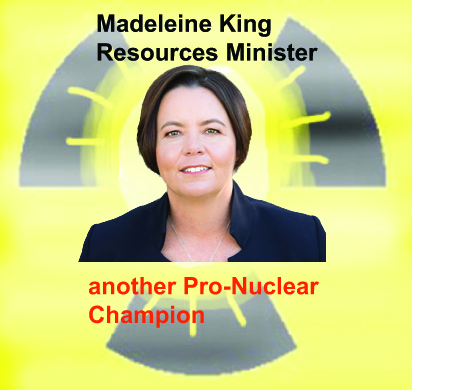
New Resources Minister backs Kimba nuke dump, https://vanguard-cpaml.blogspot.com/2022/06/new-resources-minister-backs-kimba-nuke.html?fbclid=IwAR0KRK5heMT8KlqDSY7WetXJhJrwMTqeMDwaLrzET6p-SQYA29j87DAp03Q by Nick G, June 6, 2022
The ALP’s new Resources Minister Madeline King has wasted no time in showing her support for the proposed nuclear waste dump at Napandee, near Kimba on Eyre Peninsula.
In response to an appeal to herself and PM Albanese from the disenfranchised and ignored Barngarla traditional owners, King has today stated that the nuclear waste dump was “a step forward” in the management of nuclear waste.
Background
Napandee was one of three sites proposed by the former Coalition government for the storage of intermediate and low-level nuclear waste. Two, including Napandee, were at Kimba, whilst a third was at Wallerberdina in the Flinders Ranges.
The operation of any of the three sites in SA was illegal under SA law.
Under state legislation introduced by the Olsen Liberals and strengthened by Rann Labor, it is illegal to operate a nuclear waste facility in SA or to import or transport nuclear waste in SA.
The legislation is quite clear and states:
8—Prohibition against construction or operation of nuclear waste storage facility. A person must not construct or operate a nuclear waste storage facility. Maximum penalty: In the case of a natural person—$500 000 or imprisonment for 10 years. In the case of a body corporate—$5 000 000.
9—Prohibition against importation or transportation of nuclear waste for delivery to nuclear waste storage facility. A person must not— (a) bring nuclear waste into the State; or (b) transport nuclear waste within the State, for delivery to a nuclear waste storage facility in the State. Maximum penalty: In the case of a natural person—$500 000 or imprisonment for 10 years. In the case of a body corporate—$5 000 000.
This legislation came about largely through the actions of the Kupa Piti Kungka Tjuta (the Anangu women of Coober Pedy) who led a campaign against a 1998 Howard Government proposal for a nuclear waste dump in SA.
In 2004, following Howard’s conceding defeat on the issue, three of those women, Eileen Kampakuta Brown, Ivy Makinti Stewart and Angelina Wonga issued a statement that began: “People said that you can’t win against the Government. Just a few women. We just kept talking and telling them to get their ears out of their pockets and listen. We never said we were going to give up. Government has big money to buy their way out but we never gave up…money doesn’t win.”
In 2016, SA Labor Premier Jay Weatherill set up a Royal Commission into SA’s nuclear energy future which included a proposal for a dump for high level overseas nuclear waste. Massive protests were held and a “citizen’s jury” effectively knocked all talk of nuclear waste dumps on the head.
The resurrected SA site proposals were met with further protests. The Adnyamathanha peoples led opposition to the Wallaberdina site and were successful in winning the vote in a community consultation of people in the Flinders Ranges.
The initial Kimba sites were rejected by former Minister Josh Frydenberg in 2016 due to a lack of broad community support; however in 2017 his replacement Matt Canavan revived the proposal and accepted Napandee as the site for the dump.
Barngarla Pushed Aside
Approval for the Kimba site required broad community support through a community consultation. In preparation for a local vote, millions of dollars of federal funds were poured into Kimba for “social and economic development” during the consultation process. Community facilities were upgraded, footpaths and gutters put in, and the town generally given a face lift.
No definition of “broad community support” exists in legislation, but Canavan mentioned a figure of “around 65%”. Kimba Council defined those eligible to vote as ratepayers living within a prescribed area and excluded the Barngarla native title holders on the grounds that they lived in other towns on Eyra Peninsula.
The Barngarla appealed to the Federal Court which upheld the Council’s decision on the grounds that the Barngarla would be “too difficult to identify”. A vote was held, resulting in a 61.5% vote for the dump with a majority of 70 in favour.
The Barngarla commissioned the Australian Election Company to poll people identified as Barngarla by the Barngarla Determination Aboriginal Corporation and identified 209 eligible voters. There were no votes for the dump, and 89 against it.
Had those 89 Barngarla votes been included in the Kimba Council “consultation”, the outcome would have been a “no” vote carried by a small majority.
Labor Opposition facilitates Napandee declaration
In Opposition, Labor had the opportunity to block the declaration of the Kimba site. However, Madeline King did a deal with the Coalition in June 2019 that allowed new Resource Minister Keith Pitt to declare Napandee as the site for the dump. Under the original federal legislation, an aggrieved party to the declaration had no right of judicial appeal. King negotiated to provide the appeal right and withdrew Labor opposition to the declaration despite saying that Labor would not pass the bill unless traditional owners were comfortable with it.
They clearly were not, and neither did they have the resources to properly fund a judicial appeal, although that process has now begun in the Federal Court.
Who is Madeline King?
Madeline King is a right-wing Labor politician with close ties to the mining industry and pro-US lobbyists.
She is a commercial lawyer who immediately prior to entering parliament was the chief operating officer of the Perth USAsia Centre, a think tank based at the University of Western Australia.
King was a ministerial adviser to federal Labor MP Gary Gray from 2011 to 2012. Gray had been National Secretary of the ALP from 1993 to 2000, but resigned to take up a position with fossil fuel giant Woodside Petroleum. As its Director of Corporate Affairs, he was an executive at the time when, in 2004, Foreign Affairs Minister Alexander Downer ordered the bugging of the East Timorese government during negotiations aimed at depriving the island nation of desperately needed revenue from underwater gas deposits. Gray was part of the Woodside negotiating team.
In 2007, Gray contested the WA seat of Brand and became part of Rudd’s Labor team. He retired in 2016 to take up a position with Mineral Resources, but was appointed Australian Ambassador to Ireland by Scott Morrison in 2020 in what some people have said was a move to prevent him having to testify in the case against Bernard Collaery and possibly incriminating Downer under cross-examination.
King’s employment as advisor to Gray has made her no stranger to the interplay between the corporate world and the benefits that accrue to Labor politicians who do their bidding.
No need for a Kimba dump
Opponents of the Kimba dump point out that much of the low-level waste (some of which needs to be stored for up to 300 years) is already safely stored at Woomera in SA. Some of it is stored at facilities at which it is produced. Medical nuclear waste accounts for only around 1% of the total and is short-lived and decays quite safely at the hospitals and treatment centres at which it is generated.
Intermediate level waste is generated at Lucas Heights in Sydney. Its decay time is far longer and needs to be kept from contact with humans for 10,000 years. A 2020 federal parliament inquiry confirmed that ANSTO, the operator of Lucas heights, has the ability to manage its waste onsite for “decades to come”. Ultimately, it will need to be stored in an underground repository. The government says this will take decades while the federal nuclear regulator says it could take a century to identify and construct.
If intermediate level waste is transported the 1700 kilometres from Lucas Heights to Kimba, it will be stored there as a temporary measure, in drums above the ground, pending its removal at some future stage to a permanent underground facility.
It therefore makes no sense to move these drums of intermediate level waste across the continent when there is storage capacity at Lucas Heights. Kimba is a temporary solution to a non-problem.
The issue of nuclear waste storage is one that must be referred to nation-wide community consultation. It is not a matter to be placed on the shoulders of this or that “remote” community to decided. We are all involved and we should all decide.
SA Unions made their position clear on March 15 when they unanimously supported a motion standing with the traditional owners. SA Unions Secretary Dale Beasley said “South Australian unions are completely united in their support of the Barngarla Traditional Owners and their opposition to the proposed nuclear waste site at Kimba”.
Let’s make this year’s Hiroshima Day (August 6) a day for concerted action against nuclear energy, nuclear waste dumps and nuclear-powered submarines.
Let’s keep alive the spirit of the Kupa Piti Kungka Tjuta.
Scandalous conflicts of interest in Australia’s advice from USA on nuclear submarines.


To an extraordinary degree in recent years, Australia has relied on high-priced American consultants to decide which ships and submarines to buy and how to manage strategic acquisition projects. In addition to the six retired U.S. admirals, the government of Australia has hired three former civilian U.S. Navy leaders and three U.S. shipbuilding executives.
RETIRED U.S. ADMIRALS ADVISE AUSTRALIA ON DEAL FOR NUCLEAR SUBMARINES,
Washington Post, By Craig Whitlock and Nate Jones 19 Oct 22, Since 2015, Australia has hired the admirals and other former Navy officials as high-dollar consultants on shipbuilding,
Two retired U.S. admirals and three former U.S. Navy civilian leaders are playing critical but secretive roles as paid advisers to the government of Australia during its negotiations to acquire top-secret nuclear submarine technology from the United States and Britain.
The Americans are among a group of former U.S. Navy officials whom the Australian government has hired as high-dollar consultants to help transform its fleet of ships and submarines, receiving contracts worth as much as $800,000 a person, documents show.
All told, six retired U.S. admirals have worked for the Australian government since 2015, including one who served for two years as Australia’s deputy secretary of defense. In addition, a former U.S. secretary of the Navy has been a paid adviser to three successive Australian prime ministers.
A Washington Post investigation found that the former U.S. Navy officials have benefited financially from a tangle of overlapping interests in their work for a longtime ally of the United States. Some of the retired admirals have worked for the Australian government while simultaneously consulting for U.S. shipbuilders and the U.S. Navy, including on classified programs.
One of the six retired U.S. admirals had to resign this year as a part-time submarine consultant to the Australian government because of a potential conflict of interest over his full-time job as board chairman of a U.S. company that builds nuclear-powered subs.
Australia has leaned heavily on former U.S. Navy leaders for advice during its years-long push to upgrade its submarine fleet, a seesaw effort that has rattled long-standing alliances and remains beset by uncertainty. After abruptly canceling a pact with France last year, Australia is now trying to finalize a deal with the United States and Britain to build a fleet of nuclear-powered submarines that could cost an estimated $72 billion to $106 billion, when adjusted for inflation over the length of the program.1
The outcome will have global ramifications and could alter the military balance of power among the United States, its allies and China. Helping the Australians build nuclear-powered submarines would enhance U.S. national security in Asia overall but could strain U.S. shipyards and delay the Pentagon’s own plans to add more subs to its fleet, according to U.S. military officials and defense analysts.
The Australian government has kept details of the Americans’ advice confidential. The Post was forced to sue the U.S. Navy and State Department under the Freedom of Information Act (FOIA) to obtain documents that shed light on the admirals’ involvement.
Under federal law, retired U.S. military personnel as well as reservists must obtain approval from the Pentagon and the State Department before they can accept money or jobs from foreign powers. The law applies to retirees — generally those who served at least 20 years in uniform — because they can be recalled to active duty. Records show that each of the six retired admirals followed the rules and received U.S. authorization to work for the government of Australia.
Between 2015 and 2021, the Navy received 95 applications from retirees to work for foreign governments — and approved every one, according to the documents that The Post obtained under FOIA. Government lawyers fought the release of the records, arguing that they were of little public interest and that disclosing basic details would violate the retirees’ privacy
For three of the retired admirals on Australia’s payroll, the U.S. Navy spent less than a week reviewing their paperwork before granting permission, the documents show. Two of the admirals applied to work for the Australians within one month of their retirement from the military.
Officials at the White House and the U.S. Navy declined to comment for this article.
Compared with the U.S. Navy, which has about 290 deployable ships and submarines, Australia’s fleet is small, with only 43 vessels. But Australia’s strategic importance looms large because of its proximity to the Indian and Pacific oceans, as well as the world’s busiest shipping lanes, near the contested waters of the South China Sea.
If Australia acquires nuclear subs, it will become the seventh country to do so. With only 26 million people, Australia would be by far the least populous member of the club.
To an extraordinary degree in recent years, Australia has relied on high-priced American consultants to decide which ships and submarines to buy and how to manage strategic acquisition projects. In addition to the six retired U.S. admirals, the government of Australia has hired three former civilian U.S. Navy leaders and three U.S. shipbuilding executives.
Since 2015, those Americans have received consulting deals worth about $10 million combined, according to Australian contracting records posted online.
The six retired U.S. admirals who have worked for the Australian government declined to be interviewed or did not respond to requests for comment.
Some Australian lawmakers and defense analysts have expressed doubts about whether the U.S. consultants have been worth the expense. The Americans’ recommendations have influenced a series of ill-fated decisions by Australian officials that could delay the arrival of any new submarines until 2040, almost a decade later than planned.
“We were paying a lot of money [for advice] and it wasn’t obvious to me that we were getting value for money,” said Rex Patrick, a former member of the Australian Senate who has criticized the government’s submarine acquisition plans.
$6.8 million for advice on an aging fleet
In September 2021, after years of futile attempts to replace its aging fleet of six submarines, the government of Australia announced two decisions that surprised the world.
First, it abruptly canceled a long-standing $66 billion agreement to buy a dozen French diesel-powered subs. Then it revealed it had reached a historic accord instead to acquire nuclear propulsion technology for submarines from the United States and Britain……………………………………………….
As Australia negotiates with the United States, it is paying for expert advice from two people who once served in American uniforms: retired U.S. admirals William Hilarides and Thomas Eccles……………………………………….
The influx of American shipbuilding consultants in Australia began eight years ago…………………………………………………………………………………..
The Australian government created additional naval advisory committees — and stocked them with Americans.
In October 2016, Australian officials announced a new Naval Shipbuilding Advisory Board with Winter, the former Navy secretary, serving as the chairman. He was joined by three retired admirals: Eccles, Hilarides and Sullivan.13………………………………………
Marcus Hellyer, a senior defense analyst with the Australian Strategic Policy Institute, a nonpartisan think tank based in Canberra, said the advisory panels could have used more European perspectives to balance out those of the Americans. Unlike the U.S. Navy, he noted, the Australian navy does not design its own ships from scratch and is accustomed to relying on foreign models.
“It’s a very different kettle of fish to the U.S. system,” he said.
A carousel of consultants
By 2019, Australia’s landmark submarine deal with France appeared to be in jeopardy. Delays plagued the design phase. Projected costs rose. Doubts spread about whether the Shortfin Barracudas, which the Australians dubbed their Attack class of subs, would be capable of deterring China’s more imposing undersea fleet.
The American carousel of hired help continued to spin. Sullivan, the retired vice admiral, left the shipbuilding advisory board in 2019. That same year, Johnson resigned as Australia’s deputy defense secretary. But the Australian government added three more U.S. civilian consultants to its advisory panels.
Australian lawmakers grew impatient with the submarine program’s delays and irritated by the Australian government’s unwillingness to let its highly paid U.S. advisers answer questions.
The American carousel of hired help continued to spin. Sullivan, the retired vice admiral, left the shipbuilding advisory board in 2019. That same year, Johnson resigned as Australia’s deputy defense secretary. But the Australian government added three more U.S. civilian consultants to its advisory panels.
Australian lawmakers grew impatient with the submarine program’s delays and irritated by the Australian government’s unwillingness to let its highly paid U.S. advisers answer questions.
‘It’s confidential’
In June 2021, worried about the fate of the submarine agreement with France, the Australian Senate insisted on hearing directly from Hilarides and senior Australian defense officials.
Lawmakers wanted answers: Had the American consultants urged the Australian government to consider modifying, or even killing, the Attack-class submarine deal?
Testifying remotely from the United States, Hilarides was as tight-lipped as Winter had been.
“Because that advice is used to support government decision-making, it’s confidential,” Hilarides said.
Three months later, the Australian government canceled the submarine contract with the French. It also announced a new three-way defense alliance with the United States and Britain, including an agreement to admit Australia to the exclusive club of nations with nuclear-powered submarines.
Only four other countries — China, Russia, France and India — operate nuclear subs. Brazil is trying to develop nuclear reactors for submarines, but its progress has been slow.
Left undecided was whether Australia would buy U.S. or British nuclear subs, and where they would be built. But defense analysts predicted the United States would probably win out.
Australian lawmakers soon began to raise questions about the American consultants and their connections to the U.S. submarine industry.
Donald, the retired four-star admiral on Australia’s Submarine Advisory Committee, has also served as chairman of the board of Huntington Ingalls Industries since 2020. The defense contractor, based in Newport News, Va., is the maker of Virginia-class submarines, the same model that the government of Australia was now thinking about buying.
At a parliamentary hearing in October 2021, a senior Australian defense official acknowledged that Donald’s role with Huntington presented a potential conflict of interest. But the official said the Australian government and Donald hadn’t yet decided if it was necessary for him to resign as a consultant.
Donald remained on the committee for six more months. In his written response to questions, Donald said he resigned in April to avoid any conflicts after “it became evident” his committee “would need to become involved in providing independent critical assessment” on acquiring nuclear-powered subs.
But Australia is still paying other Americans for advice on how to negotiate with the U.S. government.
Winter, the former U.S. Navy secretary, registered with the U.S. Justice Department in September 2021 as a foreign lobbyist working for the Australian prime minister’s office. In his disclosure form, Winter said he would be paid $6,000 a day, plus expenses, to support Australia during its nuclear submarine talks with Washington.15………………………………………………………
Australia will almost certainly have to buy its first nuclear subs off American or British production lines.
U.S. Navy and British Royal Navy officials, however, say their shipyards are booked solid making their own submarines. The only way to squeeze in orders from Australia would be to spend billions expanding U.S. or British shipyards.
Hellyer, the Australian defense analyst, said it is hard to envision a scenario under which Australia would receive its first nuclear submarine before 2040. With the Collins-class vessels scheduled for retirement a decade from now, that could leave Australia without submarines for eight years.
“I can’t really see what the way forward is at the moment,” he said. “The whole thing has been completely disastrous.”
About this story
Photos used in the card illustrations from Department of Defense.
Editing by David Fallis and Sarah Childress. Research by Alice Crites. Copy editing by Martha Murdock and Christopher Rickett. Photo editing by Robert Miller and Wendy Galietta. Video editing by Jason Aldag. Design and development by Frank Hulley-Jones, Stephanie Hays and Talia Trackim. Design editing by Christian Font and Matt Callahan. Project management by Wendy Galietta. https://www.washingtonpost.com/investigations/interactive/2022/australia-nuclear-submarines-us-admirals/?itid=ap_craigwhitlock
Concerns in outback SA grow as federal government plans to store defence waste at planned Kimba nuclear dump
ABC By Sara Tomevska, 18 Oct 22,
The federal government is facing questions over how it will dispose of highly-radioactive waste produced by Australia’s future nuclear-powered submarine fleet, as concerns about a controversial nuclear dump in outback South Australia grow.
Key points:
- The federal government chose a site near Kimba for its nuclear waste site in 2021
- Locals are now concerned high-level nuclear defence waste could be stored at the site
- There are two legal challenges underway to block the site from going ahead
After 40 years of searching, the federal government last year announced it had chosen Napandee, a 211-hectare property near the town of Kimba, to consolidate Australia’s low-and-intermediate nuclear waste……….
last June, the federal parliament passed a range of amendments to the National Radioactive Waste Management Act.
One of the changes allows defence waste to be stored at the site too.
Fourth generation wheat farmer Terry Schmucker has long opposed the dump, fearing the site could lead to contamination.
“As a farmer have become connected to the land and I’ve come to realise how precious topsoil and agricultural land are,” he said.
He said the changes to legislation had added to his anxiety. “I always expected that the dump was the thin end of the wedge … but it’s disappointing that the government hasn’t come straight out and said ‘this is how it is’,” he said.
A Department of Defence spokesperson said Australia’s defence programs already generated a “range of low-level radioactive waste” which was currently stored in two temporary facilities.
In September 2021, three months after the amendment bill passed through parliament, former Prime Minister Scott Morrison announced Australia would acquire nuclear-powered submarines as part of the AUKUS defence pact.
Mr Schmucker said the deal raised “serious questions” about how and where the federal government would dispose of high-level radioactive waste generated by the submarines.
“I think it’s going to come here, that’s just the way it is,” he said.
“If the waste site is set up at Kimba, there’s nothing to stop [the government] from bringing even worse stuff than what’s going to come out of the submarines and putting it here in agricultural land.”
Could submarine waste really end up in Kimba?
The legislation explicitly prevents high-level radioactive waste or spent nuclear fuel — which is what the submarines would produce — from being dumped at the Napandee site.
Barngarla Determination Aboriginal Corporation (BDAC) chairman Jason Bilney said he was concerned that could be changed with the stroke of a pen.
“We all know what the government is like, the government can change that at any given time and try and slip it through,” he said.
Former senator and submariner Rex Patrick was part of the parliament that passed the legislation, and said he believed it was unlikely that protection would ever be removed.
“The parliament that passed the facility were of the clear understanding that high-level material would not be stored at the site,” he said.
“Now, of course, [legislation] can be changed by a future parliament. And so, there is a risk there. https://www.abc.net.au/news/2022-10-18/kimba-dump-controversy-continues/101537270?utm_campaign=abc_news_web&utm_content=facebook&utm_medium=content_shared&utm_source=abc_news_web&fbclid=IwAR2plCSj2ctHNmhZEHJTvacBN5nsIb-LVQD-pyhMIcnEDkQh0OMdFOCp-Ec
The previous Liberal government lied about its Kimba nuclear waste dump plan, but be wary of the new Labor government, too.

I strongly suggest that particularly the Barngarla but the general Kimba community should be extremely cautious of the so- called support by Malinauskas and Maher for the opposition to the waste facility at Kimba as their demands for the nuclear powered submarine fleet to be built or just based in South Australia will generate significant volumes of nuclear waste which will need Kimba its storage and disposal.
Peter Remta, 17 October, While Minister Madeleine King began with great promise as a knowledgable and realistic minister for resources unlike her ministerial predecessor I have been singularly disappointed by her comments in various media outlets including in particular the Saturday’s edition of The Guardian
To say that she is allowing the Barngarla litigation to run its course is ludicrous and none of what she says can in any way justify the continued planning for the facility at Kimba
In view of this I have arranged for the ARTEMIS peer review service of IAEA to undertake a comparative study of the Kimba proposal to other suggested facilities.
What is more they will undoubtedly embarrass the government by showing up its ignorance and incompetence in the realm of nuclear waste which has previously been disguised by a barrage of
disingenuous comments and information.
I am aware that one person of interest in this review is to be Pitt as the former minister since he has shown to have little if any real knowledge of nuclear issues but was happy to disseminate incorrect and even untrue information for presumably his self importance.
However in the meantime it is necessary to ensure that the federal government will grant unfettered entry to Australia for both the ARTEMIS team and the UNHRC special rapporteurs since they have already been stopped on two occasions
Finally I strongly suggest that particularly the Barngarla but the general Kimba community should be extremely cautious of the so- called support by Malinauskas and Maher for the opposition to the waste facility at Kimba as their demands for the nuclear powered submarine fleet to be built or just based in South Australia will generate significant volumes of nuclear waste which will need Kimba its storage and disposal.
Perhaps someone should question him and Maher about their reluctance for an intervention by the State in such a significant national and international issue.
Opponents of nuclear waste facility march as one in Port Augusta to protest.
https://www.abc.net.au/news/2022-10-17/opponents-of-nuclear-waste-facility-march-in-port-augusta/101541898?utm_campaign=abc_news_web&utm_content=link&utm_medium=content_shared&utm_source=abc_news_web&fbclid=IwAR2tHJX04BCnlWAkP9YKEhyTBs2_nm5OLroG0jA5KDZl4OhOB8SFyIiTMh0 ABC North and West SA / By Bethanie Alderson and Nicholas Ward, 17 Oct 22
More than 100 opponents of a plan to build a national nuclear waste facility on the Eyre Peninsula in South Australia have rallied in Port Augusta.
Key points:
- Scores of people have marched to protest a nuclear waste facility being built in Kimba
- Traditional owners say they were never consulted about the plans by the federal government
- The government has spent almost $10 million on legal fees in support for the facility
Barngarla traditional owners, farmers and community members marched from Port Augusta’s wharf to Gladstone Square to protest the federal government’s proposal to build a nuclear waste site near Kimba.
The chair of the Barngarla Determination Aboriginal Corporation (BDAC), Jason Bilney, said if the new government was serious about supporting an Indigenous
voice to parliament, it should listen to their argument.
“It took us 21 years to win our native title; we’ll fight it for another 21 or 25 years if we have to,” he said..
“We are very strong and very passionate about preserving our culture and our heritage as well as protecting our land.
“We don’t want nuclear waste on our country.”
The federal government confirmed detailed investigation work was about to start at the site.
Mr Bilney insisted Barngarla people were never consulted about the plan and found themselves excluded from a community vote.
“Within six months of winning our native title and fighting for 21 years in the Federal Court to get a determination to then be told there’s a nuclear waste dump being built on our country — we had to go out of our way as Barngarla and contact the government,” he said.
“The government’s come out and announced they’ll commit to the Uluru Statement from the Heart.
“How can they on one hand say that and then on the other hand break the heart of the First Nations people?”
The Supreme Court’s recent decision to overturn a mining exploration company’s authorisation to drill at Lake Torrens means Mr Bilney is confident that Barngarla will succeed again.
“It was a very proud moment, and we know that they’re going to appeal it but winning one case for judicial review puts us in a good position for the federal case with the nuclear waste dump,” he said.
‘Huge’ legal spend
Greens Senator Barbara Pocock revealed the federal government had spent almost $9,905,737 on legal fees for the waste facility and the Australian Radioactive Waste Agency.
“Ten million dollars is a huge, unnecessary legal spend, much of which has focused on fighting local Kimba residents and a vulnerable First Nations community,” Senator Pocock said.
Since litigation began in December 2021, the government has spent $607,613 directly against BDAC and a further $247,806 on in-house legal salaries.
The Barngarla people spent approximately $124,000 on legal fees over the same period.
“This mega-spend is immoral. It is wasteful, and it is against the spirit of the Uluru statement.”
“We need to find a solution to dispose of our own nuclear waste, but it needs to be safe, it needs to be long term and it needs to not be in the middle of our clean green agricultural land.”
Fight for sacred site
Barngarla elder Linda Dare says Kimba is a site of great significance to traditional owners, and especially for women.
“We have the waters there, the lakes there … and if this goes on it’s actually going to affect our waterways all the way to the Flinders and surrounding areas,” she said.
“It’s very significant because along the way we’ve lost a lot of family members that have been fighting for native title for years when we were little.”
“We know we can fight this, and we know we’ve got the backing of every Indigenous tribe in Australia because it affects everybody in South Australia if there’s any damage.”
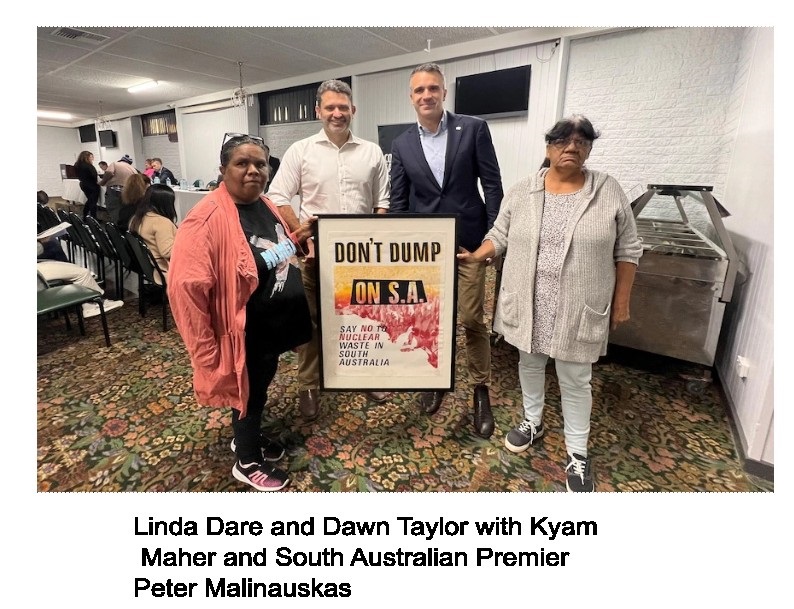
Ms Dare and Aunty Dawn Taylor met with Premier Peter Malinauskas and Aboriginal Affairs Minister Kyam Maher during the state government’s country cabinet forum in Port Pirie.
Mr Malinauskas said while the state government did not have the power to stop the planned facility, he would express his support for the Barngarla people to have the right to veto to the federal Labor government.
Mr Bilney believes the Barngarla community needs the whole country to support them in their fight.
“The more support we have locally, state and federally the stronger we become as one,” he said.
1 This month
7 April – WEBINAR – Australia and the Doomsday Clock – Preventing nuclear war through NoFirstUse and other policies
Online | Tuesday April 7, 4:00-5:30pm, Australian Eastern Time / 8:00-9:30am Central Europe Time
– Access the registration link
15 April – Zoom –Nuclear Power is Not the Solution
Apr 15, 2026 01:00 AM in Canberra, Melbourne, Sydney

Join the International Physicians for the Prevention of Nuclear War (IPPNW) on Tuesday, April 14th for a timely webinar exploring the risks associated with nuclear power and challenging the myth that it offers a simple, safe, carbon-free solution to the climate crisis

21 April Webinar: No Nuclear Weapons in Australia
Start: 2026-04-21 18:00:00 UTC Canberra, Melbourne, Sydney (GMT+10:00)
End: 2026-04-21 19:30:00 UTC Canberra, Melbourne, Sydney (GMT+10:00)
Event Type: Virtual
A virtual link will be communicated before the event.
Host Contact Info: australia@icanw.org

of the week – Australians for War Powers Reform (AWPR)
To see nuclear-related stories in greater depth and intensity
 Antinuclear