‘Reject the deadly logic of nuclear deterrence’
So, who is on board? More than 100 federal MPs and another 150 in state and territory parliaments, the Australian Greens, Labor and most other cross-benchers, including most of the new independents.
Two dozen unions, including the Australian Council of Trade Unions, more than 60 faith-based organizations, including the Australian Catholic Bishops Conference, the Australian Medical Association, dozens of civil society organisations and three quarters of the general public.
Fifty five former Australian Ambassadors and High Commissioners signed an open letter urging PM Albanese to fulfill Labor’s commitment.
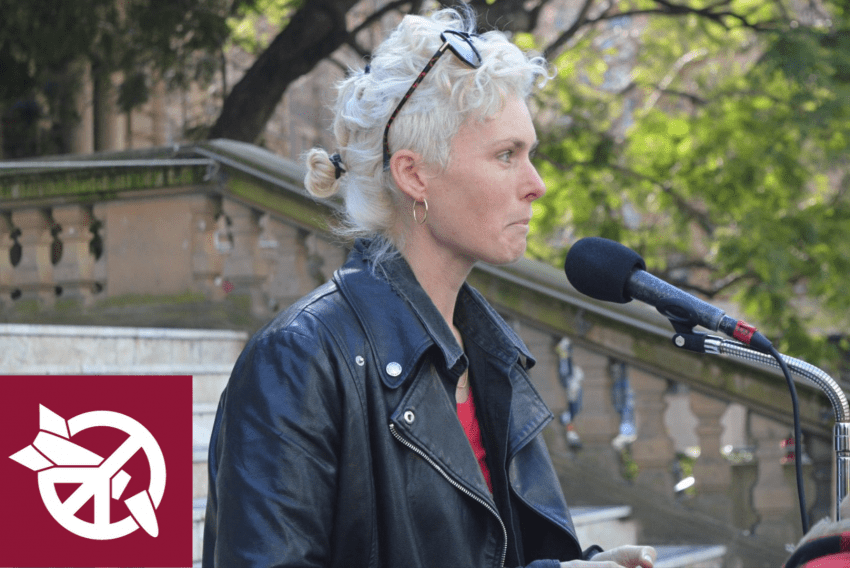
Gem Romuld, August 21, 2022, Gem Romuld, the Australian Director at International Campaign to Abolish Nuclear Weapons, Australia, delivered this speech to the Sydney Hiroshima Day rally on August 8.
I want to acknowledge that First Nations people suffer the worst of nuclear technologies, not just nuclear weapons’ testing but all aspects of the nuclear chain, including uranium mining and radioactive waste dumping.
These struggles are ongoing today with threats of uranium mining at Mulga Rock in Western Australia, a radioactive waste dump planned for Barngarla land at Kimba, South Australia and the ongoing un-remedied impacts of 12 major nuclear explosions at Monte Bello in WA, Emu Field and Maralinga in SA, followed by hundreds of radioactive experiments — “the minor trials” —at Maralinga.
Today is a really important marker in time, one that we are keeping alive by gathering here.
What happened in Hiroshima and Nagasaki is why the vast majority of sensible people totally abhor nuclear weapons and want to see every last one decommissioned and dismantled.
Five years ago, the treaty banning nuclear weapons was created and last year it entered into force. It is something that experts, governments, diplomats and, even some activists, said could and would not happen.
But with strategy and persistence it did. Now, it has permanently altered the international legal architecture on nuclear weapons: it has raised the bar and all nations are measured against this powerful new standard.
Right now, the Treaty on the Prohibition of Nuclear Weapons has 86 signatories and 66 states parties, with those numbers going out of date regularly as more nations sign on.
Every new signature and ratification is a rejection of the deadly logic of nuclear deterrence and a bold expression of the alternative — human security without nuclear weapons.
The first meeting of states parties in Vienna in June was a big success that culminated in a Declaration and Action Plan, including 50 Points outlining practical ways members of the TPNW can “facilitate effective and timely implementation” of the Treaty articles and the Vienna Declaration commitments.
The second meeting of states parties will be in November-December 2023 at the United Nations in New York City. It will come around quickly. We need Australia to be at that meeting at least as a signatory, if not a state party.
Why is this treaty important?
It’s the first treaty to make illegal everything to do with nuclear weapons.
It completes the triad of bans on the three weapons of mass destruction: nuclear weapons; biological weapons and chemical weapons.
It is a powerful instrument of international law, as well as humanitarian law: it not only prohibits, but it also compels states’ parties to seek nuclear justice by assisting victims and remediating environments impacted by nuclear weapons.
In force as of January last year it is the ultimate test for all nations, including Australia. You are either against nuclear weapons or complicit with them.
Any nations that profess commitment to nuclear disarmament and nonproliferation but haven’t yet joined this treaty are exposed for their double-speak.
Under the previous federal government, prospects for this treaty were dire.
But Prime Minister Anthony Albanese and the Labor Party have committed to sign and ratify the Treaty on the Prohibition of Nuclear Weapons since 2018. Further, three quarters of all Labor MPs have personally pledged their commitment.
We all know that MPs make and break promises. But this is one we won’t let them break, will we?
Our efforts right now are critically important. We cannot for a minute drop the expectation that the government will do what it has promised. We have to be involved and keep up the pressure with MPs, councils, superannuation funds, unions and civil society organisations.
Like most meaningful change, it will take time and be hard won but we are well and truly on the way.
So, who is on board? More than 100 federal MPs and another 150 in state and territory parliaments, the Australian Greens, Labor and most other cross-benchers, including most of the new independents.
Two dozen unions, including the Australian Council of Trade Unions, more than 60 faith-based organizations, including the Australian Catholic Bishops Conference, the Australian Medical Association, dozens of civil society organisations and three quarters of the general public.
Fifty five former Australian Ambassadors and High Commissioners signed an open letter urging PM Albanese to fulfill Labor’s commitment.
We have all the right ingredients: the moment is ripe. We can get Australia to join the nuclear weapon ban treaty in this term of government.
Doing that will help other nuclear endorsing states resist the pressure of the nuclear-armed bullies. Slowly, they will be isolated and, eventually, one of them will begin the process of disarming.
CIA spying on Assange “illegally” swept up US lawyers, journalists: Lawsuit
Newsweek SHAUN WATERMAN ON 8/15/22 CIA surveillance of Wikileaks founder Julian Assange while he was sheltering in the Ecuadorian Embassy in London included recording his conversations with American lawyers, journalists and doctors, and copying private data from visitors’ phones and other devices, violating constitutional protections, according to a lawsuit filed Monday.
The suit – filed on behalf of four Americans who visited Assange – seeks damages personally from then-CIA Director Mike Pompeo for violating the plaintiffs’ Fourth Amendment rights against unreasonable search and seizure. The suit also seeks damages against a Spanish security firm contracted to protect the embassy, and its CEO, alleging that they abused their position to illegally spy on visitors and passed on the surveillance data they collected to the CIA, which is also named a defendant in the suit.
Legal experts, including a former senior intelligence official, told Newsweek that the allegations in the lawsuit, if proven, show the CIA crossed lines drawn to protect American citizens from surveillance by overzealous intelligence agencies………………………………………………..
The suit cites evidence gathered in a preliminary criminal inquiry by the Spanish High Court, launched after whistleblowers came forward from the Spanish firm hired to provide physical security for the embassy. The firm and its CEO are under investigation for alleged violations of Assange’s privacy and the confidentiality of communications with his lawyers – both of which are guaranteed by EU law.
The plaintiffs in the U.S. suit – filed in federal District Court in New York – are two New York attorneys on the Assange international legal team and two American journalists who interviewed him. A U.S. doctor who conducted medical interviews with Assange about his mental state chose not to join the lawsuit but told Newsweek he was subjected to the same surveillance. The surveillance also swept up visits from a U.S congressman and celebrities such as model and activist Pamela Anderson.
“As a criminal attorney, I don’t think that there’s anything worse than your opposition listening in on what your plans are, what you intend to do, on your conversations. It’s a terrible thing,” said the lead plaintiff, attorney Margaret Kunstler, a member of Assange’s U.S. legal team. “It’s gross misconduct,” she added, “I don’t understand how the CIA … could think that they could do this. It’s so outrageous that it’s beyond my comprehension.”
New York-based attorney Richard Roth, who filed the suit, said, “This was outrageous and inappropriate conduct by the government. It violated the most profound privacy rights” of the plaintiffs and others who visited Assange in the embassy.
And the violation is worse, Roth added, because it included “conversations of an absolutely privileged and confidential nature,” such as those with his lawyers, and the “theft of data” from devices owned by people such as journalists and doctors who rely on confidential relationships with their sources and patients.
“All my conversations with Julian Assange were covered by doctor-patient confidentiality,” said Sean Love, a physician and faculty member at Johns Hopkins, who visited Assange twice in 2017 to conduct a study of the effects of his confinement on his physical and mental health………………………………
The privacy of other American visitors not party to the lawsuit was also violated, according to copies of surveillance material turned over to the Spanish court and reviewed by Newsweek. Every visitor had their passport photocopied and most seem to have their phones photographed. Among the visitors subject to surveillance was then-California GOP Rep. Dana Rohrabacher, who was trying to negotiate a deal for a presidential pardon for Assange. .Washington Post reporter Ellen Nakashima’s phone was photographed and a detailed written account of her visit (revealing that she removed the battery from her phone before handing it over) was prepared by embassy security guards. Anderson’s passwords for her email and other accounts were included in surveillance photographs allegedly sent to the CIA, according to disclosures by Spanish whistleblowers.
Email messages sent to Anderson’s foundation requesting comment were not returned.
Apart from the constitutional violations against Americans swept up in the surveillance, the sheer magnitude and sensitivity of the material obtained by U.S. authorities may make it impossible for Assange to get a fair trial, Roth said. In addition to the surveillance, after the Ecuadorian government allowed British police to enter the embassy and arrest Assange, it publicly turned over all his legal papers and computer equipment to the U.S. Department of Justice.
“When a federal prosecutor comes after a lawyer with a search warrant and seizes their devices, there are multiple layers of review and protection for privileged lawyer-client communications,” Roth said. The court might appoint a special master – typically a retired judge or a senior attorney independent of the government – to oversee the process and ensure that privileged communications were segregated from those collected for the prosecution.
“None of that happened here. They just grabbed everything.”
…………………………………………………………………………………. Anyone who visited was required to leave their phones and other electronic devices with security guards at the embassy, according to the lawsuit.
“Julian’s visitors weren’t allowed to bring their devices into the embassy, nothing that could photograph or record or connect to the Internet,” WikiLeaks media attorney Deborah Hrbek, the other attorney suing, told Newsweek. “We turned them over to the security guards. We thought they were embassy personnel. We believed it was a measure to protect Julian.”
In fact, the guards were contractors, working for the Spanish private security firm UnderCover Global. Engaged by the Ecuadorian government to provide security for the embassy and its long term houseguest, UC Global in 2017 began secretly also working for U.S. intelligence, according to the lawsuit, citing evidence compiled by the Audiencia National, the Spanish High Court.
UC Global CEO David Morales returned from a Las Vegas security convention in early 2017, telling colleagues they were now working “in the big leagues,” “for the dark side,” and with “our American friends,” according to whistleblower testimony from former UC Global employees. The testimony says it became clear over the subsequent weeks and months that he was being paid substantial sums of money to share surveillance data with the CIA…………………………………………………………………………………….
The suit is directed against Pompeo personally because U.S. law and the Constitution make it difficult to sue executive branch agencies for damages, said Robert Boyle, a constitutional law attorney who consulted with Roth on the suit.
A 1971 Supreme Court judgment “made it possible to personally sue government officials for violations of certain constitutional rights,” he said……………………………………………
The surveillance revealed by the Spanish courts was likely “the tip of the iceberg,” said lead plaintiff Kunstler. “We happen to have discovered that. Who knows what else they were up to?”
https://www.newsweek.com/cia-spying-assange-illegally-swept-us-lawyers-journalists-lawsuit-1731570—
Richard Marles reaffirms Australia’s commitment to the one-China policy and ‘stabilising’ Canberra-Beijing relations
The Defence Minister and acting Prime Minister reiterated Australia’s support for the one-China policy and said its principal motive was to see a “de-escalation of tensions” in the Taiwan Strait.
Sky News Miriah Davis, Digital Reporter, August 14, 2022 –
Richards Marles has reaffirmed Australia’s commitment to the one-China policy as Canberra moves towards “stabilising” its relationship with Beijing.
Speaking with Sky News Australia’s Kieran Gilbert on Sunday, the Defence Minister and acting Prime Minister said Australia’s principal motive was to see a “de-escalation of tensions” in the region.
“What we want to see is a return to normal peaceful behaviour what underpins that, from Australia’s point of view, is not wanting to see any unilateral change to the status quo across the Taiwan Strait,” he said.
“That means we have a one-China policy that’s been the status quo in Australian policy, and indeed for the United States and other countries, for a very long period of time.”
Under Australia’s version of the one-China policy Taiwan is acknowledged as a province of China and is not recognised as its own country, however, the policy allows for unofficial contact including visits from MPs on parliamentary delegations.………………………………………………….
Traditional owners seek documents in nuclear dump case
The Transcontinental. By Tim Dornin, August 15 2022 ,
Traditional owners have asked for wide-ranging access to federal government documents as part of their efforts to block the construction of a nuclear waste dump in South Australia.
The Barngarla Determination Aboriginal Corporation is engaged in Federal Court action seeking to stop the proposed dump at Napandee, near Kimba on the Eyre Peninsula.
On Monday their lawyers outlined the reasons why the government should hand over a considerable volume of material it relied on in choosing the site and in preparing supportive legislation.
Some of the most contentious material related to correspondence the applicants contend must have taken place between then resources minister Keith Pitt and his department.
Others related to commitments the previous government made not to impose the dump on an unwilling community.
But the Commonwealth argued the Barngarla had been given a “complete record of the decision-making process” and what was being asked for went far beyond an orthodox judicial review.
“They should focus their efforts upon minister Pitt’s conduct rather than essentially seeking to have a royal commission into the cacophony that surrounds the drafting of legislation and the announcement of particular political decisions,” the court was told.
Justice Natalie Charlesworth indicated she was mindful to allow discovery of some of the material, regarding it relevant to the case.
However, she asked the parties to negotiate further to potentially narrow the scope of the documents being sought, particularly in two of the seven categories outlined.
Justice Charlesworth also cautioned that while production of the documents might be ordered, whether or not they proved admissible in the substantive case, now likely to be heard in March next year, was yet to be determined.
The case will return to court next week.
The Barngarla launched their action last year seeking to overturn the coalition government’s decision to develop the dump by quashing the ministerial declaration.
The corporation also recently wrote to new Prime Minister Anthony Albanese urging him to scrap plans for the dump.
It said the previous federal government had tried to silence the traditional owners at every turn, denying their right to participate in a community ballot to gauge local support for the site.
The corporation said the coalition also refused access to the land to undertake a proper heritage survey and tried to remove its right to judicial review.
Ahead of Monday’s hearing, Barngarla chairman Jason Bilney said it was hoped the new federal government would quickly realise how badly the former government handled the project.
“We fought 21 years to win our native title and if we have to fight 21 years to stop this nuclear waste dump damaging our country, then we will have to do it,” he said…… more https://www.transcontinental.com.au/story/7861791/traditional-owners-seek-docs-in-dump-case/
How even small nuclear war would kill billions in apocalyptic famine
https://www.9news.com.au/national/even-small-nuclear-war-would-kill-billions-from-famine/0aadd094-e5be-471f-8278-b8bf485f759a By Mark Saunokonoko • Senior Journalist Aug 16, 2022,
Australia may be the best place in the world to shelter if nuclear war broke out, a study has predicted, although an “influx of refugees” from Asia and other regions would likely rush the country to try and survive the atomic holocaust.
Various apocalypse scenarios showed even a small nuclear war would cause devastating climate chaos, plunging the world into mass famine and starving billions to death.
The study estimated more than 2 billion people would die from a contained nuclear war between India and Pakistan, while more than 5 billion around the world would perish inside two years if the US and Russia launched thousands of nukes at each other.
Nuclear strikes on major cities and industrial areas would unleash massive firestorms, the peer-reviewed study said, injecting soot into the atmosphere, blocking sunlight from reaching the Earth’s surface and severely limiting food production.
Such catastrophic “soot loadings” would cause at least 10-15 years of disruption to global climate, researchers said.
As land and ocean food production faltered, and in the face of worsening hunger, the study said food exporting countries such as Australia would hunker down and hoard supplies.
“Wherever there’s scarcity, you start to see more conflicts,” Dr Ryan Heneghan, a co-author of the study from Queensland University of Technology, told 9news.com.au.
“Whether that makes Australia a (post-nuclear war) target, I don’t know.”
Being a food exporter and its location in the southern hemisphere, away from likely conflict zones, were the key factors that meant Australia was able to weather a nuclear catastrophe better than most, Heneghan said, with New Zealand not far behind.
“Australia has some resilience if there were drops in food productivity because of changes in climate caused by a nuclear war,” he said.
“We already produce more than enough food for our population.”
But waves of migrants would inevitably put “pressures” on any Australian stockpiles.
One factor not included in the models, but which could seriously affect Australia’s ability to cope, was the country’s lack of domestic fuel supplies, Heneghan said.
“Australia isn’t energy independent.
“So we would probably have shortages of fuel.”
Australia, the planet’s sixth largest country after Russia, Canada, China, the US and Brazil, would face huge challenges trying to transport food from agricultural heartlands into big, densely populated urban centres, he said.
“Even though we might make enough food, we might not be able to move it to where it needs to go,” he said, calling that a “big caveat” to the study’s models.
Researchers modelled the impacts of six atmospheric soot-injection scenarios, based on one week of nuclear war, on crop and fish supplies and other livestock and food production.
Even if humans reduced food waste reduction and began to eat crops grown primarily as animal feed and biofuel, researchers predicted livestock and aquatic food production could not compensate for reduced crop output in most nations.
Any nuclear weapon detonation that produces more than 5 teragrams (5 trillion grams) of soot, such as 100 warheads fired between India and Pakistan, would likely cause mass food shortages in almost all countries, the study said.
A nuclear war between the US and Russia could send more than 150 teragrams of soot into the stratosphere.
The bushfires that swept across Australia in 2019-20 generated 0.3 – 1 teragrams of smoke, which swirled around the world and lingered for many months.
Nuclear power – never a realistic option for Australia.
Peter Dutton wants Australia to consider nuclear power. SBS News 13 Aug 22,

“…………………………………………. In one of his most significant policy moves as Opposition Leader, Peter Dutton has been agitating for a public discussion over nuclear power……… He announced the Coalition would be formally reviewing Australia’s potential to adopt “next-generation nuclear technologies”.
………………………….. Worldwide, there are mixed feelings on how much reliance should be placed on nuclear energy………………….
Could Australia have its own nuclear industry?
Climate Energy Finance director Tim Buckley said building a homegrown nuclear power industry would never be a realistic option for a country like Australia.
He said it was extremely costly to build, required expertise Australia doesn’t have, and the public would never be comfortable with the storage of radioactive waste.
“It would be very charitable to think that Australia could have a nuclear power plant operational in the next 10 or even 20 years,” he said.
“I would absolutely bet against that probability. And the only way you could do it is with $20 billion or $30 billion of government funding underwriting the project.”………………………………………….
Energy finance analyst Bruce Robertson said investing in conventional nuclear would be a waste of money for Australia.
“We’ve got no expertise in the construction of nuclear power plants, we’ve got no expertise in their operation.
“We don’t have lots of nuclear engineers – they don’t exist in Australia. So if we wanted to build a nuclear industry here, it’s going to take a very large upfront cost.”
Could Australia build a nuclear reactor?
Australia currently has only one nuclear reactor, which is a government-run facility at Lucas Heights in Sydney. That reactor doesn’t produce electricity – rather, it is mostly used to generate chemical elements used in medicine.
While Lucas Heights produces a comparatively tiny amount of nuclear waste, there has been fierce debate within Australia over where it should be stored. Mr Buckley said this would only intensify with commercial-scale nuclear energy.
“Nuclear is a very, very divisive topic in the energy space,” he said.
“It is clearly zero emissions – but it generates toxic waste, and there is no solution for that. There are a lot safer and cheaper alternatives.”……………………………..
Nuclear fusion

………………….. Dr Adi Paterson is the former chief executive of the Australian Nuclear Science and Technology Organisation – one of Australia’s largest publicly-funded research bodies. Now he is working with an Australian start-up called HB11, which aims to commercialise nuclear fusion technology.
While nuclear fusion is incredibly promising, it has also proved to be technically frustrating. Researchers are still struggling to create conditions in which nuclear fusion produces more electricity than it requires to run……………..
The world’s largest nuclear fusion reactor is currently under construction in southern France, at a cost upwards of $21 billion.
Some 35 countries, including Australia, have been involved in the construction of the ITER reactor, one of the most ambitious energy projects in the world. Plagued by construction delays, it is now expected to start powering up in 2025.
Mr Buckley said nuclear fusion could be useful in the long term, but would not be ready soon enough to solve the immediate problems caused by global warming.
“When I was in nappies 55 years ago, nuclear fusion was a decade away from commercialisation,” said Mr Buckley.
“And now – 55 years later – it’s still just a decade or two away from commercialisation.”
Nuclear bomb tests at Maralinga triggered Hedley Marston to study fallout over Australia
ABC Radio Adelaide / By Daniel Keane 10 Aug 22,
Hedley Marston could be charming, genial and witty but he was not above fulmination, especially where fulminations of a different kind were concerned.
In the mid-1950s, the CSIRO biochemist emerged as arguably the most significant contemporary critic of Britain’s nuclear weapons testing program, which was launched on Australia’s Montebello Islands almost 70 years ago in October 1952.
Despite the imminent anniversary Marston remains an obscure figure, but his biographer Roger Cross believes that should change.
“He appears to be totally unknown to the Australian public and, of course, to South Australians — he was a South Australian after all,” Dr Cross said.
Marston’s reservations about the nuclear program were far from spontaneous; indeed, his strongest concerns weren’t voiced until several years after the first test, when he recorded a radioactive plume passing over Adelaide.
The source of that plume was Operation Buffalo, a series of four nuclear blasts in 1956, and Marston was especially outraged by the fact that the general population was not warned.
“Sooner or later the public will demand a commission of enquiry on the ‘fall out’ in Australia,” he wrote to nuclear physicist and weapons advocate Sir Mark Oliphant.
“When this happens some of the boys will qualify for the hangman’s noose.”
What made Marston’s fury difficult to dismiss, especially for those inclined to deride opposition to nuclear testing as the exclusive preserve of ‘commies’ and ‘conchies’, was the fact that he was no peacenik.
Detractors might have damned him as an arriviste, but never as an activist: his cordial relations with Oliphant and other scientific grandees demonstrate that Marston was, in many respects, an establishment man.
Dr Cross has described Marston’s elegant prose as “Churchillian”, and the adjective is apposite in other ways.
While the roguish Marston might not have gone as far as the British wartime leader’s assertion that, during conflict, truth is so precious “that she should always be attended by a bodyguard of lies”, he had, in a 1947 letter to the editor, publicly defended scientific secrecy:
Under present conditions of fear and mistrust among nations it is obvious that military technology must be kept secret; and to achieve this end it should be conducted in special military laboratories where strictest security measures may be observed.”
But by late 1956, Marston’s alarm at radioactive fallout across parts of Australia was such that he was privately demanding greater disclosures to the general public.
Much of his ire was aimed at the Atomic Weapons Tests Safety Committee — a body established before the Maralinga tests, but after blasts had already occurred at Emu Fields* and the Montebello Islands.
“He was the only senior Australian scientist to express concerns and, because of his character, the concerns that he expressed were very forthright,” said Dr Cross, whose biography of Marston, aptly entitled Fallout, inspired the documentary Silent Storm.
“When the safety committee after each explosion said there was absolutely no effect on Australians, he believed that they were lying.”
‘If the wind changes, we need to go’
The experiments that led Marston, whose reputation largely rested on his expertise in sheep nutrition, to reach this conclusion were two-fold.
In the more protracted one, he analysed the presence of radioactive iodine-131 — a common component of nuclear fallout — in the thyroids of sheep.
“One group he kept penned up under cover eating dried hay, which had been cut some time before. The other group, he put outside eating the grass,” Dr Cross said.
“He tested the thyroids in each group – the ones on the hay only had background amounts of iodine-131.
“But the ones in the fields had a tremendously high concentration of this radioactive isotope, both north and south of the city.”
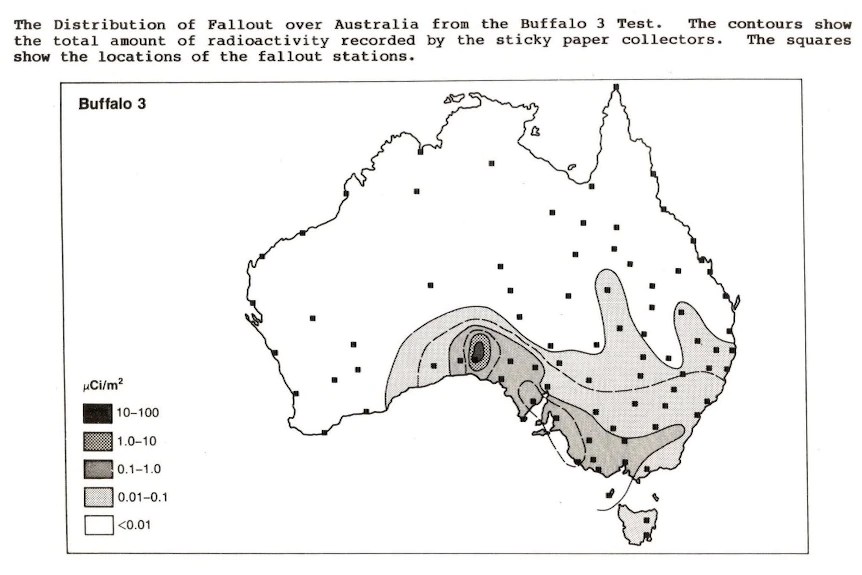
A fallout map from the 1985 royal commission, which stated that while fallout at Maralinga Village from the October 11, 1956, test was “considered to be ‘negligible from a biological point of view’ it does suggest difficulties with the forecast prior to the test”.(Royal Commission into British Nuclear Tests in Australia)
For the other experiment, Marston conducted air monitoring in Adelaide.
He was especially alarmed by what he found for the period following the Maralinga test of October 11, 1956.
“There was a wind shear and at least part, maybe the major part, of that cloud, blew in a south-easterly direction and that took it towards Adelaide and the country towns in between,” Dr Cross said.
“The safety committee — who must have known of the wind shear — had done nothing about warning Adelaide people perhaps to stay indoors.”……………………………………………………
Despite Marston’s reservations, the nuclear program carried on regardless.
Less than a year after the Operation Buffalo tests, Maralinga was hosting Operation Antler.
In September 1957, newspapers around Australia reported on an upcoming “second test” that would, weather permitting, proceed as part of a “spring series”.
If it hadn’t been for the presence of the words “atomic” and “radioactive”, a reader might easily have inferred that what was being described was as commonplace as a game of cricket.
 |
Elon Musk’s SpaceX now leaving junk in our own backyard
Independent Australia, By Darren Crawford | 10 August 2022 After a SpaceX capsule crashed onto an Australian farm, we’re left wondering if Elon Musk will clean up his own mess, writes Darren Crawford.
ACCORDING TO the ABC, the Australian Space Agency (ASA) has confirmed that debris found in a sheep paddock in the Snowy Mountains region of New South Wales, Australia, belongs to Elon Musk’s SpaceX Dragon capsule, which was launched in November 2020.
Local authorities were alerted after nearby residents heard a loud bang earlier this year on 9 July. It is now thought the bang was the noise of the capsule re-entering the Earth’s atmosphere. New South Wales Police and the ASA visited one of the sites on Saturday 31 July and confirmed that two of the pieces are from a SpaceX mission.
According to the ABC, the ASA is continuing to engage with its counterparts in the U.S. as well as other parts of the Commonwealth and local authorities.
An ASA spokesperson said:
“The agency is operating under the Australian Government Space Re-entry Debris Plan which outlines roles and responsibilities for key Australian government agencies and committees in supporting the response to space re-entry debris.”
So who is responsible for the clean-up?
According to the ABC report, the space debris will remain in place for now. However, the pieces could eventually be returned to U.S. soil.
Australian National University’s Institute of Space deputy director Dr Cassandra Steer said there was an obligation under international space law to repatriate any debris to the country from where it originated.
Dr Steer went on to confirm that “Any space object, or part thereof, has to be repatriated” and should be sent back to the U.S. However, SpaceX has only confirmed that the debris is theirs and is yet to commit to the costs associated with returning it to the U.S.
Dr Steer added:
“We have clarity in terms of lines of responsibilities. The U.S. is liable for any damage that is caused by this space debris… and Australia could go to the U.S. and seek some form of compensation if there are any costs involved in cleaning it up.”
Elon Musk and SpaceX have a poor environmental record
As reported earlier this year, Elon Musk and fellow billionaires Richard Branson and Jeff Bezos are currently participating in a dick-swinging rocket contest to see who can get to Mars first. Suffering from massive rocket envy, these three men are speeding up the climate change process by increasing the amount of carbon dioxide and other gases in the Earth’s atmosphere with every launch.
The Guardian reports that one rocket launch alone can release up to 300 tons of carbon dioxide into the Earth’s upper atmosphere and it can stay there for years. This is in comparison to a standard long-haul flight which produces three tons of carbon dioxide per passenger/per flight, into the lower atmosphere.
These impacts do not include what happens on the ground during a launch, including the heat and noise pollution in the immediate area, or the impacts on local wildlife.
There appear to be few controls put in place to protect the planet and its inhabitants from falling space junk by Elon Musk and SpaceX. In March 2021, a SpaceX rocket blew up on launch and debris was scattered throughout the protected area. According to a local non-profit environmental group, it took three months to clean up the mess.
According to the report, launch site ditches on SpaceX land and public property in the U.S. have dumped runoff water directly into the tidal flats threatening local fish breeding grounds, and public beaches and roads have been closed for longer than the agreed times.
Finally, at an earlier launch in 2018, a jettisoned SpaceX booster rocket missed its target drone ship a few hundred kilometres out to sea and destroyed itself on impact slamming into the ocean at 500 km/hour.
So, will Elon Musk and SpaceX clean up their mess down under?
This is the great unknown, as Elon Musk’s environmental record in relation to his SpaceX program is extremely poor.
It is also clear, as can be seen by his recently abandoned Twitter purchase, that Elon Musk doesn’t care who he burns, or how hard he burns them, to get his own way.
It is apparent that Elon Musk sees the increasing amount of pollution produced by his SpaceX endeavours as little more than collateral damage and less of a threat to our civilisation. Similarly, he doesn’t care whose backyard he trashes (as long as it’s not his, obviously).
Instead of turning his immense intelligence (and wealth) to solving our current problems, Elon Musk (and his billionaire space mates) seek to exacerbate these problems by polluting the planet further.
It will be interesting to see whether he does the right thing by the Australian Government and its people and pays for the clean-up of his mess.
Update, 10 August 2022:
The ABC is reporting that SpaceX has confirmed that the space debris spread throughout an Australian sheep paddock is indeed remnants of their Dragon Capsule and is sending a team down under to investigate………………………….
What was not stated was whether any ASA or government agencies were aware of or engaged in any of SpaceX’s planning. Space Law Lecturer at UNSW Canberra, Duncan Blake, wondered if they had coordinated with Australian agencies prior to their risk assessment — “If they didn’t, then that seems somewhat arrogant to make a decision that affects Australia without consulting Australians,” he said.
There has been no mention of the cost of removal or the debris, or as to whether Elon Musk and SpaceX will be more honest and open in the future and advise all Australians about the potential damage falling SpaceX junk may cause in their country.
https://independentaustralia.net/environment/environment-display/elon-musks-spacex-now-leaving-junk-in-our-own-backyard,16650
Groups join together to sign WA Nuclear Free Charter against uranium mining
Neil Watkinson & Stuart McKinnon, Kalgoorlie Miner, Thu, 11 August 2022
Nineteen groups representing thousands of West Australians have signed a joint statement against uranium mining in WA.
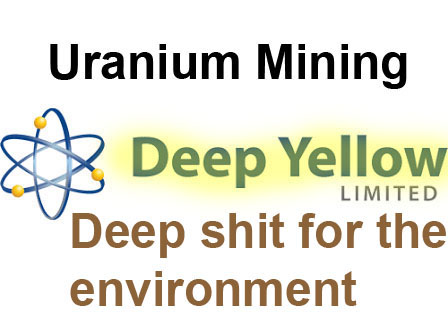
Their pledge comes as a $658 million merger of uranium mining companies Deep Yellow and Vimy Resources was confirmed this month, alongside plans to advance their $393m Mulga Rock project 290km east-north-east of Kalgoorlie-Boulder.
The groups — which include trade unions, faith groups and conservation organisations — have expressed their support for the WA Nuclear Free Charter which calls on the WA Government to remove any outstanding approvals for uranium mining at four sites across the State.
Three of the four sites — Kintyre, Yeelirrie and Wiluna — have missed development deadlines for approvals, but Mulga Rock remains active after Vimy achieved “substantial commencement” from the the State Government in December.
The price for uranium fell into the doldrums following the 2011 Fukushima nuclear accident in Japan, but the industry has been making much noise recently about a brighter future.
……………………….. Deep Yellow plans to revise and update a definitive feasibility study for Mulga Rock to include a base metals component, which was a condition of its original approval to develop the project.
The company also hopes to complete a definitive feasibility study for the company’s other project, Tumas in Namibia, by the end of the year.
Mulga Rock is expected to deliver 3.5 million pounds of uranium oxide per annum while Tumas is slated to produce 3Mlb a year.
But anti-uranium mining groups are marshalling themselves to continue fighting against the Mulga Rock project.
Signatories to the WA Nuclear Free Charter include UnionsWA and the WA branches of the Australian Manufacturers Workers Union, Electrical Trades Union, United Workers Union, State School Teachers Union, United Professional Firefighters Union and the Construction, Forestry, Mining and Energy Union, along with faith, health, and national and state environment organisations.
The charter describes uranium mining as “unwanted”, “uneconomic” and a “damaging and underperforming sector that unnecessarily risks our unique environment”.
Mia Pepper from the Conservation Council of WA — one of the many conservation groups to have endorsed the charter — urged the State Government to withdraw “expired and deficient” approvals for the four uranium mine proposals in WA.
“Consistently, the people of WA have said that they do not want uranium mining in their State,” she said.
“The current government, like many Labor governments before them, hold a strong clear position opposed to uranium mining because it puts workers, communities and the environment under threat.
“Now is the time to create lasting protections against uranium mining in WA by withdrawing outdated and deficient approvals.
“Uranium mining is different. It is radioactive, leaving behind long-lasting wastes which pose an ongoing threat to public health and the environment.
“No uranium mine in Australia has ever been successfully and completely rehabilitated.
“The Ranger uranium mine in the NT is undergoing a $2.2 billion clean-up, fortunately by a company with the money and resources to do so.
“In WA the one advancing uranium project — Mulga Rock — is being pushed by Deep Yellow . . . and we have no confidence they can do what bigger better resourced companies are failing to do.
“This government knows the risks, the costs and the legacy of this toxic trade which is why they have a strong anti-uranium policy.
“Along with unions, health, faith and environment groups we’re calling on the government to act now to put an end to uranium mining in WA.” https://www.kalminer.com.au/news/kalgoorlie-miner/groups-join-together-to-sign-wa-nuclear-free-charter-against-uranium-mining-c-7798925
The United States, in decline but still able to kill us all.
The march of folly in American strategic policy has enshrined the madness of control by a giant defence industry and defence budget now past $800 billion.
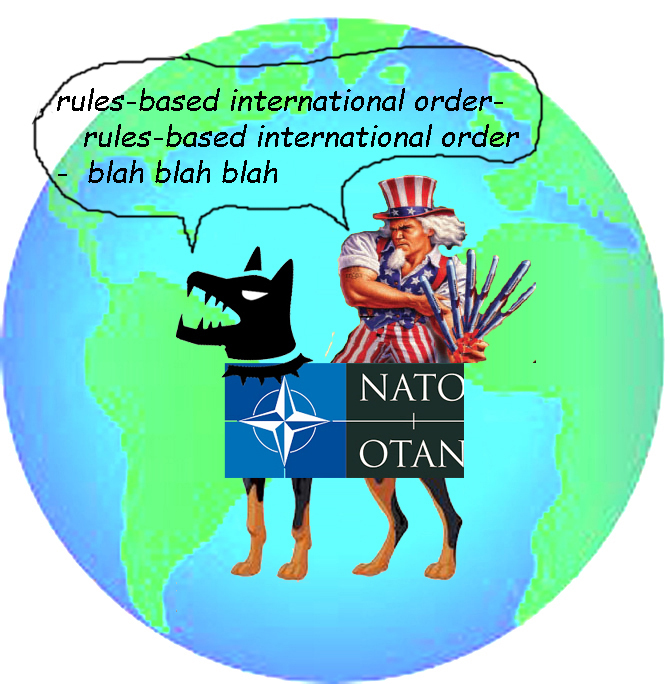
The fiercely presented wearisome trope of commitment to a Rules Based International Order is quite suddenly unmasked as an American Establishment desire to maintain a unipolar control of the world, with violence.
The fiercely presented wearisome trope of commitment to a Rules Based International Order is quite suddenly unmasked as an American Establishment desire to maintain a unipolar control of the world, with violence.
The global dominance of the United States, in so many fields, from space, to science, to entertainment, to sport, to novelty in the development of the English language, has been taken for granted, is part of our fabric of Australian existence.
Reinforced by the Covid Era of Isolation, Netflix, Facebook, and Computer Games and inability even to get to Bali or Thailand let alone China, we are now in a noisy metal barrel where even dissident voices seem projections from the dissident voices of the US, similarly muted and squeezed. At a time when the US and its roles in the world are suddenly dramatically changing.
The undoing of the United States, the collapse of the imperial centre, is happening with little awareness in Australia. Our generally oblivious mindframes affect the capacity of political leaders to reflect upon or point to core problems of our world. Richard Adams, the author of Watership Down, that great rabbit adventure full of meaning for human society, coined the rabbit language word ‘tharn’ for the mental state of rabbits caught in the headlights and stuck. We are a tharn nation, gabbling about entertainments and irritations, eyes glued to the seatback monitor, not wanting to know that the plane is crashing.
Heed these markers:
- The Americans were first to the moon, but NASA after the retirement of the space shuttle has depended on Russian rockets to get to their joint space station. The Russians are now planning to remove the propulsion units of the station which keep it from crashing, their property, for use on a bigger new venture. America is losing in space, though US private business has appallingly taken the lead in cluttering near space with junk.
- The fiercely presented wearisome trope of commitment to a Rules Based International Order is quite suddenly unmasked as an American Establishment desire to maintain a unipolar control of the world, with violence. This is being unmasked in much of the world if not NATO and AUKUS and the conservative acolytes in Japan and ROK. Ideological assertions of democracy versus autocracy, built by vilification and isolation of China and Russia, is rotting from the head as big democracies are in serious trouble.
- We are doing OK in Australia, our minds from age 12 filled with bubblegum flavoured vape and Tiktok, graduating to Facebook and the metaverse, and with a newer, kinder, kinda-tealish government we can all go to sleep, take off our masks and order American franchised fast food. Or real Aussie drinks. But while we have had a narrow focus on bad boys in the SAS we fail to review our complicity in the great crimes of the twenty first century, led by champions of democracy, smashing the lives of people in a number of countries far more violently than has the Ukraine war so far. Biden and his Secretary of State were advocates for invasions of Afghanistan and Iraq, so appallingly bringing down bad governments and making countries ungovernable. Creating Al Qaeda and ISIS in the process, directly through funding and arming extremists (in Afghanistan beginning before the Russians were invited into Afghanistan) and via embitterment of ordinary people. The world is destabilised, American control is widely undone.
- The march of folly in American strategic policy has enshrined the madness of control by a giant defence industry and defence budget now past $800 billion. Poverty of foreign policy has led to regimes of sanctions which have been substantially shaped by Richard Nephew whose book reveals that far from focusing on potentates and oligarchs, the targets of sanctions must be ordinary people and the purpose is to inflict pain and weaken resolve (his words). Consider sanctions related deaths in Iraq Venezuela Cuba, Afghanistan Pain but no loss of resolve, hatred not submission. The US official study of the effects of strategic bombing on Germany in World War II by J K Galbraith and others long ago suggested morale and resolve were increased by the bombing of cities and civilians. And yet we have the ongoing commitment to defend and achieve democracy by mass murder, with constant focus on disruption, regime change, and violence… not on peace.
- Jeffrey Sachs has recently returned to the themes of his 2013 book on the 50th anniversary of President John Kennedy’s Commencement Speech at American University in 1963. Speaking in the aftermath of the Cuban Missile Crisis, Kennedy spoke of peace not as an event or a state but a constant process of engagement. We now have no such thing, we are in an Age of Hostility, Meanness, Folly, and Decay.right wing is fervently in support. Stanley Kubrick made a movie about such madness, we are sleeping through it.
Australia recognises, as does the United States, that Taiwan is part of China. Though the media vague up the history, China kicked the Portuguese and Dutch out of Taiwan early in the 1600s, long before the greatest land grab in history, of Britain over the Australian continent, could even be imagined as the British didn’t know it was there then. The government in Taipei is the Government of the Republic of China. The large opposition party in the National Assembly is the Kuomintang, ruling party of the government of the Republic of China that lost the revolutionary war on the mainland in 1949 and retreated to Taiwan. The ROC held the China seat in the UN until 1971 with American backing. The majority of local governments in Taiwan are governed by the KMT because the party of the national government is on the nose both because of its independence-advocating foreign policy and corruption allegations. Pelosi’s visit risks great power war as not seen since 1945. The American right wing is fervently in support. Stanley Kubrick made a movie about such madness, we are sleeping through it.
The US economy is in serious trouble………………………………….
The US campaign for unipolar dominance has included partly fabricated propaganda against China and Russia. This no longer convinces or concerns a wide sweep of the world beyond NATO, the G7, the EU and AUKUS. Mix in enough lies and it all seems lies.
The summit meeting of BRICS in June seemed a more constructive meeting than the G7. The countries of Eurasia also have the Shanghai Cooperation Organisation SCO. The Iran,Russia, Turkey summit meeting in Tehran in July 2022 seems to have been more successful than President Biden’s visit to Saudi Arabia to meet also other Arab leaders, a visit described by the Wall Street Journal as worse than an embarrassment,…………………………..more https://johnmenadue.com/the-united-states-in-decline-but-still-able-to-kill-us-all/
Bob Carr puts Peter Dutton on the spot -calls for detail on Dutton’s plans for nuclear power in Australia
Bob Carr on the Opposition flagging nuclear, https://www.2gb.com/podcast/bob-carr-on-the-opposition-flagging-nuclear/ 9 August 22,
Michael speaks with Bob Carr, Former Premier of NSW & Former Australian Foreign Minister, who over the years has been a proponent of nuclear power, though becoming more circumspect with time.
Mr Carr writes, “Any opposition leader is under pressure to espouse fresh ideas and launch out in new directions. In this spirit Peter Dutton says the Coalition is open to nuclear power. He signalled an internal party review but took the opportunity to rehearse the somewhat dusty arguments about nuclear being cheap and reliable.”
“But Dutton in the next three months has the chance to prove this time Australian conservatives are serious. He can pitch it direct to 4.5 million voters in the November 26 Victorian elections. He can show this is more than a lazy “thought experiment” and invest it with hard-edge credibility.”
Taiwan not worth a mushroom cloud
Many talk about “national interest”; the need for security; and standing up for principles. But with Taiwan the choice may be more stark: allow the Chinese Communist Party to take it over or engage in a nuclear war.
Principles are meaningless amid nuclear devastation, and so is national interest and security.
http://www.crispinhull.com.au/2022/08/08/taiwan-not-worth-a-mushroom-cloud/?utm_source=mailpoet&utm_medium=email&utm_campaign=crispin-hull-column Crispin Hull 8 Aug 22,
The odd thing about the visit by the Speaker of the US House of Representatives to Taiwan was that it was done by a woman, Nancy Pelosi. Usually, women in government tend to be the negotiators and compromisers, not the aggressors and agitators.
Why not just leave well alone?
Why create for future schoolchildren (if there are any survivors) one of the “Ten Causes of the Third World War”: Pelosi’s visit to Taiwan. Just as we learned that the 10 causes of World War I and World War II included equally trivial misjudgments.
And, take note, as far as the Chinese leadership is concerned, Pelosi is not a legislator, separate from the executive government, making a visit off her own bat, because they could not conceive of such a thing. For them, she is part of the US Government. So, to them, the trip was a deliberate provocation.
The other puzzling thing about Taiwan is the way the US, on the one hand, talks the talk of defending democratic Taiwan against the bully China, but on the other hand officially accepts that Taiwan is part of China.
The US did that on January 1, 1979, when it recognised the People’s Republic of China and established diplomatic relations with it as “the sole legitimate government of China”. On the same day, the United States withdrew its recognition of, and terminated diplomatic relations with, the Republic of China (Taiwan) as the government of China.
In 1979, of course, Taiwan was not a democracy so it did not really matter in principle which of the two autocracies was the “sole legitimate government of China”. At the time, the US “national interest” suggested that the trade opportunities with mainland China were too good and democracy was not being undermined by the de-recognition of semi-autocratic Taiwan.
After Taiwan evolved into a democracy in 1996 with the first free, open, and fair election for the presidency, the US had a “whoops” moment, followed by nearly three decades of juggling three balls in the air: the principle of supporting democracy; supporting US national trade interests; and opposing ever-growing Chinese influence.
The three are hopelessly incompatible, even as the first and the third become ever more urgent. The solution for the US could have been dreamt up by the Chinese communists themselves: “deliberate ambiguity”.
The US should go back to that. More importantly, Australia should go back there, irrespective of what the US does. The west should play the long game with China and wait for it to go the way of the Soviet Union caused as the economic cost of not playing by the rules results in unsustainable pressure on the regime.
Already China is paying a penalty for its trade trashing of Australia. Australia has now found other markets. China has come back cap in hand for some of those goods and Australia has said, “No thanks, you are too unreliable because you do not follow the rules and legal principle.”
In any event, we should not, in the perspicacious words of defence expert Hugh White, “sleepwalk into war”.
If democratic Taiwan is so important to defend, why doesn’t the US officially recognise it as a nation? And if it does not recognise Taiwan as an independent democratic nation, why threaten military action if the central government of the nation that the US does recognise as exercising sovereignty over Taiwan sends in its army and police forces to physically exercise that sovereignty?
Not being a democracy is not a cause for war, nor is the overthrow of democracy in one part of a country a cause for war. If they were, the world would be in a constant state of war.
Pelosi’s visit coincided with the Rim of the Pacific naval exercise (RIMPAC), but to Chinese Communist Party chiefs it was not a coincidence.
Twenty-six nations, 38 surface ships, four submarines, nine national land forces, 170 aircraft and 25,000 military personnel took part.
From a Chinese perspective this is a tad threatening. To us it is benign. To Taiwan and Australia firing rockets over Taiwan and the seas around it is a tad threatening, To the Chinese it is a benign military exercise in its own back yard
Of course, China is jealous as well as threatened by RIMPAC. China has no friends, just nations it bribes or debt-burdens into military co-operation.
But the danger point comes when the US goes beyond seeking voluntary co-operation with allies and friends and aims for full military integration and interoperability.
The trouble here is that the US military exerts influence verging on control over the US Government. Its top military officer has a seat on the National Security Council (not just an advisory role). Both General Douglas MacArthur (Korea) and General Curtis Le May (Cuba) urged the use of nuclear weapons.
Mercifully, Presidents Truman and Kennedy stood up to them, but Biden is no Truman or Kennedy. Moreover, a change in Administration usually means little change in the military-industrial complex’s way of doing things.
In Australia, a change of Government has also meant very little change to the lock-step American Alliance – until now.
The new Defence Minister, Richard Marles, has ordered a Defence Forces Review. Maybe it will start questioning the pattern of blindly joining every major US military folly (Vietnam, Afghanistan and Iraq, for example), irrespective of whether it has anything to do with us.
Many talk about “national interest”; the need for security; and standing up for principles. But with Taiwan the choice may be more stark: allow the Chinese Communist Party to take it over or engage in a nuclear war.
Principles are meaningless amid nuclear devastation, and so is national interest and security.
It is unfortunate that 23 million people would go under the Chinese Communist jackboot, but that is better than going under a nuclear mushroom.
We allowed them to imprison, murder, and torture the Uyghurs and Tibetans and did nothing. What is the difference with Taiwan? Maybe it is just a good case to bolster a profitable arms race.
Regional security threat haunts nuclear power debate
we cannot ignore when weighing up these arguments that recent events at Zaporizhzhia help bolster the case against nuclear power. We would not want any future nuclear facilities to become hostage to the vagaries of war.
https://www.theage.com.au/national/regional-security-threat-haunts-nuclear-power-debate-20220808-p5b82t.html Editorial, August 8, 2022, The alarm sounded by the head of the International Atomic Energy Agency (IAEA), Rafael Mariano Grossi, that fighting between Russian invaders and Ukrainian forces near the Zaporizhzhia nuclear power plant carried “the very real risk of a nuclear disaster” is one with relevance far beyond the war raging within Ukraine’s borders.
The conflict has already served as a grim warning for powers such as Germany and the United States of the costs of relying on fossil fuel-producing nations with despotic leaders for energy supply. But Russia’s seizures of Zaporizhzhia and the defunct power plant at Chernobyl in the early days of the war – though Chernobyl later returned to Ukrainian control – have highlighted that a decision to increase reliance on nuclear power would carry risks even beyond the familiar ones.
As Industry and Science Minister Ed Husic pointed out during Grossi’s recent visit to this country, Australia has an exemplary record on nuclear safety. But one of the most important reasons for this is that we have a ban on using nuclear fission for power generation and have committed not to develop a nuclear arsenal under the Non-Proliferation Treaty (NPT).
In recent times both these bans have returned to the spotlight, as the Coalition in opposition has raised the possibility of domestic nuclear power plants to address our energy needs. This followed the Morrison government’s signing of the AUKUS deal with London and Washington last year. The deal envisions Royal Australian Navy submarines being fuelled with weapons-grade uranium.
Peter Hartcher reported for The Agethat the first question US President Joe Biden raised when the AUKUS proposal was put to him was whether it breached non-proliferation commitments. The key to addressing this question has been paragraph 14 of the IAEA’s safeguards agreement with Australia, which creates a loophole allowing weapons-grade material to be used without the usual safeguards in “non-proscribed military activity”. Concerns were raised earlier this month, at the latest meeting to review the treaty, that regardless of Australia’s good intentions, this would set a precedent for further transfers of highly enriched nuclear material to other nations.
Grossi has pointed out that Iran, which first informed the IAEA of its interest in naval nuclear propulsion in 2018, cited the AUKUS deal to argue for its own plans at meetings in 2021.
Some argue that this is a form of proliferation, and even our allies and neighbours, from New Zealand to Indonesia, have expressed strong reservations about the AUKUS arrangement. Australia has said that the nuclear material in its submarines will be handled only by existing nuclear states. Nevertheless, the deal could lead to a perception that nuclear “haves” will simply ignore “have-nots”.
The case for nuclear power more broadly – replacing coal and gas with another non-renewable resource in uranium – faces its own hurdles, from the cost, to the emissions involved in mining and waste management to the question of where highly radioactive waste might be stored.
As The Age has pointed out, nuclear power generation globally is declining. One major reason is the expense. A recent CSIRO report underlines that renewables are far cheaper, even after transmission and storage are taken into account.
All sides of politics agree that Australia faces an increasingly complex and challenging security environment, from talk of Chinese bases in Cambodia and Solomon Islands to cyberattacks by rogue international actors targeting key infrastructure, while general-turned-Coalition senator Jim Molan has outlined an even more apocalyptic scenario, a “second Pearl Harbour” aimed at establishing Chinese supremacy in the western Pacific.
The Age has agreed in the past that Australia should be prepared to have another look at the arguments for nuclear power. That remains our position. But we cannot ignore when weighing up these arguments that recent events at Zaporizhzhia help bolster the case against it. We would not want any future nuclear facilities to become hostage to the vagaries of war.
Hiroshima Day protests call on Albanese government to scrap AUKUS, nuclear subs
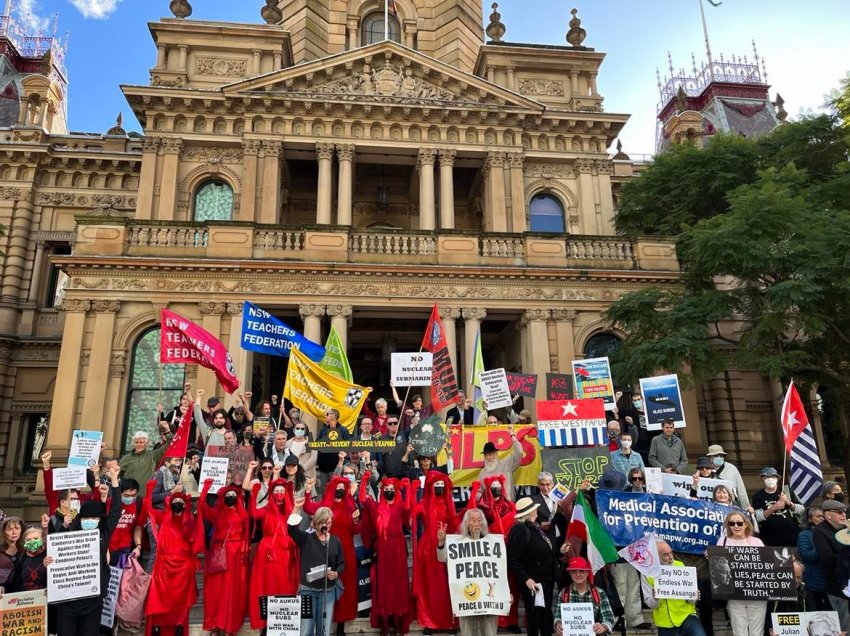
https://www.greenleft.org.au/content/photos-hiroshima-day-protests-call-albanese-government-scrap-aukus-nuclear-subs Kerry Smith, August 8, 2022,
The 77th anniversary of the United States’ atomic bombing of Hiroshima and Nagasaki in Japan on August 6 was marked by gatherings around the country calling on the federal Labor government to sign the Treaty on the Prohibition of Nuclear Weapons, to scrap AUKUS and the nuclear submarines and to bring Julian Assange home.
The Sydney rally was organised by the Hiroshima Day Committee.
Several speakers said the enduring and horrific damage of nuclear weapons should be enough to prevent their proliferation. But the integration of nuclear arsenals into militaries has raised the threat of conventional conflicts turning nuclear.
Gem Romuld from International Campaign to Abolish Nuclear Weapons said the growing number of countries signing on to the Treaty on the Prohibition of Nuclear Weapons represented a “new benchmark”.
Greens Senator David Shoebridge said if Labor did not sign on by the end of the year, the Greens will move a motion that it does.
Nick Dean, representing the Sydney Anti-AUKUS Coalition, said the nuclear submarine deal must be axed and the billions reallocated to environment and social needs.
AUKUS is a threat to the Nuclear Non-Proliferation Treaty because for Australia to operate nuclear-powered submarines, it will have to become the first non-nuclear weapons state to exercise a loophole that would allow it to remove nuclear material from the inspection system of the International Atomic Energy Agency.
This will set a dangerous precedent allowing would-be proliferators to use naval reactor programs as cover for the development of nuclear weapons — with the expectation that, because of the Australia precedent, they would not face repercussions for doing so.
The Maritime Union of Australia, NSW Teachers Federation, the Red Rebels and campaigners for Julian Assange’s release lent their support.
Reverend Ray Minniecon acknowledged country, after several anti-war songs by singer-songwriters Patrick Harte, Margaret Walker, Jude, Chris Maltby and Antoinette.
At a gathering in Armidale protesters also called for freedom for Julian Assange who is being persecuted and tortured because he helped expose recent US war crimes. “What these acts of the US Empire have in common is that they were or are intended as a warning to others. It’s time to ban nuclear weapons, reject nuclear-powered submarines, jail the war criminals and free Julian Assange,” Bea Bleile said.
Australian Prime Minister Albanese refuses to meet with Assange’s family
The claim that Australia cannot intervene in the legal case is being advanced by Labor MPs across the board, including those who previously postured as defenders of the WikiLeaks founder.
https://www.wsws.org/en/articles/2022/08/06/rbnb-a06.html Oscar Grenfell@Oscar_Grenfell5 6August 2022 In a revealing development last Wednesday, Prime Minister Anthony Albanese refused to meet with the family of incarcerated WikiLeaks publisher Julian Assange when they visited the Australian federal parliament in Canberra.
Assange’s father John Shipton and his brother Gabriel Shipton met with Independent and Greens MPs, but were reportedly unable to secure meetings with Albanese, Foreign Minister Penny Wong or Attorney-General Mark Dreyfus.
The snub expresses, again, the real attitude of the Labor government to Assange, Australia’s most famous political prisoner. In line with its commitment to US-led militarism, including the confrontations with Russia and China, Labor is intensely hostile to Assange because of his exposure of US-led war crimes in Iraq and Afghanistan.
While making highly ambiguous statements about the Assange case having “dragged on too long,” the Labor administration has refused to use its diplomatic and legal powers to secure his freedom since it was installed after the May 21 election.
This amounts to a green light for Assange’s extradition from Britain to the US, where he faces Espionage Act charges and 175 years in prison for publishing true information about the illegal wars and global diplomatic conspiracies of American imperialism.
In comments to the Guardian after their visit, both Shiptons condemned the Labor government’s failure to defend Assange and demanded that it immediately intervene.
Gabriel Shipton recalled one of the few occasions on which Albanese explicitly referenced the WikiLeaks founder. Asked about the Assange case last December, Albanese purportedly told a shadow cabinet meeting, “enough is enough”—a refrain cited publicly by several Labor MPs.
But Shipton noted: “It is months ago now that he said this stuff and made the statement that enough is enough, but when is enough, enough? Julian’s still in prison. He’s been there for three years and he is not a convicted criminal.”
Shipton added: “They could pick up the phone and call Joe Biden and make it a non-negotiable. We are strategically vital to the US at the moment, they need our resources, if it was made a non-negotiable, Julian would be here tomorrow.”
The Labor government, however, is serving as the closest of partners with the Biden administration. Albanese and Wong have met repeatedly with the US president. The primary focus of their first months in office has been on foreign policy.
Labor has functioned as an attack dog for the Biden administration throughout the Asia-Pacific, with Wong continuously traveling the region to demand that its leaders sign up unequivocally to the US-led aggression against China.
Shipton pointed to the obvious hypocrisy at the heart of Labor’s refusal to defend a persecuted citizen and journalist. “We’re dealing with this prosecution or persecution that in any normal circumstance would be seen as totally illegal, and if it was Iran doing it to somebody, or China, or Vietnam, the government would be calling them out,” he said.
Shipton continued: “It is not just about Julian’s life and his wellbeing, it is a matter of principle, and if Australia wants to be the sort of country that calls out nations on their press freedom record, they could definitely be more vocal.”
John Shipton commented on a recent Declassified Australia article. It cited internal briefings to the Labor government, indicating that the sole focus of Labor’s “diplomacy” in the Assange case, was to consider a possible prison transfer from the US to Australia.
This would only be an option after Assange had been extradited and convicted on frame-up charges in a US court, a process that could take years or decades. It would, moreover, be entirely conditional on the agreement of the US government.
John Shipton said this scenario was “grotesque.” He pointed to the spate of extraordinary abuses carried out as part of the US pursuit of Assange. They have included the theft of Assange’s legal documents, unlawful spying on him and discussions within the Trump administration and the American Central Intelligence Agency in 2017 on kidnapping or assassinating him in London.
For Labor to refuse to intervene until after Assange’s extradition was “the most feasible way for them to continue to sit on their hands and do nothing.”
Such a course of action would also amount to a death sentence. Assange’s psychologists and doctors have testified, under oath, that he would take his life were he to face imminent dispatch to his US persecutors. In addition, the WikiLeaks publisher’s physical health is failing, expressed most sharply in a minor stroke last October.
On the same day the Shiptons visited parliament, Greens Senator David Shoebridge noted in question time that Labor MPs had claimed the government was engaged in “quiet diplomacy” on Assange’s behalf. “Quiet diplomacy can’t be no diplomacy,” Shoebridge stated, before asking: “What exactly is the government doing to secure the release of this Australian citizen, journalist and whistleblower?”
In reply, Trade Minister Don Farrell stated again that the case had “gone on for too long” and should be “brought to a close,” without giving any indication of how this would take place.
Farrell said Australia was not a party to the extradition case, which was between Britain and the US, and “respected” the legal processes of both parties. This line replicates that of the previous Liberal-National Coalition government. It amounts to a green light for the extradition and a declaration that Labor will do nothing.
Assange’s extradition hearings are not a routine “legal matter” but a monstrous frame-up. They involve the persecution of an Australian journalist for his publishing activities. This is a frontal assault on the most fundamental democratic norms, including press freedom.
In numbers of cases, Australian governments have actively used their diplomatic and legal powers to secure the freedom of citizens persecuted abroad, even when such attacks have taken a pseudo-legal form.
This was the case with Peter Greste, a journalist freed from an Egyptian prison in 2015, after being framed-up on “national security” charges. The same occurred with James Ricketson, a documentary filmmaker who had phony “espionage” charges leveled against him in Cambodia, and Kylie Moore-Gilbert, an academic who was accused by Iran of being a spy.
The claim that Australia cannot intervene in the legal case is being advanced by Labor MPs across the board, including those who previously postured as defenders of the WikiLeaks founder.
It was repeated in a recent Consortium News interview by Labor backbencher Julian Hill. He insisted there were “limits to what we can do because Australia and the Australian government are not parties to the case, that’s just a fact.” Hill also defended Albanese’s supposed “quiet diplomacy.”
Hill has changed his tune since Labor took office. In August 2020, for instance, he stated: “The UK claims to be a rule of law country guaranteeing a fair trial, open justice and due process. What a joke!… The persecution and treatment of Julian Assange are unconscionable. This is inherently political and our government is too cowardly to defend him, to even demand that he gets a fair trial.”
Hill could now say the same about Albanese, the Labor government and himself.
For their part, the Greens posture as defenders of Assange. But they have rejected calls for a party campaign fighting for his freedom and buried the WikiLeaks publisher’s plight during the election.
The Greens’ entire orientation is to deepen their collaboration with the Labor government, expressed last week in their backing for Albanese’s climate bill, which will do nothing to address global warming and is premised on defending the interests of the coal and gas barons.
As the Socialist Equality Party has insisted, the fight for Assange’s freedom requires a struggle against the entire political establishment, and its program of war and authoritarianism. This must be based on mobilising the Australian and international working class, the constituency for a genuine fight against capitalist reaction and in defence of democratic rights.
1 This month
7 April – WEBINAR – Australia and the Doomsday Clock – Preventing nuclear war through NoFirstUse and other policies
Online | Tuesday April 7, 4:00-5:30pm, Australian Eastern Time / 8:00-9:30am Central Europe Time
– Access the registration link
15 April – Zoom –Nuclear Power is Not the Solution
Apr 15, 2026 01:00 AM in Canberra, Melbourne, Sydney

Join the International Physicians for the Prevention of Nuclear War (IPPNW) on Tuesday, April 14th for a timely webinar exploring the risks associated with nuclear power and challenging the myth that it offers a simple, safe, carbon-free solution to the climate crisis

21 April Webinar: No Nuclear Weapons in Australia
Start: 2026-04-21 18:00:00 UTC Canberra, Melbourne, Sydney (GMT+10:00)
End: 2026-04-21 19:30:00 UTC Canberra, Melbourne, Sydney (GMT+10:00)
Event Type: Virtual
A virtual link will be communicated before the event.
Host Contact Info: australia@icanw.org

of the week – Australians for War Powers Reform (AWPR)
To see nuclear-related stories in greater depth and intensity
 Antinuclear