Ask Fuzzy: Will Australia’s nuclear-propelled attack submarines require weapons grade fuel?

https://www.canberratimes.com.au/story/7828219/will-australias-nuclear-propelled-attack-submarines-require-weapons-grade-fuel/ By Richard Broinowski, July 24 2022
Both Britain’s Astute and US Virginia boats use highly enriched weapons-grade uranium fuel in their reactor cells.
The fuel cells last as long as the submarines – about 30 years. The submarines don’t need refuelling during that time. These cells also allow the submarines to remain underwater indefinitely, only restricted by the endurance of their crews, which in turn depends on the amount of food they can carry.
The international nuclear non-proliferation regime could be compromised if other nuclear threshold countries, encouraged by Australia’s nuclear moves, acquire their own nuclear-propelled submarines. In fact, Brazil is already doing so. The bomb-grade uranium fuel could be clandestinely extracted from submarine cores to make nuclear weapons.
Some such countries could be encouraged to arm their nuclear-powered subs with nuclear weapons.
Australians living along our coastline (the majority) would be very uncomfortable if they had to host nuclear submarine bases in their electorates.
Given that Australia has no permanent storage for even low-level uranium waste, the government would find it extremely difficult to find even temporary locations for storing highly toxic and extremely long-lasting spent nuclear reactor cores.
While it is claimed that Virginia or Astute class attack submarines are far superior in speed and quietness to conventionally powered boats, this is untrue.
Most European navies, as well as those of Japan and South Korea, have quieter and nearly as fast conventionally powered submarines. They employ auxiliary air independent propulsion systems that extend their underwater endurance to 21 days or more.
Without the pumps needed to keep reactors cool on nuclear subs, they are much quieter; they are also much cheaper. Australia could purchase or build five or more such boats for the price of one Virginia or Astute boat.
We should not expect early delivery of our subs if the Americans or British are to build them, or even only their nuclear reactors.
We should have purchased Japanese Sohryu class submarines when we had the chance.
Australia would not retain sovereignty over American or British-acquired submarines. It does not have the technology to build its own nuclear propulsion units, and will be heavily reliant on either the British or (more likely) American technology.
This will bind the Navy even more closely to US strategic planning in the Pacific, especially in its plans to confront China.
Both countries are flat out building their own fast attack submarines. It is very doubtful either country would be prepared to make space on their assembly lines to accommodate early delivery of submarines for Australia.
- Richard Broinowski AO is the author of Fact or Fission: the truth about Australia’s nuclear ambitions.
Listen to the Fuzzy Logic Science Show at 11am Sundays on 2XX 98.3FM.
Send your questions to AskFuzzy@Zoho.com Twitter@FuzzyLogicSci
Nonsense to say ‘Australia needs nuclear submarines to defend itself’: Australian scholar

Global Times 24 July 22,
After the Albanese government took office in Australia, there have been discussions about a possible reset of China-Australia ties. Global Times (GT) reporter Yan Yuzhu talked to Professor David Goodman (Goodman), director of the China Studies Centre at the University of Sydney, about his opinions on the reason why there has been hostility in Australia toward China and possible changes in the new government regarding the China policies……………………………..
Goodman:
I think this government is definitely more inclined to deal with sensible diplomacy with China than standing up in public and telling China why it is wrong. That’s a good thing, because talk is always preferable to war.
Penny Wong is a great foreign minister, as she is listening to people and doing things. She has put a whole new working party in place to see how we can more positively deal with our foreign policy. …………………..
A lot of nonsense is talked such as “Australia needs to have nuclear submarines to defend itself.” It doesn’t work, and there are many opinion influencers who agree with me that this is really not healthy.
Of course, we don’t want to be attacked by anyone, but when you think about what it would take China to physically attack Australia, including logistic and military challenges, it will be clear that China will not do so.
But a lot of the defense officials in the past government in Australia are thinking about what we would do as Australians if China “invaded” Taiwan. How crazy. Even people who are anti-China in the UK and the US have said that kind of argument is rubbish, because it is.
What I’d like to see in the bilateral relationship is that the trade ties could ease. The previous government made some statements and criticism about Chinese trade practices which led to bad trade relations between the two countries. I’d like to see them eased. And in my opinion, China has some severe economic problems ahead. It would be in China’s interests to solve them. ………………………………
About Australia’s hostility toward China, one of the reasons is that politicians outside China prefer a threat to exist so that they can use it to mobilize support for themselves. As a result, both China and Russia become the new fashionable threats.
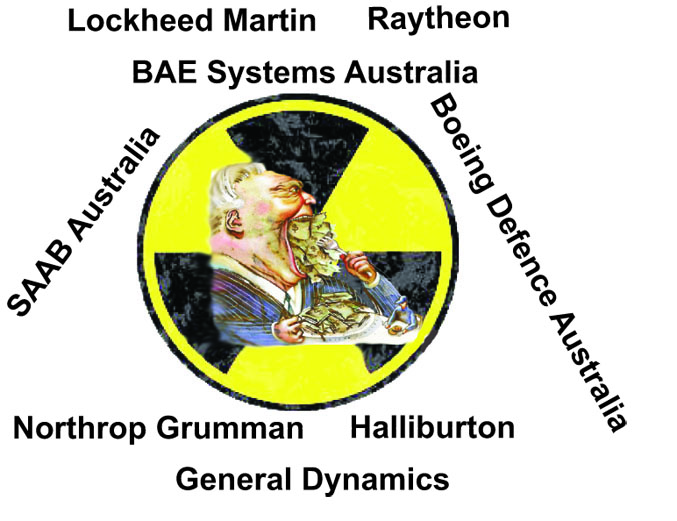
Besides, it is because of the US and European defense industries who fund one of Australia’s leading think tank that leads the charge against China.
Arms makers of course want there to be a China threat because they can sell more. It’s a logic of capitalism I’m afraid.
As to Australia’s stance toward the US, there is a debate going on in Australia as I mentioned before. I don’t know who the majority supports, but there is a sizable body of opinion that doesn’t think that America is the answer to all our problems. There’s also a lot of discussion in Australia about foreign interference and involvement in the local property market. https://www.globaltimes.cn/page/202207/1271242.shtml
Defence Minister Richard Marles is confident about AUKUS, nuclear submarines, and non-proliferation of nuclear weapons. Not everyone is so sure
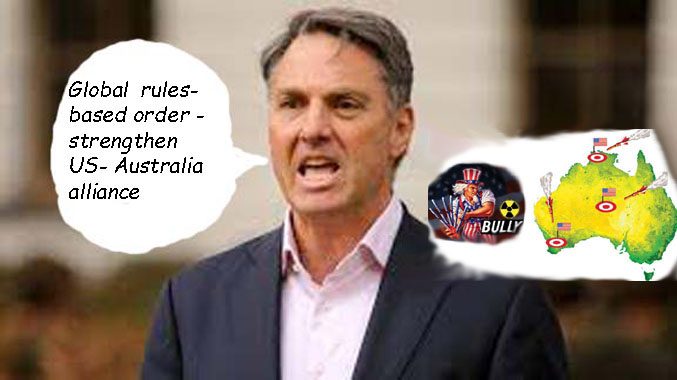
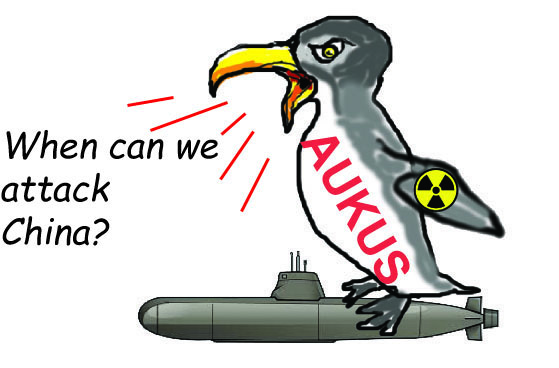
Australian National University emeritus professor of strategic studies Hugh White argues there are risks in making the AUKUS agreement at all.
In his new Quarterly Essay, Sleepwalk to War – Australia’s Unthinking Alliance with America, White warns it takes the alliance too far in the strategic contest with China.
Richard Marles on AUKUS nuclear safeguards , The Saturday Paper, By Karen Middleton. 23 Jul 22
” …………………………… “Non-proliferation was a condition of our support for AUKUS from the outset, when we were in opposition,” Marles says in an interview with The Saturday Paper, on his return from Washington, DC, this week.
While there, he discussed progress on the trilateral nuclear technology transfer agreement between Australia, Britain and the United States……..
The first non-nuclear country to seek nuclear-powered submarines, Australia will be required to sign a special International Atomic Energy Agency (IAEA) safeguards agreement. The document is likely to run to hundreds of pages, specifying in minute detail how the material will be handled – accounting for every gram – and with the tightest restrictions on its use. Amid some concern among international law specialists about exploiting existing treaty language around “peaceful use”, the wording will be designed to leave no wiggle room for more malign countries wanting to follow suit.
The greatest potential legal obstacles lie in the fact that the nuclear material is for use on a military platform. Australia’s lack of a nuclear power industry could be a reassurance, reducing the risk. Every aspect of the use and management of the enriched uranium – including in the event of an emergency – will need to be codified.
Marles says Labor’s party room will demand further assurances before consenting to move to the agreement’s next stage, which will involve the choice of future submarine design and how to resolve any capability gap in the meantime. He is confident the concerns can be addressed……………..
Navigating the non-proliferation safeguards with the IAEA is just one of the challenges for the new government in seeking to enact the monumental security agreement it has inherited.
Marles will not say if a Labor government would have taken the same decision as then prime minister Scott Morrison and his Defence minister Peter Dutton to dump the multibillion-dollar French contract for conventional submarines and switch to an American or British nuclear-powered option instead………………
“We have been supportive of the AUKUS agreement when it was announced, and we are supportive now.”
It’s clear that it wouldn’t have happened the same way, not least because of Labor’s volatile internal politics around nuclear energy.
In senior levels of the new government, there is a view that this is part of what motivated Morrison in pushing for the nuclear option to be sealed and announced with such haste. Some are convinced he believed it would wedge Labor on nuclear energy, an intergenerationally contentious issue within the party and particularly in Albanese’s Left faction.
……………….. in Labor’s upper ranks, suspicion about Morrison’s motivation raised further questions about the then prime minister’s attitude to national security.
Now in government, Labor is focused on bringing the wickedly complex submarine acquisition to completion and ensuring national security is not compromised any further along the way.
There’s a high pile of issues to be resolved before Australia has nuclear-powered submarines in the water. With the contract to buy up to 12 Attack-class submarines from France now scrapped in favour of the AUKUS agreement, the government has to decide whether to opt for the American Virginia-class boat or the British Astute-class alternative. While it hopes to get the first of whichever it chooses by the late 2030s, Marles has warned it could be the early 2040s.
That means filling the gap in the meantime.
With the existing six Collins-class submarines already extended from their initial retirement date of 2026 into the 2030s, there is a growing view in government that they will have to be extended again. What else may be required – in the form of some other possible stopgap purchase – is still unclear.
In an apparent bid to force Marles to clarify options, Peter Dutton wrote last month that he had planned to buy two American submarines to plug the capability gap. He said he had “formed a judgment that the Americans would have facilitated exactly that”.
The Saturday Paper understands that Dutton’s public commentary angered Britain, because of its presumption that Australia would choose the American option…………..
Just back from US consultations, Marles dismisses outright Dutton’s assertion about planning to buy two early American boats……………………
there are expensive decisions to be made with enormous consequences for Australia’s security.
By March next year, Marles wants to be able to announce which submarine he has chosen and when the first one will be in the water, quantify the capability gap and explain how it will be filled, outline the cost, describe industry arrangements for construction and detail the undertakings to be given to the IAEA to meet non-proliferation obligations. All this in the next eight months.
He has also vowed to produce a new force posture review in the wake of the 2020 Defence strategic update, which raised fresh questions about the strategic landscape in the region. …..
Delivering submarines makes AUKUS central to that. There is much debate on what else the agreement is meant to be and whether it makes Australia more or less dependent on the US.
In the AUKUS paperwork that has gone before the parliament so far, the submarine deal is described as its “first initiative”.
“AUKUS is about much more than submarines,” says Asia Society Australia executive director Richard Maude, who was foreign policy and security adviser to prime minister Julia Gillard and chief author of the 2017 Foreign Policy White Paper.
“AUKUS is a central platform for more co-operation and sharing of technologies that the Australian Defence Force wants.”
Maude says the issue is the nature of the submarines, not AUKUS. “The risk in AUKUS stems not from the agreement itself but from the decision to jump from a conventional to a nuclear-powered submarine.”
He points to concerning reports from the US that the Virginia-class submarine program’s production time line and costs are blowing out, raising further questions about delivery of an American boat.
“So, it’s not just our capability,” Maude says. “It’s our partner’s capability.”
Australian National University emeritus professor of strategic studies Hugh White argues there are risks in making the AUKUS agreement at all.
In his new Quarterly Essay, Sleepwalk to War – Australia’s Unthinking Alliance with America, White warns it takes the alliance too far in the strategic contest with China.
Maude says the issue is the nature of the submarines, not AUKUS. “The risk in AUKUS stems not from the agreement itself but from the decision to jump from a conventional to a nuclear-powered submarine.”
He points to concerning reports from the US that the Virginia-class submarine program’s production time line and costs are blowing out, raising further questions about delivery of an American boat.
“So, it’s not just our capability,” Maude says. “It’s our partner’s capability
Defence Minister Richard Marles downplays any broader binding role for AUKUS.
“AUKUS is not a security alliance. That’s not what it is,” he says. “Sharing capability and building technology – it doesn’t seek to be any more than that.”
Asked if it will mean an expansion of the US bases at Pine Gap or North West Cape, he would not comment…………………..
At the top of the decision pile for the “first initiative” is which submarine to buy. Neither the British nor the American version is exactly the right fit in size, crewing requirements or capability.
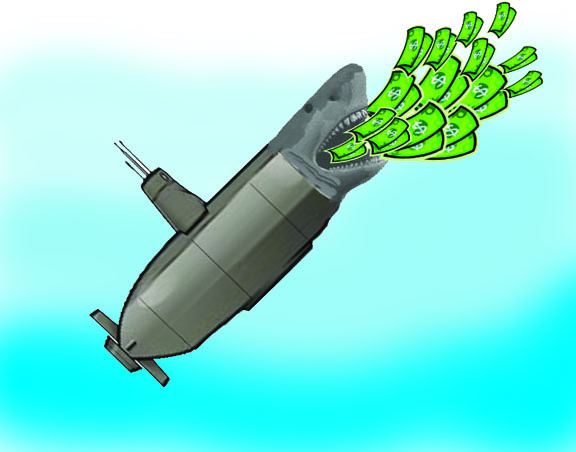
Whichever way they turn, the cost is horrendous at a time when the nation is a trillion dollars in debt…………………….
In Jakarta, there were assurances about respect, in the wake of Indonesian anger that it was not given an AUKUS heads-up. When AUKUS was announced last year, Indonesia said it intended at the next NPT review conference to seek to address what it calls the treaty’s “loophole” that would allow Australia to acquire nuclear-powered submarines. Dealing with nuclear weapons, proliferation and “peaceful use”, the NPT does not specifically go to the issue of nuclear-powered vessels. Rescheduled from January, the conference is in the US next month.
The new government has also had to reassure the nations of the Pacific.
At the recent Pacific Islands Forum, secretary-general Henry Puna, from Cook Islands, presented a report on the South Pacific nuclear treaty, known as the Treaty of Rarotonga, and “other nuclear issues”. The Saturday Paper asked the forum secretariat this week for a copy of the report but did not receive a response before time of press.
Ahead of the forum – and after a visit from Foreign Affairs Minister Penny Wong – Samoan Prime Minister Fiamē Naomi Mata’afa voiced the concerns of some Pacific countries that they were not consulted on AUKUS.
Dr Tess Newton Cain, project leader of the Pacific hub at Griffith University, says there is some unhappiness about a US pattern of using Australia as a diplomatic and defence conduit instead of approaching Pacific nations directly.
“Some of this reflects a belief in the US administration and the US policy community that a good way of understanding the Pacific is to listen to Australia and New Zealand,” Cain says. “From the Pacific side of things, that’s not necessarily how people would see it.”
Overlaying that, Pacific nations have a heightened sensitivity to nuclear matters. Having been the unhappy historical hosts of nuclear testing, they’ve had their own experience with the mushroom cloud. https://www.thesaturdaypaper.com.au/news/politics/2022/07/23/exclusive-richard-marles-aukus-nuclear-safeguards#mtr
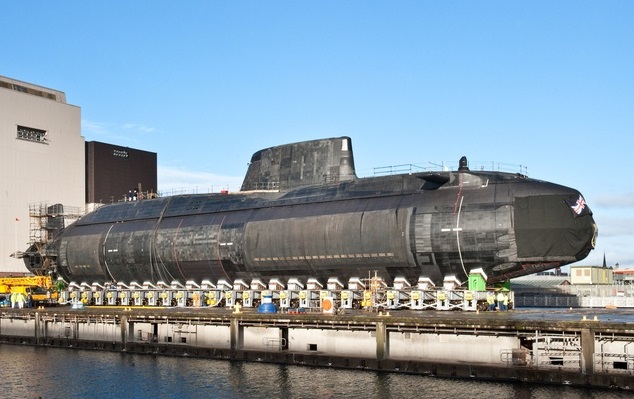
Military chiefs to hold talks on basing UK nuclear submarines in Perth
AFR Andrew Tillett, Political correspondent, Jul 20, 2022
The prospect of British submarines being based out of Perth with Australian sailors on board to undergo nuclear training will be advanced, with the head of the UK military to hold top-level talks with Australian officials next week.
The visit to Sydney and Canberra by UK Chief of the Defence Staff Tony Radakin comes as China sends fresh signals about a desire to improve ties with Australia. There have been further hints a ban on coal exports could soon end, although miners are yet to see any indications of that.
China’s foreign ministry also lauded Foreign Minister Penny Wong for advancing “positive elements” in her recent remarks on China.
A ministry spokesman welcomed Senator Wong downplaying the interpretation that her counterpart Wang Yi had issued four “demands” of Australia on how to improve relations at their groundbreaking meeting in Bali earlier this month.
While China has seized on Labor’s election as an opportunity to repair relations and the Albanese government has dialled down the rhetoric on Beijing, Canberra is still proceeding on the acquisition of nuclear-powered submarines from the UK and US under the AUKUS framework.
Admiral Radakin will meet a number of Australian officials, including recently reappointed Chief of the Defence Force Angus Campbell. In Sydney, he will attend the Indo-Pacific Chiefs of Defence conference and meet counterparts from South-East Asia and the south-west Pacific.
Plug for capability gap
Despite the war in Ukraine, sources said Admiral Radakin was “ambitious” about expanding the UK’s military presence in the Indo-Pacific and his visit was the first in a series by UK security officials and ministers to the region.
A key topic of talks with General Campbell and others will be how Britain can help Australia plug a potential capability gap between the retirement of the ageing Collins class submarines and arrival of the nuclear-powered boats, which Defence Minister Richard Marles says may not be delivered until the 2040s.
The Australian Financial Review understands this could involve the UK deploying its nuclear-powered submarines to Perth for operations in the region…………………………………………. https://www.afr.com/politics/federal/military-chiefs-to-hold-talks-on-basing-uk-nuclear-submarines-in-perth-20220720-p5b36w
AUKUS – contrived to foster the unrealistic and unattainable aims of American foreign policy

The wounded bison is thrashing about with its sole survival plan to wreck the China shop and it doesn’t care if it takes us with it. In fact, it is better to set Australia up as a primary target than Hawaii and the west coast of the US.

Anthony Albanese has not attempted to get his head around foreign relations, in particular China. He is stupidly relying on the people who advised Morrison. People like the head of ONI, the LNP favoured, Shearer and the US arms funded, ASPI. Neither should be allowed near a Labor government. They continue to push the LNP/AUKUS agenda.
https://johnmenadue.com/aukus-contrived-to-foster-the-unrealistic-and-unattainable-aims-of-american-foreign-policy/ By Bruce Haigh, Jul 20, 2022 ,
In all of my experience, AUKUS is the worst example of abuse within the so-called American alliance.
It is a prescription for failure and considerable loss of face for Australia amongst its neighbours, friends in the region and more widely spread friends and trading partners. In fact, the region has shown no support for the proposal and indicated disquiet.
Involvement with the US in the disastrous Vietnam, Iraq and Afghanistan wars should have given cause for thought, but no, a supine media, lack of debate within academic institutions and amongst what remains of an intellectual class has seen the AUKUS proposal gain ‘acceptance’ by politicians without so much as question or query. And this in the complete absence of planning detail and cost analysis.
There has been a lot of poppycock about acquiring nuclear submarines and of having them built in Australia with a lead time to delivery of 20 to 30 years. Only child politicians and their puerile advisers would be prepared to swallow such rubbish. The submarine deal was always a smokescreen to get US nuclear armed submarines based in Australia. The so-called deal was a sop to public opinion and for the moment it has worked with a China hating, US loving, Murdoch led MSM. Where is the sense in spending over $200 billion in the face of a one Trillion-dollar debt? The money would be far better spent on health, education and infrastructure.
AUKUS is nothing more than a US takeover of northern Australia as an operational base against China. Australia has rolled over and the new Minister for Defence, Marles, has gone so far as to offer full integration of the ADF into US force structures.
The most appalling defence acquisition program over 20 years has left Australia without a viable fighting force. Whose decision was it to buy the upgraded version of the Abrams tank? As an ex-tank man, I can say the decision is entirely without merit and smacks of lining US pockets at Australian taxpayer’s expense. The US has a history of foisting rubbish on the ADF, such as the F35, and Australia under leaders such as the toadying and incompetent, John Howard, of rolling over and accepting them.
Instead of weeks, which the US proposed, Labor was given just 24 hours to consider the AUKUS ‘proposal’ by the devious Morrison; it agreed in order to avoid a wedge in the face of the election. Anthony Albanese agreed to something that he knows nothing about. And to prove it he continues to grind on about nuclear submarines.
The Americans thought they were very clever in dragging the British in on the deal. Anyone but the arrant, arrogant and colonial Johnson would have demurred. The UK in AUKUS is unlikely to survive the departure of the incompetent Johnson. The British east of the Suez is the material for jokes. After Brexit they are much reduced and once the Queen dies their prestige will be on sale in second hand shops. The US made a mistake in dragging the UK in. They probably thought it would add some weight to their containment of China.
AUKUS is all about the US and its rivalry and competition with China. It wants to use what Australia has on offer, a base to confront, and when the time comes, to attack China. There is nothing in it for Australia. We are not threatened by China. It is and should remain a major trading partner.
The wounded bison is thrashing about with its sole survival plan to wreck the China shop and it doesn’t care if it takes us with it. In fact, it is better to set Australia up as a primary target than Hawaii and the west coast of the US.
Darwin will become the centre of a US centre monitoring (controlling) all sea and air movements in a wide zone embracing much of the north of Australia with what will be termed a joint operations command. Tindal is being expanded along with Stirling in order to take US arms and delivery vehicles.
The QUAD is a quad in name only. India with its strong ties to Russia was never in it beyond the extent of Modi’s ego. South Korea and Japan will always play their own game depending on who is in power in Washington and Beijing. NATO moving into the so-called Indo-Pacific is little more than a US induced wet dream on the part of Stoltenberg who has absorbed nothing of Nordic notions of social justice and dialogue. No doubt the US is pleased with the NATO announcement seeing further China containment as having been achieved.

Anthony Albanese fans the fires of AUKUS with incomprehensible talk of submarines and staying in step with allies but much more so with his inflammatory statements about China. Penny Wong has outdistanced her Coalition predecessor by leagues. She took on the very difficult task of rebuilding the relationship with China after the oafishness of Morrison and Payne over Wuhan and Covid. She is succeeding. She has deployed a nuance which is a pleasure to watch She has brought her considerable intelligence to bear. She has been subtle and tough minded. She is the person of the moment. Australia got what it needed.
Not so with Anthony Albanese. He has done his best to wreck Wong’s good work. He talks of the continuing danger posed by China, forgetting the AUKUS takeover. He says China has changed and we haven’t? What does he think Morrison did? He trashed twenty years of relationship building, including a most successful visit to Australia by Xi Jinping in November 2014. And he and Dutton banged the drums of war as an election ploy.
Anthony Albanese has not attempted to get his head around foreign relations, in particular China. He is stupidly relying on the people who advised Morrison. People like the head of ONI, the LNP favoured, Shearer and the US arms funded, ASPI. Neither should be allowed near a Labor government. They continue to push the LNP/AUKUS agenda.
Penny Wong is not in that camp, which is lucky for the rest of the country. Albanese must learn to do his own thinking and to find the courage to sack and distance himself from the pernicious influence of Morrison’s dangerous and undermining advisers.
Australia’s price tag for nuclear submarines could soar by $billions
AFR Andrew Tillett, Political correspondentJul 20, 2022
New US government reports warn that Australia could be saddled with billions of dollars of higher costs to build the most up-to-date nuclear submarines, and have cast fresh doubts on America’s defence industry being able to contribute to a speedy acquisition of boats.
Defence Minister Richard Marles wants to announce a preferred design and acquisition pathway in the first quarter of next year, but the Congressional Research Service said the US Navy’s Virginia class submarine program was suffering from construction delays and a maintenance backlog, curtailing the availability of boats already in service…………………………….. (subscribers only)
more https://www.afr.com/politics/federal/australia-s-price-tag-for-nuclear-submarines-could-soar-by-billions-20220719-p5b2p7
Global action urged to block AUKUS plan on transfer of nuclear materials

The submarine purchase, if realized, “will be the first time” after the Nuclear Non-Proliferation Treaty went into force in 1970 that nuclear weapon states transfer tons of weapons-grade nuclear materials to a non-nuclear-weapon state
The plan is high on the agenda of the 10th Review Conference of the Parties to the Treaty on the Non-Proliferation of Nuclear Weapons, which is scheduled to open in New York on Aug 1 http://global.chinadaily.com.cn/a/202207/21/WS62d898fda310fd2b29e6d83a.html By ZHANG YUNBI | CHINA DAILY | Updated: 2022-07-21,
A report written by leading Chinese nuclear security researchers urged the global community to use an upcoming global conference on nuclear nonproliferation to deter the collaboration of the United States and the United Kingdom to transfer weapons-grade nuclear materials through nuclear-powered submarines to Australia.
“The weapons-grade nuclear materials to be transferred to Australia by the two countries would be sufficient to build as many as 64 to 80 nuclear weapons,” said Zhao Xuelin, a leading engineer at the China Institute of Nuclear Industry Strategy.
Such a move would be in “serious violation” of the objectives and purpose of the nonproliferation treaty and would cause enormous harm, he said.
“Washington has been busy building up blocs and small circles like AUKUS to shore up its overwhelming advantage in military areas and secure its hegemony in the Asia-Pacific and the whole world,” said Liu Chong, director of the Institute of International Security of the China Institutes of Contemporary International Relations.
“Such moves have run counter to many countries’ need to seek common security. The trilateral bloc’s members seek their own security at the cost of the other countries, sabotaging global security,” he added.
Zhang Yan, president of the China Arms Control and Disarmament Association, noted that the AUKUS partnership is a new political and military alliance that serves the US’ “Indo-Pacific Strategy”, which aims to provoke regional confrontation and step up a geopolitical zero-sum game.
The submarine purchase, if realized, “will be the first time” after the Nuclear Non-Proliferation Treaty went into force in 1970 that nuclear weapon states transfer tons of weapons-grade nuclear materials to a non-nuclear-weapon state, Zhang said.
“The US, the UK and Australia should seriously respond to the concerns of the international community and earnestly fulfill their obligations under international law,” he added.
Pan Qilong, chairman of the China Institute of Nuclear Industry Strategy, said the AUKUS nuclear-powered submarine collaboration sets a dangerous example of illegal transfer of weapons-grade nuclear materials.
Such a “blatant act of nuclear proliferation” has triggered widespread concern and criticism from the international community, he added
The US, Britain and Australia should “stop taking double standards” and halt their collaboration on nuclear-powered submarines, said the research report issued on Wednesday in Beijing.
Two leading Chinese nuclear research agencies-the China Arms Control and Disarmament Association and the China Institute of Nuclear Industry Strategy-issued the report.
“The international community should take action to urge the AUKUS countries to revoke their wrong decision, and jointly safeguard the integrity, authority and effectiveness of the international nuclear nonproliferation regime,” the report said.
The research report is the first of its kind made by Chinese think tanks focused on the collaboration of the three nations, and it offers abundant evidence and data to prove how the AUKUS countries-Australia, the UK and the US-affect the international nuclear nonproliferation system and stir up the arms race, Foreign Ministry spokesman Wang Wenbin said on Wednesday.
The report is the latest proof that the international community’s concerns on AUKUS collaboration “are well-founded by facts”, he added.
Washington, London and Canberra built the AUKUS trilateral security partnership last year. That prompted anger within and outside the Asia-Pacific region as they announced a plan to allow Australia to purchase nuclear-powered submarines from the UK.
The plan is high on the agenda of the 10th Review Conference of the Parties to the Treaty on the Non-Proliferation of Nuclear Weapons, which is scheduled to open in New York on Aug 1.
The conference, a top-level global meeting that aims to prevent a nuclear arms race and checks on the status quo of nuclear materials around the world, has been delayed for two years due to the COVID-19 pandemic.
Documents show Australian Labor government supports Assange’s extradition to the US
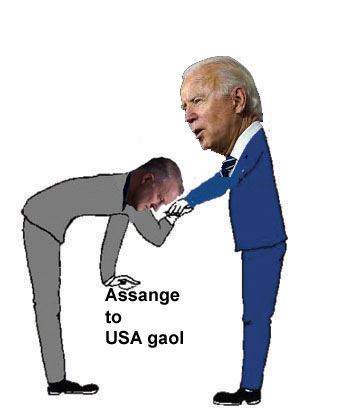
as far as the Labor government is concerned, Assange’s extradition is a done deal.
the greatest mistake defenders of Assange could make would be to harbour illusions that Labor will act to free the WikiLeaks founder.
as far as the Labor government is concerned, Assange’s extradition is a done deal.
the greatest mistake defenders of Assange could make would be to harbour illusions that Labor will act to free the WikiLeaks founder.
https://www.wsws.org/en/articles/2022/07/18/rqbf-j18.html Oscar Grenfell @Oscar_Grenfell, 18 July 22,
Documents obtained by lawyer Kellie Tranter and published on the Declassified Australia website cast a damning light on the Australian Labor government’s role in facilitating the continued imprisonment of WikiLeaks publisher Julian Assange and his extradition to the US.
The material gives the lie to the claims of Labor supporters that the newly-elected government may be seeking to secure Assange’s freedom through backroom diplomacy, despite the refusal of Labor ministers to condemn the attempted US extradition and prosecution.
They show that Labor is willing to let Assange be sent to the US, despite doctors and his family warning that it would be a death sentence. A successful extradition would also set a sweeping precedent for attacks on journalists and political dissidents globally.
Assange faces 17 charges under the Espionage Act, and 175 years imprisonment, for publishing true information exposing massive US-led war crimes in Iraq and Afghanistan.
Tranter, a longstanding legal advisor to Assange, has for many years filed freedom of information requests aimed at acquiring official documents revealing the role of Australian governments in the persecution of Assange. Those released by Declassified Australia are the first she has published since the Labor government was installed after the May 21 federal election.
The two documents are redacted. What is present, however, gives a sufficient picture of Labor’s acquiescence to Assange’s extradition, and the cynical, duplicitous character of the ambiguous public statements its leading representatives have made.
The first are internal “talking points” prepared for Attorney-General Mark Dreyfus on June 2. It is entitled: “Julian Assange – International Transfer of Prisoners process – talking points and background.” Its heading indicates the central preoccupation of the document, which states:
“Prisoner transfers cannot be agreed between governments in advance of a person being a prisoner (after a criminal trial, conviction and sentencing) in a particular country, and require the consent of the prisoner;
“International prisoner transfers to Australia are initiated by an application from a prisoner after the prisoner has been convicted and sentenced;
“If surrendered, convicted and sentenced in the US, Assange could apply under the ITP scheme to serve his sentence in Australia;”
In other words, Assange is to be extradited to the US, where the former Trump administration and the CIA plotted to kidnap or assassinate him from London in 2017, before settling on a pseudo-legal criminal indictment. He would be hauled before a kangaroo court in the District of Virginia, with a jury stacked by the very same CIA officers and their relatives. The hearings would proceed in secret and Assange’s detention regime would be one of total isolation.
With this hanging over his head, the document suggests that perhaps Assange will feel compelled to plead guilty to the “crime” of journalism revealing the illegal killings of civilians, torture and other violations of international law.
Tranter notes that following a redacted section, the document continues: “However, the UK High Court’s judgment does note that the US has provided an assurance that they will consent to Mr Assange being transferred to Australia to serve any custodial sentence on him if he is convicted.”
The US “assurances” are not worth the paper they are written on. Their sole aim was to overcome an earlier British court ruling, which found that Assange’s extradition would be “oppressive” because of his deep on-going health issues and the horrific conditions in which he would be held in a US prison.
The assurances, accepted by a British High Court as bona fide last October, asserted that Assange’s conditions of detention would not be as bad as his lawyers claimed. But those very assurances made plain that the intelligence agencies, including the CIA, would have complete control over the circumstances of Assange’s imprisonment, which could be changed at any time.
The second, June 8 document, is a “ministerial submission,” entitled “Julian Assange – extradition request from the United States to the United Kingdom.” It recommends that Dreyfus “note” the situation confronting Assange, in the lead up to an announcement by British Home Secretary Priti Patel on whether she would approve extradition. Several weeks later, Patel gave her green light.
The submission to Dreyfus bluntly stated: “The UK Home Secretary is due to make a final decision on Mr Assange’s extradition to the US by 20 June. Mr Assange will have one final avenue of appeal with the leave of the High Court, otherwise he must be extradited within 28 days of the Secretary of State’s decision.”
And again: “If Mr Assange is extradited, convicted and sentenced in the US, he may apply for transfer to Australia under the International Transfer of Prisoner’s Scheme. This will require the consent of the US and Australian authorities.
“The UK High Court’s judgment notes that the US has provided an assurance that it will consent to Mr Assange being transferred to Australia to serve any custodial sentence imposed on him if he is convicted.”
Later on, the document stated: “‘If Mr Assange is convicted and sentenced to imprisonment in the US, it will be possible for him to apply under the ITP scheme to serve the remainder of his sentence in Australia. A transfer would also require the consent of the US, the Australian Government (through you as Attorney-General), and the relevant minister in the state into whose prison Mr Assange would be transferring.
“In making any such decision, the department would provide you with advice on factors such as the extent to which the transfer would assist the prisoner’s rehabilitation, sentence enforcement, community safety and any relevant humanitarian considerations, in addition to any conditions of transfer required by the US.’”
In other words, as far as the Labor government is concerned, Assange’s extradition is a done deal.
Also striking is the fact that the documents do not countenance the possibility that he would be found “not guilty” in a US court. The entire thrust of the two documents is that the extradition and successful prosecution have already been stitched up, in a conspiracy involving the British government, the UK courts, the American authorities and the Labor administration.
Once Assange were in the US, moreover, the documents acknowledge that any “prison transfer” would be dependent upon the acquiescence of the American government whose President, Joe Biden, has previously branded Assange as a “high-tech terrorist.” A prison transfer, even in the unlikely event that it occurred, would mean years more of Assange’s incarceration, in Britain, the US and then Australia.
The contempt of the government for Assange is summed up by the reference to “factors such as the extent to which the transfer would assist the prisoner’s rehabilitation.” Assange does not need to be rehabilitated. He is a heroic journalist who has done a major service to humanity. It is the war criminals he has exposed who need to be placed in an institution.
Obviously it is unknown what is contained in the redacted section. It may deal with the elephant in the room, which is excluded from the rest of the documents. Assange’s doctors, lawyers and family have all testified that the WikiLeaks founder would take his life if he were to be extradited to the US. That judgment was effectively upheld by the British District Court, before it was overturned on the basis of the bogus US assurances.
All of the talk about “prison transfers” and the like is therefore window dressing for what would amount to a death sentence.
The documents reveal the sinister character of statements by Labor leaders, including Prime Minister Anthony Albanese, Foreign Minister Penny Wong and Dreyfus, that the Assange case has ‘gone on for too long,” and “needs to be brought to a close.” When asked by journalists, each has refused to elaborate on what this precisely means.
One thing that is entirely absent from the documents is any suggestion that Labor has so much as suggested the US government drop the charges against Assange and end the extradition proceedings. The continuation of the judicial frame-up and victimisation is taken as given.
The documents vindicate the warnings of the Socialist Equality Party that the greatest mistake defenders of Assange could make would be to harbour illusions that Labor will act to free the WikiLeaks founder.
The 2010-2013 Gillard Labor government initiated Australia’s collaboration with the persecution of Assange. Gillard slandered Assange by falsely claiming that he had broken Australian laws. Assange publicly accused Gillard and other senior ministers of secretly collaborating with the American state against him and other Australian citizens associated with WikiLeaks.
Those actions were bound up with the Gillard government’s full-throated support for the “pivot to Asia,” a vast military build-up aimed at preparing for an aggressive US-led war against China.
A decade on and the military preparations are far advanced. The new Labor government is functioning as an attack dog of the Biden administration throughout the region. Last week, during a visit to Washington, Defence Minister Richard Marles hailed the US-Australia alliance as “unbreakable,” as he outlined a further massive military-build up.
The documents confirm that the fight for Assange’s freedom requires a political struggle by the working class, the social constituency for democratic rights, against the Labor government and all of its defenders. A Labor government will only intervene diplomatically and legally to free Assange, if it is forced to do so by a mass movement from below.
Climate protesters criminalised as climate crisis escalates
Long-term environmental activist Bob Brown, Human Rights Watch and a network of grassroots campaigners have condemned the recent raids and police repression against climate protesters, joining in solidarity with a collective warning from 40 civil society organisations.
However, by criminalising protest, governments expose their allegiance to profit before the people. Rather than generate fear amongst us, this may just mobilise more people in defence of systems that threaten life on Earth.
Independent Australia. By Claire Burgess | 18 July 2022.
With anti-protest laws on the rise as our climate crisis worsens, activists are fighting back to raise awareness, writes Claire Burgess.
CLIMATE ACTIVISTS are increasingly using protest tactics that cannot be ignored. They are targeting Australia’s economic and political centres, contending that these systems built from colonial dispossession are responsible for climate destruction and inaction. Does this approach to bringing about change hold up empirically?
Is Australia a colonial and extractive-based climate pariah?
The extraction of “natural resources” is the backbone of colonial relations to the Earth — climate change is a symptom of this way of operating. The sixth International Panel on Climate Change (IPCC) report points to how marginalised communities, particularly Indigenous, disproportionately bear the burden and harm from climate change though they are the least responsible. Scholars now argue that climate action requires addressing the ongoing legacies of colonialism.
Australia’s current extractive regime has its roots in colonial systems of violence and dispossession of Aboriginal and Torres Strait Islander people. The political and economic system sits proudly upon scarred and damaged land that was never ceded. Mining giants continue to be prioritised by governments, such as coal mining company Adani over the land rights of Traditional Owners.
Politics and economics have been identified by the IPCC as major impediments to climate action. This is particularly evident in the contradiction of Australian mining companies becoming both global leaders in “green” economies while expanding coal and gas production. The plunder for capitalising on the economic opportunities of new green economies is the latest threat to the planet.
Despite all the talk about “green” growth, energy-related emissions have accelerated, reaching record highs in 2021. The only slowdown of emissions occurred during the COVID lockdown. Degrowth scholars highlight how the myth of progress continues to underpin market approaches to climate change. They remind us of the hard limits on the number of natural resources left that we can use.
Every ecosystem is under pressure. First Nations elders and scholars have also long called for designing systems based on ecological relationality with the Earth.
The signs of both planetary collapse and the knowledge of regenerative ways of being have long been available. It is the dominating, extractive-based system that is maladaptive to our planet — not us.
How has people-power shaped this country?
The goal of non-violent direct action (NVDA) is to draw attention to contentious practices and in doing so, exert pressure on targeted actors. In lutruwita/Tasmania during the Franklin Dam blockade, a total of 1,400 people were arrested and gaoled including federal and state parliament members.
This campaign led to a large area of wilderness being saved from development. Grassroots, direct action galvanised the environmental movement in Australia and these tactics continue to be used to defend wild places.
NVDA can encompass open or covert tactics from blockades, sit-ins and occupations to street protests. In gaining land rights, the occupation of land outside Parliament House for establishing the “Aboriginal Tent Embassy” sent a message to the public about the impacts of landlessness and dispossession. Resistance in the form of land defence continues today, in blockading extractive industries on Traditional Lands.
Perhaps because of this history, governments are responding to climate activists with nationwide legislative crackdowns in the form of anti-protest laws. The link between the protection of extractive industries, political power and government repression of protesters should concern all of us.
Long-term environmental activist Bob Brown, Human Rights Watch and a network of grassroots campaigners have condemned the recent raids and police repression against climate protesters, joining in solidarity with a collective warning from 40 civil society organisations.
However, by criminalising protest, governments expose their allegiance to profit before the people. Rather than generate fear amongst us, this may just mobilise more people in defence of systems that threaten life on Earth.
Is collective action commensurate to co-creating a sustainable future?.
…………………………………………………. Reclaiming our humanity in the face of planetary collapse is tapping into the one autonomous vehicle we have — our collective bodies. Speaking truth to power by drawing upon strategies that have worked in the past is an integral part of reimagining and bringing to life the regenerative future, one that we desperately need.
All we have is the Earth and each other https://independentaustralia.net/politics/politics-display/climate-protesters-criminalised-as-climate-crisis-escalates,16572
How social media is censored by algorithms to effectively throttle dissent.

ED note: This article is very personal for me. I’ve had the experience in the last few days of Facebook suppressing my post (posted as Noel Wauchope). The post was a transcript of a Youtube item by prestigious Australian journalist Michael West
It was an important article, showing up the hypocrisy of Rupert Murdoch’s News Corporation, in this case , shamefully and inaccurately promoting nuclear power as ”cheap”
I can dispute this censorship – but that could take months – even if I succeed, it would be too late to matter.
Censorship By Algorithm Does Far More Damage Than Conventional Censorship, Caitlin’s Newsletter, Caitlin Johnstone Jan 25 2022
”…………………………………………………….’And Silicon Valley did eventually admit that it was in fact actively censoring voices who fall outside the mainstream consensus. In order to disprove the false right-wing narrative that Google only censors rightist voices, the CEO of Google’s parent company Alphabet admitted in 2020 to algorithmically throttling World Socialist Website. Last year the CEO of Google-owned YouTube acknowledged that the platform uses algorithms to elevate “authoritative sources” while suppressing “borderline content” not considered authoritative, which apparently even includes just marginally establishment-critical left-of-center voices like Kyle Kulinski. Facebook spokeswoman Lauren Svensson said in 2018 that if the platform’s fact-checkers (including the state-funded establishment narrative management firm Atlantic Council) rule that a Facebook user has been posting false news, moderators will “dramatically reduce the distribution of all of their Page-level or domain-level content on Facebook.”…………………….
That’s the biggest loophole the so-called free democracies of the western world have found in their quest to regulate online speech. By allowing these monopolistic megacorporations to become the sources everyone goes to for information (and even actively helping them along that path as in for example Google’s research grants from the CIA and NSA), it’s possible to tweak algorithms in such a way that dissident information exists online, but nobody ever sees it.
You’ve probably noticed this if you’ve tried to search YouTube for videos which don’t align with the official narratives of western governments and media lately. That search function used to work like magic; like it was reading your mind. Now it’s almost impossible to find the information you’re looking for unless you’re trying to find out what the US State Department wants you to think. It’s the same with Google searches and Facebook, and because those giant platforms dictate what information gets seen by the general public, that wild information bias toward establishment narratives bleeds into other common areas of interaction like Twitter as well.
The idea is to let most people freely share dissident ideas and information about empire, war, capitalism, authoritarianism and propaganda, but to make it increasingly difficult for them to get their content seen and heard by people, and to make their going viral altogether impossible. To avoid the loud controversies and uncomfortable public scrutiny brought on by acts of overt censorship as much as possible while silently sweeping unauthorized speech behind the curtain. To make noncompliant voices “disappear from view so slowly you won’t even notice,” as Cook put it
The status quo is not working. Our ecosystem is dying, we appear to be rapidly approaching a high risk of direct military confrontation between nuclear-armed nations, and our world is rife with injustice, inequality, oppression and exploitation. None of this is going to change until the public begins awakening to the problems with the current status quo so we can begin organizing a mass-scale push toward healthier systems. And that’s never going to happen as long as information is locked down in the way that it is.
Whoever controls the narrative controls the world. And as more and more people get their information about what’s happening in the world from online sources, Silicon Valley algorithm manipulation has already become one of the most consequential forms of narrative control.
Australian local governments vote to retain prohibitions on nuclear power
Local government talks nuclear, Cosmos 15 July 22
Energy shortages across the world have shone a harsh spotlight on the way forward for energy production, and renewed the nuclear power debate in Australia. But what stance are our local government representatives taking on this divisive issue?
What do our grass-roots leaders think about nuclear power?
……. A motion to call on the federal government to remove restrictions to progressing nuclear energy in Australia has recently been defeated by a narrow margin at the National General Assembly in Canberra.
But the heated debate included a claim from one councillor he wouldn’t mind if it was in his own backyard.
Delegates from Australia’s 537 councils took part in the June 19-22 conference, billed by its organisers the Australian Local Government Association (ALGA) as “the largest most influential local government conference in Australia”.
Motion number 52, submitted by Gunnedah Shire Council in north-west New South Wales, called on the federal government to “remove restrictions preventing the development of nuclear energy as a viable option in the production of base-load electricity following the decommissioning of coal-fired power stations throughout Australia”.
Gunnedah Mayor Jamie Chaffey told delegates……………. Nuclear power production has developed exponentially since its early days and is now considered to be safe and reeliable with nations such as Germany [ really?] and France leading the way.
The plea brought an emotional response from Inner West (Sydney) Councillor Mark Drury, who quoted the 2021-22 CSIRO GenCost report.
“Let’s not go through this again, delegates,” Drury said.
“Let us not repeat the mistakes of the last 10 years. Let us not sing from the Mineral Council songsheet. Let us move on.
“Interestingly, the restriction Gunnedah wants to remove is the 1999 [Prime Minister John] Howard ban on ministers considering nuclear power. Since 1999, no Liberal prime minister has changed that. I know Albo [Prime Minister Anthony Albanese] won’t.
“Why? Because nuclear power is expensive. It is really, really expensive.”
Gladstone Mayor Matt Burnett said even people who supported nuclear energy had told him they did not want it in their own backyards.
He quoted the 2018 CSIRO GenCost report that stated by 2050, nuclear energy would cost $16,000 per kilowatt to produce, while solar energy would cost $600 per kilowatt.
“The same report identified it would take 9.4 years before we saw a nuclear generation plant in this country,” Burnett said. “In context, in the Gladstone region, with our beautiful deepwater harbour and our industrial port, the Gladstone Port Corporation estimates we’ve got upwards of 2,500 wind towers coming into the Gladstone Port over the next 10 years.”…………..
The motion was defeated 109 to 93 votes.
The construction and operation of nuclear power stations was prohibited in Australia in 1998. https://cosmosmagazine.com/technology/nuclear-power-local-government-australia/
Liberals to seek ‘social licence’ for nuclear power
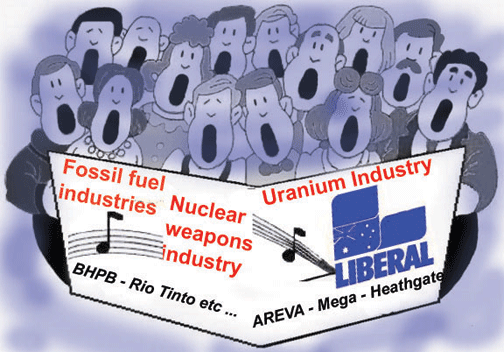
AFR 15 July 22, As Liberal leader Peter Dutton and Nationals leader David Littleproud backed an examination of nuclear power, new shadow energy minister Ted O’Brien said while his immediate focus was the gas and energy crisis, his longer-term mission would be to build support for nuclear energy.
Uranium is losing the new energy market battle.

Uranium is losing the new energy market battle. Uranium is being bypassed
in the rush to embrace renewable wind and solar energy sources, leaving
nuclear power floundering well short of its once anticipated potential.
Mining Journal 14th July 2022
Michael West busts the spin of Murdoch media’s nuclear marketing.
It’s the nuclear debate. On the one hand, we have all the scientists, and experts on finance and energy.. And on the other hand we have Rupert Murdoch’s experts – Chris Kenny, Caleb Bond and the whole Sky News team. These people are experts in nuclear energy.
And so we have one side saying ”No Australia should not build nuclear power plants because they are too costly and there’s the issue of how to dispose of the nuclear wastes
But on the other hand – we have new evidence, unveiled by Sky News – by Rupert Murdoch’s News Corporation, that nuclear energy is actually the cheapest new form of energy
Australian nuclear engineer Tony Irwin [of Small Nuclear Technologies company] has crunched the numbers and it’s turned out – that in the long term nuclear energy is the cheapest form of energy. Daily Telegraph’s Piers Ackerman reported on all these numbers, – on the capacity factor, the estimated plant life, line transmission costs and all the other factors that are considered in the cost of building nuclear power stations is cheaper than wind and solar and vastly more efficient than pumped hydro
All prevailing wisdom – the science indeed would say that nuclear is the most expensive.
Why are we having thi debate? If we were to build a NPP right now, it wouldn’t be up and running for 10 years they cost $20 billion to build.
Here we have Caleb Bond from Adelaide Advertiser – no need for a university education. Chris Bowen described nuclear energy as a complete joke. ” Doesn’t he have egg on his face right now” – Caleb’s take.
Most experts think nuclear energy is a joke, too expensive Who are the people quoted here?
The Australian and The Murdoch publications ……………..rabbiting on about how we have to go nuclear for baseload energy
Where do they get their experts from?
We are getting to Murdoch’s experts, Caleb Bond cited in evidence a story in the Daily Telegraph another Murdoch – ”New research reveals that nuclear energy is actually the cheapest form of energy” the expert here is pre-eminent global expert Piers Ackerman, one of Muroch’s greatest lackeys. – saying the nuclear energy is the cheapest.
The CSIRO value nuclear energy at 128-330 MW per hour . 9()% wind and solar they valued at 55-80 MW less than half. Coal is cheaper – they all are cheaper. Backing up the CSIRO is the world economic forum -is the IEA the International Energy Agency. They base their decisions on the science
Nuclear is not only dangerous because of the wastes, but it is also perilously expensive to build, and it won’t be done before the climate is irretrievably damaged.in 2030
This is a complete distraction and it’s utter nonsense . And the Murdoch people actually understand this – they understand that it is never going to happen.
This is quintessential Murdoch stuff. It’s a distraction.They know that nuclear energy is not viable, It does not make commercial sense. The debate was over at least 2 years ago. Solar is the cheapest, then wind, and hydro and so on.
Despite people like Matt Canavan. Barnaby Joyce, playing up to their coal donors, their vested interests – the problem is in the grid now, that coal is not viable.
2 years ago the IAE declared in its world energy outlookj solar as the cheapest.energy in history
Murdoch’s nuclear push is a distraction. They know it will never happen. They need to have a hat at the table. They come up with a contrarian view – to create division and debate. Murdoch creating enemies – our experts like Piers have told us that this is so- the enemy is renewable energy everyone else are all woke latte-sipping lefties -anybody that doesn’t like coal. They’ve lost that debate, They know that they have no basis to push coal and gas will be next.
So what they’re doing now is promoting SMRs. Lets’ build smrs. This has been tried elsewhere hasn’t been seen to work efficiently – If the Chinese the Russians, the Americans and Brits can’t get it going – why are we even talking about them? When we have free solar and wind Because Murdoch wants to be a player in this debate. it’s all about media creating goodies and baddies, Liberal good, Labor bad, Green terrible.
Thanks to Giles Parkinson at REneweconomy. we quote his research into this.
The track record of smrs around the world has been pitiful. Just a handful of projects most or all suffering massive cost overruns and multi years delay. Russia’s floating nuclear plant was 9 years behind schedule, more than 6 times over budget and the electricity it produces is estimated to cost an exorbitant US $200 per Megawatt hour.- according to the OECD;s nuclear energy agency – a source that Murdoch minions would be fleeing from. Why would you when you have Chris Kenny Piers Ackerman and the lobbyists from ANSTO?
The only other operational smr anywhere else in the world, China’s high temperature gas cooled smr, was 2 to 3 times more expensive than initial estimates. It was 8 years behind schedule and plans for additional reactors at the site have been dropped . Argentina’s smr is 7 years behind schedule , billion dollar cost overruns, current cost 23 times beyond preliminary estimates. . The cost exceeds A$1billion for a plant with the capacity of 2 large wind turbines.
By the time we did it in Australia and spent $5 billion on our smr that would have gone out to $20 to $30 billion for a small nuclear reactor when the climate has been destroyed by 2035. Not a very sensible policy outcome.
China recently began construction of an smr based on conventional light-water reactor technology. According to China National Nuclear Corporation, construction costs per kilowatt (kW) will be twice the cost of large reactors and the levelised cost of electricity will be 50% higher than for large reactors.
So not only do they take a long time to build, are hugely expensive, they’re not efficient either, So there you have it. It doesn’t work, like carbon capture and storage.
Yet it is being feverishly espoused in the Murdoch press. They’re coming out with nuclear energy stories daily. Their copy is pay-walled. it is losing influence. The ABC has just said it doesn’t want to showcase Murdoch newspapers in its breakfast television.
These guys are in a bind and they have to be controversial, combattive even, to maintain their tiny Sky News audience, which they package up as recent research found, and send it all around the world as evidence that their climate-denying analysis has legs. It is a classic misinformation – propaganda machine. which is subsidised by us, the tax-payer. They are looking for a cause celebre. looking for relevance Their bullying tactics are on the way, They will come up with any proposition possible to create a difference, to create a media narrative and this nuclear narrative despite it being majestically ill-conceived has no legs but that will not stop then from carping on about it.
Clean energy builds self-reliance: Zibelman

Clean energy builds self-reliance: Zibelman Australia can be a superpower in clean energy tech and must embrace the opportunity, says Audrey Zibelman, now heading up the grid moonshot at Alphabet’s X
1 This month
7 April – WEBINAR – Australia and the Doomsday Clock – Preventing nuclear war through NoFirstUse and other policies
Online | Tuesday April 7, 4:00-5:30pm, Australian Eastern Time / 8:00-9:30am Central Europe Time
– Access the registration link
15 April – Zoom –Nuclear Power is Not the Solution
Apr 15, 2026 01:00 AM in Canberra, Melbourne, Sydney

Join the International Physicians for the Prevention of Nuclear War (IPPNW) on Tuesday, April 14th for a timely webinar exploring the risks associated with nuclear power and challenging the myth that it offers a simple, safe, carbon-free solution to the climate crisis

21 April Webinar: No Nuclear Weapons in Australia
Start: 2026-04-21 18:00:00 UTC Canberra, Melbourne, Sydney (GMT+10:00)
End: 2026-04-21 19:30:00 UTC Canberra, Melbourne, Sydney (GMT+10:00)
Event Type: Virtual
A virtual link will be communicated before the event.
Host Contact Info: australia@icanw.org

of the week – Australians for War Powers Reform (AWPR)
To see nuclear-related stories in greater depth and intensity
 Antinuclear