One white elephant submarine deal replaced with a worse one
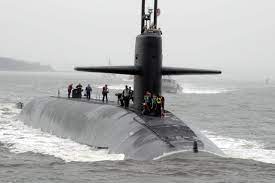
Australia’s submarine policy has previously eschewed nuclear propulsion. Now, as a dowry for receiving such largesse, Canberra is offering up Australia as a confirmed US asset in policing the Indo-Pacific. US Navy commanders will be smacking their lips at maintaining attack vessels in Australia as part of the arrangement……
Nuclear white elephants: Australia’s new submarine deal, Green Left, Binoy KampmarkSeptember 16, 2021Issue 1319Australia Few areas of public expenditure are more costly and mindlessly wasteful than submarines. Australia’s effort is particularly impressive.
Pick a real winner by signing a contract for a yet-to-be-designed attack class submarine, supposedly “necessary” in an “increasingly dangerous” region. Ensure the submarine design is based on a nuclear model, but remove that attribute and charge at least twice as much for a less capable weapon. Make sure the order is for 12 of these yet-to-be-designed-and-built systems. And make sure that they are only ready sometime in the 2030s (by which time they risk being obsolete).
The dubious honour for this contract, initially costing $50 billion, went to the French submarine company DCNS (now called Naval Group), which nudged out German and Japanese contenders with pre-existing designs………
The French military establishment praised it as the “contract of the century”. Le Parisien’s editorial lauded the prospect of thousands of jobs. French Defence Minister Jean-Yves Le Drian proclaimed a “50-year marriage” had begun……..
On September 15, the Canberra press gallery was awash with rumours that a divorce was being proposed.
The following day, Prime Minister Scott Morrison announced a security ménage à trois with the United States and Britain, with Australia as the subordinate partner. The glue that will hold this union together is a common suspicion: China.
Replacing the Attack Class submarine will be a nuclear-powered alternative with Anglo-American blessing, based on the US Virginia class or British Astute class.
The joint statement announcing the creation of AUKUS said the three countries were “guided” by “enduring ideals and shared commitment to the international rules-based order”. They resolved “to deepen diplomatic, security, and defence cooperation in the Indo-Pacific region, including by working with partners, to meet the challenges of the twenty-first century.”
AUKUS, they said, would be a new “enhanced trilateral security partnership” to further such goals.
The agreement is nothing less than an announcement to the region that the Anglophone bloc intends to police, oversee and, if necessary, punish…….
The first initiative is a “shared” ambition “to support Australia in acquiring nuclear-powered submarines for the Royal Australian Navy”. US and British expertise will be drawn on to “bring an Australian capability into service at the earliest achievable date” from the submarine programs of both countries…..
Australia’s submarine policy has previously eschewed nuclear propulsion. Now, as a dowry for receiving such largesse, Canberra is offering up Australia as a confirmed US asset in policing the Indo-Pacific. US Navy commanders will be smacking their lips at maintaining attack vessels in Australia as part of the arrangement……
The enduring problem of Australia being able to build these submarines will have US lawmakers pushing for their construction on home soil, a situation that could mirror the Naval Group contract headaches. Australia also lacks a shipyard able to build or maintain such vessels.
In helping create AUKUS, Canberra has exchanged one white elephant of the sea for another. It has also significantly increased the prospects for a potential nuclear conflict in the Indo-Pacific region. The warmongers will be ecstatic.
[Dr Binoy Kampmark lectures at RMIT University, Melbourne. Email bkampmark@gmail.com.] https://www.greenleft.org.au/content/nuclear-white-elephants-australias-new-submarine-deal
Ballarat Council considers supporting the U.N. Treaty on the Prohibition of Nuclear Weapons
Question raised as to why Ballarat councillors are discussing nuclear weapons, https://www.3ba.com.au/news/local-news/108123-question-raised-as-to-why-ballarat-councillors-are-discussing-nuclear-weaponsNuclear arms will be on the agenda at Wednesday night’s City of Ballarat council meeting, with one councillor labelling it a waste of time.
Councillors will vote on whether or not to support a treaty on the prohibition of nuclear weapons.
Cr Ben Taylor says it’s disappointing they are dealing with items that have nothing to do with Ballarat.
“We’re in the middle of a lockdown, people are worried about their jobs and their kids not going to school and Ballarat City Council seems to want to put their attention on the prohibition of nuclear weapons.”
“It’s got nothing to do with Ballarat and nothing to do with Australia,” Cr Taylor said.
US nuclear submarines: a dangerous nonsense

A third reason concerns the continued use of military might as the way to address conflicts. Bellicose, top-down exercise of power demonstrates a fascination with violence and a corresponding illiteracy about non-violence
. You have to ask whether men in suits, in politics, corporations and in association with media acolytes, ever learn.
US nuclear submarines: a dangerous nonsense https://www.greenleft.org.au/content/us-nuclear-submarines-dangerous-nonsense, Stuart Rees,September 20, 2021Issue 1320Australia Unless you think that force of arms gives security and that revival of alliances with far away governments makes sense, the decision to own and operate United States nuclear submarines should be judged a dangerous nonsense.
There are four reasons for making this claim.
Foreign policy in search of an enemy — in this case China — looks like a guarantee of conflict if not war. Polarisation with little room for dialogue only benefits the arms industry, United States corporations and those in the US, Britain, Australia and China who think a taste for militarism and masculinity will show the benefits of violence. Capacity to learn from the devastation of the past is once again shoved aside.
A second reason concerns Australia’s geography: as though days of empire must not be forgotten, a country located in South East Asia and the Pacific chooses an alliance with elderly friends in Washington and London underscores my submarine despair.
Such a decision reeks of cultural disdain for diverse countries. Even if dialogue with China seems currently blocked, it should make diplomatic sense to communicate about security by being at coffee tables and in tea houses in Malaysia, Vietnam, Indonesia, Cambodia and the Philippines, as well as Pacific Island nations.
Such communication would be about Millennium goals, COVID-19 vaccinations and the future of planet Earth. Alliances with those countries about those issues would make sense.
A third reason concerns the continued use of military might as the way to address conflicts. Bellicose, top-down exercise of power demonstrates a fascination with violence and a corresponding illiteracy about non-violence. You have to ask whether men in suits, in politics, corporations and in association with media acolytes, ever learn.
At a time when surveys of young people record their fear of the future and their despair that powerful, inaccessible men refuse to hear them, they are offered a massive bill for nuclear operating submarines.
Indifference to contracts and derision about trust is a fourth and final reason for disdain about the nuclear submarine alliance.
Whatever the merits of building even one submarine, at least there were years of agreement with French companies to undertake that ship building task. I understand there are up to 60 Australian naval personnel in Cherbourg, France, who have been taken by surprise at US President Joe Biden, British Prime Minister Boris Johnson and Prime Minister Scott Morrison’s announcement.
Who cares? Trust is of no consequence. Contracts can be torn up. Promises were never meant to be kept. Besides, in Morrison’s case, an election looms and boasting about national security by having US submarines gives a potential war-like platform for winning.
There are and there will be no winners.
Can anyone forget the very recent US betrayal and refusal to consult friends and allies in Afghanistan? To distract from that debacle, just pretend that Washington will provide strength and trust in submarines. This is a dangerous nonsense.
[Stuart Rees OAM is Professor Emeritus, University of Sydney, recipient of the Jerusalem (Al Quds) Peace Prize and author of Cruelty or Humanity. He is also the founding Director of the Sydney Peace Foundation. This article was first published at The New Bush Telegraph.]
Scientists still don’t know how far melting in Antarctica will go – or the sea level rise it will unleash
Chen Zhao and Rupert Gladstone
The Antarctic ice sheet is the largest mass of ice in the world, holding around 60% of the world’s fresh water. If it all melted, global average sea levels would rise by 58 metres. But scientists are grappling with exactly how global warming will affect this great ice sheet.
French ambassador says Scott Morrison gave no warning on the nuclear submarine deal
‘Maybe we’re not friends’: French Ambassador claims ScoMo offered no warning about AUKUS deal A powerful French official has slammed Scott Morrison, accusing the Prime Minister of one thing to do with the submarine deal. news.com.au , Helena Burke, 20 Sep 21
The former French Ambassador to Australia has ripped into Scott Morrison for his defence of the AUKUS submarine deal, claiming the Prime Minister lied about warning France about it.
Jean-Pierre Thebault, who had been the French Ambassador in Canberra since 2020, was recalled last week after France expressed outrage at being left out of the new nuclear submarine deal between the US, UK, and Australia.
Speaking to Radio National on Monday, Mr Thebault said France had been completely blindsided by Mr Morrison’s decision to accept the new deal.
“We discover(ed) through the press that the most important person in the Australian government kept us in the dark intentionally until the last minute and was not willing to at least have the decency to enter conversation about the alternative,” Mr Thebault said.
“This is not an Australian attitude towards friends.”
Maybe we’re not friends.”
Mr Morrison had previously rejected that he had not warned France about the new deal, insisting he told French President Emmanuel Macron in June that Australia might scrap its original submarine agreement,,,,
But the French Ambassador insisted France had never been warned about the potential for a new deal which would exclude them. https://www.news.com.au/national/politics/maybe-were-not-friends-french-ambassador-claims-scomo-offered-no-warning-about-aukus-deal/news-story/467293b479eca4741c116ba5ced54751
Scott Morrison’s AUKUS deal designed to win election, not make Australia safe
That Fella Down Under! Scott Morrison’s AUKUS deal designed to win election, not make Australia safe
By Michael West| September 17, 2021

Strap in for a media blitz on the threat from China. Prime Minister #ThatFellaDownUnder Scott Morrison and his merry band are about to take a war to the election. Michael West reports.
US President Joe Biden might have forgotten his name but, in the Canberra Bubble, Scott Morrison is unforgettable, a marketing maestro, a prince among men; literally, because there don’t seem to be any women among his phalanx of advisers.
The PM’s army of propagandists has been working around the clock over the past two days marketing the latest announcement to a fawning press: AUKUS, a new “Alliance for the Ages as China Threat Grows”, according to The Australian. And what results!
Christian Porter’s secret legal payments are off the front pages, as is the JobKeeper mega-rort, the biggest transfer of wealth in history from working Australians to wealthy Australians and foreign corporations.
Early Thursday morning there was no AUKUS. The AFR did have a scoop though, splashing with: “PM to announce $90b French submarine deal is dead”.
That story soon vanished from the website. Bad headline. Around 7.30, The Australian was trumpeting “A major coup for Australia”. A veritable onslaught of gushing PR ensued: the new “Forever Alliance” as Nine put it, or “Friends in Freedom” as The Australian glowed.
“Australia confirms landmark nuclear submarine deal and it’s ‘China’s worst nightmare’,” declared a truckling news.com.au.
That Fella Down Under
The funny thing was that US President Joe Biden seemed to have forgotten Scott Morrison’s name as he announced this new AUKUS alliance with Boris Johnson. “That Fella Down Under” he called him, casually gesticulating in Scott Morrison’s general direction.
Perhaps it was a deliberate thing, such was the PM’s unctuous toadying to the buffoon Donald Trump.
n any case, Australia’s massive $90 billion submarine deal with the French had been junked in a jiffy. Good thing too, because if the French had got involved in this new alliance for freedom it might have been more appropriately monikered FAUKUS.
What that will cost in tearing up this contract with the Gauls, who knows? Probably in the billions. We’ve toasted $2b so far.
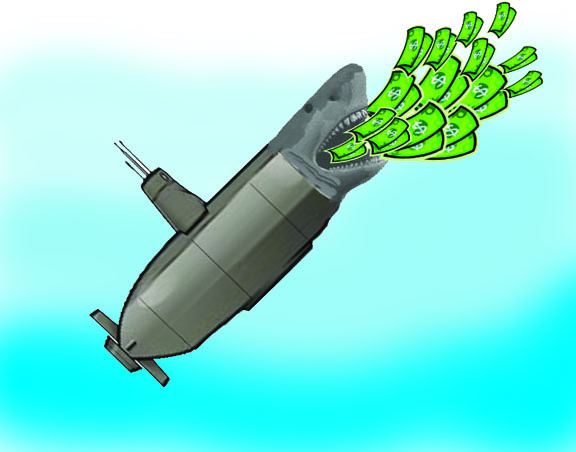
What will the new subs cost? Probably more than $100 billion. As jobless Australians are degraded with their measly $4 a day rise in welfare payments, you can count on one thing; the sheer, incontestable incompetence of this government will ensure a new maelstrom of waste and spending.
They struggle to get anything right, except announcements, media relations, scare campaigns at election time.
That King of Lemons the F-35 Strike Fighter is a gilten cadaver now, debunked even by the top military figure in the US. The chair of the Armed Services Committee Democrat Adam Smith reckons they should stop throwing money down “that particular rat hole”.
For Australia, the cost of those 72 lemons is $17 billion, before running into the hundreds of billions to be maintained for life, if they can fly.
Where is New Zealand?
In light of the long-standing ANZUS treaty there was one notable omission in the AUKUS line up, New Zealand. Notwithstanding that NZAUKUS or AUKUSNZ is far too ugly an acronym, the Kiwis are too sensible to blow up their biggest trading partner, China, as the Coalition Government here has proven so adroit at doing.
Unlike #ThatFellaDownUnder, New Zealand Prime Minister Jacinda Adern would have the sense to ask her people first if they wanted to poke the bear, tear up billions on last century military hardware and park nuclear submarines in their harbours. They don’t. They are sticking to their no-nuclear policy and won’t even let the subs in their waters, said Ardern
The whole thing is so last century, and so dangerous in geopolitical terms. To deflect from their abominable policies at home, to deflect from the retinue of scandals the likes of Christian Porter, JobKeeper, Team Australia, as the AFR calls them, or Team #ThatFellaDownUnder on Twitter, now appears certain to fight the Election by beating up the China military threat.
Murdoch loves it, Keating not
There is nothing like an enemy to exploit for political purposes, a military threat, no matter how ludicrous and unlikely. Naturally, it plays well for the craven Murdoch press which adores a war; has cheered avidly every failed US invasion from Vietnam, through Iraq to Afghanistan.
Gird the loins then for the daily barrage of provocative, misleading nonsense in the corporate media, to be followed daily – with a tad less fervour – on the airwaves of the ABC.
China has zero intention of invading Australia but already, thanks to this reckless messaging by a suborned corporate media, half the country thinks they might…………..
What is this deal which #ThatFellaDownUnder has signed up for, besides electoral fodder and domestic distraction value? Presumably we buy defence tech from the US, so it’s commercial for them. If the F-35 debacle is anything to go by they will control our submarines anyway. We weren’t allowed to control the software in our own billion-dollar jets.
AUKUS reaffirms ties with the “Mother Country” Great Britain, which has ballsed-up its own markets thanks to Brexit.
Er … uranium?
It begs the question of uranium. Do we use our own uranium, breaking tradition with decades of sensible nuclear policy? What do we do with the toxic waste? Where are these things going to be berthed? South Australia, at the bottom of the country, or at the top, somewhere near the Port of Darwin which the Coalition sold to the Chinese?
The warmongers lobby is loving it. Chief among them the Australian Strategic Policy Institute (ASPI) whose executive director Peter Jennings suddenly enthused: “AUKUS sets a better direction for Australia’s defense”.
But of course, ASPI is funded by Defence, the department that is – it is paid by the Government to lobby the Government – and by foreign weapons manufacturers and the media leaks are already foreshadowing a big escalation on defence spending. The irony is that Jennings himself, a champion of the French subs deal, was awarded France’s top honour, Le Légion d’Honneur.
“Vive Australia’s choice of a French submarine,” headlined the story in The Australian.
The silence of the Labor
That Fella Down Under has also managed to wedge Labor. Not matter how foolish and provocative is AUKUS, you won’t hear a ruckus from Albo. The Opposition Leader is sticking steadfastly to his small target tactics, as well he would. Were he to kick up a stink about China provocation and cuddling up to the US and the Poms, Albanese would be pounced upon as a chicken, anti US, pro China.
And so billions will be squandered and hostilities will increase with our major trading partner and there is unlikely to be a squeak of disapproval from Labor. That of course leaves it open slather for a PMO media campaign to scare as many Australians as they can while delivering enormous profits to foreign weapons manufacturers. https://www.michaelwest.com.au/that-fella-down-under-scott-morrisons-aukus-deal-designed-to-win-election-not-make-australia-safe/
$90 Billion Nuclear Powered Subs To Bring Australia Out Of Lockdown In Time For Christmas
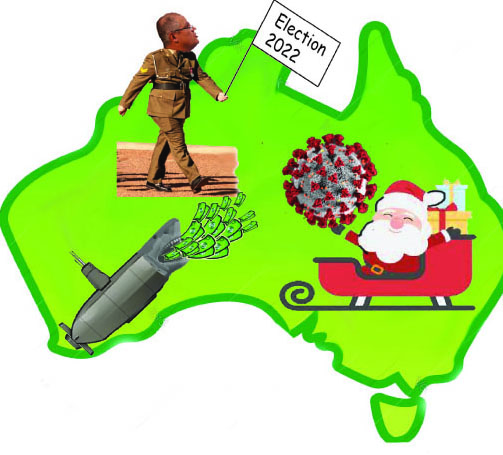
$90 Billion Nuclear Powered Subs To Bring Australia Out Of Lockdown In Time For Christmas, https://www.betootaadvocate.com/breaking-news/90-billion-nuclear-powered-subs-to-bring-australia-out-of-lockdown-in-time-for-christmas/LOUIS BURKE |.
Locked down Australians are getting ready to say a big hello to freedom as $90 billion worth of nuclear powered submarines are coming to our nation girt by sea.
During a teleconference that many mistook for the worst episode of Gogglebox yet, US President Joe Biden, UK Prime Minister Boris Johnson and our very own Scotty from Marketing announced they had formed a new security partnership called AUKUS with the first item of business to set Australia up with $90 billion worth of nuclear powered submarine freedom.
Despite the fact the three nations recorded a total of 317,060 new cases between them on Monday alone, the three world leaders really put their heads together and decided what their constituents really needed was to splash out big on some top-secret subs.
“I’m actually really excited for them!” said one local weirdo who, thankfully, does not live near any schools.
“Oh no, you’re not one of those anti-nuclear guys are you? Seriously? In 2021? I blame Chernobyl. The show.”
According to Scotty, this historic new alliance is great news for freedom loving Australians as we partner closer with the most hated nation on Earth and a country led by a man who literally cannot count the amount of illegitimate children he has.
When asked if the USA were a good military ally based on very recent events, Scotty was quick to remind our reporting team that we should be out of lockdown in time for Christmas.
“It’s all about perspective,” stated Scotty, as he thumbed through a sample book of the best submarine photo-ops.
“Christmas is coming and Santa is riding in on a nuclear sub pulled by water-breathing reindeer and in his big red sack is a present for you; family.”
Nuclear submarines may never eventuate; it’s just Scott Morrison’s giant new election ploy
The timing of Mr Morrison’s announcements also merits some consideration. In our view, this project is a political stunt aimed to distract from Covid failures, please coalition constituencies, and split the Labor Party and render the Greens shrill and sidelined.
In reality, it is likely that after a passage of years of staged announcements and pseudo-planning there will be little to show for it, and the enormously expensive, strategically ill-considered, and force-structure distorting project will quietly die.
But, to use Prime Minister Morrison’s phrase, “let us be clear,” in terms of Australian security, it is a gigantic nuclear election stunt that in the long run may increase the risk of nuclear war while drawing Chinese return fire on our vulnerable export sectors, including iron ore.
“To be clear” again, it is utterly mendacious of Prime Minister Scott Morrison to say that these forces have nothing to do with nuclear weapons because Australian submarines won’t be so armed, assuming it does not cross that barrier in the future if the submarines ever come to pass. As noted above, they may play a crucial role in US nuclear strike and defence operations……..
Scott Morrison’s Giant Nuclear Election Ploy, APLN Asial Pacific Leadership Network. 19 Sep 21,
Even leaving aside the fiscal profligacy and defence opportunity costs for Australia of the literal blank cheque issued by the Morrison government, the nuclear submarine decision takes Australia into the heart of naval warfighting in East Asia and Southeast Asia.
Further, the Australian nuclear submarine decision will have knock-on effects in Japan and the Republic of Korea, leading them not only to move their already highly capable submarine fleets to nuclear power, but also thereby heighten the likelihood they will then equip those submarines with nuclear weapons.
For several decades the US has been concerned to negate two military advances the Chinese regard as essential protection against literally existential threats. The Australian submarines will be designed primarily to contribute to negating both of those military advances.
Continue readingWe need a full and transparent Inquiry into the nuclear submarine deal

But the uncertainties are huge. We don’t know whether it’s proposed to acquire a US or a British submarine. We don’t know how many might be constructed. We don’t know the cost, although we know it’s going to be huge. We don’t know the delivery schedule, though it’s been suggested the first boat won’t be completed until 2040 and not operational for several years after that.
Putting the schedule into perspective, by the time Australia’s first nuclear submarine goes into the water, Aussies will have voted in at least seven federal elections. Scott Morrison will be 72 years old, Prime Minister Boris Johnson will be 76 and President Joe Biden will be a venerable 98.
Nuclear-level spin masks a massive failure, https://indaily.com.au/opinion/2021/09/17/nuclear-level-spin-masks-a-massive-failure/
This week’s nuclear submarine announcement raises questions that need full and transparent examination. What is certain, writes Rex Patrick, is that the Federal Government’s atomic marketing efforts are designed to cover a huge mess of its own making.
In many respects Scott Morrison’s nuclear submarines announcement fits the Prime Minister’s standard modus operandi.
Having presided over a huge shambles, he’s always ready to pull down the curtain and then present something new and shiny to the electorate as a distraction to the failure.
In this case, however, he’s taken his marketing strategy to a new atomic level.
I’ve been a strong critic of the French submarine deal. The projected delays and cost overruns, jointly the fault of Defence and Naval Group, were huge and unacceptable. The Government managed to achieve Australia’s worst-ever defence procurement disaster – which is saying a lot.
Although they repeatedly refused to admit it, and fought tooth and nail to prevent the release of information about the problems with the Future Submarine Program, the Government knew they had a total lemon on their hands – a lemon of their own making.
To deal with the strategic possibility of conflict with China, the Government contracted the French to redesign one of their nuclear submarines to create a completely new long-range diesel-electric submarine. That was always going to be fraught with difficulty, with inevitable cost and time overruns.
It wasn’t Australia’s changing strategic circumstances that have driven a shift to the US/UK nuclear submarine option – that was already factored into the French program – it was complete project disarray.
The PM’s atomic marketing is intended to mask the Government’s own mess.
The distant and uncertain future
We now have to be very careful not to jump from the frying pan into the fire.
I don’t underestimate the significance of the joint announcement of a new strategic and defence technology partnership between Australia, the United States and the United Kingdom. It’s a big commitment with long term national security, geopolitical, and economic consequences.
But the uncertainties are huge. We don’t know whether it’s proposed to acquire a US or a British submarine. We don’t know how many might be constructed. We don’t know the cost, although we know it’s going to be huge. We don’t know the delivery schedule, though it’s been suggested the first boat won’t be completed until 2040 and not operational for several years after that.
Putting the schedule into perspective, by the time Australia’s first nuclear submarine goes into the water, Aussies will have voted in at least seven federal elections. Scott Morrison will be 72 years old, Prime Minister Boris Johnson will be 76 and President Joe Biden will be a venerable 98.
And by 2040, the first of the Collins-class submarines, HMAS Collins, will have been operating for 44 years. The Royal Australian Navy will be trying to stretch out the life of the Collins-class subs far beyond what was ever intended.
At least the Government has finally decided to end the nonsense of shifting Collins-class full-cycle dockings from South Australia to Western Australia. We’re going to have to preserve and nurture all the submarine expertise we have to keep the Collins boats ticking over. The risk of a major capability gap is significant.
The nuclear question
The PM says the new nuclear-powered vessels will be built in Adelaide. It is unclear whether this would involve manufacturing or just assembly of pre-manufactured modules supplied from the US or UK.
If it’s the latter, this would have a huge impact on the extent of technology transfer and the shipbuilding workforce in Adelaide. The Australian local manufacturing content for nuclear boats is certainly likely to be much lower.
If the project proceeds there will be operating nuclear reactors sitting on hard-stands at Osborne and moored in the Port River.
Acquiring, operating and maintaining a nuclear submarine fleet without a domestic nuclear power industry is a challenge that must not be underestimated. The nuclear safety and non-proliferation safeguards issues are unquestionably complex and likely to be controversial.
This decision will likely reignite debate over nuclear power options for Australia. It can’t be said there is much political consensus about that.
There are many significant issues that will need to be properly considered and I fear that they haven’t yet. The proposed initial US-UK-Australia joint study to be undertaken over the next 18 months will take place after Australia’s election. But that doesn’t mean that there shouldn’t be rigorous and wide-ranging scrutiny of the Government’s decision now.
I am going to press for the Senate to open an immediate inquiry to ensure that all the angles, including alternative conventionally-powered submarine procurement options, are fully explored and understood.
We need such an inquiry to inform Government, Opposition, the Parliament and, most importantly, the Australian people before the next election.
This is a huge decision taken in response to a Liberal Party own goal which has cost the taxpayer and national security dearly. We don’t want an even bigger repeat of a failure and this massive project should not proceed further without full transparency and scrutiny.
Rex Patrick, a former submariner, is an independent senator for South Australia.
Australia to lease nuclear submarines from USA, UK?
Dutton may consider leasing nuclear subs, Canberra Times, Colin Brinsden 19 Sept
The federal government is prepared to lease nuclear submarines from the US while its own fleet is being built, Defence Minister Peter Dutton says. Last week, Australia entered into a surprise regional security pact with the US and the UK, known as AUKUS, which includes building US nuclear submarines but these will not be ready until the late 2030s.
Asked on Sky News’ Sunday Agenda program whether the government would consider leasing nuclear submarines in the interim, Mr Dutton said: “The short answer is yes”.
“There is all of that discussion to take place in the next 12 to 18 months,” he said………
The technology used by Britain and the US means the reactor does not need to be refuelled for the life of the submarine – about 35 years.
“Therefore, we don’t need a domestic industry around nuclear,” Mr Dutton said.
“That is a game changer for the Labor party and we wanted to make sure that this was a bi-partisan effort.”
While Labor backs the government’s decision, one of its frontbenchers, Ed Husic, said it is typical of the coalition that as soon as events start to unravel, they try to shift responsibility to someone else. https://www.canberratimes.com.au/story/7436344/dutton-may-consider-leasing-nuclear-subs/
How much will Australia’s nuclear submarines cost the taxpayer?
How much does a nuclear submarine cost?
Jessica YunFri, 17 September 2021 Is the new ‘AUKUS’ alliance to build Australia a fleet of nuclear-powered submarines battles growing criticism, a key question has emerged: how much do nuclear submarines actually cost?Before we get to that, what’s a nuclear submarine? It’s not considered a nuclear weapon, first of all. It all comes down to how it’s powered; a nuclear submarine works from its own miniature nuclear reactor, whereas conventional submarines use diesel-electric engines.In terms of how much they’ll cost, not even the Federal Finance Minister knows.
“Finalisation of those costs is something that will be assessed in [that] 12-18 month process we’re now embarking on with the UK and the US,” Finance Minister Simon Birmingham told ABC Radio National when asked about how much building the submarines would cost.
“The Prime Minister has acknowledged that it will likely cost more than what we had assessed for the conventionally powered submarines.”
Before the new AUKUS deal, Australia had a $90 billion contract with France to build 12 conventional submarines. To make way for the new defence pact, that deal has now been scrapped.
Opposition Leader Anthony Albanese has taken aim at the question marks around what this will cost Australian taxpayers.
“We know there are contracts in place already that will be breached. And we know there will be substantial compensation costs payable,” Albanese said. These ‘walk-away’ costs are estimated to be in the hundreds of millions.
“And Australian taxpayers are entitled to know, given that under this Government they began with arrangements with Japan, then arrangements with France, and now we have these arrangements with the United States and potentially the UK as well.”
What DO we know about the nuclear submarine deal and the costs so far?
T he new ‘AUKUS’ partnership will see Australia acquire a fleet of “at least eight” nuclear-powered submarines to “protect our national security interests” and “work with our partners across the region to achieve the stability and security of our region”, in Prime Minister Scott Morrison’s words………the new AUKUS deal means that we’ve torn up a $90 billion contract with France’s Naval Group to build 12 “Attack class” submarines, infuriating France along the way.
How much nuclear submarines cost around the world
The US Navy’s latest submarine model, the Virgina-class submarine, claims to have the latest tech in stealth, intelligence gathering and weapons system tech.
According to documents prepared for the US Congress, procuring a Virgina-class submarine is estimated to cost US$3.45 billion, or AU$4.73 billion, per boat.
Australia doesn’t currently have a domestic nuclear industry. SA Senator Rex Patrick told Yahoo Finance he expects each submarine will cost at least $5 billion to build.
Australian National University research fellow and nuclear science expert AJ Mitchell said there would be an “eye-watering cost” to constructing these high-tech watercrafts.
“Each nuclear submarine typically costs several billion dollars to build, and requires a highly skilled workforce with expertise in nuclear science,” Mitchell wrote in a new piece for The Conversation……… https://au.finance.yahoo.com/news/how-much-nuclear-submarine-cost-022130602.html
Big questions remain about Australia’s nuclear submarines, but it’s a massive financial gain for nuclear corporations

The possibility of a submarine deal with Australia came at an opportune moment. It provided Biden with a chance to demonstrate support for a close ally and boost its military strength. For Boris Johnson it could show that
relations with the US had not fallen apart because of the chaotic Afghanistan withdrawal, and it validated claims that the UK can play a prominent security role in the Indo-Pacific region.
For Australians it provides reassurance that it is still backed by its oldest allies. Having abandoned a “forever war”, the US and UK have signed up to what the Australian prime minister, Scott Morrison, has described as a “forever
partnership”. The test will lie in this submarine project being more successful than the French-backed one it has replaced. This is not something that can be taken for granted.
The big questions about the boats’ design and manufacture will not be answered until 2023. The value
of the contract will be massive, and we should expect the competing claims of all three partners to be pressed hard when they are deciding their contributions. Instead of building diesel-powered submarines with the French, Australia upgraded its requirement to nuclear-powered submarines. These are quieter, can spend more time at sea and can travel greater distances, but they are fiendishly difficult to construct. Although the UK’s Astute-class programme is now running reasonably smoothly, with each boat costing almost £1.5 billion, the first vessel was almost five years
late and massively over budget.
Times 19th Sept 2021
https://www.thetimes.co.uk/article/the-submarine-deal-is-a-real-downer-for-china-x6t89v022
Malaysia and Indonesia warn Australia’s Indo-Pacific pact could trigger nuclear arms race
Malaysia and Indonesia warn Australia’s Indo-Pacific pact could trigger nuclear arms race, Taipei Times, 19 Sep 21
The new AUKUS alliance will involve Australia, the US and Britain exchanging technology and intelligence
Australia will have access to US nuclear technology, which will enable it to build nuclear submarines
Australia’s nuclear arms ban remains in new deal
Birmingham said there was no “quid pro quo” in Australia agreeing to step up its strategic relationship with the UK and the US.
He insisted that nuclear weapons would not be based within Australia’s jurisdiction. “We’ve been clear, Australia’s position in relation to nuclear weapons does not change, will not change,” he said yesterday.
“We will meet all of our non-proliferation treaty arrangements and obligations and not be changing any of our policies in relation to the nuclear weapons technology.”
Birmingham did not rule out an increase in the number of UK and US military personnel on Australian shores. “We already have US troops and marines who work in Australia on rotational deployments at times,” he said………….
it is not just the French who have been made uneasy by the AUKUS arrangement, which is still to be worked out in detail. Australia’s allies in the Indo-Pacific have also raised concerns over what the deal will mean for tensions in the region.
Malaysia said on Saturday that Canberra’s decision to build atomic-powered submarines could trigger a regional nuclear arms race, echoing concerns already raised by Beijing.
“It will provoke other powers to also act more aggressively in the region, especially in the South China Sea,” the Malaysian prime minister’s office said, without mentioning China……https://www.taipeitimes.com/News/world/archives/2021/09/20/2003764684
China fears that the nuclear-powered submarines could be armed with nuclear weapons at short notice
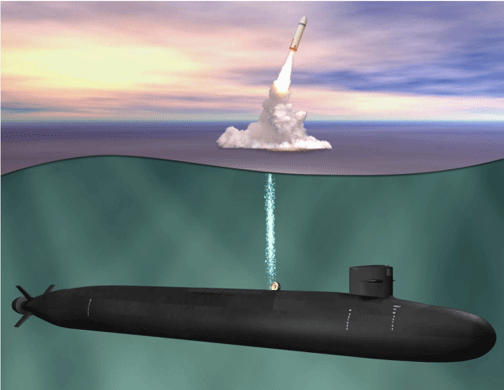
US FORCES US submarine launches Trident II nuclear missiles in stunning show of strength U.S,Sun Olivia Burke, Sep 19 2021
THE US Navy triumphantly test-launched Trident D5LE nuclear missiles on Friday in a stunning show of strength.
The scheduled two-missile deployment of the unarmed revamped weapon took place off the coast of Cape Canaveral, Florida from the USS Wyoming (SSBN-742) submarine……
The Navy boasted of the “unmatched reliability” of the new “sea-based nuclear deterrent” as tensions continue to increase with China.
It was the 184th successful Trident II (D5 & D5LE) SWS missile test flight and follows the last launch in February this year off the coast of Florida……..
“This same team is now developing the next generation of the Trident Strategic Weapon System, which will extend our sea-based strategic deterrent through 2084,”
The Navy also revealed the submarine missiles have been given “a life extension program to address potential impacts from aging and obsolescence”.
They are now primed to be stationed amongst the rest of the fleet alongside the UK Vanguard-class, US Colombia-class, UK Dreadnought-class.
With an estimated annual cost of $170million, the US spend a whopping $2.4million each year to run the Ohio-class submarines.
….the launch comes in the wake of the revelation of the UK’s and US’ plans to build nuclear-powered submarines for Australia.
AUKUS’ ALLIANCE
The alliance has angered China, who fear the subs could be armed at short notice with nukes, despite assurances they will only carry conventional weapons.
The countries leaders carefully navigated the announcement without directly mentioning China’s imposing power – but hinted at their intentions behind the move by discussing “democracy, freedom of navigation, and security.”
The new Indo-Pacific security pact, known as AUKUS, will give the land Down Under the technology to deploy nuclear-powered submarines.
It is part of an agreement intended to counter China’s rising military might – that they have splashed six times more cash on than Australia.
With 42 times more soldiers, 55 times more tanks, 13 times more submarines and 16 times more fighter jets, they eclipse the Aussies artillery.
And with 3.3 million troops in service, Beijing dwarves Australia’s 80,000 soldiers – but AUKUS has still managed to seriously ruffle some feathers.
CHINA’S FURY
Chinese Foreign Ministry spokesman Zhao Lijian condemned the alliance as “seriously damaging regional peace and stability, intensifying the arms race, and undermining the Treaty on the Non-Proliferation of Nuclear Weapons”.
China is believed to have between 250 and 350 nuclear weapons, compared to America’s colossal arsenal of 5,800 and Russia’s total of 6,375. ……. https://www.the-sun.com/news/3691458/us-submarine-trident-ii-nuclear-missiles-chinas-threats/
Nuclear submarines and their disadvantages
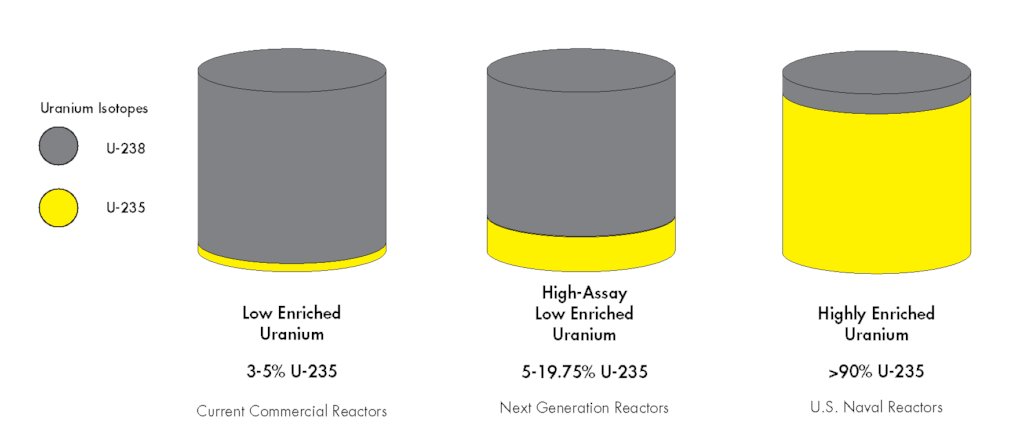
The US Virginia-class submarines typically use highly enriched uranium (HEU) that does not need replacing during the lifecycle of each submarine. Across the world, the US, Britain, Russia and India are the only countries to use HEU in naval reactors. Other countries like France use high-density, low-enriched uranium that will occasionally require swapping out with a replacement source.
HEU is one of the most dangerous metals on earth and also one of the simplest nuclear materials to work with. These twin traits also make it a security risk over fears rogue states or terrorists might develop a nuclear weapon, or mishaps trigger a serious accident. It is also why it has been targeted under non-proliferation treaties to reduce its use.
What are nuclear-powered submarines, anyway? A guide to Australia’s looming military addition,Guardian, Royce Kurmelovs. @RoyceRk2T, hu 16 Sep 2021
What are they and what design might Australia get?
It is not clear which submarine the Australian government will obtain, but the US navy’s latest design is the Virginia-class submarine. Manufactured by American aerospace and defence company General Dynamics, this submarine has gone through several iterations but is generally powered by a single nuclear reactor and can travel at more than 25 knots. Its crew includes 15 officers and 117 enlisted personnel, and the subs are used both in anti-submarine warfare and intelligence gathering operations.
The vessel is powered by a 210MW pressurised water nuclear reactor, inside of which the enriched uranium fuel is sealed. The reactor does not have to be refuelled over its 30-year lifespan …………..
What are the drawbacks of nuclear?
Because nuclear submarines tend to be larger, one downside is they can’t move into shallow waters, making them more easily detectable. During one war game in 2015, a Russian-built, Kilo-class diesel-powered submarine used by the Indian navy “sank” a US nuclear-powered sub – although the US navy has never acknowledged the sinking.
Traditionally Australia’s diesel-powered submarines are thought to have been complementary to US powered nuclear subs used by the US, making the recent announcement a surprise.
Nuclear submarines are also more complicated to maintain and service. Unlike the US and UK, Australia does not have a domestic nuclear power industry, which could provide a highly skilled workforce of engineers and nuclear physicists. Much of the work on the subs will probably have to be done overseas.
It is also not clear what plans are being made to handle the spent uranium. The Australian government has been working to build a controversial nuclear waste storage facility in Kimba in South Australia, but this proposal has so far been limited to low-level and intermediate waste from 100 sites around the country.
Are nuclear subs quieter?
It depends. Diesel-electric subs are quieter while running in electric mode, but must at some point surface or pop up a snorkel to run their diesel engines and recharge the batteries. When the diesel engines are running, these noisier than nuclear-powered subs. Nuclear subs also generate noise from the reactor, including the coolant pipes, turbines and steam generation.
What fuel do they use?
The US Virginia-class submarines typically use highly enriched uranium (HEU) that does not need replacing during the lifecycle of each submarine. Across the world, the US, Britain, Russia and India are the only countries to use HEU in naval reactors. Other countries like France use high-density, low-enriched uranium that will occasionally require swapping out with a replacement source.
HEU is one of the most dangerous metals on earth and also one of the simplest nuclear materials to work with. These twin traits also make it a security risk over fears rogue states or terrorists might develop a nuclear weapon, or mishaps trigger a serious accident. It is also why it has been targeted under non-proliferation treaties to reduce its use.
Will it be able to launch nukes?
If there is one thing the Australian government has been very clear about, it’s that the subs will not be armed with nuclear weapons and that Australia is not seeking to obtain nuclear weapons capability.
That’s not to say the submarine won’t be capable of doing so. Using the Virginia-class as an example, the build comes equipped with 12 vertical missile launch tubes and four 533mm torpedo tubes. It is capable of launching 16 Tomahawk cruise missiles in one salvo but can be modified to mount heavier weapons systems. While these missiles could potentially be built to carry a nuclear warhead, as of 2019 the only variations of the Tomahawk missile in operation were non-nuclear.
What happens when things go wrong?
Serving on a naval submarine has not always been a pleasant experience. For example, German U-boat crews in the second world war suffered devastating losses and many were killed not just in combat but from catastrophic mechanical failures, including asphyxiation from diesel exhaust or explosive decompression after flushing a toilet.When it comes to nuclear subs, radiation adds a new dimension, although there have been no known reactor meltdowns in the sinkings that have occurred to date.
The most recent nuclear sub disaster involved the Russian Kursk, which sank after a faulty weld on a torpedo caused an explosion that then detonated other torpedos. All of the 118 crew members died. Many were instantly killed in the initial blasts, although failsafes in the nuclear reactor shut it down without incident. The 23 sailors who survived the blasts spent six hours awaiting a rescue that did not come, and were killed in a desperate attempt to create oxygen. https://www.theguardian.com/australia-news/2021/sep/16/what-are-nuclear-powered-submarines-anyway-a-guide-to-australias-looming-military-addition
1 This month
Chernobyl: The Lost Tapes – A good documentary on Chernobyl on SBS available On Demand for the next 3 weeks– https://www.sbs.com.au/ondemand/tv-program/chernobyl-the-lost-tapes/2352741955560
15 April – Zoom –Nuclear Power is Not the Solution
Apr 15, 2026 01:00 AM in Canberra, Melbourne, Sydney

Join the International Physicians for the Prevention of Nuclear War (IPPNW) on Tuesday, April 14th for a timely webinar exploring the risks associated with nuclear power and challenging the myth that it offers a simple, safe, carbon-free solution to the climate crisis

21 April Webinar: No Nuclear Weapons in Australia
Start: 2026-04-21 18:00:00 UTC Canberra, Melbourne, Sydney (GMT+10:00)
End: 2026-04-21 19:30:00 UTC Canberra, Melbourne, Sydney (GMT+10:00)
Event Type: Virtual
A virtual link will be communicated before the event.
Host Contact Info: australia@icanw.org

of the week – Australians for War Powers Reform (AWPR)
To see nuclear-related stories in greater depth and intensity
 Antinuclear