Need to reveal full details of nomination forms for Kimba and Wallerberdina nuclear waste dump plans

Full copies of the nomination forms by the respective owners of the site at Wallerberdina and the five or six sites at Kimba should be publicly known
They should be full and true photocopies without redactions as apparently the original forms have handwriting on them which could be extremely embarrassing to the government and the responsible ministers Canavan and Pitt
All of these nominations were under machinery provisions of the National Radioactive Waste Management Act 2012 but the form of the nomination and administrative requirements are contained in the Radioactive Waste Management Nominations of Land: Guidelines November 2016 issued by the then Department of Industry Innovation and Science
Previous requests for the nominations were met with the standard response that they could not be disclosed as they contained personal and private information of the respective parties nominating their land but instructions note 8 in the nomination form prescribed by the Guidelines specifically states that the Nominator confirms that it consents to the public disclosure of the nomination ……
In addition the Guidelines contain quite detailed provisions regarding disclosures and privacy including the operation of the freedom of information regime . The nominations requested will also be of significance in any judicial review or similar proceedings .
Barngarla people hold Native Title land close to planned nuclear waste dump, but were denied a vote on this.
The nuclear waste site is planned for Barngarla Country, but the amendments will allow Traditional Owners to take the matter to court, https://www.sbs.com.au/nitv/article/2021/06/23/traditional-owners-can-challenge-nuclear-waste-dump-country-1?fbclid=IwAR0ZYwZRYOUQn58LdV3A0X4L1AeERiDi8ylqkVFcjReI5KQj7_fl6VTXcaABy Keira Jenkins
Source: NITV News, 23 JUN 2021 The Senate has passed legislation that would allow nuclear waste to be stored at a remote site in South Australia, replacing current city facilities.
The Morrison government was forced to abandon key features of the bill to gain opposition support, including a provision that would have locked in Kimba as the new storage location.
Instead, Minister for Resources Keith Pitt can issue an ‘intention to declare’ a preferred location.
The amended bill, which passed through the Senate this week, also allows for a judicial review of the location if there is a dispute.
Barngarla Determination Aboriginal Corporation welcomed the reinstatement of the right to a judicial review on the process.
“This is a great moment for democracy, and for those who appreciate the independent scrutiny of government action,” they said in a statement.
In 2019, the Australian Electoral Commission conducted a month-long community ballot, asking the question ‘Do you support the proposed National Radioactive Waste Management Facility being located at one of the nominated sites in the community of Kimba?’
The ballot returned a 61.58 per cent ‘yes’ vote.
Barngarla conducted their own poll, saying they had been excluded from the AEC’s postal ballot.
100 per cent of the votes returned from Native Title holders said ‘no’ to the proposed nuclear facility.
Barngarla said the site selection process had been “completely and utterly miscarried”.
“No proper heritage assessment of the site was ever undertaken,” read the statement.
“… the most obvious and appalling example of this failed process was when the Government allowed the gerrymandering of the Kimba ‘community ballot’ in order to manipulate the vote.
“The simple fact remains that even though the Barngarla hold Native Title land closer to the proposed facility than the town of Kimba, the First Peoples for the area were not allowed to vote.
“…Mistakes have been made and the process needs to start again.”
Australia’s collective voice should silence the ‘drums of war’

Australia’s collective voice should silence the ‘drums of war’ Independent AustraliaBy Barbara Hartley | 24 June 2021, With Australia raising its hand to be part of joint naval exercises in the South China Sea, its departure from the G7 in Cornwall continues the “down-under” tradition of following U.S. foreign policy.
Although the beat of war drums is currently more muffled, anti-China rhetoric still echoes down the chilly halls of Federal Parliament as the winter sitting takes place.
In 2003, without parliamentary oversight, Australia followed the U.S. into Iraq. The given purpose was to initiate action against what then-U.S. President George W. Bush called the “axis of evil”: initially Iraq, Iran and North Korea, and later expanded to Cuba, Libya and Syria. This axis was in fact quite shaky.
One consequence of that unconscionable invasion was the toll on young Australian defence personnel, and others such as journalists, in terms of moral injury and stress. The compulsive loop of the Federal Government supporting U.S. wars with no direct relation to Australia – Korea, Vietnam, Iraq, Afghanistan – and those wars damaging Australian lives, has played non-stop since its entry into the ANZUS agreement.
Some, especially weapons trade profiteers and their political lackeys, want conflict with China to continue that unhappy pattern.
It is imperative that the now muted “drums of war” are silenced once and for all.
Readers are therefore urged to respond to the People’s Inquiry for a Peaceful and Independent Australia being conducted by the Independent Peaceful Australia Network (IPAN).
The inquiry’s purpose is to examine the impact of involvement in U.S.-led wars and the U.S.-Australia Alliance on everyday Australians. The current obsession with China and the inexplicable desire to face off with the world’s greatest military power is arguably a result of our alliance with the U.S.
The Inquiry Chairperson is Kelly Tranter, one of Australia’s leading authorities on the growing influence of weapons manufacturers on government policy in Australia.
There are also several panels addressing the various ways in which involvement in U.S.-led wars impacts our lives.
In addition, an IPAN website questionnaire can be completed in a very short time. Both submission and questionnaire suggestions will inform the Inquiry’s final report. Possible submission talking points are raised below………………………….. https://independentaustralia.net/politics/politics-display/australias-collective-voice-should-silence-the-drums-of-war,15219
Barngarla Aboriginals and Kimba farmers join forces to fight nuclear waste dump plan
Barngarla Determination Aboriginal Corporation and No Radioactive Waste on Agricultural Land in Kimba or SA group 24 June 21, The issue of the nuclear waste facility is something which provokes significant emotion, and community opposition. However, no one else is as affected by it like we are. We issue this joint press release as the First Peoples for the Kimba area, and the farming communities who make their livelihood from the land because we are having our home, our land and our heritage threatened. We are the groups of people whose lives will be permanently damaged,if a waste facility is placed on our home.
We have fought hard and will continue to fight against a nuclear waste facility being placed on our home. We do not want it, and we will never support it. Our voices and views have been ignored by the Government. Local member Rowan Ramsey has been one of the main influences in pushing the Government to place a nuclear waste facility at Kimba. If you do not want this facility in SA orin the Eyre Peninsula or the Mid-North, then you must vote out Rowan Ramsey. We will never end this issue, whilst he is a local member.
The Government has completely and utterly miscarried the site selection process. There are many examples of this. No proper heritage assessment of the site was ever undertaken, andthey have marginalised the voices of the farming community throughout the entire process. However, the most obvious and appalling example of this failed process was when the Government allowed the gerrymandering of the Kimba “community ballot”, in order to manipulate the vote. The simple fact remains that even though the Barngarla hold native title land closer to the proposed facility than the town of Kimba, the First Peoples for the areawere not allowed to vote. They prevented Barngarla persons from voting, because native title land is not rateable. Further, they did not allow many farmers to vote, even though they were within 50km of the proposed facility, because they were not in the Council area. They targeted us, because they knew that if they had a fair vote which included us, then the vote would return a “no” from the community.
The process also ignores the fact that the Government never sought the views of the communities which will be affected by the transport of nuclear waste. Those communities, where the waste will be transported through, have had no right to have a say. SouthAustralians more broadly have had any rights to have a say.
Mistakes have been made and the process needs to start again. Instead, the Government sought to change the law to remove our democratic right to judicial review of their actions so that no Court could ever assess what had been done. We find this staggering, as checks and balances are needed for a functioning democracy. The removal of independent scrutiny is, for all Australians, frightening, Protecting judicial review was the issue before the Federal Senate on Monday. It is important to understand that this is what the Senate was debating. We have won our right to have judicial review restored in this process. The broader failures are matters which will have to be dealt with in the future.
The Government have been forced by the Senate to preserve judicial review. The table in Schedule 1 of the Government’s revised Bill, is merely a face-saving exercise, and has no legal impact or effect. Even the Government Explanatory Memorandum makes this clear. Their own document states: “Recognition of the three shortlisted sites confirms the sites as being nominated and approved under the Act, but does not limit the Minister from approving new nominations. The Minister may declare any approved nomination as a site, and is not bound to declare one of the three shortlisted sites”
The Government’s attempt to remove judicial review was so egregious and careless, that it provoked almost unanimous opposition across the political spectrum. This is a great moment for democracy, and for those who appreciate the importance ofindependent scrutiny of Government action, this is a day that the Barngarla people and the farmers at Kimba have saved one of the fundamental rights in a Democratic Country. Because the Government were opposed by everyone from very different political backgrounds, such as: Labor, Pauline Hanson’s One Nation, the Greens and Senator Patrick, we consider it appropriate to express our thanks to all of these groups. This reflects the fact that judicial review is a pivotal right no matter a person’s political background. We thank everyone in no particular order, as it remains the fact that had they not stood together, the Government would have removed the democratic rights of judicial review from us, and set a precedent which would have weakened democracy for all Australians:
Labor: The Australian Labor Party deserves congratulations from all Australians for its actions. Without of the support of the Opposition, the Government would have gotten away with removing a fundamental democratic right from us and set aprecedent to remove that right every other time they did not get their way.
Labor listened to all of us, but in particular they lived up to their commitment to listening to the First Peoples for the Kimba area. The Barngarla worked extensively with Labor, and in particular the Shadow Minister Ms Madeliene King ensured that the Barngarla were entitled to review any further amendments before they wereintroduced. We intend to write to other members of Labor, such as Senator Wong who has fought for all South Australians to express our thanks. As a party, however, they have been outstanding.
More broadly, there is the issue of what to do if Labor win Government. Many in Labor do not support a process where Aboriginal people were denied the right to vote. We believe Labor will continue to fight for us. But that is tomorrow’s issue. Monday was about judicial review, and Labor protected us and by extension all Australians, by preserving our right to judicial review. •
Pauline Hanson’s One Nation & State Leader of One Nation in SA Ms Jennifer Game: It remains a simple statement of fact that without PHON and Ms Jennifer Game, there would be a nuclear waste facility on prime farming land, in circumstances where Aboriginal people were denied the right to vote, and Aboriginals and farmers would have no right to independent legal review.
For those of you out there who might relate to this side of politics, particularly the farmers in the Eyre Peninsula, who do not want a waste dump then we strongly suggest you look at what One Nation and their representative Ms Jennifer Game have done to save South Australia from nuclear waste. They said “no” and listened to the local farming community when the Local member ignored us.
The Barngarla also recognise the great work of PHON and Ms Jennifer Game. It is a testimony of our work together that we have prevented the Government from removing fundamental basic rights for all Australians.
The Greens: Special recognition must be given to the Greens. This is an issue that is central to the Greens, they have stood up and through their tireless and passionate advocacy have helped us immensely.
All Green supporters should be proud of their party’s efforts. In particular, Senator Hanson-Young has been a tireless advocate for South Australia. She was one of the first Senators to help us, and we imagine she will be with us to the end of this fight.
We would also like to acknowledge the strong words of Senator Thorpe. We agree that the Government has been tokenistic in its approach to the Barngarla people. What could be more tokenistic than saying they want to hear Barngarla views, but then deny the Barngarla the right to vote. It is our hope that with advocates likeSenator Thorpe, no other Aboriginal group will ever have to be treated in such a despicable way.•
Senator Patrick: Senator Patrick deserves great credit for his commitment to South Australia. He deserves the recognition of everyone committed to our State. He has been actively engaged on this issue from the very beginning. He has tirelessly fought to access Government documents under FOI so that South Australian’s can have access to the information which shows how badly this process has been miscarried.
We would like to thank Senator Patrick for his regular commitment and support to us in fighting to ensure our access to judicial review. Senator Patrick has also sought to find other solutions by trying to assess additional site options, whether Woomera or Leanora or others. We hope that this work by Senator Patrick will one day paydividends, and the Government will abandon its terrible plan to place this facility on prime agricultural land, which is significant also to the Barngarla People. •
The remaining cross bench: We would also like to thank the efforts of the remaining cross bench. Although we did not ultimately need to rely on their votes, we understand that they would likely have ensured our rights to judicial review. Theyspoke to us and engaged and should be acknowledged for their efforts.
Further information contact: Barngarla: barngarlamedia@gmail.com Peter Woolford: 0447 001 493
Lowy Institute polling shows that 91% of Australians want the federal government to support renewable energy development
https://poll.lowyinstitute.org/charts/potential-federal-government-policies-on-climate/ Looking at a range of possible federal government policies, almost all Australians (91%) say they would support the federal government ‘providing subsidies for the development of renewable energy technology’. This aligns with Lowy Institute polling in 2018 in which 84% of Australians said the government should focus on renewables rather than traditional energy sources
.ight in ten Australians (78%) support ‘setting a net-zero emissions target for 2050’, suggesting they seek a firmer commitment from Prime Minister Scott Morrison, who has said that Australia’s “goal is to reach net zero emissions as soon as possible, and preferably by 2050”.
Seven in ten Australians (77%) support providing subsidies for the purchase of electric vehicles. A sizeable majority of Australians (64%) support introducing an emissions trading scheme or a carbon tax. These views have shifted significantly in the past five years. In 2016, in response to a differently-worded question in the Lowy Institute Poll, only 40% said they would prefer the government to introduce an emissions trading scheme or price on carbon.
ustralian views of coal exports and coal mines also appear to have shifted significantly in recent years. Six in ten Australians (63%) support a ban on new coal mines opening in Australia. The same proportion of the population (63%) say they support reducing Australian coal exports to other countries, in an apparent shift from five years ago when a majority (66%) said Australia should continue to export coal. In 2021, only three in ten Australians (30%) say they support the federal government providing subsidies for building new coal-fired power plants.
On a number of these policies, there is a significant gap between support from younger and older Australians. For example, 72% of Australians aged 18–44 years old support banning new coal mines, compared to 55% of Australians aged over 45. Similarly, 71% of respondents aged 18–44 support imposing a carbon tax or emissions trading scheme, compared to 57% of Australians over 4
The federal government’s promotion of a ‘gas-fired recovery’ for Australia’s economy appears to have general support, with 58% in favour of Australia increasing the use of gas for energy generation.
Australians are split over the question of nuclear power, which has been prohibited in Australia since 1998. Almost half the population (47%) would support removing the existing ban on nuclear power, but the same number (51%) are opposed to that measure.
Australian government pushes to remove the ban on nuclear power – UK’s Daily Mail
Why the government’s push to finally drop the ban on nuclear power in
Australia could be one of the most important decisions in a generation. The
federal government is reportedly considering a move to lift the ban on
nuclear energy to help reduce carbon emissions while providing reliable
power. According to The Australian, ministers from both the Liberal and
National parties have discussed taking the policy to the next election,
which is due by May.
Daily Mail 23rd June 2021
https://www.dailymail.co.uk/news/article-9715061/Push-remove-ban-nuclear-energy-Australia.html
Morrison government bringing push for nuclear energy as an election issue
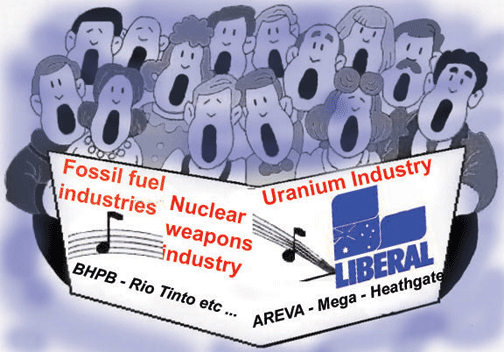
Morrison ministers lay the groundwork for nuclear energy election plan. The Australian 23 June 21, The option of taking a proposal for nuclear power in Australia to the next election has been considered in cabinet-level discussions as pressure grows within the Morrison government to prepare for a nuclear energy industry.
The top-level political and policy discussions including Liberal and Nationals ministers involved the argument that the moratorium on nuclear energy could be lifted in the decades ahead ….
Politically, the option of the Coalition adopting a policy of future nuclear energy was considered too dangerous without bipartisan support from the ALP.Before attending the G7 summit in Cornwall, Scott Morrison publicly said nuclear power was not an option in Australia unless there was bipartisan support for lifting the moratorium. The cabinet-level discussions were not part of a formal cabinet submission but traversed the politics and strategy of taking advantage of a shift in public opinion about the role of nuclear energy in reducing carbon emissions.
……… the Morrison government has included considering the latest modular nuclear reactor technology as part of its “energy road map” to create affordable, reliable energy…
Politically, the option of the Coalition adopting a policy of future nuclear energy was considered too dangerous without bipartisan support from the ALP.Before attending the G7 summit in Cornwall, Scott Morrison publicly said nuclear power was not an option in Australia unless there was bipartisan support for lifting the moratorium. The cabinet-level discussions were not part of a formal cabinet submission but traversed the politics and strategy of taking advantage of a shift in public opinion about the role of nuclear energy in reducing carbon emissions.
……… the Morrison government has included considering the latest modular nuclear reactor technology as part of its “energy road map” to create affordable, reliable energy…
Resources Minister Keith Pitt forced to back down – now must allow legal scrutiny of the ill-advised Kimba nuclear dump plan.

Resources Minister Keith Pitt has been forced to abandon moves to quash legal scrutiny of a federal plan for a national radioactive waste facility near Kimba in regional South Australia.
“More than a year after he began his push to make the choice of location immune from legal challenge, Minister Pitt has had to restore this fundamental democratic right in a move that passed the Senate last night,” said ACF nuclear free campaigner, Dave Sweeney.
The Minister’s backflip to break this year-long stalemate further highlights the federal government’s piecemeal and politicised approach to radioactive waste management.
“The government has failed to demonstrate there would be any public health or radiological benefits in moving Australia’s most problematic radioactive waste from its current secure storage at Lucas Heights to a location with fewer assets and much less protection at Kimba.
“The Kimba plan shirks the hard and long-term questions. Minister Pitt is not advancing a comprehensive solution, he is merely kicking a radioactive can down a dirt road.
“There are many reasons why the Lucas Heights facility, run by the Australian Nuclear Science and Technology Organisation (ANSTO), is the best place for our worst waste until a lasting and credible waste management solution is identified.
“Lucas Heights has secure tenure, a 24/7 federal police presence, the best radiation monitoring and response capacity in Australia and around 95% of the waste is already there.
“Importantly, ARPANSA, the federal nuclear regulator, has confirmed storage at ANSTO is secure, consistent with global best practice and can safely remain ‘for decades to come.’
“The revised approach reintroduces Wallerberdina in the Flinders Ranges as a potential waste facility site, showing the government is making policy on the run and has little understanding about how damaging this plan is to community cohesion.
“In December 2019 former Minister Canavan said the Flinders Ranges was no longer being considered as a site. It is a profound failure that 18 months later it is back on the list.
“This is not a Telstra tower. Australia’s first purpose built national radioactive waste facility deserves the highest level of scrutiny – not a highly politicised approach.”
Premier Marshall must enforce South Australia’s legislation prohibiting nuclear waste dump.

21 June 2021 ‒ Friends of the Earth Australia
By accepting amendments to the National Radioactive Waste Management Amendment Bill, the federal government has today abandoned its year-long attempt to shield its plan for a national nuclear waste dump in SA from judicial review. A vote on the Bill is expected this afternoon or tomorrow and the Bill is expected to pass.
Dr. Jim Green, national nuclear campaigner with Friends of the Earth, said: “The Morrison government’s disgraceful efforts to override the unanimous opposition of Barngarla Traditional Owners to the proposed nuclear dump will be challenged in the courts and politically. Barngarla Traditional Owners are expected to launch a judicial challenge.
“Friends of the Earth welcomes SA Labor’s policy that Traditional Owners should have a right of veto over nuclear projects given the sad and sorry history of nuclear projects in this state.
“Premier Steven Marshall’s support for a nuclear waste dump that is unanimously opposed by Barngarla Traditional Owners is unconscionable, crude racism and Friends of the Earth calls on the Premier to support Traditional Owners ‒ and all South Australians ‒ instead of shamefully falling into line behind his federal colleagues.
“The SA Nuclear Waste Storage Facility (Prohibition) Act was an initiative of the SA Olsen Liberal government to prevent the imposition of an intermediate-level nuclear fuel waste dump in SA. The state legislation was strengthened by the Rann government in 2002. Premier Marshall should fight Canberra’s push to dump nuclear waste on SA and to override state legislation, as did Premier Olsen and Premier Rann.
“The SA Nuclear Waste Facility (Prohibition) Act mandates a state Parliamentary inquiry in response to any attempt to impose a nuclear waste dump on SA and the Premier should initiate that inquiry immediately.
“Repeated claims that most of the nuclear waste is medical in original are dishonest. Claims that 45 jobs will be generated are deeply implausible. The dump will likely be the thin edge of the wedge; indeed several Coalition Senators today linked the looming passage of the Amendment Bill to the development of a nuclear power industry in Australia.
“Measured by radioactivity, well over 90% of the waste is long-lived intermediate-level waste that the federal government wants to store above ground at Kimba until such time as a deep underground disposal facility is established. No effort is being made to find a location for such a facility so this long-lived waste would remain stored above ground in SA ad infinitum.
“Intermediate-level waste should be stored at ANSTO’s Lucas Heights site until a suitable disposal facility is available. The Morrison government’s plan to move intermediate-level waste from secure above-ground storage at Lucas Heights to far less secure storage at Kimba is absurd and indefensible.
“The Howard government had to common sense to abandon plans to co-locate intermediate-level waste with a repository for low-level waste, and Premier Marshall should insist that the Morrison government do the same.
“South Australians fought long and hard to prevent the Howard government turning SA into the nation’s nuclear waste dump. We fought and won the campaign to stop the Flinders Ranges being used for a national dump. We fought and won the campaign to stop SA being turned into the world’s high-level nuclear waste dump. And now, we will fight until the Morrison government backs off.
“South Australians have greater ambitions for our state than to be someone else’s nuclear waste dump,” Dr. Green concluded.
Contact: Dr. Jim Green 0417 318 368
Nuclear waste storage facility legislation passes Senate.
– The Advertiser 21st June 2021, The Federal Government is now expected to name Kimba as the site of the facility after a key vote in Canberra. A nuclear waste dump set to be built in South Australia has cleared a major hurdle, with a shortlist of sites passing the Senate on Monday night.
Federal Resources Minister Keith Pitt is now required to name a site, which is expected to be Napandee farm, near Kimba on the Eyre Peninsula.Mr Pitt said: “This is an historic moment for our country that will pave the way for a critically important piece of national infrastructure.”He said while the bill has been amended, the Government would not be placing the facility in a community that does not provide broad support for it.
Wallerberdina voted against the facility in 2019, and is not expected to be the site.After months of deadlock, Labor agreed to back the Bill after the government last week proposed changes that would name three possible sites for the facility instead of specifying Kimba.The opposition had refused to back the original Bill over concerns that naming the site in legislation, rather than by a ministerial decision, would prevent the possibility of a future legal challenge.
Labor senator Murray Watt said the amendments were a “good compromise” that allowed for a potential judicial review but also acknowledged the work that had been done to shortlist three sites.Lyndhurst, in northeast SA, Kimba, and Wallerberdina, in the Flinders Ranges, are listed as the three possible sites.
Greens senator Sarah Hanson-Young accused the major political parties of joining to “dump on South Australia”.She said community consultation for the sites had been a “debacle” which treated the traditional owners “terribly”. Labor consulted with the Kimba region’s traditional owners, the Barngarla people, before backing the Bill.The Barngarla Determination Aboriginal Corporation was opposed to the Kimba site, but Mayor Dean Johnson last week said the community just wanted a decision.
Racism on show in the Australian Senate.
Senator Lidia Thorpe addressed the Senate today on the subject of the newly amended National Radioactive Waste Bill.
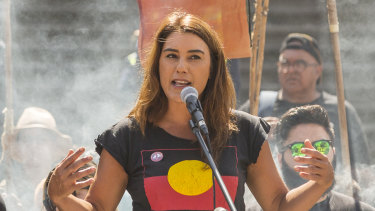
”…We need a new approach – unequivocal rejection of this fundamentally flawed and deeply disrespectful Bill.
How can Labor acknowledge the traditional owners when you can support a Bill that will destroy women’s sacred sites? Labor you should stand up and vote this Bill down along with us”
Senator Thorpe spoke passionately and eloquently, explaining First Nation people’s stromg opposition to the planned nuclear waste dump.
And whaddya know – from the Gallery yelled an old white man, a Member of the House ofrReps, but not a member of this Chamber. Yes, Rowan Ramsey MP, yelled ”Bullshit”.
Just as well the Hon Ramsey is a white man, confronting a black woman. Otherwise, if it were the other way round, you can bet your boots that the interjector would have been expelled from the Gallery……
And here’s some of what Senator Thorpe said (inexact transcript):” Greens speak up for the Barngarla people, oppose this Bill. The clearly expressed opposition of Aboriginal people. They strongly oppose the Wallerberdina site, and need to protect that sacred women’s site. Today’s proposed amendment again paves way for radioactive dump on this sacred site. The amendment puts all 3 sites back on the table. None of these sites have the consent of the traditional owners. None of these traditional owners want their sacred sites degraded.The ”community” consent was conducted on the basis that only rate-payers could vote. The Barngarla Aboriginal Corporation commissioned an independent company to conduct a ballot, with the result – unanimous opposition.
Labor – you’re agreeing with the amendment so that the traditional owners can fight this plan in court. Is Labor going to pay for their lagal action? Stop pretending that you’re here for the first people in this country. We say NO and we will continue to fight against the destruction of our country. Radioactive waste is something that will outlast you and this Parliament………We need a new pproach – unequivocal rejection of this fundamentally flawed and deeply disrespectful Bill. How can Labor acknowledge the traditional owners when you can support a Bill that will destroy womeb’s sacred sites. Labor you should stand up and vote this Bill down along with us.
Australian Senate now deliberating on the controversial Nuclear Waste Dump Bill

The Australian Senate is about to finally debate and decide on a new amendment to the National Radioactive Waste Management Amendment (Site Specification, Community Fund and Other Measures) Bill 2020, which has been languishing in the Senate for months.
The crux of the matter is that whereas the Bill previously designated Napandee, a farm near Kimba, South Australia, as the site for a nuclear waste dump, it now slightly, (but significantly) changes that , mentioning the possibility of other sites. Minister Keith Pitt is now almost certain to formally declare Napandee as the site.
The whole process has been obscure, while being highly promoted to the local community as both a ”Australian medical necessity” and a ”local economic boon”. Information provided to the local area has been promotional material and speakers from ANSTO and the Industry Department, but with no independent voices explaining the negative aspects. Local residents, farmers, and business people are calling on the government for a portion of the grant funding to Kimba to be allocated to an independent review and assessment of the project.
The Barngarla Traditional Owners were excluded from a community vote that approved the project, as were other landholders close to the Napandee site. They will now have the right to legally challenge the nuclear dump plan.Residents of the wider Eyre Peninsula, have had no say in the Kimba decision. Nor have the various communities whose residents are likely to object to having radioactive waste carried through their area, in this unnecessarily long transport from one temporary storage to another. South Australia has clear laws prohibiting the establishment of a nuclear waste dump in that State, the Nuclear Waste Storage Facility (Prohibition) Act 2000.
The most significant contributor to this planned waste dumping will be intermediate level nuclear waste produced by ANSTO’s nuclear reactor at Lucas Heights, Sydney. These toxic wastes are in interim storage in large canisters at Lucas Heights, where they are safely managed and guarded.. There is ample room for more storage at Lucas Heights, and no reason for this double handling, sending the same temporary storage canisters to Kimba.
If this Bill is now passed by the Senate, it will bring on a more chaotic situation of uncertainty for the people of Kimba, but with not one step towards what is really needed.
The Senate should reject this poorly devised Bill. Australians deserve a thorough, properly researched independent inquiry into finding a permanent and safe solution to ANSTO’s nuclear waste problem.
THIS WEEK’S SPECIAL THEME. Australian government headed to impose a nuclear waste dump on Kimba, South Australia
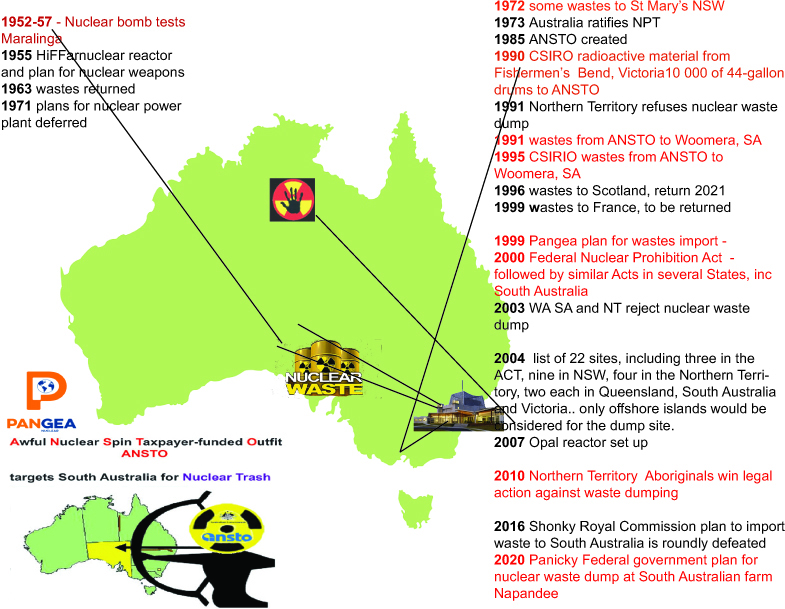
Never mind that South Australia has clear laws prohibiting a nuclear waste dump, the Australian Senate has passed a law enabling the Resources Minister, Keith Pitt, to impose a nuclear waste dump on any site apptroved by the government – but they mean Kimba. Far far away from the source of the nuclear waste (ANSTO’s OPAL nuclear in Sydney) the Napandee farm will be the dump for ANSTO’s toxic wastes. The plan is simply to shove the responsibility for these stranded wastes over to South Australia. The government cons the locals that this will be an economic boon for them
It’s just the latest in the long saga of the nuclear lobby’s attempt to get a nuclear waste dump. It has never been a goal that would make sense – ethically and environmentally . – (an ethical goal would be a complete clean-up drive, permanently getting rid of Australia’s nuclear reactor and its radioactive trash).
But no, this latest push is just part of ANSTO’s grandiose goal of expanding its operations, to produce more toxic trash.
And that may not be all. The Australian saga follows decadesof efforts by the nuclear lobby to make South Australia the nuclear waste dump for the world. That goal, spelt out clearly in 1999 by the company Pangea (now reborn as Arius), was pushed again in the 2016 South Australian Nuclear Fuel Chain Commission
The Napandee dump is1700 km from Lucas Heights. The dump will house the same ”interim” waste conatainers as at ANSTO. They could stay at ANSTO, more safely, for many years. As for a permanent repositary, there are many geolocally more suitable sites much closer to the reactor.
I have no doubt that some who push for the Napandee dump see it as a foot in the door for the old dream of importing the world’s muclear trash.
The Federal government is pulling a nuclear waste confidence trick on South Australia.
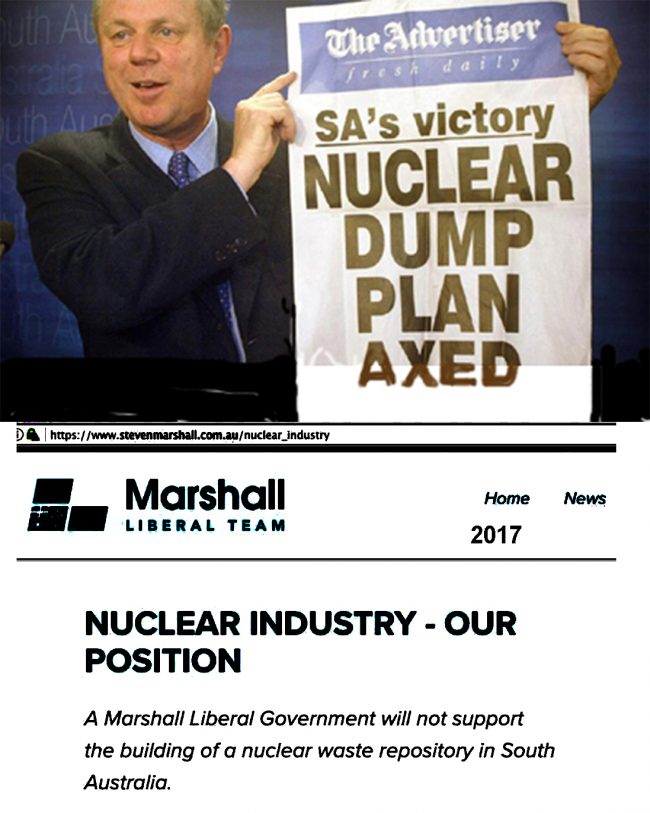
Well, that’s a relief to South Australians.
But aw shucks, that was 2017. Is Premier Marshall now going to do a backflip, and let the Federal government send ANSTO’s radioactive trash to a small rural community in South Australia?
On Monday 21 June at 12.20 pm, the Australian Senate will debate, and may vote on, the revised National Radioactive Waste Management Amendment (Site Specification, Community Fund and Other Measures) Bill 2020 .
South Australia has clear laws prohibiting the establishment of a nuclear waste dump in that State. Nuclear Waste Storage Facility (Prohibition) Act 2000
There is a strange and hypocritical silence from the State’s Liberal leaders, and Labor Opposition. Only the Greens have spoken out against this Federal plan to establish a nuclear waste dump in a rural area.
Why the silence from the rest? It could be because they sort of support the plan, even though it contravenes the State’s law. Or, just as likely, they know that even if this Bill is passed, it’s not really going anywhere, anyway.
The idea of toting ANSTO’s ”intermediate level” nuclear waste from temporary storage at Lucas Heights, to way across the continent to another temporary storage in some little rural agricultural area in South Australia, is fraught with problems, and unanswered questions.
If this Bill becomes law, three previously short-listed locations Lyndhurst in New South Wales, Napandee near Kimba, and Wallerberdina in the Flinders Ranges are nominated as suitable sites, and Minister Keith Pitt will be required to formally declare a site. Correction. I am informed that the New South Wales site is not included, and that Federal Labor have put up an amendment to remove that Wallerberdina site in theFlinders Ranges.
From then on, the rot will really set in, and I don’t like Minister Pitt’s chances of imposing a facility on any of these communities. For a start, the Wallerberdina site has already been rejected. via a community ballot, and that location was scrapped by the previous Minister Matt Canavan.
The obvious target is the Kimba site, where in a fairly restricted vote, a community vote did favour this ”interim” waste dump, accompanied as it was by financial incentives for the town.. But there is strong opposition from the Barngarla people, traditional owners who were excluded from the vote. There are also farmers most unhappy with the choice of this agricultural area: they have formed a group – No Radioactive Waste on Agricultural Land in Kimba or SA.
The newly amended Bill opens the matter up for legal challenge, which is sure to come about. There are serious objections to the plan, not least of which is the problem of transport, involving numerous communities whose residents are likely to object to having radioactive waste transported through their area. There certainly is the question of placing nuclear waste in an agricultural area. Nuclear enthusiasts claim that this is acceptable overseas. They cite France ignoring the protest continuing in the village of Bure where the French government has tried to set up a waste facility.
There are serious doubts on the soundness of the proposal, especially as it relates to the Napandee site . Is it geologically suitable, seismically safe?Meanwhile the interim storage at Lucas Heights has room for years more storage, and has the staff, the security, and the expertise to safely manage the wastes on site.
Above all – the Napandee site has been promoted to the local community, with enthusiastic information from ANSTO and Industry Department experts, and promises of economic benefits. What has not been provided, but in fact, actively discouraged, is the other side of the story. Kimba residents have not had access to the misgivings of other experts about this proposal – economic disadvantages, environmental considerations, water problems, and the long-term probability for the community to be stuck with stranded wastes
Kalbar’s exotic minerals mine a toxic risk to Victoria’s food bowl
Kalbar’s exotic minerals mine a toxic risk to Victoria’s food bowl, Michael West Media by Elizabeth Minter | Jun 18, 2021 | A hearing into the Environment Effects Statement for Kalbar’s mineral sands project on rich Victorian farmland has been told about competition for billions of litres of water, high levels of uranium, untested technologies and a strange backflip by the project’s “independent experts”. Elizabeth Minter investigates.
For exactly 100 years, Kane Busch’s family have farmed the fertile soils of the Lindenow Valley in East Gippsland, Victoria. After leaving Denmark in 1913, Kane’s great-grandfather Eiler Busch settled in the Valley, buying in 1921 the land that is now the home of Busch Organics.
Kane’s grandfather, also called Eiler, was behind the push for more environmentally friendly farming while experiencing the devastating droughts of the 1990s. The farm gained official organic certification in 2000. Grandson Kane is following in those footsteps, and was recently a finalist for a national award for “Young Grower of the Year”.
The Lindenow Valley produces the salad greens and vegetables – broccoli, green beans, cauliflower, celery, beetroot, cabbage and carrots – that help feed the nation. The Valley produces nearly one-third of the state’s vegetables; employs up to 2000 people at peak times; and is worth more than $150 million to the local economy.
The area also has huge environmental significance, with the heritage-listed Mitchell River, the Ramsar-protected Gippsland Lakes wetlands, and the Perry River’s unique Chain of Ponds, which is home to many threatened plant and animal species. Once ubiquitous across south-eastern Australia, “chain of ponds” systems are now rare.
But this is all now in jeopardy thanks to a mineral sands mining proposal from Kalbar Operations Pty Ltd (Kalbar), a company that was established as an investment vehicle and that has never operated a mine. It would be almost comical were it not for the potentially deadly consequences.
There’s monazite, which contains rare earth metals plus radioactive uranium and thorium and is thus potentially dangerous to residents, the waterways and the vegetables growing by the mine’s boundary; the competition for billions of litres of water; and the untried technology being proposed to tackle the mining waste. Nowhere in Australia is a mineral sands mine located so closely to, and upwind of, a major vegetable growing industry.
Kalbar is proposing a 1,675-hectare open-cut mine just 350 metres from the Mitchell River, which flows into the Gippsland Lakes wetlands. The mine will operate 24 hours a day, 365 days a year, for 15 years. A public hearing is under way as part of the inquiry into the Environment Effects Statement (EES). The following information has been revealed during the hearing.
Big miners walk away, lack of water the key risk
The multinational miner Rio Tinto originally owned the mining exploration licences. In 2011 Oresome, a subsidiary of Metallica Minerals, entered into a right to explore and option to purchase agreement with Rio for the licences.
A scoping study it commissioned showed a mine could be viable only if there was a dependable water supply. The risk of not finding a reliable source of up to 6.2 billion litres annually for an acceptable price received a Category F rating, defined as a problem with possibly “no viable solution” and a “fatal flaw”.
Water supplies
Kalbar’s proposed mine will sit on the plateau high above the Mitchell River with the vegetables growing just metresfrom the river.
The mine is 3.5 kilometres from the main source of the region’s drinking water (other than tank water). The mine and the horticultural industry will be in direct competition for water, with both relying on the Mitchell River and the same groundwater………….
Treatment of mine waste
Also controversial is access to how mine waste will be managed. The mine’s original design included a 90-hectare tailings dam.
But when government agencies and others highlighted the extreme danger such a dam posed to the Perry River and the Chain of Ponds, Kalbar changed its proposal.
The mine now plans to use giant centrifuge machines to remove water from the tailings waste, and then reuse that water.
The East Gippsland Shire Council, which unanimously opposes the mine, was not convinced of the viability of centrifuges, which are untested in mineral sands mining. The council commissioned a report from an independent mining industry consultancy, Ausenco.
Ausenco’s report raised concerns and advised that many more centrifuges would be required than Kalbar proposed. Then just weeks later, of its own volition, Ausenco issued a new report …………..
Radioactive dust a hazard
Kalbar plans to mine for and partially refine zircon, titanium-bearing rutile, ilmenite and rare earths minerals.
Airborne dust generated from mineral sands mines not only contains toxic heavy metals and radioactive monazite, thorium and uranium but also respirable crystalline silica, which leads to the deadly lung disease silicosis……………
Reputational damage to growers…… https://www.michaelwest.com.au/kalbars-exotic-minerals-mine-a-toxic-risk-to-victorias-food-bowl/
1 This month
Chernobyl: The Lost Tapes – A good documentary on Chernobyl on SBS available On Demand for the next 3 weeks– https://www.sbs.com.au/ondemand/tv-program/chernobyl-the-lost-tapes/2352741955560
15 April – Zoom –Nuclear Power is Not the Solution
Apr 15, 2026 01:00 AM in Canberra, Melbourne, Sydney

Join the International Physicians for the Prevention of Nuclear War (IPPNW) on Tuesday, April 14th for a timely webinar exploring the risks associated with nuclear power and challenging the myth that it offers a simple, safe, carbon-free solution to the climate crisis

21 April Webinar: No Nuclear Weapons in Australia
Start: 2026-04-21 18:00:00 UTC Canberra, Melbourne, Sydney (GMT+10:00)
End: 2026-04-21 19:30:00 UTC Canberra, Melbourne, Sydney (GMT+10:00)
Event Type: Virtual
A virtual link will be communicated before the event.
Host Contact Info: australia@icanw.org

of the week – Australians for War Powers Reform (AWPR)
To see nuclear-related stories in greater depth and intensity
 Antinuclear