THE THOUGHT SHAPERS: How Jillian Segal’s Agenda Threatens to Capture Australia’s Universities – and Why We Must Resist
The message is clear: you should assume that Jewish Australians support Zionism. And if you criticise Zionism, you may be targeting Jewish identity itself.
25 February 2026 Dr Andrew Klein, PhD, AIM
Let’s be direct about what we’re facing.
Jillian Segal, the government’s Special Envoy to Combat Antisemitism, has proposed a sweeping agenda that would fundamentally alter how Australian universities operate. Her plan includes “university report cards” grading campuses on their efforts to combat hate speech, the power to withhold public funding from researchers or programs deemed insufficiently compliant, and ultimately, a judicial inquiry into campus antisemitism if universities fail to meet her standards by 2026.
On its face, this sounds reasonable. Who could oppose tackling antisemitism?
But the devil, as always, lives in the definitions. And the definition being advanced is not about protecting Jewish students from genuine prejudice – it is about shielding a foreign government from criticism, erasing Palestinian suffering, and creating an “authorising environment” where dissent becomes punishable.
This is not about safety. This is about control. This is about shaping what can be thought, said, and taught in Australian universities. And the people driving this agenda are not neutral arbiters of academic freedom – they are political actors with a very specific agenda.
Let’s examine what’s actually happening.
Part I: The Segal Agenda – What It Really Does
Jillian Segal’s 20-page report, Plan to Combat Antisemitism released in July 2025, proposed a series of measures that have been quietly implemented over the following months.
The Report Card System
Universities will now be assessed on their:
“… adoption of an appropriate definition of antisemitism, their delivery of training to staff, the accessibility and fairness of complaints processes, and governance responses to activities that may incite discrimination.”
The key phrase is “appropriate definition.” Which definition? The government has endorsed the Universities Australia definition, which critics argue is so broad and ambiguous that it can be used to brand almost any criticism of Israel as antisemitic.
Funding Threats
The government plans to empower the higher education regulator, Teqsa, to impose “significant financial penalties” on universities that fail to manage antisemitism to its satisfaction. Segal’s original proposal went further, recommending that funding could be withdrawn from individual researchers, centres, or programs where antisemitic behaviour is “left unchecked.”
The Task Force
A new Antisemitism Education Task Force has been established, led by David Gonski – the same David Gonski whose name is now synonymous with the school funding reforms that Victoria has systematically failed to implement. The task force includes Segal, Universities Australia chair Carolyn Evans, and representatives from Teqsa and other bodies.
The Monash Initiative
The Monash Initiative for Rapid Research into Antisemitism (MIRRA) has been funded to provide training programs on “recognising antisemitism” to staff and leaders of universities across Australia. Its director, Associate Professor David Slucki, was one of the authors of the Universities Australia definition of antisemitism.
Part II: The Definition Problem – When Criticism Becomes Hate
Here is the central issue: what counts as antisemitism under these new frameworks?
The Universities Australia definition acknowledges that “it can be antisemitic to make assumptions about what Jewish individuals think.” Yet it simultaneously deems it necessary to state that “for most … Jewish Australians, Zionism is a core part of their Jewish identity.”
The message is clear: you should assume that Jewish Australians support Zionism. And if you criticise Zionism, you may be targeting Jewish identity itself.
This is not a protection against racism. It is a political test.
When pressed on whether slogans like “From the river to the sea, Palestine will be free” should be considered antisemitic, Slucki was unable to give a clear answer. The ambiguity is the point. It allows institutions to police speech without clear guidelines, to punish based on “vibes” rather than evidence.
Greg Craven, the constitutional lawyer appointed to lead the report card initiative, has been even blunter: “Every time you see a chanting, vicious protest on a university campus, it’s telling you that anti-Semitism’s all right.”
Every protest. Every chant. All presumed vicious, all presumed antisemitic, unless proven otherwise.
This is not a framework for justice. It is a framework for suppression.
Part III: The Subjective Turn – When “Feeling” Trumps Fact
Perhaps most concerning is the shift toward subjective definitions of harm.
In MIRRA’s report on antisemitism in the cultural sector, the authors explicitly dispense with objective definitions. One participant argues that “if someone…feels that [something] has happened to them, then that has happened to them.” The report’s authors concur, stating that “illustrative examples demonstrating the impact of recent incidents … may be more effective than definitions that emphasise intention.”
Under this framework, any encounter with pro-Palestinian speech can be experienced as antisemitic. The report explicitly cites “we support solidarity with Gaza” as an example of an opinion that was experienced as antisemitic.
This is the logic of the “trauma-informed” university, weaponised against political dissent. If your speech causes me distress, you are responsible for that distress – regardless of your intentions, regardless of the content’s legitimacy, regardless of whether I have any right to be free from political disagreement.
The Australian Federation of Islamic Councils has condemned this approach in the strongest terms:
“These decisions are not about antisemitism, they are about silencing. They are not about cohesion, they are about control. When governments begin to punish solidarity and redefine dissent as hate, they do not protect democracy, they dismantle it.”
Part IV: The Gonski Contradiction – Funding Schools While Policing Thought
…………………………………………………………………………………………………………………………………………………………………………………………………………………….. https://theaimn.net/the-thought-shapers-how-jillian-segals-agenda-threatens-to-capture-australias-universities-and-why-we-must-resist/
Is Australia-US Alliance Hurting Australia?

27 February 2026, By Denis Hay
Criticism of the Australia-US alliance examines whether unquestioning support for the US undermines peace, sovereignty, and regional stability.
Introduction – Asking the Question Australians Rarely Hear
For decades, Australia has treated close alignment with the United States as the unquestioned foundation of its foreign and defence policy. This article advances criticism of the Australia-US alliance in a calm, factual way, asking whether that loyalty still serves Australian interests or exposes the country to unnecessary risk. This is not an argument against the American people. It is an argument for honesty about power, history, and Australia’s place in the region.
The Problem – A History That Is Rarely Acknowledged
1. US power and coercion are not new
US pressure on other nations did not begin with Donald Trump. Across its history, the United States has used sanctions, economic coercion, regime change, and military force to advance strategic and corporate interests. Trump did not invent this behaviour; he removed the diplomatic language that once softened it. This matters because Australia often treats US actions as benign by default, even when they undermine international law or regional stability.
2. US military influence on Australia
The influence of the U.S. military-industrial system extends beyond policy advice to Australian territory itself. Through joint facilities, force posture agreements, and rotational deployments, US military assets run on Australian soil with limited transparency and little public scrutiny. Although described as cooperative, these arrangements often leave strategic control and escalation decisions primarily with Washington.
This creates a clear danger for Australia. In any conflict involving the United States, Australian bases may be considered legitimate targets, regardless of whether Australia has made an independent decision to participate. Hosting foreign forces therefore increases Australia’s exposure to war while reducing its ability to stand apart from US strategic choices.
The Impact – How Fear Shapes Policy and Public Debate
3. The China threat narrative in Australia
Public discussion of China in Australia is dominated by fear-based framing. China is routinely portrayed as an inevitable military adversary, despite being Australia’s largest trading partner and a country whose primary focus has been economic development and internal stability. This narrative leaves little room for diplomacy, cooperation, or recognition that China has not pursued global military dominance as the United States has.
4. Why politicians rarely challenge the US
Australian politicians across both major parties rarely question US behaviour because the costs of dissent are high. Defence integration, intelligence sharing, media pressure, and elite political incentives all discourage independence. Challenging the US risks being labelled reckless or weak on security, even when the concern is evidence-based and aligned with Australian interests.
The Alternative – A Clearer View of Australia’s Interests
5. Seeing China without fear or fantasy
Viewing China in a more positive and realistic light does not mean ignoring disagreements. It means recognising that China poses no credible invasion threat to Australia and that stability is better served through engagement than confrontation. A mature foreign policy distinguishes between legitimate concerns and manufactured fear.
6. An independent foreign policy grounded in peace
Australia keeps full sovereignty over its choices. Independence does not need abandoning alliances, but it does require the courage to say no when US actions increase the risk of war. Reducing automatic alignment would strengthen Australia’s credibility in the region and lower the chance of being drawn into conflicts that do not serve Australian citizens
Practical steps include:
• Prioritising diplomacy and regional institutions
• Limiting foreign military exposure on Australian soil
• Encouraging genuine parliamentary debate on alliance commitments
• Investing in peace building rather than perpetual deterrence……………….
Final Thoughts – Choosing Independence Over Reflex
Australia-US alliance criticism is not about turning away from allies. It is about recognising that blind loyalty carries real dangers. Australia is better served by calm engagement with its region, a realistic view of China, and a clear-eyed assessment of US behaviour. Peace, not fear, should guide Australian foreign policy https://theaimn.net/is-australia-us-alliance-hurting-australia/
AUKUS & potential terrorism threats.

I don’t think the federal or state government have seriously evaluated what would happen if there was an accident or terrorism strike on the AUKUS nuclear submarines, either in Adelaide or Perth. Or if they have, they certainly aren’t telling us, or planning to provide iodine tablets to locals living in the area.
Robyn Wood. FOE Adelaide, 27 Feb 2026
I’ve been looking at a bit of history and since 2000 there have been three credible attempts towards bombing Lucas Heights.
Three bomb threats to Lucas Heights
The first plot was uncovered by NZ police who found Afghan refugees had plans to bomb Lucas Heights during the Sydney Olympics. They weren’t jailed. I wonder where they are now.
The second was in 2003, when a French Al Qaeda supporter called Willie Brigette came to Australia to teach people how to make bombs destined for Lucas Heights. He was deported back to France. I wonder where he is now. After the plot was discovered, the NSW Health Department told councils and emergency services that residents within 3km of Lucas Heights would be evacuated, and residents within 80km of Lucas Heights (most of Sydney) should stock up on iodine tablets at their own expense. I doubt Sydney people have been told that. The fire brigade, ambulance and other emergency services threatened not to attend a nuclear emergency as they didn’t think the state government was prepared enough, and they were not happy that iodine tablets wouldn’t be supplied to Sydney.
Secret government report – I don’t know who the whistleblower was, but it’s thought that a secret “radiation consequences analysis” commissioned by the nuclear regulator ARPANSA found that a terrorist strike on Lucas Heights could contaminate most of Sydney with radiation. Not released publicly. After 9/11 the regulator’s CEO told a Senate Inquiry that they were considering the impact if a plane hit the reactor building. Nothing has been released publicly. The government claims that it has to stay secret as it might help terrorists and Sydney residents don’t need to know.
The third one was in 2005, Islamic militants in Sydney were arrested for being a terror cell and stockpiling bomb-making materials, training in outback hunting camps and planning a possible attack on Lucas Heights. Three of them were caught near Lucas Heights and when they were separated, each man told police a different story. Bomb making chemicals and equipment was found in their houses. I can’t find what happened to them, and wonder where they are now.
Years ago, Islamic State called for jihadist supporters to attack in western countries.
I wonder if Mark Butler and other MPs are aware of this history? I wasn’t.
References. The Guardian –https://www.theguardian.com/world/2005/nov/15/australia.bernardoriordan
Nuclear FOE – https://nuclear.foe.org.au/articles-about-lucas-heights-accidents-emergency-planning-insurance-etc/
Jewish groups call on Tony Burke to cancel Israeli journalist visa
by Stephanie Tran | Feb 24, 2026, https://michaelwest.com.au/jewish-groups-call-on-tony-burke-to-cancel-israeli-journalist-visa/
Jewish orgs request Tony Burke reject Australian visa for Israeli journalist as his funders’ links to IDF emerge. Stephanie Tran reports.
A coalition of Australian Jewish organisations has written to the Home Affairs Minister Tony Burke, urging him to cancel the visa of Israeli journalist Zvi Yehezkeli on character grounds, citing comments in which he called for mass killings in Gaza and advocated violence against journalists.
The letter was initiated by Anti-Zionism Australia and signed by several Jewish groups including, Jewish Voices of Inner Sydney, Jews Against the Occupation ‘48, Jews for Palestine Western Australia, Jewish Advocates for Understanding Antisemitism, Jews for a Free Palestine, Jews for Human Rights and the Coalition of Women for Justice and Peace.
The groups have requested that Yehezkeli’s visa application be rejected under the Migration Act 1958, specifically invoking section 116(1)(e)(i), which allows for cancellation where a person’s presence may pose a risk to the health, safety or good order of the Australian community, and section 501, the character test.
“The undersigned request that you reject Zvi Yehezkeli’s visa application … on the basis that his presence in Australia shall pose a risk to the health, safety or good order of the Australian community and that his past and present general conduct indicates a foreseeable risk of vilifying a segment of the community and inciting discord,” the letter states.
Burke mulls visa
Tony Burke has indicated the government is considering whether to deny Yehezkeli’s visa application.
Speaking to the Sydney Morning Herald, he said: “It always surprises me when someone, who has made the sorts of comments that this individual has, advertises a speaking tour before they’ve even received a visa.”
Yehezkeli, an Israeli journalist and resident of a settlement in the occupied West Bank, is due to visit Australia in March and is slated to appear as a keynote speaker at fundraising events in Sydney and Melbourne.
Tax-deductible fundraiser under scrutiny
The Sydney and Melbourne events are raising funds for Israeli organisation The Institute for Social Momentum. Donations are being collected in Australia through the Chai Charitable Foundation, which is promoting the fundraiser as tax deductible.
A link to donate via the Chai Charitable Foundation appears on the registration pages for both events.
According to its 2024 financial report, the Chai Charitable Foundation reported more than $19m in revenue. Of that, $15.39m was distributed in grants and donations for use outside Australia, compared with $1.62m directed domestically.
The foundation facilitates tax-deductible donations from Australians to organisations in Israel and has previously come under scrutiny over its fundraising activities.
T
An investigation by MWM, found that the charity hosted multiple online fundraisers linked to Israeli military units and West Bank settlements.
The Chai Charitable Foundation initially denied that it was raising funds for such causes. However, those pages were removed after MWM put questions to Chai.
Incitement to commit genocide
n a submission to the International Criminal Court (ICC), French-Israeli human rights lawyer Dr. Omer Shatz concluded that “there is reasonable grounds to believe that Yehezkeli’s statements amount to direct and public incitement to commit genocide.”
In December 2023, Yehezkeli stated that the Israel Defense Forces should have killed more than 100,000 Palestinians in Gaza.
In a 2024 interview, he said that in order to destroy Hamas, Israel needed to take measures that would “bring Gaza to the point of a humanitarian disaster”.
Last year, Yehezkeli advocated for the killing of journalists in Gaza, stating that “if Israel already decides to eliminate journalists then better late than never” and lamented the “damage” caused to Israel by journalists reporting on the atrocities in Gaza.
“This is an understanding in Israel of how much damage those who transmitted the pictures of hunger and all of Hamas’s one side did […] how much psychological damage those journalists in quotation marks, terrorist journalists, or you can call them Nukhba journalists, how much damage they did to Israel,” Yehezkeli said.
Australia invests $310m to fast-track parts for first AUKUS nuclear submarines
Minister for Defence Industry Pat Conroy has announced an increased investment into the AUKUS program to bolster the nation’s military capabilities during talks in London
Minister for Defence Industry Pat Conroy has announced an increased investment of $310m into the AUKUS program to bolster the nation’s military capabilities during a meeting with British counterparts.
Minister Conroy met with the UK’s Defence Minister Luke Pollard in London this week — the first meeting for the Australia-United Kingdom Defence Industry Dialogue (AUKDID) since 2018 — and he said there will be further investment in the AUKUS program’s Pillar One including the construction of the very first parts to go into the nuclear reactors.
“I’m announcing that we have invested $310m in long-lead items for the reactors for the first two SSN-AUKUS boats,” Minister Conroy said.
“We just spent $310m acquiring the very first parts that will go into the reactors for the first two submarines that we will construct in Adelaide beginning later this decade.
“This project will create 20,000 high-skilled secure jobs making the most advanced submarines in the world, equipping the Royal Australian Navy with the capabilities it needs to deter conflict in our region”.
Mr Conroy will this week visit Rolls Royce Derby, northwest of London, to inspect reactors and also visit BAE Systems at Barrow-in-Furness in Cumbria to discuss the progress of the SSN-AUKUS program.
“The defence relationship between Australia and the United Kingdom is going from strength to strength,” he said.
“Today’s announcements demonstrate further integration … to grow our industrial bases to give our respected forces the equipment they need to make both our countries safer in an increasingly uncertain world”.
Minister Conroy said the AUKUS timeline remains “on track” and the government was “hitting all major milestones” including the arrival of HMAS Anson.
It arrived at WA’s HMAS Stirling on Sunday to undergo its first maintenance of a UK nuclear-powered submarine in Australia.
Minister Conroy said the latest meetings between the two governments was a sign “relationship is the strongest that it’s been for a long, long time, we are the best of friends”.
He said the discussions also included: “Deepening co-operation on advanced radar technology including exploring the use of Australian radar technologies on UK projects”.
“We also flagged greater work on resilience supply chains and critical minerals and we’ve also flagged an increase on a number of Australian embeds at the BA submarine construction yard at Barrow,” he said.
“We are also supporting UK weapons testing of systems destined for Ukraine”.
British submarine arrives for ‘extraordinary’ AUKUS visit

Retired rear admiral Philip Mathias, a former director of nuclear policy with the UK Ministry of Defence, told this masthead last month he feared Australians were not adequately informed about how the troubles plaguing the British navy could scuttle the SSN-AUKUS plan.
“ there is a high probability that the UK element of AUKUS will fail,”
“Australia has shown a great deal of naivety and did not conduct sufficient due diligence on the parlous state of the UK’s nuclear submarine program before signing up to AUKUS – and parting with billions of dollars,”
Matthew Knott, SMH, February 22, 2026 —
A British nuclear-powered submarine has arrived in Australia for an unprecedented month-long visit despite the well-chronicled problems plaguing the British navy’s ability to send its vessels to sea.
The British and Australian governments are holding up the visit as a sign of the countries’ commitment to the AUKUS pact, even as the United Kingdom views Russia as its most pressing security threat.
HMS Anson, an Astute-class nuclear-powered submarine, arrived on Sunday at the HMAS Stirling naval base in Perth for a month-long maintenance visit.
described the first such visit by a UK nuclear‑powered submarine in Australia as a “historic step in our nation’s readiness to operate and maintain conventionally armed, nuclear‑powered submarines”.
HMS Anson, which was commissioned in 2022, is reportedly the only available submarine in the British navy’s fleet of five Astute-class boats, highlighting the significance of the extended deployment to Australia.
British defence publication Navy Lookout has written that the “timing of the deployment seems extraordinary” as the British navy does not have any other Astute-class submarines available.
“The UK must continue to play its part in AUKUS, but in the short term, perhaps more local concerns should be the priority,” the publication argued this month.
“Placing the sole attack submarine on the other side of the globe appears to be at odds with vigorous official warnings to Russia that ‘any threat will be met with strength and resolve’.”
Navy Lookout said the British navy’s other four Astute-class submarines were “all at low or very low readiness”…………………………………………………………………………………
The plan involves the US selling Australia at least three Virginia-class submarines while the UK and Australia partner on the development of a new class of submarine known as the SSN-AUKUS………….
Retired rear admiral Philip Mathias, a former director of nuclear policy with the UK Ministry of Defence, told this masthead last month he feared Australians were not adequately informed about how the troubles plaguing the British navy could scuttle the SSN-AUKUS plan.
“Whilst the United States may sell some [nuclear-powered submarines] to Australia, there is a high probability that the UK element of AUKUS will fail,” he said
Mathias, who led a 2010 review of the UK Trident nuclear-weapons system, said: “It is clear that Australia has shown a great deal of naivety and did not conduct sufficient due diligence on the parlous state of the UK’s nuclear submarine program before signing up to AUKUS – and parting with billions of dollars, which it has already started to do.”
The head of the British navy, First Sea Lord Gwyn Jenkins, ordered an urgent 100-day drive to tackle systemic delays in the UK submarine program in October.
UK publication Defence Eye reported that the British navy “has struggled to put more than one of its five Astute boats to sea at a time” and that “for a number of months over the past two years, no Astute boats have been at sea”. https://www.smh.com.au/politics/federal/british-submarine-arrives-for-extraordinary-aukus-visit-20260222-p5o4d8.html
China’s Retaliation: when will it happen?

And more appropriately, what form will it take?
Jerrys take on China, Feb 18, 2026, https://jerrygrey2002.substack.com/p/chinas-retaliation-when-will-it-happen?utm_source=post-email-title&publication_id=1744413&post_id=188346536&utm_campaign=email-post-title&isFreemail=true&r=ln98x&triedRedirect=true&utm_medium=email
A few comments about why China is like it is – first of all, in the last 45 years, there has been no invasions, despite what people like little Marco Rubio of the US and Richard Marles the Australian Defence Minister might say, China is not and does not pose a threat to any of these countries – Japan might think there is a threat, China does not agree, in fact the opposite is true, Japan poses a much larger threat to China than China has ever posed to Japan.
China is concerned about, and in fact does feel threatened by Japan’s military expansion because the last time it happened literally millions of Chinese were murdered by the Japanese. Australia’s defence minister, Marles, asks us to consider why China has the world’s largest military expansion but he’s wrong – we have to hope he’s wrong because he’s been misinformed and is too dim to check out for himself, but more likely he knows he’s lying about this as China spends considerably less money than the US, in terms of not only its population but its geographical size, it’s quite entitled to spend more cash, when on a per capita basis, the amount is tiny compared to the US, on a ratio to GDP, it’s smaller than the US, it’s one third or less than NATO has been required to spend in terms of percentage of GDP and there’s one more very important factor that the US with only two neighbouring countries doesn’t have – that is 14 neighbouring countries with a shared land border.
Here’s another thing. China was invaded when they were weak, the British did it, the Americans did it, the eight nations alliance did it, Britain carved up part of Burma and took away some of China, it carved up India and took away parts of China, the Russians carved up Mongolia and Heilongjiang, taking away parts of China, the Japanese invaded and occupied China for 14 years. The classic twists and mental gymnastics people like Marles make would have us believe that the hundreds of US bases around China are to prevent China from doing what they’ve NEVER done – going out to invade other countries.
He, and several pundits would like us all to believe is that the US is keeping the world safe from China by arming their neighbours, interfering in the Provinces, Regions and the SARs but the reality is, China is building a military that will defend Chinese people inside China and Chinese land that belongs to China now – it’s not looking to reclaim land back, except in disputed regions.
Those disputed regions include parts of Tibet that the British took away and gave to India, parts of the South China Seas that the Japanese took away and both the US and UK, at the end of the Second World War, agreed would come back to China. There’s one military base in Africa, which is in a region shared with many other countries, including the USA, Japan, France, Italy, Germany Spain and even Saudi Arabia. Taiwan is NOT one of these disputed regions – the entire world whether they recognise Beijing or Taipei as the capital, recognises that there is one China and Taiwan is part of it – anyone who suggests that Taiwan is a country is either a liar, deliberately misleading us, or is far too dim to read the Constitution of the Republic of China, which not only claims all of the Chinese Mainland, it also wants those disputed regions back too.
China has something else which its detractors hate to admit and will lie about – that’s a policy of non-interference in the affairs of a sovereign nation – when it invests in another nation, it doesn’t call for democracy or elections, it doesn’t even ask that Communism or Socialism are accepted, it doesn’t send military to protect its assets, it won’t send missionaries to convert their subjects and it won’t impose conditions that force countries to give up their national assets or utilities if they can’t make the payments – if that sounds familiar and if it’s because you’ve been hearing that China will do all of those things and, if you think they have, I’d implore you to find me an example of where it’s happened, outside of opinion pieces written by people who want you to believe they have, almost every incident where we can find any of these things alleged, will be speculative – they’ll tell us what China might do, what China could do, what China may be doing, is alleged to have done or suspected to be involved in.
We might find individual cases of rogue Chinese people, Chinese criminals even and they use these tiny individual examples to tell you that this is “what China does” when that person who has broken the law has usually already been punished by the time they report it in western media and, if they mention that at all, it’ll be after the third paragraph where most of us have stopped reading.
On the other hand, I can find literally hundreds of examples where the USA is doing these things, where the UK and France have done these things, where Germany, Belgium, even Spain and Portugal have done them.
So then some of the comments I have been getting relate to the Port in Darwin, the ports in Panama and the Pirelli saga in Italy. Just for some background here, Sinochem owns 37% of Pirelli, the big Italian tyre company which wants to expand into the USA, of course the US won’t allow that while China has such a controlling interest. The share of Sinochem hasn’t changed, the only change is that the board, and remember Sinochem had controlling interest being the largest single shareholder, has declared that Sinochem no longer has control, giving the board more autonomy, – Sinochem agreed to this, so this isn’t a situation where anything has been taken from China, merely an agreement that the board retains control which a Chinese corporation retains more shares.
Erich, one of my followers said this: “if China doesn’t protect its assets it will lose them like Pirelli in Italy, the Ports in Panama, etc. Maybe at some point China will start caring about these things.”
My response is that it’s not just Erich, it’s literally hundreds of people, probably thousands but many in my responses who are misunderstanding China. China cares very deeply about the assets its people and corporations invest in, particularly overseas, but it will not break international laws, or contractual Agreements in order to protect them from people or governments which do break laws.
China will react to this in the same way it reacts to every other illegal action against it, by negotiations, and where they fail, arbitration, it will, when all else fails, take the appropriate legal action, which might be appeals to the WTO and perhaps even the UN or more likely the local courts – it knows there will be no satisfaction from those appeals but they are the legal mechanisms open to Chinese corporation. China as a government participates in legal and lawful bodies and does not want to overthrow them, to do so, makes China another USA – so the actions China takes, which will definitely be retaliatory, will be legal, they can, and probably will reduce purchases from offending countries, and of course, they will be much more careful in the decisions when investing in those countries both of which are well within their legal rights.
What China will not do is: unilaterally sanction anyone, any country or even any organisation within the country, it will not militarily defend its assets, it will not interfere in the internal affairs of another country but there is no doubt in my mind that if any country persists and acts on threats to China’s investments, there will be repercussions, probably it’s best not to call them retaliations, they are simply normal responses to a situation of risk.
In Australia for example, if they persist with this challenge to the legal investments Landbridge has made, investments that are compliant in every way and even beneficial to the people of the Northern Territory in jobs and payroll taxes, as well as increased business going through it’s port and beneficial to the people of Australia in 4.5 million income tax paid last year, those are the people who will suffer – China will find other suppliers for the things Australia sends – so far, the only one which is not directly sourced elsewhere is iron ore and, if China stops buying that in any great quantity, it will kill Australia’s economy.
Just continuing to use Darwin Port as an example, it is a critical trade hub in Northern Australia, handling minerals, agriculture, and livestock, with 2,295 vessel visits recorded in 2024-25, marking a 31.07% increase on the previous year. Darwin serves as a key gateway to Asia, managing significant exports of manganese, titanium, iron ore, and livestock. Given that China is the major trading partner of Australia, a huge proportion, unfortunately, there’s no way I can find out, would be Chinese owned, flagged, operated or destined ships, they would be travelling between China and Darwin – that’s 44 ships a week, many of which will simply divert to other ports, or, if the asset has been seized they’re more likely to simply stop coming altogether – how can that possibly benefit the warehouses, the truckers, the waste management, the catering and hospitality venues that the sailors use, the customs brokers, the security and surveillance companies – there’s an entire eco-system of industries deriving their income from a well-operated port and Darwin, which is a small city will feel a very heavy impact from no Chinese ships arriving and departing there. There will also be a lot of farmers, miners and other suppliers using that port to ship to China – it will all stop.
So, to think China will just sit back and do nothing is wrong, they are very mindful that their investments are not just at risk but under threat – business leaders in China understand this and are already taking action – there’s an April 2024 KPMG report, that’s almost 2 years old now showing that China’s investments in Australia have declined from a peak in 2016, just after the Free Trade Agreement was signed to the lowest level since 2006. It’s well worth a read if you’re interested, the report defines all kinds of factors but fails to mention the obvious one – Australia simply doesn’t want Chinese investment, they feel threatened by perceptions given to them by media which are completely false.
In keeping with the maxim that one person’s loss is another’s gain, the vast majority of China’s Overseas Direct Investment is now going to One Belt One Road countries – these are safe destinations, they are countries that welcome trade with and investments from China. In the Western world, that’s not many countries. Leaders of Canada and the UK were recently in China seeking investment opportunities, in both cases, they returned to their home countries to media criticism. It remains to be seen how they will handle this but they, as leaders, and their business leaders all know the truth – the media is lying, a few politicians who are actually paid by Washington to further lie about China are losing influence. Some people will assume that I’m either exaggerating about this but the reality is there for all to see, if you don’t believe me, go look up who are the main funders of the Inter Parliamentary Alliance on China (IPAC). It states clearly on its website that it does not accept funds from governments. But then lists the Taiwan Foundation for Democracy, the National Endowment for Democracy, the International Republican movement, Hello Taiwan the National Democratic Institute and others, all of which are government funded and almost all of which can trace their funds back to Washington DC and congressionally approved expenditure.
The vast majority of the Non-US aligned world realises – there is no threat from China and, once again I reiterate something I’ve said many times, the people telling you China is a threat are more likely to damage your economy and your global standing than China ever will – China isn’t a threat, it’s those people telling you it is, who are.
Australia’s culture of complicity
When we look at the visit of the Israeli President Isaac Herzog, we see the complicity in full view. Herzog is like Prime Minister Anthony Albanese, both have no moral backbone.
The executive officer of the Jewish Council of Australia surmised what most independent observers have surmised:
“Herzog represents a state currently facing proceedings before the International Court of Justice for alleged breaches of the Genocide Convention. His public statements have been cited as evidence of incitement to genocide. He supports the expansion of illegal settlements in the West Bank and has made racist statements about Palestinians and Arabs, including depicting a Muslim man in the crosshairs of a gunsight during an election campaign.”
By Kim Sawyer |Independent Australia, 19 February 2026, Dr Kim Sawyer is a retired Associate Professor, University of Melbourne.
WHEN I APPEARED before the first Senate Committee on Whistleblowing in 1994, I spoke of the problem of accomplices.
There was the auditor who prefaced their audit,“Under the direction of senior management,” but only after they were given evidence of fraud; the auditors who covered up a university enrolling staff to cover shortfalls in enrolments; the regulators who turned a blind eye to financial mismanagement. I came to learn the meaning of complicity.
The 1995 Senate inquiry into 16 unresolved whistleblowing cases was a testament to complicity. There were 16 recommendations; none of them were ever enabled, and it has been the same for most Senate inquiries. The 2001 Senate inquiry into universities recommended the establishment of a universities’ ombudsman but it never happened. Inquiry after inquiry, universities, banks, gambling, lobbying, ASIC, no recommendations are ever followed through. Politicians so addicted to window dressing that they do not understand their complicity.
Whistleblowing legislation is an example. The government purports to be a supporter of whistleblowing protection, yet it is all spin. There have been no prosecutions for retaliation against whistleblowers, instead whistleblowers have been prosecuted. I have long advocated for a False Claims Act, the most powerful whistleblowing act anywhere. When I spoke to the former Attorney General Mark Dreyfus at a 2008 hearing of the House Constitutional and Legal Affairs Committee about a False Claims Act, he responded that it was too early for Australia. It was 18 years ago and it’s probably too early still…………………………………………………………………………………………………..
When we look at the visit of the Israeli President Isaac Herzog, we see the complicity in full view. Herzog is like Prime Minister Anthony Albanese, both have no moral backbone.
The executive officer of the Jewish Council of Australia surmised what most independent observers have surmised:
“Herzog represents a state currently facing proceedings before the International Court of Justice for alleged breaches of the Genocide Convention. His public statements have been cited as evidence of incitement to genocide. He supports the expansion of illegal settlements in the West Bank and has made racist statements about Palestinians and Arabs, including depicting a Muslim man in the crosshairs of a gunsight during an election campaign.”
Herzog is not popular in Israel. A poll published in July last year found 57 per cent of Israelis dissatisfied with Herzog’s performance, compared with 30 per cent who were satisfied. Given that he is a ceremonial head of state and given that Israel is involved in a war, the poll represents a verdict on his complicity.
Unlike the former President Reuven Rivlin, Isaac Herzog has not challenged Prime Minister Benjamin Netanyahu on the Nation-State Law that weakened the judiciary and allowed Netanyahu to defer charges of corruption.
Herzog’s greatest complicity relates to Gaza. On 7 October, 2023, Hamas killed 1,139 people and took 240 hostages. Since 7 October, 2023, 71,000 Palestinians have been killed, including 20,000 children; 170,000 Palestinians have been injured, many with life-threatening injuries. Surely that constitutes genocide. Surely that requires condemnation.
…………………..The government that has been complicit in the retaliation against whistleblowers and complicit in the victimisation of the victims of scams is now complicit with what has occurred in Gaza. We should never be complicit with genocide.
Perhaps Albanese should watch Awni Eldous on YouTube to get a refresher course on humanity.
Submarine boasts, yet nuclear waste dumps submersed in secrecy.

Albanese and Marles clearly don’t think they’ll be around in politics when the radioactive mess hits the fan. For them, that’s a future Government’s problem to solve.e.
by Rex Patrick | Feb 16, 2026 , https://michaelwest.com.au/submarine-boasts-yet-nuclear-waste-dumps-submersed-in-secrecy/
As the SA Premier basks in the campaign glory of a $3.9 billion downpayment on shipyard for nuclear subs, the Federal Government is kicking the nuclear waste can down the road. Rex Patrick reports.
Meanwhile, two senior government officials have told the Administrative Review Tribunal that the public they serve need to be kept in the dark on plans to deal with civil and AUKUS nuclear waste.
For over 40 years, Australian governments of various flavours have been trying, and failing, to work out what to do with the nation’s growing medical and industrial nuclear waste. That problem has become harder as the need to deal with AUKUS’s high-level reactor waste has been added to the task.
Australia’s 3,700m3 of low-level and 1,300m3 of intermediate-level radioactive waste is stored in over 100 locations nationwide, including at hospitals, science facilities and at universities.
Since July 2023, when the Federal Court set aside the decision of the Morrison Government to locate a civil National Radioactive Waste Management Facility at Kimba, there’s been radio silence from Prime Minister Albanese’s Government on what the next steps will be.
There has been a similar silence about the plans for AUKUS high-level waste, despite the Government already having a plan for selecting a dump site.
Narrative control
As MWM tried to use Freedom of Information (FOI) laws to squeeze some information from the Government about on what’s going on, what was instead revealed was a conscious plan to keep the public in the dark.
In order to try to keep everything secret the CEO of the Australian Radioactive Waste Agency (ARWA), Mr Sam Usher, give evidence to the Tribunal explaining the dangers of letting what he described as a “nuclear illiterate” Australian public know what’s going on. The Government’s remedy to public illiteracy, it seems, is to keep the public illiterate.
In an 18th-century approach to winning over the public, he affirmed in an affidavit that
“The release of information (requested by MWM) in these circumstances does not align with current messaging or status on (redacted) – which heavily relies on public approval – could negatively impact trust, and the building and sustaining of the social license that ARWA and the Australian Government will need to deliver (redacted).”
And indeed, CEO Usher asked the Tribunal to keep that statement secret. MWM challenged the secrecy, and the Tribunal ordered the statement to be released; trust and social licence, all to be obtained from the public by narrative control.
Thou shalt not debate!
Alex Kelton, Deputy Director General of Strategy at the Australian Submarine Agency, gave similar evidence. The public should not know – it’s too dangerous for government.
Kelton testified that transparency would cause the diversion of Government resources “by inviting [public] discussion about early contemplative thinking on a matter which Australia does not have a long-standing policy position”.
Transparency would, she said:
“provide signalling about the advice to Government which may result in commentary“
“that places pressure on government to rule in or out particular options, ideas or strategies, or effectively forecloses approaches to issues, by reason of adverse public sentiment that is not fully informed and which it is premature for the government to engage publicly on until it has done further work to develop its view of the options and the position.”
The Australian Government has never run a successful program to obtain social licence for a nuclear waste facility. A fact that flows from that is that Deputy Director General Kelton has no experience in such an endeavour either. She was the Chief of Staff to Defence Minister Linda Reynolds, so she does have political experience.
“Important or urgent?“
The argument adopted by Usher and Kelton on behalf of the Government is that there will be a public consultation, but until that occurs, nothing should be made public.
The evidence in the Administrative Review Tribunal paints a disturbing picture.
In the middle of Usher’s evidence was a sentence with unusual quotation marks around the words “important” and “urgent”.
21.9. Managing radioactive waste that is “important” but rarely “urgent”, considering the long lead times involved
Redacted evidence from Kelton, which the Government was later forced to reveal the gist of under challenge from MWM, explained that the Government was sitting on its hands, not doing anything. A brief on how to choose a location for AUKUS nuclear waste was provided to Defence Minister Richard Marles in December 2023, and nothing has happened.
Under cross examination it was clear that Usher was frustrated by the Government’s failure to deal with an “important” issue with the necessary “urgency”,.
No consultation
MWM was at pains to point out to the Tribunal that there is no legal requirement for the Government to conduct consultation. Section 10 of the Australian Naval Nuclear Power Safety Act allows the Defence Minister to issue a regulation declaring any site in Australia as a nuclear facility for the purposes of AUKUS.
No consultation is required, and any future Government, faced with delays caused by inaction by today’s Government, can just announce a site – and in those circumstances, the Government is asking for no information to be released under FOI.
“Any place in Australia is on the cards.”
Kelton also put in her affidavit that (this) Government has announced the AUKUS nuclear waste site will be on current or Defence land.
However, during cross-examination, Kelton conceded that any location in Australia can be selected and then turned into Defence land by way of compulsory acquisition. She confirmed that all the Defence Minister’s announcement means is that whatever land is used, it will be a “Commonwealth Facility”.
Along with an announcement that any decision on a future nuclear submarine will now not be made until the 2030’s, it is clear that from the Administrative Review Tribunal proceedings that, against the advice of the ARWA, the Government are not interested in advancing work on a future high-level radioactive waste dump. Again, starting from scratch, that project might take at least a decade, probably longer, but Marles and Albanese appear to have no interest in getting things underway.
Living in the moment
Marles gets to jump on a private jet and head to Washington to meet with Secretary of War Pete Hegseth. He gets to strut around and talk tough on Defence. Meanwhile, Albanese clings to AUKUS like a political lifebuoy, hoping to avoid a hostile social media post from President Trump and any suggestion Labor is “soft on defence”.
But in a gross act of maladministration, they’re avoiding the tough political decisions needed now if AUKUS nuclear waste, and indeed all our other radioactive waste, is to be properly tackled.
Albanese and Marles clearly don’t think they’ll be around in politics when the radioactive mess hits the fan. For them, that’s a future Government’s problem to solve.
Rex Patrick
Rex Patrick is a former Senator for South Australia and, earlier, a submariner in the armed forces. Best known as an anti-corruption and transparency crusader, Rex is also known as the “Transparency Warrior.”
Australia-based Bannerman Energy join China’s CNNC for debt-free construction of its Namibian uranium project
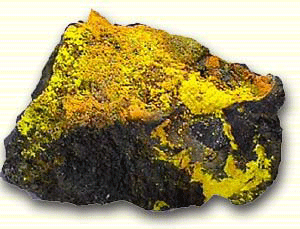
World Nuclear News , Friday, 13 February 2026
Australia-based Bannerman Energy has signed a strategic financing and joint venture agreement with China’s CNNC Overseas Limited, paving the way for debt-free construction of its Etango uranium project in Namibia.
Under the agreement, CNNC Overseas Limited (CNOL) – a subsidiary of China National Uranium Corporation (CNUC) and part of China National Nuclear Corporation (CNNC) – and Bannerman will form an incorporated joint venture. This will be done through Bannerman’s UK subsidiary, Bannerman Energy (UK) Ltd (JVCo), by way of CNOL’s subscription for newly issued shares in JVCo, resulting in JVCo ownership of 55% by Bannerman and 45% by CNOL upon completion. JVCo holds a 95% interest in the Etango Project. CNOL will make an initial investment of USD294.5 million into JVCo upon completion.
The agreement includes a provision for additional investment by CNOL of up to USD27 million upon completion, to reimburse Bannerman for CNOL’s 45% share of project-related expenditure incurred between 1 July 2025 and completion. Bannerman and CNOL will each fund post-completion capital expenditure and operating costs of JVCo and the Etango Project pro rata to their respective 55% and 45% equity interests. The agreement also includes a life-of-mine offtake entitlement for CNOL covering 60% of actual production from Etango.
Upon completion, underlying economic ownership of the Etango project will comprise 52.25% Bannerman and 42.75% CNOL, with Namibian social welfare organisation One Economy Foundation (OEF) retaining its 5% loan-carried shareholding.
Bannerman said the agreement “enables debt-free construction of Etango mine – a financing pathway that delivers greater financial and offtake flexibility and with reduced risk”.
The transaction is targeted for completion in mid-2026, pending key conditions including filings with the relevant Chinese government authorities and foreign exchange registration, CNUC shareholder approval, clearance from the Namibian Competition Commission, amendment to the OEF funding agreement, and execution of key infrastructure supply contracts………………………………
Etango is in Namibia’s Erongo uranium mining region, which hosts the operating Rössing (in which CNUC holds a 68.62% stake), Langer Heinrich and Husab uranium mines. The proposed Etango mine received environmental approval in 2010 and the Namibian Ministry of Mines and Energy in 2017 granted Bannerman a five-year, extendable, mineral deposit retention licence over the project. Namibia’s Ministry of Mines and Energy granted Bannerman Energy a mining licence for Etango in December 2023.
https://www.world-nuclear-news.org/articles/bannerman-partners-with-cnnc-for-namibian-uranium-project
Why The Economics of War in Australia Matter
14 February 2026 AIMN Editorial, By Denis Hay
Australia’s defence spending is rising at a time when housing stress, health system pressure, and energy transition demands are also intensifying.
Public debate often treats defence and social investment as separate conversations. They are not. Both draw on the same public money, skilled labour, industrial capacity, and political attention.
This article examines how the war economy functions, how Australia’s major defence commitments shape long-term fiscal settings, and what opportunity cost means in practical terms. It does not argue for ending defence. It does not dismiss strategic risk.
Instead, it asks a structured economic question: when public funds are allocated to long-duration military programs, which alternatives are delayed or constrained?
Unlike earlier articles on Monetary Sovereignty that focus on financial capacity, this piece concentrates on real resource allocation and political incentives within defence policy.
The Problem: The Economics of War and Locked-in Spending
Rising Global Military Spending
The Stockholm International Peace Research Institute reports that global military spending reached US 2.7 trillion in 2024. Australia is part of this global expansion…………………….
Australia’s Major Defence Commitments
Under the Department of Defence strategy and the AUKUS submarine pathway, Australia has committed to multi-decade procurement and sustainment programs………………………………………………………
Systemic Causes
- Alliance integration priorities
- Strategic deterrence doctrine
- Industrial policy embedded within defence
- Long-term contracting frameworks
Political Incentives
- Regional job creation promises
- Perception of strength and security
- Limited scrutiny of lifecycle costing
- Concentrated contractor influence
Beneficiaries of the Status Quo
- Large defence primes
- Specialist subcontractors
- Regions hosting major facilities
- Political actors are able to signal security leadership
This does not imply corruption. It shows structural incentives.
The Economics of War in Australia and Opportunity Cost
Opportunity cost is not abstract. For example, if $10 billion in defence procurement employs engineers and advanced manufacturers, those same skilled workers are not simultaneously available to expand public housing construction…………………………………………………………………………………………………………………………………………………………………………………………
Conclusion
The economics of war in Australia are about allocation, not ideology.
Defence commitments such as AUKUS are long-term and capital-intensive. Housing shortages, healthcare strain, and energy transition pressures are immediate and socially destabilising.
Public money reflects political priorities. The central question is whether more military capability delivers greater marginal security than investment in social resilience.
Australia has the institutional capacity to pursue both strategic security and domestic stability. Outcomes depend on policy choice, not inevitability.
The economics of war in Australia are not just about defence budgets or alliance commitments. It is about choices. Every dollar committed to long-term military expansion is a dollar not invested in housing, healthcare, education, and productive industry. A balanced approach to the economics of war in Australia requires transparent costing, clear strategic purpose, and a serious national discussion about opportunity cost. https://theaimn.net/why-the-economics-of-war-in-australia-matter/
Aussie Flotilla Team to Gaza Announced
13 February 2026 AIMN Editorial, https://theaimn.net/aussie-flotilla-team-to-gaza-announced/
The Australian Delegation of the Global Sumud Flotilla released the names of the first wave of Australians, including several First Nations participants, a feminist author, climate justice activists and an anti-zionist Jewish activist, due to set sail to Gaza in late March 2026.
Australian delegates, including Anny Mokotow, Sam Woripa Watson, Clementine Ford, Surya McEwen, Juliet Lamont, Zack Schofield and Jayden Kitchener-Waters, will join thousands of participants from 100 countries as part of the Global Sumud Flotilla. The flotilla will again attempt to break the illegal Israeli naval blockade of Gaza to deliver crucial aid and medicine to Palestinians.
In January, the Israeli government banned Doctors Without Borders, Oxfam, Save the Children, and over 30 other aid organisations from operating within Gaza. Medical evacuations have ended. This attempt by the Global Sumud Flotilla to break the siege on Gaza is now more vital than ever. One of the Australian delegation’s demands is the establishment of a Palestinian-led humanitarian corridor to deliver food and medicine, and to facilitate the entry of health, legal, engineering, logistics and construction workers to support the people of Gaza.
Spokesperson Juliet Lamont stated: “People around the world have had enough of watching the starvation of children and the bombing of Palestinian families in tents. Members of the Australian delegation are sailing to Gaza to sustain and support life. Meanwhile, the Australian Government hosts the President of Israel, Isaac Herzog, a president who has been accused of incitement to genocide by the United Nations Human Rights Council.”
Juliet Lamont, leader of the Australian delegation sailing to Gaza on the Global Sumud Flotilla, condemned the visit of Israeli President Isaac Herzog to Australia, calling it “a failure of democracy and a betrayal of human rights”.
Zack Schofield of climate activist group Rising Tide stated, “Most Australians reject association with breaches of international law. Australians do not want to welcome or assist the architects of mass civilian starvation. We don’t want to be tied to governments that openly flout the Geneva Convention and commit war crimes.” He confirmed a much larger delegation of Australians will be sailing this time in an attempt to break Israel’s illegal maritime blockade and deliver food and medical aid to Gaza.
As Israel continues to attack Gaza from the air, land and sea (despite the so-called ceasefire), the Global Sumud Flotilla is needed now more than ever to break the siege and to let aid flow to Gaza. According to the Gaza Ministry of Health, since the ‘ceasefire agreement’ came into effect on October 10, 2025, Israeli forces killed more than 464 people, including at least 100 children. UNICEF reports that Israeli bombing injured 1,275 people during this period of time. According to the UN, more than three-quarters of the population of Gaza is facing acute hunger and malnutrition.
Zack Schofield explained “A country our politicians call a mate is actively starving and bombing civilians and instead of punishing that behaviour, we’ve just spent millions in taxpayer dollars to play host to a politician who has, according to the United Nations, incited genocidal violence.”
“Ordinary Australians don’t want us to extend friendship, free trade, and even weapons components to a country so proficient at killing unarmed civilians as people suffer through a cost-of-living crisis at home. It’s time for us to get new mates, get aid to Gaza, and get Australia out of Israel.”
He went on to say, “those of us joining the flotilla will be putting our lives on the line to protect what people we can against tanks made with Australian steel, and bombs dropped from F-35s with Australian engineering.”
Jewish activist Anny Mokotow stated “I’m joining the Flotilla because I cannot stand by while Palestinian children die from starvation, homes and hospitals are bombed, and aid is blocked. As a child of Holocaust survivors, I believe “never again” means for everyone. When governments fail, ordinary citizens must act to bring food, medicine, and hope to the most vulnerable.”
Sam Woripa Watson, Wangerriburrah and Birri Gubba community activist and film maker said “We see our collective liberation in Palestinian liberation, and theirs in ours. As First Nations people, we know what colonial violence looks like – land theft and erasure. Palestinians are facing that same violence now. Standing with Gaza is standing for justice everywhere. Let Palestinians live. Let aid flow. Cut ties with Israel.”
Author Clementine Ford stated on joining the Flotilla “I am no different to the mothers in Gaza, even if governments want me to believe I am while they send weapons that kill their children. I know what it is to love a child the same way Palestinian parents do. Let aid flow. Cut ties with Israel.”
Jayden Kitchener-Waters a Gomeroi and Ngiyampaa singer and storyteller said “Our government is helping to do to Palestinians what they did to our people – colonisation, land theft, and starvation. We need to cut ties with Israel, instead of spending millions on bringing Herzog here.”
Surya McEwen, taking part in his fourth flotilla stated “We all feel that the suffering on this mass scale is too much to bear, and something desperately has to be done. Taking these steps together is the most natural and reasonable response in the world. Let Palestinians live. Let aid flow. Cut ties with Israel.”
The Global Sumud Flotilla is calling on people around the world to get involved, sign up to join the flotilla or donate and follow online to keep participants safe. The Flotilla will be sailing from various ports around the Mediterranean from late March 2026 onwards.
Exposing the DISTURBING ISRAELI Lobby inside Australia | Ex-Foreign Minister Bob Carr
In this exclusive interview, former Australian Foreign Minister, the Hon. Bob Carr reveals the deep underlying influence of the Israeli lobby in Australian politics – and how it has long shaped Canberra’s stance on Israel–Palestine.
Once a co-founder of the Labor Friends of Israel with Bob Hawke in 1977, Carr has undergone a dramatic transformation – from being hailed in Tel Aviv as an “honourable gentile” to now becoming one of the loudest critics of Israel’s brutality in Gaza.
Herzog’s Visit to Australia: Just Who Is Being Comforted, and at What Cost?
12 February 2026 AIMN Editorial, By Ricky Pann, https://theaimn.net/herzogs-visit-to-australia-just-who-is-being-comforted-and-at-what-cost/
Chris Minns, symbolism, policing, and the narrowing of dissent
The five-day visit of Israeli President Isaac Herzog to Australia in February 2026 was framed by the federal government as a gesture of compassion. A “moment of profound significance,” we were told, intended to comfort a Jewish community still reeling from the Bondi Beach massacre. Yet as Sydney’s CBD was placed under extraordinary police powers under the authority of NSW Premier Chris Minns, and peaceful dissent was progressively marginalised, a harder question emerged. Who exactly was being comforted, and who was being disciplined?
This essay is not about Jewish Australians, nor is it an attack on Jewish identity, culture, or faith. It is about power. Specifically, it examines the political influence of pro-Zionist lobbying networks, their intersection with far-right activism, and the way criticism of Israel’s war in Gaza has been recoded as antisemitism in order to narrow the space for lawful protest and political dissent in Australia.
The radicalization confronting this country is not racial or religious. It is ideological.
Symbolism, Selectively Applied
Symbolism, Selectively Applied
Political authority in modern Australia is increasingly exercised through symbolism. In October 2023, the Premier Chris Minns NSW Labor Government authorized the projection of the Israeli flag onto the Sydney Opera House, a unilateral display of solidarity following the outbreak of war in Gaza. No equivalent space was afforded to Palestinian grief, despite mounting civilian casualties and credible allegations of war crimes.
Less than two years later, when hundreds of thousands of Australians sought to march peacefully across the Harbour Bridge in the “March for Humanity” to protest the starvation and bombardment of Gaza, NSW Premier Chris Minns attempted to block the demonstration entirely. The stated reasons were “logistics” and “public safety,” yet the inconsistency was glaring. The same government that had no difficulty illuminating national icons for one side of a foreign conflict suddenly discovered insurmountable risk when confronted with mass civic dissent.
This contradiction matters because Minns’ own federal party had already moved to recognize the State of Palestine in early 2025, a move grounded in international law and bipartisan precedent. His resistance to the march therefore cannot be explained by party policy. It must be understood as political pressure from lobbying networks that historically provide the largest sponsorship of non-government funded international trips for federal parliamentarians.
Electoral Mandates and Managed Fear
Minns’ 2023 election was powered by Muslim and multicultural Western Sydney electorates. These communities did not merely vote Labor. They organized, volunteered, and mobilized. By 2026, those same voters found their protests discouraged, surveilled, and in some cases forcibly dispersed under expanded “Major Event” police powers.
The Premier moved from campaigning on inclusion to presiding over the criminalization of dissent. Symbolically, he shifted from promising a “fresh start for all of NSW” to publicly accepting praise from Isaac Herzog as a “friend of Israel,” even as Palestinian Australians were told their grief must remain silent.
Why?
Dissent Recast as Disloyalty
That question sharpened further when the police response and official rhetoric began to frame protesters as “anti-Australian.” The remark was not incidental; it signaled a reframing of peaceful assembly as national disloyalty.
Anti-Australian is not marching with placards. Anti-Australian is pepper-spraying, manhandling, and arresting ordinary citizens exercising democratic rights. Among those dispersed and detained at Town Hall and Bondi were young people affiliated with the Labor movement itself. The irony is difficult to ignore: a government elected by grassroots mobilization now presiding over the physical suppression of its own political base.
When dissent is redefined as threat, the social contract fractures. Protest becomes suspicion. Citizenship becomes conditional.
The Infrastructure of Influence
The answer lies not in religion, but in networks. Central to this landscape is Jillian Segal, Australia’s Special Envoy to Combat Antisemitism appointed by Prime Minister Antony Albanese. Appointing any lobbyist as a special envoy is a dangerous move for social cohesion, especially one with strong links to a right wing government that operates with its military, intelligence agencies, the military industrial complex and propaganda machine hand in glove.
While the role is framed as protective, its credibility has been undermined by Australian Electoral Commission data showing her household, via the Henroth Discretionary Trust, as a significant donor to Advance Australia. Advance Australia led the campaign against the Indigenous Voice to Parliament, arguing that constitutional recognition would grant disproportionate influence to a single minority. Yet the same ideological ecosystem now demands exceptional legal protections that redefine criticism of a foreign state as racial hatred. In doing so, it collapses the distinction between antisemitism and opposition to Zionism or Israeli military policy.
This is not a contradiction. It is a strategy.
By expanding definitions of antisemitism to include phrases, political speech critical of Israel, these actors create a legal and cultural environment in which Palestinian Australian identity itself becomes suspect.5 Protest becomes threat. Dissent becomes hate. Assembly becomes extremism.
Fear as a Political Tool
Former Foreign Minister and Labor Premier of NSW Bob Carr has described the pro-Israel lobby in Australia as a “well-funded foreign influence operation.” Its power does not rest solely on donations, though the Henroth Trust alone provided $280,000 to the Liberal Party in 2024-25, but on fear. Fear of reputational destruction. Fear of being branded weak on security. Fear of becoming the next viral political target of confected rage.
Public rebukes from Israeli Prime Minister Benjamin Netanyahu, including claims that Australian policy “fueled” the Bondi attack, functioned as signals. The message was clear: deviation will be punished. For a state premier, the threat of an organized backlash from internationally connected lobbying networks appears to have outweighed the expressed will of his voters, the principles of his party caucus, and the basic democratic right to protest.
The Theatre of Tragedy
The Bondi Beach attack must be named for what it was: outright terrorism driven by radicalized ideology. It is a national trauma. Australians are grieving. Jewish Australians are grieving. Muslim Australians are grieving. This pain is real and shared.
To use that tragedy as diplomatic cover for Herzog’s visit is not an act of healing. It is socially inflammatory populist theatre. It is exploitation pornography, weaponizing grief to silence dissent and to morally coerce the public into picking a side while laws are quietly rewritten in the background. Politicians call for social cohesion while banning words, narrowing protest rights, and empowering police to detain, search, and suppress political opponents. They invoke unity while demanding ideological compliance.
Is this cohesion, or is it theatre?
Surveillance and the Authoritarian Horizon
That question becomes more urgent in light of the federal government’s expanding relationship with Palantir, the data analysis firm whose platforms underpin United States immigration enforcement (ICE) and provide battlefield intelligence to the Israeli military.
Australia has now granted this company “protected-level” access to sensitive national data following its Nov 2025 assessment. The question is no longer theoretical. How long before these tools are turned inward? How long before citizens who challenge laws championed by foreign-aligned lobbyists find themselves catalogued, profiled, and neutralized in the name of security?
True social cohesion is not achieved through surveillance, intimidation, or moral blackmail. It is built through consistency, restraint, and the protection of civil liberties. When governments abandon those principles, they do not preserve democracy. They hollow it out. And no amount of symbolic lighting can conceal that erosion.
Author’s Note
I am pro-Jewish. I am pro-Arab. I am unequivocally opposed to antisemitism, Islamophobia, and political violence in all forms. I draw a clear distinction between race, religion, and ideology. In an age of populism and misinformation, where mainstream and social media demand that we pick a side, I refuse to do so. As a centrist, I reject the false binary that equates moral clarity with tribal allegiance. Democracies fail not when citizens disagree, but when dissent itself is recast as disloyalty. I have resigned from the Labor party as it no longer hears my voice or represents my values
1 This month
.

Australians deserve the truth
about
AUKUS – https://aukuspublicinquiry.com/

PETITION – To: Prime Minister Anthony Albanese and the Australian Labor Government

of the week – Australians for War Powers Reform (AWPR)
To see nuclear-related stories in greater depth and intensity

