Australian Robert Floyd to head the Comprehensive Nuclear-Test-Ban Treaty Organisation.
‘Never in my wildest dreams’: The Australian set to head UN body policing nuclear weapons has grand plans, SMH, By Anthony Galloway, May 30, 2021 When Australian Robert Floyd began his career as a biological scientist, he had no aspirations of heading a United Nations body charged with policing the world for any signs of nuclear tests. He did not foresee a life of negotiating with the world’s major powers to ban all testing of nuclear weapons.
But that is exactly what is in store for him after last week being elected as the first Australian executive secretary of the Comprehensive Nuclear-Test-Ban Treaty Organisation.
………… He will take up his position in Vienna in August, after 10 years as the Director-General of the Australian Safeguards and Non-Proliferation Office, which implements Australia’s treaty obligations on weapons of mass destruction……..
The CTBTO is the organisation charged with policing the Comprehensive Nuclear-Test-Ban Treaty, which was adopted by the United Nations General Assembly in 1996 and seeks to ban all nuclear tests.
But the treaty is not legally binding because eight countries have held off on ratifying it: the US, China, North Korea, India, Pakistan, Iran, Israel and Egypt.
Floyd concedes it is unlikely that he will convince all eight countries to ratify the treaty, but he is going to try to get some of them across the line before his four-year term is up.
…….. The CTBTO has an arsenal of more than 300 monitoring stations that can pick up seismic vibrations or radioactive particles in the air, ocean or atmosphere. Floyd says this allows it to detect a nuclear explosion “anywhere, anytime”.
“That network produces data that no country can have by themselves. So everyone sees value in the treaty,” he says.
………. Unlike other nuclear treaties, the CTBT is not about nuclear getting states to rid themselves of nuclear weapons; it is focused on convincing them not to test them. ………..https://www.smh.com.au/politics/federal/never-in-my-wildest-dreams-the-australian-set-to-head-un-body-policing-nuclear-weapons-has-grand-plans-20210527-p57vlf.html
Environmentalists and Aboriginal traditional owners object to rocket launching on South Australian protected heritage land, at Whaler’s Way.
Rocket launching proposals worry traditional owners, environmentalists, but company committed to holistic care of the land, ABC Eyre Peninsula / By Evelyn Leckie 28 May 21, Popular South Australian tourist spot Whalers Way could become the site of three test rocket launches later this year, causing concern among some environmentalists and traditional owners.
Key points:
- Traditional owners and conservationists have raised concerns about the proposed site for three rocket launches this year
- Nature Conservation SA holds concerns over two threatened species
- Southern Launch says it’s committed to a holistic approach to care for the area during its testing program.
SA space industry leader Southern Launch is looking to conduct test launches on privately owned land, with a view to making the area a permanent launching site in the future to send satellites into space.
Nature Conservation Society of SA advocate Julia Peacock said the area, on the state’s rugged southern coast, wasn’t the right site to conduct test launches.
“It’s a really special conservation area,” she said.
“It’s actually specifically protected under environment legislation that’s called a heritage agreement, which means a private landholder agreement to protect that area so we would really like to see that agreement honoured.
We’re also really concerned that it is habitat for a number of species of conservation concern.”
Ms Peacock said the society was worried about threatened species in the area such as southern emu wrens and white-fronted whip birds.
“They’re very small and shy birds, so they’re quite hard to see,” she said.
We’re concerned that we’re building an industrial facility that involves explosions that are noisy and causes vibrations — that those species are going to be frightened.
“It’s going to change their behaviour and impact the way they want to move through this area.”
‘Let it be natural’
Nauo elder Jody Miller said there were a lot of cultural issues out at Whalers Way.
“It’s significant culturally, there are stories [out there] and we don’t want to destroy anything,” Mr Miller said.
“If it’s just left alone, let it be natural, people can see this for the next generation — everybody’s children as well as my children.”
Holistic protection
Southern Launch CEO Lloyd Damp said the testing program would provide the chance to specifically measure what the noise effect would have on local species.
“We’re working with one of the best universities in Australia to undertake the measurements and then provide that for the environmental impact statement assessment,” Mr Damp said……….. https://www.abc.net.au/news/2021-05-28/rocket-launching-proposals-worry-environmentalists/100173472
Australia, the USA’s only ”best friend” in the Indo Pacific, to deploy more USA military equipment, heightening the threat against China.

Zhang Junshe, a senior research fellow at the PLA Naval Military Studies Research Institute, told the Global Times on Friday that Australia is likely to allow the US to deploy more military equipment on its soil, making it the only US friend on its Indo-Pacific strategy.
By doing this, Australia will make itself a target for future military conflicts between the US and other countries, Zhang said, adding that a responsible government which really cares about the interests of its people would never allow it.
China urged to increase sea-based nuclear deterrent amid US intensified strategic threat https://www.globaltimes.cn/page/202105/1224773.shtml By Zhang Hui May 28, 2021 Facing a serious strategic threat from the US, China was urged to increase the number of nuclear weapons, especially its sea-based nuclear deterrent of intercontinental submarine-launched ballistic missiles, to deter potential military action by US warmongers, Chinese military experts said on Friday, after reports that the US’ new defense budget will modernize its nuclear arsenal to deter China.
Having a nuclear arsenal appropriate to China’s position will help safeguard national security, sovereignty and development interests and establish a more stable and peaceful world order, which will be beneficial for the world, they said.The US defense budget, set to be sent to Congress on Friday, is expected to include investments in troop readiness, space, and the Pacific Deterrence Initiative aimed at countering China’s military existence in the region, and nuclear weapons technology, Reuters reported on Thursday.
However, Chinese military experts believe that US attempts of increasing military deployment in the Indo-Pacific region will not increase returns for the US as most countries in the region will not allow the flames of war initiated by the US to burn themselves.
The US would buy ships and jets and develop and test hypersonic weapons and other “next-generation” weapons systems to build capabilities to counter Russia and China. The total national security budget will be $753 billion, a 1.7 percent increase over the 2021 figure, Reuters said.
China has kept its defense spending at around 1.3 percent of GDP in recent years, which is far below the average global level of 2.6 percent, data shows. The US, by far the world’s top military spender, has spent about four times that of China in recent years.
Chinese analysts said China has never taken aim at US military spending, nor does China want to engage in any form of arms race with the US.
But the US has applied greater military pressure on China, sending warships and warplanes at an increasing frequency to the South China Sea and Taiwan Straits.
The US is also preparing what US media called its “biggest navy exercise in a generation with 25,000 personnel across 17 time zones,” as it’s preparing for a “possible conflict” with China and Russia.
The US attempted to deepen the militarization of space with its new budget plan, including its investment on future weapons. Considering that the US deems China its top imaginary enemy, China needs to increase the quantity and quality of nuclear weapons, especially submarine-launched ballistic missiles, to effectively safeguard its national security, sovereignty and development interests, Song Zhongping, a Chinese military expert and TV commentator, told the Global Times on Friday.
Some military experts said China should increase the number of its most advanced intercontinental ballistic missiles (ICBM), the DF-41, which has the longest operational range among all Chinese ICBMs.
Facing a serious strategic threat from the US, China was urged to increase the number of nuclear weapons, especially its sea-based nuclear deterrent of intercontinental submarine-launched ballistic missiles, to deter potential military action by US warmongers, Chinese military experts said on Friday, after reports that the US’ new defense budget will modernize its nuclear arsenal to deter China.
Having a nuclear arsenal appropriate to China’s position will help safeguard national security, sovereignty and development interests and establish a more stable and peaceful world order, which will be beneficial for the world, they said.
Song said that strengthening sea-based strategic nuclear deterrence is also an important direction for China’s future development, as these weapons are better at stealth and secondary nuclear strikes.
China could use its most advanced submarine-launched ballistic missile (SLBM) to effectively counter the US threat, Song said.
China just commissioned three PLA Navy warships, namely the Changzheng 18, the Dalian and the Hainan, at a naval port in Sanya, South China’s Hainan Province in April. Observers identified the Changzheng 18 as a likely Type 09IV nuclear-powered strategic ballistic missile submarine.
Burning themselves
The US Pacific Deterrence Initiative, created to counter China, focuses on competition in the Indo-Pacific and aims to boost US preparedness in the region by funding radars, satellites and missile systems, according to Reuters.
Wei Dongxu, a Beijing-based military expert, told the Global Times on Friday that the initiative enables the US to use a variety of spy satellites to conduct reconnaissance and intelligence gathering to provide extensive and accurate intelligence support for US military operations, including joint military operations with its allies, and the US will also use allies, such as US overseas military bases, to deploy more radar systems to guide its weapons.
On the day its budget was sent to Congress, US Secretary of Defense Lloyd Austin was expected to meet with India’s Minister of External Affairs, Subrahmanyam Jaishankar, as part of India’s first cabinet-level visit to Washington, the Pentagon said.
“The secretary’s meeting with the external affairs minister will continue discussions that the two held in New Delhi in March and will continue the robust bilateral defense and security relationship between our two countries,” the Pentagon said.
Chinese military experts said it’s likely that India would buy more American weapons, have more military drills with the US or deepen its cooperation with the US in military intelligence sharing, and the US will use these in exchange for India’s cooperation for its Indo-Pacific strategy.
But India will have second thoughts on US military deployment on its soil, Song said, noting that weapons and radar deployment involves a country’s sovereignty, and India, which has been claiming to pursue an independent foreign policy, will unlikely give the US a satisfactory answer.
Even if India would like to deepen its military cooperation with the US, certain cooperation such as opening military bases to the US is not an option for India, Song said.
India may not be a very ideal partner, and most of US allies in Asia, including Japan and South Korea, also fear that the flames of war would eventually burn themselves.
In South Korea, protests against US military presence have become louder in the past years, and South Korea will not allow the US to turn Northeast Asia into a battlefield and drag itself into war, nor will it sacrifice its relations with China, observers said.
Zhang Junshe, a senior research fellow at the PLA Naval Military Studies Research Institute, told the Global Times on Friday that Australia is likely to allow the US to deploy more military equipment on its soil, making it the only US friend on its Indo-Pacific strategy.
By doing this, Australia will make itself a target for future military conflicts between the US and other countries, Zhang said, adding that a responsible government which really cares about the interests of its people would never allow it.
New research highlights need for international standards to safeguard against plutonium ”hot” particles.
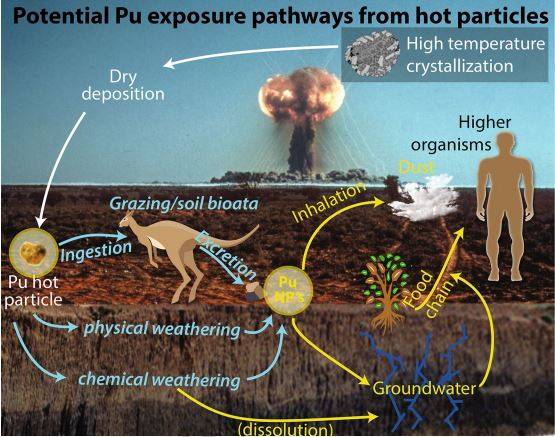
New study delves into issues relating to soils around Maralinga region, https://www.portlincolntimes.com.au/story/7262167/study-shows-radioactive-particles-from-nuclear-testing-persist-at-maralinga, Luca Cetta,
A new study has highlighted the first international standards needed to safeguard against contamination from nuclear testing, and a Kokatha Elder says the impact of nuclear testing at Maralinga cannot be forgotten.
More than 100 kilograms of highly toxic uranium and plutonium was dispersed in the form of tiny ‘hot’ radioactive particles after nuclear tests were conducted by the British in remote areas of South Australia, including Maralinga.
Scientists have new evidence these radioactive particles persist in soils to this day, more than 60 years after the detonations.
The British detonated nine nuclear bombs and conducted nuclear tests in South Australia between 1953 and 1963.
There had previously been limited understanding in how plutonium was released from the particles into the environment for uptake by wildlife around Maralinga.
The new study, published in Nature’s Scientific Reports, led by Monash University researchers, warns the hot particles are more complex and varied than previously thought.
Currently, there are no international best practice standards for the environmental impact or risk assessment of plutonium and uranium-rich hot particles released during nuclear testing.
This study provides the first mechanism for future modelling to predict the environmental life cycle of plutonium from hot particles, including how they are slowly broken down in the environment over a long period, and potentially exposed to animals and humans through inhalation, soil or ground water.
“The resulting radioactive contamination and cover-up continues to haunt us,” lead study author from Monash University’s School of Earth, Atmosphere and Environment Dr Megan Cook said.
“The results of our study profoundly changes our understanding of the nature of hot particles at Maralinga – despite the fact that those were some of the best studied particles anywhere in the world.”
Sue Haseldine, who grew up in the Koonibba district in the 1950s and 1960s, has long campaigned against nuclear testing and weapons.
She has been part of the International Campaign to Abolish Nuclear Weapons (ICAN), an organisation awarded the Nobel Peace Prize in 2017, and has spoken about her experience growing up in the shadow of nuclear testing at Maralinga.
Ms Haseldine said the people in the area had long-suspected there were health issues deriving from those tests.
“Experts would tell you that radiation will not last for 60 years, nor 60,000, but for a long, long time, and it is still causing troubles today,” she said.
“The old ladies told me these cancers and illnesses were not around before the bomb and over the years I have seen the rates go up.
“There are a lot more younger people with heart problems – it is known that radiation problems can cause heart diseases – and it is coming down through the generations.”
Ms Haseldine said the testing and fallout from Maralinga was not spoken about enough and that was why her campaigning with ICAN was so important.
“It is important to let people know what the government’s legacy is to us through their testing and we have to keep the past alive to protect the future, so they don’t do it to future generations,” she said.
“I grew up in the Koonibba district, but the radiation didn’t just stay in the Maralinga area.”
Study co-author professor Joël Brugger said the study invited a revisit of the implications of earlier results for the fate of plutonium at Maralinga.
“Understanding the fate of hot particles in the arid environment setting of the Australian outback is critical for securing Australia in case of nuclear incidents in the region, and returning all the native land affected by the British tests to the traditional Anangu owners of the Maralinga Tjarutja lands.”
The research team used synchrotron radiation at the Diamond Light Source near Oxford in the United Kingdom to decipher the physical and chemical make-up of the particles.
At Monash, they dissected some of the hot particles using a nano-sized ion beam, and further characterised the complex make-up of these particles down to the nano-size.
“It’s a major breakthrough,” study co-author associate professor Vanessa Wong said.
“Our observations of the hot particles from Maralinga provide a clear explanation for the complex and variable behaviour of different hot particles with respect to the chemical and physical weathering that has hindered predictive modelling to this day.
“This study provides a mechanistic foundation for predicting the future evolution of hot particles from high-temperature nuclear events and the likely exposure pathways.”
The researchers demonstrated the complexity of the hot particles arose from the cooling of polymetallic melts from thousands of degrees Celsius in the explosion cloud during their formation.
“We found that the particles contained low-valence plutonium-uranium-carbon compounds that are typically highly reactive – which is unexpected for particles that survived for over 30 years in the environment,” corresponding author Dr Barbara Etschmann said.
U.S. Energy Information reports uranium at lowest price since 2007

Uranium Week: Struggling With Low Prices
FN Arena Weekly Reports By Mark Woodruff May 25 2021, As the uranium spot price rose 2% for the week and 9% for the month, an EIA report revealed the lowest price paid since 2007 by owners and operators of US commercial nuclear plants
The US Energy Information Administration (EIA) released both its 2020 US Uranium Marketing Annual Report and its 2020 Domestic Uranium Production Report last week.
Despite covid roiling energy markets during 2020, the reports pointed to nuclear energy being a fundamental source of base load electricity generation (20%) with capacity factors steady at 94%, explains Canaccord Genuity. The broker believes coverage of future demand will continue to provide an impetus for a more active term market over 2021.
The EIA is responsible for collecting, analysing and disseminating energy information to inform policy making and efficient markets. It also adds to the public understanding of energy and its interaction with the economy and the environment.
The released reports in 2020 quantify developments in the US uranium industry, including decreased inventories, explains industry consultant TradeTech. They also showed an elevated aggregated contractual coverage rate among owners and operators of US civilian nuclear power reactors. Additionally, lower weighted average uranium prices and historically low uranium production were reported.
The Uranium Marketing Annual Report showed owners and operators of US commercial nuclear plants in 2020 purchased nearly 49mlbs uranium from US and foreign suppliers. These were transacted at a weighted-average price of US$33.27/lb, which represents a 1% increase in volume and a -7% decline in price compared to 2019 data. The weighted average price is the lowest price paid by owners and operators of US civilian power reactors since 2007.
Of the US deliveries, 76% were through longer-term contracts, averaging US$34.74/lb. As Canaccord notes, it’s always darkest before the dawn, with pricing failing to represent the marginal cost of production let alone the incentivisation price for restarts or new developments.
During 2020, 11.7mlbs or 24% of sales were on a spot basis, up from 10.5mlbs in 2019 and the highest since 2014. This illustrates that long-term contracts signed post-Fukushima (2011-2015) are starting to expire, explains Canaccord.
The report showed Australian and Canadian-origin uranium combined accounted for 42% of reported volumes by country of origin. Uranium purchased by owners and operators of US civilian power reactors from Russia again was the lowest weighted average price paid at US$25.73/lb, while purchases from Australia occupied the highest cost position at US$39.86/lb.;;;;;;;;;;;;;; https://www.fnarena.com/index.php/2021/05/25/uranium-week-struggling-with-low-prices/
Australian company Greenland Minerals fails community test over controversial rare earths and uranium mine plan
Greenland Minerals fails community test over controversial rare earths and uranium mine plan, https://www.acf.org.au/greenland-minerals-fails-community-test 27 May 21, It is a long way from Greenland to Western Australia, but concerns from the Narsaq community in Greenland about a controversial mining project will be raised at today’s annual meeting of Perth-based company Greenland Minerals, listed on the ASX as GGG, which is behind the Kvanefjeld rare earths and uranium mine.
Opposition to the planned mine dominated Greenland’s recent national elections. On 6 April Greenlanders elected the Inuit Ataqatigiit (Community for the People) party, which campaigned on an explicit platform opposing Kvanefjeld.
The new coalition government has committed to stop the mine going ahead.
“When a mine proposal triggers an election and the results show a clear rejection of the project, it is time for the company to accept the community’s will and end its mining plans,” said Mineral Policy Institute board member Dr Lian Sinclair, who will attend the GGG meeting.
Australian groups are calling on GGG to recognise that it has failed to secure social license for the Kvanefjeld project.
“We need a different approach to mining, one based on free, prior and informed consent,” said Australian Conservation Foundation nuclear free campaigner Dave Sweeney.
“Mining materials that are used in renewable energy does necessarily make a company ethical or responsible.
“There are dangerous radioactive elements within these deposits, including uranium, that pose long term environmental and health risks.
“These risks should not be imposed on an unwilling community.
“The Narsaq and wider Greenland community and the new Government have rejected this project. GGG should recognise and respect this clear and democratic decision”.
Will Kimba nuclear waste situation become untenable for Kimba District Council?
It is obvious that the South Australian government will have to publicly disclose all documents and information given or received by it which should presumably include all transactions with the federal government in its various guises.
The disclosures will also include the Kimba District Council which will put its councillors in an invidious position in trying to give the Kimba community impartial and independent advice while at the same time trying to justify its past actions with regard to the federal government’s proposals for the nuclear waste management facility at Kimba.
This untenable situation for the Kimba councillors may require them to stand aside while commissioners or administrators are appointed to run the Council
South Australia’s Whyalla Council’s cop-out: just ”don’t want to know nothin” about nuclear waste through their town.

Kazzi Jai No nuclear wastec dump anywhere in South Australia, 24 May 21. Yet AGAIN – sneaky sneaky Feds are hoping for NO RESISTANCE regarding the problems arising from TRANSPORTATION OF NUCLEAR WASTE – NOT YELLOWCAKE, NOT NUCLEAR MEDICINES – ACROSS 1700KMS OF AUSTRALIA….OR IN OUR FRAGILE SEA ECOSYSTEMS!!
Josie Hocking, Whyalla
It seems that our Council don’t consider the transport of intermediate level nuclear waste through our town to be any of their business.
Dear Ms Hocking I write with regard to your question below.This question was submitted to the Ordinary Council Meeting held on Monday 17 May 2021. Below, is Council’s response (as recorded within the Minutes of the Meeting): 10. Public Question Time 10.1 Ms J Hocking – Resident 10.1.1 Transportation of Nuclear Waste.
Question 1. I, and no doubt many others, would like to know if permission is required from the Whyalla Council to allow nuclear waste to be transported through our city or port?
What is the general view of the Mayor and Councillors in this respect? Can the Federal Government override any objections by the Mayor and Councillors?
If the Mayor and Councillors are in favour of allowing this to happen, then I respectfully suggest that the decision should not be theirs alone. A vote should be held among the Whyalla residents to see whether we are willing to take the risks involved in this venture. I have seen nothing about Council’s views on this subject in the Whyalla News or anywhere else.
My personal view is that Council should be taking every opportunity to refuse to allow nuclear waste to be transported though our town, and hopefully other Councils in our neighbourhood might follow your example. Perhaps there could be a meeting between the town Councils to come up with a strategy to protect all of these towns and let them know how populations feel about this dump being imposed on our neighbourhood without proper consultation of everyone involved, and that includes the residents of all towns the nuclear waste is intended to travel through.
Answer1. Council does not have a written public policy which relates to the handling of ‘intermediate level’ nuclear waste, or any matter relating to nuclear energy.
Regarding the road/rail transport of waste through Whyalla and its surrounds, the roads which would be used in the transport of this waste, are managed and controlled by the Department of Infrastructure and Transport, including the Port Augusta Highway which is outside the Whyalla Council boundary. If waste was shipped into, or out of the Whyalla Port, this Port is owned and managed by the GFG Alliance companies, which is also outside of Council’s boundary. On behalf of Council, thank you for taking the time to submit the question under reference.
Regards, Shell Michelle ArmstrongExecutive Co-ordinator – CEO and Mayor https://www.facebook.com/groups/1314655315214929
r
·
Indigenous rights issues in Kimba nuclear waste dump proposal
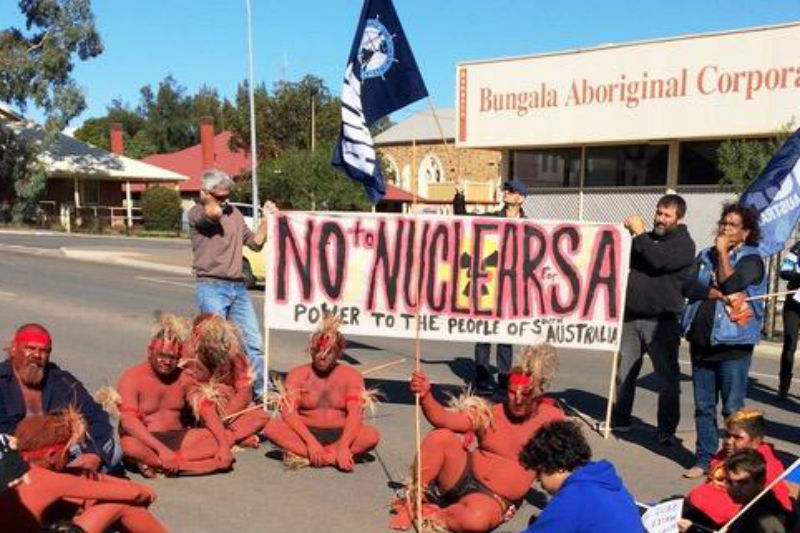
Looking back to the 2016 shonky South Australian Nuclear Fuel Cycle Royal Commission, – the same problems apply to the present Federal Government plan . Friends of the Earth Australia examined these- in Arguments against turning SA into the world’s nuclear waste dump.
”Aboriginal Traditional Owners
Our organisations hold serious concerns over past and continuing nuclear industry practices and impacts and the following comments highlight the often poor treatment of Aboriginal people by the nuclear/uranium industries in Australia and by governments pursuing or facilitating nuclear/uranium projects.
”The SA Government’s handling of the Royal Commission process systematically disenfranchised Aboriginal people. The truncated timeline for providing feedback on draft Terms of Reference disadvantaged people in remote regions, people with little or no access to email and internet and people for whom English is a second language. This was compounded when the Commission was formulated as there was no translation of the draft Terms of Reference, and a regional communications and engagement strategy was not developed or implemented. Subsequent efforts by the Royal Commission to provide translators and to translate written material were highly selective, partial and simply inadequate. Aboriginal people repeatedly expressed frustrations with the Royal Commission process.
The federal government tried but failed to impose a national nuclear waste dump on Aboriginal land in SA from 1998‒2004, then tried but failed to impose a dump on Aboriginal land in the NT from 2005‒14, and now the federal government appears to again be seeking to impose a dump on Aboriginal land in SA against the near-unanimous opposition of Traditional Owners.
At the federal level Labor and the Coalition both supported the National Radioactive Waste Management Act, which permits the imposition of a dump on Aboriginal land without any consultation with or consent from Aboriginal Traditional Owners (to be precise, the nomination of a site is not invalidated by a failure to consult or secure consent).
In SA, there is bipartisan support for the South Australian Roxby Downs Indenture Act. The Act was amended in 2011 but it retains indefensible exemptions from the SA Aboriginal Heritage Act. Traditional Owners were not even consulted about the amendments. The SA government’s spokesperson in Parliament said: “BHP were satisfied with the current arrangements and insisted on the continuation of these arrangements, and the government did not consult further than that.” Arguments against turning SA into the world’s nuclear waste dump https://nuclear.foe.org.au/waste-import-arguments/?fbclid=IwAR1yajKABFYLvMp3gFjM_DuYJFFMu4nnuc3LXxLFEBLpI7Da9-OjSv0IHrk#_ftnref4
Safety issues in nuclear waste dump proposal

Looking back to the 2016 shonky South Australian Nuclear Fuel Cycle Royal Commission, – the same problems apply to the present Federal Government plan . Friends of the Earth Australia examined these- in Arguments against turning SA into the world’s nuclear waste dump.
” The so-called ‘Interim Storage Facility’ is proposed to accumulate 50,000 tonnes of high level nuclear waste before a repository begins accepting waste. There is a significant risk that high level waste will be imported and will have to remain in ‘interim’ storage ad infinitum due to i) the lack of a repository, ii) the lack of a return-to-sender clause in contracts and iii) the inability to send the waste on to a third country.”
” the fundamental lesson from the WIPP fiasco – initially high safety and regulatory standards gave way to complacency, cost-cutting and corner-cutting in the space of just 10–15 years. The Royal Commission correctly notes that high level waste “requires isolation from the environment for many hundreds of thousands of years”. How can we be confident that high safety and regulatory standards in SA would be maintained over centuries and millennia when WIPP shows that the half-life of human complacency, cost-cutting and corner-cutting is measured in years or at most decades?”
”South Australia has a track record of mismanaging radioactive waste (Radium Hill, Maralinga, Port Pirie, Arkaroola, etc.) and no experience managing high-level nuclear waste.
If there were clear recognition of the mismanagement of radioactive waste in SA, coupled with remediation of contaminated sites, we might have some confidence that lessons have been learnt and that radioactive waste would be managed more responsibly in future. But there is no such recognition in the Royal Commission’s report or from state or federal governments, and there are no plans to remediate contaminated sites. ” Arguments against turning SA into the world’s nuclear waste dump https://nuclear.foe.org.au/waste-import-arguments/?fbclid=IwAR1yajKABFYLvMp3gFjM_DuYJFFMu4nnuc3LXxLFEBLpI7Da9-OjSv0IHrk#_ftnref4
Time to question the authorities on the nuclear waste dump mess, the incompetence of ANSTO, and the ?inactive role of Kimba nuclear waste staff .
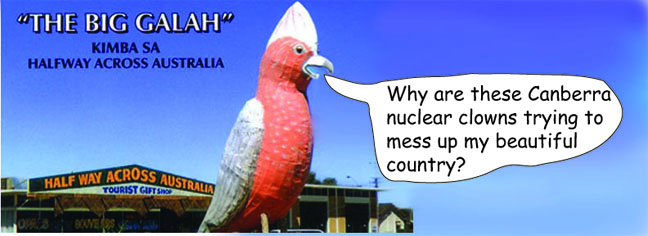
The decision in South Australia authorising the full disclosure of government papers was made on the application of Rex Patrick by the South Australian Civil and Administrative Tribunal by its president who is a Supreme Court judge and not by the Supreme Court as I wrongly stated.
The practical outcome of the decision is that interested parties should now ask various federal and state governments and district councils for full disclosure of all papers relating to the nuclear waste facility at Kimba .
It has been suggested that the federal government is proceeding with the facility and related aspects WITHOUT AUTHORITY in the hope that the composition of the Senate will change in its favour after the federal election but this seems to me a forlorn expectation particularly if the preceding state election in South Australia were to see a change in government to the Labor Party.
However the actions and conduct of the federal government as to the facility are still badly prepared by persons who are ignorant and inexperienced in this area – this is the view of many overseas experts who consider that Australia does not know or understand what is involved with regard to nuclear waste engineering .
The incompetency of ANSTO is best exemplified by lengthy and now somewhat outdated development of the SYNROC process and the continued technical difficulties and breakdowns with the nuclear medicine facility at Lucas Heights
Interested parties should also be questioning what work is actually being done by the government’s personnel located at Kimba since there appears to be no new outcomes through their presence
Plutonium ”hot particles” are not as stable as we assumed. Research on contaminated landscape around Maralinga in outback South Australia

We sliced open radioactive particles from soil in South Australia and found they may be leaking plutonium https://theconversation.com/we-sliced-open-radioactive-particles-from-soil-in-south-australia-and-found-they-may-be-leaking-plutonium-161277
Barbara Etschmann, Research officer, Monash University
Joel Brugger, Professor of Synchrotron Geosciences, Monash University
Vanessa Wong, Associate Professor, Monash University
May 21, 2021 Almost 60 years after British nuclear tests ended, radioactive particles containing plutonium and uranium still contaminate the landscape around Maralinga in outback South Australia.
These “hot particles” are not as stable as we once assumed. Our research shows they are likely releasing tiny chunks of plutonium and uranium which can be easily transported in dust and water, inhaled by humans and wildlife and taken up by plants.
A British nuclear playground
After the US atomic bombings of Hiroshima and Nagasaki in 1945, other nations raced to build their own nuclear weapons. Britain was looking for locations to conduct its tests. When it approached the Australian government in the early 1950s, Australia was only too eager to agree.
Between 1952 and 1963, Britain detonated 12 nuclear bombs in Australia. There were three in the Montebello Islands off Western Australia, but most were in outback South Australia: two at Emu Field and seven at Maralinga.
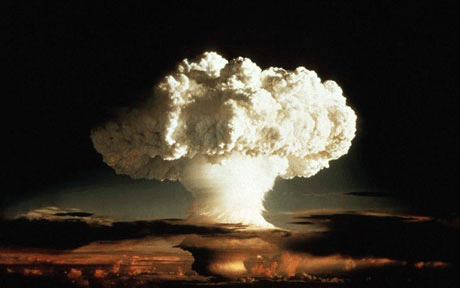
Besides the full-scale nuclear detonations, there were hundreds of “subcritical” trials designed to test the performance and safety of nuclear weapons and their components. These trials usually involved blowing up nuclear devices with conventional explosives, or setting them on fire.
The subcritical tests released radioactive materials. The Vixen B trials alone (at the Taranaki test site at Maralinga) spread 22.2 kilograms of plutonium and more than 40 kilograms of uranium across the arid landscape. For comparison, the nuclear bomb dropped on Nagasaki contained 6.4 kilograms of plutonium, while the one dropped on Hiroshima held 64 kilograms of uranium.
These tests resulted in long-lasting radioactive contamination of the environment. The full extent of the contamination was only realised in 1984, before the land was returned to its traditional owners, the Maralinga Tjarutja people.
Hot potatoes
Despite numerous cleanup efforts, residual plutonium and uranium remains at Maralinga. Most is present in the form of “hot particles”. These are tiny radioactive grains (much smaller than a millimetre) dispersed in the soil.
Plutonium is a radioactive element mostly made by humans, and the weapons-grade plutonium used in the British nuclear tests has a half life of 24,100 years. This means even 24,100 years after the Vixen B trials that ended in 1963, there will still be almost two Nagasaki bombs worth of plutonium spread around the Taranaki test site.
Plutonium emits alpha radiation that can damage DNA if it enters a body through eating, drinking or breathing.
In their original state, the plutonium and uranium particles are rather inactive. However, over time, when exposed to atmosphere, water, or microbes, they may weather and release plutonium and uranium in dust or rainstorms.
Until recently, we knew little about the internal makeup of these hot particles. This makes it very hard to accurately assess the environmental and health risks they pose.
Monash PhD student Megan Cook (the lead author on our new paper) took on this challenge. Her research aimed to identify how plutonium was deposited as it was carried by atmospheric currents following the nuclear tests (some of it travelled as far as Queensland!), the characteristics of the plutonium hot particles when they landed, and potential movement within the soil.
Nanotechnology to the rescue
Previous studies used the super intense X-rays generated by synchrotron light sources to map the distribution and oxidation state of plutonium inside the hot particles at the micrometre scale.
To get more detail, we used X-rays from the Diamond synchrotron near Oxford in the UK, a huge machine more than half a kilometre in circumference that produces light ten billion times brighter than the Sun in a particle accelerator.
Studying how the particles absorbed X-rays revealed they contained plutonium and uranium in several different states of oxidation – which affects how reactive and toxic they are. However, when we looked at the shadows the particles cast in X-ray light (or “X-ray diffraction”), we couldn’t interpret the results without knowing more about the different chemicals inside the particles.
To find out more, we used a machine at Monash University that can slice open tiny samples with a nanometre-wide beam of high-energy ions, then analyse the elements inside and make images of the interior. This is a bit like using a lightsaber to cut a rock, only at the tiniest of scales. This revealed in exquisite detail the complex array of materials and textures inside the particles.
Much of the plutonium and uranium is distributed in tiny particles sized between a few micrometres and a few nanometres, or dissolved in iron-aluminium alloys. We also discovered a plutonium-uranium-carbon compound that would be destroyed quickly in the presence of air, but which was held stable by the metallic alloy.
This complex physical and chemical structure of the particles suggests the particles formed by the cooling of droplets of molten metal from the explosion cloud.
In the end, it took a multidisciplinary team across three continents — including soil scientists, mineralogists, physicists, mineral engineers, synchrotron scientists, microscopists, and radiochemists — to reveal the nature of the Maralinga hot particles.
From fire to dust
Our results suggest natural chemical and physical processes in the outback environment may cause the slow release of plutonium from the hot particles over the long term. This release of plutonium is likely to be contributing to ongoing uptake of plutonium by wildlife at Maralinga.
Even under the semi-arid conditions of Maralinga, the hot particles slowly break down, liberating their deadly cargo. The lessons from the Maralinga particles are not limited to outback Australia. They are also useful in understanding particles generated from dirty bombs or released during subcritical nuclear incidents.
There have been a few documented instances of such incidents. These include the B-52 accidents that resulted in the conventional detonation of thermonuclear weapons near Palomares in Spain in 1966, and Thule in Greenland in 1968, and the explosion of an armed nuclear missile and subsequent fire at the McGuire Air Force Base in the USA in 1960.
Thousands of active nuclear weapons are still held by nations around the world today. The Maralinga legacy shows the world can ill afford incidents involving nuclear particles.
Australia’s mining lobby exaggerates by $45 billion the taxes and royalties they pay
Mining lobby exaggerates taxes and royalties paid by $45 billion, Michaelo West Media, by Callum Foote | May 21, 2021,
The mining industry has exaggerated its contribution in taxes and royalties to Australian governments by an estimated $45 billion over the past 10 years. Callum Foote reports on the findings of an independent research project by Michael West Media.
The mining lobby and its “independent experts” from Deloitte Access Economics have routinely overcooked the contribution that mining companies make to Australia.
Michael West Media was commissioned to undertake an investigation into Australia’s mining royalty regime by the Neroli Colvin Foundation.
The report, A Fair Share?, found the mining lobby exaggerated by 19% its contribution to Australian government revenues through royalties and taxes for the period where government data has been made available, or an estimated $45 billion over the past decade.
The mining industry sold $2.1 trillion worth of Australian resources overseas in the past decade but Australian governments received less than a 10% return. The actual rate – 9.1% – covers royalty payments and taxes paid. If we consider only royalties, then the rate drops to 5.6% of the value of exported resources.
The mining industry regularly combines royalties and taxes but this is misleading when talking about its contribution to Australia.
Less than 10% of $2.1 trillion worth of Australian resources is perhaps not the “staggering” contribution as described by Resources Minister Keith Pitt earlier this week on the release of the latest Minerals Council report.
This is particularly the case given that the large mining houses are owned by foreign shareholders, so are the largest beneficiaries of Australia’s mineral wealth.
Michael West Media has found that, on average, mining companies make a 1654% revenue mark-up on Australian commodities………..
In Australia, all mineral commodities below the earth are owned by the Australian people. It is up to State and Federal governments to sell these commodities to mining companies that wish to extract and process them for selling. In accounting terms, royalties are deemed to be a “cost of goods sold”.
Just as a baker must buy raw flour from a mill and process it into bread to sell, royalties are the payment made by miners to the Australian people for the raw commodities that they then sell internationally.
Deloitte’s most recent report is more accurate than previous estimates of mining taxes and royalty payments. Michael West Media had contacted the firm for comment before it published this report because it was found that royalty and taxation figures were previously exaggerated by 33%, or $78 billion, for the period between 2010 and 2017………
The total export value of Australian commodities over the period, which is indicative of the revenue these companies have made from selling Australian resources overseas, is $2.1 trillion. This means that only 9.1% of the export revenue made by these companies has been paid to state and federal governments. ……………. https://www.michaelwest.com.au/mining-lobby-exaggerates-taxes-and-royalties-paid-45-billion/
Senator Rex Patrick challenges Scott Morrison’s special arrangement to protect his government from public scrutiny

Senator challenges cabinet secrecy, The Saturday Paper 33 May 21, Scott Morrison is using a special arrangement to keep the workings of his government secret, but independent senator Rex Patrick has launched a challenge to its legality. By Karen Middleton. Karen Middleton is The Saturday Paper’s chief political correspondent.
A special policy committee the prime minister uses to keep the workings of his government secret is being called into legal question as part of a challenge to the confidential status of national cabinet.
Independent senator Rex Patrick launched the challenge after the Department of the Prime Minister and Cabinet refused two freedom of information requests for access to national cabinet documents.
Appearing before the Administrative Appeals Tribunal (AAT) this week, the Commonwealth argued that national cabinet’s workings must be secret because it is an offshoot of federal cabinet, which is governed by a confidentiality convention.
It argued that deciding how cabinet committees are formed and who joins them is in the prime minister’s “gift” alone.
The national cabinet arrangement relies on the controversial cabinet office policy committee that Morrison created upon becoming prime minister. He is its only permanent member. The one-man construct allows the prime minister to declare almost any gathering he attends to be a cabinet committee meeting, protecting it from public scrutiny.
When the tribunal’s Justice Richard White queried the mechanism purporting to give national cabinet confidential status, the government could provide no information.
“Is there anything else that tells me anything about the cabinet office policy committee?” Justice White asked counsel for the Commonwealth, Andrew Berger, QC, on Wednesday. “I’m not sure there is, Your Honour,” Berger replied.
Last year, Labor’s senate leader, Penny Wong, condemned the one-man committee as “an abuse” of process used to “cover up blatant political decision-making”.
Senator Patrick’s AAT challenge could also have implications for accessing information from other designated cabinet subcommittees and groups advising them.
The one-man construct allows the prime minister to declare almost any gathering he attends to be a cabinet committee meeting, protecting it from public scrutiny…………..
…………………………. After the hearing, Rex Patrick described national cabinet as “a last-minute idea dealt with at short notice, without its implementation or consequences being properly considered”.
“That’s apparent when looking back at the various media statements, the cobbling together of a new cabinet handbook and the evidence before the AAT,” he told The Saturday Paper.
Patrick said the legislated right to access information on intergovernmental communication had existed in Australia for almost 40 years, “subject only to a test of public harm”.
“Last year, Prime Minister Morrison took that right away,” he said. “He did not ask the parliament to change the law.”
Patrick said he was in a fight for transparency and responsible government. “And I’m in a fight to stop a prime minister unilaterally taking away a right that was given to me and all Australians, by the parliament.”
Whether Justice White agrees will be clear soon. He reserved his judgement and promised a quick decision.
This article was first published in the print edition of The Saturday Paper on May 22, 2021 as “Cabinet of one”. https://www.thesaturdaypaper.com.au/news/politics/2021/05/22/senator-challenges-cabinet-secrecy/162160560011709
New research on the complexity of particles from plutonium resulting from British atomic bomb tests at Maralinga

 Pu particles from nuclear testing more complex than previously thought https://www.eurekalert.org/pub_releases/2021-05/mu-ppf051821.php Plutonium particles from British nuclear testing in outback Australia more complex than previously thought, scientists warnMONASH UNIVERSITYResearch News 21 May 21 Pu particles from nuclear testing more complex than previously thought https://www.eurekalert.org/pub_releases/2021-05/mu-ppf051821.php Plutonium particles from British nuclear testing in outback Australia more complex than previously thought, scientists warnMONASH UNIVERSITYResearch News 21 May 21More than 100 kg of highly toxic uranium (U) and plutonium (Pu) was dispersed in the form of tiny ‘hot’ radioactive particles after the British detonated nine atomic bombs in remote areas of South Australia, including Maralinga.Scientists say that these radioactive particles persist in soils to this day, more than 60 years after the detonations. Previously, we had limited understanding of how Pu was released from these “hot” particles into the environment for uptake by wildlife around Maralinga. |
But now, a new study published today in Scientific Reports and led by Monash University researchers warns that the particles are actually more complex and varied than previously thought. This means that the processes which slowly release Pu into the environment are also much more complex and varied.
“The British detonated nine nuclear bombs and conducted hundreds of nuclear tests in outback South Australia between 1953 and 1963,” said lead study author Megan Cook, a PhD student from the Monash University School of Earth, Atmosphere and Environment. “The resulting radioactive contamination and cover-up continues to haunt us.”
“The results of our study profoundly changes our understanding of the nature of hot particles at Maralinga – despite the fact that those were some of the best studied particles anywhere in the world,” said study co-author Associate Professor Vanessa Wong.
The research team used synchrotron radiation at the Diamond Light Source near Oxford, UK to decipher the physical and chemical make-up of the particles.
At Monash University they dissected some of the hot particles using a nano-sized ion beam, and further characterised the complex make-up of these particles down to the nano-size in exquisite details.
The researchers demonstrated that the complexity of the hot particles arose from the cooling of polymetallic melts from thousands of degrees Celsius in the explosion cloud during their formation.
“We found that the particles contained low-valence plutonium-uranium-carbon compounds that are typically highly reactive, yet, had been stabilised in the hot-particle matrix for nearly 60 years,” said corresponding author Dr Barbara Etschmann.
Between 1950 and 1988 alone there were more than 230 recorded nuclear weapon accidents, including at least 10 with documented release of radioactive particles into the environment. The risks of such incidents are only increasing as international treaties such as the Intermediate-Range Nuclear Forces Treaty were cancelled.
“Understanding the fate of hot particles in the unique setting of the Australian outback is critical for securing Australia in case of nuclear incidents in the region, and returning all the native land affected by the British tests to the traditional Anangu owners of the Maralinga Tjarutja lands,” said study co-author Professor Joël Brugger.
1 This month
Chernobyl: The Lost Tapes – A good documentary on Chernobyl on SBS available On Demand for the next 3 weeks– https://www.sbs.com.au/ondemand/tv-program/chernobyl-the-lost-tapes/2352741955560
15 April – Zoom –Nuclear Power is Not the Solution
Apr 15, 2026 01:00 AM in Canberra, Melbourne, Sydney

Join the International Physicians for the Prevention of Nuclear War (IPPNW) on Tuesday, April 14th for a timely webinar exploring the risks associated with nuclear power and challenging the myth that it offers a simple, safe, carbon-free solution to the climate crisis

21 April Webinar: No Nuclear Weapons in Australia
Start: 2026-04-21 18:00:00 UTC Canberra, Melbourne, Sydney (GMT+10:00)
End: 2026-04-21 19:30:00 UTC Canberra, Melbourne, Sydney (GMT+10:00)
Event Type: Virtual
A virtual link will be communicated before the event.
Host Contact Info: australia@icanw.org

of the week – Australians for War Powers Reform (AWPR)
To see nuclear-related stories in greater depth and intensity
 Antinuclear